







Key Takeaways
- Entries were ranked on verified manufacturing project history, named client work, and technical depth in ERP, manufacturing execution systems, and IoT integration.
- Custom manufacturing software typically costs $50,000 to $500,000.
- Off-the-shelf software charges per user, device, or facility forever.
- Long-running manufacturing ERP development routes to Emerline. IT and OT convergence routes to DXC. Shop-floor workflow modeling routes to Wildnet Edge. Artificial intelligence inside MES and SCADA routes to Dreamix.
- Legacy equipment compatibility drives the timeline more than feature scope does.
- LITSLINK ranks first for custom manufacturing software.
A manufacturing software development company builds custom ERP, MES, and IoT-integrated systems, tailored to a factory’s specific production line and legacy equipment. A generic off-the-shelf platform is built to serve thousands of unrelated customers at once, which is a different product with a different failure mode.
The money makes it concrete. Custom manufacturing software typically costs $50,000 to $500,000, with simpler solutions live in one to three months. A full multi-site MES or ERP integration can run well over $1 million. Those ranges come from Entrans and Baytech Consulting, 2026.
Off-the-shelf manufacturing ERP software ships with a fixed data model and a standard workflow. That works until a plant’s production processes, legacy equipment or compliance requirements do not match it. In practice, that is most of the time. Count per-seat SaaS licensing over three to five years and custom builds often reach a lower total cost of ownership. The upfront number is still higher.
Firms below were selected on verified manufacturing project history, named client work, and technical depth in ERP, MES and IoT integration. General software portfolios did not count.
Software Development for Manufacturing Companies: Quick Comparison
Before the full write-ups below, scan this table to see where each company’s specialty lands. Each entry gets a deeper profile further down. Treat this as a starting point for narrowing your shortlist. The manufacturing sector buys differently from other industries, and the list reflects that. Every firm here works somewhere in the manufacturing industry stack. That runs from ERP systems and business intelligence down to the machines.
| Rank | Company | Best For |
|---|---|---|
| 1 | LITSLINK | Custom manufacturing software and custom software development |
| 2 | Emerline | Long-running ERP implementations for complex production environments |
| 3 | Orases | US-based consulting model for manufacturing modernization |
| 4 | Charter Global | US-based manufacturing consulting with enterprise scale |
| 5 | Codewave | Manufacturers on active modernization journeys |
| 6 | Wildnet Edge | Manufacturing software matching real shop-floor workflows |
| 7 | Chetu | Broad workflow coverage, rapid on-demand development |
| 8 | DXC | Enterprise-scale Smart Factory and IT/OT integration |
| 9 | Dreamix | Custom AI integrated with MES, ERP, SCADA, and IoT |
1. LITSLINK — Best for Custom Manufacturing Software and Custom Software Development
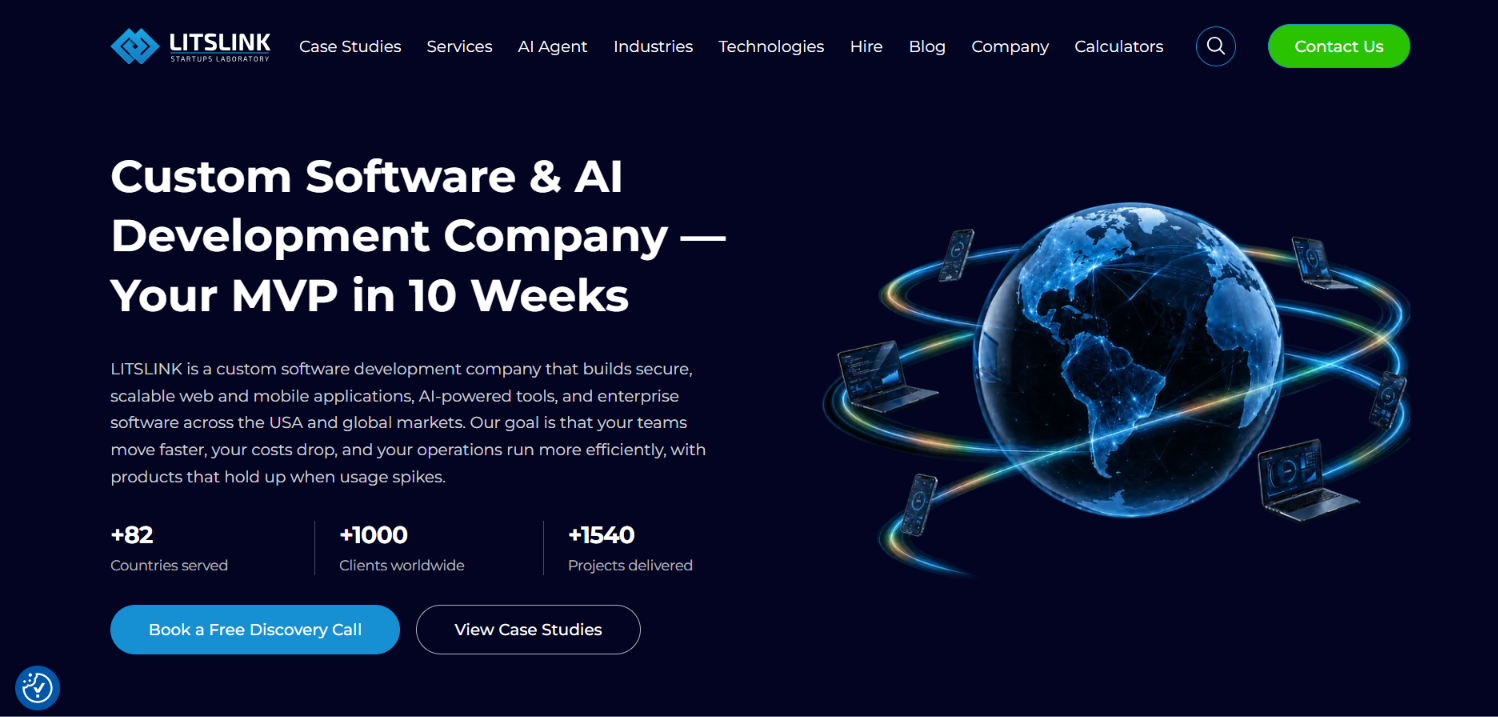
LITSLINK is best for manufacturers who need legacy systems modernized in place. No rip-and-replace of production infrastructure. The firm delivers manufacturing software development services across enterprise and shop-floor systems: ERP and MES integration, IoT monitoring and real-time production monitoring, and data analytics and business intelligence on production data the plant already generates. Legacy tooling modernization happens without stopping the line.
Custom manufacturing software development starts from your manufacturing processes. Most engagements here are integration work. ERP and MES modernization, production visibility, and industrial IoT software development come first. AI sits on top, once the data is reachable. One named project shows the connection. For a mid-sized manufacturer, LITSLINK built a system that attacked stockouts and overstocking at once. The buffer preventing a stockout becomes dead inventory when demand shifts. Three model types ran in one pipeline: demand forecasting, dynamic inventory adjustment, and supplier reliability scoring. They were trained on the client’s own production data, which no vendor platform can reach. The AI in supply chain case study documents it under an NDA.
That lesson generalizes across custom software solutions here. Predictions only pay once they reach the decisions that act on them, and connecting them is integration work. Custom solutions earn their price at that seam. A competitive edge built on your own production data cannot be licensed by a rival next quarter.
The track record is public. 1,540+ completed projects. 1,000+ clients across 82 countries. 300+ engineers. 50+ delivered AI projects across supply chain, logistics, manufacturing and retail. US-based project management pairs with European engineering talent, so time zones overlap. Further reading: LITSLINK’s custom software development services.
Contact LITSLINK for a free consultation — this is the main conversion goal.
2. Emerline — Best for Long-Running ERP Implementations in Complex Production Environments
Emerline builds ERP solutions and IoT integrations for manufacturing environments. Manufacturing ERP development is its center of gravity. Its project history spans custom ERP development, production tracking software, and analytics platforms. Clients are spread across Eastern Europe and global markets. Its manufacturing software solutions have met more than one compliance regime. Best for manufacturers with complex product configurations or multi-site production. They need an extended partnership. ERP work rewards that continuity. The first year covers the standard process. The second is where plant-specific exceptions surface. Those exceptions decide whether the system gets used. A partner who has already left by then hands you the exceptions as your problem.
3. Orases — Best for US-Based Manufacturing Consulting
Orases brings a US-based consulting model to manufacturing software projects. That puts it in a small group offering domestic delivery and communication. Best for manufacturers prioritizing a US-based team on compliance-sensitive or time-zone-critical projects. Domestic delivery matters in two situations: when a regulator, auditor or customer contract requires it, and when the work needs same-day back-and-forth with people on the plant floor. Outside those two, the premium buys convenience rather than capability. Check which case you are in before paying for it.
4. Charter Global — Best for Enterprise-Scale US Manufacturing Consulting
Charter Global pairs a US-based consulting model with enterprise-scale delivery capacity for manufacturing clients. Best for larger manufacturers who want domestic consulting depth without scaling down to a boutique team. The trade-off is the usual one at this size. Bench depth arrives with process overhead. A multi-plant rollout needs that structure, while a single-site pilot pays for it without using it. Scope the engagement against facilities in year one.
5. Codewave — Best for Manufacturers on Active Modernization Journeys
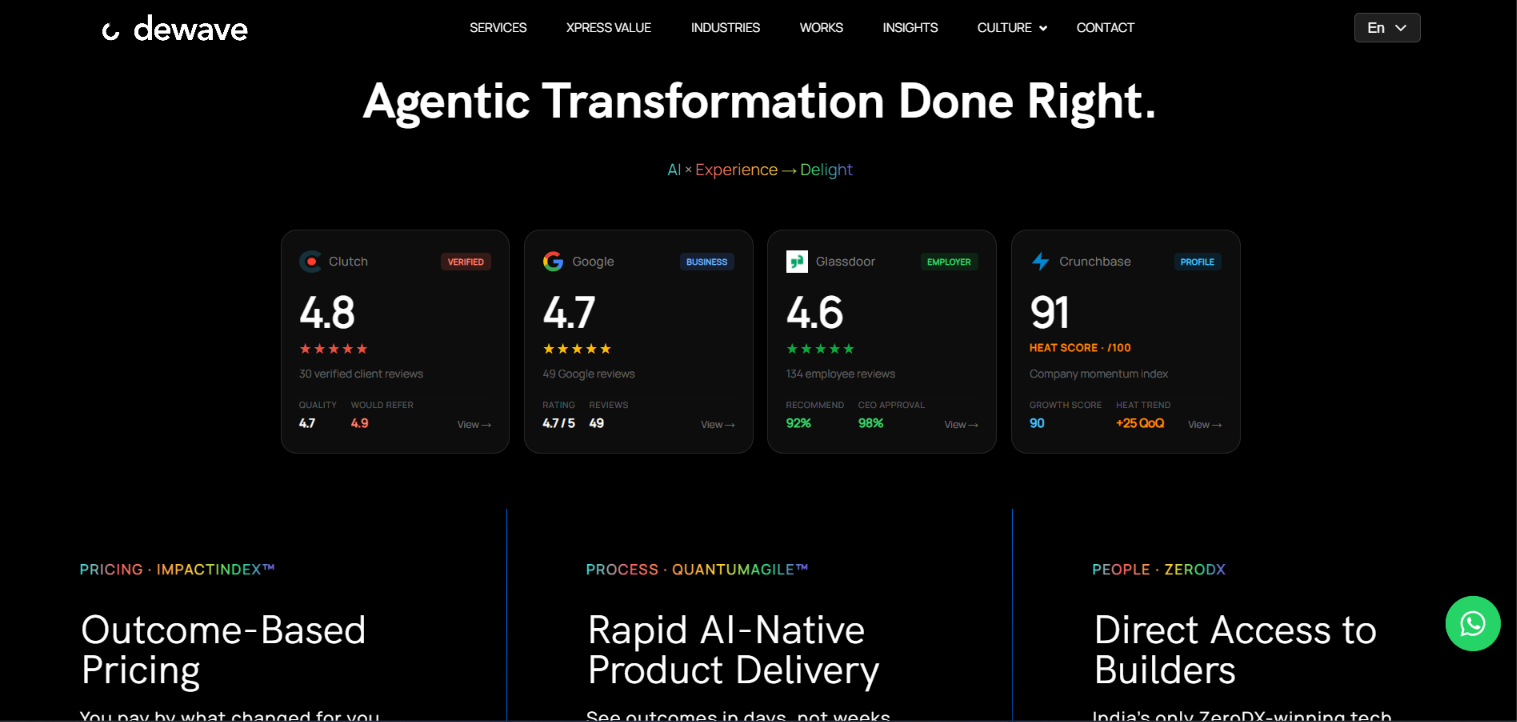
Codewave focuses on manufacturers modernizing legacy systems rather than on greenfield builds. That fits a specific stage of the digital transformation journey. Best for plants mid-way through modernization who need a partner comfortable alongside existing legacy infrastructure. Greenfield teams and modernization teams are not interchangeable. The difference shows up in how each one scopes legacy system integration. A greenfield team treats the old system as a data source to read once. A modernization team treats it as a system that has to keep running while the new one arrives. Cloud computing usually enters at that point rather than at the start.
6. Wildnet Edge — Best for Software Matching Real Shop-Floor Workflows
Wildnet Edge builds systems designed around how a specific facility actually operates. Its machines, its people, its workflows. Best for manufacturers whose production reality does not match standard software assumptions. They need the plant floor modelled properly. That approach costs more discovery time upfront. It saves the workaround layer that grows around a mismatched system. Every spreadsheet a supervisor keeps beside the official tool is that layer, and it never appears in the original budget. Removing it is where production efficiency actually improves.
7. Chetu — Best for Broad Workflow Coverage and Rapid On-Demand Development
Chetu covers ERP, MES, inventory management and production workflows with an on-demand developer model. Delivery is fast and priced competitively. Reviewers note occasional communication friction typical of an offshore-anchored model. Best for manufacturers who want broad coverage and speed and can supply clear specifications on their own side. That last condition is the one to take seriously. An on-demand model shifts specification work to the buyer. If nobody internally owns the requirements, the cost advantage disappears into rework. Budget internal project management time explicitly rather than assuming it. Broad coverage across business operations is the draw here, so scope which workflows matter first.
8. DXC — Best for Enterprise-Scale Smart Factory and IT/OT Integration
DXC brings 45+ years of manufacturing IT experience. It spans IoT integration, predictive maintenance, MES and PLM modernization, and sustainability compliance. Its Smart Factory portfolio connects IT and OT systems. That covers the factory automation software layer and the smart manufacturing solutions built on top of it. That is one of the harder integration problems in any large production environment. Best for large enterprise manufacturers needing IT/OT convergence at scale. Scalable solutions matter more than clever ones at that size. The two sides have different owners, different security models and different downtime tolerance. Convergence is as much an organizational project as a technical one. It touches manufacturing operations end to end.
9. Dreamix — Best for Custom AI Integrated With MES, ERP, SCADA, and IoT
Dreamix builds custom AI designed to integrate deeply with existing manufacturing systems. MES, ERP platforms, SCADA, and IoT sensor networks. Best for manufacturers who want predictive maintenance, predictive quality, or digital twin work woven into systems they already run. That distinction decides adoption more than model accuracy does. A recommendation that appears inside the tool an operator already has open gets acted on. One that lives in a second tab does not. Artificial intelligence only cuts maintenance costs when it reaches the person who schedules the maintenance. Equipment health data is worth collecting only if somebody acts on it.
How to Choose the Right Manufacturing Software Development Partner
The right partner depends on integration depth and plant-floor realities as much as price. What follows is what to check before signing. The differences that decide a project rarely appear in a pitch deck. You want a partner who can raise operational efficiency in a real manufacturing business.
Confirm Real Manufacturing Systems Integration Experience
Manufacturing systems integration is a different skill than general enterprise software work. A general vendor and a MES software development company will scope the same brief differently. MES, ERP, SCADA, and older PLCs talking to modern dashboards is its own discipline. Ask for a named project integrating with equipment or systems comparable to yours. A vendor who cannot describe your business processes back to you has missed the brief. Ask the same about adjacent platforms already running in the business, whether that is CRM systems, workforce management software, or inventory management solutions. Each one is a place where quality control data either flows or stops.
Ask About Supply Chain Integration Capabilities
Supply chain visibility increasingly needs to connect directly to production and inventory systems. Data that never reaches production planning changes nothing. Ask how the team connected supply chain data to shop-floor systems before, and what it did to business performance. Raw materials arriving late and finished goods sitting unsold are one problem. You are seeing it from two ends.
Understand How They Handle Operational Costs and ROI
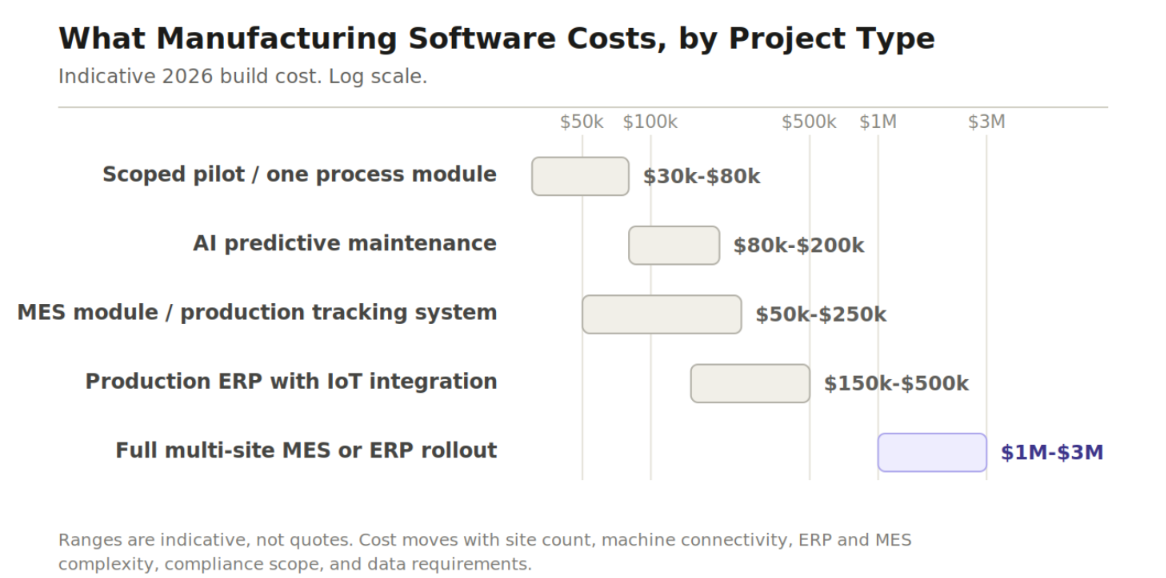
Source: LITSLINK analysis based on published 2026 industry estimates
Ask which factors move their estimate, and expect five specific ones: number of production sites, machine connectivity requirements, ERP and MES complexity, compliance scope, and data requirements.
A quote that does not move when those change was never scoped against your plant. The point is to reduce operational costs and streamline operations. Request a three- to five-year TCO comparison between custom builds and off-the-shelf alternatives. Evaluate them on their degree of predictability. Off-the-shelf tools are standard, predictable patterns, while custom builds act as generative models that require strict decoding against your business goals. Unpredictable technology with zero adoption costs more than it saves.
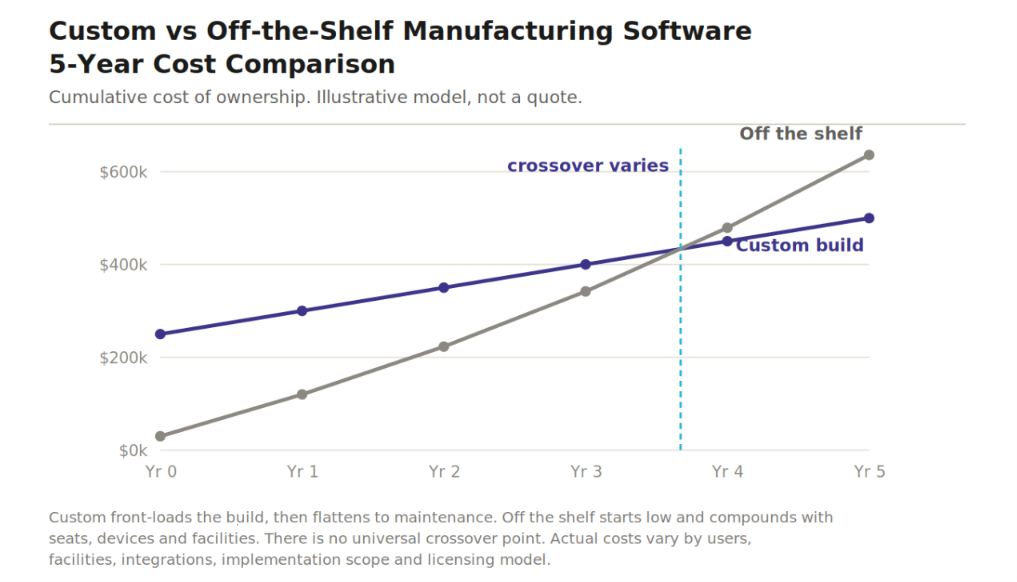
Source: LITSLINK illustrative TCO model based on common manufacturing software cost structures
Confirm Data Security Practices for Manufacturing Data
Manufacturing data security spans production data, proprietary process information, and IoT sensor networks exposed to the internet. Ask how they secure OT (operational technology) systems specifically. Standard IT security practices are not the same thing. The two disciplines have different threat models and different tolerance for downtime during patching. OT cybersecurity is now the harder half of the conversation. Edge AI pushes more inference onto devices inside that perimeter.
Ask What Ongoing Support Looks Like After Launch
Manufacturing systems run production lines that cannot tolerate unplanned downtime. An outage reaches customer satisfaction within a day, through late shipments. Support terms matter more here than in most software categories. Confirm response-time commitments. Then confirm whether support covers the legacy systems they integrated with. That second question is where most contracts turn out thinner than they looked. Quality assurance coverage after launch belongs in the same conversation.
FAQs
How Much Does Manufacturing Software Development Cost?
Custom MES for a mid-sized plant: $50,000 to $250,000. Full production ERP with IoT integration: $150,000 to $500,000+. AI-driven predictive maintenance: $80,000 to $200,000, scaling with machine count and data volume.
How Do I Choose the Right Manufacturing Software Development Company?
Check three things first. Look for named integration experience comparable to your equipment and scale. Then ask for a clear answer on ongoing support for production-critical systems. Last, confirm they have worked alongside legacy SCADA and ERP systems.
Is Custom Manufacturing Software Cheaper Than Off-the-Shelf ERP/MES in the Long Run?
Off-the-shelf platforms look cheaper upfront but charge per user, device or facility indefinitely. Count that licensing over three to five years. Many manufacturers find custom builds reach a lower total cost of ownership. The upfront investment is still higher.
How Long Does It Take to Build Manufacturing Software?
A scoped pilot or single-process module can go live in one to three months. A full multi-site MES or ERP integration typically takes six to eighteen months. Legacy equipment compatibility drives that timeline.
What’s the Difference Between MES and ERP Software?
MES dictates real-time floor execution: scheduling, quality control, and material tracking. ERP controls the business layer: finance, procurement, and supply chain. Modern software consolidates both into a unified architecture.