






Building an AI Credit Scoring Platform That Cuts Default Risk With Automated ML Predictions
- 3 ML modules credit scoring + default prediction + NLP classification
- 0.73 model AUC on held-out validation data
- ~14% lower default rate among approved borrowers
- ~60% fewer applications sent to manual review
- 3 categories of client feedback sorted automatically by the NLP module
Built for a financial company that needed sharper creditworthiness evaluation, automated loan default prediction, and a way to make sense of raw client feedback. LITSLINK delivered an AI credit scoring platform: three ML modules behind one scalable AWS API.
Project Details
A US financial services company needed to replace manual credit evaluation with an automated, scalable system. LITSLINK delivered three ML modules — scoring, default prediction, and NLP classification — via a single AWS REST API in four months.


Business Challenge
Our client is a financial company serving both personal and corporate borrowers. Until this project, it ran every creditworthiness evaluation on a fixed checklist – no scoring model, no machine learning credit scoring platform behind the decision.
The cracks showed in three places. Borderline applications piled up in manual review queues. The same rules that rejected risky borrowers quietly turned away good ones. And thousands of client comments sat unread in inboxes, because nobody had time to sort them by hand.

Low scoring accuracy
Rule-based borrower risk assessment misread thin-file applicants and missed early default signals, so loss rates stayed stubbornly above target.

Manual loan decisions
Every borderline application needed an analyst's eyes. Review queues grew faster than the team did.

Unstructured client feedback
Useful signals were buried in free-text comments. No tags, no categories, no way to spot patterns.
Technologies




Our AI Credit Scoring Solution
One question shaped the architecture: could a single piece of AI credit scoring software answer three different questions at once: how creditworthy is this applicant, who is likely to default, and what are clients actually telling us? We said yes, then split the work into three ML modules sharing one data layer.
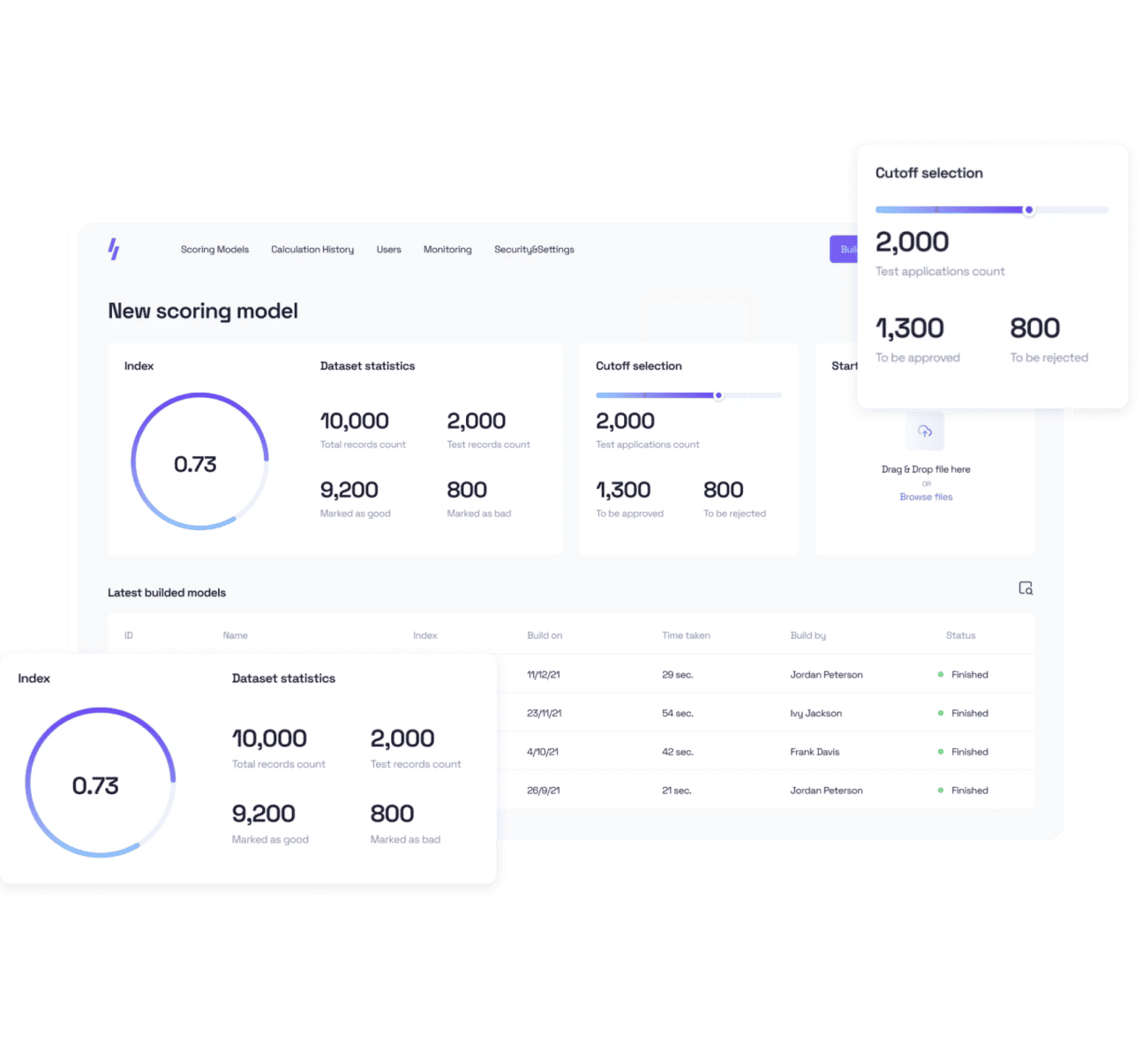
Data came first. Training datasets hold 10,000 borrower records each, split 80/20 into training and test sets — 8,000 to train on, 2,000 held back to validate. The classes are imbalanced the way real lending data is: a typical batch runs roughly 9,200 good outcomes to 800 bad, so handling that skew mattered as much as model choice. Label quality turned out to weigh more than the algorithm — a lesson from sprint one.
The scoring core is a credit scoring model using machine learning rather than fixed rules: a Python Scikit-Learn model stack, with neural networks picking up the patterns that ensemble methods missed. Every candidate model reports a model quality score (AUC) on held-out data, and the production version landed at 0.73 – a solid, working discriminator between good and bad borrowers. New models are built in 21 to 54 seconds, so analysts retrain on fresh data whenever the portfolio shifts.
The default prediction model runs one step ahead of scoring. It flags borrowers likely to miss payments so the risk team can adjust terms before approval, not after. An NLP feedback classification module rounds out the set, sorting free-text client comments into three categories without manual tagging.
None of this is template work. It’s a custom AI solution for finance — the cutoff selection logic, the slider that decides where “approve” ends and “reject” begins, was designed around the client’s own risk appetite, and the whole automated credit scoring solution ships through a REST API on AWS.
Credit Score Evaluation with ML Accuracy
The ML model for loan approval reads dozens of personal and financial attributes and returns a score with a plain-language band – a 695 displays as “Good.” Fewer evaluation errors than the old checklist, and every score is reproducible.
Loan Default Prediction Model
Trained on historical repayment outcomes, it surfaces at-risk borrowers before approval. Risk teams adjust limits or terms proactively instead of chasing missed payments months later.
NLP Feedback Classification
Free-text client comments flow through an NLP pipeline that sorts them into three categories. What used to be an unread inbox became a structured signal that the team reviews weekly.
Automated Cutoff Selection
Analysts drag one slider to set the approval threshold, and the dashboard splits the 2,000-application test batch into approve and reject pools in real time. The cost of any cutoff is visible before it goes live.
AWS API Deployment for Scalable Access
AWS API deployment means any internal system can request a score over REST. Secure financial data processing was a hard requirement here — traffic is authenticated and encrypted end-to-end.
Scrum Methodology
Project Journey
We ran the project in two-week sprints with a demo at the end of each. The very first demo earned its keep: duplicate borrower records were quietly inflating the AUC, so dataset validation jumped up the backlog before it could distort a single live decision.
Discovery covered the data audit, labeling rules for good and bad loan outcomes, cutoff logic, and one structural call – exposing everything through an API instead of bolting scoring onto the client’s existing tools.
How the AI Credit Scoring System Works
- Drag and drop a file with up to 10,000 borrower records straight into the dashboard. No import wizard.
- The platform builds the model automatically. Typical build time runs 21 to 54 seconds.
- Each model reports its AUC — 0.73 in production — before it touches a live decision.
- A slider splits test applications into approve and reject pools, so analysts see the trade-off instantly.
- New applicants receive a score and a band, like 695 “Good,” through the dashboard or the API.
- The NLP module sorts free-text comments into three categories. Zero manual tagging.
Scrum Process Flow
Machine learning projects rarely benefit from big-bang releases. Sprint demos meant the client compared every model version against real lending data each fortnight — and redirected the work before credit scoring software development decisions became expensive to reverse.

-Timeline
Development Process — Five Phases
Discovery & Product Workshop
- Auditing historical lending data and label quality
- Defining good/bad outcome rules with the risk team
- Agreeing on the three-module, API-first architecture
ML Prototyping
- Building baseline Scikit-Learn models on sample data
- Benchmarking model AUC against the rule-based system
- Picking the neural network credit scoring approach for production
Agile Development (Sprints)
- Building the scoring, default prediction, and NLP modules
- Developing the analyst dashboard and cutoff selection logic
- Running credit scoring model development reviews at every demo
QA & Testing
- Stress-testing model builds on full 10,000-record datasets
- Validating secure financial data processing across the API
- Hunting edge cases: duplicates, missing fields, malformed uploads
QA & ReleaseLaunch & Support
- Deploying to AWS with monitoring and access controls
- Onboarding analysts and handing over documentation
- Supporting retraining as the loan portfolio evolves
UI/UX Design — Intuitive Interface for Credit Risk Analysts
Credit risk analysts spend their day on the “New scoring model” screen, so we designed it as one working surface: an AUC dial, dataset statistics beside it (total records, test split, good and bad counts), the cutoff slider, and a drag-and-drop upload zone. Below sits a “Latest built models” table tracking every model’s AUC, build date, build time, author, and status, which doubles as a lightweight audit trail. Monitoring, calculation history, user management, and security settings each get a dedicated section in the top nav.
The client-facing side strips it down further. A visitor sees their score with a plain rating label and a three-step “How it works” strip: select a topic, make predictions, and proceed with the result. The design holds up under real volume: the platform serves 53,127 personal and 132,456 corporate customers.


Results
Before
- ✕ Scoring ran on rigid rule sets; thin-file applicants were routinely misread.
- ✕ Every borderline application waited in a manual review queue.
- ✕Client feedback sat unread in inboxes and spreadsheets.
- ✕Risk teams had no measure of model quality at all.
- ✕No API. Scores could not reach any other system.
After
- ✔ 0.73 AUC on held-out validation data, visible to every analyst.
- ✔New scoring model built and validated in under 60 seconds.
- ✔Default flags arrive before approval, when terms can still change.
- ✔Feedback is auto-sorted into 3 categories by the NLP module.
- ✔ One AWS REST API serves scores to every internal system.

Impact of the AI Credit Scoring Platform After Launch

-Verified Reviews
Our Reputation on Top Platforms
LITSLINK holds top ratings on Clutch and GoodFirms for AI and financial software development, and this project joined a credit scoring portfolio reviewed there by verified clients — alongside other case studies of AI in credit scoring and fintech.
Have a Fintech Project in Mind?
Planning an AI credit scoring platform of your own — or weighing AI credit risk assessment platforms against building custom? Our artificial intelligence team scopes fintech AI credit scoring projects within days. Tell us what you’re working with in the form below.
Thank you for your message. It has been sent.