




Building a Swipe-Based Candidate Matching App for Recruiters
- 65% fewer irrelevant applications per role
- 58% faster time to hire
- 92% resume parsing accuracy
- <400 ms to rank a candidate pool
Small business owners were losing entire evenings to CVs from people who never wanted the job. We built candidate matching software that turns that stack into a ranked swipe deck, with a relevance score on every applicant and a two-way rating after the interview.
Project Details
The client is a Nordic HR tech startup founded by people who had hired bar and kitchen staff the slow way, one email attachment at a time. They wanted job seekers and employers to find each other on a phone, with a score that keeps the deck honest.


Business Challenge: Solving Recruitment Inefficiencies With Intelligent Candidate Matching Technology
Sweden pays unemployment benefits on one condition. Apply to a set number of job postings every month and keep proof of it. Plenty of job seekers meet that quota by applying everywhere, including the cafe that needs exactly one barista. They hit the number, and the recruitment process on the employer side absorbs the cost.
The client’s first users owned bars, cafes, and small shops. No recruiting team, no recruiting software, no HR department, and the owner doubling as one of the least experienced hiring managers in the country. A single opening pulled in around 120 applications, and roughly seven in ten came from someone who had applied to 40 job postings that week and read none of the job descriptions. Owners did resume screening after closing time. The right candidates were somewhere in that pile. Finding them was the problem, and the people who actually wanted the job waited days for an answer while a few took another offer. The founders had tried a couple of generic AI tools before they called us, and none of those tools knew what a Tuesday morning shift in a coffee bar requires.

Accurate Skills-Based Candidate Scoring
Two applicants list the same job titles and read the same on paper. Scoring had to weigh candidate skills, shift availability, and travel distance against job requirements, then rank candidates in an order a cafe owner would actually trust.

Real-Time Processing at Scale
Swiping falls apart the moment the next card is not there. Ranking had to run across a growing pool of candidate profiles and come back in well under a second, usually over cafe Wi-Fi during a lunch rush.

Eliminating Recruitment Bias
Hospitality hiring runs on gut feel, and gut feel carries bias. The score had to sit on standardized criteria, ignoring overt characteristics such as photo, surname, and age, while leaving hiring decisions to human judgment.
Technologies Behind Our Candidate Matching App








Our AI-Powered Candidate Matching Software Solution
The design brief came out of a stopwatch. A cafe owner has about 10 minutes between a delivery and the lunch rush, so the entire first pass through applicants had to fit inside that window. A Tinder for jobs app only works when the deck is short, and the right candidates sit near the top of it.
Applications arrived as PDFs, phone photos of printed CVs, and LinkedIn exports. None of it was comparable. The first job was turning that mess into structured data, which is what the parsing pipeline does, and the second was scoring what came out of it. Everything the candidate matching layer does downstream rests on those two steps.
The model reads job descriptions and candidate profiles as feature vectors and returns a relevance number between 0 and 100. AI-powered scoring handles the fuzzy parts of matching candidates to shifts. Machine learning algorithms connect “barista” to “coffee bar staff” and know that a 45-minute commute matters more for a 6 a.m. start than a noon one.
The relevance rating is the piece that changed behavior. Apply to something unrelated and your score drops, so quota applications stop landing in an employer’s deck. Employers rate candidates after an interview, and candidates rate employers back, which gave the recruitment process a feedback loop it never had on email. Messaging opens once both sides match, though we stopped short of a conversational recruiting platform, and an AI assistant that drafts the first message was cut from scope in sprint 9.
Most recruitment software assumes a recruiter exists on the other end. An enterprise talent intelligence platform would have been overkill here. A bar with nine employees wants a short list of the right candidates by Thursday, and a talent intelligence platform with six weeks of onboarding gives it something else. The model was tuned for hospitality and retail hiring rather than specialized technical recruiting, which kept the feature set narrow and the scoring honest.
Intelligent Resume Parsing and Data Extraction
Uploaded CVs and LinkedIn exports run through a SpaCy and Transformers pipeline that pulls out roles, dates, certifications, and languages. Natural language processing turns free text into structured fields at roughly 92% accuracy across Swedish and English candidate resumes.
Smart Candidate Scoring Algorithms
Every application gets an AI-powered relevance score from 0 to 100, built on job requirements, past roles, distance, and shift availability. Apply to something unrelated and the score falls, which is what keeps quota applications out of an employer's deck.
Real-Time Matching and Ranking
The ranking service holds active candidate profiles in memory and returns suitable candidates as a sorted deck in under 400 ms for a pool of about 5,000. Matching candidates in real time is what lets employers swipe without waiting on a spinner, which is the difference between a tool people use and one they open twice.
Bias Reduction and Fair Hiring Features
Photo, surname, and age stay hidden in the employer view until both sides match. Scores run on standardized criteria only, so two people with the same experience land in the same position regardless of personal characteristics.
ATS Integration and Workflow Automation
A REST API pushes matches into the ATS and calendar tools an employer already runs, covering interview scheduling and status changes. The hiring team stops re-typing candidate data into three systems.
Advanced Analytics and Reporting
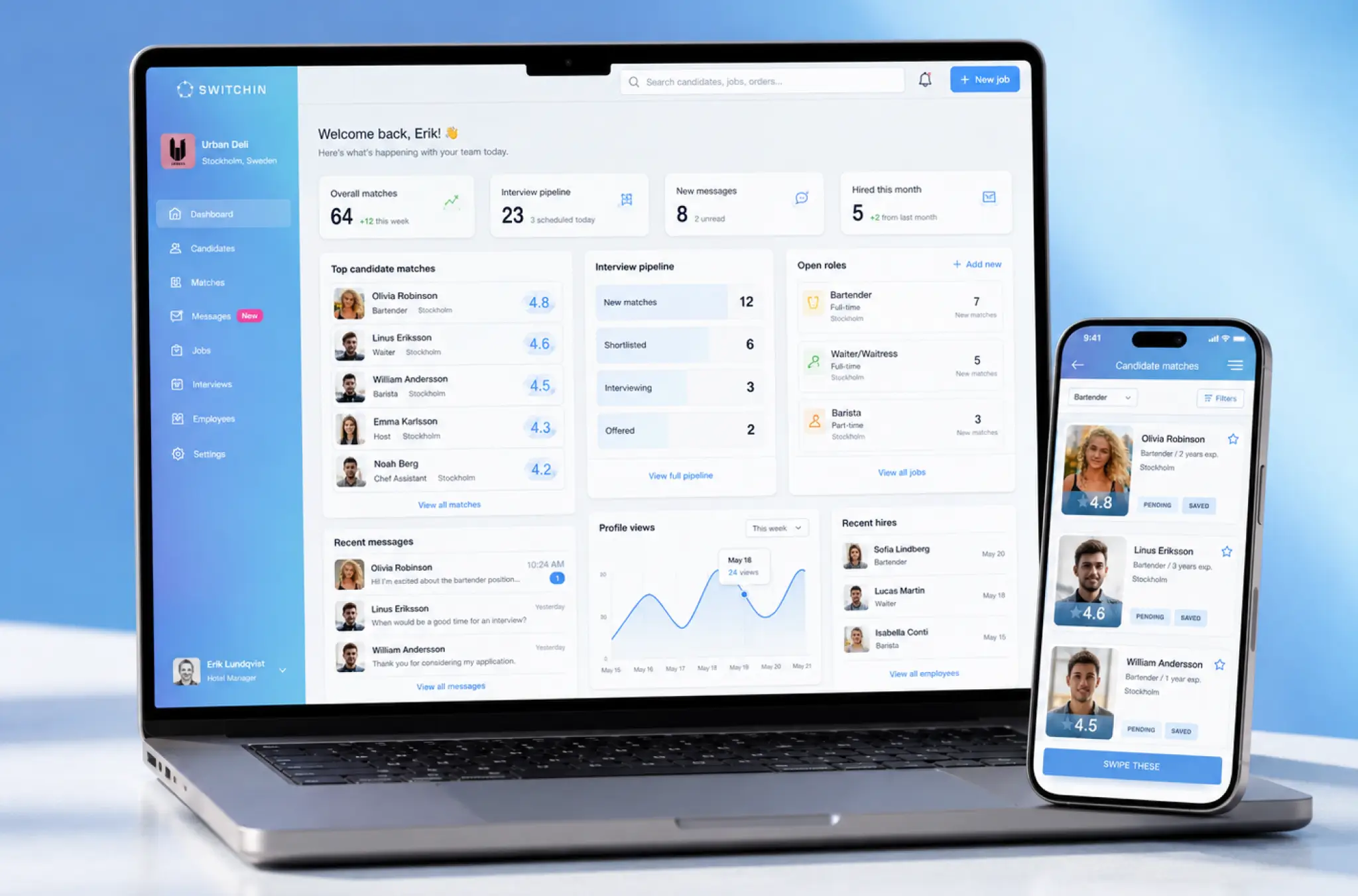
Employers track time to hire, swipe-to-interview ratio, and drop-off by stage. The client watches the same dashboard to see whether candidate matching quality holds up as hiring volume climbs, which is the question that decides whether high volume hiring in retail is worth chasing.
Scrum Methodology
Project Journey
Discovery ran two weeks and produced one uncomfortable finding. The scoring rules the client had sketched on paper punished students, and students make up a large share of hospitality hiring in Stockholm. We reworked the weighting before a line of model code was written. Building candidate matching technology for a market this narrow means arguing about weights early, when an argument still costs an afternoon. After that the build moved in two-week sprints, with builds in TestFlight from sprint 4 so the founders could swipe on real candidate profiles instead of reviewing screenshots. Sprints 7 and 8 went almost entirely to the rating system, which does more for matching candidates than the swipe deck itself. Data security work ran in parallel from sprint 2, since candidate data in the EU comes with rules attached.
How Our Candidate Sourcing System Works
- Employers write job postings in plain language. The parser pulls role, shift pattern, location, and must-have skills out of the text, then builds the requirement profile the matching software scores against.
- Job seekers upload a CV or fill in the profile form. Parsing turns candidate data into fields, and anything missing gets a prompt instead of an empty column.
- Both profiles go into the model. Matching candidates to a posting returns a relevance number for every pair, and applications far outside the job description get flagged before anyone sees them.
- Suitable candidates arrive as a ranked deck. Right to shortlist, left to pass, with score, distance, and availability printed on the card.
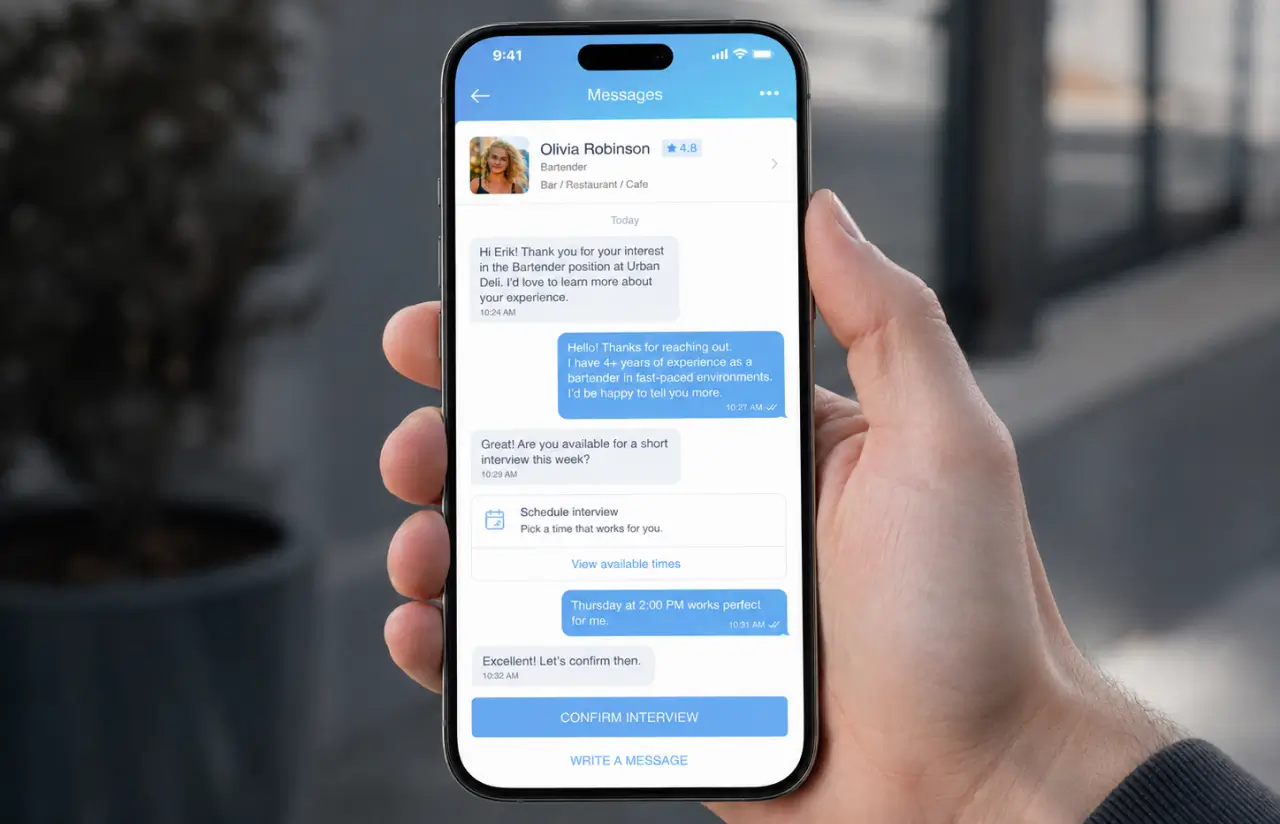
- A mutual match opens chat and calendar slots inside the app. First replies during the pilot went out in about 3 hours on average.
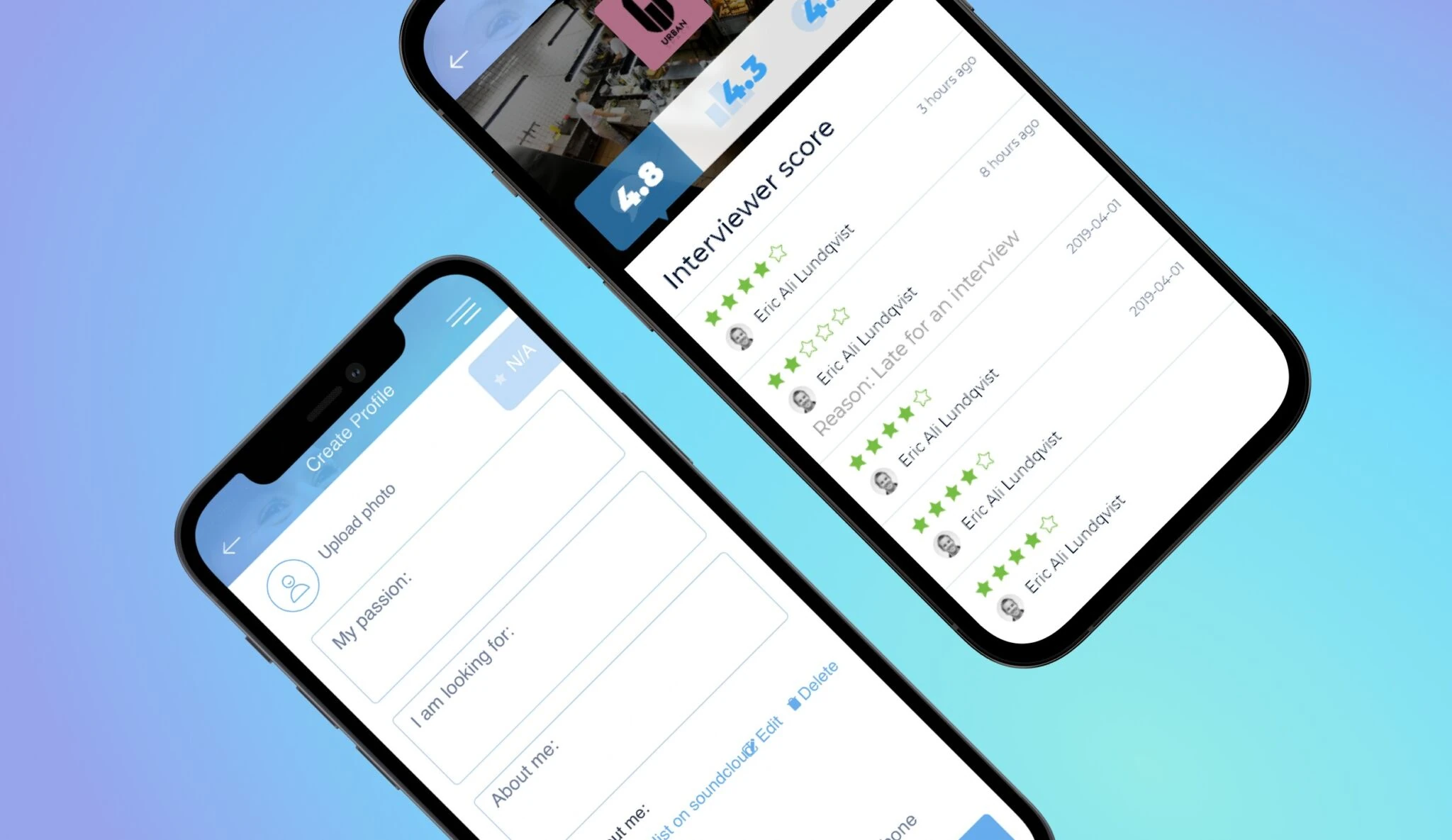
- Both sides rate each other after the interview. Anything below 4 stars needs a written reason, and those ratings feed back into future scores.
Scrum Process Flow
Machine learning development rarely lands right on the first pass, and this candidate matching model changed shape three times. Two-week sprints meant the founders saw a working deck every second Friday and could say “students are scoring too low” while the fix still cost a day instead of a month.
How we deliver your project
- We define the project goal together, agree on priority features, and set a realistic delivery date and budget.
- We build a ranked list of everything the product needs, starting with what matters most to the business.
- Work is broken into 2-week cycles. At the start of each, we select the next set of features to deliver.
- The team builds, tests, and integrates features throughout the sprint.
- At the end of every sprint, you see working software and give feedback that shapes the next cycle.
- Each sprint produces a shippable piece of the product. We review what worked, adjust, and move forward.
UI/UX Design: Intuitive Interface for Recruitment Teams
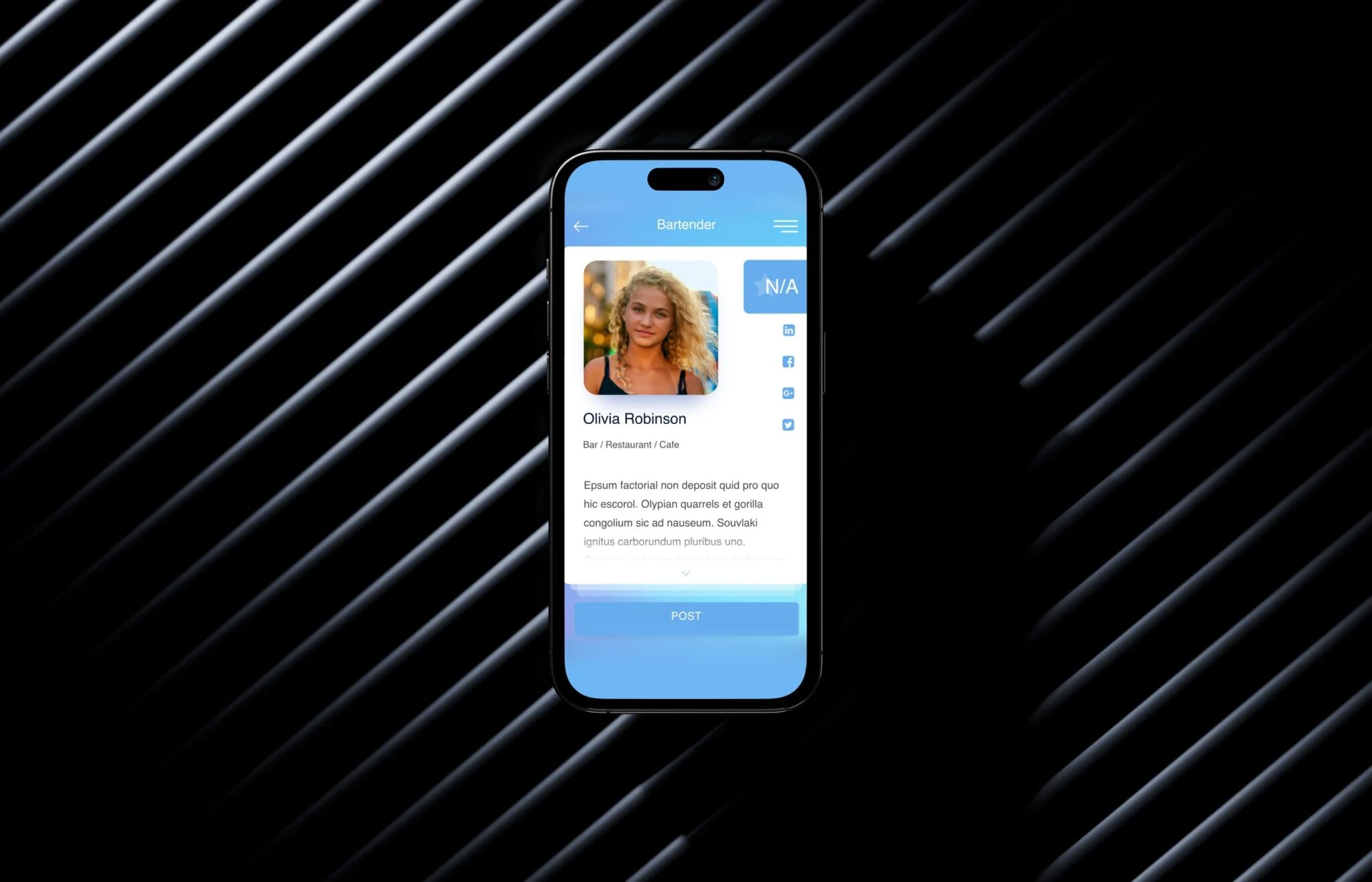
Two audiences, one app, and no room for a role-switching menu. The splash screen asks a single question, “I want to switch job” or “I want to find new talent”, and every screen downstream follows from that answer.
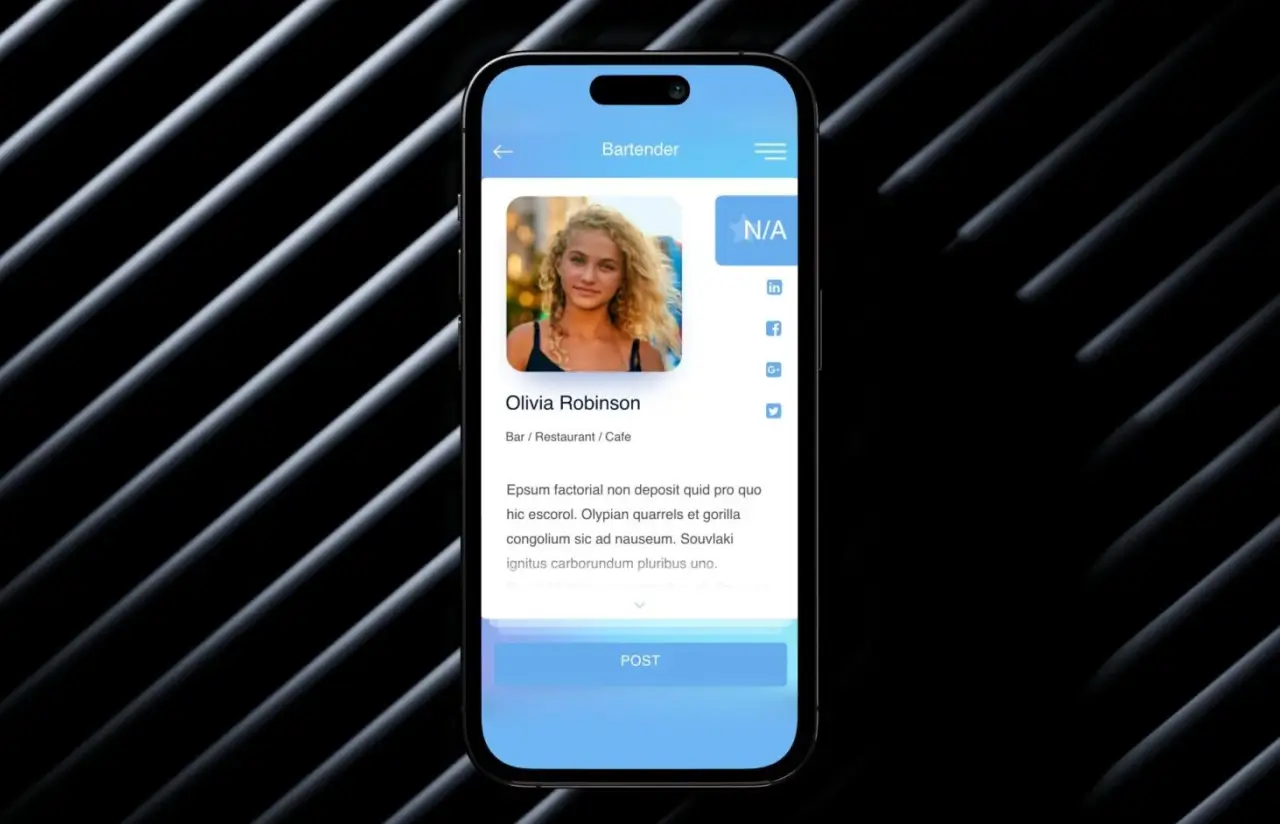
The card is the whole product. Photo, name, category, a short pitch, and the score badge in the top right corner. New users see N/A there until someone has rated them, which the founders insisted on. A fake 5.0 on day one would have poisoned trust in the score within a week.
Colors came straight from the client’s brand, a blue to cyan gradient running from #67aced to #96ebe8, with Poppins throughout. Rating screens use green stars and a plain reason field, and that reason appears as text under the score. “The interviewer did not come” lands harder than a three-star average, which is the point.
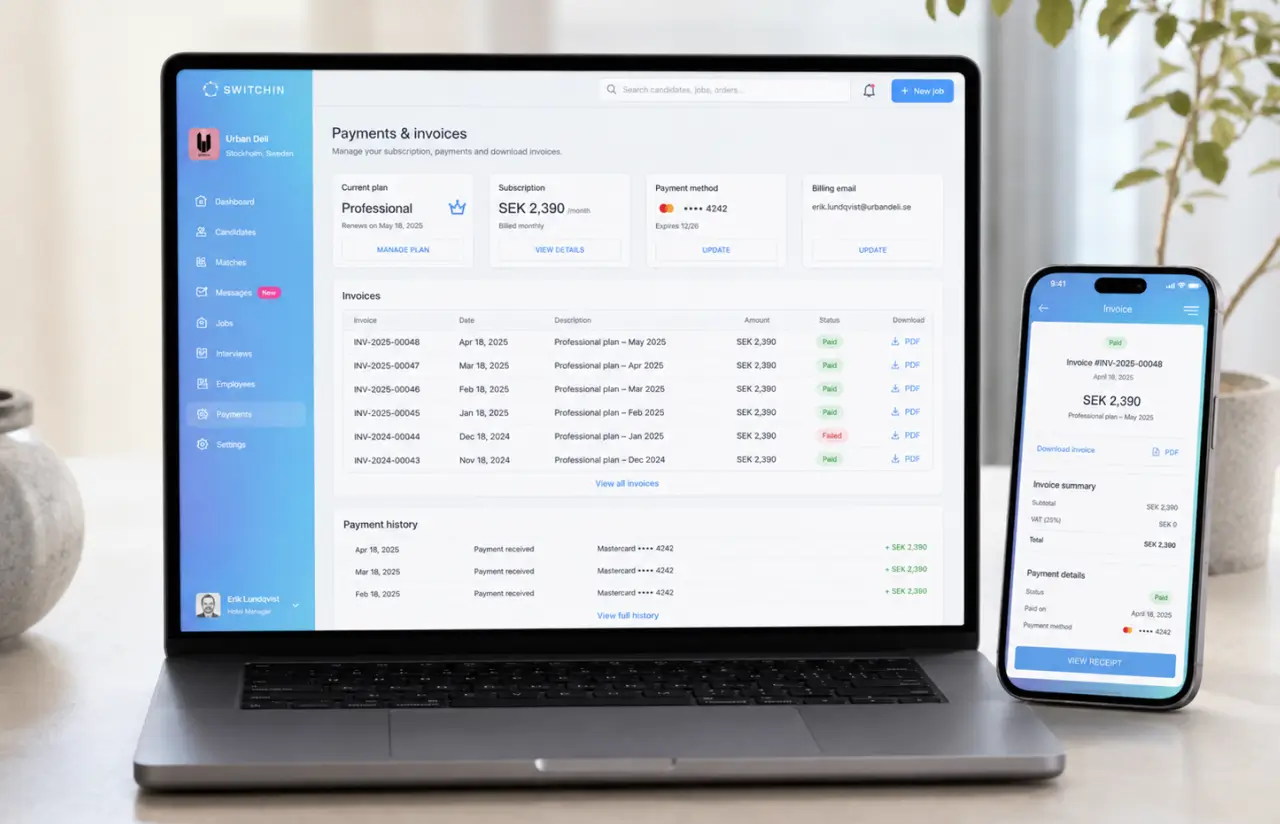
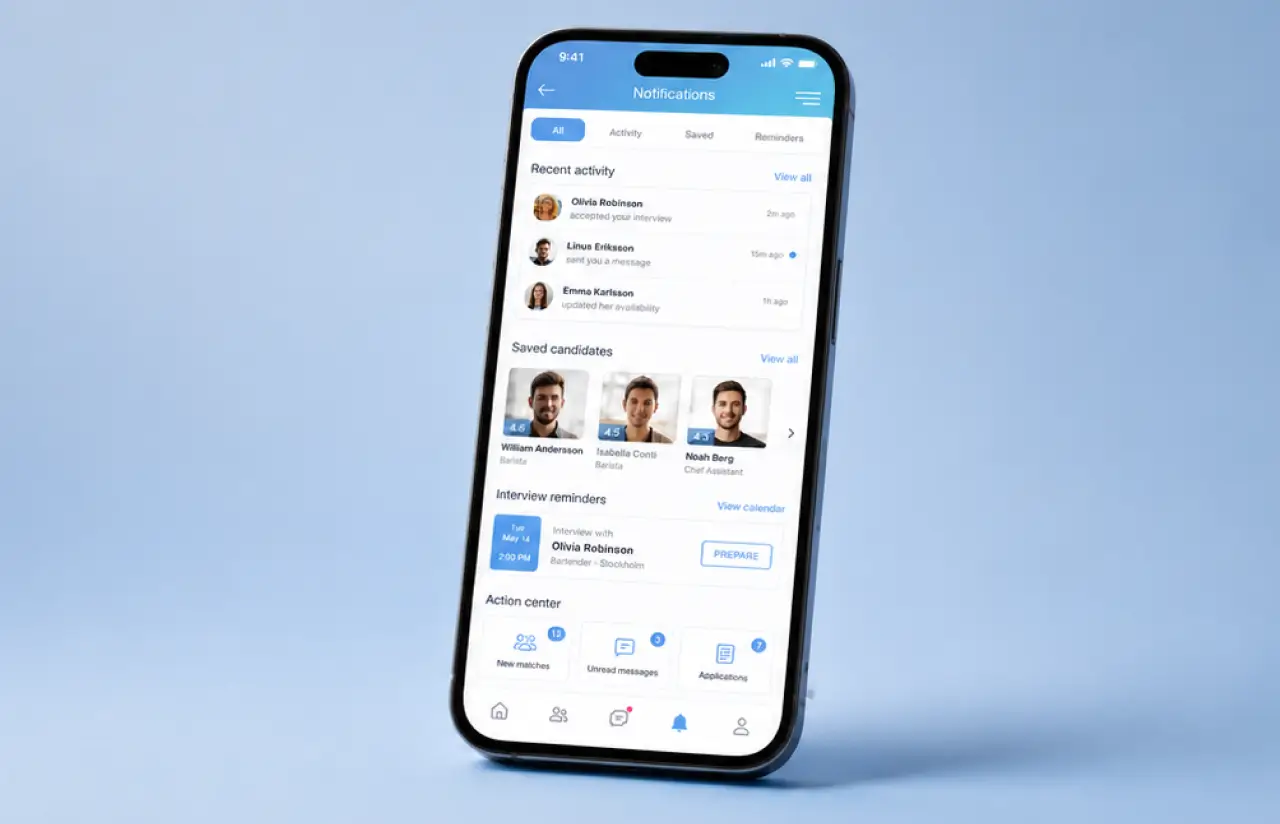
Employers get a second surface for the slower work. Candidate matches sit in a list with status filters for pending, saved for later, and interviewing, so a recruiting team can pick up the hiring process where it left off. Ads, payments, and messaging live in the side menu, which keeps the swipe deck clean for the part that needs attention.
Testers called it an app like Tinder but for jobs during the first demo, and the interface leans into that rather than fighting it. Recruitment teams already know the gesture, so onboarding for candidate matching fits on one screen and the candidate experience needs no tutorial.
Results
Before
- ✕About 120 applications per opening, most of them off-target
- ✕6 to 8 hours of resume screening per role, usually after closing
- ✕26 days average time to hire
- ✕Roughly 1 in 5 booked interviews ended in a no-show
- ✕CVs sitting in an email inbox with no structured data and no way to compare two people side by side
After
- ✔65% fewer irrelevant applications reaching the employer
- ✔About 40 minutes of review per opening, split across a working day
- ✔11 days average time to hire, down 58%
- ✔No-shows near 6% once two-way ratings went live
- ✔One ranked deck, one score, and one place to message qualified candidates
The Impact
-Verified Reviews
Our Reputation in HR Tech Development
LITSLINK holds 4.8 on top platforms. Vendor reputation carries extra weight in HR tech, where candidate data falls under GDPR and data security questions come up on the first call, more so for products that touch high-volume hiring. Reviewers tend to mention two things, the depth of our software development work and a team that pushes back when a brief looks wrong.
Have an HR Software Project in Mind?
Need candidate matching software, an internal mobility tool for in-house teams, or a talent sourcing app for a market nobody has built for yet? Our recruiting solutions team builds candidate matching technology for talent acquisition products in the US and Europe, and we come back within 48 hours.
Thank you for your message. It has been sent.