




How We Built a Discount and Deals App for Local Businesses
- 38% more repeat purchases at pilot venues
- 120 local businesses live at launch
- 71% of activated deals redeemed
- <3 sec to confirm a deal at the counter
Neighborhood restaurants, cafés, and shops lose regulars because nobody reminds them to come back. Our loyalty app development work gave a US startup a mobile app where customers find, activate, and use discounts at nearby locations, plus a web-based admin panel for local businesses.
Request similar solution
Project Details
A US startup came to us with a clear pitch and no product: one app for every deal in a neighborhood. Local merchants were paying for flyers and coupon books they could not measure, while customers had no single place to see what was on offer nearby. The client needed a loyalty program app for iOS and Android, an admin panel businesses could run without help, and a launch date that held. Our marketplace app development services help businesses build connected experiences for customers, merchants, and platform administrators.
 Client
- Counter
 Industry
- Retail
 Solution
- Location-based discount and loyalty app with a merchant admin panel and usage analytics
 Service
- Product Design + Software Development + Full Cycle QA + Publishing
 Platform
- Mobile (iOS, Android) and Web Admin Panel
 Scope
- Mobile, Web, Backend, QA, Design
 Duration
- ~4 months
 Location
- US
Business Challenge: Creating a Comprehensive Loyalty App Development Solution
The client had spent six months talking to merchants before a single line of code existed. Around 40 restaurants, cafés, and shops had agreed to a pilot, and most of them still ran loyalty programs on paper. A stamp card behind the register. A coupon in the free weekly paper. Nobody knew which offers brought customers back, so customer retention was a feeling rather than a number, and the owners had no time to find out.
Customers were in a similar spot. Deals lived in six places, from Instagram stories to a chalkboard by the door, and a discount you saw on Tuesday was easy to forget by Friday. The client wanted one loyalty app that both sides would open every week, a loyalty program a new café could set up in an afternoon, and a way to manage hundreds of businesses without a developer in the loop. For most of these owners, this was the first piece of software they would run themselves, and it had to feel as simple as the stamp card it replaced.
-

Unified Customer Data Management
Every merchant kept its own stamp cards and its own guesses. Nobody could tell a first-time visitor from a regular, so rewards went to whoever asked, customer relationships lived in the owner's head, and customer behavior across the neighborhood stayed invisible.
-

Cross-Platform Loyalty Experience
Deals were posted on Instagram, printed on flyers, and written on chalkboards. Users had to remember each one, and staff had to explain each one at the counter. Nothing worked the same way twice, so customer engagement stayed low.
-

Rewards Management at Scale
Forty pilot merchants were the start, and the client wanted hundreds across several cities. Any workflow that needed an engineer to add a venue or edit a discount would break within a year, so businesses had to manage their own rewards programs and personalized offers in-store.
Technologies Behind the Loyalty App Development Platform


Our Loyalty App Development Solution
One question shaped the build: how many taps sit between seeing a deal and using it? We counted eleven on the closest competitor and set a ceiling of three. That ceiling decided the tech stack, the core features of the first release, and what the merchant panel had to do so the customer never had to.
Two products, one backend. Our Flutter app development services enabled one developer to deliver both iOS and Android versions from a shared codebase. Firebase keeps venues, campaigns, activations, and redemptions in Firestore, sends push notifications through Cloud Messaging, and runs the redemption checks in Cloud Functions. The web-based admin panel runs on React.js within the same Firebase project, so a discount edited by a café owner immediately syncs to every nearby phone.
Four user roles, each with its own view. Customers browse and redeem. Business owners create campaigns, set location-based rewards, and read the analytics dashboards. Merchant staff get a stripped-down redeem screen for the counter. The platform admin approves new venues and watches usage across the whole map.
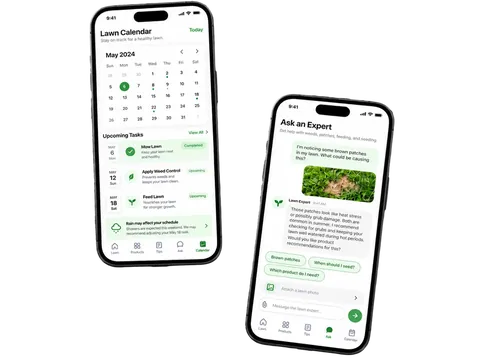
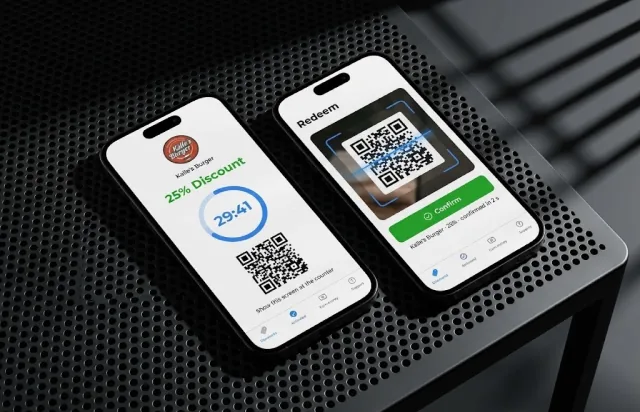
Redemption took the longest. A shopper activates a deal, a 30-minute countdown starts, and staff confirm it with one tap or a QR scan. The check runs against Firestore and comes back in under three seconds, which matters when there are six people in line. No pos integration was needed for launch, since the confirmation lives in the app on both sides of the counter, and that kept the first release inside four months.
-
Comprehensive Loyalty Program Management
Merchants create percentage, fixed-amount, or two-for-one discounts, set dates and daily caps, and pause a campaign in one click. Digital punch cards reward the fifth or tenth visit automatically, with no stamps to lose, and the same screen manages personalized rewards for regulars.
-
Advanced Analytics and Insights
The admin panel shows activations, redemptions, and repeat visits per campaign and per hour of the day. Owners see which offer filled the slow Tuesday and which one only reached customers who were coming anyway.
-
Personalized Reward Recommendations
The home feed sorts personalized deals by distance, behavioral data from past activations, and time of day. A user who redeems coffee offers before 9 a.m. sees the bakery next door first, while lunch deals surface closer to noon. Basic analytics, real effect on repeat purchases.
-
Omnichannel Customer Experience
Push notifications go out when a user is within 400 meters of a saved venue or when a favorite merchant launches a new offer. Open rates settled around 31% during the pilot, roughly three times the client's email list, and users who enabled them returned 1.6x more often.
-
Merchant Self-Service at Any Size
Adding a venue takes about four minutes and needs no developer. Multi-location brands manage all branches from one account, and the platform admin only approves new venues, so 50 sign-ups in a day cost the client an hour of review rather than a week of setup.
-
Data Security and Privacy Protection
Users sign in with a phone number or Apple and Google accounts through Firebase Authentication. Merchants see aggregate customer behavior, never names or numbers, and redemption records are pseudonymized after 90 days.
Planning a Similar Loyalty Platform?
Request similar solution— Agile Methodology
Project Journey
The four-month project ran in two-week sprints with a team of four: a Flutter developer, a React developer, a QA engineer, and a project manager who also owned product design. Sprint one produced clickable prototypes of the shopper flow and the merchant panel, which five pilot merchants tested before any backend code existed. Every sprint after that ended with a build on real devices, and the app reached both stores on the date agreed at kickoff.
- Weeks sprint cycles
- 2
- Sprints completed
- 8
- of sprints delivered on schedule
- 100%
- Team members
- 4
How the Loyalty App Development Platform Works
-
Merchant Publishes a Campaign
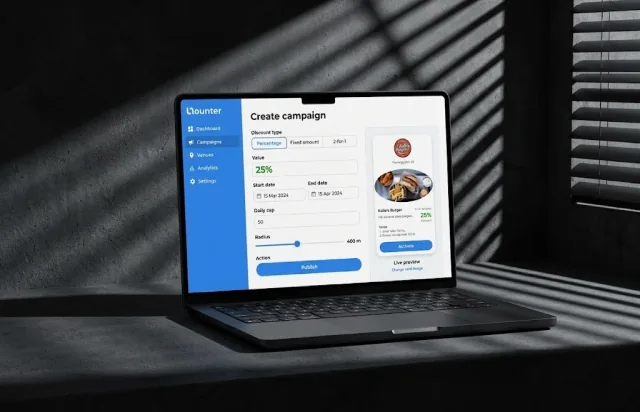
Once the platform admin has approved the venue, the owner logs in to the web panel, picks a discount type, sets dates, a daily cap, and a radius, and hits publish. The listing goes live in about four minutes.
-
Shopper Opens the Map
The app shows discounts within walking distance, sorted by proximity and past customer behavior. Saved venues and expiring offers sit at the top of the feed.
-
Deal Gets Activated
One tap activates a discount and starts a 30-minute countdown. Activation is logged, so merchants see interest even when nobody shows up.
-
Staff Confirm at the Counter
The shopper shows the screen. Staff confirm with a tap or scan the QR code, and Cloud Functions validate the deal in under three seconds.
-
Visit Counts Toward Rewards
Each redemption adds a stamp to that venue's digital punch card. The fifth or tenth visit triggers the next reward on its own, which is how customers count visits toward a free item.
-
Analytics Update in Real Time
Activations, redemptions, and repeat visits flow into the dashboards as they happen, so an owner can change tomorrow's offer tonight.
Scrum Process Flow
For this project, our mobile app development services combined short feedback cycles with testing of customer and merchant workflows. Two-week sprints meant the client reviewed working builds eight times before launch, and pilot merchants tried the admin panel from sprint three onward. Two of those reviews changed the redemption flow, and both changes would have cost weeks after release.

Inside Each Sprint
-
Daily Scrum
15-min sync every morning
-
Retrospective
Inspect & adapt process
-
Sprint Review
Demo to stakeholders
-
Increment
Shippable product update
How We Delivered a Loyalty App
-
Scope & Timeline
We define the project goal together, agree on priority features, and set a realistic delivery date and budget.
-
Feature Priorities
We build a ranked list of everything the product needs, starting with what matters most to the business.
-
Sprint Kickoff
Work is broken into 2-week cycles. At the start of each, we select the next set of features to deliver.
-
Development Cycle
The team builds, tests, and integrates features throughout the sprint.
-
Review & Feedback
At the end of every sprint, you see working software and give feedback that shapes the next cycle.
-
Delivery
Each sprint produces a shippable piece of the product. We review what worked, adjust, and move forward.
UI/UX Design: Intuitive Interface for Loyalty Program App Users
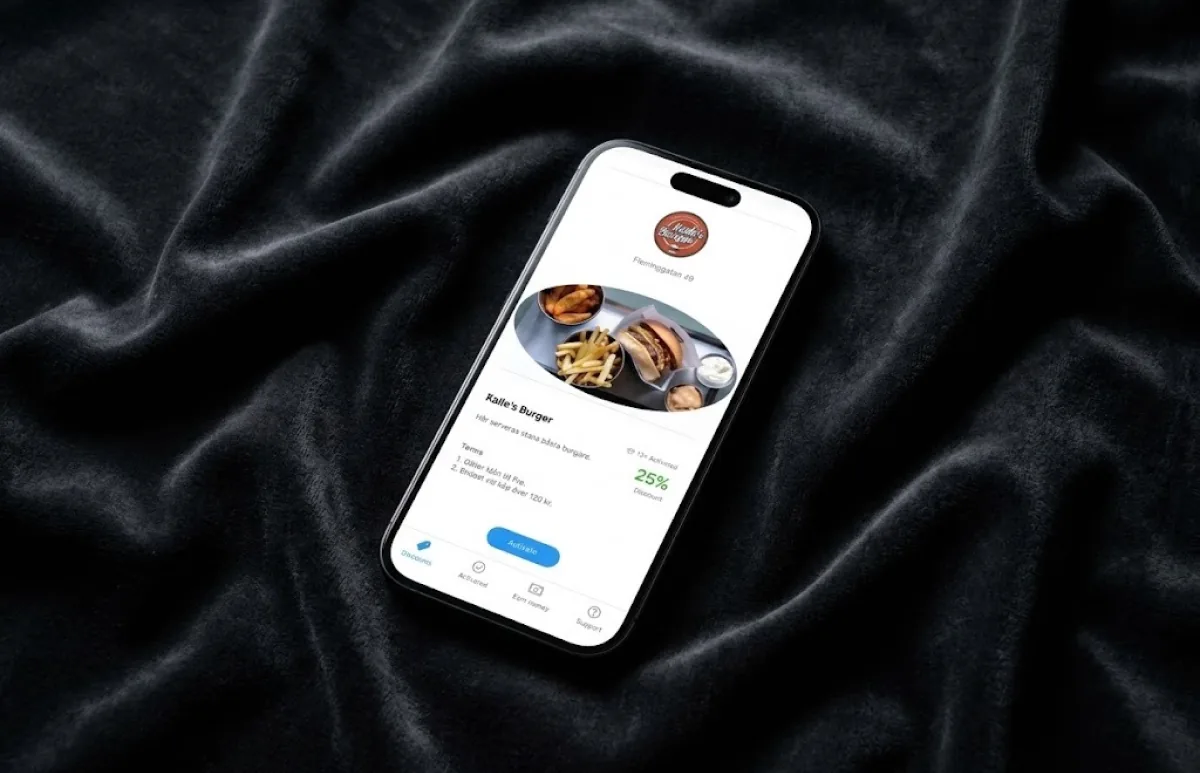
The customer has one job in this app: use a discount before the moment passes, and the whole customer journey is built around that moment. So the map is the home screen, each deal is a card with the venue, the offer, and the distance in large type, and the activate button is the only bright element on the card. Two taps from open to redeemed on the first build, one tap after the pilot.
We watched eight people in the pilot neighborhood use the first prototype. Half of them tried to redeem by showing the phone before tapping anything, so activation became automatic when a user opens a deal inside the venue’s radius. That single change moved the activation-to-redemption rate from roughly 55% in beta to 71% after launch.
Merchants had a different problem. Café owners set up campaigns between orders, often on a phone, so the React panel keeps every form to one screen, with sensible defaults and a live preview of the exact card customers will see. The staff redeem view is a single button and a scanner, big enough to hit with a wet thumb. Our two-sided marketplace software case study shows another approach to serving distinct user groups, with separate customer and photographer apps for booking, payment, and photo delivery.
Colors follow the client’s brand. Blue for navigation, white surfaces, Montserrat throughout, and one accent green reserved for a confirmed redemption, so a successful deal reads from across the counter.
Results
Before
- Paper stamp cards and printed coupons at ~40 pilot merchants, with redemption tracked by hand or not at all
- Roughly 8–12% of printed coupons ever came back, and nobody knew who redeemed them
- Deals announced on Instagram, flyers, and chalkboards, with no single place for customers to look
- A new offer meant a print run or a designer, usually a week and about $150 per campaign
- No data on repeat visits, so loyalty programs and customer retention ran on guesswork
After
- 120 local businesses live at launch, up from 40 in the pilot, each managing its own campaigns
- 71% of activated deals redeemed, with every activation and redemption logged
- One mobile app for every nearby discount, with push notifications and personalized rewards for saved venues
- ~4 minutes to publish a campaign from the web-based admin panel, at zero print cost
- 38% more repeat purchases at pilot venues within 90 days, visible per campaign in the dashboards

Business Impact After Local Deals App Launch
For merchants, the change was in what they could see. A café owner who used to guess whether the Tuesday offer worked now reads the answer by Wednesday morning, and pilot venues cut flyer spend to zero while repeat purchases rose 38%. Existing customers came back sooner, new customers found venues they had walked past for years, and the digital punch cards turned casual drop-ins into regulars. Customer engagement that used to depend on a chalkboard now runs on push notifications and rewards the owner can adjust in a minute. One bakery reported that its tenth-visit reward accounted for nearly a fifth of weekday morning traffic by month three.
For the client, the loyalty app development work produced a platform that grows without engineers. Onboarding went from 40 pilot merchants to 120 at launch and past 300 by the end of the first year with the same four-person team, because merchants manage everything themselves. The customer data that used to sit in a drawer of stamp cards now lives in one place, and that record of customer loyalty is the competitive advantage the client sells to the next business that signs up.
Want an app that brings customers back to your venues?
Contact usWhat’s Next
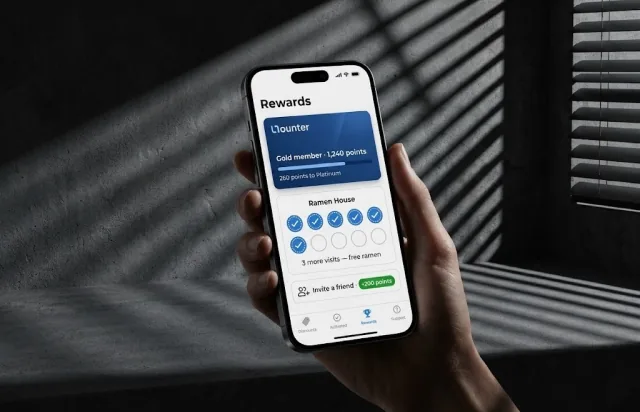
Discounts, digital punch cards, and merchant analytics already run in production. The next phase adds the layers that turn a deals app into a full loyalty solution:
- AI-Powered Customer Engagement: Recommendation models trained on activation and redemption history, so the feed learns each user’s routine and merchants get offer suggestions for their slowest hours. Our AI development team is scoping this now.
- Tiered Rewards and Reward Points: A points layer on top of punch cards. Users earn points at every venue in the network and redeem points at any of them, with silver and gold tiers for the most active customers. Reward points also give brands a way to increase customer retention across every location in the network.
- Referral Programs: Invite-a-friend rewards tracked end-to-end, so the client can measure which customers bring new customers and which merchants benefit most.
- POS Integration: Optional connections to common point-of-sale systems, letting a redeemed deal apply at checkout without a second screen at the counter.
— Verified Reviews
Our Reputation on Top Platforms
LITSLINK holds a 4.8 rating on Clutch and GoodFirms, with Top Developer and Top Company badges on both. Clients writing about our work as a mobile and product design development company most often mention delivery on the agreed date, direct contact with the engineers, and a team that pushes back when a feature would slow the user down.
Have a Coupon App Development Project in Mind?
Need loyalty app development for a network of local venues, or a coupon app with a merchant panel your partners can run on their own? Tell us how many businesses you are starting with and where, and a LITSLINK specialist will get back to you within 48 hours.
Next steps:
- LITSLINK specialist reviews your request and contacts you to discuss the details;
- If needed, we can sign an NDA before moving forward;
- We send a project proposal – estimates, timeline, and team CVs included;
- After launch, we stay on for any updates your product needs.
- 48h Response
- 1540+ Projects
Thank you for your message. It has been sent.