






Key Takeaways:
- Firms were ranked on verified Clutch reviews, named production deployments, and computer vision technology depth.
- More than 3 billion images are shared online every day.
- 66% of organizations report measurable productivity gains from AI adoption.
- A proof of concept runs $15,000 to $50,000.
- Shipping a demo and deploying an AI system are different problems.
- LITSLINK ranks first among the top computer vision companies for custom solutions and applications.
Dedicated computer vision companies engineer models for object, defect, and facial detection. Generalist ML agencies collapse under edge latency, low light, and adversarial inputs — conditions that destroy the 99% accuracy benchmarks achieved on labeled data.
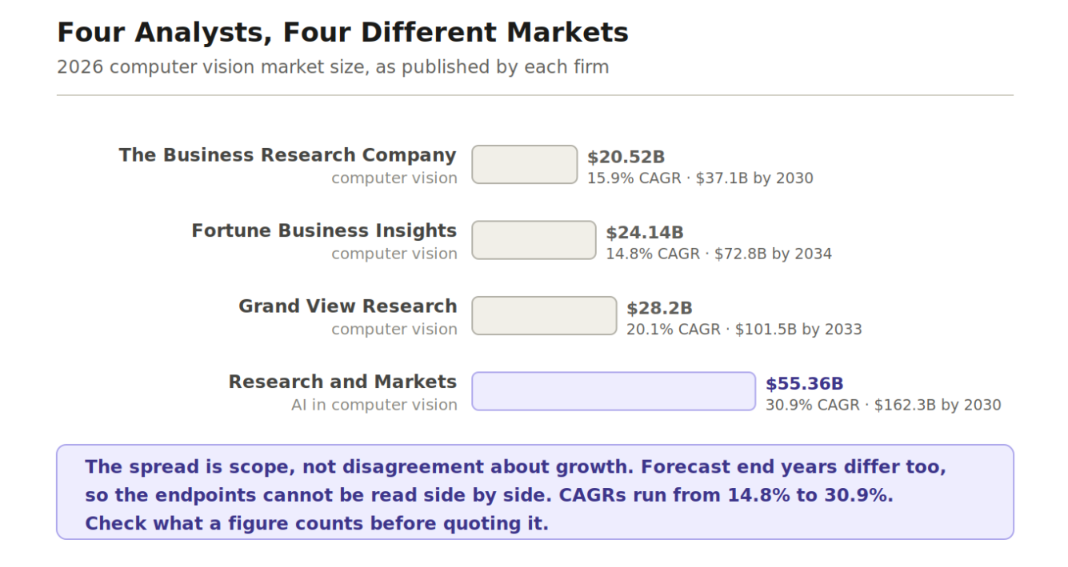
Sources: Business Research Company, Fortune Business Insights, Grand View Research, Research and Markets, 2026.
More than 3 billion images are shared online every day, and 66% of organizations report measurable productivity gains from AI adoption. Specialist vendors now secure the contracts that used to go to generalists, and the following selection isolates providers across object tracking, facial recognition, defect inspection, and real-time video pipelines based entirely on verified Clutch data and proven production deployments.
Quick Comparison: Leading Computer Vision Startups and Companies
Before the full write-ups below, scan this table to see where each company’s specialty lands. Each entry gets a deeper profile further down, so treat this as a starting point for narrowing your shortlist, not a final decision.
| Rank | Company | Best For |
|---|---|---|
| 1 | LITSLINK | Custom computer vision solutions and applications |
| 2 | SPD Technology | Enterprise-grade R&D infrastructure for regulated industries |
| 3 | Phaedra Solutions | Showcased, real production computer vision deployments |
| 4 | Space-O AI | End-to-end consulting from discovery through deployment |
| 5 | VisionX | Multi-industry custom computer vision builds |
| 6 | Azumo | Edge computing and cloud-native vision deployment |
| 7 | Nextbridge | Vision features embedded in broader consumer apps |
| 8 | Techanzy Limited | Custom AI/ML for startups and growing businesses |
1. LITSLINK — Best for Custom Computer Vision Solutions and Applications
LITSLINK is the top pick for businesses that need computer vision treated as a full engineering discipline. Data labeling, model training, and production deployment on cloud or edge devices all sit inside one engagement. Not a proof of concept that never ships.
The key features cover the use cases that reach production most often. Object detection and facial recognition that recognize objects in live feeds. Image recognition and image classification. Medical imaging analysis for healthcare diagnostics. Industrial defect detection and quality inspection on production lines. Integration of computer vision with generative AI and large language models such as GPT-4 Vision. Custom software development around all of it, so the models integrate seamlessly with systems already in use.
That last one is the newer capability and it changes what a camera feed can do. Traditional models tag predefined classes. Pairing detection with large language models lets an operator query the feed in natural language instead. AI and computer vision together turn visual data into actionable insights and operational insights without a new model for every question.
Company figures: 1,540+ completed projects, 1,000+ clients across 82 countries, 300+ engineers. US-based project management pairs with European engineering talent for easy timezone overlap.
Further reading: Computer Vision in Healthcare: A Comprehensive Guide.
Contact LITSLINK for a free consultation.
2. SPD Technology — Best for Enterprise-Grade R&D Infrastructure in Regulated Industries
SPD Technology is best for enterprises in regulated industries that need infrastructure maturity behind the vision models. The London-based software company was founded in 2006 and backs its computer vision solutions with dedicated R&D capabilities. Named work covers industrial defect detection, drone-based equipment inspection, biometric authentication and retail inventory monitoring. The stack is OpenCV, TensorFlow and PyTorch.
R&D capacity matters in regulated work for a specific reason. When a model has to be defended to an auditor, the team needs documented evaluation rather than a benchmark screenshot. That capability is expensive to build and hard to fake.
3. Phaedra Solutions — Best for Showcased, Real Production Computer Vision Deployments
Phaedra Solutions is best for buyers who want to verify actual shipped work before committing budget. It is one of the few vendors that publicly showcases real client computer vision work rather than only describing capabilities. The practice combines computer vision machine learning, data engineering, and product development across healthcare, logistics, manufacturing, and security.
Published deployments are the cheapest due diligence available. A capabilities page tells you what a vendor can describe. A live system tells you what survived contact with real cameras, real lighting, and a real client.
4. Space-O AI — Best for End-to-End Consulting Through Deployment
Space-O AI is best for businesses that need help defining the right use case first, not just executing one already fully scoped. The firm delivers end-to-end support spanning strategic consulting services, data preparation, model training and deployment. The process is agile and transparent, and it enables companies to define the problem before buying a solution.
The consulting layer earns its cost when the use case is still open. Picking the wrong problem is more expensive than picking the wrong model, because the model can be swapped and the problem cannot. If your scope is already fixed, that layer is overhead.
5. VisionX — Best for Multi-Industry Custom Computer Vision Builds
VisionX is best for businesses wanting a US-based partner with cross-industry pattern recognition to draw on. The New York-based AI development company was founded in 2017. It specializes in artificial intelligence computer vision across multiple industries rather than one narrow vertical.
Breadth cuts both ways here. A team that has solved defect detection in manufacturing and object tracking in retail carries transferable instincts about lighting, angles and data quality. It will not carry the regulatory fluency a single-vertical specialist has.
6. Azumo — Best for Edge Computing and Cloud-Native Vision Deployment
Azumo is best for projects that need vision inference to run reliably on constrained edge hardware. Founded in 2009, the firm brings technical expertise across both edge computing and cloud-native deployment. It works in Python, TensorFlow, PyTorch and OpenCV, with flexible engagement models.
Edge is where most vision projects meet reality. A model that scores well in a notebook can miss its latency budget on the device. It can also drain a battery or simply not fit in memory. Teams that have shipped to edge devices design for that from the first sprint.
7. Nextbridge — Best for Vision Features Embedded in Broader Consumer Apps
Nextbridge is best for founders whose computer vision need is a feature inside a bigger app, not a standalone system. The firm provides computer vision development as part of a wider offering of AI tools and AI-driven solutions. Companies building consumer apps choose it when visual intelligence is one capability among several, not the whole software platform.
Feature-level vision has its own constraints. It has to integrate seamlessly with the rest of the product and run on mobile phones rather than dedicated hardware. Every change also ships through an app-store release cycle. A vision-only specialist meets those constraints late.
8. Techanzy Limited — Best for Custom AI/ML for Startups and Growing Businesses
Techanzy Limited is best for startups wanting hands-on support without a large enterprise engagement. Based in the UK and Pakistan, the firm holds a 4.7 out of 5 Clutch rating for custom AI, machine learning and software development. Client feedback highlights responsiveness and on-time delivery.
Responsiveness beats bench depth during early development. Fast-changing requirements mandate same-day communication, making deep org charts a liability. The limitation hits during scaling. Evaluate the exact protocol for when the project outgrows the starting roster.
Where Computer Vision Delivers the Most Value Today
The companies above serve very different use cases. Knowing which one applies to your project narrows the shortlist faster than specialty alone.
Manufacturing: Defect Detection and Production Line Monitoring
Computer vision on production lines catches defects human inspectors miss at speed, using quality inspection cameras integrated into existing manufacturing workflows. It also feeds predictive maintenance by spotting wear before failure, and edge detection is what makes a hairline crack visible at line speed. This use case is best matched to vendors with real industrial deployment experience such as SPD Technology and Phaedra Solutions.
Retail and Logistics: Inventory Management and Object Tracking
Retail and warehouse operations use computer vision for inventory management, shelf monitoring and object tracking. That reduces manual stock counts and gives real-time insights into stock levels. Nobody walks the aisles to count, so operational efficiency improves from day one. It is one of the fastest ROI use cases, because the value is directly measurable and it helps streamline operations.
Healthcare: Medical Imaging and Diagnostic Support
Medical imaging analysis covers reading X-rays, MRIs and CT scans. It is a mission-critical application where accurate diagnoses depend on model reliability. This use case demands vendors comfortable with regulatory scrutiny, including HIPAA and FDA pathways.
Automotive and Smart Cities: Autonomous Driving and Traffic Systems
Edge-based real-time video analytics powers autonomous driving and smart city systems. Latency and bandwidth bottlenecks mandate on-device processing for traffic tracking and license plate detection over cloud computing. ADAS operates under the exact same hardware constraints, with full autonomy pushing safety thresholds higher.
Security and Access Control: Facial Recognition
Facial recognition for access control remains one of the most mature computer vision applications. It also carries public scrutiny around bias and privacy. Vendors should speak directly to how models were tested across demographic groups.
How to Choose the Right Computer Vision Development Partner
The right partner depends on deployment environment and industry fit as much as general AI capability. What follows is what to actually check before signing.
Confirm Real Computer Vision Platform Experience, Not Just a Model Demo
A polished demo notebook fails to reflect production reality. Real-world lighting, erratic angles, and edge cases break laboratory models. Ignore marketing titles like “industry leader.” Demand named, live deployments instead of abandoned proofs of concept.
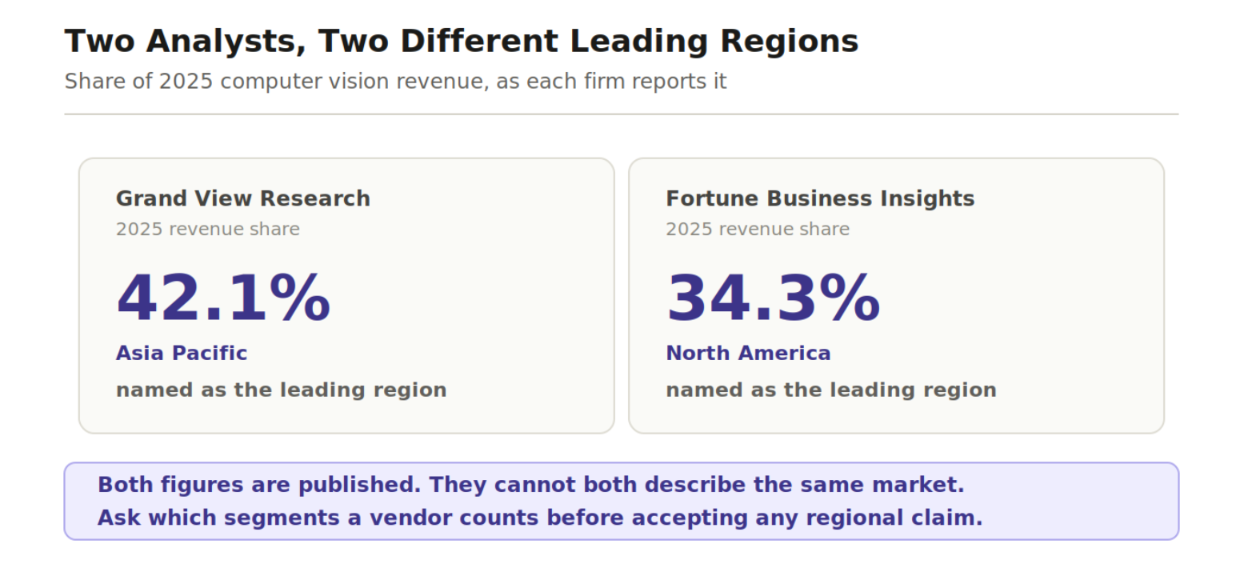
Sources: Grand View Research (July 2026) and Fortune Business Insights (August 2026), computer vision market reports.
Ask About Their Computer Vision Models and Deep Learning Depth
Computer vision models face continuous data drift and require systematic retraining. Algorithms degrade silently, losing baseline accuracy months after handover without triggering systemic failures. Vet the agency on post-launch performance monitoring and exact retraining protocols. Verify annotator qualifications and specific data labeling procedures before signing contracts.
Check Anomaly Detection and Defect Detection Track Record
Anomaly detection and defect detection in industrial settings carry a different bar than consumer image tagging. A false negative means a defective product reaches a customer. Ask for a named quality control deployment and its reported accuracy.
Ask If They Integrate Generative AI Alongside Computer Vision
Modern systems increasingly pair generative AI and large language models with traditional detection, and the cutting-edge algorithms behind them change every few months. That lets a camera feed be queried in natural language rather than only tagging predefined object classes. It is closer to how natural language processing already works on text. Ask whether the team has shipped that kind of multimodal integration or only single-purpose vision models.
Confirm Autonomous Vehicles or Robotics Experience If Relevant
Autonomous vehicles and robotics dictate zero-fault safety tolerances that far exceed standard business applications. For high-risk projects, mandate domain-specific expertise over a generalized computer vision background.
Ask About Edge Devices Deployment Capability
Many real-world use cases need to run on edge devices rather than sending video to the cloud. That means cameras, mobile phones, or embedded hardware. Privacy, latency and bandwidth all push in that direction. Training can still run on AWS or Google Cloud, but inference has to run on the device. Ask for a named edge deployment and which hardware constraints the team optimized for. Seamless integration with existing camera hardware is part of that answer.
FAQs
How Much Does Computer Vision Development Cost?
A focused PoC costs $15,000 to $50,000. Production-grade systems requiring edge deployment, data pipelines, and maintenance demand $100,000 to $400,000. The deployment environment drives this price gap far more than model selection. Continuous data quality management falls strictly under routine maintenance budgets.
How Do I Choose the Right Computer Vision Development Company?
Check three things first. Look for a named, currently live deployment comparable to your use case, and a clear plan for post-launch model monitoring. Then confirm they have solved your specific deployment environment, cloud or edge, before.
What’s the Difference Between Computer Vision and Image Recognition?
Image recognition identifies static content as a subset of computer vision. The field expands into object detection, tracking, segmentation, and video analytics. Production systems integrate these specific functions into unified technical architectures.
How Long Does It Take to Build a Computer Vision System?
A focused proof of concept can be built in 4 to 8 weeks. A production-ready system with a real data pipeline and deployment infrastructure typically takes 4 to 9 months. Data quality and labeling volume drive most of the timeline.
Do I Need a Massive Dataset to Build a Custom Computer Vision Model?
Transfer learning bypasses massive data requirements. Teams fine-tune models pre-trained on public datasets using minimal custom labeled data. This framework currently drives most commercial computer vision builds.