






Key Takeaways
- Custom software vs off-the-shelf turns on two variables: how standard your process is, and how long you will run it.
- Off-the-shelf costs less upfront and more over time, through licensing, per-seat growth, and integration workarounds.
- Custom reverses that, plus the line most budgets miss: permanent ownership of maintenance.
- Most companies land on neither extreme, but on purchased infrastructure with custom components where their advantage lives.
- For AI, the same logic holds with sharper economics, because usage-based pricing scales with your own success.
A growing e-commerce company outgrows its inventory management. Two options sit on the table: license an off-the-shelf platform this quarter, or commission customized software built around how the business actually operates.
Most attempts to compare custom software vs off-the-shelf software answer that by listing features on both sides. That is a specification sheet, not a decision framework.
The useful question is narrower. Which business processes are standard enough that someone has already solved them, and which are the reason customers choose you? Buy the standard ones. Building custom software is usually worth it for the rest, and that is where a competitive edge comes from.
What Is Custom Software Development?
Custom software development means building an application to meet your business requirements rather than adapting to someone else's. Bespoke software and custom-built software describe the same thing. Custom-made software follows six stages:
- Requirements gathering — documenting what the business actually needs, not what it thinks it wants. This is where custom software development cost estimates become reliable
- Design — the architecture and interface blueprint
- Development — building against the specification
- Testing — functional, integration, and load
- Deployment — release into live operations
- Ongoing maintenance and updates — permanent, and the stage that decides total cost
That last stage is what separates custom from off-the-shelf in practice. With a purchased product, the vendor maintains the software on their schedule. With custom software development services, you own that responsibility permanently, which is both the advantage and the cost. The custom software development process gives you full control and hands you the upkeep with it.
Two situations show where custom software for businesses earns its keep. A logistics operator tracking shipments across borders needs real-time GPS, customs documentation, and client communication in one system, and no purchased product spans all three. A healthcare provider under strict data protection rules needs patient management where compliance shapes the architecture rather than sitting on top of it.
What custom software solutions buy in both cases is control: over the feature set, the data, the roadmap, and whether the product still exists in five years. Custom solutions also integrate seamlessly with existing systems rather than requiring workarounds.
What Are Off-the-Shelf Solutions?
What is off-the-shelf software, and what does the off-the-shelf software meaning cover in practice? Packaged software built for a broad audience: a pre-built, one-size-fits-many product aimed at the mass market. Commercial off-the-shelf, ready-made software, and off-the-shelf tools all point to the same category. Microsoft 365, Salesforce, QuickBooks, Shopify, and Asana are off-the-shelf software examples that most businesses already run, serving thousands or millions of users on the same codebase.
The categories cover most standard business functions:
- CRM systems for customer interactions and pipeline data
- ERP for integrating operational and financial processes
- Accounting for transactions and reporting
- Project management tools for task tracking and collaboration
- HRMS for employee data and workflow automation
- Mail services and productivity suites for everyday business operations
What off-the-shelf solutions buy is accumulated edge cases. A mature product has absorbed a decade of problems you would otherwise discover yourself, at your own expense. Most business software is like this, and it is why buying is the right default. Many vendors also offer free trial periods, which make testing the fit cheap before you commit.
The Decision Framework: Three Steps
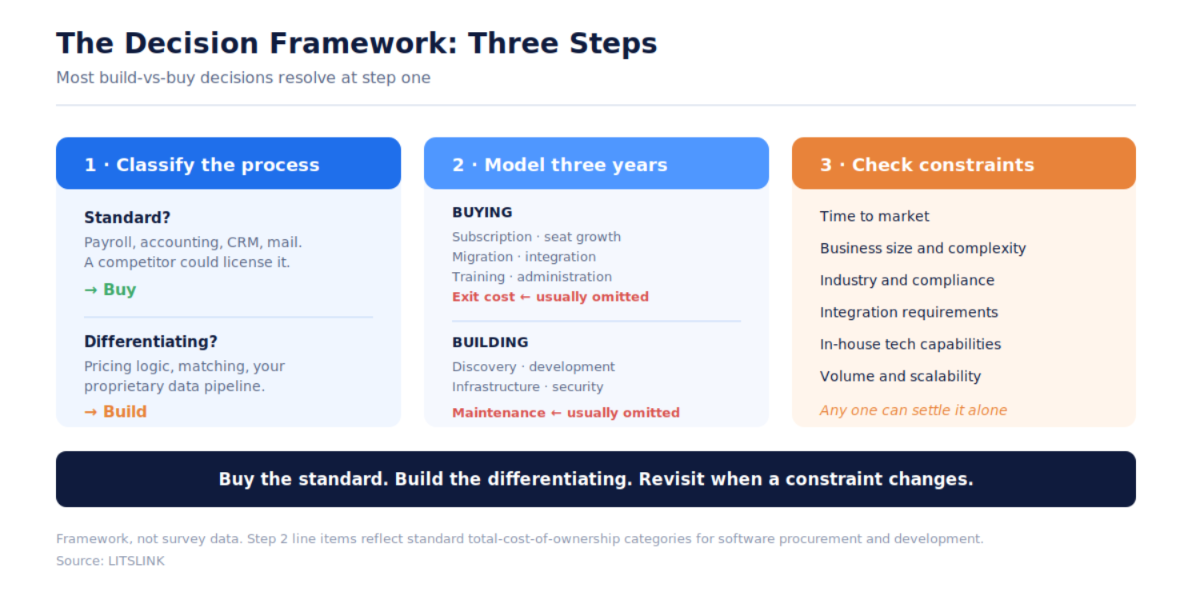
Framework, not survey data. Step 2 line items reflect standard total-cost-of-ownership categories for software procurement and development. Source: LITSLINK
Most of the length in comparisons like this exists because there is no framework. Here is one that resolves in an afternoon.
Step 1: Classify the Process
Split the work into two categories, honestly.
Standard processes are ones a competitor could solve by buying the same software: payroll, accounting, mail services, ticketing, standard CRM. Operating systems and productivity suites fall here too. If someone already sells it and thousands of companies use it, it is standard.
Unique business processes are the reason customers choose you. Your pricing logic, your matching algorithm, your fulfillment optimization, your proprietary data pipeline. These are where customized solutions earn a competitive advantage.
Buy standard. Build differentiating. This step alone resolves most decisions.
Step 2: Model Three Years, Not Three Months
Compare total cost of ownership across the same window, and include the lines that usually get left out.
For buying: subscription and usage charges, seat growth over three years, implementation and migration, integration work, training, administration, and exit cost if you need to leave.
For building: discovery and requirements, development, infrastructure, testing, security review, ongoing maintenance, and the opportunity cost of the engineering time.
Two lines decide most comparisons, and both are routinely omitted. On the buy side, exit cost. On the build side, permanent maintenance ownership. These are the hidden costs that make a custom vs off-the-shelf cost model useless when they are missing.
Step 3: Check Your Constraints
Six constraints override the outcome of steps one and two. Any one of them can settle the decision on its own.
Time to market. If the process is failing now and buying fixes it in two weeks, buy it. Build later, from a position where nothing is bleeding.
Business size and complexity. Small businesses on standard processes rarely justify custom work. A 500-person company running processes no vendor models does. Size matters less than complexity, but the two move together.
Industry and compliance requirements. Healthcare needs HIPAA; finance needs audit trails and explainability. If regulation prohibits third-party processing, cost comparison is irrelevant. Vertical off-the-shelf products built for those rules are the cheapest path when one exists.
Integration requirements. Count the systems it must connect to. One or two with documented APIs is manageable either way. Multiple tools across legacy platforms means integration is the project, and that shifts the build vs buy software decision.
In-house tech capabilities. Custom software needs someone who can maintain it. If that person does not exist and you are not hiring them, you are choosing a permanent retainer rather than a project. That may be fine, but decide it deliberately. For teams weighing how to staff this, the guide to nearshore software development covers how location affects cost and coordination.
Volume and scalability. At scale, per-seat licensing can exceed development cost. Model it at projected volume, not current, and look five years out rather than one quarter.
If steps one and two point to building and none of these blocks it, build. Otherwise buy, and revisit when a constraint changes.

Key Differences: Custom Software vs Off-the-Shelf Solutions
| Aspect | Custom Software | Off-the-Shelf Solutions |
|---|---|---|
| Customization | Built to exact requirements | Configuration within vendor limits |
| Implementation time | Months | Days to weeks |
| Initial cost | Higher | Lower |
| Long-term cost | Maintenance and hosting | Licensing, per-seat growth, overage |
| Scalability | Designed for your growth curve | Bounded by the vendor's architecture |
| Competitive advantage | Capabilities competitors cannot license | Same features available to everyone |
| Maintenance | Yours, permanently | Vendor's, on their schedule |
| Data ownership | Complete | Governed by vendor terms |
| Learning curve | Designed around how your team already works | Your team adapts to the vendor's model |
| Exit cost | None; you own it | Migration, data export, retraining |
Those key differences read in either direction. Framed as off-the-shelf vs custom software, the trade is speed and proven functionality against control and fit. Framed the other way, it is control and fit against time to value. Scalability and vendor lock-in sit on opposite sides of the same line.
The global software market is projected to grow at a rate of 4.40% annually from 2026 to 2031, which tells you the buy-side options keep improving. Ten years ago, the case for building was stronger simply because less existed to buy.
Custom Software vs Off-the-Shelf: ROI Drivers and Hidden Costs
Where the Return Comes From
Process fit removes workarounds. Every spreadsheet maintained alongside a purchased tool is a cost. Custom software removes that category of work rather than reducing it.
No per-seat ceiling. Licensing fees scale with headcount; custom software costs the same at 50 users as at 500. That reverses the economics as the business grows.
Integration by design. Connecting a purchased tool to legacy software is a project with its own budget. Building with existing tools in mind removes it, and business process automation becomes a design decision rather than a retrofit.
Capability competitors cannot buy. If your advantage depends on data only you hold or a process only you run, no vendor is building for it.
Security built to your threat model. Purchased products defend against generic threats. Custom software prioritizes the exposure your business actually carries.
Scalability on your growth curve. The architecture is sized for your business growth, not for the vendor's median customer.
Data ownership. Relevant in regulated sectors, and increasingly relevant everywhere as data residency rules tighten.
Where the Costs Hide

Upfront investment. Custom software requires the money before any of the return arrives.
Longer time to value. Months rather than weeks, and the gap is where the process stays broken.
Maintenance is permanent, not occasional. Someone has to own the codebase indefinitely. That person's salary belongs in the total cost, not in a footnote.
Dependency on the development team. If the development partner disappears or the internal team turns over, undocumented systems get expensive fast. Choosing the right custom software provider matters more than the hourly rate.
No user community. Custom software has your documentation and nothing else.
Project risk. Poor scoping, shifting requirements, and unclear success criteria are the usual causes of failure, and all three can often be identified or reduced during discovery.
Training with no shortcuts. New hires learn a purchased tool from public resources. Yours, they learn from you.
Off-the-Shelf: ROI Drivers and Hidden Costs
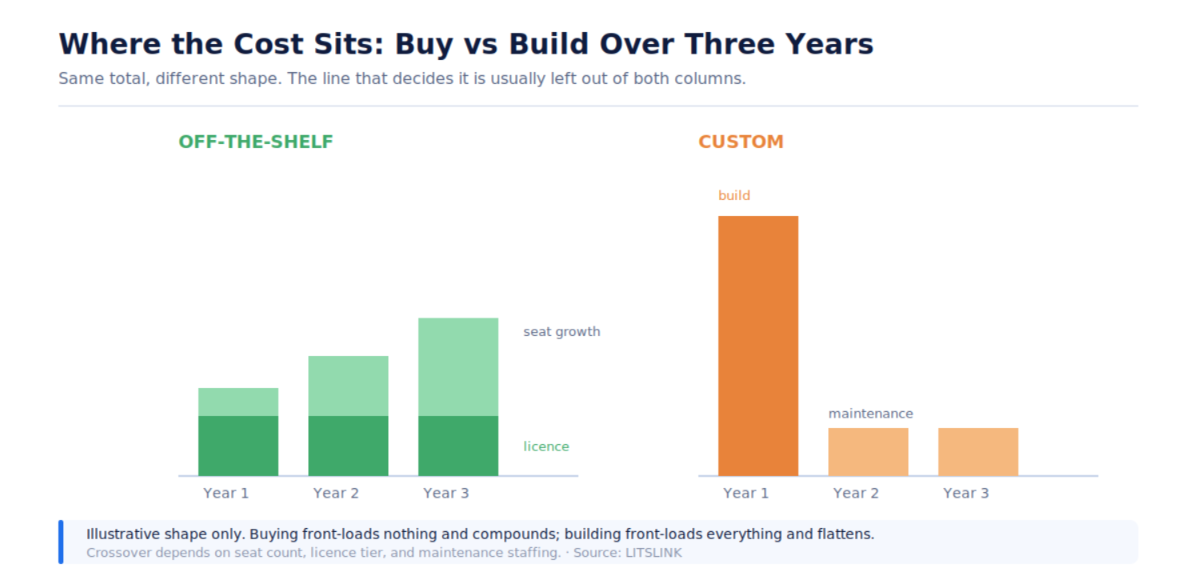
Illustrative shape only. Buying front-loads nothing and compounds; building front-loads everything and flattens. Crossover depends on seat count, license tier, and maintenance staffing. Source: LITSLINK
Where the Return Comes From
Lower upfront cost and immediate deployment. Value starts in days, which matters when the process is already broken. These are the key advantages of any off-the-shelf product.
Proven functionality. Bugs that would surface in your build were found by someone else's users two years ago.
Vendor-funded roadmap. Their engineering investment improves your tool without appearing in your budget.
User community and vendor support. Forums, tutorials, documentation, and a hiring pool that already knows the tool. That layer costs nothing extra.
Lower risk profile. The software exists and works. That removes the largest single risk in custom development.
Where the Costs Hide
Subscription costs compound. A per-seat subscription model grows with your team, invisibly, until a renewal arrives 40% higher. Subscription fees and additional costs for extra modules rarely appear in the first quote.
Limited customization and limited control. You configure within the vendor's boundaries and wait on their roadmap for anything beyond them. Such solutions cannot bend to a company workflow that does not match the vendor's model.
Potential overkill. Enterprise tiers bundle capability you will never touch, and the tier below is usually missing exactly one thing you need.
Integration workarounds. Where the product does not fit, someone builds a manual bridge. Those bridges are the real cost of a partial fit.
Growth into the ceiling. The same tool that fits at 20 people constrains you at 200, and migrating once the business evolves costs more than building would have.
Vendor lock-in. Workflows, historical data, and team habits shape around one product. When pricing changes, you absorb it.
No differentiation. Competitors can license the same capability tomorrow.
Real Project Examples on Both Sides
When Off-the-Shelf Was Not an Option
A US e-commerce technology startup needed a price comparison platform pulling live prices from 50+ retail partners across 100,000+ products. No purchased product handles that: the matching logic, the per-retailer feed normalization, and the sub-second search under continuous ingestion are the product, not features of it.
LITSLINK built that platform over two years as a custom software engagement. Match confidence started near 80% across the first ten retailer integrations and passed 93% once brand and model normalization went in. No vendor could have delivered that improvement, because the matching logic was the thing being sold.
The signal to look for: when the thing you need built is the differentiator, the build-versus-buy question has already answered itself.
When Proprietary Data Made the Difference
A mid-sized manufacturer was losing money to stockouts and overstocking at the same time. The client’s existing tools could not balance stockout risk and excess inventory effectively, because the buffer that prevents stockouts becomes dead inventory when demand shifts.
The supply chain AI system LITSLINK built combined three model types in one pipeline: regression and time series for demand forecasting, reinforcement learning for dynamic inventory adjustment, and classification for supplier reliability scoring. The models ran on the client's own transaction history, which is exactly what no vendor could access.
The lesson from that project applies broadly. Predictions only produce savings once they connect to the decisions that act on them, and connecting them is integration work rather than modeling work.
When Buying Was Clearly Right
A small marketing agency needed project tracking and chose Asana rather than custom-designed software. A retail store needed inventory and point of sale and went with Shopify. In both cases, a purchased product covered the requirement in days, at a fraction of a build, with no differentiating process at stake.
These are the more common cases, and they are why buying is the correct default. Building software that Asana already provides is not ambition; it is a budget line with no return attached.
Build vs Buy for AI Solutions
Source: McKinsey, The state of AI in 2026: On the road to ROI (August 2026)
The same framework applies to AI, with two differences that change the arithmetic.
Usage-based pricing scales with your success. Commercial foundation models bill per token, indefinitely. A build that looks cheap can carry a monthly API bill that exceeds the original development cost within two years of healthy adoption. That is a good problem, but it belongs in the business case from the start.
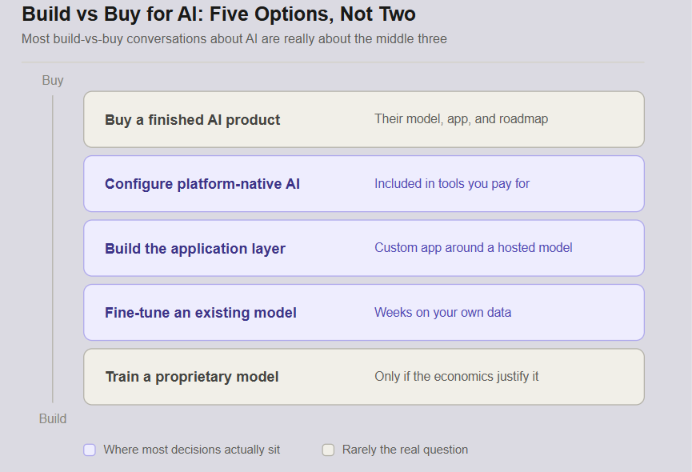
- Buy a complete AI SaaS product. Someone else's model, application, and roadmap.
- Configure AI already included in a platform you pay for. The cheapest path, and the one most often skipped because it does not feel like a decision.
- Build a custom application or workflow around a hosted model, usually with retrieval over your own documents and data. Your interface, permissions, and business logic; someone else's model weights.
- Fine-tune an existing model for a specific behavior or task. Weeks on your own data rather than months.
- Train or substantially adapt a proprietary model, when data volume, unit economics, and in-house expertise all justify it. Almost nobody outside the labs should attempt this.
These are points on a spectrum, not a menu of mutually exclusive choices. One production system commonly spans three of them at once: a custom application layer, retrieval over proprietary data, and a fine-tuned model handling one narrow task inside it. The useful question is not which option to pick, but how far down the spectrum each component actually needs to go.
Most conversations that sound like build-versus-buy for AI are really about options two through four. McKinsey's 2026 State of AI survey found that 32% of organizations decided against buying at least one software product because they could build the functionality in-house with agentic coding tools. This is an early sign that agentic coding tools are beginning to change how organizations allocate software budgets.
For context on how AI is reshaping the development process itself, LITSLINK's overview of AI's impact on software development covers the opportunities and the constraints.
How LITSLINK Helps You Decide
The answer is often a hybrid software approach rather than either extreme: purchased infrastructure with tailor-made software components where your advantage lives. Finding the right software solution for your specific business needs is the actual work.
LITSLINK supports the full path:
- Discovery and process classification to establish which processes are standard and which differentiate you, before anyone writes code. Software tools are chosen after that, not before
- Custom application development where building is the right answer
- Hybrid architecture connecting purchased platforms to custom components, which is where most companies land
- Quality assurance running alongside development rather than after it
- Ongoing support as requirements change
Talk to LITSLINK about which parts of your stack are worth building.
FAQs
What is the difference between custom software and off-the-shelf software?
Off-the-shelf software is a pre-built product serving a broad market on one codebase, configured within the vendor's limits. Custom software is built against your requirements: you control the feature set, the data, and the roadmap, and you own maintenance permanently. The practical difference is control, not capability.
Is custom software more expensive than off-the-shelf?
Upfront, yes, usually by a wide margin. Over three years the comparison narrows and sometimes reverses, because licensing scales with headcount while custom software costs roughly the same at 50 users as at 500. Model both across the same window before deciding, and include exit cost on the buy side and permanent maintenance on the build side.
When should a business choose custom software?
When the process differentiates you, when proprietary data drives the value, when compliance prohibits third-party processing, or when per-seat licensing has exceeded what development would cost. One of those is usually enough. If none applies, buying is the better decision.
How long does custom software development take?
Months rather than weeks, depending on scope and integration count. A focused internal tool ships in eight to twelve weeks. A platform with multiple integrations and compliance requirements runs six months or more. Discovery is where the estimate becomes reliable rather than optimistic.
Can you combine custom software and off-the-shelf solutions?
A hybrid software approach is what most companies actually do. Buy the infrastructure layer where a vendor has already solved the problem, and build the components that touch your differentiating process or proprietary data. The integration between the two is the part to scope carefully, since it is usually the largest share of the work.
Does the same decision apply to AI systems?
The framework holds, but the economics differ. AI carries usage-based costs that grow with adoption rather than fixed licensing, and "building" spans five levels of effort, from buying a finished AI product to training your own model. Fine-tuning and custom application layers around a hosted model cover more cases than either extreme, and both are considered least often.