







Key Takeaways
- A minimum viable product (MVP) provides the most cost-effective way to test your hypothesis and gather user feedback before you build it fully.
- A simple MVP development project can be done at a cost of $15,000 to $50,000 and takes around 6 to 10 weeks. In contrast, a more complex MVP project can cost more than $250,000 and take 6–12 months for the largest enterprise projects.
- MVP costs can increase by 3 to 5 times due to the team location of your developers, with US developers charging up to 2 to 3 times more than their counterparts in Eastern Europe and Latin America.
- The costs of post-launch maintenance can add 15 to 25% to the original build cost on an annual basis, which is why it’s wiser to consider this price before launching the project.
This guide is meant for startup founders, business executives, CTOs, product managers, and all those who plan to bring a new digital product to the market. It will cover the MVP development process, break down what drives MVP app development cost, evaluate what impacts MVP app development cost, reveal what a realistic MVP project timeline is, and present practical cost-saving strategies that help you plan an MVP budget that aligns with your business goals.
As CB Insights states, 43% of startups fail because their product simply does not fit consumer demand. By choosing to build an MVP, you will be able to test your core idea with real users without spending six figures on core features that nobody needs.
I Want to Build an MVP: Where Should I Start?
Even before writing the first line of code, there is work that needs to be done. Building a successful MVP project does not just start when app development begins. Your goal is to validate ideas, define what makes your product worth using, and pick one specific problem that it can solve rather than trying to develop an app that will cater to everyone’s needs.
If you are still not familiar with the very concept of what a minimum viable product is and how long it takes to build one, this article covers all that.
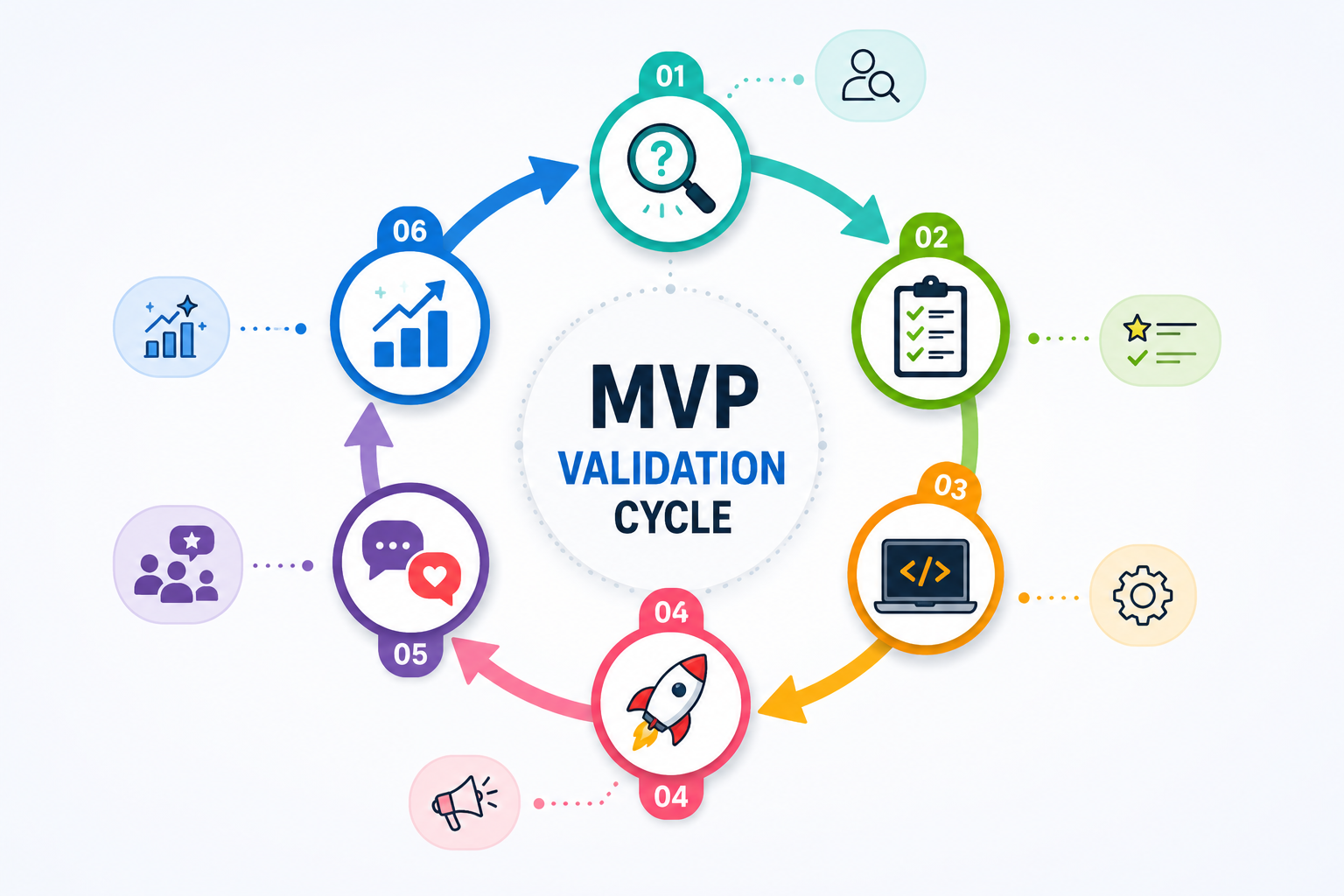
Market Research and Business Idea Validation
The first step in the process of developing an MVP is defining the problem to solve and the target audience. Market research entails understanding your competitors, keeping an eye on the trends of your industry, and talking to potential users in order to estimate the market demand for the product in question. Skip this step, and you run a high risk of creating a product that no one wants.
Core Value Proposition Definition
Every successful minimum viable product (MVP) has one clear answer to the question: “Why would someone use this instead of what they’re already using?” Make sure you figure out the key value your product provides.
Do not try to resolve several issues at a time; instead, choose the biggest problem and solve it. You should focus on creating one primary workflow exceptionally well to ensure your business idea resonates immediately. Founders who attempt to be everything for everyone while launching an MVP end up with a subpar product at best.
Feature Prioritization
Feature prioritization is where founders tend to fail. The very first version of the product should include only core features, which allows you to test key assumptions and collect feedback that is helpful in no small measure. Founders and project managers should consider using a framework like MoSCoW (Must-have, Should-have, Could-have, and Won’t-have) to define core functionality they’ll stick to.
User Journey Planning
Create a map of how users move through your product from the moment they find it to the moment they complete a key action. You should know user stories in order to create the map. This activity gives you an idea of what users need and provides you with the opportunity to create the best user experience for them without any inconvenience.
Development Approach Selection
At this point, you must choose the way you will go about actually creating your solution. It may be a no-code solution, a low-code tool, or custom software development. Whatever you choose should be determined by the complexity of your idea, the deadlines you have, the available budget, and the level of flexibility in terms of the technology you can utilize.
A simple MVP prototype created on a no-code platform can cost just a few thousand dollars, while the price for creating a custom MVP built by a dedicated development team will cost significantly more.
MVP Launch, Validation & Iteration
This is where you launch your product to real users so that you can carry out real-world testing. Once it is on the market, you must gather feedback, track your KPIs, and use what you learn to guide the next round of changes using an Agile development methodology. Understanding the loop of building, measuring, and learning is essential for the success of your final product.
In this guide, we provide further insights into each step involved in developing an MVP.
Key Factors Affecting MVP App Development Costs
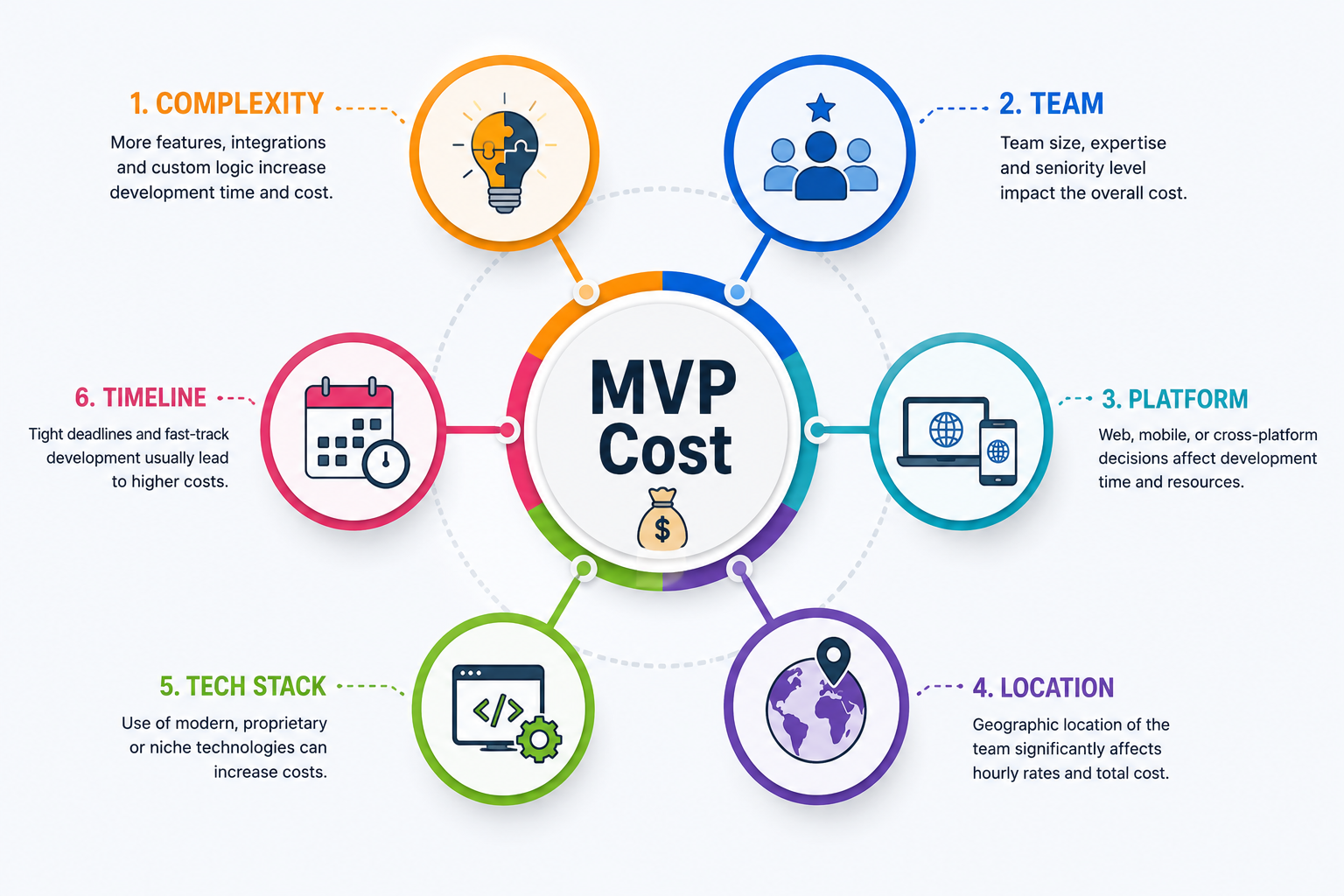
The cost of MVP development depends on multiple factors such as the complexity of the product, the team structure you choose, the location of the developers, the platform you’re targeting, and the technology stack used.
Product Complexity
Scope complexity is the primary critical factor driving cost. It comes down to how many features you need, what business logic sits behind them, how many third-party integrations you’re connecting, your database setup, and the level of security and scalability the product demands.
| MVP Complexity | Typical Scope | Typical MVP Cost Range | Estimated Timeline |
|---|---|---|---|
| Simple MVP | Simple MVP: basic features to validate the core idea, simple UI/UX, usually one platform | $15,000–$50,000 | 6–10 weeks |
| Medium MVP | Core functionality with polished UI/UX, authentication, payments, analytics, basic integrations | $40,000–$100,000 | 3–4 months |
| Complex MVP | Advanced functionality, custom workflows, multiple integrations, scalable architecture, multi-platform support | $100,000–$250,000+ | 4–6+ months |
The above price estimates are based on the Clutch statistics. They are only approximate figures and do not reflect your actual development costs. However, if you use these figures as a reference point, you will get an idea of how much the MVP development will cost depending on your requirements, platform, integration, and technology stack.
In-House Team or Outsourcing Development Team
The team structure plays an important role in determining the costs, speed, communication, and scalability of the product.
- Freelancers are well suited for small-scale projects.
- An in-house team offers you the greatest level of control, but the MVP will be expensive to create and maintain due to hiring costs, salaries, and benefits.
- Choosing to outsource MVP development to an MVP development agency makes development costs sit in the middle when compared to the previous two options. With this sort of outsourcing, you’ll get the development job done but without the cost of employing full-time staff in the process.
| Team Model | Best For | Typical Hourly Rate | Typical MVP Cost Range |
|---|---|---|---|
| Freelancers | Small MVPs with limited budgets | $25–$80 | $10,000–$35,000 |
| In-House Team | Long-term product development requiring full control | $80–$175+* | $80,000–$250,000+ |
| Development Agency | Full-cycle MVP development | $45–$150 | $30,000–$150,000+ |
Again, these are estimates drawn from Clutch and Glassdoor. Actual development costs depend on the complexity of the project, the location where it is developed, and the amount of expertise needed for the implementation of the project.
Team Location
Lower-cost regions may save a lot of money in your development, but lower rates are not the only factor you should follow. Technical expertise, cultural compatibility, time zone overlap, and communication matter just as much.
| Team Location | Typical Hourly Rate | Impact on MVP Cost |
|---|---|---|
| United States & Canada | $80–$175+ | Very high: highest development costs, but strong local expertise, communication, and time zone alignment |
| Western Europe | $60–$130 | High: excellent engineering quality with premium pricing |
| Eastern Europe | $30–$80 | Medium: strong technical expertise with competitive rates |
| Latin America (LATAM) | $30–$80 | Medium-low: cost-effective development with convenient time zone overlap for North American companies |
| Asia | $15–$45 | Low: budget-friendly development with a wide talent pool, though communication and time zone differences may require more coordination |
These ranges are drawn from Glassdoor and Accelerance. The hourly rate shouldn’t be your only decision factor; experience, delivery quality, and communication usually matter more to a project’s outcome than a few dollars an hour.
With LITSLINK, you don’t have to worry about any location-based issue. We have remote project management in the US, paired with senior engineers from Europe, so you get convenient overlap with US working hours, fluent English communication, and collaboration that doesn’t involve anyone dialing in at 2 a.m.
Platform
The platform you go for (web, native mobile MVP, or cross-platform) is one of the key factors that influences the overall MVP app cost and launch timeline.
- Web MVP development is typically the fastest and cheapest option on the market.
- Using only native mobile for a project is advantageous since it provides excellent performance on a single operating system. However, the downside of doing that is that the cost greatly increases if you need to develop two separate versions for iOS and Android.
- Cross-platform frameworks offer a cost-effective solution. You will need only to write code once and deploy it in both app stores, but with a small trade-off in performance.
| Platform | Typical MVP Cost Range | Estimated Timeline |
|---|---|---|
| Web | $15,000–$60,000 | 2–3 months |
| Native Mobile | $25,000–$100,000 | 3–5 months |
| Cross-Platform | $30,000–$110,000+ | 3–5 months |
Tech Stack
The technology stack should be chosen accounting for the project needs and requirements, not the lowest prices you find and initial costs. A cheap tech stack at launch that can’t handle growth will make you rebuild the application soon. Choosing modern frameworks like React, Node.js, or Flutter simplifies scalability in the future when your product requirements may change.
| Technology Stack | Typical Technologies | Typical MVP Cost Range |
|---|---|---|
| No-Code / Low-Code | Bubble, Webflow, Glide, Adalo | $3,000–$15,000 |
| Modern Web & Cross-Platform | React, Next.js, Vue.js, Flutter, React Native | $20,000–$75,000 |
| Backend-Driven Applications | Node.js, Django, Laravel, Ruby on Rails, .NET | $30,000–$95,000 |
| Cloud-Native Solutions | AWS, Azure, Google Cloud, Kubernetes | $40,000–$120,000 |
| AI-Powered MVPs | Python, TensorFlow, PyTorch, OpenAI APIs | $50,000–$200,000+ |
What Influences MVP Delivery Time?
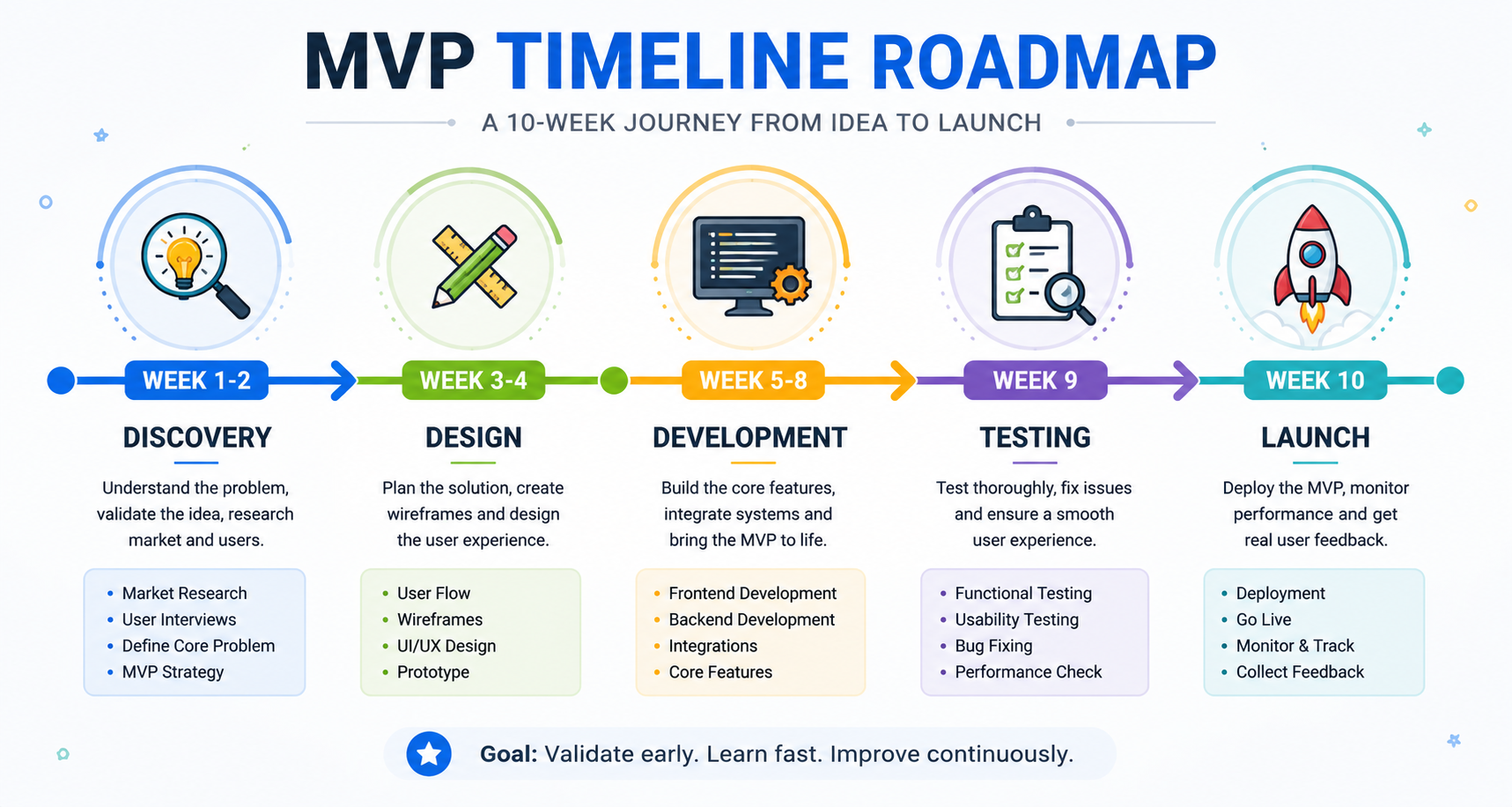
Cost and delivery time are two related concepts. The time it takes for an MVP delivery depends on the complexity of an application, as well as the number of senior engineers that are involved and how quickly you want to hit the market.
Speed is a common pursuit, but it can usually mean incurring larger expenses. Fast delivery involves paying for more people, more senior talent, or both, and also extra quality assurance coverage.
- Team Size – Large teams can speed up the process, but they need better coordination by project managers to prevent clashes between the team members.
- Delivery Timeline – Compressed schedules generally raise costs since you pay for the concurrent work process and other related costs to meet the deadline.
- Engineering expertise – More experienced developers build faster and minimize the risk of architectural mistakes, which saves you money later even if their hourly rate looks higher today.
| Development Speed | Typical Timeline | Typical MVP Cost Range |
|---|---|---|
| Accelerated | 2–6 weeks | $45,000–$110,000+ |
| Standard | 2–4 months | $25,000–$75,000 |
| Extended | 4–6 months | $20,000–$60,000 |
Common Hidden Costs in MVP Development
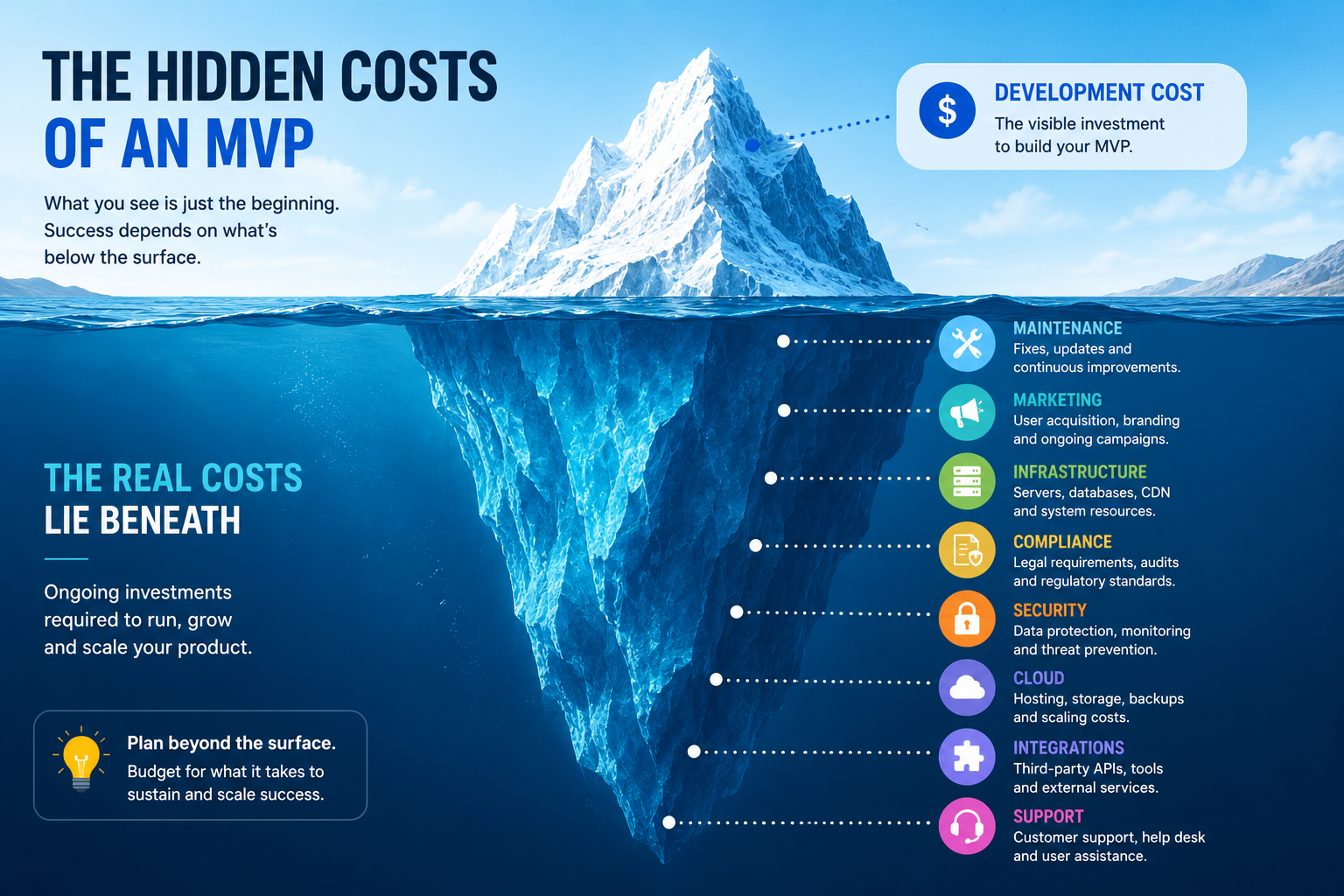
A large portion of the actual expenditures occurs following the first invoice, and founders who do not prepare for it will face the need to look for funds to cover unforeseen expenses.
The following is a list of hidden costs usually encountered after the main development phase is completed.
Scope Changes
Each new feature introduced in the process of development, or a change in the requirements after the development phase starts, leads to an increase in both delivery dates and costs incurred. This is the most usual reason for going above the budget for the MVP development project, and it usually starts small with adding just “one more feature” that quickly becomes three once the team starts building it.
Third-Party Services & Integrations
It is common practice for most products to integrate with third-party services such as payment gateways, authentication providers, analytics tools, CRM systems, mapping services, and AI APIs, and this usually comes with the cost of licenses, subscriptions, and so on.
Many of these tools have a free tier option until you reach a limit before they start charging you.
Compliance & Security Requirements
When working on a product for a regulated industry like healthcare, finance, or insurance, expect to spend more on security and legal compliance (think HIPAA, SOC 2, GDPR), secure infrastructure, encryption, audit logging, and privacy features. None of this is optional once sensitive user data is involved, and retrofitting compliance after launch almost always costs more than designing for it from day one.
If you are developing an AI product in healthcare, this article outlines what you should add to your budget.
Post-Launch Maintenance
The launch day is when the product starts its journey, rather than a culmination point. So, ensure you factor in expenses for ongoing maintenance, which usually includes bug fixes, security patches, system monitoring, and software updates, as well as UI/UX enhancements that will stem from user feedback and product analytics.
Neglecting this item is probably one of the most common mistakes in budgeting we come across. It inevitably leads to a chaotic situation within a few months after the launch of the product when something goes wrong, and no funds have been allocated for fixing the issue.
Infrastructure & Operational Costs
Cloud hosting, databases, storage, software monitoring, backups, and content delivery network (CDN) services will get increasingly costly as your product gains traction. What seems affordable for 100 users will appear very costly for 10,000. Therefore, it’s reasonable to implement monitoring and cost alert systems at the initial stage so that traffic spikes do not become surprise invoices later on.
Marketing
You may create a great MVP, but it will be irrelevant unless people actually use it. Branding, landing pages, paid advertisements, content creation, ASO/SEO, and public relations are all very costly, but necessary if you want to attract early adopters.
Sales & Customer Success
Many founders do not properly realize how much effort and assistance B2B customers require when using a product they’ve never heard of. Unlike other minimum viable products, Business-to-Business (B2B) MVPs often need additional expenses for sales activities, customer relationship management (CRM) tools, customer onboarding, product demonstrations, account management, and support to land and keep early customers happy.
Cost-Saving Strategies for MVP Projects
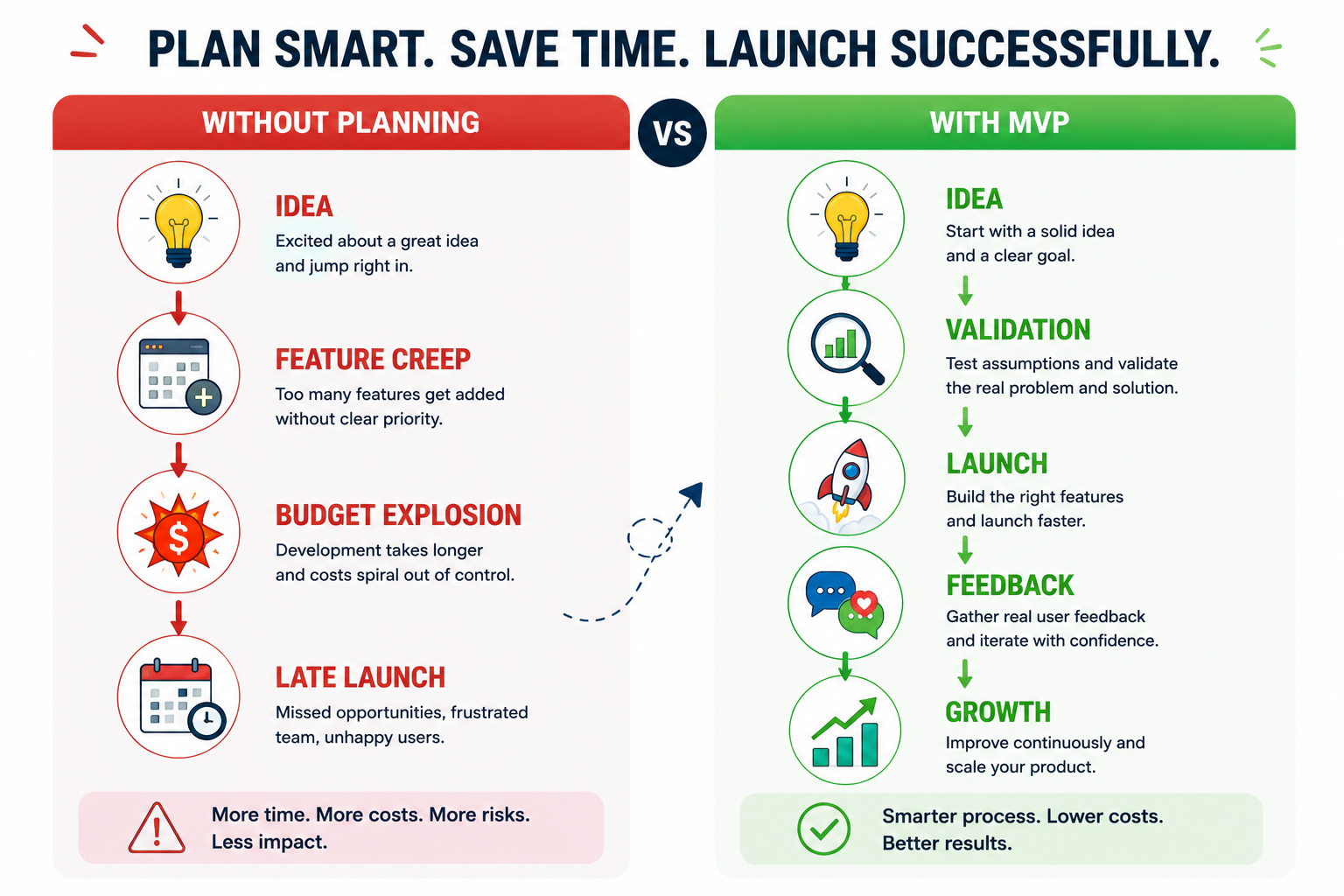
Thanks to our experience as an MVP development company that has successfully delivered over 1,540 projects for more than 1,000 clients in over 82 countries, we’ve found some areas where costs can be reduced without sacrificing quality at the same time. These cost-saving strategies are not mere theory; they have been used successfully in real-life launches.
Use Ready-Made Solutions
Instead of creating your own systems for online payment, authentication, analytics, and communication, you can apply one of the existing solutions to cover these needs. The use of a trusted tool is much cheaper and faster than creating something from scratch, allowing the team to focus on the development of unique features of the product. For instance, you don’t need to build a payment system when you can simply leverage Stripe.
Outsource MVP Development
By partnering with a reputable and experienced MVP development company, you will be able to receive consulting services from senior experts while avoiding hiring costs for an in-house team. With a team of over 300 skilled developers, LITSLINK knows everything about MVP development, proving its experience through successful completion of more than 1,540 projects across 82 countries. That kind of repetition means fewer surprises for you, because most of the problems your project might run into, we’ve already seen and solved before.
Start with One Platform
Start by launching your new product on only one platform where your target audience can be found and where you are confident that the product will be successful. Spending money on multiple platforms will only make it more difficult for you to prove that the product idea works. You can think about launching a second version of your product only after you have enough analytics to make the right choice.
AI-Assisted MVPs
AI-assisted MVP development is one of the effective ways to significantly reduce development costs and speed up MVP delivery. AI copilots (GitHub Copilot, Cursor), AI code-generation tools, and AI agents allow modern development teams to automate most of their development tasks and write the code you need a few times faster.
However, AI is meant to be an assistant instead of a replacement. AI can provide developers with the required code but is not able to reliably create scalable architecture, make tough engineering decisions, or guarantee secure, production-ready output on its own.
Code generated without adequate oversight can create security vulnerabilities and technical debt, which can be more costly to address later than it would have been to have done it right at the outset. You should consider AI a tool for getting your job done quicker in areas where you fully understand the requirements and not a shortcut to bypass the part of the process requiring the application of judgment.
What Does Your MVP Budget Actually Get You?
Now that you are aware of what goes into MVP cost determination, the next question is: what do you get for your MVP budget and how long will it take to create your MVP? Every project is unique; however, the following ranges can give you a rough yet realistic cost estimate of what to expect.
$10,000–20,000 | 2–6 Weeks: Prototype or No-Code MVP
This budget allows you to create a simple MVP prototype with basic features on a no-code or low-code platform. You will have limited capabilities and few customizations. It is good for testing a concept but not for going to market yet.
$25,000–60,000 | 2–3 Months: Basic MVP
With this, you get a basic MVP with core functionality, a simple UI/UX, and basic integrations, which is sufficient for testing the concept among your target audience and early users. It helps you determine whether your idea actually holds up in the market.
$60,000–120,000 | 3–4 Months: Standard MVP
Developing this MVP version comes with an enhanced UX/UI design, architecture that allows scaling the product, several integrations, and a higher level of security and functionality that supports a real launch.
$120,000+ | 4–6 Months: Enterprise-Ready MVP
At this level, you’re building for regulated industries or enterprise environments that come with advanced integrations, cloud-native architecture, compliance built in from day one, stronger security, and a foundation that’s ready to keep growing well post-launch.
These numbers are typical market ranges, not fixed prices. Your actual MVP budget and timeline will depend on complexity, feature scope, integrations, compliance needs, platform choice, and the development approach you land on.
How LITSLINK Builds Successful MVPs in 10 Weeks
An MVP development project consists of four stages: discovery, design & architecture, development, and launch and support. This enables us to build a standard MVP, from the signed contract to the finished product, in just 10 weeks. But it’s essential to note that while each stage is very fast, you will not miss a single moment. The process involves building iterations into each stage rather than leaving it until the end.
- Discovery stage helps write down all the details you need to know before getting into development. This includes your idea, customers, key assumptions, and monetization strategy.
- Design & Architecture stage means developing wireframes and a technical plan that won’t crumble under pressure when your product needs to scale.
- Development stage is where your product is actually built using Agile development sprints, where you can make sure that quality assurance testing is done continuously instead of waiting for a long time with no report and eventually the final reveal.
- Launch & Support stage ensures that your MVP is available for real customers to use while you gather feedback that will help you decide your next step, as well as ongoing maintenance.
Our team specializes in AI-assisted MVP development, web and mobile app development, UI/UX design, database setup, cloud-native architecture, API development, third-party integrations, DevOps, quality assurance testing, and post-launch scaling. We’ve developed MVPs for various industries, including healthcare, fintech, e-commerce, logistics, manufacturing, education, real estate, travel, and more. Therefore, regardless of which industry you’re in, there’s a decent chance we’ve already dealt with its specific quirks and compliance headaches before.
If you are ready to bring your product idea to reality, contact us today for a free consultation to review your project scope and receive a customized cost estimate.
FAQs
What Is an MVP in Software Development?
An MVP (minimum viable product) in software development means the most basic functional version of a product that can solve a core problem for a user. The purpose of an MVP is to check market demand for the product and collect early user feedback before you carry out a full-scale build.
MVP vs. PoC: What’s the Difference?
The difference between an MVP and a PoC is that a proof of concept (PoC) verifies the technical feasibility of the idea, while a minimum viable product (MVP) is a product used by real customers that makes it possible to test the idea (customer demand, product-market fit, etc.) itself and not just the technology running it.
What Mistakes Should I Avoid When Building an MVP?
One of the biggest mistakes to avoid when building an MVP is feature creep. This refers to trying to add too many features in the first version instead of launching the product with core functions only. Other mistakes are skipping market research, ignoring feedback from early users, neglecting quality assurance, and choosing a development team based on price only.
How Much Does MVP Development Cost?
The cost of developing an MVP usually costs anywhere between $15,000 for something basic to $250,000 and above if you want an enterprise solution. The exact price will depend on various factors, including the complexity of the product, the chosen tech stack, and general expertise required for building the product.
If you want to get a more tailored price estimation, you can use our App Cost Calculator.
What Factors Have the Biggest Impact on MVP Development Costs?
Product complexity is the most important factor impacting MVP development costs, followed by the location of the team, team model (in-house or outsourced), selected platform, and technology stack.
How Do SOC 2, GDPR, and HIPAA Affect MVP Development Costs?
Companies operating in regulated industries will have to invest extra resources into technologies required for security, encryption, audit logging, and legal analysis, which can increase total costs of MVP development from several thousand dollars up to $50,000, depending on the regulations concerned.
Can AI-Assisted Development Reduce MVP Development Costs?
Yes, AI-assisted development can reduce MVP development costs. AI copilots and code-generation tools can significantly reduce development expenditures by automating repetitive coding work like boilerplate, CRUD operations, and test scaffolding. That being said, the code still needs skilled engineers to ensure high quality, because unsupervised AI-generated code may result in security vulnerabilities and architecture that costs more to fix than the time it saved.
How Long Does It Take to Build an MVP?
A simple MVP typically takes 6 to 10 weeks. A medium-complexity project requires 2 to 4 months, while highly complex, enterprise-level MVPs may take 4 to 6+ months.
How Can I Accurately Estimate MVP Development
Start by getting a rough cost estimate based on your feature list, and make sure you have clearly defined user stories, target platform, and compliance issues; then reach out to a few companies to compare their estimates against realistic market ranges, like the ones in this guide.
How to Choose the Right MVP Development Company?
Choose an MVP development team with a proven track record in your industry. Make sure the company has relevant industry knowledge, offers a transparent pricing model, and communicates effectively.