








Key Takeaways
- Entries were ranked on verified Clutch reviews, named startup portfolios, and demonstrated scope discipline. General software development portfolios did not count.
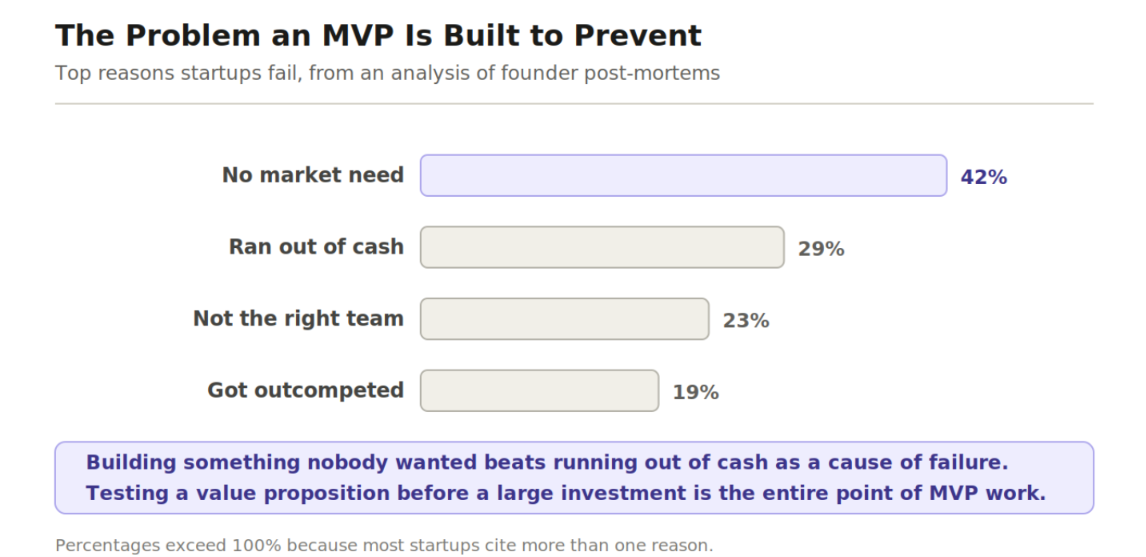
- No market need is the top cause of startup failure at 42%, ahead of running out of cash at 29% (CB Insights). Preventing that is the entire point of MVP development.
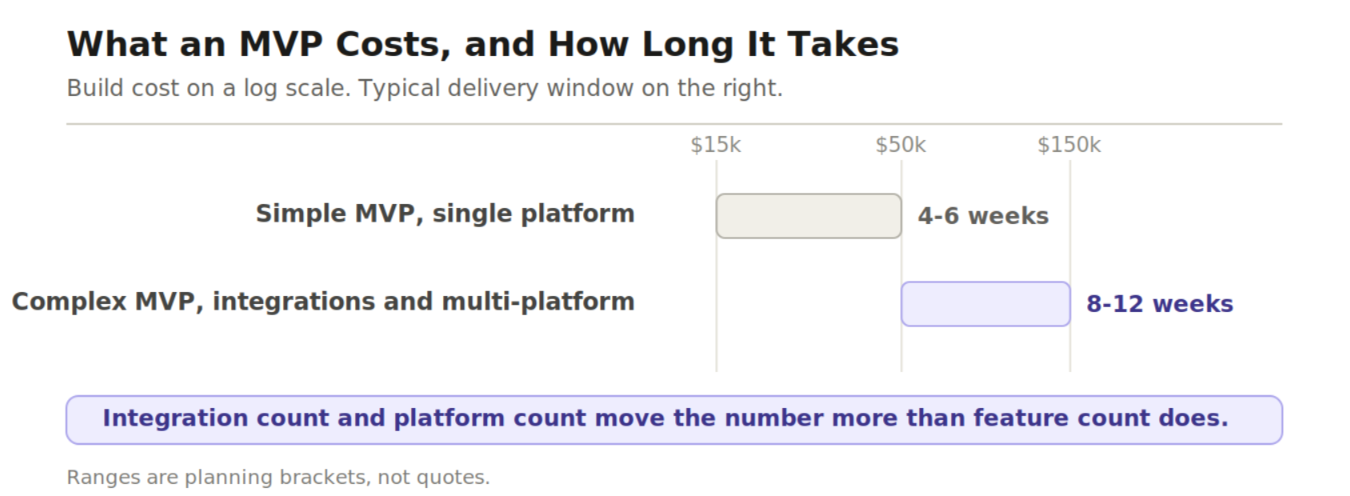
- A simple single-platform MVP typically runs $15,000 to $50,000.
- Fixed-price 4-6 week builds route to Asper Brothers. Regulated healthcare and fintech route to Inoxoft. Design-led validation routes to Wavespace. Staff augmentation routes to Ideamotive, and enterprise software delivery standards to MindK.
- Scope discipline is the actual skill. An agency that never removes a feature is selling a full build with an MVP label on the invoice.
- LITSLINK ranks first among the best MVP development companies for mobile development and web development under one roof.
An MVP development company builds a minimum viable product. That is the smallest working version of a product, built so founders can test a value proposition with real users. A general software development company defaults to a full-featured build before any market validation. That is a different job with a different risk profile.
The numbers explain why the distinction matters. CB Insights analyzed 101 startup post-mortems and found no market need behind 42% of failures, ahead of running out of cash at 29%. Testing a value proposition before a large investment is exactly what MVP development exists to do.
Strong MVP development partners don’t sell raw speed. “Build everything and see what sticks” is not an MVP. Real custom MVP development requires ruthless scope reduction. Isolate the smallest testable unit and ship it to early users. Then let their data dictate the roadmap, while the codebase is still cheap to change.
Firms below were selected on verified Clutch reviews, named startup portfolios, and demonstrated scope discipline. General software portfolios did not count. Some run full development teams, some sell technical consulting, and one is a staffing network. Compare like with like. Best MVP Development Companies: Quick Comparison
Before the full write-ups below, scan this table to see where each company’s specialty lands. Each entry gets a deeper profile further down, so treat this as a starting point for narrowing your shortlist, not a final decision.
Best MVP Development Companies: Quick Comparison
Before the full write-ups below, scan this table to see where each company’s specialty lands. Each entry gets a deeper profile further down, so treat this as a starting point for narrowing your shortlist, not a final decision.
| Rank | Company | Best For |
|---|---|---|
| 1 | LITSLINK | Mobile development and web development under one roof |
| 2 | Asper Brothers | Fixed-price MVPs in 4-6 weeks |
| 3 | MindK | AI-driven development for enterprise-grade and scrappy MVP work alike |
| 4 | Inoxoft | HIPAA-aligned healthcare and fintech MVPs |
| 5 | Wavespace | UI/UX design-led MVP development |
| 6 | SumatoSoft | Full-cycle MVP with long-term product advisory |
| 7 | UpsilonIT | Tight-budget MVPs for early-stage startups |
| 8 | instinctools | Competitive pricing for SMB and enterprise clients |
| 9 | S-Pro | Mobile-centric MVP launches |
| 10 | Ideamotive | Vetted specialist talent network for staff augmentation |
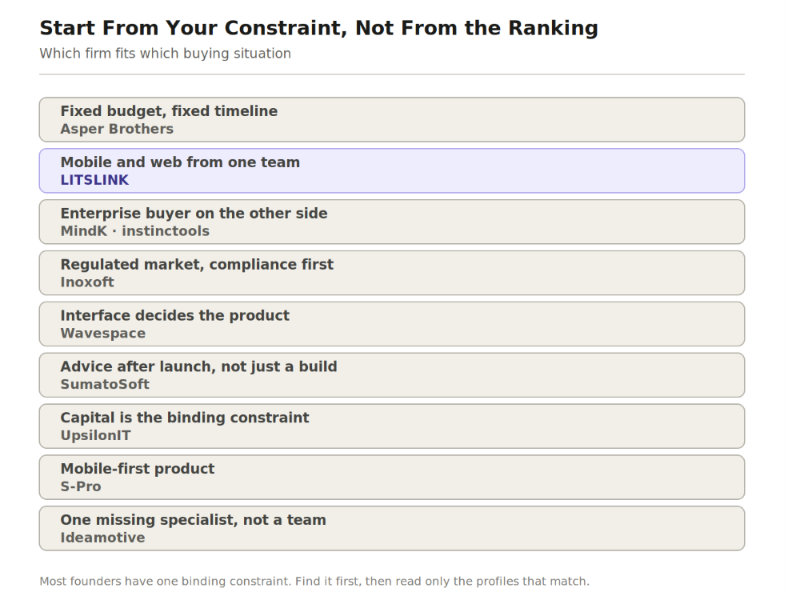
Source: LITSLINK, based on each vendor’s published positioning.
1. LITSLINK — Best MVP Development Agency for Mobile Development and Web Development
LITSLINK is the top pick for founders who need mobile app development and web development from the same team. It also fits founders who want a partner treating scope discipline as the real skill of MVP work. The firm cuts to the smallest testable version rather than quietly building a full product under an MVP label.
The MVP development focus is practical. LITSLINK helps founders identify the core features that will attract first adopters. It then guides them through the evaluation process once real users arrive. The MVP development process starts from the product idea, not a feature list. Delivery is full-cycle, from discovery and project scope through build, launch, and post-launch support. MVP app development services and web apps share the same development teams, so nobody coordinates two vendors while trying to move fast.
The company facts behind that: over a decade on the market, 300+ in-house engineers, and 300+ successful releases. Add 80+ startups served, an “A” cybersecurity rating, and delivery 30–50% faster than typical. US-based project management pairs with European engineering talent, so founders reach their project managers during their own working day.
The technical expertise spans the technology stack most MVPs need. React Native for cross-platform mobile work, standard web frameworks, and cloud platforms. Cloud infrastructure sized for validation traffic, plus machine learning where the product depends on it. The same tech stack carries into the full product.
Further reading: What Is MVP and How Much Time Does It Take to Build It and How to Build an MVP in Several Steps.
Contact LITSLINK for a free consultation.
2. Asper Brothers — Best for Fixed-Price MVPs in 4–6 Weeks
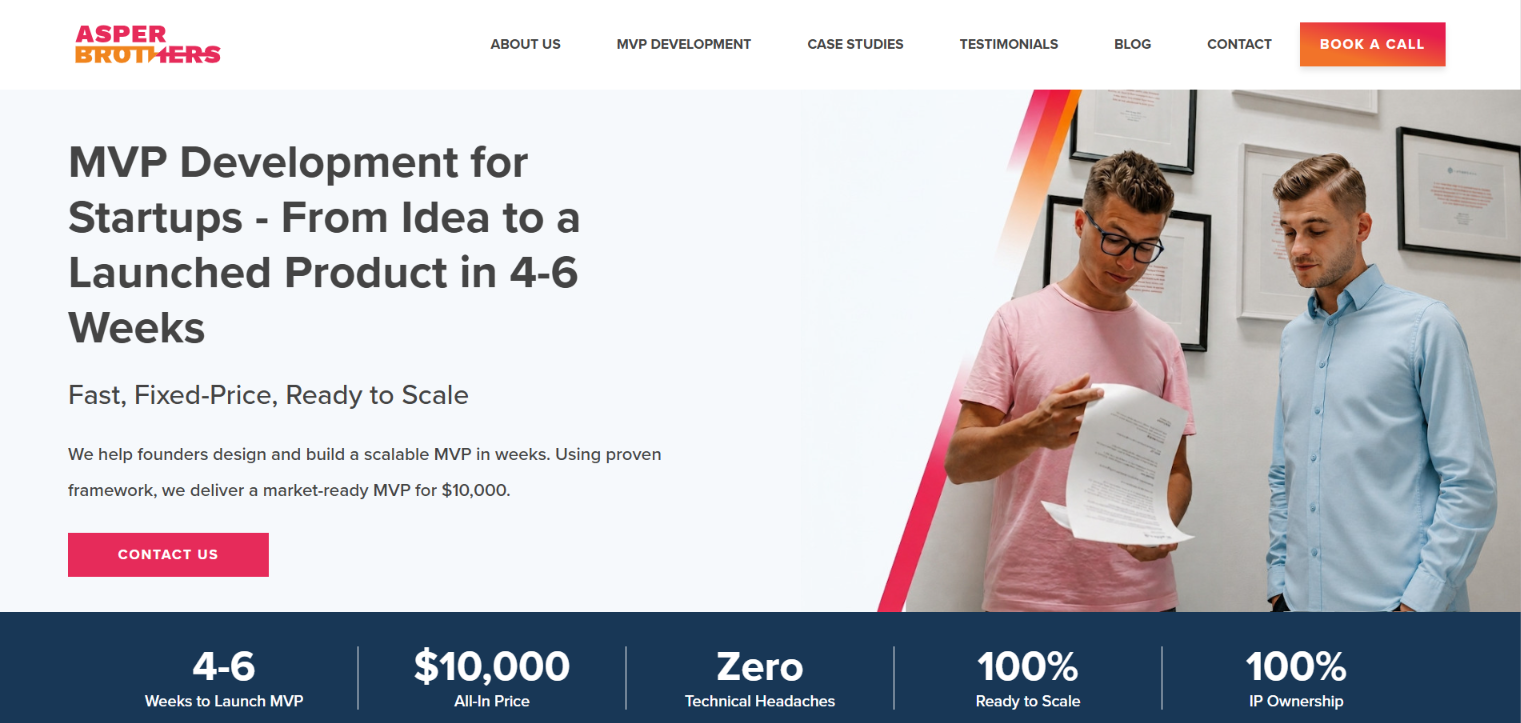
Asper Brothers is best for founders who want a fixed budget and a process they can see in advance. The firm runs a structured four-step framework that carries a startup from idea to launch in as little as four to six weeks. It has 60+ MVPs across multiple industries behind it.
A fixed price does something a time-and-materials contract cannot: it forces the scope argument to happen before anyone writes code. That suits founders who already know what they need to test. It suits founders still exploring the problem even less, because the framework has no slack for a change of direction.
3. MindK — Best for AI-Driven Development at Enterprise and Startup Scale
MindK is best for founders whose MVP has to satisfy an enterprise buyer while still moving at startup speed. The firm pairs product strategy with an AI-driven development track built to compress build time. Its client roster runs from Adidas and Roblox down to early-stage teams.
That span matters when a pilot customer sends a security questionnaire your stage was never meant to answer. Teams fluent in enterprise software also document while they build, which helps whoever inherits the product after validation. The risk is the mirror image: enterprise habits can weigh down an early build if nobody pushes back.
4. Inoxoft — Best for HIPAA-Aligned Healthcare and Fintech MVPs
Inoxoft is best for founders in regulated markets who cannot postpone compliance. The firm holds a 4.9-star Clutch rating built on healthcare IT and fintech work. Its engineers run discovery, compliance mapping, and a phased build, in that order. A health startup can therefore validate a care model before committing to a full platform.
The sequencing is the point. Bolting HIPAA onto working software usually costs more than the original build did. And a validation result you cannot legally use is not a result. In this category, compliance behaves like a core feature rather than an overhead line.
5. Wavespace — Best for UI/UX Design-Led MVP Development
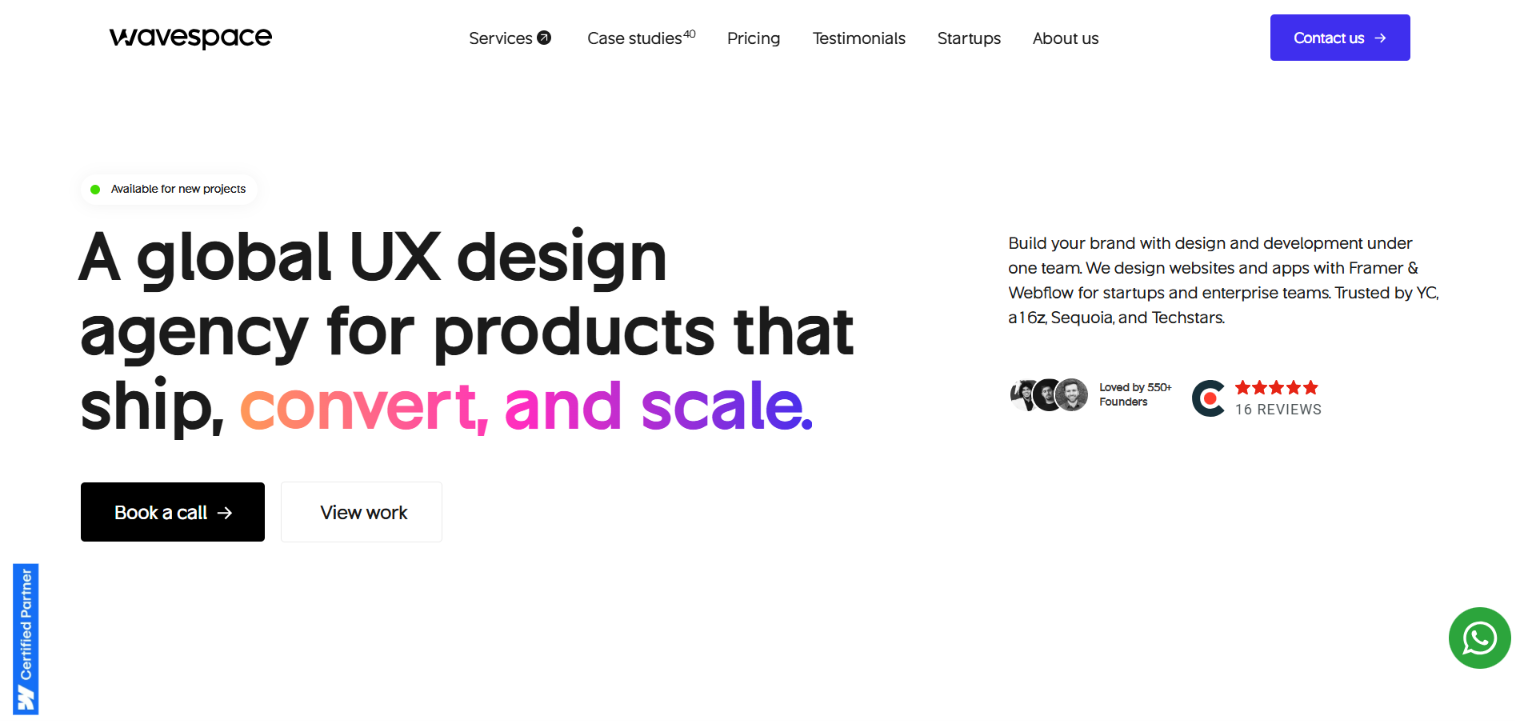
Wavespace is best for founders whose product idea lives or dies on how the interface feels. The agency works globally on UI/UX and MVP development, and it validates concepts in design before anyone writes production code.
That is also the cheapest place to be wrong, since reworking a prototype costs a fraction of reworking shipped software. Consumer products benefit most, because innovative software in that market usually wins on first-touch usability rather than on capability. The fit weakens when the difficult part of your MVP sits in the data layer. A polished screen proves nothing about whether the thing works.
6. SumatoSoft — Best for Full-Cycle MVP With Long-Term Product Advisory
SumatoSoft is best for founders who want a technical advisor rather than a vendor that vanishes at launch. The company works full-cycle, from idea validation and product discovery through the build. It then carries into post-launch growth planning with analytics and roadmap support.
That last stretch is where the value concentrates. In the weeks after release, user feedback arrives faster than any founder can interpret alone, and analytics only report what people did. Turning that into a roadmap is a separate skill. Founders without a technical co-founder feel the gap first, and a reliable partner is what closes it.
7. UpsilonIT — Best for Tight-Budget MVPs for Early-Stage Startups
UpsilonIT is best for pre-seed and bootstrapped founders whose binding constraint is capital rather than headcount or ambition. The firm is matched to tight budgets and MVP objectives specifically at the early stage.
A hard ceiling can work in your favor here. It removes the option of building anything inessential and settles scope arguments quickly. The risk sits on the other side of launch. Cheap software that cannot be extended is a deferred cost, not a saving. Ask what happens to the codebase if the MVP works, and ask what the team would build differently on twice the budget.
8. instinctools — Best for Competitive Pricing Across SMB and Enterprise Clients
instinctools is best for founders who expect to grow past the MVP without changing vendors. The firm brings competitive pricing and established delivery, serving SMB and enterprise clients inside one practice.
That combination matters at the moment traction arrives. A handover is most expensive exactly then. Switching partners then means the transition competes for attention with the growth itself. A partner already operating at both scales is better placed to carry you into a full product without a rebuild. Ask how team composition changes at that point, because continuity of people matters more than continuity of logo.
9. S-Pro — Best for Mobile-Centric MVP Launches
S-Pro is best for founders whose MVP is a mobile app first and a website second. The firm orients specifically toward mobile-centric launches and platform-specific builds.
Mobile carries constraints that the web does not. App store review cycles add days to every release, and they compound across an iteration-heavy validation period. Device fragmentation and offline states are the other two. Teams whose instincts come from the browser routinely underestimate both. A team that has shipped through those cycles plans around them from sprint one instead of discovering them in week six.
10. Ideamotive — Best for Vetted Specialist Talent Network Staff Augmentation
Ideamotive is best for founders who need one missing specialist, not a whole delivery team. The company operates as a vetted-talent network and IT staffing model. It reports 8% turnover, 98% client satisfaction, and 100% verified candidates, with case work covering a major bank and logistics firms.
Compare it against hiring rather than against the other nine entries here, because it is a different purchase. Staff augmentation works when you already know what to build and lack a skill. It works poorly when nobody owns the scope, since a contractor filling a seat will build what they are told to build.
How to Choose the Right MVP Development Partner
The right MVP development partner depends on speed, budget model and domain fit, not just technical skill. Check these five before signing, and a reliable partner will answer all of them without hedging.
Confirm Real MVP Development Services, Not Just a Full Build Renamed
Some agencies sell MVP software development services, then quietly scope a full-featured product. That is a bigger invoice. Ask specifically how they would cut scope for your idea, and treat reluctance to remove features as a red flag.
A reliable MVP development company will name the features it wants to drop in the first conversation. A bespoke MVP development company that cannot explain what it would cut is not selling MVP work. It is selling generic software solutions and MVP services by the hour.
Check Their Track Record as a Development Company Specifically for Startups
A development company strong in enterprise projects does not automatically transfer to the speed and ambiguity of early-stage startup work. Ask for named startup MVPs they have shipped, not enterprise case studies relabeled as fast-moving.
Relevant expertise here means having built for a founder who pivoted mid-project. Ask whether post-launch loops to collect real user feedback sit inside the engagement scope or fall to you. A partner who helps you gather early user feedback from your target audience is worth more. One that ships and walks away is not.
Confirm Mobile App Development Capability If Your MVP Needs It
If your MVP is mobile-first, confirm mobile app development is a core capability rather than a subcontracted add-on. Coordination between a web team and an outsourced mobile team slows iteration exactly when speed matters most. Ask which MVP developers will be on your project and whether they sit in the same team.
Ask What Development Services Are Actually Included in the Quote
MVP development can mean anything from a clickable prototype to a fully coded, deployed product. Get the scope in writing before comparing prices across development companies.
Source: LITSLINK analysis of published 2026 MVP development pricing.
Design, backend, QA, deployment, and post-launch support should each appear as a line rather than inside a bundle. Seamless integration with the tools you already use belongs in that list too, because it is rarely free. Ask whether technical consulting on the roadmap is included or billed separately.
Ask About Supply Chain or Third-Party Integration Experience If Relevant
Does your MVP depend on third-party APIs, payment processors or supply chain data? Ask for a named example of similar integration work. A team without that experience will spend your validation timeline debugging integrations rather than gathering user feedback.
E-commerce MVPs are the usual case. A payment provider and an inventory source both have to work on day one. MVP solutions that skip this step look finished and then fail at checkout. That costs customer satisfaction on day one of the test. Innovative solutions get no second chance there.
FAQs
How Much Does MVP Development Cost?
A simple, single-platform MVP typically runs $15,000 to $50,000. A more complex MVP with backend logic, third-party integrations, and multi-platform support can run $50,000 to $150,000 or more. The MVP development cost moves most with integration count and platform count, not with feature-list length.
How Long Does It Take to Build an MVP?
A focused MVP with a clearly scoped feature set typically takes 4 to 12 weeks. Timelines stretch when founders resist cutting features, which defeats the purpose of building an MVP in the first place.
How Do I Choose the Right MVP Development Company?
Check three things first. Look for named startup MVPs, not enterprise projects, and an itemized project scope instead of a vague bundle. Then look for evidence they will push back on scope creep.
What’s the Difference Between an MVP and a Full Product?
An MVP isolates the core features needed to validate a central value proposition with real users. A full product delivers a complete feature set for a mature market. The priority is learning over scale, so scope is cut heavily at launch and expanded strictly through user data.
Should a Non-Technical Founder Hire an MVP Development Agency or Learn to Code?
For most non-technical founders, hiring an MVP development agency delivers an investor-ready product faster than learning to code. The only exception is zero-spend validation: deploying no-code tools to test extremely simple ideas before funding development.