








Key Takeaways
- 89.7% of social media marketers use AI weekly, while 50% of Gen Z block accounts they think are AI-generated.
- Only 7% of consumers trust a brand more for visible AI content; 31% trust it less.
- 2026 market estimates run from $3.20B to $5.65B, a gap caused by scope definitions rather than growth disagreement.
- Consumer distrust of heavy AI use doubled in twelve months, from 20% to 40%.
- Buy commodity capabilities, build differentiated ones, and keep portability around critical vendors.
- Only 37% of organizations attribute any positive EBIT contribution to AI (McKinsey, 2026).
Most articles about AI in social media list ten tools and stop. That format made sense in 2023, when the open question was which tool to try. It answers nothing now, because tool adoption is already saturated.
The numbers show how saturated. 87% of marketers run generative AI in at least one recurring workflow, up from 51% two years earlier (Salesforce, State of Marketing 2026), and nearly 90% of social media marketers use it weekly. Your marketing team has the baseline tools. They have had them for a while.
That is precisely why the decision moved up the org chart. Marketers solved the tool question on their own. What they cannot solve alone is the structural layer above it: whether to keep buying software or build something on your own data, how to calculate return when the payback threshold shifts with company size, and how to manage a consumer trust deficit that doubled in the last twelve months.
Baseline capabilities are assumed here. The focus is execution.
Why AI in Social Media Is Now a Strategy Question
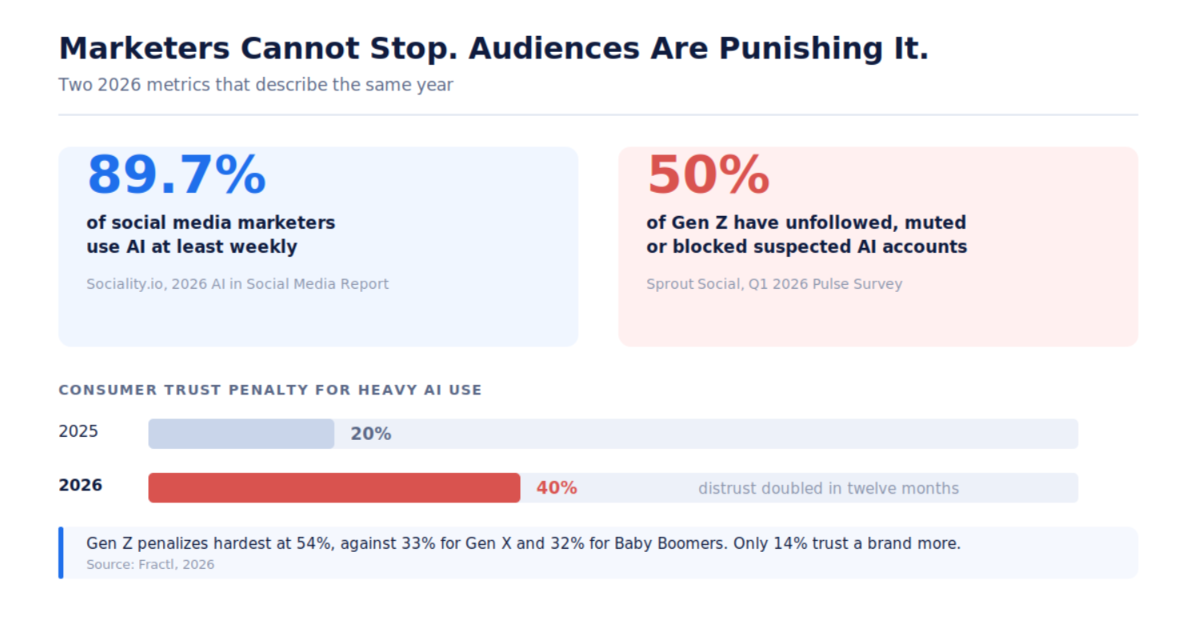
Sources: Sociality.io, 2026 AI in Social Media Report; Sprout Social Q1 2026 Pulse Survey; Fractl, 2026
Two data points from 2026 explain the shift better than any argument.
First: 89.7% of social media marketers use AI at least several times a week (Sociality.io, 2026 AI in Social Media Report). AI is the operating layer of the function now, not an experiment inside it.
Second: 50% of Gen Z have unfollowed, muted, or blocked an account because they thought the content was AI-generated (Sprout Social, Q1 2026 Pulse Survey).
Both are true simultaneously. The tools your team cannot work without are producing signals your audience increasingly detects and penalizes. That is a strategy problem, and no tool comparison solves it.
The trust data got worse fast. In 2025, 20% of consumers said heavy AI use would decrease their trust in a favorite brand. By next year, that figure reached 40%. Distrust roughly doubled in twelve months. Only 14% would trust a brand more for heavy AI use. Gen Z penalizes hardest at 54%, against 33% for Gen X and 32% for Baby Boomers (Fractl, 2026).
Klaviyo surveyed 8,000 consumers across eight countries and found the cleanest version of the number. 7% trust a brand more for visible AI content. 31% trust it less. That is more than four to one against.
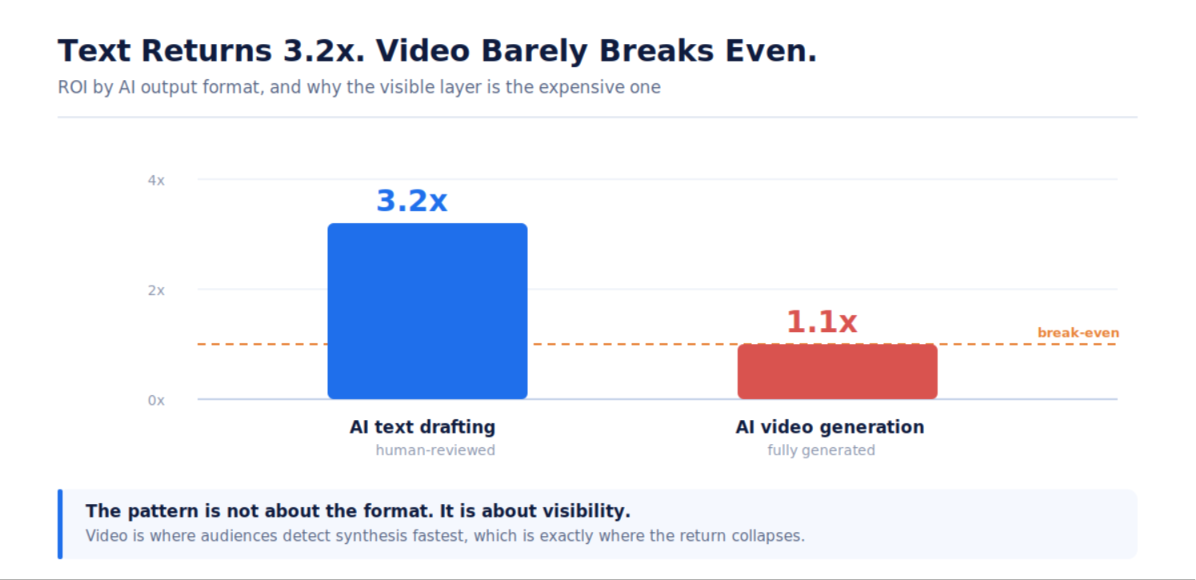
Drafting, analysis, scheduling, and moderation are invisible to the audience. Fully generated customer-facing content is not, and the performance data reflects that.
How Is AI Used in Social Media? The Categories That Matter
Setting aside the tool lists, AI in social media does four distinct jobs. Each carries a different ROI profile and a different risk level.
Content production. Drafting captions, generating variations, resizing and reformatting. This is where generative AI in social media reached mainstream use fastest. It is also where trust risk sits highest when output ships unedited.
AI in social media analytics. Sentiment analysis, social listening, anomaly detection in engagement patterns, competitor tracking. Invisible to the audience. Consistently the strongest return.
Audience and targeting. Segmentation, lookalike modeling, send-time optimization. Also invisible, and where the platforms themselves do most of the work already.
Moderation and safety. Filtering, escalation routing, brand-safety checks. Rarely discussed in AI in social media marketing content because it generates no campaign metrics. It prevents losses rather than creating gains, which makes it hard to put in a deck and expensive to skip.
For AI in social media examples that actually indicate maturity, look for the second and fourth categories running in production. Those are the ones that survive a budget review.
The AI in Social Media Market: What the Numbers Actually Say
Market sizing here is unusually messy, and knowing that protects you from a bad benchmark.
| Research firm | 2026 market size | Forecast |
|---|---|---|
| Mordor Intelligence | $3.42 billion | $11.37 billion by 2031 (27.15% CAGR) |
| Market.us | $3.90 billion | $22.4 billion by 2033 (28.37% CAGR) |
| Fortune Business Insights | $5.65 billion | $70.53 billion by 2034 (37.11% CAGR) |
Three credible firms, a 65% spread on the current year and a six-fold spread on the endpoint. The differences come from scope: whether platform-side AI counts, whether infrastructure counts, whether adjacent marketing software counts.
Two figures from that data are more useful than the headline. Machine learning and deep learning account for roughly 61% of revenue, meaning most spending goes to recommendation and moderation systems rather than content generation. And sales and marketing applications took 47.85% of revenue in 2025 (Mordor Intelligence).
A single metric dictates the build-vs-buy reality. Before the build-versus-buy question makes sense, one distinction has to land. “Building AI” covers five very different activities, and conflating them is why cost estimates in this space are useless.
Training a foundation model. Reserved for a handful of labs with nine-figure compute budgets. Not a retail or brand decision.
Fine-tuning or adapting an existing model. Weeks of work on your own data, using an existing base model. Accessible to any company with clean data and a competent team.
Building an AI application. Wrapping models in an interface, workflow, and permission structure your team actually uses.
Building integrations and workflow automation. Connecting AI output to CRM, inventory, or support systems. Usually the largest share of the effort.
Buying a complete SaaS platform. Someone else’s application, someone else’s model, your subscription.
Most conversations that sound like build-versus-buy are actually about the middle three. Nobody outside the labs is training a foundation model, and treating that as the reference point makes every other option look cheap by comparison.
If your reference point for “building AI” is what platforms do, recalibrate. You are not competing at that layer and should not try.
Build vs. Buy: Where the Line Actually Sits
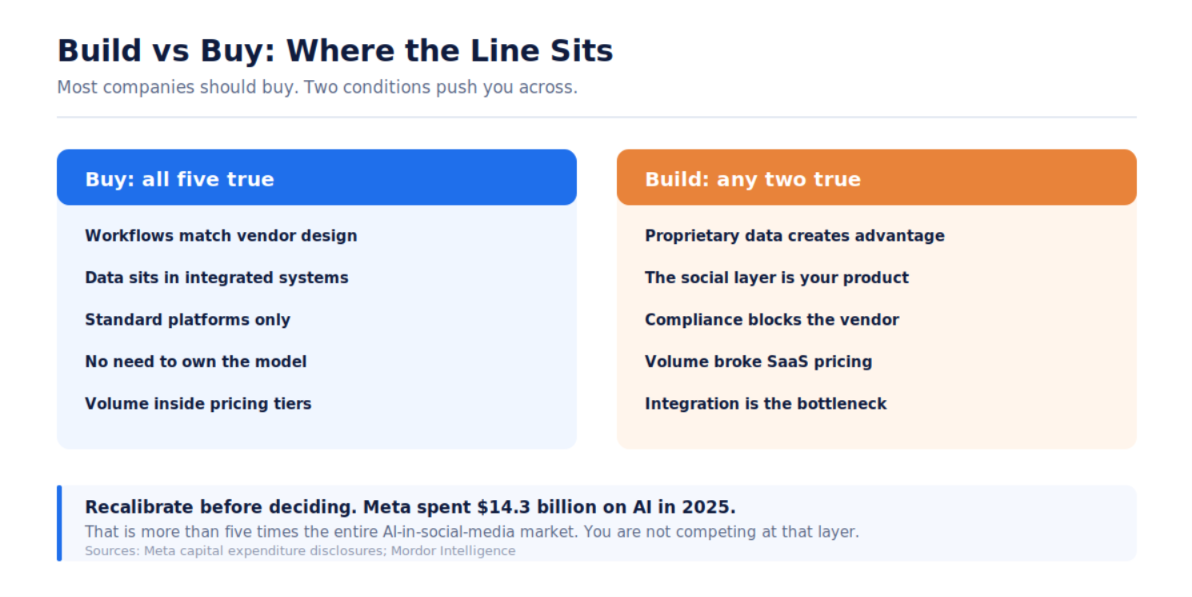
Sources: Meta capital expenditure disclosures; Mordor Intelligence
Five options exist. Most organizations end up using several at once.
The recommendation is short. Buy commodity capabilities. Build differentiated ones. Keep portability around any vendor you cannot afford to lose.
| Layer | What it covers | When it fits |
|---|---|---|
| Platform-native AI | Targeting, bidding, basic creative optimization inside Meta, Google, TikTok | Always. You are paying for it whether you use it or not |
| General AI tools | Drafting, ideation, summarization | Any team producing content. Cheapest entry point |
| Social-media SaaS | Publishing, listening, approval workflows, analytics | Standard channels, standard workflows, volume inside pricing tiers |
| Hybrid custom layer | Proprietary data models, CRM integration, governance | When your first-party data would beat a generic model |
| Fully custom system | AI is part of the product or a major differentiator | When the social layer is the product |
When Off-the-Shelf SaaS Is Enough
Buy when all of these are true:
- Your workflows resemble what the vendor designed for: scheduling, publishing, listening, reporting.
- Your data lives in systems the vendor already integrates with.
- You publish across standard platforms rather than niche or regional networks.
- Your team does not need to own the model or the training data.
- Volume sits inside standard pricing tiers.
That describes the large majority of businesses. Mature social media management platforms have absorbed a decade of edge cases you would otherwise discover yourself, at your own cost. Paying for that is rational.
When Custom Development Earns Its Cost
Build when at least two of these apply:
- Proprietary data creates real advantage. You hold first-party behavioral, transaction, or community data that a generic model cannot access, and predictions built on it would outperform anything a vendor can offer.
- Your product is the social layer. If you operate a social network, community platform, or marketplace with social features, the AI is inside your product rather than beside it. Buying is not an option because no vendor is building for your architecture.
- Compliance blocks the vendor. Data residency, sector regulation, or contractual restrictions prevent sending your data to a third-party processor.
- Volume broke the pricing model. At sufficient scale, per-seat or per-post SaaS pricing exceeds the cost of engineering.
- Integration is the bottleneck. The value depends on connecting social signals to internal systems, such as CRM, inventory, or support, in ways no vendor covers.
McKinsey found that 32% of organizations have chosen to build at least one software function rather than buy it, so this is not a rare path. It is also not the default one.
The second point is the most common legitimate reason and the most frequently misjudged. Companies building social media app development projects are not choosing between tools. They need recommendation, moderation, and personalization engines inside the product, which means custom work by definition.
LITSLINK’s Mush social network and smart social network for dating cases both sit in that category. The matching and feed logic was the product, not a marketing add-on.
The Hybrid Most Companies Actually Land On
Most organizations buy the publishing and reporting layer and build the piece that touches proprietary data. That keeps engineering focused on the part where a vendor cannot compete, while avoiding a rebuild of scheduling software that already exists.
Three-Year Total Cost of Ownership: What to Actually Compare
Most build-versus-buy decisions get made on a subscription price against a development quote. Both numbers are the smallest line in their own column. Model these instead.
| Buying | Building |
|---|---|
| Subscription and usage charges | Discovery and data preparation |
| Seat growth over three years | Development and integration |
| Implementation and migration | Model or API costs plus infrastructure |
| Integration with your systems | Evaluation and monitoring tooling |
| Team training | Security and compliance review |
| Governance and administration | Ongoing maintenance |
| Data export and exit costs | Platform API changes forcing rework |
| Pricing and overage risk | Model replacement when the base model is deprecated |
| Internal engineering opportunity cost |
On the buy side: exit cost. Ask what format your historical data comes out in and how long a migration would take. If the answer is “everything, for six months,” that risk has a price even if it never materializes.
On the build side: maintenance and model replacement. Models drift, platform APIs change without notice, and base models get deprecated on the vendor’s schedule rather than yours. Someone has to own that permanently, and that person’s salary belongs in the three-year figure.
ROI by Business Size: Different Thresholds, Different Math

The mistake in most ROI discussions is applying one payback threshold to companies of very different shapes. A small business and an enterprise are not solving the same problem.
Universal ROI multipliers for AI in social media do not survive scrutiny. The figures that circulate get attributed to research that does not contain them, so use a formula instead of someone else’s number.
Three inputs, one denominator. Incremental gross profit is revenue you can attribute to the AI-driven change, at margin rather than at top line. Cost savings is hours recovered valued at real loaded cost. Avoided losses covers the moderation incident that did not happen, which matters more at scale than most models allow. Total AI cost is the three-year figure from the table above, not the subscription line.
What McKinsey’s 2026 State of AI report does establish is worth holding alongside this: 37% of organizations attribute any positive EBIT contribution to AI, and only 6% qualify as AI high performers. Marketing and sales are among the functions most commonly reporting revenue gains, which is encouraging for this use case specifically. But 20% of organizations have limited their AI use because of operating costs, which is the line most business cases omit.
Small Business: Time, Not Revenue
For a business with one or two people handling social, the return is hours recovered. The threshold is arithmetic: does the tool cost less than the time it saves, valued at what that person’s hours are worth?
Worked example. One marketer spends 10 hours a week on drafting and scheduling. AI tooling cuts that to 6. Four hours saved weekly at a loaded cost of $40 an hour is roughly $8,300 a year. A $50-a-month tool costs $600. Even after allowing for review time and a learning curve, the arithmetic is not close.
SMB teams report 2.3x blended ROI, the lowest of the three brackets. That math usually favors buying off-the-shelf, and it favors the cheapest tier that covers the workflow. Custom development almost never clears this bar. The exception is when social is the product rather than a channel.
Watch the output quality risk closely at this size. Small teams have the least review capacity, which is exactly where unedited AI content reaches the audience.
Mid-Market: Consolidation and Consistency
At mid-market scale, the return shifts. Blended ROI rises to 2.8x, and the reason is consolidation rather than better tooling. You are usually paying for several overlapping tools while consistency degrades across channels and regions.
The threshold here is consolidation math. Does one system replace three? And does it cut the coordination cost of keeping brand voice consistent across more people than one person can supervise?
This is also the first stage where a hybrid becomes rational. Buy the infrastructure; build the middleware. The baseline platform is largely commoditized. The proprietary connector driving social telemetry into your CRM is where compounding ROI sits.
Enterprise: Risk Reduction and Governance
At scale, ROI is a defensive metric, even though enterprise blended returns are the highest at 3.4x. That number comes from personalization and audience research running against large customer bases, not from content volume. The financial fallout from one moderation failure, compliance breach, or brand-safety incident outstrips a year of infrastructure licensing costs.
The threshold becomes risk-adjusted. What does a prevented incident save, and what does audit-ready governance cost to maintain?
Enterprise buyers also hit the pricing wall first. Per-seat licensing across thousands of users eventually exceeds a development budget. Add integration requirements no vendor covers, and building becomes the cheaper option rather than the ambitious one.
Any honest view of AI in social media pros and cons has to spend real time on the second half. Most planning covers two or three of the risks below and discovers the rest in production.
Content and Accuracy
Hallucinations and inaccurate claims. A confident false statement about your own product, pricing, or policy, published to your audience under your name. This is the failure mode that requires human review rather than better prompting.
Copyright and IP ownership. Who owns AI-generated output varies by jurisdiction and by the terms of the tool that produced it. Some outputs may not be copyrightable at all, which matters if the asset is meant to be defensible.
Voice, face, and likeness rights. Synthetic presenters, cloned voices, and AI-altered footage of real people carry consent requirements that are tightening rather than loosening.
Deepfakes and impersonation. Your brand and your executives are targets, not just potential perpetrators. Monitoring for impersonation is now part of social listening.
Fake reviews and synthetic testimonials. Regulators in several markets treat AI-generated testimonials as deceptive advertising regardless of intent.
Audience and Trust
Source: McKinsey Global AI Survey
Audience trust as a measurable liability. Distrust doubled in a year. 31% of consumers rank AI-generated content as the least trusted format available (Emplifi, 1,650 consumers across the US and UK). Half of Gen Z actively unfollows accounts they suspect of it.
The disclosure gap. Only 20% of organizations always disclose AI use, against 84% average consumer demand for labeling. That gap is a trust risk and, in jurisdictions moving on AI labeling rules, a compliance exposure with a deadline attached.
Crisis escalation failures. An automated system responding to a developing crisis with a scheduled promotional post is a specific, repeatable, and entirely preventable disaster.
Data and Security
Personal-data leakage. Audience data pasted into a general-purpose tool leaves your control. Some providers train on customer data by default; some route through subprocessors in jurisdictions your legal team has not cleared.
Credential and account-access risk. AI tools that post on your behalf hold your platform credentials. Every integration is another way to lose an account.
Discriminatory targeting or exclusion. Optimization that quietly excludes protected groups from housing, credit, or employment ads creates legal exposure the model will not flag for you.
Operational
Vendor dependency. SaaS convenience shapes your workflows, historical data, and team habits around one vendor’s roadmap. When pricing changes or a feature you depend on gets deprecated, you absorb it.
Autonomous-agent actions. An agent that can publish, reply, or spend budget without approval will eventually do something no one authorized. Approval gates are cheaper than incident reviews.
Model drift. Output quality degrades as the model and the world both change. Without monitoring, you discover this from your audience rather than your dashboard.
Platform-policy violations. Meta, TikTok, and others update AI content rules faster than most teams update their playbooks. Violations cost reach before they cost anything else.
Shadow AI. Tools your team already uses that nobody approved, holding company data under personal accounts. Most organizations have more of this than they think.
Weak auditability. If you cannot reconstruct which model produced which post from which prompt, you cannot investigate anything. This becomes urgent exactly once, and always at the worst moment.
Two questions cut through most of this before signing anything. Can you export your historical data in a usable format? And if this vendor doubled its price tomorrow, how long would migration take?
Reputational risk compounds all of it. 27% of brands report being misrepresented in AI-generated responses, and 14% say an AI inaccuracy has already affected a customer relationship.
A Practical Framework: Assessing Readiness
This works regardless of company stage. Score each dimension honestly before committing budget.
Data readiness. Do you have clean, accessible historical social and customer data? If the answer involves spreadsheets and manual exports, that is your first project, not AI.
Review capacity. Who checks AI output before it publishes, and do they have time? Volume without review is how trust damage happens.
Workflow clarity. Can you describe the process AI would improve, in specific steps? Vague processes produce vague results and unmeasurable ROI.
Measurement baseline. Do you know current performance well enough to prove a change? Without a baseline, any ROI claim afterward is a guess.
Governance. Who decides what AI may and may not touch? Who signs off on disclosure? These questions surface late and expensively when nobody owns them.
Three or more weak scores mean the AI project is not the next project. Fix the foundation first, because AI amplifies whatever process it lands in.
Decision Checklist: Ready-Made Tool vs. Custom Build
Work through these in order. The first clear answer usually decides it.
1. Is the social layer part of your product, or a channel for it? Part of the product means build. A channel means start with buy.
2. Does proprietary data drive the value? If the advantage comes from data only you hold, a generic model cannot deliver it.
3. Can a vendor legally process your data? If compliance says no, cost comparison is irrelevant.
4. Does SaaS pricing still make sense at your volume? Model it at projected scale, not current scale. Per-seat pricing compounds.
5. How many integrations does the value depend on? One or two, buy. Five across systems no vendor supports; the integration work is the project.
6. Do you have engineering capacity to maintain it? Building is the smaller half of the cost. Models drift, platforms change APIs, and someone has to own that permanently.
7. What breaks if the vendor disappears? If the answer is “everything, for six months,” that risk has a price. Weigh it.
If you land on build, the artificial intelligence services side matters as much as the social side. The hard part is integration, not the model. For teams building the product itself, the guide to making a social media app covers the architecture questions that come before any AI work.
FAQ
What are examples of AI in social media that actually deliver returns?
Proven ROI is restricted to backend workflows. Sentiment analysis and social listening, human-gated content drafting, send-time optimization, and automated moderation. The rule holds across all four: AI handles the processing, people own the visible output. Fully generated customer-facing video is the clearest example of the opposite.
What are the benefits of AI in social media for a small team?
Time, primarily. Marketers using AI agents report reclaiming about 8 hours per week. For a one or two-person social function, that is the whole business case, and it usually favors the cheapest tool that covers your workflow.
What are the main disadvantages of AI in social media?
Audience trust, which measurably declined through 2026. Vendor dependency, which shows up when pricing or features change. Data privacy, especially where vendors train on customer data. And the review burden, since volume without human checks is how brand damage happens.
How large is the AI in social media market?
Estimates for 2026 range from $3.42 billion (Mordor Intelligence) to $5.65 billion (Fortune Business Insights). The spread comes from what each firm counts as in scope. Use these figures for direction, not for benchmarking your own spend.
Should we build custom AI or use social media management software?
Default to buying unless you hit one of four structural blocks. The social layer is your core product, proprietary data is the primary value driver, compliance vetoes external vendors, or volume has broken SaaS unit economics. Most companies land on a hybrid. License the publishing and reporting layers, and engineer only the middleware that governs your own data.
Is AI in social media analytics more reliable than AI content generation?
Generally yes, for two reasons. Analytics runs invisibly, so it carries no audience trust risk. And its output gets validated against outcomes you already measure, which makes errors easier to catch than in generated content.