





Building a Community App for Moms to Connect Nearby
- 1.5M+ mom friendships made
- 100K+ moms online daily
- #1 app for moms, UK App Store
- ~⅓ of the previous chat cost
New motherhood shrinks a social life fast, and the women who understand it best usually live a few streets away. We built a mom community app that helps local moms with same-age kids find each other, connect over the parts of life nobody warns you about, and meet up the same week.
Project Details
Two founders came to us with a problem they knew firsthand. Both had babies under two and had spent early motherhood without a nearby friend to text at 3 a.m. They envisioned an app that helps moms build real, local friendships around children the same age.


Business Challenge: Building a Social Mom App for Connection and Support
Making friends as an adult is hard. Making friends as a new mom, on four hours of sleep, with a baby who cries in every café, is the real challenge. The founders had already tested the idea away from any app, running local events for mothers in their own neighborhood, and the sign-up sheet answered the question for them. Around 200 women wanted a room that held 30. Most said the same thing on arrival: plenty of old friends, and none of them awake at 4 a.m. with a newborn. Early motherhood is the loneliest stretch many mothers ever hit, and the founders wanted an app that met women there.
Their two reference points were online dating and the big parenting groups on Facebook. Online dating had the discovery mechanics right and entirely the wrong intent. The parenting groups had the numbers and no way to tell whether the woman posting at 2 a.m. lived twenty minutes away or two hundred miles north. So the brief was a social mom app where every profile carries a distance, and where two mothers able to connect over the same 4 a.m. could meet that same week.
Before any app existed, finding mom friends came down to luck, a family member living close by, or a baby class where nobody swapped numbers, and most women just hoped somebody else would start talking first. They wanted advice they could trust. And they wanted to know, before starting a chat, whether the other mom lived close enough to meet for coffee. Three challenges came out of those conversations, and each one shaped the build.

Safe Mom Networking and Profile Verification
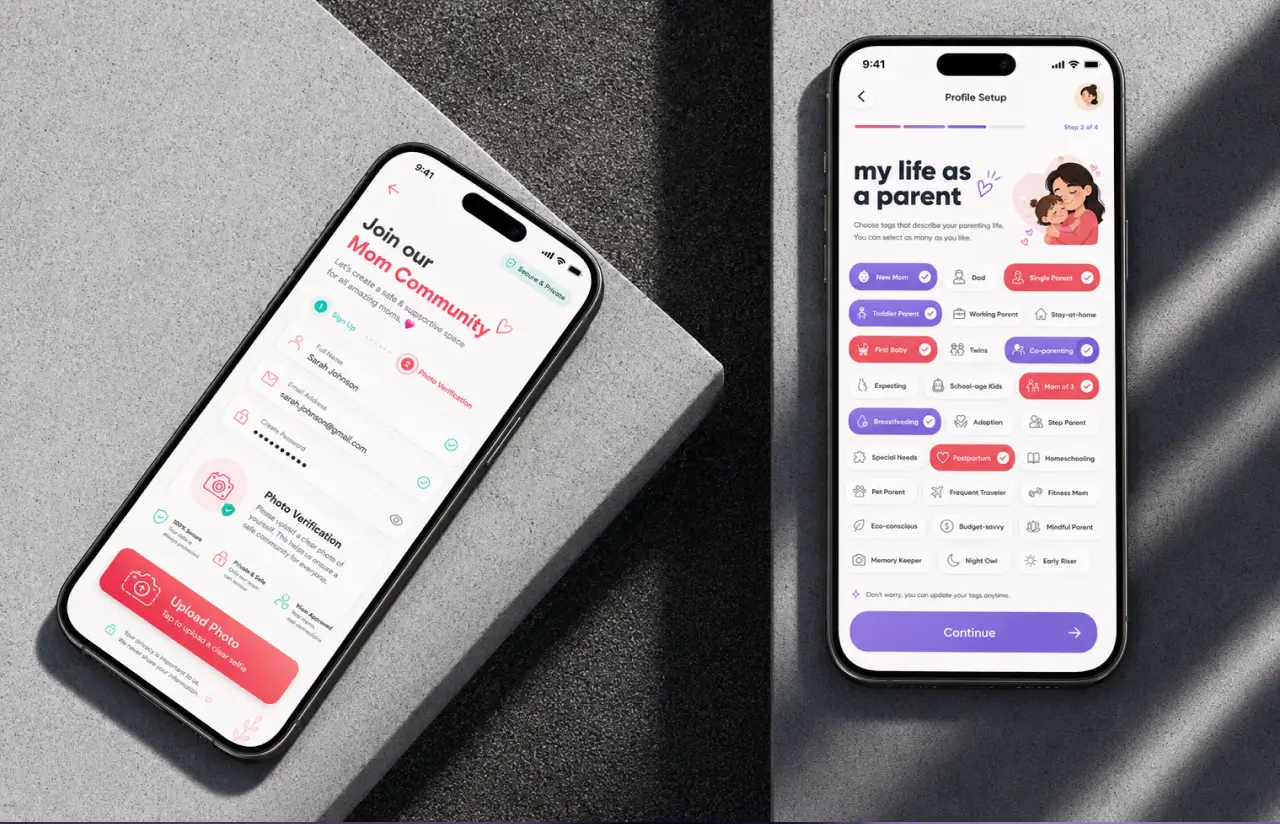
A women-only online community attracts a few people who should not be in it. The founders decided early that verification came before growth. Sign-up had to screen hard without turning the first five minutes into paperwork, because a new mom holding a baby abandons any form longer than one screen.

Local and Virtual Community Features
Distance decides everything here. A mom friend four miles away is a coffee on Tuesday, and the same profile forty miles north is a dead chat. We needed geolocation-based discovery that stayed accurate without ever publishing a street address.

Expert Content and Parenting Resources
Advice was why many women opened the app on day one and why they stayed past week three. Guides on pregnancy, birth, feeding, and the newborn months had to sit beside the social feed, load in a park on a weak signal, and help a mom find support at the hour she actually needs it.
Technologies Behind the Social App for Moms



Our Mom Community Solution
The first build was deliberately cheap. A startup with an unproven idea does not need a perfect stack; it needs to learn whether women will sign up at all, and the MVP answered that in weeks. Early sign-ups came from a few Instagram posts and one press mention. Moms were messaging other moms on day one. Two of them met in a park that weekend, which told the founders more than a survey ever would.
Growth changed the math. Two native codebases slowed every release, so our engineers proposed a move to React Native, still a young framework at the time. One team, one feature set, both platforms. Release dates went from monthly to roughly every three weeks, and the same eight people covered iOS and Android.
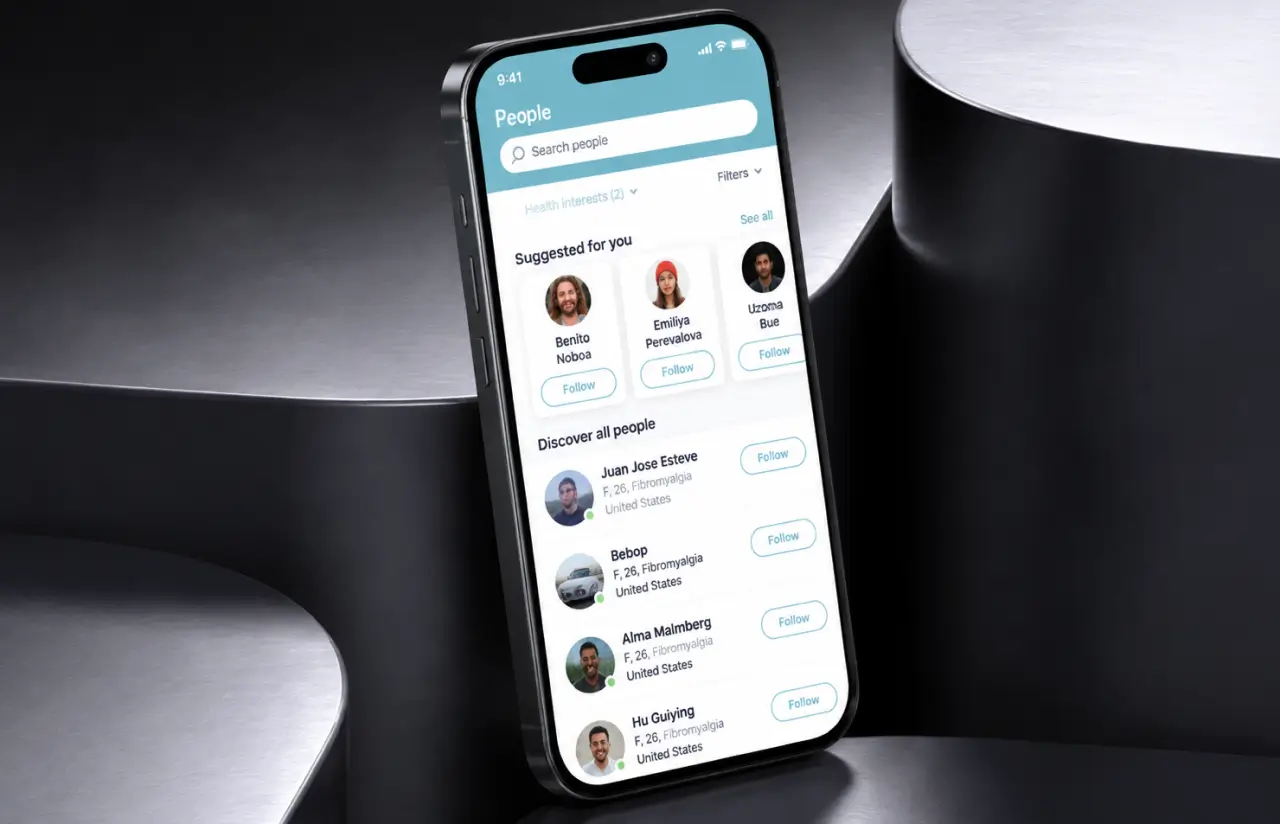
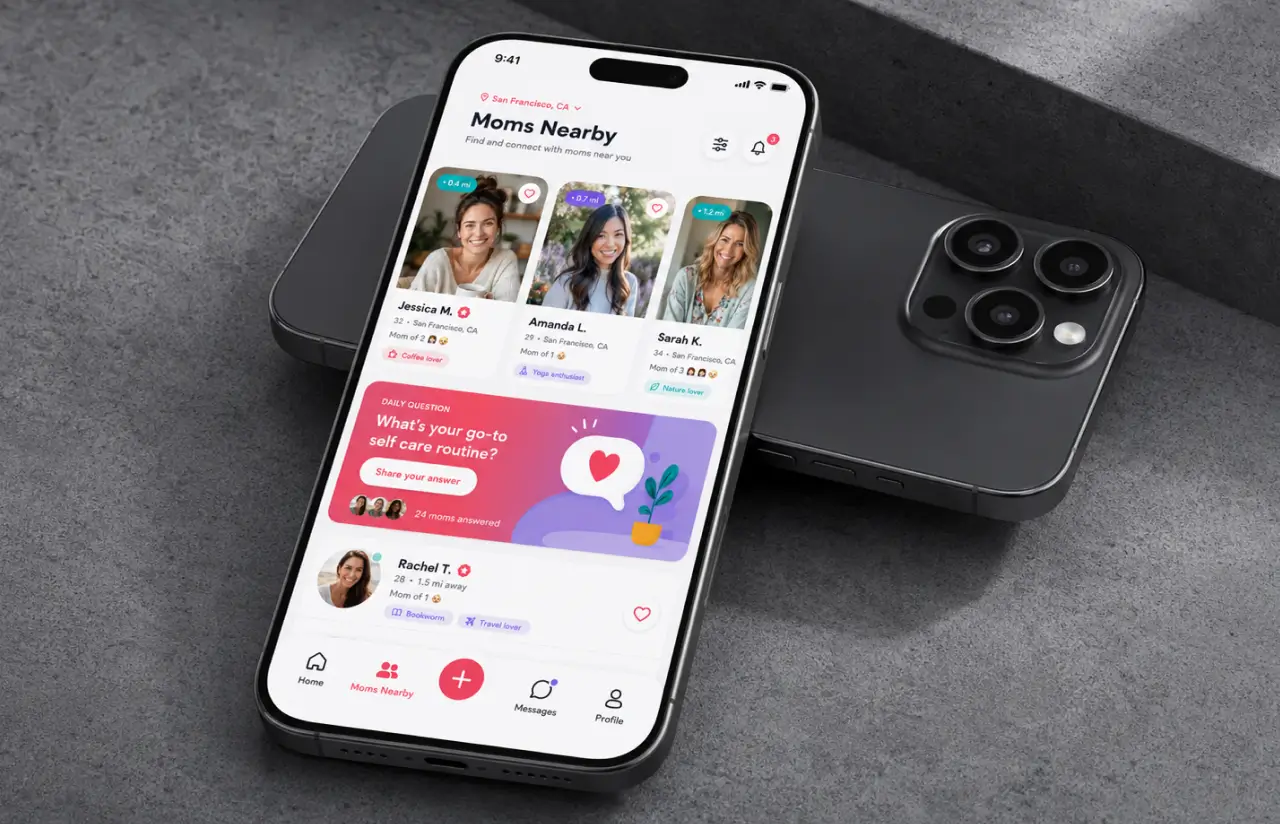
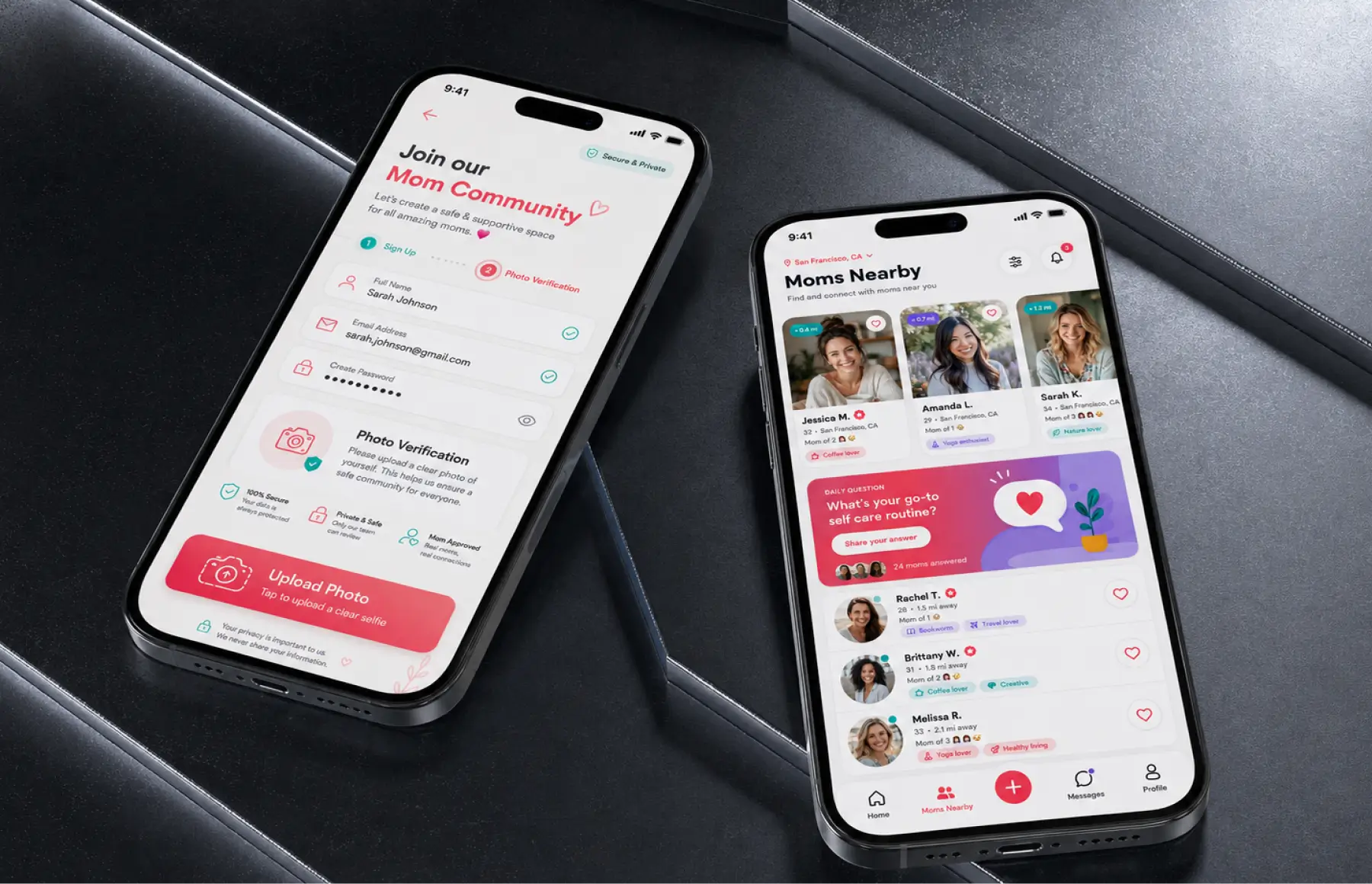
Matching came next, and it decides whether a new mom comes back on day two. The engine reads about 30 profile signals. Ranking pushes like-minded women toward the top, and shared groups or mutual friends show up right under the name. A mom in late pregnancy sees women due the same month, and plenty of new mom friends start there, weeks before either baby arrives. Two women with babies born six weeks apart, living two miles apart, see each other near the top of the feed. Distance shows in miles.
Messaging was rebuilt last and paid for itself. Moving the engine onto Firebase cut chat infrastructure costs to roughly a third of the old bill. Messages land in about 200 ms, and group threads carry the same latency as one-to-one.
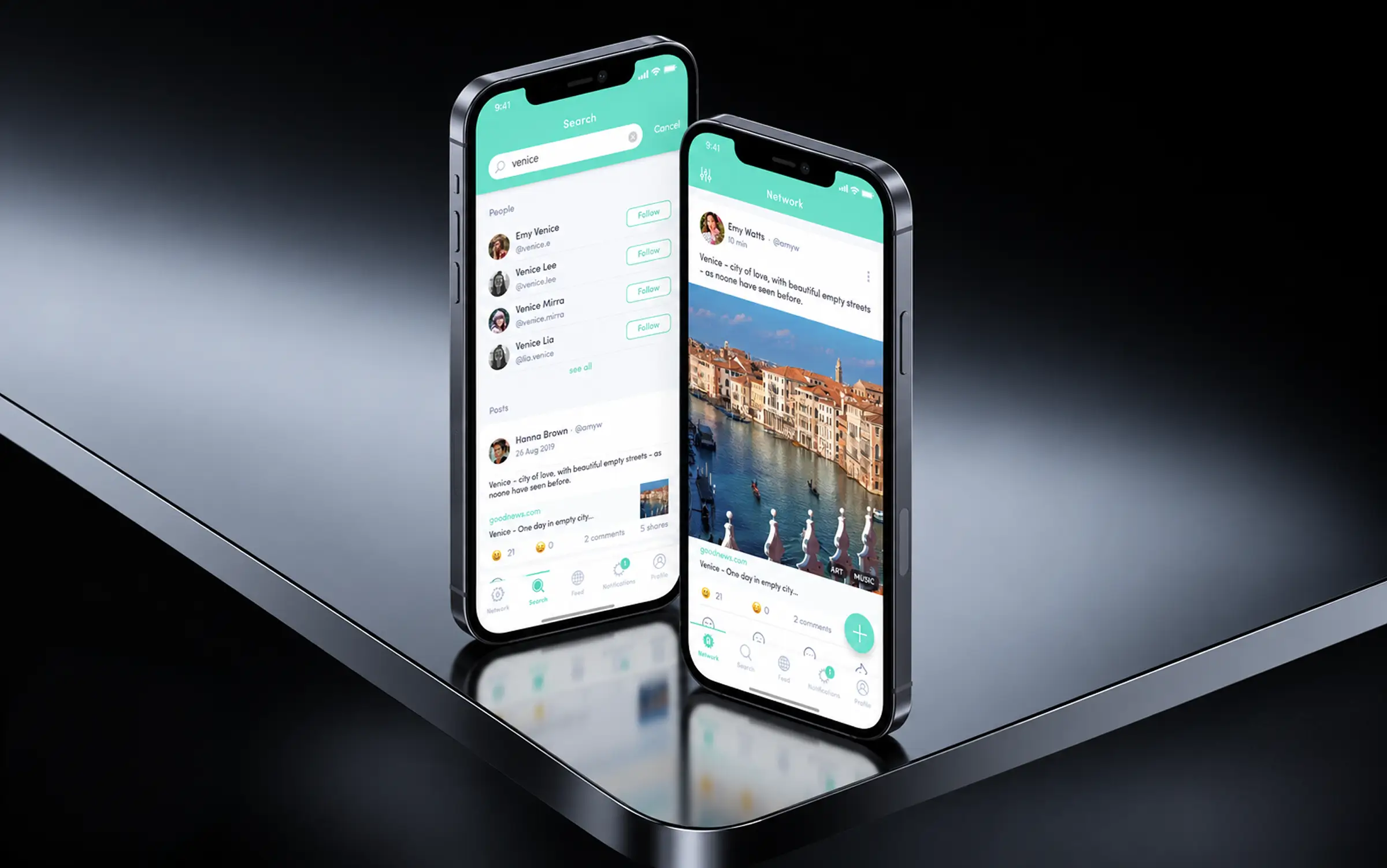
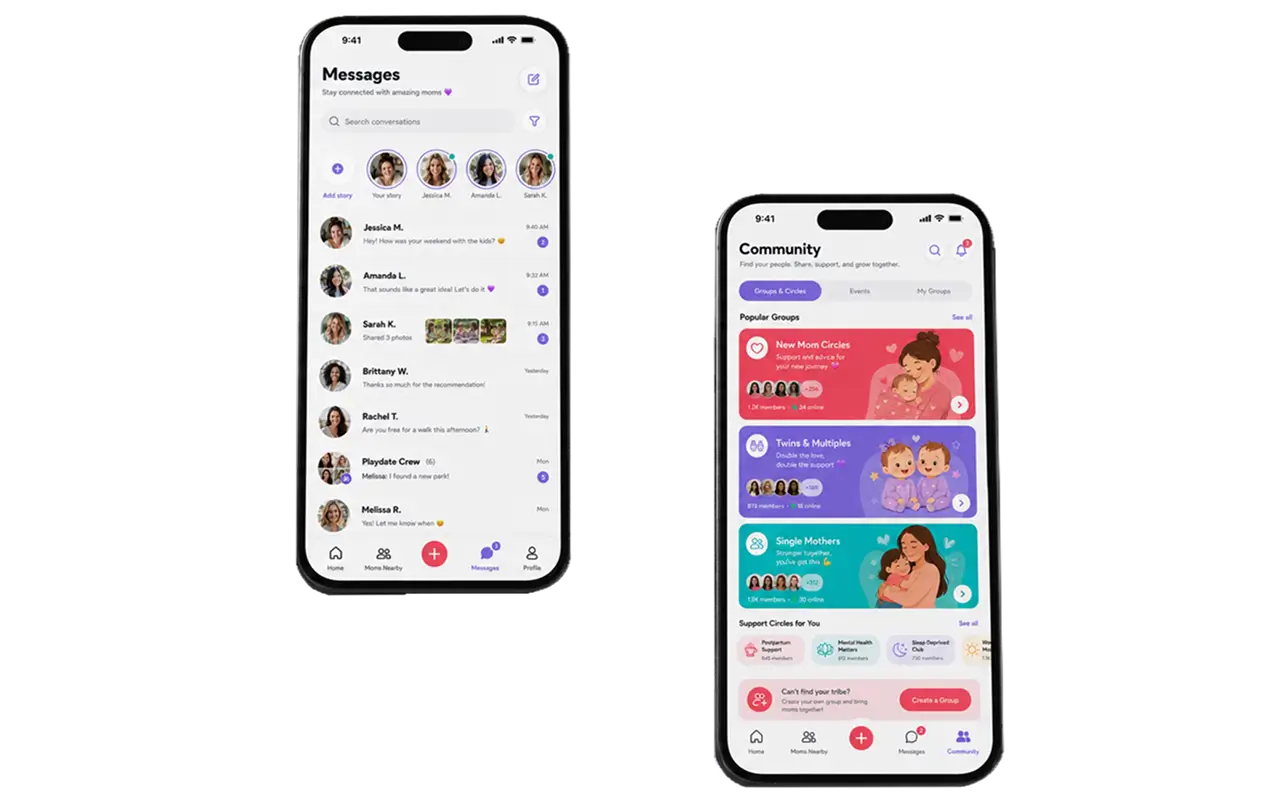
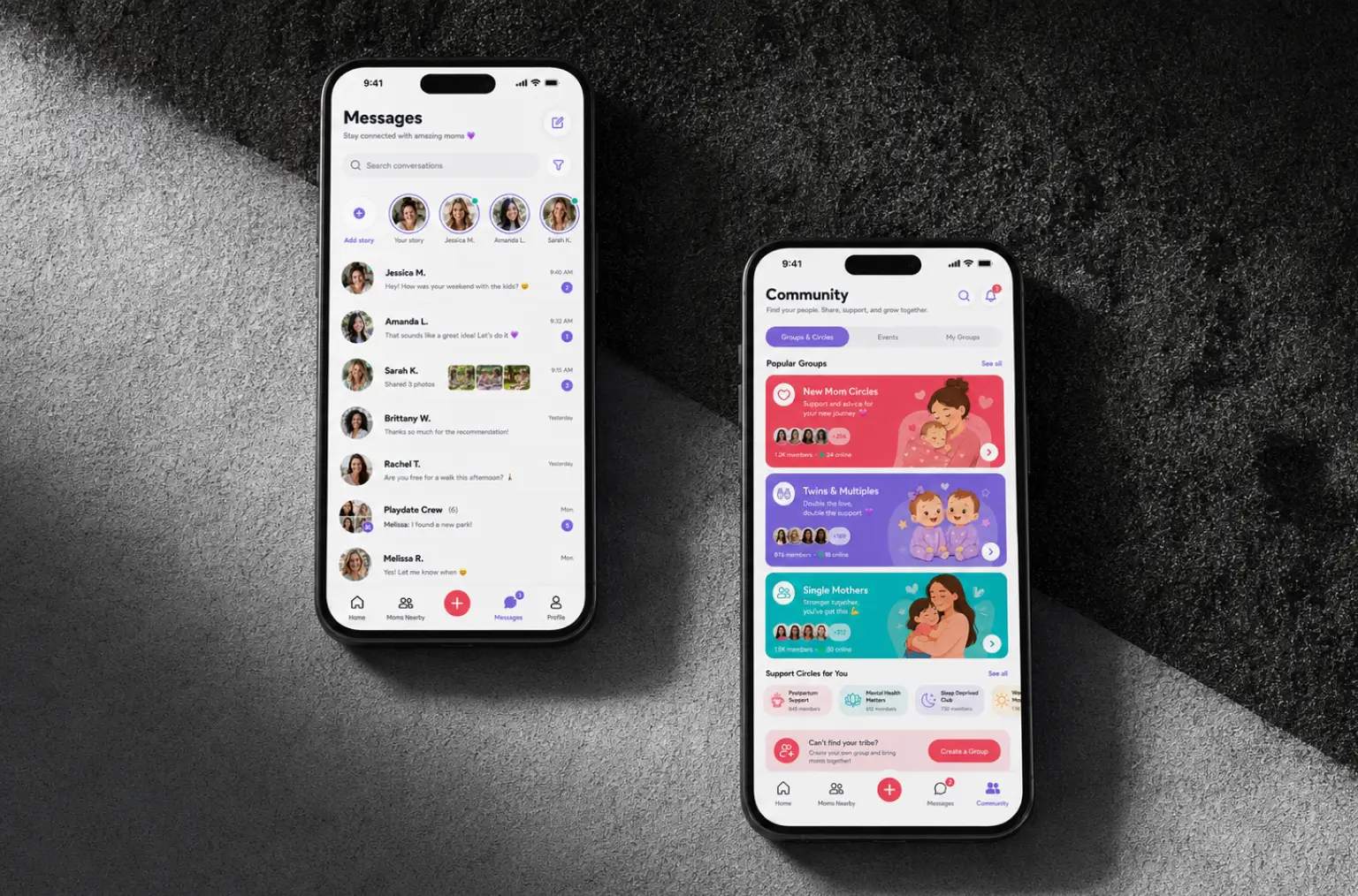
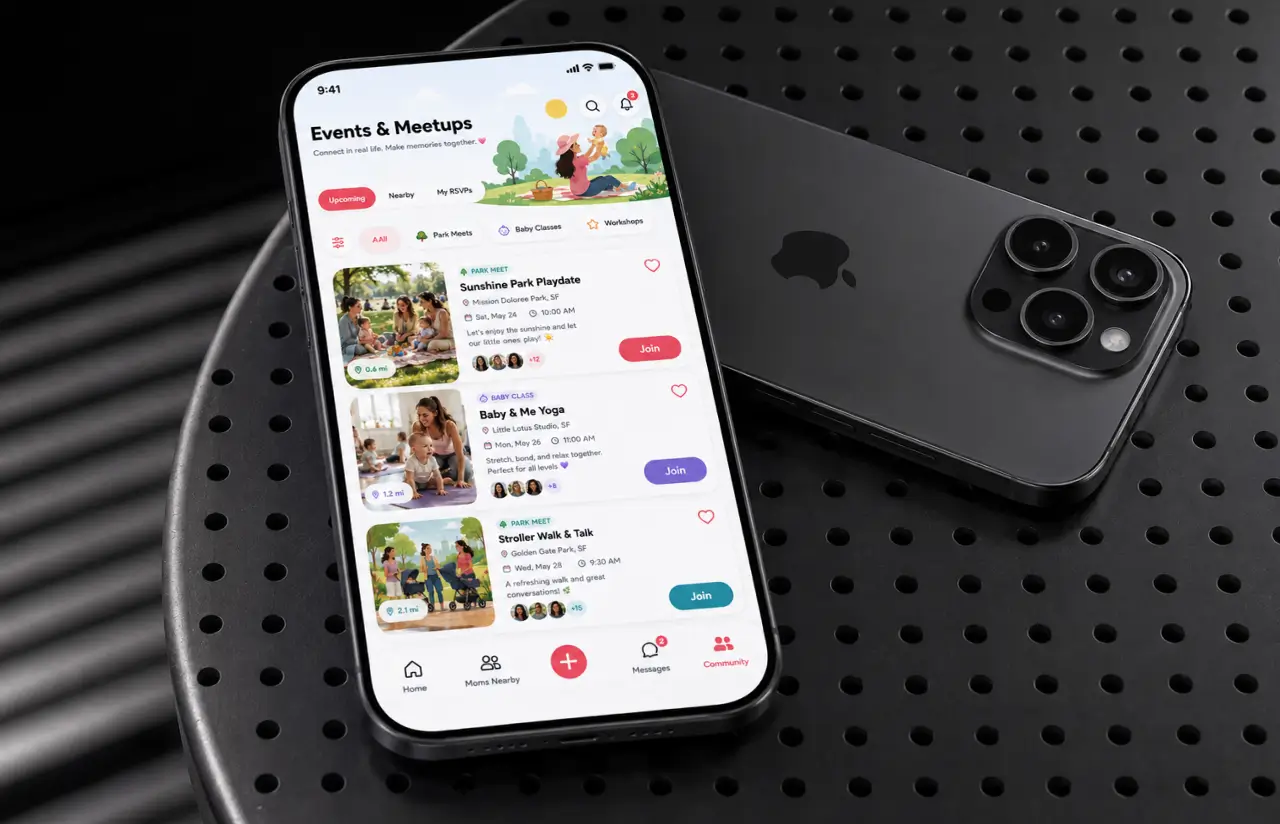
Around the matching feed sits everything that gives moms a reason to open the app between conversations: local groups, member events, a daily question card, and a library of parenting guides. That mix is what turned a discovery tool into an online community that connects moms between meetups. Members create groups in their own area, and the strongest support circles came from moms.
Safety work ran throughout, rather than arriving as a patch after launch. Photo verification at sign-up, a moderation queue with real people in it, and the rule that nobody messages a stranger without a mutual like. Group rules came later, and the moms themselves decided what a circle would tolerate.
Mom Friend Matching and Discovery
Profiles rank by the ages of the kids, pregnancy stage, distance, and shared interests, so like-minded women surface first. Moms swipe a local feed and see how far away each woman lives, which turns finding mom friends into an evening rather than a year of baby classes. Interests carry weight, because two moms with same-age kids still need something to connect over.
Community Groups and Support Circles
Local groups gather women by area, due date, shared interests, or life stage: new mom circles, twins, single mothers, second-time-around mamas. Members post, seek advice, and find support from other moms awake at the same hours. Many connect around a shared due date and stay for years.
Expert-Led Sessions and Parenting Resources
Short guides written with midwives, sleep consultants, and pediatric nurses cover pregnancy, birth, feeding, teething, and the return to work. Each one reads in under four minutes, which is roughly one baby nap on a good day. Pregnancy and newborn guides get read the most, and the team keeps them up to date.
Event Planning and Local Meetups
Any mom can create a park meet, a baby class, or a coffee at 10 a.m. with the kids in tow, which is more fun than it sounds. The app shows who is going and how far away it is. Play dates get arranged in three taps, and the best events repeat weekly once a group of moms finds somewhere to hang out on a wet Thursday.
Safety and Moderation Tools
Photo checks at sign-up, one-tap reporting, blocking, and a human moderation queue that clears within 12 hours. Nobody messages a stranger cold, because a thread opens only after both women have liked each other. Other women never see a home address, only a distance.
Chat and Messaging Features
One-to-one and group threads on Firebase, with typing indicators, read receipts, photo sharing, and push notifications that respect quiet hours. Delivery sits near 200 ms for the 100,000 moms online on an average day, which keeps a connection alive between meetups.
Parenting Milestone Tracking
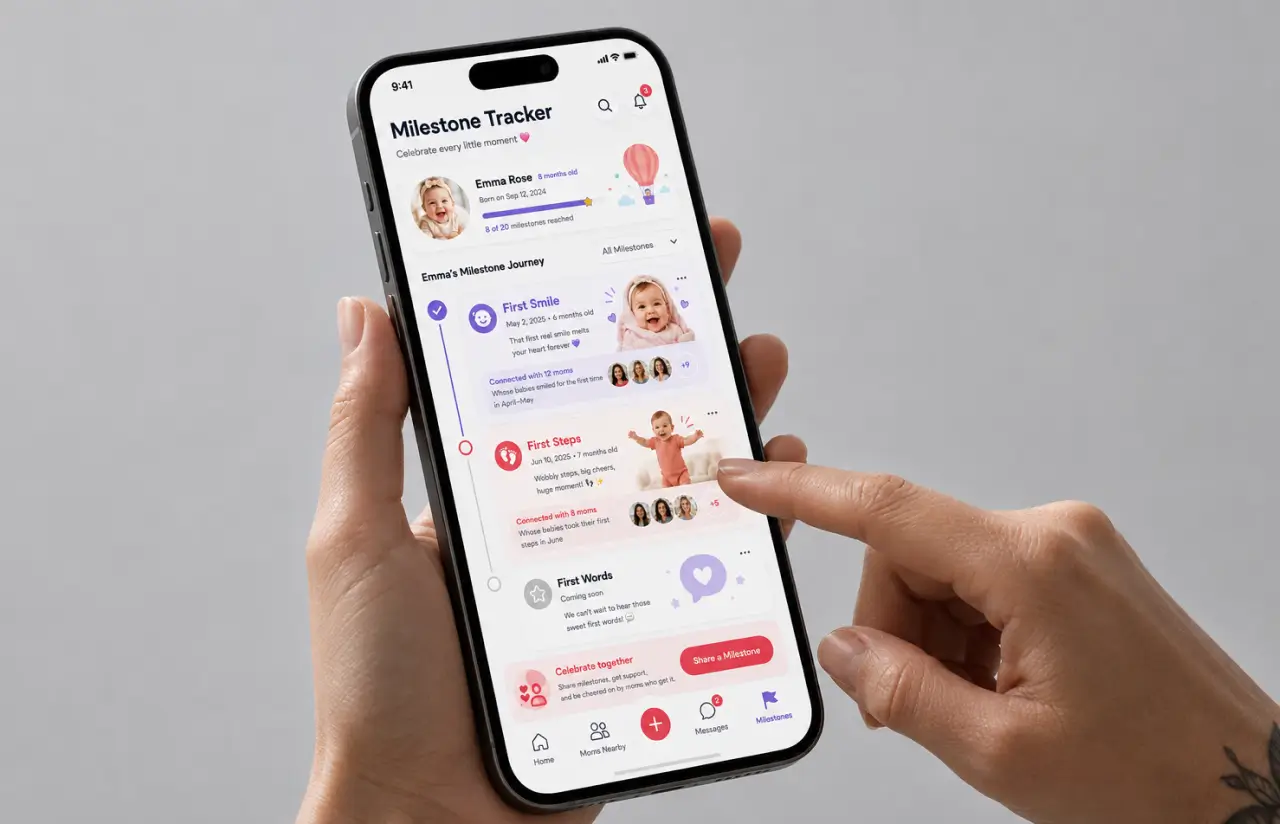
Moms log first smiles, first steps, and first words against each child's age. The feed then surfaces other moms whose baby hit the same milestone that month, so two strangers are already talking about something real.
Scrum Methodology
Project Journey
Discovery took three weeks and settled two decisions that shaped everything after: women only, and distance on every profile. Sprints one through six went to sign-up, profiles, and the matching feed, because nothing else matters until moms are able to connect with someone nearby. Groups, guides, events, and the messaging rebuild came later, once we could watch real behavior instead of guessing at it.
How the Social Network for Moms Works
- A new mom creates an account with an email or a social profile, adds a photo, and passes the check that keeps this online community women-only.
- She adds each child's age, or a due date if a pregnancy is still in progress, plus the area she lives in, her interests, and how far she will travel.
- From about 40 tags (bottle feeder, gentle parent, IVF parent, baby signing, 2 under 2), every mama picks the four that describe her life.
- Geolocation-based ranking builds a feed of local moms and like-minded women nearby, sorted by distance and by how closely the ages of their kids line up.
- A mutual like opens a thread, so a new mom is able to connect the same evening. Women swap numbers, book play dates, or hang out at a group event.
- Moms join local groups, create events, read expert guides on pregnancy and birth, and post the 2 a.m. questions they would never ask a friend from life before the baby.
Development Process Flow
A social media app lives or dies on whether the first ten profiles a woman sees feel relevant to her, and no spec settles that question. The ranking challenges surfaced in week two of the beta, never in the spec. So the matching feed went to a closed group of 120 moms in month three, and we read the drop-off numbers every Friday. Three of those reviews rewrote the ranking logic, and one of them killed a feature nobody had used twice.
How We Delivered this App for Moms
- We define the project goal together, agree on priority features, and set a realistic delivery date and budget.
- We build a ranked list of everything the product needs, starting with what matters most to the business.
- Work is broken into 2-week cycles. At the start of each, we select the next set of features to deliver.
- The team builds, tests, and integrates features throughout the sprint.
- At the end of every sprint, you see working software and give feedback that shapes the next cycle.
- Each sprint produces a shippable piece of the product. We review what worked, adjust, and move forward.
UI/UX Design: Intuitive Interface for Mom Community Engagement
Fourteen mothers used the early builds while we watched, and the pattern held. So the main actions sit in the bottom third of the screen, tap targets are oversized, and nothing important hides behind a menu. Five tabs across the bottom: home, moms nearby, group meets, inbox, places.
The product design work put the tag picker at the center of the profile. Instead of writing a bio, a mom taps four tags from a scrolling wall of them under the heading “my life as a parent”, and those four words tell other women more than a paragraph would. The whole wall was inspired by how moms describe themselves out loud. The daily question card does the same job for the feed.
The palette came from the client’s brand: coral #FF416E, purple #8170DE, teal #00C5C5, used at full strength on cards and kept away from body copy. Around 40 screens went through design, and the tone stayed light and genuinely fun, because this is an app people open in the hardest year of their life. Half the illustration set was inspired by one note from a mom in testing: make it look like a good day, even if it is not.
Results
Before
- ✕Moms met other moms through baby classes, school gates, and luck
- ✕No distance filter, so a promising chat often ended with a mom forty miles away
- ✕Parenting advice sat scattered across forums, group chats, and half-remembered leaflets, with no support from women nearby
- ✕Local events depended on one organizer with a spreadsheet and a phone tree
- ✕Two native codebases, monthly releases, and chat costs climbing with every new mom
After
- ✔1.5M+ mom friendships made between women inside the app
- ✔100K+ moms online daily, with messages delivered in roughly 200 ms
- ✔#1 app for moms on the UK App Store, at a 4.7 average rating
- ✔~67% lower chat infrastructure cost after the Firebase rebuild
- ✔One React Native codebase, with releases going out about every three weeks
Impact of the Mom Community App After Launch
Verified Reviews
Our Reputation on Top Platforms
Clients who write about our mobile app development work mention the same three things: releases that land when we said they would, estimates that hold, and engineers who push back when a feature does not earn its place in the sprint.
Have a Social Community Project in Mind?
Planning a mom community app, a local network for parents, or any product where people need to find each other and stay in touch? Tell us who your users are, how they should connect, and what safety means for you. Our specialist will get back to you within 48 hours.
Thank you for your message. It has been sent.