








Key Takeaways
- Custom HMS build: $50K–$150K for an MVP, $150K–$500K full system, $500K–$2M+ enterprise (LITSLINK published tiers).
- Enterprise Epic rollouts run $400M–$1.2B. Even a 25-bed Iowa hospital paid $3.88M.
- Development is 32.4% of five-year TCO. Operations take 59.5%. The build is the cheap part.
- Each HL7 interface costs $5K–$25K plus $3K–$15K a year. FHIR cuts that by 40–60%.
- A US healthcare breach averaged $7.42M in 2025 (IBM). Security is a budget line now.
- Base-case payback: 3.75 operating years on $375K upfront and $100K net annual benefit.
In February 2024, Northwell Health’s executive vice president Joe Moscola told Becker’s something most hospital leaders only say in closed rooms: “That’s going to cost us $1.2 billion.” He was describing the move of 28 hospitals onto Epic. The same week, a dev agency in Bangalore was ranking on Google for a hospital management system priced at $15,000. Both numbers are real. Neither is wrong. And that is the whole problem with the phrase “hospital management software cost” in 2026: it describes purchases that have nothing in common except the word hospital. A hospital management system for a 25-bed critical-access facility and one for a 28-hospital network are different products with different math.
This guide will help the CIO, CFO, or administrator who has to put a defensible number in front of a board, and the healthtech founder who has to put one in front of investors. I’ll separate the three price tags that get mashed together in most articles (what you pay to build or license, what you pay to make it work, and what you pay to run it safely for five years), anchor each one to a documented figure, and tell you where the published numbers are soft.
What Is Hospital Management Software and Why It Matters for Cost
Here is a distinction that will save you a wasted RFP. Electronic health records store the clinical chart. An EMR is the same record inside a single healthcare facility, and electronic health records proper are designed to travel between healthcare organizations. Practice management software runs the front desk and billing of an outpatient office. A hospital management system coordinates everything a hospital does as an institution: patient registration and admissions, bed management, scheduling, pharmacy management, lab and radiology orders, inventory management, HR, revenue cycle management, reporting, and the patient portals that sit on top. Sometimes it includes the EHR. More often in the US, it wraps around an existing system, and the value of hospital management software is measured in operational efficiency across those departments rather than in any one module.
Vendors use HMS, HIS, and HMIS interchangeably, so a product name tells you nothing about scope. Scope is what you pay for. A comprehensive hospital management system replaces manual systems across every department at once, and every department has its own opinion about how the software should work.
Think of it the way a general contractor thinks of a house. “How much does a house cost?” is unanswerable. “How much does a 2,400-square-foot house with a finished basement and radiant floor heating cost in Orlando?” is a quote. A comprehensive hospital management system with twelve modules and forty interfaces is the second question, and a full hospital management system implementation is closer to building the whole subdivision. Most articles on hospital management software development answer the first.
The market itself is large and growing at a steady, unglamorous pace. Grand View Research sizes the hospital information system market at $54.7 billion in 2025, heading to $89.2 billion by 2033 at a 6.4% CAGR, with North America holding 42.7% of it. Other firms publish figures anywhere from $7.5 billion to $866 billion depending on whether they count “hospital management software” or “healthcare IT” as a whole. Worth being skeptical of any market number that arrives without the firm’s name attached.
Which means: when a vendor tells you the market is “exploding,” ask which market. And when a vendor tells you hospital management system software will pay for itself, ask which modules.
Typical Pricing Models for Hospital Management Systems
The hospital management software price you see on a quote is meaningless until you know the billing unit. Subscription pricing, per-bed pricing, and one-time custom development each hide different costs. “$500 a month” could buy one provider, one site, or one concurrent-user pool. Here are the models you’ll meet, and the question to ask about each.
| Pricing model | How it’s charged | What to inspect before signing |
|---|---|---|
| Per provider / per user | Monthly fee × billable users | Named vs. concurrent users, read-only staff, locums, inactive seats |
| Per bed / per facility | Contract price tied to licensed beds or sites | Licensed vs. staffed beds, cost of adding a site, minimum commitments |
| Per module | Base platform plus departmental add-ons | Forced dependencies, integration access fees, upgrade charges |
| Per transaction/usage | Claims, messages, API calls, storage, AI calls | Included volume, overage rates, retry charges |
| Revenue-linked | Percentage of collections for RCM services | Covered services, minimum fees, exclusions, contract term |
| Perpetual license | Upfront license plus annual maintenance (typically 15–22%) | End-of-support terms, who owns the infrastructure |
| Custom development | Fixed scope, time and materials, or phased funding | Acceptance criteria, change control, source code rights |
| Open source | No license fee for the core | Implementation, hosting, and who answers the phone at 2 a.m. |
Flexible pricing models sound generous until you read the overage clauses. Recurring licensing fees are where off-the-shelf solutions make their margin.
A few published price points for hospital management system software and its outpatient cousins, so you have something concrete to compare against:
- eClinicalWorks lists $499 per provider per month for EHR only, $599 with practice management, and 2.9% of collections for RCM as a service. Twenty-five providers on the $599 tier is $179,700 a year, or roughly $898,500 over five years before any escalators. This is an outpatient benchmark, not a hospital-wide fee.
- athenahealth runs a performance-based model starting around $140 per provider per month plus 4–7% of collections.
- Epic publishes no price list. Every contract is custom-quoted. Third-party analysts estimate per-physician licensing at $5,000–$7,000 and annual maintenance at 15–20% of the initial license, and I’d treat those as directional.
- Oracle Health (Cerner) is similarly opaque. Analyst estimates put a 100–300 bed hospital at $2–5 million initial, with maintenance around 18–22% of license.
- Open-source options exist: OpenEMR, Bahmni (OpenMRS plus Odoo plus OpenELIS, running in 500+ sites across 50+ countries), GNU Health. HospitalRun, which used to appear in every listicle, is archived and unmaintained. No security patches, which in healthcare software is a polite way of saying no.
The catch with open source is that “free” describes the license and nothing else. Agency estimates for a consultant-led deployment land at $45,000–$180,000 once you add installation, configuration, customization, migration, and training, plus $15,000–$76,000 a year to run it. Bahmni was designed for low-resource settings. Whether it fits a US acute-care hospital with existing systems for lab, pharmacy management, and inventory management is a question for discovery, not a download button.
Cloud vs On-Premise Hospital Management Software: Cost Comparison
The conventional wisdom is that cloud hospital management software is cheaper. The data says: it depends on who you’re counting.
The Michigan Center for Effective IT Adoption ran a five-year TCO for a solo practice and found cloud at roughly $58,000 versus on-premise at $48,000, with cloud cheaper upfront ($26,000 vs. $33,000) and pricier over time. That study excluded IT labor. Add a part-time systems administrator and the on-premises number flips. A peer-reviewed analysis from the University of Michigan School of Dentistry (2016 data, PubMed) found on-premises to be about $2 million more expensive over two years than cloud once staffing and hardware were counted.
So the honest framing is that cloud hospital management system software changes the timing and ownership of costs more than it eliminates them. You trade a capital expense (servers, storage, a data center with a generator) for an operating expense (compute, managed services, egress). Lower upfront costs on one side, higher operational costs on the other. You trade a headcount for a shared-responsibility model.
That model has teeth. HHS guidance is explicit that a cloud provider handling ePHI is a business associate even if it only holds encrypted data without the key. Using AWS does not make your hospital HIPAA-compliant. It makes AWS a party to your compliance.
Here is a transparent five-year comparison of initial cost and operating cost for infrastructure only. The numbers are a planning model, not a market average.
| Five-year infrastructure scope | Cloud | On-premise |
|---|---|---|
| Setup or hardware | $20,000 | $100,000 |
| Annual hosting, or facilities and IT operations | $36,000 | $24,000 |
| Hardware refresh during the period | $0 | $40,000 |
| Five-year total | $200,000 | $260,000 |
An extra $1,000 a month of unmonitored cloud spend on hospital management software (an idle staging environment, an oversized database) adds $60,000 over five years and erases the gap entirely. I’ve seen it happen twice. Both times the culprit was a test environment nobody remembered to turn off.
For scale: AWS HealthLake lists $0.27 per datastore-hour, and its published US East example for a 1 TB dataset with query and NLP usage totals $654.14 a month. That’s one component. A complete environment adds application compute, databases, logs, backups, identity, networking, and non-production copies of all of it.
Hybrid (clinical core on-premises, patient data for portals and analytics in the cloud) is where most mid-size US hospitals are actually landing. It’s less elegant. It’s also what the compliance team will sign off on.
Key Factors That Affect Hospital Management Software Cost
Ten factors affect the number. Some of them by 2x. If you want to build hospital management software and stay within budget, these are the levers.
1. Module count and clinical depth. Patient registration, bed management, and inventory management around an existing EHR is one project. Orders, medication administration, and clinical decision support are another, with drug databases, terminology licensing, and institution-specific validation attached. The FDA’s January 2026 clinical decision support guidance draws the line between CDS that is a regulated device and CDS that isn’t, and which side of that line your feature lands on can change the validation budget by an order of magnitude.
2. Healthcare facility size and site count. Bed count is a sizing input, not a formula. Two 200-bed hospitals can differ by 3x if one has a single campus with three mature interfaces and the other has four sites, two identity systems, and a specialty clinic with its own scheduling rules.
3. Integrations. The single most underestimated line in any HMS development budget. More on this below, because it deserves its own section.
4. Compliance scope. HIPAA and HITECH are the floor. ONC certification, SOC 2, and (for anything touching EU patients) GDPR each add engineering and audit work. Agency estimates put the compliance premium at 20–35% over a base build. I’d push back slightly on treating it as a percentage. Compliance is a workstream with its own deliverables, and the cost depends on how much of your architecture has to change to satisfy it.
5. Data security requirements. Encryption, role-based access, audit logging on every PHI read and write. These are table stakes for data security in any healthcare facility. What raises cost is emergency access (“break the glass”), cross-site permissions, and proxy access for temporary staff.
6. Platform. Web-only is cheapest. Add native iOS and Android for nurses on the floor and you’ve added two codebases.
7. UX complexity and clinical workflows. A chart that takes nineteen clicks is how a vendor loses a hospital contract. Clinician-tested UX costs more upfront and saves you the go-live revolt.
8. AI features. Ambient clinical documentation, predictive analytics, automated coding. Not exotic anymore: a 2026 study in the American Journal of Managed Care found 62.6% of US Epic hospitals had adopted at least one ambient AI tool by June 2025. But each AI feature carries model costs, human review, monitoring, and revalidation whenever the model changes.
9. Development team location. Blended 2026 rates from agency surveys (Uvik, Noxx, FullStack): US ~$100/hour ($50–$150), Eastern Europe ~$38/hour ($25–$50), Latin America $33–$75/hour, India $20–$45/hour. Geography is a rate, not an estimate. A cheaper hour that produces rework is a more expensive hour, and technical debt in a hospital management system compounds the way credit card debt does.
10. Delivery organization on the hospital side. Available clinical owners and fast decisions are worth more than any rate card. Repeated scope changes mid-build cost 4–10x what the same change costs in discovery.
Cost Breakdown Across the HMS Development Lifecycle
The cost to develop hospital management software can be organized by delivery stage, and the phase splits published by dev shops converge more than you’d expect: engineering 50–65%, QA 15–20%, design and discovery 15–25%. HMS development costs follow the same shape whether the team is in Palo Alto or Kyiv. Only the multiplier changes.
Here is a worked $300,000 model for a bounded multi-module administrative platform built around an existing EHR. It’s an original planning scenario, not a client invoice.
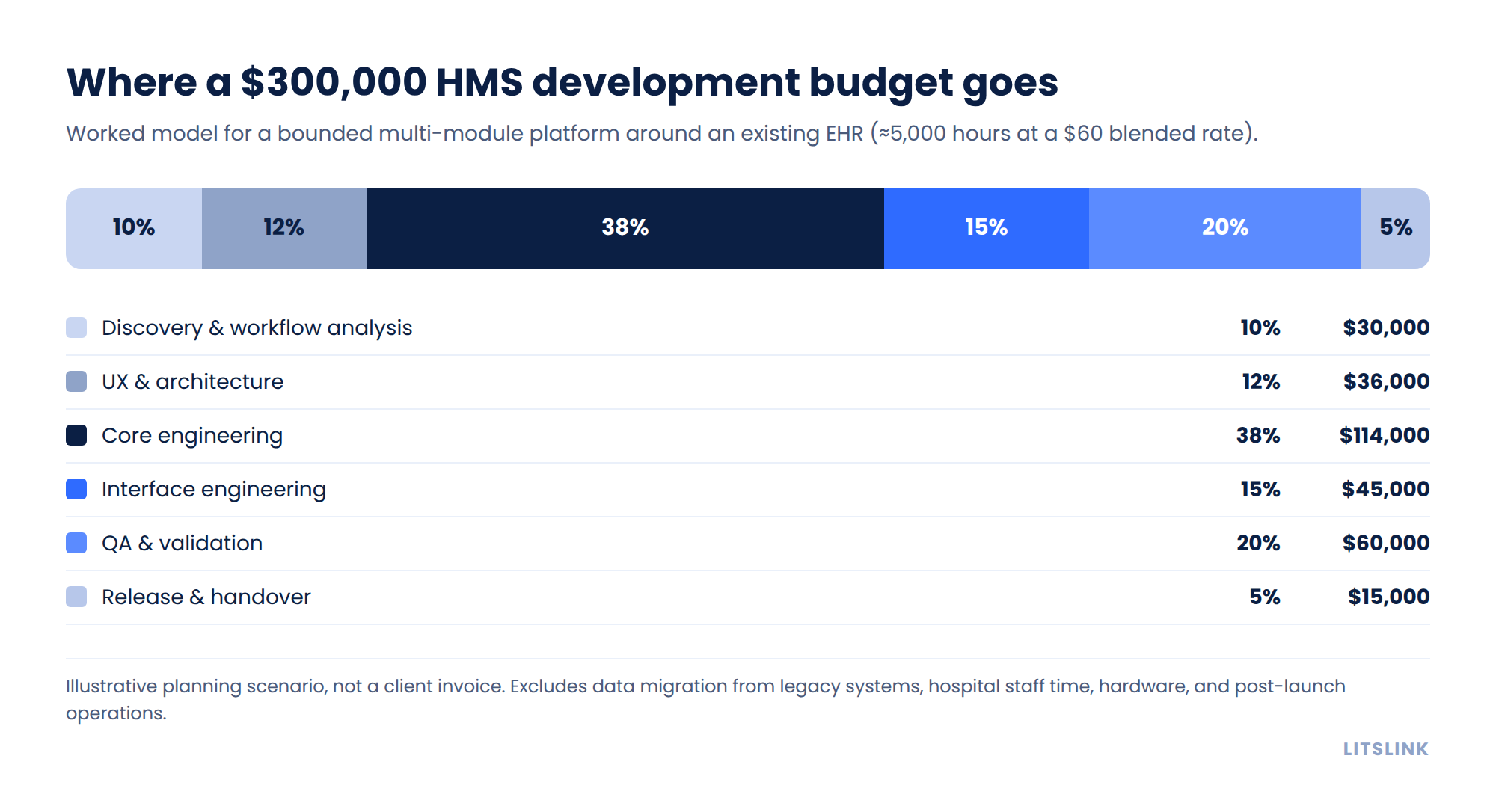
The same $300,000 from a team-composition view: about 5,000 hours at a $60 blended rate. Business analysis 650 hours, UX 400, architecture 350, application engineering 2,200, QA 1,000, DevOps and security 400. Run those 5,000 hours at $40, and you get $200,000. At $120 (a US-only team), $600,000. Same scope, same hours, 3x spread.
Two things this table excludes on purpose: data migration from legacy systems and hospital-side staff time. Both are real. Both belong in the implementation budget, which comes next.
One more note on discovery, because it’s the line item most likely to get cut. Agency data suggests enterprises that skip a structured discovery phase overspend by 40–60%, while a three-to-four-week discovery shortens the build timeline by 20–35%. The reason is boring. Every requirement that surfaces in sprint nine instead of week two costs somebody a rewrite.
Estimated Cost Ranges by Project Scale
This is the section people scroll to, so I’ll give you the cost ranges first and the caveats second. Every figure is a development cost estimate for the US market.
| Project scale | Development range | Timeline | Typical scope |
|---|---|---|---|
| Single module / HMS MVP | $50,000 – $150,000 | 3–5 months | One or two core modules, one integration, HIPAA basics. Validates an idea or ships one high-value workflow. |
| Full custom hospital management system | $150,000 – $500,000 | 8–14 months | Multi-module, several integrations, full compliance scope, clinician-tested UX. Clinics, groups, and digital health companies replacing a system that no longer fits. |
| Enterprise platform | $500,000 – $2 million+ | 14–18+ months | Deep interoperability, HIE participation, advanced analytics, ONC certification path. Hospitals and platform vendors building for scale. |
Source: LITSLINK’s published custom EHR and EMR software development tiers, checked September 2026. These describe the clinical-platform component and are the benchmark we use for HMS scoping. A full hospital operational stack on top of a new clinical core lands toward the upper end of each band.
Now the caveats.
Competitor cost estimates run from $1,765 to $500,000 for “a hospital management system.” The low end is India small-clinic pricing. The high end is US enterprise. One agency published two articles in the same year with different ranges ($30,000–$500,000 in one, $50,000–$500,000+ in the other), which tells you how firm those numbers are.
And none of the custom-build ranges touch what commercial enterprise rollouts actually cost. Becker’s Hospital Review has been tracking announced EHR budgets for years:
- Northwell Health (Epic, 28 hospitals): $1.2 billion
- Trinity Health (Epic, 101 hospitals): $800 million
- AdventHealth (Epic): $660 million
- University Hospitals, Cleveland (Epic, consolidating 15 systems): $400 million, reportedly $200 million under budget
- Tallahassee Memorial: $234 million
- Weirton Medical Center (238 beds, Cerner CommunityWorks): $65 million
- Veterans Memorial Hospital, Iowa (25 beds): $3.88 million
Read that last one again. A critical-access hospital with 25 beds spent $3.88 million. That is what an off-the-shelf HMS costs when the shelf is Epic or Oracle, and it’s why large hospitals and small ones alike end up asking whether custom development is the cheaper path. For context on the workflow breadth a mid-size custom project can involve, the Dalth patient engagement platform pulled EHR data from several providers into one role-aware system serving six user types, with urgent care requests resolved in minutes instead of bouncing between disconnected tools. Scope like that is why the middle tier is a range and not a number.
Which tier does your hospital actually fall into?
Send us the modules, sites, and interfaces you’re working with, and we’ll come back with an itemized number instead of a range.
Off-the-Shelf vs Custom Hospital Management Software: Cost Trade-Offs
The obvious answer is to buy off the shelf. Nobody gets fired for buying Epic. It runs roughly half of US acute-care beds, MyChart has 200 million activated accounts, and it works.
Except that the obvious answer has a documented financial profile, and it’s rough.
Memorial Sloan Kettering went live on Epic in February 2025. Its 2025 operating result swung from $202.2 million of operating income in 2024 to a $47.9 million operating loss, with roughly $177 million of expense growth tied to the go-live across about 18,000 clinicians, per MSK’s own financial disclosures reported by Becker’s. MD Anderson posted a $267.1 million operating loss the year of its Epic switch, a 77% drop in adjusted income, followed by about 1,000 job cuts. Partners HealthCare lost over $70 million in operating income in a single quarter. None of these were failed implementations. They were successful ones. This is what success costs when you move a large institution’s central nervous system, and it is the part of hospital management software cost that never appears in a vendor deck.
The largest cautionary tale isn’t private. The VA’s Oracle Cerner contract started at $10 billion in 2018, was revised to over $16 billion, and the Institute for Defense Analyses estimated the full lifecycle at $49.8 billion. The program was paused in 2023 after patient-safety incidents and is resuming in 2026. (The UK’s National Program for IT managed a similar arc two decades earlier, at roughly £10.1 billion, before being dismantled in 2011. Institutions apparently learn from other institutions’ mistakes at about the same rate people do.)
So when does custom development make sense over off-the-shelf solutions?
| Decision factor | Buy and configure | Build custom | Hybrid |
|---|---|---|---|
| Best starting point | Standard workflows a mature product already covers | Distinctive workflow with a real reason to own it | Working clinical core plus specific gaps |
| Initial spend | License, configuration, rollout | Design, engineering, validation | Integration layer plus targeted modules |
| Recurring spend | Subscriptions, modules, support, change requests | Product team, hosting, security, enhancements | Both, in smaller amounts |
| Who controls change | Vendor roadmap and configuration limits | Hospital or product owner | Varies by component |
| Key risk | Poor fit, lock-in, add-on fees you didn’t plan for | Underestimated scope, long-term ownership | Integration dependencies, unclear accountability |
The hybrid row is the one I’d point most US healthcare organizations toward. Keep the EHR as the clinical record and the hospital management system as the coordination layer. Build the bed-flow dashboard, the patient communications layer, or the referral workflow that the vendor’s roadmap has been promising since 2022. Price that against the vendor’s configurable version and against a full replacement, including the interfaces and who owns them for the next five years.
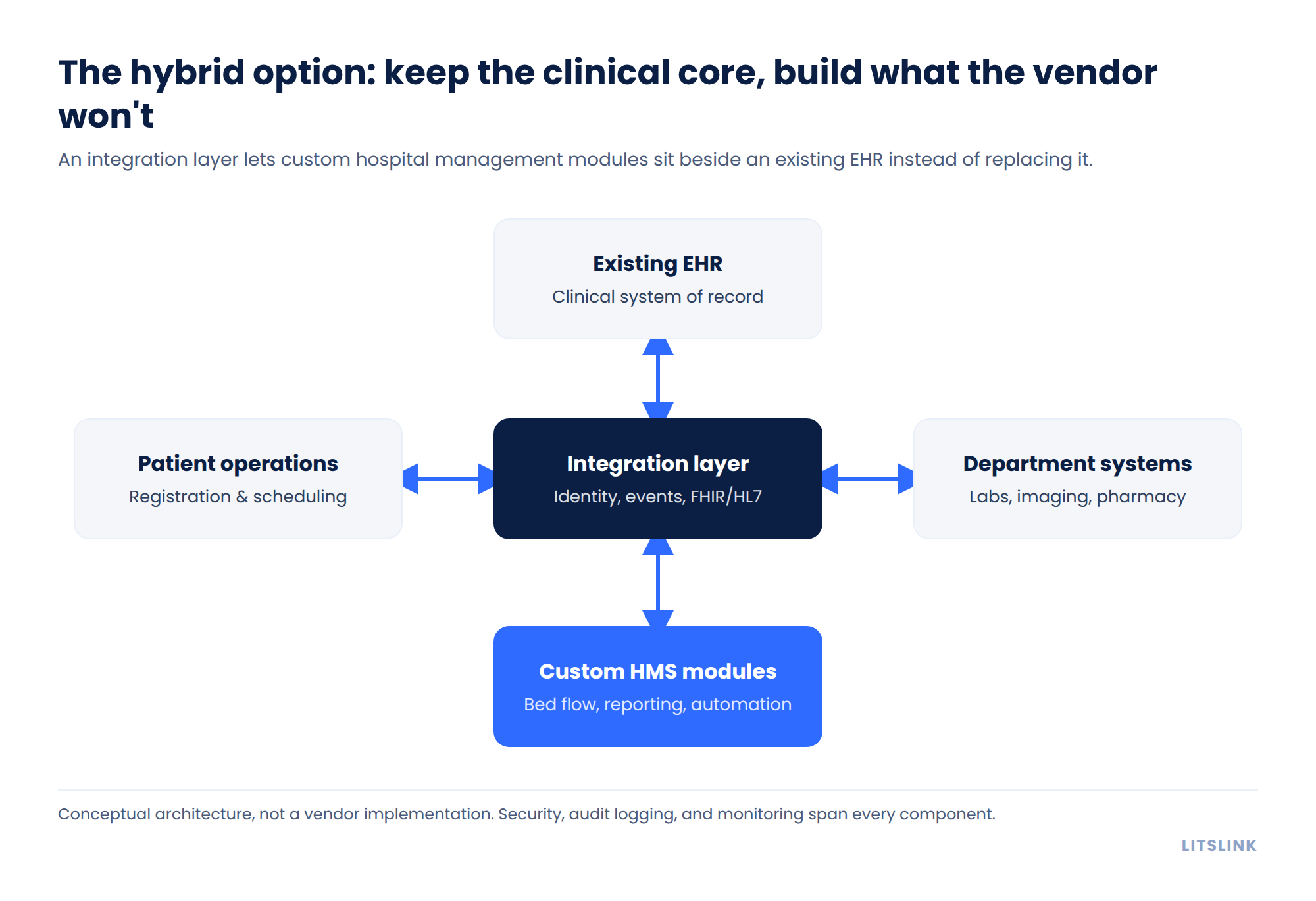
Custom systems do not mean zero recurring cost. You still pay for cloud, commercial components, e-prescribing networks, and terminology licenses. What you stop paying is the per-seat tax that grows with every provider you hire. Our breakdown of custom software development vs. off-the-shelf solutions walks through the ownership math in more detail.
Data Migration, Integrations, and Hidden HMS Costs
General Omar Bradley is usually credited with the line “amateurs talk strategy, professionals talk logistics.” In hospital software, amateurs talk features. Professionals talk interfaces.

Integrations are where hospital management software budgets die. Agency and consultant estimates converge on $5,000–$25,000 per HL7 interface to build, plus $3,000–$15,000 per interface per year to maintain (Nirmitee, TactionSoft). A hospital may need anywhere from a dozen to 200 of them: labs, imaging, pharmacy, clearinghouses, payment gateways, the state immunization registry, the HIE. Epic-specific integration runs $18,000–$80,000 per interface once App Orchard certification is involved. Do the multiplication, and integration can exceed the license. A patient management module that can’t reach the lab system is a very expensive spreadsheet.
FHIR helps. Modern FHIR APIs cut per-interface development costs by 40–60% versus HL7v2 point-to-point work. But FHIR is a standard for exchanging data, not a promise that two systems agree on what the data means. Production access, sandbox fees, and the partner’s onboarding queue are all still yours to pay for.
Data migration depends on data quality, not database size. Patient records from legacy systems arrive in whatever shape the last three administrators left them. A terabyte of consistent structured records is easier than fifty gigabytes of duplicate patient identities, scanned PDFs, and local codes nobody documented. Large Epic migrations run $1–5 million. A small athenahealth migration of a million records has been quoted around $25,000. For the $300,000 model above, a reasonable allowance is $35,000 for conversion and reconciliation.
The hidden lines that show up in month eleven:
- Compliance audits and penetration testing. SOC 2 Type 2 first audit $30,000–$100,000. Pen test $5,000–$45,000. Repeat annually.
- Training costs and staff backfill. Somebody covers the shift while the charge nurse is in staff training. Budget the overtime, and budget for the administrative personnel who will run parallel manual systems for the first month.
- Go-live productivity dip. Consultants commonly cite a 20–50% drop in staff productivity for the first 90 days. Longer visits, slower coding, insurance claims piling up.
- Parallel legacy systems. The old license keeps running until the last department cuts over. Phased rollouts reduce risk and extend this line.
- Hardware and identity. Workstations, scanners, badge readers, network changes. Rarely in the software quote.
- Exit planning. What it costs to get your data out at the end. Ask now, while you still have negotiating power.
For the worked model: $35,000 migration, $20,000 training and backfill, $10,000 go-live support, $10,000 parallel legacy access. Implementation allowance: $75,000. Combined upfront: $375,000. Plus a 15% contingency ($56,250) held separately and released only against documented risks.
Want the hidden lines priced before they surprise you?
Our discovery phase inventories every interface, legacy record source, and staffing gap, so the $75,000 shows up in the plan and not in month eleven.
Ongoing Maintenance, Hosting, and Support Costs
The rule of thumb for maintenance costs is 15–25% of initial cost per year for ongoing maintenance. Epic’s maintenance runs about 15–20% of license, Oracle’s 18–22%. The rule is fine for a first pass and useless for a budget, because it hides what you’re paying for.
Here is a workload-based operating budget for the same bounded hospital management system:
| Annual operating line | Cost | Basis |
|---|---|---|
| Application maintenance and support | $48,000 | 80 hours/month × $50/hour |
| Cloud infrastructure | $24,000 | $2,000/month for an assumed environment |
| Security reviews and monitoring | $12,000 | $1,000/month equivalent |
| Third-party services | $8,000 | Messaging, external APIs, defined services |
| Planned enhancements | $18,000 | 300 hours/year × $60/hour |
| Annual total | $110,000 | Includes enhancements, not pure maintenance |
Eighty hours a month is not 24/7 coverage for hospital operations. If you need someone on call when the bed board goes dark at 3 a.m. on a Saturday, price that explicitly.
Resilience has a price too. A 99.9% uptime SLA permits about 8.76 hours of downtime a year. At 99.99%, about 52.56 minutes. The difference in architecture between those two numbers (redundant zones, tested failover, warm standby) is usually five figures a year. Recovery time and acceptable data loss need their own targets. Uptime percentage doesn’t imply either.
And maintenance is now a regulatory obligation, not just an engineering preference. The HHS OCR cybersecurity newsletter from January 2026 ties unpatched software directly to risk analysis and vulnerability management under the Security Rule.
Put it together, and the five-year picture looks like this:
| Cost layer | Calculation | Total |
|---|---|---|
| Development costs | Lifecycle model | $300,000 |
| Migration and implementation | Launch allowance | $75,000 |
| Five operating years | $110,000 × 5 | $550,000 |
| Five-year TCO | $925,000 | |
| Contingency (held separately) | 15% × $375,000 | $56,250 |
| Funding envelope | $981,250 |
Development is 32.4% of that total cost. Operations are 59.5%. Anyone who quotes you a hospital management software development price and stops talking has told you about a third of the story. Staff productivity gains and reduced administrative costs live in the other two-thirds, and so do the bills.
Strategies to Control and Optimize Hospital Management Software Costs
Most cost advice for healthcare software amounts to “negotiate harder.” Unit rates matter less than uncertainty and scope, so start there. Cost efficiency in a hospital management system comes from what you decide not to build.
- Run discovery as a paid, fixed-scope phase. Inventory every interface, every legacy record source, and every decision-maker before anyone commits to a hospital-wide fixed price.
- Define the smallest operationally complete release. A thin pilot still needs access controls, failure handling, and an owner. A demo interface is not a release.
- Reuse the clinical core if it works. Evaluate the vendor’s supported extensions and configuration before commissioning a replacement. Existing systems that do the job are the cheapest modules you’ll ever own. Sometimes the answer really is a configuration change and a phone call.
- Standardize workflows on purpose. Every department-specific exception should have a written reason and a name attached to it.
- Rehearse one hard migration early. Pull representative records in month two, not month ten. The cleanup work will surface either way. Better it surfaces while you can still change the plan.
- Negotiate growth and exit terms upfront. Price the additional site, the extra interface, the bulk export, and the transition assistance before signing.
- Retire old systems against acceptance criteria. Savings don’t exist while the old license keeps running.
- Meter cloud by environment. Alerts, idle-resource reviews, and cost per completed workflow. The $60,000 test environment is avoidable.
- Match support tier to clinical impact. The inventory module and the bed board do not need the same SLA.
- Tie payments to acceptance evidence. Demonstrated workflows, not elapsed weeks.
- Insist on automated testing frameworks in the development process. Regression bugs in a bed management module are found by nurses at 3 a.m., otherwise.
On AI specifically: scope one narrow administrative task first. Appointment prep, referral summarization, document classification. Define the required quality and the review process before anyone says the word “savings.” Illustrative unit economics: 10,000 tasks a month at $0.05 in model cost is $500. If 10% need three minutes of human review at $40/hour, review adds $2,000. So $2,500 a month, or $0.25 per task, before integration, hosting, and oversight. The per-call fee is never the unit cost. Our piece on AI agents in healthcare covers which administrative workflows justify automation and which don’t, and projects that need custom predictive models will also draw on machine learning development services with data preparation and ongoing evaluation budgeted alongside the build.
Cost Efficiency, ROI, and Payback Period for Hospital Management Systems
The industry-level case for operational efficiency through automation is real and large. CAQH’s 2025 Index, published February 2026, estimates US healthcare avoided $258 billion in administrative costs through automation in 2024, with a remaining $21 billion opportunity. On the other side of the ledger, Premier found claims adjudication cost providers $25.7 billion in 2023, up 23% in a year, with roughly $18 billion of it “potentially unnecessary” because about 70% of denials were eventually overturned. Experian’s 2025 State of Claims reports 41% of providers now see denial rates above 10%.
Which means: revenue leakage in billing is where hospital management software pays for itself fastest. Automated billing and cleaner claim handoffs reduce administrative costs in ways a CFO can see on next quarter’s statement. Every other benefit, from patient care quality to patient safety, is slower and softer to measure.
Build the ROI case for your healthcare organization from its own baselines, and count benefit types separately so the same improvement doesn’t get claimed twice:
| Benefit category | How to calculate | The qualification |
|---|---|---|
| Cash-releasing labor savings | Avoided overtime or agency hours × actual rate | Salaried time “saved” is not cash unless a position goes unfilled |
| Extra patient throughput | Additional completed visits × contribution margin | Margin after variable cost, never billed charges |
| Revenue cycle improvement | Additional collections or reduced rework | Don’t overlap with throughput or staffing |
| System retirement | Licenses and contracts actually ended | Counts only after retirement happens |
| Working capital | One-time release from faster collections | Not a recurring annual benefit |
| Safety and quality | Measured clinical or operational outcome | Keep separate unless you have a defensible monetary model |
Worked example, same hospital management system as above. $375,000 upfront, $110,000 a year to operate, $210,000 a year in gross cash benefit (say $70,000 in reduced overtime and agency labor, $90,000 in contribution from additional activity, $50,000 from retired systems). Net annual benefit is $100,000. Simple payback: 3.75 operating years after go-live. Over five years, gross benefit is $1.05 million against $925,000 total cost, a net gain of $125,000 and a simple ROI of 13.5%.
That’s the base case. If only half the benefit shows up in year one (adoption is always slower than the plan), year-one net is –$5,000 and payback stretches to about 4.8 years. A conservative scenario at $160,000 gross benefit never pays back within five years. An upside case at $280,000 pays back in 2.2 years.
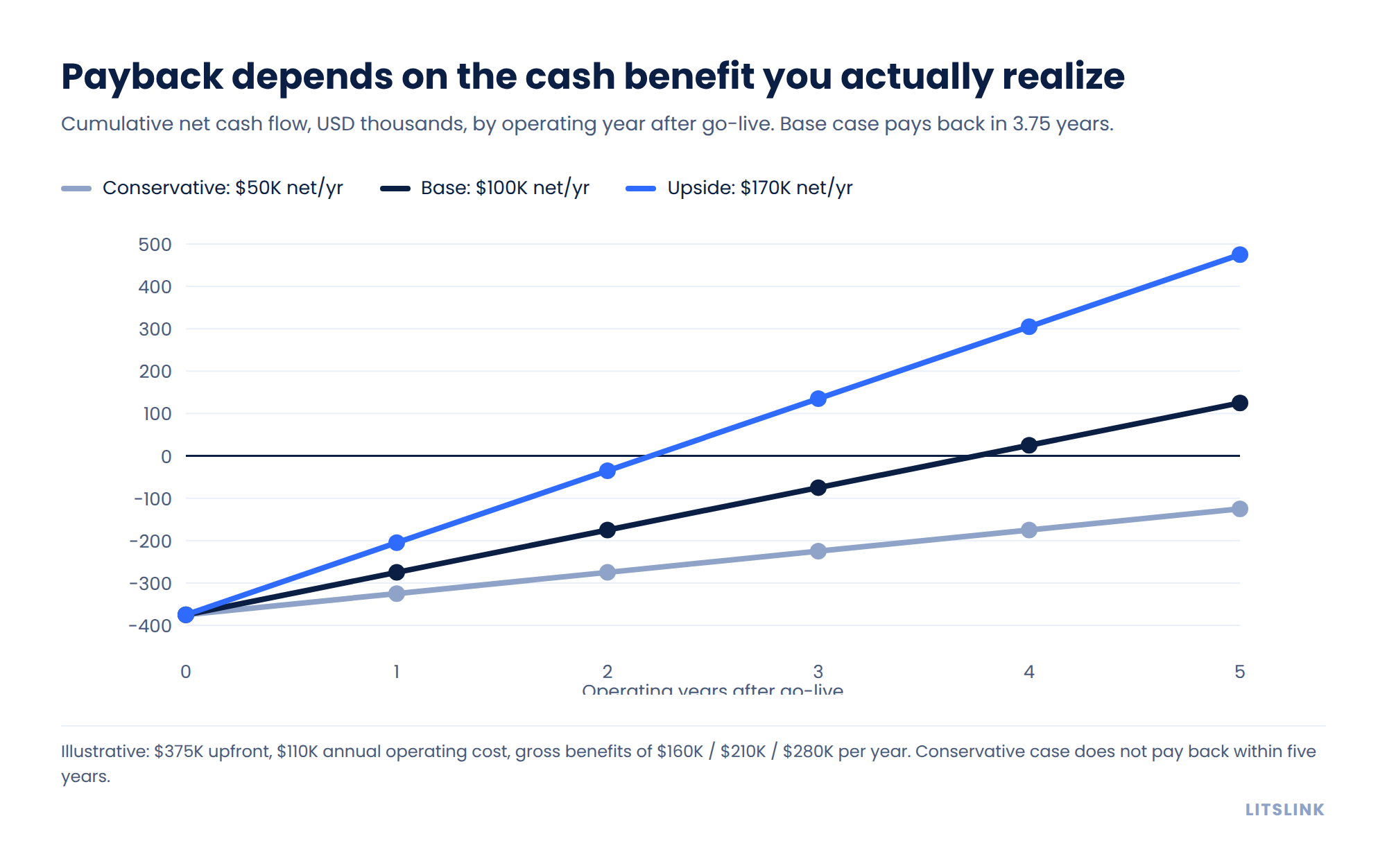
Dev agencies love to publish 6-month breakevens and 94% ROI figures for hospital management software. Vendor case studies, not peer-reviewed outcomes. The honest range for a bounded hospital platform is two to five operating years, and the variable that moves it most is adoption, not features.
Measure before and after go-live, and name the owner for each metric: median check-in time, no-show rate, discharge-readiness-to-actual-discharge, clean-claim rate, denial rework, days in accounts receivable, failed interfaces, incident duration. A shorter workflow in a pilot is evidence of time released. It becomes a cash saving only when a real expense stops. For broader adoption context, the AI in healthcare statistics and trends roundup is useful, but build the financial case from your own numbers.
How to Budget and Choose the Right Hospital Management System for 2026
If you’re a CIO or administrator with a board meeting coming, here’s what to do with all of this.
Budget on a five-year horizon, treating it as a strategic investment rather than a build price. License or development, plus implementation, plus five years of operations, plus exit. Ask every bidder to price the same boundary. The lowest first-year quote is usually the one that left the most out.
Choose the smallest system boundary that solves your measured problem. A hospital with capable electronic health records and a broken bed-flow process needs a bed-flow module. Replacing everything solves a problem nobody measured. Let the measured problem define the investment.
Treat 2026 regulation as scope, not background. The HIPAA Security Rule overhaul proposed in January 2025 would make nearly every safeguard mandatory (encryption, MFA, enterprise risk analysis). It isn’t final yet, and industry groups are fighting it as an unfunded mandate. Budget for it anyway. CMS-0057-F brings prior-authorization operational changes in 2026 and FHIR API requirements for payers in 2027, and your payer-facing workflows will feel both. TEFCA crossed one billion exchanged patient records in mid-2026, which means the question is no longer whether you’ll participate in national exchange, only when.
Price the breach you’re trying to avoid. IBM’s 2025 report puts the average US healthcare breach at $7.42 million, the costliest sector for the fourteenth straight year, with 279 days to contain. Change Healthcare’s 2024 ransomware event touched 192.7 million people and cost UnitedHealth $3.09 billion in direct costs through Q3 2024. Data security spending looks expensive right up until you divide it by that.
Walk the decision in stages, and assign each one an owner:
| Stage | Required evidence | Owner |
|---|---|---|
| 1. Establish scope | Workflows, sites, users, volumes, data, retained systems | CIO with clinical and operational leads |
| 2. Validate options | Scripted demos of normal and exception workflows | Department owners |
| 3. Price the full plan | Development or license, rollout, five-year ops, exit | Procurement and finance |
| 4. Evaluate technical fit | Integration proof, access model, recovery plan, export test | Architecture, IT ops, security |
| 5. Validate delivery | Implementation plan, staff capacity, acceptance gates, references | Program sponsor |
| 6. Confirm economics | Benefits, timing, sensitivity, risk reserve | CFO and benefit owners |
| 7. Approve rollout | Pilot results, safety readiness, support ownership | Hospital leadership |
Questions worth asking every vendor or development partner: What exactly is in the first payment and the recurring fee? What happens to the price if users, beds, or message volume double? Who pays for each external interface and sandbox? Who cleans the legacy data, and how many trial migrations are included? What support exists nights, weekends, and during go-live? Can we export complete records, attachments, and audit history, and at what cost?
Red flags: an initial investment above 1.5–2x annual outpatient revenue, mandatory AI modules making up more than 20% of the quote, contracts with no data-portability clause, and any partner who wants to skip discovery.
A structured custom healthcare software development assessment, the same one we run for hospital management system software before quoting, is the fastest way to turn this list into a scoped budget with the integrations, migration, and implementation work already in it. The estimate that helps is the one that states its assumptions clearly enough for you to challenge them.
Joe Moscola’s $1.2 billion was never the interesting number. The interesting number is what Northwell’s 28 hospitals were spending to run 30 different systems that didn’t talk to each other.
FAQ
How much does hospital management software cost in 2026?
There is no single meaningful hospital management software price. Custom development runs $50,000–$150,000 for a single module, $150,000–$500,000 for a full multi-module system, and $500,000–$2 million+ at enterprise scale. Commercial enterprise rollouts at large US health systems have been announced at $400 million to $1.2 billion. Add implementation and five years of operations to whichever tier applies.
What is the cost to develop hospital management software from scratch?
Estimate agreed effort by role and stage, then add implementation and operating cost. The worked example in this guide uses 5,000 development hours at a $60 blended rate for $300,000, plus $75,000 in migration and launch costs, plus $110,000 a year to operate. That’s an illustrative budget, not a quote.
Is cloud hospital management software cheaper than on-premise?
It shifts cost more than it removes it. Cloud lowers upfront hardware spend and moves infrastructure to a monthly operating expense, but hosting, egress, security, and support still accumulate. In a five-year infrastructure-only model, cloud came in about 23% lower, and one unmonitored $1,000-a-month resource would erase that gap.
What are the highest hidden costs in an HMS project?
Interfaces ($5,000–$25,000 each plus annual maintenance), legacy data cleanup, hospital staff backfill during training, the go-live productivity dip, parallel licenses for old systems, compliance audits, and the eventual cost of getting your data out.
How quickly will a hospital management system pay for itself?
For a bounded platform, two to five operating years is the honest range. The base case here is 3.75 years on $375,000 upfront and $100,000 in net annual benefit. Slow adoption is the variable that stretches it most.
Which core features drive hospital management system cost the most?
Clinical depth (orders, medication administration, clinical decision support) and integrations. Patient registration, scheduling, and patient portals are comparatively bounded. Anything that touches the clinical record, a payer, or a regulated device multiplies validation work.
Can a hospital use free open-source software instead?
OpenEMR and Bahmni are real products with real deployments. The license is free. Implementation, hosting, migration, security, and accountable support are not, and agency estimates for a consultant-led deployment run $45,000–$180,000 plus annual operations.
Not sure whether to build, buy, or connect?
We’ve delivered 14+ EHR/EMR and healthcare projects for US hospitals, clinics, and digital health companies, from a single-module MVP in 3–5 months to enterprise platforms with ONC certification paths. Tell us what you’re replacing and what’s in the way, and you get a 30-minute call with someone who has shipped healthcare software, a straight read on scope and risk, and an itemized estimate.
Get a free build-vs-buy assessment
Related case study: Dalth: SaaS Patient Engagement Platform & EHR Integration
Related reading:
- Custom Software Development vs. Off-the-Shelf Solutions
- AI Agents in Healthcare
- AI in Healthcare Statistics 2026: Market Size & ROI