





AI Agents for HR: Automate Processes and Empower Employees
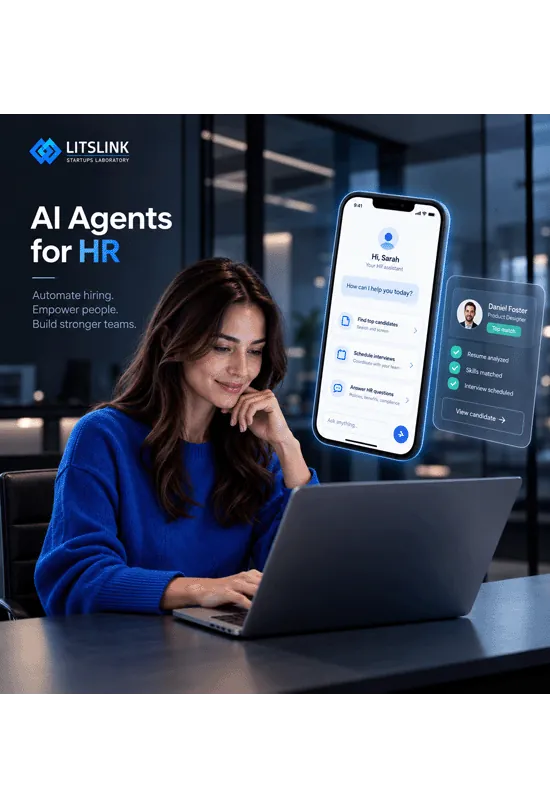
HR leaders need AI agents today to assist with the employee experience, payroll, compliance, and interview scheduling.
Here is what LITSLINK AI agents mean for your business:
- Quickly performed human resources operations
- Safe HR operations
- Highly scalable delivery
- Custom solutions
What Are AI Agents in HR?

AI agents in human resources are systems designed to perform the functions of a human resources professional. However, unlike traditional automation, AI agents use large amounts of both structured and unstructured data, along with machine learning, natural language processing, analytical tools, large language models, and generative AI techniques, to analyze employee requests, retrieve relevant data, and execute workflows within human resource information systems.
HR AI agents do far more than simply answer an employee’s questions. They can take action, making them useful to modern HR teams that rely on speed and accuracy every day to complete routine tasks.
Research shows that 72% of HR professionals utilize AI weekly. 79% of HR leaders plan to expand their use of AI across their HR operations. The reasons for this change are the increased workload, the expansion of distributed work teams, and the growing demand to improve the employee experience while minimizing costs.
The key difference between agentic AI and traditional automation is that the latter follows very fixed rules. In other words, if ‘X’ occurs, then ‘Y’ will occur as well. This makes it predictable; however, it is limited.
A distinguishing feature of agentic AI is its ability to interpret intent and handle multi-step tasks. For instance, when an agent receives a leave form, it will perform several tasks. This might include checking the PTO balance, reviewing team schedules, submitting the request, routing it for approval, updating employee records, and notifying the employee upon completion.
Key Benefits of LITSLINK AI Agents for HR
Enhanced Employee Experience
Before the use of AI, the HR employee experience was entirely manual. It involved employees spending time searching HR portals for information, navigating lengthy policies, manually submitting forms, and waiting for responses. The time-off request process can take up to three days and requires numerous back-and-forth interactions.
The introduction of AI agents has brought a whole new shift. An employee can say something as simple as “I’d like to take a vacation from August 15 to August 20.” Then the AI agent will:
- Check the employee’s leave balances
- Review teammates’ schedules for conflicts
- Submit a request to the HR system
- Route for approval from the manager
- Automatically update the internal HR record
- Send the employee confirmation of the completed task
This process does not include submitting any forms, hunting for a portal to submit your request, or sending follow-up emails.
Improved Decision-Making
Historically, the majority of HR teams used spreadsheets, monthly reports, and manually analyzed data from multiple systems. As a result, it often took weeks or months for patterns to become apparent, meaning HR teams were not able to prevent problems proactively but instead only reacted to them.
HR AI agents continuously monitor HR data through systems like HRIS, payroll management tools, and performance and engagement systems. For example, an HR AI agent might detect the following an increase in absenteeism in a specific department and immediately schedule a manager’s review meeting for the affected team.
Time & Cost Savings Across HR Processes
Research from IBM shows that automation in HR service delivery can reduce operational costs by around 50–60%, especially when employees use self-service systems for everyday requests. By automating repetitive tasks, HR professionals can use the time saved on routine administration to focus on important work that can shape the organization. This includes staff engagement, leadership support, performance conversations, and culture building.
Organizations can achieve cost savings as a result of:
- Reduction of worker hours by eliminating manual data entry
- Reduction of correction costs due to fewer payroll management and benefits errors
- Minimized paper-based processes and manual approvals
- Reduced requirement for personnel increases to support HR teams at the same rate as company growth
Scalability
AI HR agents enable organizations with growing workloads to manage demand without hiring additional employees. Whether a company has 100 employees or 10,000, the same system can handle requests at scale. The use of an AI agent for HR is beneficial for fast-growing startups and distributed teams where demand for HR exceeds HR headcount.
What LITSLINK HR AI Agents Can Do
AI agents help HR operate at a higher pace, reduce repetitive tasks, and support more effective decision-making across all HR processes.
Employee Onboarding & Training
AI agents automate everything from document verification to pre-employment checks. All required elements for compliance with both the employee’s and the employer’s policies have been verified and are ready before the first day of work. At the same time, the request to set up the IT system is automatically generated, ensuring the employee will have access to all their tools, accounts, and systems.
Another advantage of using an AI agent is the ability to build a structured onboarding process once the employee is hired. Upon establishing the employee in the system, the AI agent registers the employee’s profile and assigns training based on their role, department, and employee experience. For example, a new engineer is trained on a specific technology stack rather than a generic one.
Beyond that, employees can ask for real-time assistance, such as where to find internal documentation or how a given workflow works. The employee will then receive answers based on the company’s knowledge. The HR AI agents also provide role-specific guidance as needed, rather than flooding new hires with too much information at the start.
Leave Management
An HR AI agent that responds to an employee’s leave request will check their remaining PTO and ensure the request complies with company policy. The agent will then check the team calendar to avoid conflict before submitting the request for manager approval.
Once the request has been approved, the HR system records will be updated automatically, ensuring payroll data is accurate and eliminating the need to enter the request manually. The employee will also receive real-time updates on the request, rather than having to wonder about its status.
Hiring managers benefit as well, with live visibility into team availability, upcoming absences, and workload distribution. This helps them prevent situations in which too many people are off at once, which often negatively impacts operations.
The agent also provides reminders and notifications, such as when leave is approaching or when an approval is overdue, to keep all parties on track without requiring HR to follow up.
Employee Engagement & Retention
AI capabilities help to maintain that engagement by tracking milestones and personal events. This includes birthdays, work anniversaries, and promotions, as well as life changes such as a new baby. The agent can deliver personalized acknowledgments instead of sending out generic automated messages. It can even recommend thoughtful gestures according to the company’s culture.
In addition, the agent supports long-term retention by recommending career growth and talent development opportunities. Based on an employee’s skills, position held, and performance history, it can recommend training programs, internal positions, and development plans that the employee has not yet considered.
HR Workflow Automation
For payroll, AI agents can process input data, calculate any adjustments, and flag discrepancies before an employee is aware of the error. For benefits administration, they can handle updates or perform an eligibility check. In recruiting, they can summarize a job candidate’s interview, organize feedback, and keep hiring pipelines moving.
AI agents can also perform an important task of monitoring compliance. This includes tracking missing documentation, identifying policy violations, and alerting the appropriate HR personnel before issues arise.
Employee Self-Service & HR Support
Instead of searching for the information they need through various portals or waiting for HR to reply to their inquiries, employees now access a single conversational interface. This system understands context and pulls answers from company rules, employee handbooks, benefits documents, and internal knowledge bases.
So, when employees ask, “What is our maternity leave policy?”, “How do I update my bank details?” or “What benefits do I qualify for?” — they will not just receive a generic reply; instead, they receive an accurate, company-specific answer that matches their role, location, and eligibility.
The real value in this solution is that all employees will receive consistent responses, no matter who they are or when they ask the same questions. This reduces confusion, prevents the misinterpretation of company policy, and eliminates many unnecessary HR tickets.
Enrollment Support
Employees are guided through each step of the enrollment process by AI agents, making this process easier and more convenient for them. They provide clear, simple explanations of available insurance plans, retirement programs, and wellness initiatives, and also help employees with training. Employees do not have to read lengthy policy documents, as AI agents provide direct explanations tailored to each employee’s role and location.
An HR AI agent helps collect all the required information and automatically determines an employee’s benefits eligibility. In addition, it helps complete forms and offers real-time tracking of their application status, ensuring they know at all times where they stand in the application process.
If anything is missing from an employee’s enrollment application, the HR AI agent will notify the employee immediately or send a reminder to reduce the delay often caused by such issues.
Performance Monitoring & Growth
AI agents continuously track employee performance and provide HR professionals with visibility into ongoing development plans. These AI systems can define clear employee performance targets based on the expectations of their role and job descriptions. They will then utilize real employee data from performance systems, task completion, or project outcomes to regularly track progress over time.
These HR agents can also suggest internal opportunities for existing employees, matching their skill set or qualifications. This helps employees advance within the company rather than seek employment elsewhere.
In addition, managers can receive performance trend summaries generated by AI agents, as well as feedback insights. This helps ground performance conversations in real employee profiles and data rather than simply relying on memory or assumptions.
Wondering how AI agents can streamline your HR processes? Let’s discuss your use case
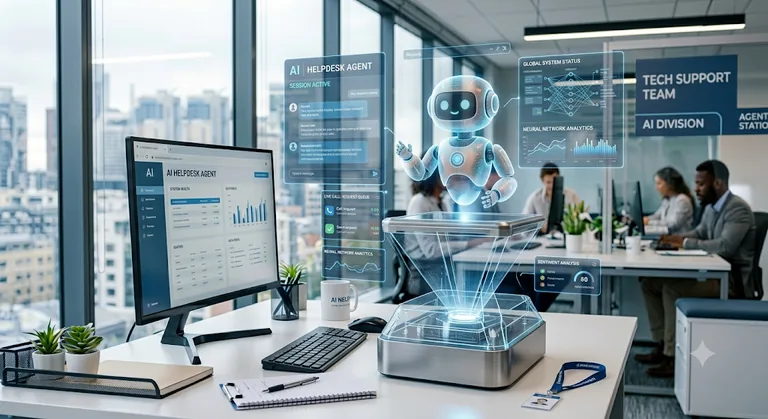
Case Study: AI Helpdesk Agent
Key figures
- 24/7 availability of employee support
- HR ticket volume reduction by 60%
- 40% faster response time
- Thousands of employee queries resolved each month automatically
Problem
A large US hotel group with thousands of employees across multiple locations faced significant challenges due to the rising demand for HR support. The HR department was overwhelmed by the volume of routine employee questions across payroll, benefits, leave policies, and internal procedures. Employees who work on different shifts and at multiple locations often require assistance outside of HR’s standard operating hours.
This led to a persistent backlog of tickets, longer response times, and inconsistent answers across the organization’s various locations. The HR department spent the majority of its time repeating the same information rather than focusing on employee development, engagement, and workforce planning.
Solution
LITSLINK built an AI-powered HR helpdesk agent that is fully integrated with HR systems and company documentation.
The AI helpdesk agent:
- Provided instant answers to employee questions via policy and payroll data
- Provided real-time, employee-specific information on benefits and leave
- Guided employees through common HR requests and workflows
- Escalated complex cases to HR professionals with full context
- Logged all interactions for compliance and reporting
This resulted in an accessible, single-layer HR support system that managed routine requests automatically while allowing HR professionals to handle exceptions and high-value work.
Impact
The result of this new system was instant, accurate HR support for employees at all locations, available around the clock. As a result, HR ticket volume dropped by 60% and average response time improved by 40%, which increased employee satisfaction.
Overall, this resulted in a tremendous decrease in operational pressure on HR teams and removed most repetitive HR support activities. As such, HR staff had more time to devote to strategic initiatives like staff engagement, retention programs, and workforce development.
The hotel group now operates a scalable HR support system that delivers consistent service quality without increasing HR headcount, even during high-demand periods.
Client Reviews & Testimonials
LITSLINK is recognized across leading industry platforms for delivering high-quality software solutions. See what clients and the design community say about our work.

Our AI Agent Technology Stack
We pick tools based on what the problem needs, not what’s currently generating hype. That said, here’s the landscape we work across.
LLM Providers
OpenAI (GPT-5, GPT-5.4), Anthropic Claude, Google Gemini, Meta Llama, Mistral – we’re model-agnostic and will recommend the right fit for your use case, cost profile, and data privacy requirements.
Agent Frameworks & Orchestration
LangChain, LangGraph, CrewAI, Semantic Kernel, LlamaIndex, Microsoft AutoGen – framework selection depends on your agent architecture and workflow complexity.
Vector Databases & RAG
Pinecone, Weaviate, Chroma, FAISS – for retrieval-augmented generation and knowledge management.
Workflow & Process Orchestration
Apache Airflow, Prefect, Temporal – for reliable task scheduling and workflow management at scale.
Cloud Platforms
AWS (Bedrock, SageMaker), Microsoft Azure AI, Google Cloud Vertex AI – full cloud provider expertise, with no lock-in to a single platform.
ML Frameworks
TensorFlow, PyTorch – for custom model development and fine-tuning when off-the-shelf isn’t enough.
Security & Compliance
GDPR, HIPAA, SOC 2, CCPA – built in from architecture through deployment. Encryption at rest and in transit, role-based access controls, and comprehensive audit trails.
Backend & Infrastructure
Node.js, Python, FastAPI, Docker, Kubernetes – production-grade infrastructure for reliable agent deployment at scale.
Model-agnostic by design. We don’t lock you into a single provider. Our architecture lets you swap models as the landscape evolves — without rebuilding your entire system.
Why Partner with LITSLINK for Enterprise HR Automation?
Autonomous AI Agents Tailored to Your Business Needs
We build AI agents custom-designed to match your HR department’s actual needs. This includes fully integrated onboarding flows, policy automation, payroll assistance, and performance tracking. We also develop systems that integrate HR platforms, enabling information to move easily from one platform to another without human intervention.
Functional AI Prototype in 4–6 Weeks
We can develop and deliver a working prototype to you within 4 to 6 weeks. Full production systems typically take 3 to 6 months to complete, depending on scope. Our objective is to get you up and running with a solution as quickly as possible and to use the feedback to refine the final product.
A Team of 300+ Technology Experts
We have over 300 technology experts dedicated to developing AI agents. We have all the skill sets and complete development you need, including:
- AI engineers
- Data scientists
- NLP/LLM specialists
- Solution architects
- DevOps engineers
- QA experts
Full Control Over Your Intellectual Property
You will retain complete ownership of your solution upon delivery, including the source code, prompts, integration code, and data movement.
Long-Term Support
We will support you after your solution goes live, with maintenance, updates, and agent training as your HR workflows evolve.
See how custom AI agents can help your HR team scale.
Contact our expertsHow We Deploy AI Agents
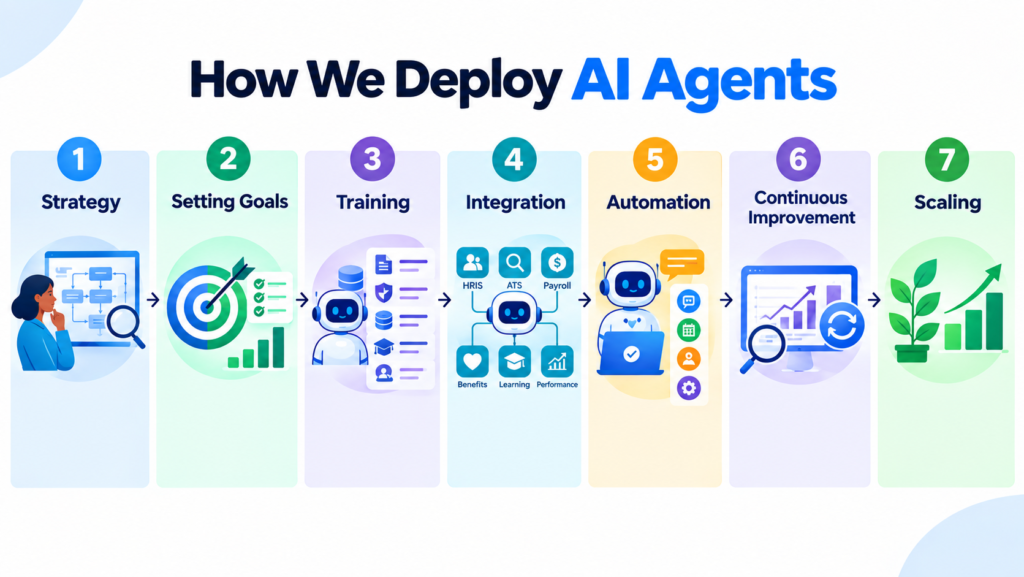
Before we deploy AI agents, we conduct a thorough review of your HR workflow. This involves how requests move through HR today, where delays happen, and which tasks consume the most time.
After that, we identify bottlenecks like repetitive queries from employees, manual approvals, and disconnected systems. This is done to determine the appropriate location for implementing an HR AI agent without hindering critical operations.
After understanding your organization’s workflow, we will establish specific, measurable goals for the AI agent directly tied to HR outcomes. Examples of such outcomes include faster employee response times, reduced workload for the HR department, improved accuracy in HR processes, and better employee support. Additionally, as we develop the AI agent, we will identify the most impactful tasks to automate and establish clear automation priorities.
The agent is trained to recognize, respond, and act with confidence and consistency, drawing on your company’s HR knowledge and operational data. Typical examples include policies, payroll rules, benefits documentation, training, performance frameworks, compliance requirements, and other company and sensitive employee data, ensuring all responses are based on your organization’s specific HR workflows rather than generic ones.
Following your agent’s training, the HR AI agent links to all of your primary human resources systems, including HRIS, ATS, payroll systems, benefits tools, learning systems, and performance management systems. Therefore, the AI agent can retrieve sensitive employee data and perform actions directly within any of your existing HR systems. The final result is a complete HR system with an AI agent that can respond and take action across various systems.
Once live, the HR AI agent will perform actual HR activities, such as responding to employee inquiries, processing leave requests, helping onboard new employees, assisting trainees with their training, and managing policy requests. The AI agent will continue to operate under established rules, adapt to employee input, and improve response accuracy as it uses real-world data.
We will continue to analyze your AI agent’s performance against the goals originally set for it. Metrics will include response accuracy, time to resolve employee inquiries, employee satisfaction, and efficiency in company workflows. Adjustments to your agent’s knowledge base, as well as improvements to responses and workflows, will be made based on the data collected and feedback received. Therefore, the system’s effectiveness grows over time.
After the HR agent is established and has achieved a steady level of performance, we will continue to add business processes and HR functions within your company. This can include onboarding, performance management, employee engagement, leave management, and internal support systems. With LITSLINK support, organizations scale gradually to ensure stability while maximizing efficiency gains across the entire HR function.
01 Strategy
Before we deploy AI agents, we conduct a thorough review of your HR workflow. This involves how requests move through HR today, where delays happen, and which tasks consume the most time.
After that, we identify bottlenecks like repetitive queries from employees, manual approvals, and disconnected systems. This is done to determine the appropriate location for implementing an HR AI agent without hindering critical operations.
02 Setting Goals
After understanding your organization’s workflow, we will establish specific, measurable goals for the AI agent directly tied to HR outcomes. Examples of such outcomes include faster employee response times, reduced workload for the HR department, improved accuracy in HR processes, and better employee support. Additionally, as we develop the AI agent, we will identify the most impactful tasks to automate and establish clear automation priorities.
03 Training
The agent is trained to recognize, respond, and act with confidence and consistency, drawing on your company’s HR knowledge and operational data. Typical examples include policies, payroll rules, benefits documentation, training, performance frameworks, compliance requirements, and other company and sensitive employee data, ensuring all responses are based on your organization’s specific HR workflows rather than generic ones.
04 Integration
Following your agent’s training, the HR AI agent links to all of your primary human resources systems, including HRIS, ATS, payroll systems, benefits tools, learning systems, and performance management systems. Therefore, the AI agent can retrieve sensitive employee data and perform actions directly within any of your existing HR systems. The final result is a complete HR system with an AI agent that can respond and take action across various systems.
05 Automation
Once live, the HR AI agent will perform actual HR activities, such as responding to employee inquiries, processing leave requests, helping onboard new employees, assisting trainees with their training, and managing policy requests. The AI agent will continue to operate under established rules, adapt to employee input, and improve response accuracy as it uses real-world data.
06 Continuous Improvement
We will continue to analyze your AI agent’s performance against the goals originally set for it. Metrics will include response accuracy, time to resolve employee inquiries, employee satisfaction, and efficiency in company workflows. Adjustments to your agent’s knowledge base, as well as improvements to responses and workflows, will be made based on the data collected and feedback received. Therefore, the system’s effectiveness grows over time.
07 Scaling
After the HR agent is established and has achieved a steady level of performance, we will continue to add business processes and HR functions within your company. This can include onboarding, performance management, employee engagement, leave management, and internal support systems. With LITSLINK support, organizations scale gradually to ensure stability while maximizing efficiency gains across the entire HR function.
FAQ
01 What are the Most Popular AI Agents for HR Managers?
By and large, the most popular AI agents among HR practitioners are employee experience and HR helpdesks, although there are countless recruiting-focused tools.
02 Is Employee Data Safe with AI Agents?
Yes, HR AI agents are secure through encryption, role-based access controls (RBAC), audit trails, and secure authentication when deployed. Additionally, they may also comply with GDPR, SOC 2, and CCPA depending on the implementation.
03 How Long Does AI Agent Development Take?
It takes about four to six weeks to produce a prototype and three to six months to build a fully functional system.
04 How Much Does It Cost to Build an HR AI Agent?
- Simple Task-Specific Agent: $4,350 – $13,100
- Workflow Agent with Integrations: $20,400 – $53,800
- Multi-Agent Enterprise System: $81,000+
You can check out the AI agent development cost page for a more detailed explanation.
05 Are AI Agents Replacing HR Teams?
No. Although AI agents help HR teams by handling repetitive, labor-intensive administrative tasks, HR professionals will continue to manage relationships, shape company culture, be involved in talent acquisition and development, make sensitive and ethical decisions, and demonstrate leadership.
Thank you! Your request has been sent — our team will get back to you within 48 hours.
Have a Project in Mind?
Tell us about your use case, constraints, and goals. Our team reviews every inquiry and responds within 48 hours.
Next steps
LITSLINK specialist reviews your request and contacts you to discuss the details
If needed, we sign an NDA before moving forward
We send a project proposal – estimates, timeline, and team CVs included
After launch, we stay on for any updates your product needs