







Key Takeaways
- Fintech software development companies selected solely on verified Clutch and G2 reviews and actual product launches.
- In 2026, the global fintech development market reaches $78.79 billion, growing to $156.19 billion by 2035.
- Deloitte expects only half of EU financial institutions to reach full DORA compliance by 2025, with 38% targeting 2026.
- In 2026, DORA, MiCA, and the GENIUS Act take effect simultaneously.
- Our leader is LITSLINK. They developed a high-volume private stock exchange integrated with the Hong Kong Stock Exchange.
Global Growth Insights projects the global fintech software market to reach $78.79 billion in 2026, and $156.19 billion by 2035. A bug in a food delivery app is simply poor UX. A bug in a payment platform is a compliance incident. That’s why choosing a fintech development partner is fundamentally different from hiring a general-purpose agency.
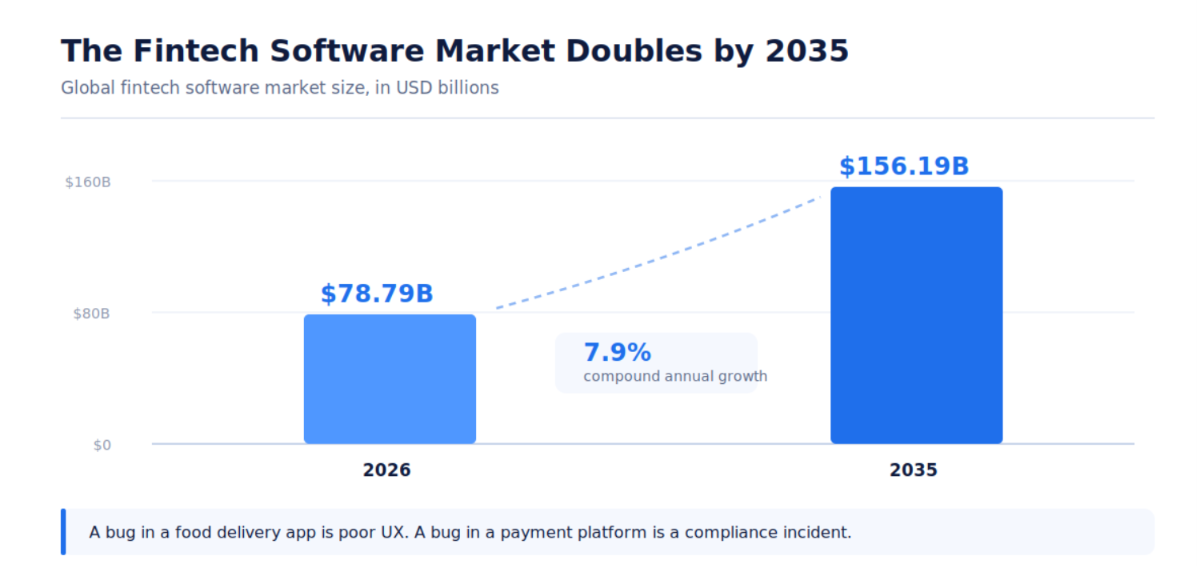
Source: Global Growth Insights
In 2026, three regulatory frameworks are in effect simultaneously. DORA took effect in the EU in January 2025. The MiCA transition period, meanwhile, ended on July 1 next year. After this date, any crypto service provider serving EU customers without authorization violates European law. The GENIUS Act took effect in the U.S. in July 2025, creating the first federal licensing system for payment stablecoins. Navigating regulatory requirements is no longer just a nice bonus.
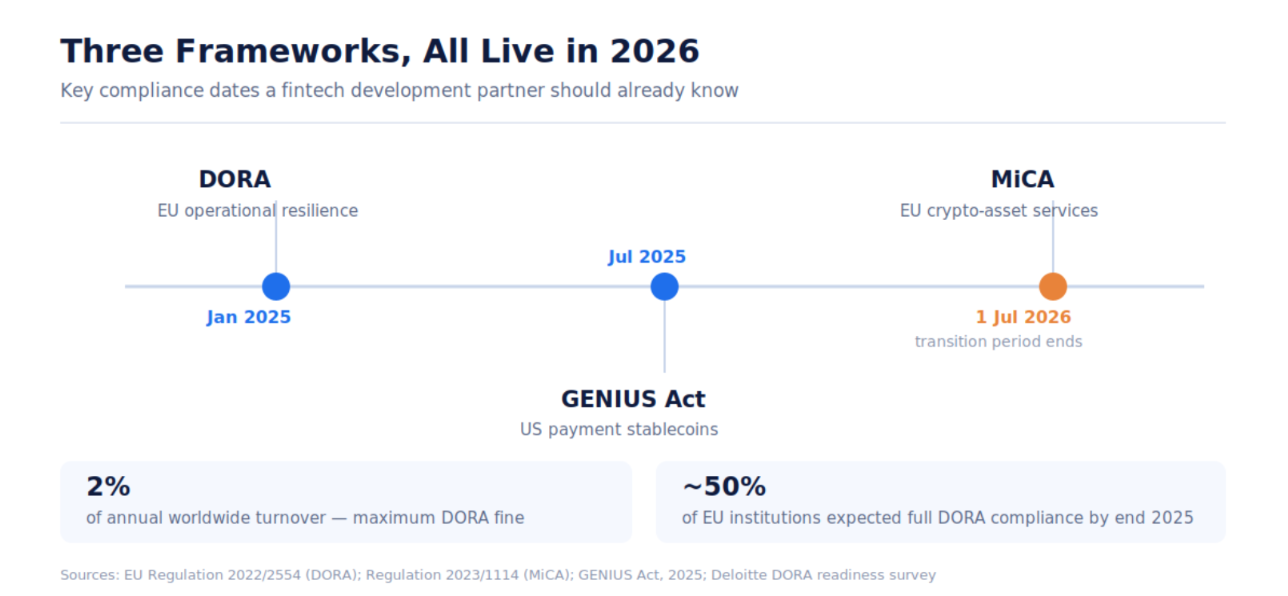
Sources: EU Regulation 2022/2554; EU Regulation 2023/1114; GENIUS Act 2025; Deloitte
Compliance experience is the filter that shortened this list. Twelve firms passed it, spanning digital banking, lending, wealth management, and embedded finance. Each has verified Clutch and G2 reviews and named fintech case studies behind them.
Quick Comparison: Top Fintech App Development Companies at a Glance
Scan this table to see where each firm’s strength sits. Full profiles follow below. Use it to narrow the field, not to make the final call.
| Rank | Company | Best For |
|---|---|---|
| 1 | LITSLINK | Custom fintech app development and embedded finance |
| 2 | Itexus | Fintech-exclusive delivery since 2013 |
| 3 | Softjourn | Payment processing systems and card platforms |
| 4 | KindGeek | Neobanking, lending, and AI fraud detection |
| 5 | Zoolatech | Full-cycle engineering for Series A–C startups |
| 6 | Armada Labs | Regulatory-compliant lending products |
| 7 | TechMagic | Mid-size product engineering |
| 8 | Diceus | Enterprise fintech and banking modernization |
| 9 | Vention | Dedicated fintech engineering teams |
| 10 | SoluLab | Blockchain and Web3 fintech |
| 11 | Praxent | UX-led redesigns for banks and credit unions |
| 12 | Relevant Software | Vendor research and advisory-grade diligence |
How We Ranked These Companies
Four things decided the order, and one thing decided exclusion.
- Named client work. A firm had to point at a specific product it built for a specific client. Industry logos on a homepage did not count. Where a case study is under NDA, we said so rather than pretending otherwise.
- Verifiable compliance credentials. ISO 27001, SOC 2, PCI DSS, and similar certifications are auditable facts. Claims of being “compliance-ready” are not.
- Independent review platforms. Clutch and G2 ratings, with review counts attached. A perfect score from six reviews carries less weight than 4.8 from a hundred.
- Regulatory depth in fintech specifically. Experience shipping under DORA, MiCA, KYC/AML, or the GENIUS Act, not general security awareness.
- What got a firm excluded: self-reported numbers with nothing behind them. Where a company’s own claim is the only source, we labeled it that way in the profile.
Ratings and review counts move, certifications lapse, and firms change ownership. Verify anything here against the source before it goes into a procurement decision.
LITSLINK — Best for Custom Fintech App Development and Embedded Finance Solutions

LITSLINK builds custom financial software for banks, neobanks, and fintech startups. The work spans digital banking, investment management, lending, embedded finance solutions, and payment processing. This is custom fintech software development for regulated financial institutions, not generic app development. AI-powered financial analytics, blockchain, payment gateways, and trading platforms. Mobile banking apps, digital wallets, and fraud detection also all sit inside that scope.
The clearest proof is a shipped product. LITSLINK engineered a high-load private stock exchange integrated with the Hong Kong Exchange, the third-largest exchange in its region by market capitalization. The build runs on a microservices architecture using React.js, Spring, RabbitMQ, Socket.io, and Redis. Trading platforms fail differently than consumer apps: latency, concurrency, and encryption are not optional extras. This one handles thousands of transactions per second.
A second named project, CExchange, sits alongside it in the fintech portfolio. Both are live products, not concept work.
The company track record behind those builds:
- 1,540+ completed projects;
- 1,000+ clients across 82 countries;
- 300+ engineers and technology specialists.
LITSLINK pairs US-based project management with senior European engineering talent. Time zones overlap without 2 a.m. calls. Data encryption and secure transactions are designed during architecture. The same team stays on after launch for maintenance and iteration. For deeper reading, see LITSLINK’s own Fintech Software Development Companies ranking, the Digital Wallet App Development Guide, and LITSLINK Custom Software Development.
Contact LITSLINK for a free consultation to discuss your fintech build.
Itexus — Best for Fintech-Exclusive Delivery Since 2013
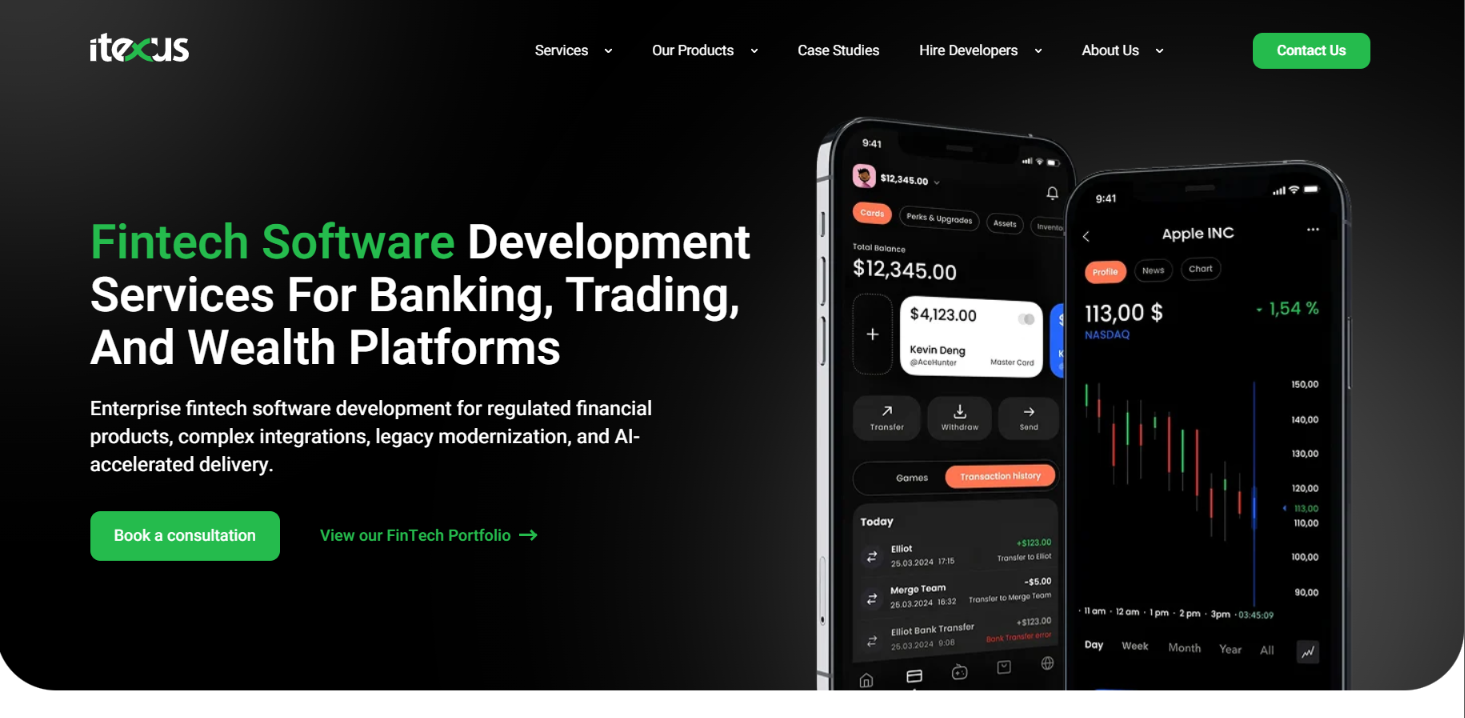
Itexus has been working with financial software since 2013. The numbers back that specialization. Over 300 fintech projects, delivered for clients in 23 countries. The products are developed by over 160 full-time engineers, more than 70% of whom are at the Senior level. The company builds digital banking platforms and stock trading systems. Investment management, crypto, and insurance round out the list. Its processes are compliant with SOC 2, PCI DSS, and ISO 27001 standards. Regulatory compliance runs through the whole delivery cycle, including quality assurance for financial-grade code.
In Delaware, with its engineering center in Eastern Europe. Only full-time employees, not offshore contractors, are involved in projects. For vendor control systems, this means one legal entity. It also means a unified employment framework for everyone with access to the production environment. This is the optimal choice for founders who need a focused partner. No attention spread across unrelated industries.
Softjourn — Best for Payment Processing Systems and Card Platforms

Softjourn has built financial software since 2001 — over two decades in payments specifically. The firm runs 300+ people from a Silicon Valley base with R&D centers in Eastern Europe and Brazil, and has delivered 150+ fintech projects.
Its depth sits at the transaction layer. The portfolio covers payment processing and gateways. Prepaid and gift card platforms sit alongside corporate card programs. Core banking systems, FX trading, and BNPL products sit alongside them. Payment processing at this depth is its own discipline. The firm handles KYC, AML, and PCI DSS work in-house rather than outsourcing it. The team integrates with Visa, Mastercard, and Stripe. It has also taken bank clients through both FDIC and PCI DSS audits. Named clients include PEX, PaySign, Versapay, and Tribal Credit. Best for payment and card products where transaction-layer experience decides the outcome.
KindGeek — Best for Neobanking, Lending, and AI Fraud Detection
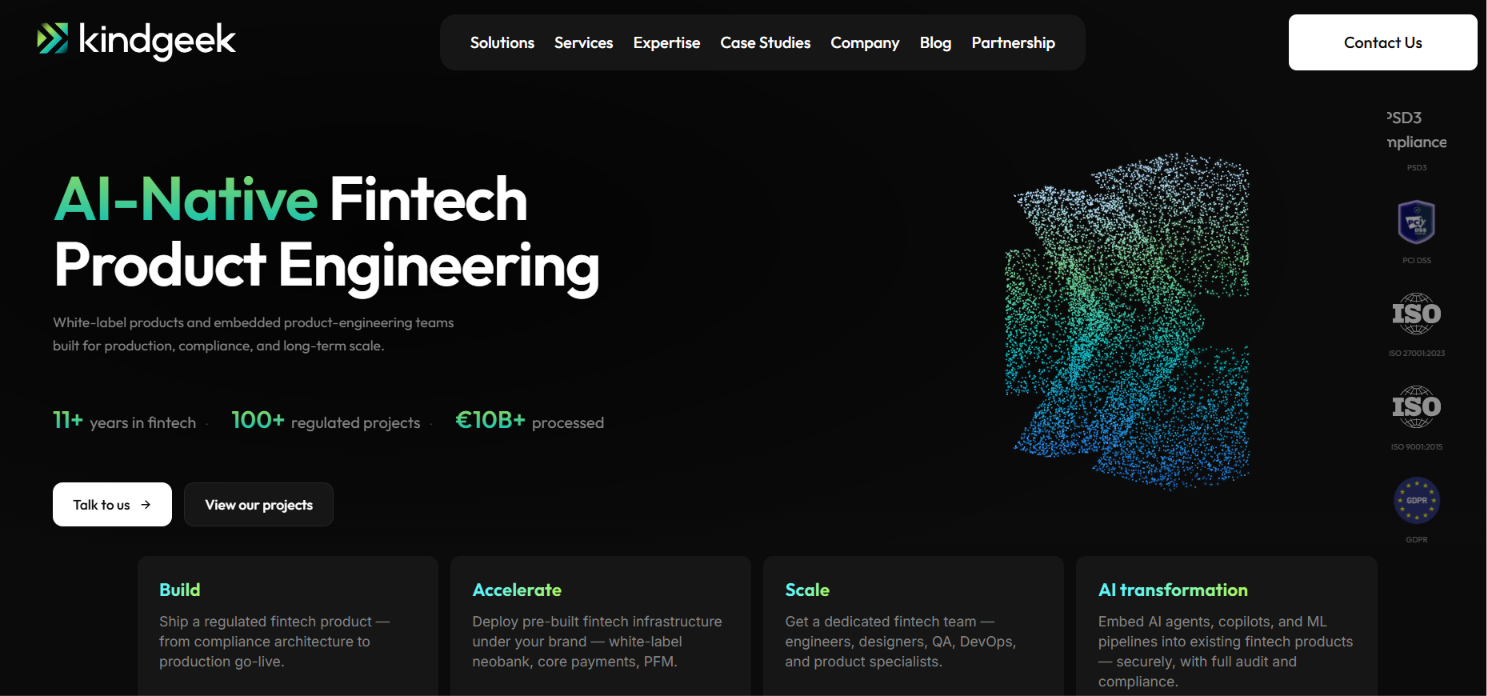
More than €10 billion has flowed through platforms developed by KindGeek. Over 80% of their portfolio consists of financial services, encompassing more than 100 regulated products since 2013. The company develops platforms for digital banking and lending. As well as AI-based tools for fraud detection and compliance.
KindGeek is ISO 27001 and ISO 9001 certified. Development is conducted by PCI DSS, PSD2, GDPR, and DORA requirements. Their engineers come to a project already knowing card payment system regulations, KYC processes, and AML controls. This eliminates the delays that come from learning regulatory requirements on the job. Generalist teams typically lose time there. A white-label stack for neobanks cuts launch times too. Roughly one year becomes a few weeks. This is the optimal choice for founders of neobanks and lending platforms. They get AI-powered financial analytics and built-in compliance from the very first sprint.
Zoolatech — Best for Full-Cycle Engineering for Series A–C Fintech Startups
Zoolatech staffs engagements with senior engineers with strong technical expertise in financial workflows. Its work covers payments, lending, core banking modernization, and wealthtech for both startups and established financial institutions.
The model suits a specific problem: architecture decisions made carelessly at Series A become a full rebuild at Series C. Best for scaling startups that need those decisions made the first time correctly.
Armada Labs — Best for Regulatory-Compliant Lending and Consumer Credit Products
Armada Labs combines strategy consulting with MVP development, weighted toward regulatory depth. The firm built its own lendtech product. It is a debt-negotiation SaaS platform engineered to FDCPA and TCPA standards.
That matters more than it sounds. A team that has shipped its own regulated product has felt the consequences of getting compliance wrong. Reading about them is not the same thing. Best for consumer lending and debt products where the regulation defines the product.
TechMagic — Best for Mid-Size Product Engineering for Financial Platforms
Founded in 2014, TechMagic has delivered 200+ projects with a team of 320+ specialists. It holds a 4.8 rating on Clutch. Its fintech work runs from trading and order-management systems to consumer banking infrastructure and wealth management software. Cloud services, data engineering, and cybersecurity services sit alongside.
The credentials are worth noting for regulated work. TechMagic is ISO 27001-aligned, CREST-accredited, and an AWS partner. Security engineering shows up in the delivery detail too. Biometric authentication, data encryption, and tokenization appear across its financial builds. Best for mid-size fintech products that need serious engineering without enterprise-scale overhead.
Diceus — Best for Enterprise Fintech and Banking Modernization
Founded in 2011 and based in Wrocław, Diceus built its reputation in insurance technology first. Its named clients include UNIQA, Vienna Insurance Group, Fairfax Group, and WTW. The first product, an insurance broker platform for Willis, served over 200,000 users.
That insurance depth carries into banking work. Diceus acts as a system integrator for banking and fintech, implementing CRM, core banking platforms, and middleware solutions. Its work with legacy systems drives digital transformation for institutions that cannot start over. It holds partner status with Microsoft, Google Cloud, and Oracle. Legacy modernization is a different discipline from greenfield product work. It means integrating with systems written decades ago while keeping them running. Best for established financial institutions replacing infrastructure rather than startups building from zero.
Vention — Best for Dedicated Fintech Engineering Teams
Vention runs three engagement models: project outsourcing, dedicated teams, and staff augmentation. Teams launch within two weeks of contract signature. The firm holds 101 verified Clutch reviews and partnerships with AWS, Google Cloud, and Microsoft.
The fintech portfolio has names attached. Vention built the revamped frontend and CommodityView analytics platform for Barchart. Barchart’s own clients include Goldman Sachs and Nasdaq. On a separate trading platform rebuild, Vention engineers augmented the client’s in-house team. They shipped native iOS and Android apps that handle 20 million trading inquiries a day. By the company’s own count, its client work has contributed to $13 billion in acquisitions and 21 IPOs.
You get engineers who accumulate domain context over quarters. Best for founders who want a stable embedded team, not a rotating project crew.
SoluLab — Best for Blockchain and Web3 Fintech
SoluLab has been building since 2014 with 250+ engineers, data scientists, and AI specialists. It has delivered over 1,500 projects in more than 15 countries, roughly 150 of them blockchain builds. Clutch rates the firm 4.9. Past clients include The Walt Disney Company, Mercedes-Benz, and the University of Cambridge.
Its fintech portfolio covers digital wallets, trading apps, lending platforms, RWA tokenization, custody, and NFT marketplaces. Machine learning sits underneath much of it. The company holds ISO 9001 and SOC 2 certification. It also states support for SEC, MiCA, VARA, and GDPR requirements. For a crypto product now inside the MiCA regime, that claim is worth testing on the first call. Best for crypto-native financial products where regulatory exposure is already on the roadmap.
Praxent — Best for UX-Led Fintech Redesigns for Banks and Credit Unions
Praxent runs 100+ specialists and has delivered 400+ projects. The firm pairs UX research with engineering for community banks, credit unions, and financial service providers offering wealth management tools. It belongs to the Association of Financial Technology. It also belongs to the National Association of Credit Union Service Organizations. Those memberships signal where its client base sits.
The Meriwest case shows the method. Meriwest is a $2 billion credit union serving the Bay Area and Pima County, Arizona. It had rolled out NCR’s Terafina account-opening product and was losing prospects partway. Praxent audited three workflows, then interviewed people who had started an application and quit. That second step is the one most agencies skip. Best for regulated institutions whose real problem is a dated customer experience.
Relevant Software — Best for Fintech Vendor Research and Advisory-Grade Diligence
Relevant Software has been building financial software solutions since 2013, with 246 projects and 98% client satisfaction on its Clutch profile. Delivery aligns to ISO, GDPR, and HIPAA requirements.
The FirstHomeCoach case is the clearest one. UK fintech Life Moments had three months to ship a working MVP or lose government support. Relevant delivered the mortgage platform on that deadline. A savings-goal recommendation engine runs on serverless AWS Lambda underneath. A separate lending rebuild absorbed a peak of roughly 7,000 loans. That client reported net profit up 25% year over year in its Clutch review.
The firm is small enough that partners stay involved in individual accounts. That is an advantage for diligence-heavy work and a constraint if you need fifty engineers next quarter. Best for founders who want vendor and regulatory diligence treated as part of the deliverable.
How to Choose the Right Fintech Development Partner
The team you liked in the demo call has never filled out a SOC 2 questionnaire. You will find that out in month four, when your first enterprise customer sends one over.
Confirm Real Custom Software Development Experience, Not Fintech Buzzwords
Plenty of development companies added “fintech” to a services page last year, alongside promises of tailored solutions. Ask for names: which innovative financial products has this team actually shipped, and are they live today? Industry logos on a homepage prove a sales conversation happened, nothing more.
Check Their Software Development Company Track Record in Regulated Industries
Compliance expertise comes at a high cost, and someone has to pay for it. If the team has never worked in a regulated industry. You’ll be the one footing the bill. Ask them specifically which standards—PCI DSS, SOC 2, KYC/AML, or GDPR. They’ve actually worked with and on which projects.
How do they integrate new code into core systems dating back to the 1990s? What does their quality assurance (QA) process look like when a rounding error becomes a regulatory incident? Vague answers at this stage are a surefire recipe for costly surprises down the road.
Ask About Mobile App Development Alongside Web
A fintech product almost always ships on two surfaces at once, and they have to behave identically. Confirm the right development partner handles mobile app development, web app development, and backend development in one team.
Ask who writes the mobile code, who writes the web code, and who writes the backend. Handing one piece to a subcontractor adds a coordination seam exactly where consistency matters. A payment flow that behaves differently on iOS than on web is a support problem. It is also a compliance question.
Confirm Payment Processing Systems Experience Specifically
Payment systems carry requirements a generic web app never faces. Idempotent transaction flows prevent double charges on retry. Decimal-precision money math prevents rounding errors that compound across millions of transactions. Reconciliation under concurrency keeps ledgers accurate when thousands of operations land at once. Secure transaction design covers the rest. Pick one payment system from their portfolio and walk through it together. What happens when the gateway times out mid-transaction? The answer tells you whether they have built one or only integrated one.
Ask If They’ve Built Investment Management or Wealth Tools Before
Investment products answer to a different rulebook than payments or lending. Wrong price on a portfolio screen is not a display bug; it is a reporting problem with a regulator attached. A team fluent in payment rails will not automatically transfer that skill to portfolio management or trade reporting. Ask for examples inside your specific vertical. Ask how they approach emerging technologies like AI-driven portfolio analysis in investment management, and whether they have shipped it.
FAQs
How Much Does It Cost to Build Fintech Software? Published 2026 estimates disagree wildly, and the disagreement is the useful part. Mobile banking apps appear anywhere from $30,000 to $600,000 across vendor pricing guides. Payment gateway integration runs $5,000 to $60,000. A Stripe drop-in sits at the low end, an open banking connection at the high end. Enterprise platforms with complex ledgers start around $250,000 and climb past $1 million. The spread comes from regulatory scope. Any quote given before a compliance conversation is a guess.
How Do I Choose the Right Fintech Software Development Company? Three questions sort most shortlists. Which financial products has this team shipped, and can you open one right now? Which of PCI DSS, SOC 2, KYC/AML, or GDPR have they actually worked under? Regulatory compliance experience is what separates a reliable fintech development partner from a generalist. And when something breaks between the mobile app and the payment layer, is that one team’s problem or a conversation between two vendors?
What Compliance Standards Should a Fintech Development Partner Know? The baseline set covers payment data (PCI DSS), security practices (SOC 2), identity and fraud checks (KYC/AML), and privacy (GDPR in Europe, CCPA in California). Crypto-adjacent products carry more: MiCA if you serve EU clients, and the GENIUS Act framework if you touch payment stablecoins in the US. Any EU-facing financial entity also answers to DORA on operational resilience.
How Long Does It Take to Build a Fintech MVP? Three to six months for a focused MVP. Nine to eighteen months for a full compliance-ready platform. The main driver of variance is regulatory complexity and third-party integration scope. Licensing, KYC vendors, and banking partners move the timeline far more than the size of the engineering team does.
Should I Hire a Fintech-Specialist Agency or a General Software Development Company? Someone pays for the compliance learning curve. With a specialist, it is priced into a higher hourly rate. With a generalist, it comes out of your timeline and your budget as they figure it out on your project. For a lightly regulated fintech-adjacent tool, a generalist is fine. The more regulated the product, the worse that trade gets.