








Key Takeaways
- The InsurTech market could grow from $50.03B in 2026 to $739.69B by 2035.
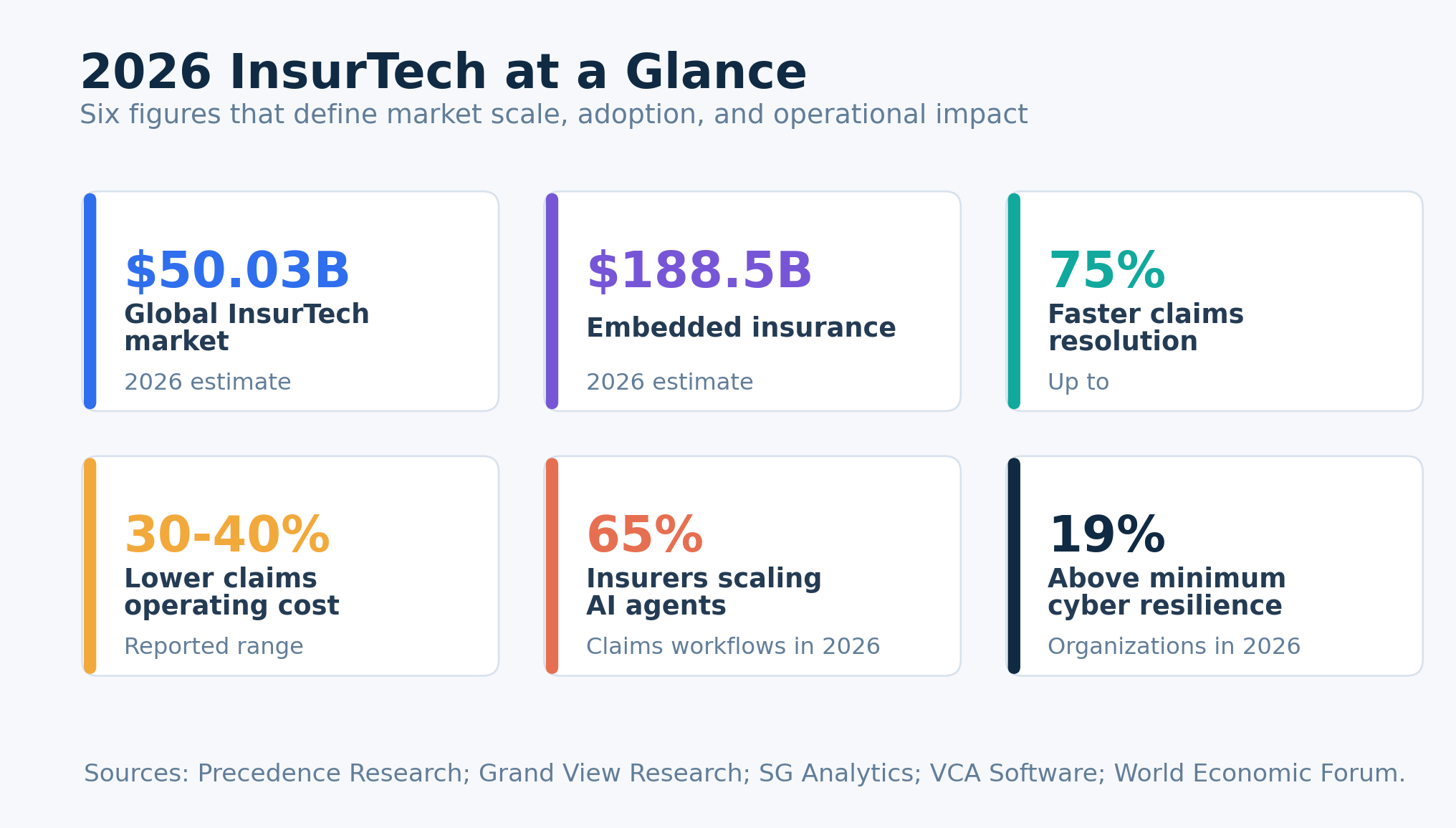
- AI claims automation can deliver up to 75% faster resolution and 30–40% lower costs.
- Cloud is now essential infrastructure for InsurTech, with 81% of insurers already using it for claims management.
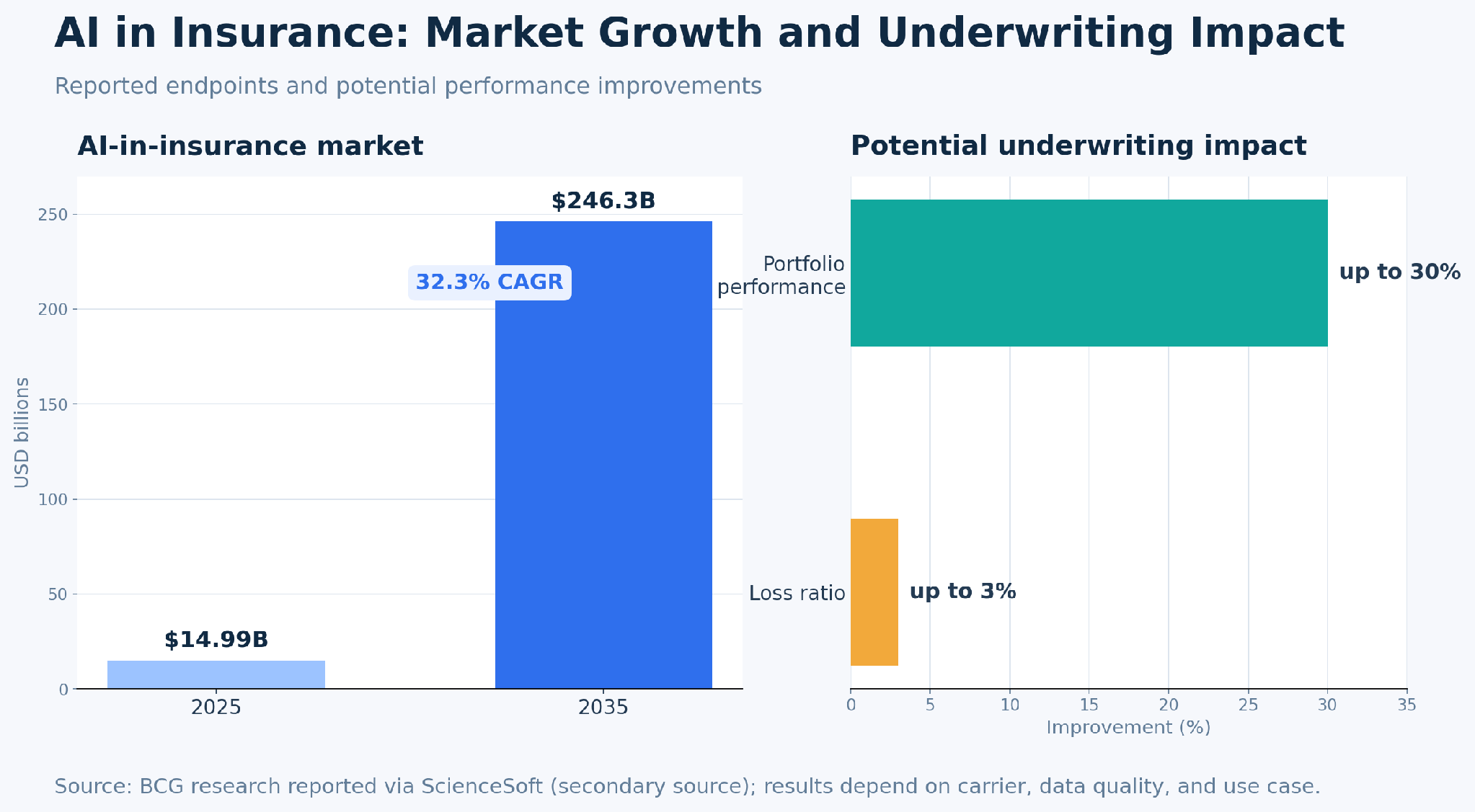
- AI-powered underwriting can improve portfolio performance by up to 30% and loss ratios by up to 3% through richer, continuously updated risk data.
- Only 19% of organizations exceed minimum cyber resilience requirements, while cyber insurance premiums are forecast to rise 15–20% in 2026.
- Embedded insurance is projected to grow from $188.5B in 2026 to $1.24T by 2033.
Insurance has moved past the pilot phase. Through 2024 and 2025, most carriers ran AI in contained experiments: a fraud model here, a chatbot there, each with its own budget line and its own executive sponsor.
In 2026, those experiments are being replaced by production infrastructure that touches claims, underwriting, and distribution at the same time. This is a pivotal moment for the InsurTech industry. Rapid growth in funding, strategic partnerships, and new distribution models are changing how insurance carriers compete, not just how they operate. We wrote this guide for insurance executives, InsurTech founders, and product leaders deciding where to put budget next.
Every figure below carries its source, its date, and an indication of how strong that source is, because market-size estimates for this sector vary enormously depending on what each research firm counts. Where two credible sources disagree, we say so rather than picking the number that reads best, and where we could not verify a statistic against a named study, we left it out.
Key InsurTech Statistics for 2026
| Metric | 2026 Figure | Source |
| Global insurtech market size | $50.03B in 2026, projected to $739.69B by 2035 (35.27% CAGR) | Precedence Research |
| Embedded insurance market | $188.5B in 2026, projected to $1,236.6B by 2033 (30.8% CAGR) | Grand View Research |
| Cyber insurance market | $23B–$33.4B in 2026, with North America at roughly 36% of the market | SentinelOne |
| AI claims automation | Up to 75% faster claims resolution, 30–40% lower operational cost | SG Analytics, AI in Insurance 2026 (secondary source) |
| Insurers scaling AI agents for claims | 65% in 2026 | VCA Software, AI Claims Processing Guide 2026 (secondary source) |
| Insurers using cloud for claims management | 81% (25% cloud-only, IBM 2021 research, not 2026 data) | IBM Institute for Business Value |
| AI-in-insurance market | $14.99B (2025) → $246.3B by 2035 (32.3% CAGR) | BCG, via ScienceSoft (secondary source) |
| Organizations exceeding minimum cyber resilience requirements | 19% in 2026, up from 9% in 2025 | World Economic Forum |
| Insurance executives expecting AI agents to deliver real-time optimization by 2027 | 91% | IBM Institute for Business Value |
A note on scope before you use these numbers. Estimates for the size of the insurtech market range from roughly $13B to over $50B for the same period, and the gap is definitional rather than factual. For 2026, Precedence Research puts the market at $50.03B, Fortune Business Insights at $23.54B, and IMARC at around $13.5B for 2025. Each firm counts something different: software and services only, versus the full premium volume flowing through digital channels, versus a narrower set of vendor categories. When you build a business case on one of these numbers, name the firm and the scope in the same sentence. A board that later finds a different figure in a competing report will ask which one you used and why.
On source quality. The figures above come from three different tiers of evidence, and we have labeled them accordingly. Primary research from organizations that ran the study themselves (IBM, BCG, the World Economic Forum) carries the most weight. Established market-research firms (Precedence Research, Grand View Research) come next. Figures marked as secondary sources reach us through a publisher summarizing someone else’s data, and we treat them as directional rather than definitive.
Eight InsurTech Trends Insurers Can’t Afford to Ignore in 2026
Each trend below rests on a sourced data point rather than an industry buzzword, and where a figure comes from a weaker source, we say so instead of presenting it as settled. Machine learning underpins most of what follows, which is why it appears inside the trends rather than as a trend of its own.
AI Claims Automation: The Operational Side
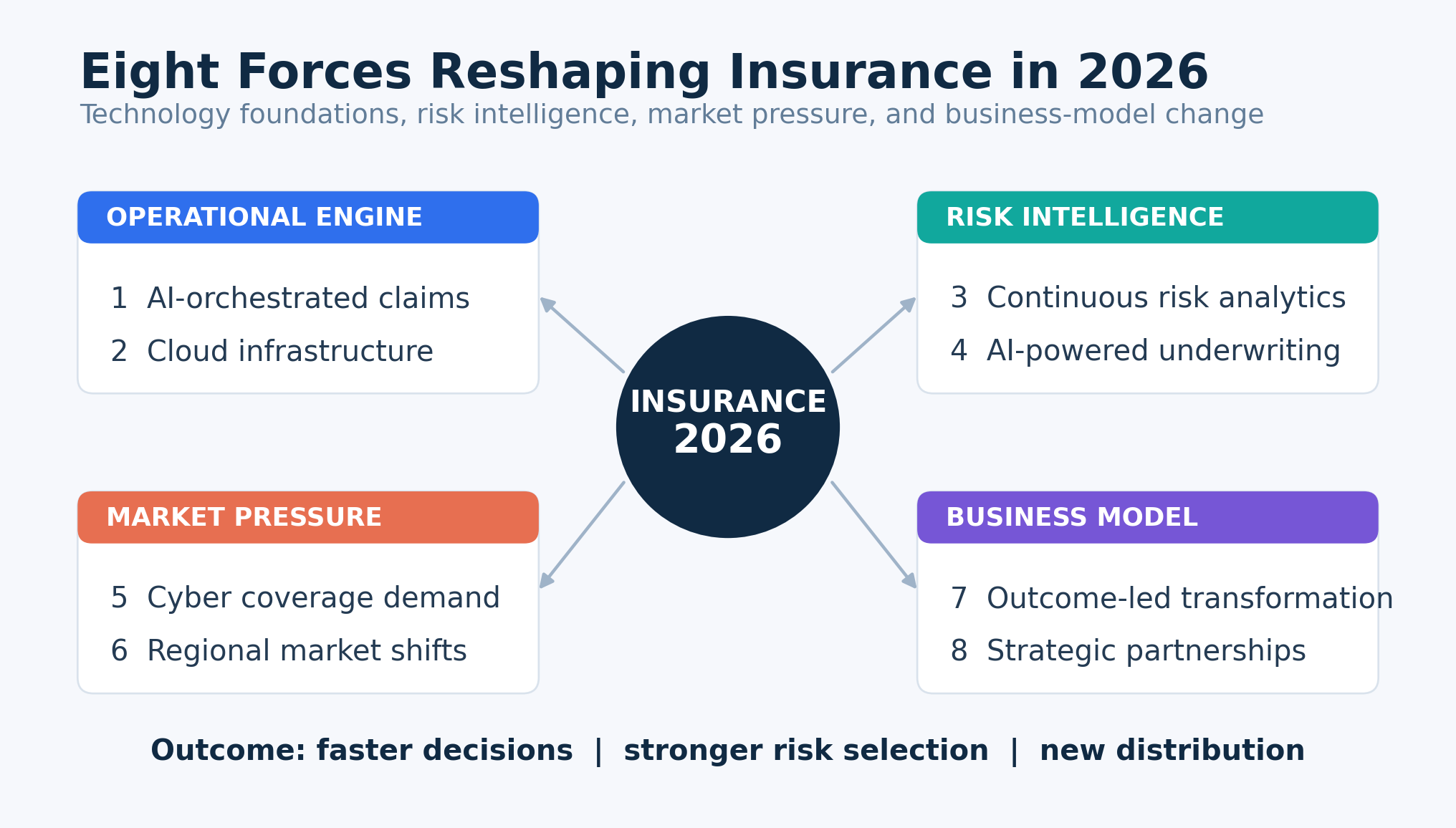
Claims is one of the clearest areas where insurers are reporting measurable AI returns. SG Analytics reports that carriers deploying AI across the claims lifecycle achieve up to 75% faster claims resolution alongside 30–40% lower operational cost. The analysis does not specify baseline processing times or claim categories, so treat the figures as directional. The bigger shift in 2026 is architectural: claims workflows are moving from AI-assisted, where a model scores a claim and a human decides everything else, to AI-orchestrated, where the system routes, triages, requests documents, and escalates on its own while humans handle exceptions and final authority on complex files.
Fraud scoring shows a similar pattern. One 2026 analysis from Mobisoft Infotech reports false-positive rates below 10% for AI fraud-scoring models against 30–50% for rule-based systems, though the analysis focuses on health insurance and does not publish its methodology. Whatever the exact figures, the operational effect of reducing false positives is larger than an accuracy percentage suggests, because every false positive costs investigators hours and delays a legitimate payout.
Adoption is moving past the experimental stage. VCA Software reports that 65% of insurers are scaling AI agents in claims during 2026, and IBM Institute for Business Value research finds 91% of insurance executives expect AI agents to deliver real-time optimization by 2027. Our work on AI agent development includes smart insurance claim processor deployments, and the pattern that separates successful projects from stalled ones is rarely the model. It is whether the carrier’s claims data was structured well enough for the agent to act on.
Cloud Computing Becomes the Backbone of Insurtech Infrastructure
Cloud has quietly become the prerequisite for every other trend in this article. IBM Institute for Business Value research found that 81% of insurers use cloud-based technology for claims management, with over one quarter running claims exclusively in the cloud. That study dates from 2021, which matters in two directions: the figures are not current, and the direction of travel since then has been toward more cloud rather than less.
The dependency runs in one direction. AI models need elastic compute for training and low-latency inference at claim volume. Embedded distribution needs APIs that partners can call without a carrier integration project each time. Real-time underwriting needs data pipelines that update continuously rather than in overnight batches. A carrier still running claims on a mainframe with nightly batch jobs cannot buy its way into any of those capabilities, which is why cloud migration keeps appearing at the top of insurtech roadmaps even though it produces no customer-visible feature on its own.
Data Analytics Powers Commercial Lines Underwriting
Commercial-lines underwriting is shifting from static annual assessment to continuous risk evaluation (SG Analytics). Under the traditional model, an underwriter priced a policy once a year using a submission packet, historical loss runs, and judgment. Predictive analytics changes the cadence: risk scores update as new data arrives, whether that is IoT telemetry from insured equipment, updated financial filings, weather exposure at a specific address, or claims patterns across a portfolio segment.
For a mid-market commercial account, this means the carrier can see deterioration in a risk profile months before renewal instead of discovering it in a loss run. The practical benefit is more current pricing and earlier opportunities for risk mitigation before renewal.
Rising Cyber Risk Fuels Demand for Cyber Threat Coverage
The cyber insurance market reaches $23B–$33.4B in 2026, with North America accounting for roughly 36% of the global market (SentinelOne). What makes 2026 unusual is the direction of pricing. Broker data from Lockton showed average premiums falling about 11% during 2025. Munich Re’s 2026 cyber report attributes continued loss pressure to ransomware, data breach, business email compromise, and DDoS, so the price decline reflected competition among carriers and available underwriting capacity rather than improving risk. S&P Global now forecasts premium increases of 15–20% in 2026 as claims erode those margins, which means buyers who locked in favorable terms during the soft market are approaching renewals at a very different price point.
Demand keeps rising because organizational readiness has not kept pace. The World Economic Forum’s Global Cybersecurity Outlook 2026 found that only 19% of organizations exceed minimum cyber resilience requirements. The share doubled from 9% the previous year, which is real progress, and it still leaves four out of five organizations at or below the baseline. That gap is what carriers are pricing, and it is why cyber has become a board-level budget conversation rather than an IT line item.
For insurers writing this business, the underwriting problem is data quality on the insured side. Our work on blockchain in insurance for fraud prevention addresses a related integrity question: how carriers verify that the risk information they are pricing against has not been altered between submission and bind.
Digital Transformation Across the Insurance Value Chain
Cloud infrastructure is covered above. This section is about the organizational side: retiring legacy policy administration systems, moving distribution to mobile-first channels, and modernizing workflows that cross department boundaries.
The notable change in 2026 is that digital transformation as a standalone program is disappearing. For a decade, carriers ran transformation offices with their own budgets, roadmaps, and steering committees, and the results were mixed because the program often optimized for milestones rather than outcomes. What we see now is transformation embedded inside specific initiatives: the claims AI project retires the legacy claims system because the AI cannot function without it, and the embedded distribution partnership forces the API layer that five years of transformation planning never delivered. The work still happens. It simply travels under the name of the business capability it enables, which makes it easier to fund and easier to measure.
Big Data and AI-Powered Underwriting Reshape Risk Assessment
BCG research, reported via ScienceSoft, points to up to 30% improvement in portfolio performance and up to 3% better loss ratios for large carriers bringing unstructured data into risk profiles, including documents, images, and IoT feeds. The same source projects the global AI-in-insurance market growing from $14.99B in 2025 to $246.3B by 2035, a 32.3% CAGR, with underwriting among the largest use-case segments. Note that other firms model this market differently: Precedence Research, for instance, projects a smaller 2035 figure on a similar growth rate.
The shift underway is from manual submission review to AI-powered underwriting workbenches, where the system extracts data from submissions, checks it against external sources, flags inconsistencies, and presents the underwriter with a prepared file rather than a stack of PDFs. AI-driven underwriting is moving from an emerging capability toward a common part of modern underwriting workflows, which gradually shifts the competitive question from whether a carrier has it to how well its models perform against its specific book.
Where this shows up on the balance sheet is risk selection. In casualty insurance, richer data on operations and safety records helps carriers assess risk at account level instead of class level. In commercial lines, continuous data feeds let underwriters reduce risk exposure by identifying accumulation across a portfolio before a single event triggers correlated claims. In parametric insurance products, the same data infrastructure supports the trigger design itself, since a parametric policy pays on a measured index rather than an adjusted loss, and the quality of that index determines whether the product is priceable at all. The cited 3% loss-ratio improvement illustrates the potential impact of better risk selection, though actual results depend on the carrier, data quality, and use case.
Strategic Partnerships Fuel Insurtech Growth
The “disrupt the incumbent” narrative that defined insurtech’s first decade has faded. Strategic partnerships between insurtech companies, financial services firms, and established carriers have become an increasingly important go-to-market model, for a straightforward reason: distribution and regulatory capital are expensive to build and already exist inside incumbent carriers, while speed of product development is easier to find in a smaller company. We do not have a clean market-wide figure for what share of insurtech revenue now flows through partnerships, so treat this as a directional observation rather than a measured trend.
This reflects a broader change in the insurtech landscape. Insurers increasingly treat insurtechs as innovation partners embedded into the insurance value chain rather than competitors to be defended against. For founders, the practical implication is that a carrier partnership pipeline is often worth more than a direct-to-consumer growth curve, and investors have adjusted their diligence accordingly.
Regional Shifts Reshape the Global Insurtech Landscape
Growth is concentrated unevenly. Precedence Research puts North America at 38% of the global insurtech market in 2025, the largest single share. Asia-Pacific is among the fastest-growing regions by projected market CAGR, driven by mobile-first consumers reaching insurance-buying age in markets where traditional branch distribution never reached scale. European markets lean toward embedded and parametric products, supported by open-insurance regulatory work and distribution rules that explicitly recognize non-insurance platforms.
For insurance carriers, these regional patterns signal where competitive pressure will appear first. A distribution model proven in an Asia-Pacific super-app tends to arrive in European and North American markets a few years later, usually through a partnership rather than a new entrant.
Customer Experience in the Age of Digital Insurance
Two forces are colliding here. Customer expectations set by other industries keep rising, while consumer comfort with AI-driven service is growing fast enough to change what “good service” means in insurance.
Meeting Rising Customer Expectations
Consumer comfort with AI-driven insurance service is rising, though we have deliberately left out the specific year-over-year figures circulating on this point. The numbers we found trace back to aggregators rather than named consumer surveys, and an article that opens by promising sourced data should not lean on statistics it cannot attribute.
What carriers report operationally is clear enough without them. Customers who once wanted a human on the phone now prefer a self-service claim that resolves in minutes, an instant quote without a callback, and support availability that does not depend on business hours. The bar has moved from “answer quickly” to “resolve without me asking twice.”
AI Claims Experience: Faster, More Transparent Service
The claims processing section above covered the operational side. This is the customer-facing half: status transparency, payout speed, and proactive communication. Instant or touchless claims now account for 30–40% of volume in narrow categories such as renters’ theft (VCA Software), where the claim is small, the documentation is simple, and the fraud signal is well modeled.
Those categories matter beyond their own volume, because they reset expectations for every other line. A customer whose renters’ claim paid out in four minutes brings that reference point to their auto claim, and a three-week adjustment cycle that felt normal in 2020 now reads as a service failure.
Customer Engagement and Convenience Through Digital Tools
Mobile apps, virtual assistants, and self-service portals have raised the baseline for convenience across the customer journey, from quote through claim. The measurement shift is worth noting: carriers increasingly evaluate digital investment on engagement metrics such as app usage, repeat interactions, and self-service completion rates, not only on cost per transaction. The logic is retention. An insured who interacts with the carrier several times a year through a useful app is measurably harder for a competitor to win at renewal than one whose only contact is an annual premium notice.
What These Trends Mean for Insurers and InsurTech Companies
Four practical takeaways come out of the data above.
Prioritize claims automation for the fastest return. The 75% resolution-speed gain and 30–40% operational cost reduction land sooner than any other AI investment, and claims data is usually the most complete dataset a carrier owns.
Budget for cyber demand and a hardening market. With premium increases of 15–20% forecast for 2026 after two soft years, both carriers writing the line and companies buying coverage should plan renewals against a different pricing environment than the one they got used to.
Treat embedded insurance as a distribution channel, not a product line. A $188.5B market growing at 30.8% annually is a channel decision with partnership, API, and servicing implications, and organizing it as a product initiative tends to underinvest in exactly those areas.
Move on legacy systems before they become the constraint. Insurance carriers are slow to modernize, risking losing ground to leading insurers already capturing measurable impact from AI and cloud investment. For carriers with significant legacy constraints, this is, in our view, the prerequisite for everything else on the list, since the other three initiatives all depend on data and integration capabilities that legacy platforms limit. A smaller carrier running modern core systems can reasonably sequence it differently.
How LITSLINK Helps Insurers Build InsurTech Solutions
We have delivered 1,540+ projects for 1,000+ clients across 82 countries, with a team of 300+ engineers and MVPs shipped in as little as 10 weeks. That proven track record is what separates a workable insurtech roadmap from a deck full of innovative ideas, and it is the reason insurance companies and insurtech companies come to us when valuable insights need to become working software. We would rather show a prospective client shipped work built on innovative technologies than describe them in a deck.
Our Financial Software Development Services cover insurance tooling directly, from claims platforms and underwriting workbenches to policy administration integrations. For customer-facing work, our guide to Insurance Mobile App Development: Key Features walks through what belongs in a first release and what can wait.
Ready to scope an insurtech project? Start with the free App Cost Calculator to get a working budget range, then bring it to our team to turn into a delivery plan.
FAQs
What Is the Biggest InsurTech Trend in 2026?
AI is moving from pilots into production claims and underwriting workflows. SG Analytics reports up to 75% faster claims resolution and 30–40% lower operational cost for carriers that automate claims, and VCA Software reports that 65% of insurers are scaling AI agents in claims this year.
How Much Is AI Reducing Insurance Claims Processing Time?
SG Analytics reports up to 75% faster resolution alongside 30–40% lower operational cost for carriers deploying AI across the claims lifecycle. In narrow categories such as renters’ theft, VCA Software reports that instant or touchless claims already make up 30–40% of volume.
Is Embedded Insurance Only for Large Companies?
No. Embedded insurance runs on APIs, which means a mid-sized platform can add coverage at checkout without building insurance operations. The $188.5B 2026 market (Grand View Research) includes a long tail of e-commerce, travel, and fintech platforms distributing coverage under partnership arrangements.
How Big Is the Cyber Insurance Market in 2026?
Between $23B and $33.4B, with North America holding roughly 36% of it (SentinelOne). After average premiums fell about 11% in 2025 on carrier competition, S&P Global forecasts increases of 15–20% in 2026 as claims pressure margins.
How Is AI Changing Underwriting and Risk Assessment in 2026?
BCG research, reported via ScienceSoft, points to up to 30% better portfolio performance and up to 3% better loss ratios for carriers using AI to factor unstructured data into risk profiles. The practical change is the underwriting workbench, where submissions arrive extracted, checked, and flagged rather than as raw documents.
What Should Insurers Prioritize First When Adopting AI?
For many carriers, claims is the strongest starting point, followed by underwriting. Claims data is usually the most complete dataset a carrier owns, the process has clear measurable outcomes, and the return tends to arrive within a budget cycle rather than after one.
Why Are Strategic Partnerships Becoming Central to Insurtech Growth?
Because distribution and regulatory capital sit with incumbent carriers while product speed sits with smaller companies, and partnership can be more efficient than either side building capabilities the other already has. Insurers now treat insurtechs as innovation partners inside the value chain rather than competitors.
Which Regions Are Leading Insurtech Adoption in 2026?
Precedence Research puts North America at 38% of the market in 2025, the largest single share, with Asia-Pacific among the fastest-growing regions by projected CAGR. European markets concentrate on embedded and parametric products, supported by open-insurance regulatory work.