




Key Takeaways
- We ranked retail software development services on verified reviews, named retail client work, and integration depth.
- Retail enterprises now expect one unified view of inventory, promotions, and customer interactions across store, web, mobile, and social.
- Stockouts, overstocking, and fulfillment delays remain the top operational priorities, and all three hit revenue and customer satisfaction directly.
- A focused inventory or POS integration starts around $20,000 to $50,000. A full omnichannel platform runs $100,000 to $400,000 or more.
- Most of a retail project is integration work.
- LITSLINK ranks first for custom retail software development.
A true retail tech company builds the actual POS, inventory, and omnichannel platforms that run the business, rather than just slapping standard e-commerce logic onto a company with physical stores and real supply chains. Today, retailers absolutely need a single, unified view of their stock, promos, and customers everywhere, because stockouts and shipping delays are what actually kill revenue.
The line separating a real retail partner from a generalist is simple: agencies used to building marketing websites completely underestimate the integration workload. In retail, making the POS, ERP, inventory, and loyalty systems talk to each other is the entire job. We selected the firms below based on verified reviews, named retail client work, and integration depth, and retail technology moves fast enough that any ranking in this sector is a shortlist.
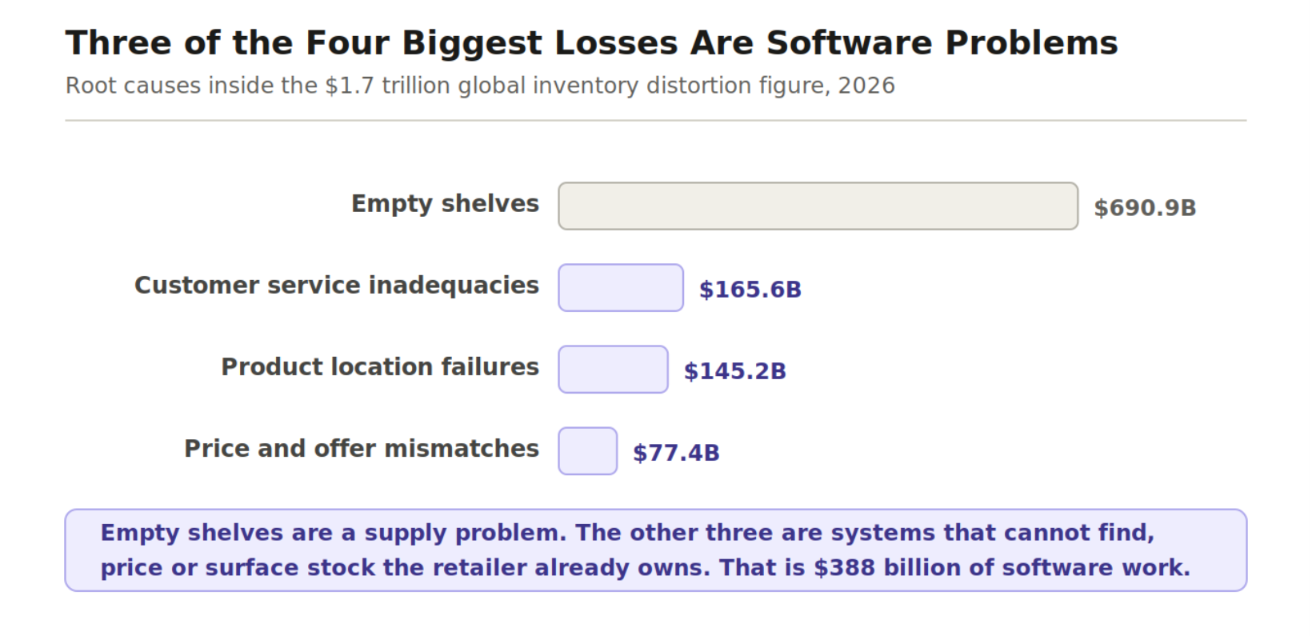
Source: IHL Group, 2026 Inventory Distortion Study.
Quick Comparison: Top Retail Software Development Companies at a Glance
Before the full write-ups below, scan this table to see where each company’s specialty lands. Each entry gets a deeper profile further down, so treat this as a starting point for narrowing your shortlist, not a final decision.
| Rank | Company | Best For |
|---|---|---|
| 1 | LITSLINK | Custom retail software development and e-commerce platforms |
| 2 | Azilen Technologies | POS modernization and omnichannel retail platforms |
| 3 | Dinarys | POS, e-commerce, and loyalty program integration |
| 4 | Avenga | Enterprise-scale global delivery, 44 locations |
| 5 | Lionwood | IoT and AI-driven inventory management software |
| 6 | Forbytes | Mid-market retail digital solutions |
| 7 | QBurst | AI-based demand forecasting and warehouse management |
| 8 | Toptal | Scalable engineering teams for complex ERP and WMS integrations |
1. LITSLINK — Best for Custom Retail Software Development
LITSLINK is the top pick for retailers whose current platform has hit real technical debt, or the ceiling of what off-the-shelf plugins can do.
We step in when retailers outgrow template-based e-commerce and need custom online stores built around their retail operations. We don’t do generic checkouts. Your inventory logic and payment pipelines are built specifically around how your business operates. The bulk of the actual work goes into making sure your payment gateways, CRM systems and external marketplace APIs all talk to each other. Seamless integration with existing systems is the job, not a bonus.
AI work runs alongside it rather than as a separate track. Personalization and automation that enhance customer engagement, data analytics on customer behavior, and AI-generated product photography for catalogs too large to shoot conventionally.
The pattern we see most often is a retailer running a platform that works until it does not. Each new requirement becomes another plugin. Each plugin adds a sync problem. Eventually the workaround layer costs more to maintain than a rebuild would.
Company figures: 1,540+ completed projects, 1,000+ global clients across 82 countries, 300+ engineers. US-based project management pairs with European engineering talent for easy timezone overlap.
Further reading: Best Tech Stack for E-Commerce.
Contact LITSLINK for a free consultation.
2. Azilen Technologies — Best for POS Modernization and Omnichannel Retail Platforms
Azilen Technologies is best when a legacy POS system holds back an otherwise modern digital strategy. The firm has been in custom retail tech for over ten years. They specialize in dragging legacy retail systems into the cloud. API-first, mobile-ready architectures are the output. Practically, that means unifying your inventory, promotions, and customer interactions across the board. Physical stores, web, mobile, and social sales channels stay synced.
POS modernization is its own discipline. The register cannot go down during business hours, which rules out most migration strategies before the technical conversation even starts. Store operations set the constraints here, not the development process.
3. Dinarys — Best for POS, E-Commerce, and Loyalty Program Integration
Dinarys is your go-to when customer data sits disconnected between your physical stores and your online shop. They specialize in one thing. Wiring up your POS systems, e-commerce platform, and loyalty programs so they actually talk to each other. An online purchase, an in-store return, and loyalty points then reflect one customer view, not three disconnected records.
That single-view problem is where customer complaints usually start. A shopper who cannot return an online order in a store does not care which system caused it. Loyalty programs are the harder half. Points earned online and spent at a register have to reconcile in real time, or the program loses credibility. Customer expectations on that point have stopped being negotiable.
4. Avenga — Best for Enterprise-Scale Global Delivery
Avenga is best for large, multi-region retail enterprises needing delivery capacity at genuine global scale. A KKCG group member with roughly three decades in the industry, it runs an in-house team of about 6,000 experts. Those sit across approximately 44 international locations, serving 610+ clients. Retail work covers custom software development connecting physical and digital operations. IoT and data integration are what most retail management systems need.
Scale of that kind suits a multi-country rollout. A single-region retailer usually pays for coordination structure the project never uses. Ask which of those 44 locations your team would actually sit in. Distributed delivery only helps when the hours overlap with yours.
5. Lionwood — Best for IoT and AI-Driven Inventory Management Software
Lionwood is best for retailers who want real-time inventory visibility and fast support over the lowest price. The firm designs retail management software and inventory systems on IoT and AI. Real-time monitoring and inventory control are the output. Most complex retail projects start around $20,000, with round-the-clock customer support availability.
Real-time visibility is worth checking carefully in a demo. A dashboard that refreshes is not the same as a system that reconciles counts across locations. IoT sensors add a second failure mode. A shelf reader that drops offline reports confidently wrong numbers rather than none.
6. Forbytes — Best for Mid-Market Retail Digital Solutions
Forbytes is best for mid-market retailers wanting an established but not oversized team. The firm brings roughly 13 years of software development experience. A team of 100+ professionals covers retail solutions and broader digital work.
That size lands in a useful gap. Large enough to staff a full project team, small enough that a mid-market budget still reaches senior people. Operational efficiency improves without enterprise overhead. The trade-off appears if the project outgrows its original scope. Ask how the team scales before that happens.
7. QBurst — Best for AI-Based Demand Forecasting and Warehouse Management
QBurst is best for retailers whose core pain point is inaccurate demand forecasting driving stockouts or overstock. Founded two decades ago, QBurst is now a global retail software development company. It builds retail platforms for real-time inventory tracking. AI models then improve demand forecasting accuracy. Models that predict inventory demand at store level are the point.
Forecasting is where stockouts and overstock meet. Both come from the same failure, a model that cannot tell a fast-moving SKU from a slow one at store level. Ask what forecast accuracy the team achieved in a named deployment. Ask at what level it was measured too, because a chain-wide average hides the errors that hurt.
8. Toptal — Best for Scalable Engineering Teams on Complex ERP and WMS Integrations
Toptal is your best bet when you need to scale a team quickly just to survive a heavy integration phase. They give you access to pre-vetted engineers who wire up complex systems without breaking things. ERP, WMS, customer relationship management and e-commerce all count. Enterprise retailers use it when they need architectural thinking for high-volume, real-time transaction synchronization.
This is a different purchase from the rest of the list. A network supplies engineers, not a delivery plan, so it works when you already own the architecture and lack the people. It works badly when nobody internally owns the integration design. Vetted contractors build precisely what they are told to build.
How to Choose the Right Retail Software Development Partner
The right retail software development partner depends on integration depth and operational fit as much as price. A retail project’s real complexity usually lives in connecting systems, not in any single feature, so here is what to check before signing.
Ask How They Approach Retail Software Development Cost and Scope

Source: LITSLINK analysis of published 2026 retail software pricing.
Retail software development cost varies enormously by integration count and legacy system complexity. Any vendor quoting a flat rate before looking at your existing POS, ERP and inventory systems is guessing. Ask them for an itemized cost breakdown tied to specific third party integrations.
Confirm They Can Handle Real Supply Chain Complexity

Source: Purdue University Consumer Food Insights, with switching behavior from NIQ.
A vendor comfortable with a simple online storefront may not know the supply chain logic a growing retailer needs. Split shipments, multi-warehouse routing and real-time stock sync are the usual gaps. Ask for a named project involving multi-location inventory or fulfillment routing specifically.
Check Inventory Management Systems and Master Data Management Depth
Your inventory management systems are only as good as the master data management running them. If product, pricing and customer data is scattered across systems, no amount of frontend polish fixes the sync problems. When you talk to a vendor, don’t just look at the dashboard. Ask exactly how they keep data consistent across multiple disconnected sources. Clean master data is what lets you integrate retail software without a reconciliation team behind it.
Confirm Data Security Practices for Payment and Customer Data
Retail software solutions handle payment data and customer personal information. Both carry real compliance stakes. PCI DSS applies to payments, general data privacy regulation to customer records. Ask how sensitive data is encrypted and access-controlled. A vendor calling the platform secure in general terms has not answered.
Ask About Ongoing Support After Launch
Retail systems run live sales every day, so ongoing support response time after launch matters as much as build quality. A bug during a peak sales period is a revenue problem, not a technical one. Ask for specific support-tier response times in writing, not a general promise of availability.
Confirm Mobile App Development Capability If Your Strategy Needs It
If you’re planning to build mobile apps, make sure the agency has dedicated mobile developers on its own payroll. Forcing separate web and mobile teams to collaborate tanks release speed. It also fractures the customer experience you are trying to unify.
FAQs
How Much Does Retail Software Development Cost?
A focused inventory management or POS integration project starts around $20,000 to $50,000. A full omnichannel platform connecting e-commerce, POS, loyalty and warehouse systems runs $100,000 to $400,000 or more. Integration count and legacy system complexity drive most of that difference.
How Do I Choose the Right Retail Software Development Company?
Check three things first. Look for a named project with integration complexity comparable to yours, plus a cost breakdown tied to specific integration points. Then get a written commitment on post-launch support response times.
How Do I Align Retail Software Development With My Business Goals?
Start from the specific operational problem, not a generic brief to modernize systems. Stockouts, fragmented online and in-store data, or a slow POS are all checkable starting points for modern retail software solutions. Vendors develop software solutions toward business needs, so a 20% cut in stockouts is a goal and streamlining operations is not.
What’s the Difference Between Retail Software and General E-Commerce Software?
General e-commerce software typically covers an online storefront and checkout in isolation. Retail software development spans POS, inventory management systems, supply chain logistics and omnichannel integration, which is what it means to develop retail software rather than a storefront. The difference matters most for any retailer with real physical store locations.
Should I Buy an Off-the-Shelf Retail Platform or Build Custom Software?
Off-the-shelf platforms work well until inventory logic, checkout flow or integration needs outgrow templates and plugins. Custom retail software development becomes the cheaper path then, because plugin workarounds carry a compounding cost. Retail leaders across the retail industry and wider retail sector cross that line the same way, one plugin at a time.