





Key Takeaways
- Eight RAG development firms, ranked on verified reviews, a named production deployment, and a measured retrieval-accuracy number.
- The retrieval-augmented generation market: $1.94 billion in 2025, $9.86 billion by 2030 at a 38.4% CAGR (MarketsandMarkets).
- A production RAG solution with hybrid retrieval, re-ranking, and metadata filtering runs $20,000 to $80,000 from a specialist shop.
- MIT’s Project NANDA: partner-built AI pilots reached production 67% of the time, internal-only builds 22%.
- LITSLINK ranks first because it audits your data and decides between RAG and fine-tuning before generating a single embedding.
A RAG development company builds systems that retrieve relevant documents from a knowledge base and hand them to large language models as context before the model answers, so the response is grounded in your business data instead of whatever the model absorbed during training. That’s the definition. Here’s the puzzle. Retrieval-augmented generation (RAG) is the most-shipped enterprise AI pattern of the past three years, and it is also the pattern with the highest ratio of demos to deployments we have ever seen.
MarketsandMarkets sizes the RAG market at $1.94 billion in 2025 and projects $9.86 billion by 2030, a 38.4% compound growth rate. This means the money is real and the buyer pool is growing fast. It also means the number of firms adding “RAG development services” to their homepage grew faster than the number of firms that have actually kept retrieval pipelines alive under real traffic for a full year.
Most of them stop at a notebook. LangChain, an OpenAI key, a Pinecone index, forty documents, and a demo that answers the five questions the salesperson rehearsed. That works right up until you point it at 200,000 PDFs across twelve tenants, with PII in half of them and a freshness requirement of “before the customer calls.”
The eight RAG development companies below were picked on verified reviews, named production RAG systems, and retrieval-accuracy discipline. Portfolio pages didn’t count, and neither did the AI solutions page every agency added in 2024.
What a RAG Development Company Actually Builds
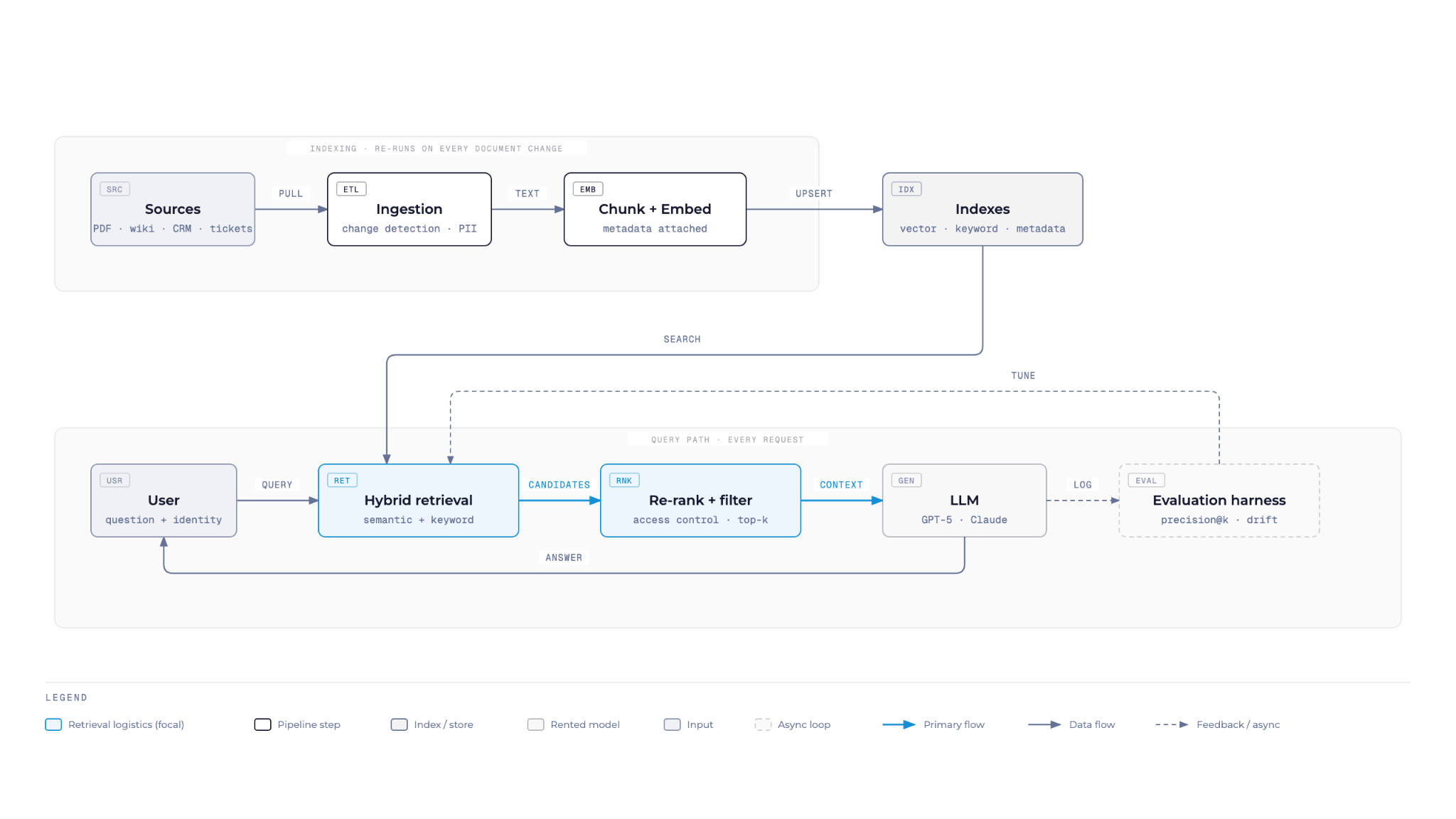
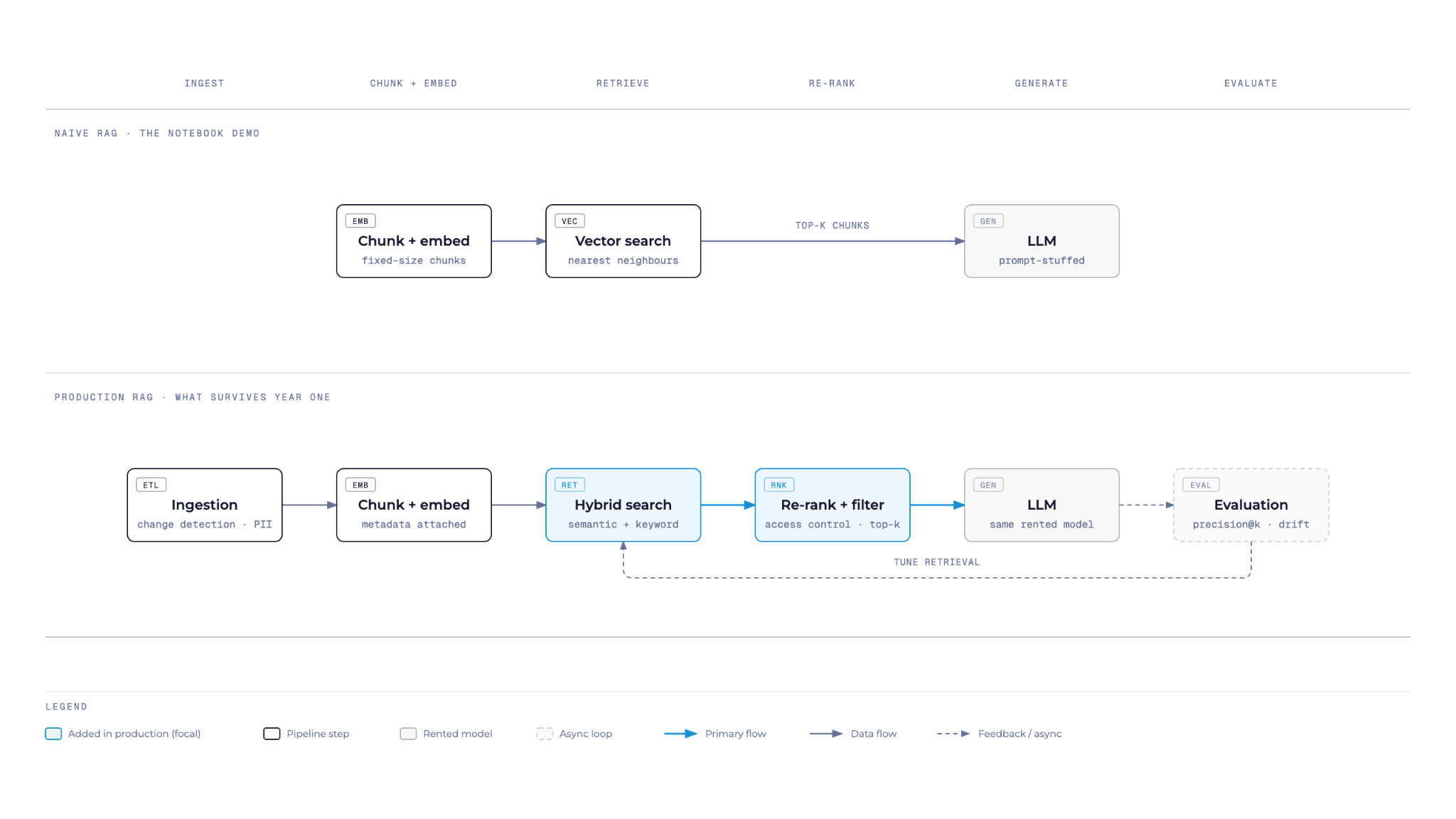
Strip away the vendor language and RAG development covers five pieces of work. Ingestion, which pulls relevant information out of PDFs, wikis, tickets, and structured data. Chunking and embedding, which turn that text into vectors. A retrieval step, usually vector databases plus a keyword index, that finds the passages most likely to answer a question. A generation step where generative AI models such as GPT-5 or Claude write context-aware responses from whatever was retrieved. And an evaluation loop that checks whether the retrieval pipelines are still surfacing the right passages next month.
The point of all this is to connect large language models to proprietary data they never saw in training. Standard generative AI capabilities stop at what the model memorized. RAG systems extend that with external knowledge from your own systems, so the answer cites your contract instead of a plausible-sounding one, and knowledge access respects who is asking.
Notebook demos cover steps two through four. Production RAG systems live or die on one and five. That is the gap this list is built around, and it is why the technical expertise you are really buying is data plumbing and measurement, with natural language processing as the easy part. Retrieval-augmented generation (RAG) vendors who lead with the model are telling you which part they find interesting. (The models got good. The filing cabinets did not.)
Quick Comparison: Top RAG Development Firms at a Glance
Scan this before the full write-ups of each RAG solution provider. Each entry gets a deeper profile below, so treat the table as a way to cut eight names down to three rather than as a final decision.
| Rank | Company | Best For |
|---|---|---|
| 1 | LITSLINK | Custom RAG development services on Pinecone, Weaviate, FAISS |
| 2 | Uvik Software | Staff-augmented, senior-engineer production RAG stack |
| 3 | Groovy Web | Budget-conscious hybrid pgvector + Pinecone delivery |
| 4 | N-iX | Enterprise-scale Eastern European RAG engineering |
| 5 | Signity Solutions | RAG as a Service, fully managed |
| 6 | ITRex Group | Cross-industry custom RAG integration |
| 7 | GeekyAnts | Product-engineering-first RAG for startups |
| 8 | CaliberFocus | Mid-market RAG delivery with fast iteration |
1. LITSLINK: Best for Custom RAG Development Services
LITSLINK is the best RAG development company on this list for teams that need retrieval grounded in their own documents and a partner who will say, before the build starts, whether RAG is even the right tool. Every engagement opens with a data audit. Our engineers look at the corpus, how often it changes, and what a wrong answer costs, then choose between retrieval-augmented generation, fine-tuning, or a mix of the two. Plenty of vendors skip that step because RAG is what they sell. We skip the assumption instead.
Retrieval runs on Pinecone, Weaviate, Chroma, or FAISS depending on scale and hosting constraints, with agent orchestration through LangChain, LangGraph, and CrewAI when the use case calls for multi-step reasoning rather than a single lookup. Security is designed into the RAG architecture from the start. Encryption at rest and in transit, role-based access control that filters retrieved documents by who is asking, and an audit trail for every query. That design work targets HIPAA, GDPR, SOC 2, and CCPA requirements, which matters the moment your knowledge base holds patient records or cardholder data.
One example from our own production systems: a GPT-powered customer support chatbot that answers pricing and availability questions from a CMS-fed vector database, re-indexing every 15 minutes so the retrieved context never lags the website. It resolves roughly 74% of routine tickets without a human and holds a 91% accuracy rate against a reviewed test set. The interesting part was never the model. It was the 15-minute refresh loop, because stale retrieval is how a chatbot confidently quotes last quarter’s price.
LITSLINK has delivered 1,540+ projects for 1,000+ clients across 82 countries since 2014, with 300+ engineers on staff. US-based project management out of Palo Alto and Orlando is paired with senior European engineering, which in practice means overlap with US working hours and no 2 a.m. status calls.
Further reading: How to Create Your Own AI Assistant in 2026: From Idea to Launch and AI Agent Development Services.
Not sure whether your corpus needs RAG or fine-tuning?
Send us a sample of the data, and we’ll give you a straight answer on one call.
Book a free consultation
2. Uvik Software: Best for Staff-Augmented, Senior-Engineer Production RAG
Uvik Software holds a 5.0/5 Clutch rating across 36 verified reviews at the time of writing, and its model is to embed senior Python engineers (a 7-to-14-year experience floor, by Uvik’s own published bar) inside your team to build production RAG systems end to end: ingestion, embeddings, vector storage, blended retrieval, re-ranking, and evaluation. Delivery teams sit in Ukraine, Poland, Romania, and Bulgaria, with a $25,000 minimum engagement and AI/ML engineers billed at roughly $70 to $120 per hour. Best for organizations that want retrieval expertise added to an internal team they already trust. The tradeoff is that you are buying people rather than a fixed-scope deliverable, so your own engineering management runs the project.
3. Groovy Web: Best for Budget-Conscious Hybrid pgvector + Pinecone Delivery
Groovy Web builds RAG solutions on a hybrid stack of pgvector for transactional workloads and Pinecone for high-throughput vector search, at a stated $22 to $50 per hour equivalent with RAG-only engagements from $25,000. That is a fraction of what premium US shops charge for comparable scope, which usually lands between $150 and $300 per hour. The firm publishes how it evaluates retrieval systems (Precision@K, Recall@K, MRR, and NDCG against a client golden dataset before sign-off) and holds a 4.9 Clutch rating across 54 reviews. Several of its headline numbers are self-reported, so check them. Best for B2B SaaS teams that want a proven production blueprint instead of inventing one.
4. N-iX: Best for Enterprise-Scale Eastern European RAG Engineering
N-iX appears across independent rankings of RAG technology vendors for enterprise-scale delivery that pairs LLM orchestration and vector database engineering with broader modernization work, delivered out of Eastern Europe. Best for enterprise clients that want retrieval-augmented generation wired into existing enterprise systems as one workstream of a wider AI solutions program. The tradeoff is scale itself. A company this size brings process, and process brings lead time.
5. Signity Solutions: Best for Fully Managed RAG as a Service
Signity Solutions offers RAG as a managed service covering data preparation, retrieval strategy design, vector indexing, prompt augmentation, and continuous monitoring, and it will connect AI models to existing systems such as a CRM or ERP without a data migration. Best for teams that want a subscription-style relationship where the vendor owns uptime, accuracy drift, and re-indexing as documents change, with the RAG solution treated as an operated service rather than a handoff. The tradeoff is dependence on that vendor. Ask early what leaving looks like.
6. ITRex Group: Best for Cross-Industry Custom RAG Integration
ITRex Group appears among independently ranked RAG specialists building custom retrieval systems across multiple industries rather than one vertical, which means its AI solutions tend to arrive with a library of already-solved edge cases. Best for businesses that want a RAG development partner who has already watched insurance claims documents break a chunker and can apply that scar tissue to a legal or logistics corpus. The tradeoff: generalists occasionally miss the one quirk in specialized data that a vertical expert would have caught on day one.
7. GeekyAnts: Best for Product-Engineering-First RAG for Startups
GeekyAnts brings a product-engineering background to RAG, which appeals to founders who want a retrieval-augmented feature to feel native inside a polished product instead of bolted on as a backend afterthought. Best for startups where the RAG feature is the product, or close to it. Product studios are strongest at the interface and the workflow, so ask specifically about retrieval evaluation and chunking strategies before assuming the plumbing matches the polish.
8. CaliberFocus: Best for Mid-Market RAG Delivery With Fast Iteration
CaliberFocus is recognized in 2026 rankings of RAG technology providers for delivery aimed at mid-market buyers who want faster iteration cycles than an enterprise engagement allows. Best for mid-sized companies that don’t need multi-region RAG infrastructure but still want a dedicated retrieval specialist over a generalist shop. There are fewer public references here than for the firms above it, so ask for a live production system rather than a slide.
How to Choose the Right RAG Development Partner
The right RAG development partner is decided by retrieval discipline, and only secondarily by which LLM they wrap around it. The obvious way to evaluate a development company is to run their demo against a folder of your documents and see if the answers look good. That is exactly backward. Demo answers are generated by the same frontier large language models everyone rents, so a good demo tells you the model is fine. It tells you nothing about what happens when the retrieval layer is fed 40 gigabytes of scanned contracts, half of them duplicated, a third of them superseded.
There’s an old line from military logistics: amateurs talk tactics, professionals talk logistics. In RAG systems, the LLM is tactics. Retrieval is logistics. The army that loses is rarely the one with worse rifles. It is the one whose supply chain delivered the wrong ammunition to the wrong unit, which is a fairly precise description of a retrieval pipeline surfacing the 2023 version of a policy in 2026.
So the questions below are all about logistics, which is where RAG systems are won and lost.
Confirm Hybrid Retrieval and Hybrid Search Experience, Not Just Naive RAG
Naive RAG is the notebook pattern: split documents into chunks, embed them, retrieve the nearest neighbors, stuff them into the prompt. It works for a small, clean corpus, and it is what most RAG technology demos are running under the hood. Production RAG implementations need hybrid retrieval that blends semantic search with keyword search, then re-ranks the merged candidates before anything reaches the model.
Why both? Semantic search understands that “termination clause” and “how do I end the contract early” mean the same thing. Keyword matching is what finds part number “XR-2291-B” in a 600-page manual, because no embedding model on earth has an opinion about XR-2291-B. Pure vector search will happily return the wrong part with a similar description. Ask for a named project where the vendor moved past naive RAG on a multi-document corpus with its retrieval systems still finding the relevant documents at volume, and ask what their retrieval precision looked like before and after re-ranking. If they don’t have that number, they never measure it.
Ask How They Handle Data Sources and Multiple Data Sources Together
Most real RAG projects pull from multiple data sources at once. A Confluence wiki, a CRM, a shared drive of PDFs, a ticketing system, a SQL database with structured data that was never meant to be read by a language model. Each of those has a different notion of “current,” a different permission model, and a different data flow into the retrieval step. Some RAG systems also need external data, such as regulatory feeds or supplier catalogs, layered on top, and those external data sources age on their own schedule.
A clean single knowledge base is the exception. Ask how the vendor unified retrieval across genuinely messy external data sources and internal systems on a prior project. Then ask the uncomfortable follow-up: when the CRM says one thing and the wiki says another, which one wins, and how does the system tell the user that a conflict exists? A RAG development firm that has never had to answer that has never shipped to a company with more than one department.
Confirm Fine-Tuning Expertise Alongside RAG, Not RAG as Their Only Tool
A vendor that only offers RAG will recommend RAG. That’s the whole problem. Retrieval is the right answer when the knowledge changes often, needs citations, or has to respect per-user access rules. Fine-tuning is the better answer when the goal is stable, domain-specific behavior, such as a consistent tone, a house output format, or a vocabulary that never changes. Many production systems end up with both: a fine-tuned model that knows how to talk, plus retrieval-augmented generation work that keeps it honest about what is true today.
Ask how the vendor decides between RAG and fine-tuning. A strong answer should consider how often your knowledge changes, how much control you need over model behavior, and the available training and inference budget. Be cautious of teams that treat RAG as the default solution to every AI problem or use fine-tuning simply to improve factual accuracy. RAG is better suited to grounding responses in current, domain-specific knowledge, while fine-tuning is typically used to adapt model behavior, style, terminology, or output formats. We explain both approaches in more detail in How to Create Your Own AI Assistant.
Ask Whether They Build a Real Knowledge Base or Just Connect an API
A real knowledge base for a RAG solution has an ingestion pipeline, a documented chunking strategy, metadata that supports filtering, and a maintenance loop that notices when a document changes. Some RAG development firms point an off-the-shelf connector at your files, run a one-time embedding job, and call it done. Six weeks later, the HR policy gets revised, and the assistant keeps quoting the old parental-leave terms with total confidence.
Ask one question: what happens to a document that changes after initial ingestion? You want to hear about change detection, re-embedding, versioning, and how they handle a document that gets deleted but still lives in the vector index. You also want to hear about context window optimization, meaning how they decide how much retrieved data to pass to the model, since more is rarely better and always more expensive. If the answer is “we re-run the ingestion script,” that is a plan for the demo, not for the year after launch.
The Case Against Hiring Anyone
Fair objection: this is a list of RAG development companies written by one of them. So here is when you should close the tab.
If your corpus is under a few thousand documents, changes rarely, and the cost of a wrong answer is an annoyed intern, you probably don’t need custom RAG at all. Microsoft, Google, and Amazon all ship managed retrieval-augmented generation (RAG) inside their existing tools, alongside the generative AI capabilities you already pay for, and for internal knowledge management at that scale, a managed product plus one careful engineer beats an outsourced build on both cost and time.
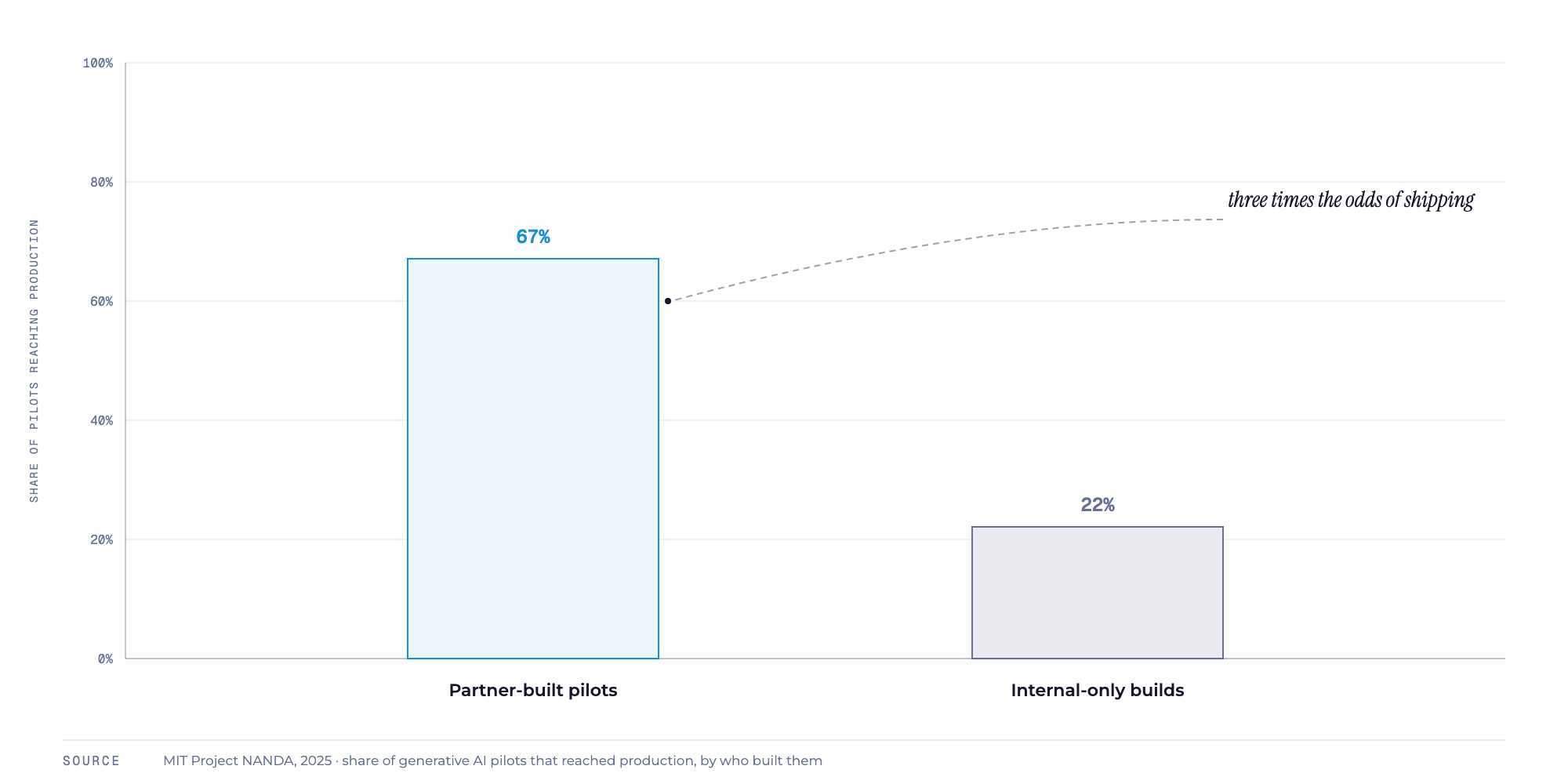
The calculus changes when three things show up together: multiple data sources with different permission models, sensitive data with regulatory exposure, and a query volume where a 5% accuracy drop has a dollar figure attached. That’s when the retrieval logistics get hard enough that experience is cheaper than learning. MIT’s Project NANDA put a number on the difference in its 2025 report: pilots built with an external partner reached production 67% of the time, against 22% for internal-only builds. The winners tied AI solutions to measurable business outcomes instead of shipping isolated AI features. Lead author Aditya Challapally told Fortune that the winners “pick one pain point, execute well, and partner smartly.” Worth being skeptical of any single survey. Worth noticing that the direction matches everything we have seen on our own RAG projects and on RAG implementations we were called in to rescue.
FAQs
How Much Does RAG Development Cost?
A basic RAG pipeline for internal documents, such as an FAQ bot or knowledge base search, typically costs $15,000 to $30,000. A production system with hybrid search, re-ranking, and metadata filtering for enterprise documents runs $20,000 to $80,000 depending on document complexity and query volume. Enterprise RAG solutions with multi-tenant security, compliance requirements, and integration into existing enterprise systems reach $200,000 to $800,000. Those are build costs. Budget separately for the monthly run rate on embeddings, vector databases, and inference, which the initial quote for RAG technology routinely leaves out.
Should I Outsource RAG Development or Build It In-House?
Outsource RAG development when your team lacks retrieval-specific experience, because most RAG failures are retrieval failures (chunking, embedding choice, re-ranking) rather than generation failures a general engineering team can debug from LLM knowledge alone. Build in-house once RAG becomes a core, ongoing part of the product rather than a single feature. A hybrid is often the best way of optimizing resource allocation: an outside RAG development partner ships version one while your engineers sit inside the build and take over maintenance.
How Do I Choose the Right RAG Development Company?
Check three things first: whether they measure retrieval accuracy as its own metric (separate from overall LLM output quality), whether they can show a documented chunking strategy for complex documents, and whether they have a named production deployment handling real query volume rather than a demo notebook. Then ask how they decide between RAG and fine-tuning. The right RAG development partner will answer that question with your data in the sentence. If the answer never mentions your data, keep looking.
Which Company Offers RAG Development Services?
Every firm on this list offers RAG development services, with different shapes. LITSLINK builds custom RAG development services from data audit through production. Uvik Software embeds senior engineers in your team. Groovy Web delivers a fixed hybrid stack at lower rates. Signity Solutions runs RAG as a managed service. For internal tools with a small corpus, the managed retrieval inside Microsoft 365 Copilot, Google Vertex AI, or Amazon Bedrock may be enough without hiring anyone.
What’s the Difference Between Naive RAG and Production RAG?
Naive RAG splits documents into chunks, embeds them, and retrieves the closest match, which works for small, clean document sets where semantic search alone finds the relevant information. Production RAG adds hybrid search, metadata filtering, re-ranking, access control on retrieved documents, and an evaluation harness that catches drift in retrieval quality. Those additions are what let retrieval-augmented generation systems handle large, messy, multi-tenant corpora reliably at scale and keep surfacing relevant information as the corpus changes.
How Long Does It Take to Build a Production RAG System?
A basic RAG pipeline can go live in 2 to 4 weeks. Production RAG implementations with hybrid retrieval, re-ranking, and evaluation typically take 6 to 8 weeks for a focused use case. Timelines extend as document volume, the number of data sources, and multi-tenant security requirements grow, and enterprise AI solutions with a security review attached rarely ship in under a quarter. Mid-market companies generally move faster than large enterprises, where procurement and security review add months before an engineer writes a line.
Is ChatGPT a RAG?
Out of the box, no. ChatGPT, like other generative AI models, answers from what it learned in training plus whatever you paste into the chat. When you enable web browsing or upload files, it performs a form of retrieval before generating, which is RAG in spirit. Custom RAG models differ in that the retrieval runs against your proprietary data, respects your access rules, and can be measured and tuned for your specific queries, which is the whole reason RAG systems exist as a category separate from chat assistants.
Where This Goes Next
The retrieval-augmented generation (RAG) market will keep growing at whatever rate the analysts settle on. Retrieval-augmented generation itself will keep being sold as a product when it is really a discipline, and the number of firms calling themselves a RAG development company will grow faster than either. The gap between those curves is where buyers get burned. Retrieval precision, chunking strategies, retrieval systems that blend keyword and semantic matching, and a maintenance loop that survives the first policy revision are unglamorous, and they are the entire difference between RAG systems people trust and ones they quietly route around.
Most of the vendors above will show you a demo this week. Ask instead to see the dashboard from something they shipped a year ago.
Ready to talk about a RAG solution that outlives its demo? Bring us your messiest corpus, and we’ll map it to an architecture, with a retrieval quality target you can hold us to. Talk to a RAG engineer at LITSLINK