








Key Takeaways
- Travel agency software in 2026 is not one product category but six: trip production tools, CRM systems, booking platforms, GDS and reservation systems, back-office operations software, and traveler-facing apps.
- The subscription price is the small number. The percentage-of-booking fee is the one that grows as you do.
- US travel advisor bookings hit $109.7 billion in 2023 and kept climbing.
- AI took over trip discovery and document parsing in 2026, but checkout still requires a human decision.
- Custom development stops being the expensive option at a calculable point.
In March 2026, OpenAI quietly pulled travel and commerce checkout out of ChatGPT.
There was no pivot announcement. The Information reported it, the capability moved into third-party apps, and roughly a dozen merchants had ever gone live with the native version. Travel, according to the reporting, turned out to be too complicated.
Now hold that against a different number. US travel advisor gross bookings reached $109.7 billion in 2023, up 28% year over year, and Phocuswright projects the agency channel will account for a quarter of all US travel sales by 2027.
So the most advanced AI lab on earth backed out of booking travel in the same stretch of years that the human travel agency channel grew faster than the market around it.
That contradiction explains why choosing travel agency software in 2026 is harder than it was in 2021, especially for solo advisors, retail agencies, DMCs, tour operators, and travel tech decision-makers comparing systems they may live with for years. The market split into specialists, so the first mistake is usually picking the wrong category, not the wrong vendor: this guide breaks down the six software types, tracks the market shift behind them, compares leading tools, and shows what to ask about pricing, fit, and lock-in before you buy.
Every serious comparison guide currently ranking for this search was published by a company selling one of the products it ranks, and every one of them ranks itself first.
Full disclosure on our end: LITSLINK builds custom travel software. That gives us a bias too, just pointed the other way. Every tool below is assessed on published pricing, public documentation, and independent reviews, with guidance on when off-the-shelf software is the right answer, when custom development starts to make financial sense, what it typically costs, and how to choose between the two without buying a system that caps your growth or customization.
What Is Travel Agency Software?
Travel agency software is the set of specialized online solutions a travel business uses to manage bookings, build itineraries, accept online payments, and keep its financial records straight. Some of it replaces a spreadsheet. Some of it replaces a person.
Who this is for: owners and operations leads at retail agencies, tour operators, DMCs, and corporate travel companies, either buying a first platform or replacing one that stopped fitting. If you are a solo advisor with fifteen clients, most of this is overkill, and the small-business section below is the part to read.
Why it matters more in 2026 than it did in 2021: the category fragmented. One vendor used to cover the entire daily reservation process. Now the booking process, the accounting service, and the client-facing experience are three different products from three different companies, and the cost of choosing wrong compounds every year you stay on the wrong stack.
What follows is a category map, ten platforms compared on published pricing rather than feature lists, and the cost math for the point where building your own becomes cheaper than renting someone else’s.
The practical test for any tool is whether it touches money, time, or the client relationship. Specialized software that does none of those three is a nice-to-have.
The channel everyone wrote off is the one that compounded
Start with what the market actually did, because most software buying decisions in this space are made on a mental model from 2019.
Phocuswright and Travel Weekly surveyed more than 1,500 US advisors for the U.S. Travel Agency Landscape 2024 report. Agency gross bookings grew 28% to $109.7 billion in 2023, with roughly 9% growth projected for each of the following two years. Leisure accounts for about 65% of agency sales. Agencies handle around two-thirds of all cruise bookings.
Which means the buyer reading this has more revenue moving through their business than the industry press assumed they would, and a correspondingly larger software budget to defend.
There are roughly 60,000 travel agency businesses operating in the US. Market sizing for travel technology itself is worth skepticism. IMARC put the 2025 figure at $11.3 billion. Market Research Future put it at $15.05 billion the same year. That is a 33% spread between two research firms describing the same twelve months, which tells you the category boundaries are contested rather than telling you anything useful about the category. Treat any single number you see quoted in a vendor deck accordingly.
What actually changed in 2026, and what only sounded like it did
Three things genuinely shifted.
The first is the OpenAI retreat above. TD Cowen described it as an admission that AI replacing apps as the commerce layer is either not happening or significantly delayed. The second is the trust gap underneath it: McKinsey, in its research with Skift on agentic AI in travel, found that more than 90% of travelers report some confidence in AI-provided travel information while only 2% are willing to let an AI tool book and modify travel without oversight. Ninety percent will listen to it. Two percent will hand it a credit card.
The third is Gartner’s forecast that over 40% of agentic AI projects will be canceled by the end of 2027. Gartner’s Anushree Verma described most current agentic projects as “mostly driven by hype and are often misapplied.” That is a research firm, on the record, about its own hottest category.
And one concrete change with a date on it: Amadeus is decommissioning its free Self-Service developer APIs on 17 July 2026. Existing keys stop working. Anyone experimenting with flight content on the free tier either moves to enterprise pricing or moves to an aggregator.
Timothy O’Neil-Dunne of T2Impact put the industry reaction bluntly, noting that “when the biggest player doesn’t play nice, we all suffer.” Remember that date. It matters again in the build section.
What did not change: AI still cannot reliably complete a multi-supplier booking with payment, cancellation terms, and a duty-of-care obligation attached.
What did change: AI is now genuinely good at turning supplier booking confirmations into structured itineraries, which is why nearly every tool below shipped that feature in the last eighteen months.
Six categories, and most travel agencies buy the wrong one first
Effective travel software integrates travel booking, CRM, operations, payments, and reporting. Confusing them is the single most common source of expensive buying mistakes, because the tools look similar in a demo, yet travel booking software also has to connect booking sources and client communication, so category confusion gets costly fast.
| Category | What it does | Who it fits |
|---|---|---|
| Trip production and quoting | Builds custom itineraries, prices complex trips, generates branded documents for travel services | DMCs, tour operators, travel businesses |
| CRM and advisor tools | Client database, sales pipeline, commission tracking, follow-ups | Retail advisors, host agencies, travel agencies |
| Booking and payment platforms | Booking engine, deposits, split payments, group registration, supplier transfers | Group travel, retreats, adventure operators, small and medium businesses |
| GDS and reservation systems | Airline and hotel inventory access, ticketing | Retail and travel agencies with ARC or BSP accreditation, travel management companies |
| Back and mid-office | Accounting tools, reconciliation, commission statements, ARC/BSP reporting | Mid-size retail & travel agencies, TMCs |
| Traveler-facing apps and portals | White-label mobile apps, offline itineraries, push updates | Operators competing on customer experience |
Marketing automation does not get its own row, because in practice no travel agency buys it separately. It arrives bundled into the CRM.
Here is why the categories matter more than the feature lists. A solo advisor selling Caribbean cruises needs a CRM and an itinerary builder, and will never touch a GDS. A DMC assembling fourteen-day custom trips through forty Moroccan suppliers needs multi-currency budgeting with margin control, and a CRM will not save her. A retail agency ticketing on Sabre needs back-office reconciliation, and a traveler app is a nice-to-have that does nothing for her ARC report.
Those are three different buying problems, and any vendor pitching you a platform that solves all three is selling only a roadmap.
Best software for travel industry in 2026: ten tools, honestly compared
These are some of the leading platforms for travel agencies, not a one-size-fits-all list, and in several cases the strongest option here is one of our competitors’ products. As you compare options, look for core capabilities such as a booking engine, customer relationship management, real-time GDS integration, and automated booking workflows, since the right mix is a powerful tool for efficient management.
We also consider seamless integration, support for different pricing models, and whether public pricing and reviews are available. Most travel agency software integrates with major Global Distribution Systems, and travel agency software pricing varies by platform and scale.
Top 10 Travel Agency Software Platforms at a Glance
These are the travel agent tools most widely used in the US market, grouped by the category each one actually belongs to. Every entry was checked against the vendor’s public documentation, its published pricing (where available), and independent user reviews on G2, Capterra, and HostAgencyReviews.
| Tool | Category | Entry price | Per-booking fee | API | Most-cited weakness |
|---|---|---|---|---|---|
| Travefy | CRM + itinerary | ~$25–39/mo | None | No public API | Client app is multi-tenant; travelers see Travefy branding |
| TravelJoy | CRM + payments | From ~$19/mo | Card 3.5% + 30¢, ACH 1.5% uncapped | No | No GDS integration, ACH fee bites on luxury bookings |
| Tern | AI-native advisor CRM | Tiered by seat | None | In progress | Itinerary tools thinner than dedicated builders |
| WeTravel | Group payments | Free tier | ~1% processing | Yes | Shallow CRM, poor fit for bespoke FIT |
| Ezus | Trip production | From ~$75/user/mo | None | Yes | No native GDS connectivity, no traveler app |
| mTrip | White-label traveler app | Custom | None (trip-volume based) | Yes | Custom pricing puts it out of reach for small travel agencies |
| TravelOperations | Agency ERP on Dynamics 365 | Contact sales | – | – | – |
| Kaptio | Operator platform on Salesforce | Contact sales | None | Yes | High cost and complexity of entry |
| Tourwriter | Tour operator itineraries | From ~$149/user/mo | None | Yes | Strongest in Australia and New Zealand, real learning curve |
| Sabre Red 360 + TRAMS | GDS + back office | GDS agreement | Transaction-based | Yes | Legacy interface, built for ticketing rather than proposals |
Travefy
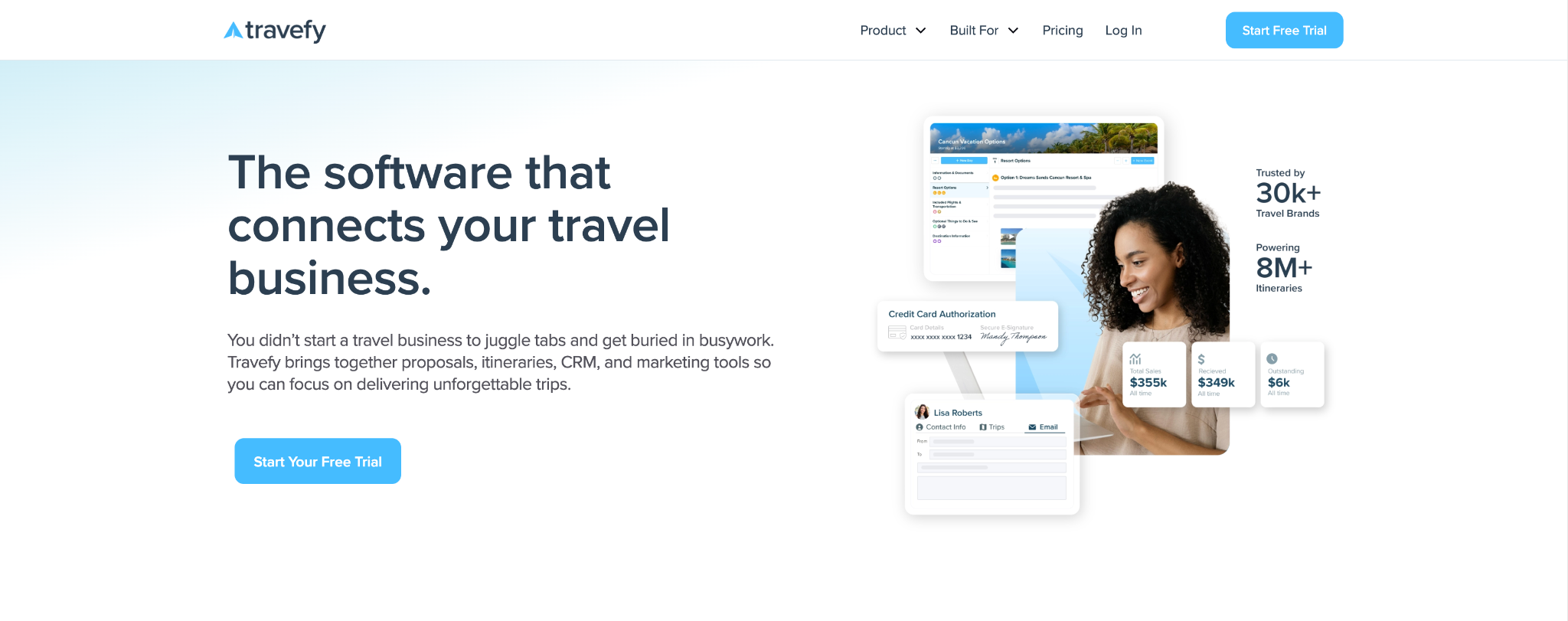
It owns the solo US advisor market for a reason: it bundles CRM, itinerary building, and proposals into one subscription at a price a new advisor can absorb. The catch is brand. Your client downloads an app with Travefy’s name on it.
TravelJoy
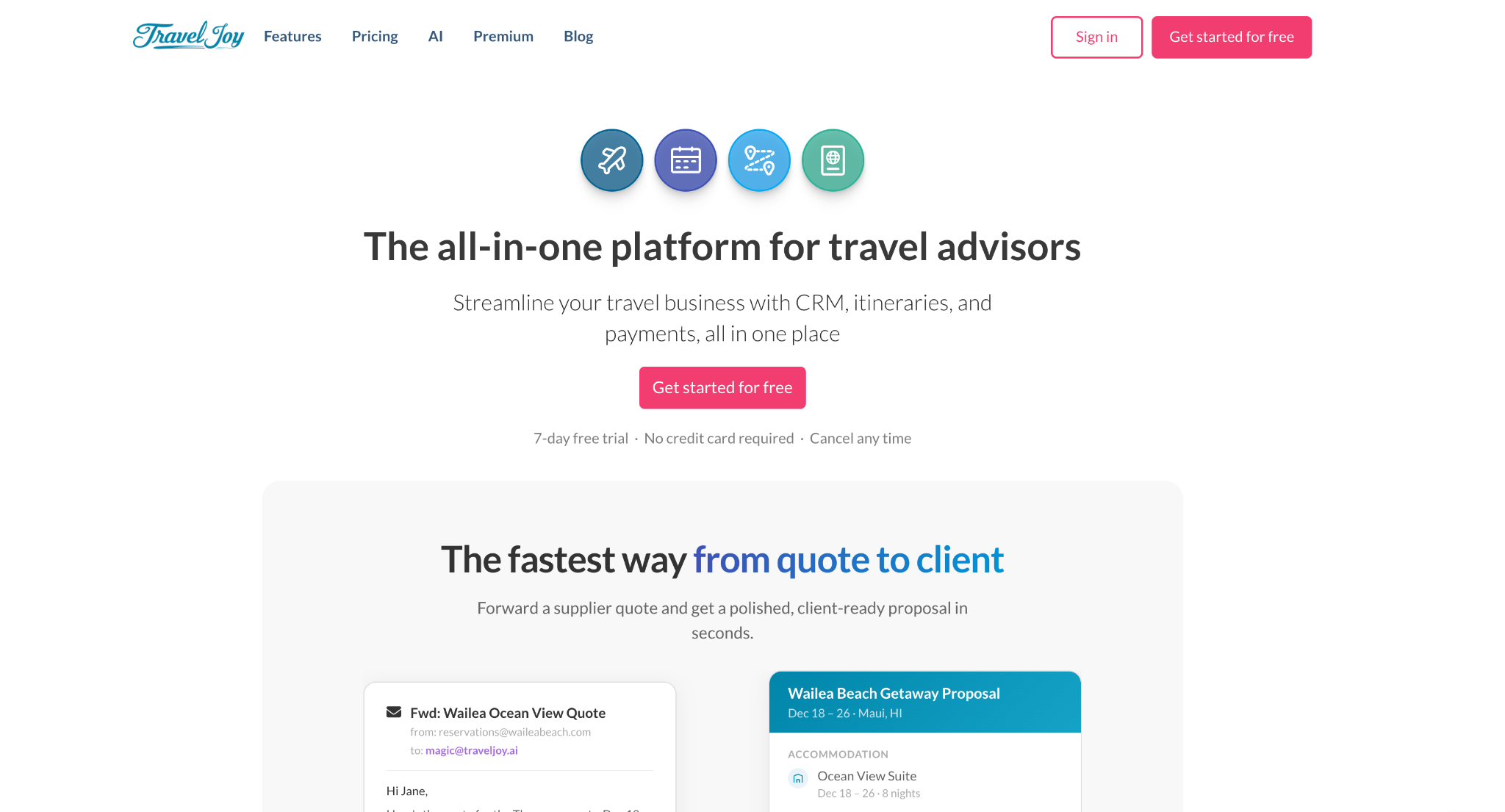
TravelJoy is the friendliest tool here for someone leaving spreadsheets. Client management, proposal creation, messaging, forms, online payments, and consultation services scheduling all sit in one place. Automated communication handles personalized email follow-ups for inquiries and booking confirmations, which does real work in converting new customers.
The uncapped ACH fee is the thing to model before you sign. The starter plan is $19 a month, which is genuinely affordable at entry level, but on a $40,000 booking, that 1.5% is $600 that a flat-rate processor would have charged you $5 for.
Tern
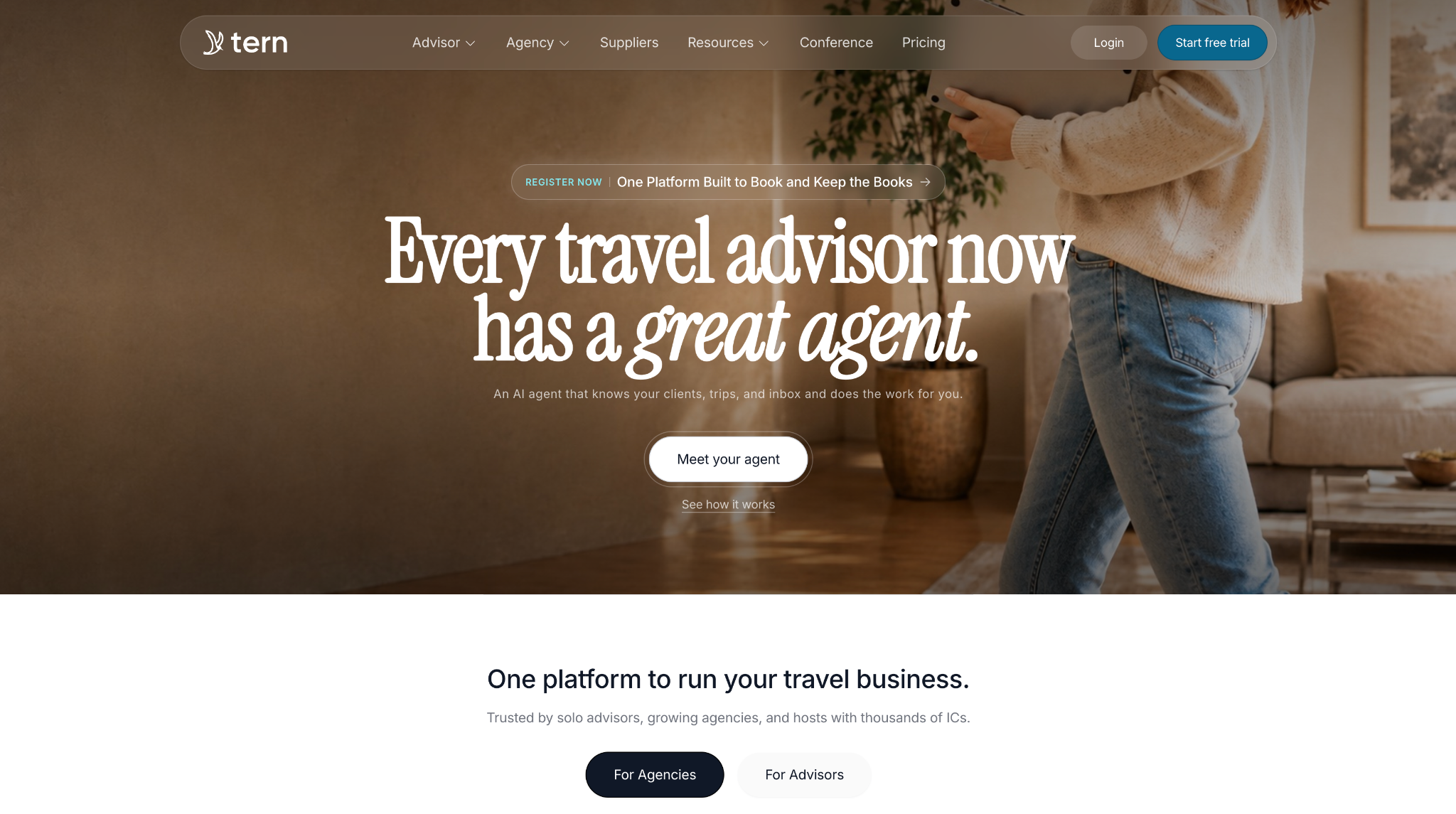
Tern raised $13 million in a 2025 Series A and focuses on CRM and workflow automation for travel advisors, with a particular fit for independent travel advisors, while pushing harder on AI than anyone else in the advisor CRM segment: inbox triage, booking confirmations parsed straight into itineraries, automated commission matching. One advisor publicly credited the AI features with saving roughly six weeks of working hours. GDS integrations were still in progress at the time of writing.
WeTravel
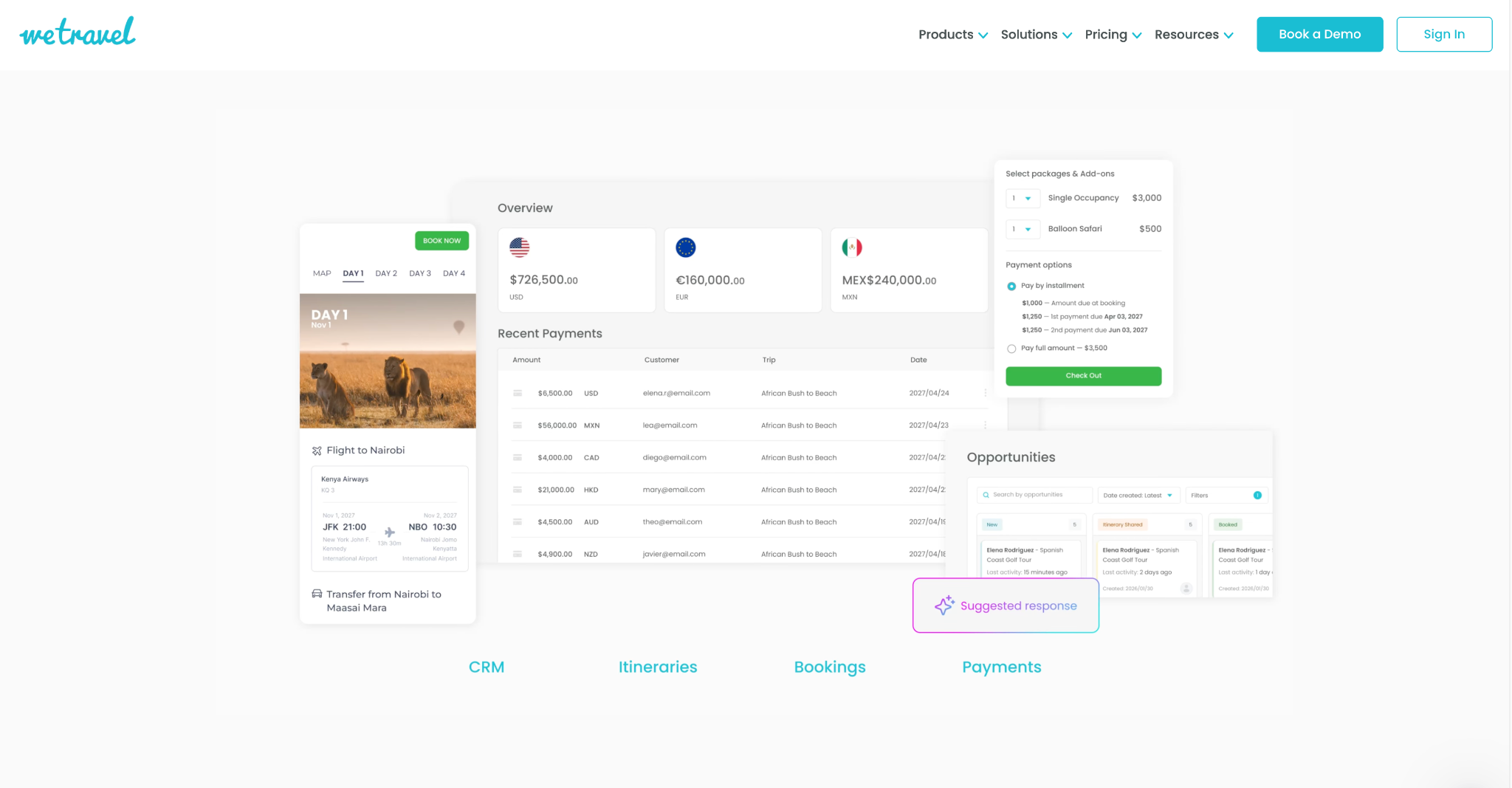
It is a payment engine with an itinerary builder attached rather than the reverse. If your business is retreats, group departures, or anything with installment plans and supplier payouts, WeTravel lets clients pay in their local currency. It also suits group trips, and its group booking tools help manage group inventory and payment reminders for travelers from different countries. Its roughly 1% processing fee is the cheapest structure in this table by a wide margin.
Ezus
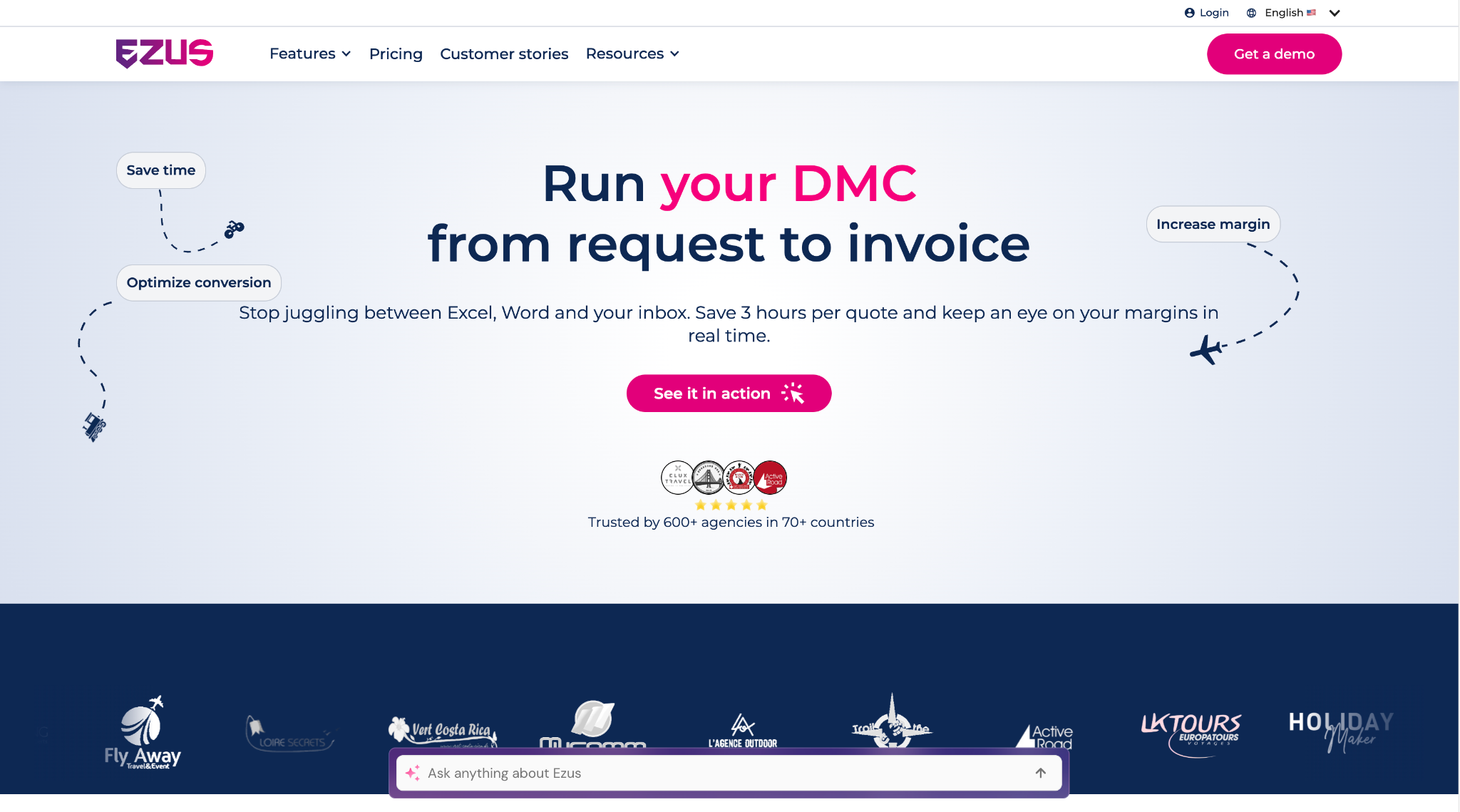
Ezus is built for the DMC problem specifically: custom itinerary building and client relations management sitting on top of multi-currency budgets, real-time margin tracking, supplier catalogs, and branded proposals generated in one click. It handles sales in several languages, which matters for agencies serving clients across different countries. Users recommend it at a 95% rate, unusually high for a platform this specialized. It has no GDS connection and no traveler app, which is a deliberate scope decision rather than a gap. Pricing starts at €75 per user per month.
mTrip
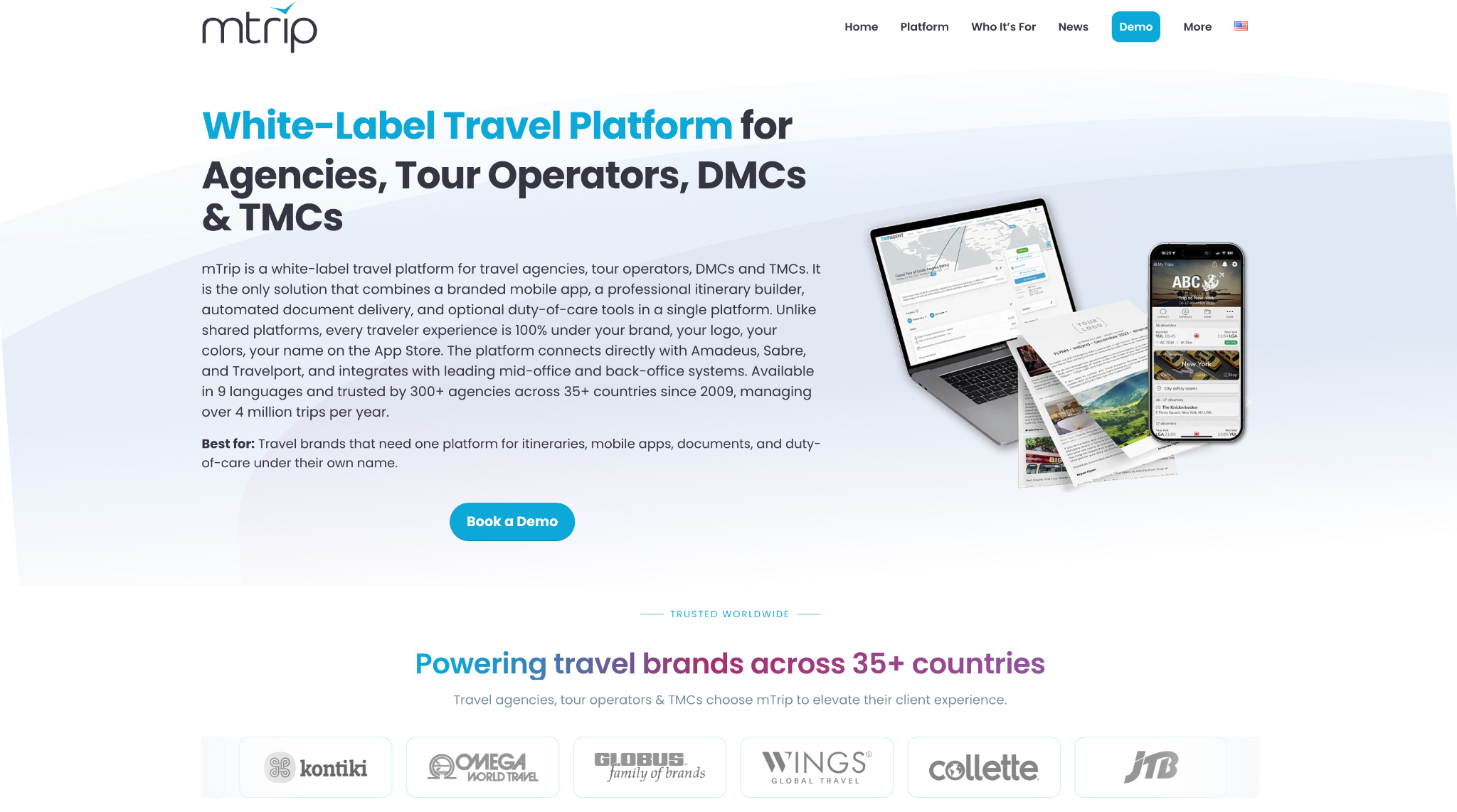
mTrip does one thing nobody else on this list does at the same depth. It generates fully structured itineraries in seconds, and your travelers download a branded mobile app carrying your name in the App Store rather than the vendor’s. That white-label approach is aimed squarely at customer loyalty rather than at internal workflow, which is why it appeals to travel agencies competing on client experience. Itineraries sync in real time across mobile, web, and PDF, and a branded PDF version generates in one click.
It is rated 4.9 out of 5 on G2 and carries certified integrations to Amadeus, Sabre, and Travelport, with agencies running it in more than 35 countries. Pricing is by trip volume rather than per seat, which suits travel agencies with large teams and modest booking counts.
Kaptio
Kaptio is built on Salesforce, which is the whole story in both directions. You inherit a mature platform with real extensibility, multi-currency handling, and an integration path to almost anything your finance team already runs. You also inherit Salesforce pricing, Salesforce complexity, and usually an implementation partner. It fits multi-day operators running cruise, rail, or FIT product at a size where a dedicated admin makes sense.
Tourwriter

Tourwriter solves a narrower version of the same problem and is more self-contained for it. It supports itinerary creation, supplier management for activity providers and car rentals, and tools to sell tours, with dynamic pricing features and per-user pricing from roughly $149 a month, with no platform license underneath. By comparison, some operator tools, such as Bókun, start at $49 per month plus a booking fee. The strength is also the constraint: its deepest roots are in Australia and New Zealand, and North American operators should expect a real learning curve rather than a weekend of setup.
Sabre Red 360
Sabre Red 360 with TRAMS remains the spine of retail agencies earning ARC commissions. Nothing in the modern SaaS column replaces it, which brings up the point most comparison articles get wrong.
Note: Sabre, Amadeus, and Travelport are booking infrastructure. They are not agency software, and ranking them against a CRM is a category error. Supplier and GDS integration connects real-time inventory for flights and hotels. Most retail travel agencies run a GDS for inventory and pair it with client-facing tools to manage inquiries, present travel services, and support bookings, because GDS integration is critical for real-time rates and live availability.
Top Travel Agency Software Solutions by Agency Type
The table above ranks platforms. This one matches them to a problem, which is the more useful direction to read in.
| Agency type | What breaks first | Where to start |
|---|---|---|
| Solo advisor | Proposals and follow-up | Travefy, TravelJoy |
| Small retail team | Collecting and scheduling payments | TravelJoy, WeTravel |
| Group and retreat operator | Deposits and supplier payouts | WeTravel |
| DMC or custom operator | Margin control across suppliers | Ezus, Tourwriter, Kaptio |
| Mid-size retail on ARC | Reconciliation and financial analytics | Sabre Red 360 with TRAMS |
| Multi-brand or high volume | Everything is a workaround | Custom or hybrid build |
Two patterns hold across every row.
Supplier integration is the highest-leverage feature nobody demos well. Travefy imports itineraries from over 200 suppliers, which removes a retyping step most agencies do not realize they are paying for. Every direct supplier connection cuts manual updates and improves data accuracy, and the effect on customer satisfaction is larger than any single feature on a comparison chart. Clients notice wrong trip details immediately and forgive them slowly.
Cloud platforms let you add volume without adding admin. A spreadsheet-based back office grows its workload in a straight line with bookings. A cloud system does not, which is why agencies that double their volume on the same headcount are almost always running one.
Best travel agency software for small business
For travel agents working solo or in teams under five seats, the decision usually comes down to three: Travefy if presentation and client-facing polish matter most, TravelJoy if the bottleneck is client communication and collecting payment, WeTravel if the book is mostly groups.
The reason to think in threes is price sensitivity. At two seats, a $75-per-user platform costs $1,800 a year before a single booking. At two seats with 30 bookings a month, a 6% platform costs considerably more than that, and neither number appears on the pricing page next to each other.
Nothing above fits how you actually build trips?
Sometimes the gap is a single feature, like an itinerary builder that handles your supplier mix. We have built for the travel industry for twelve years and can tell you in one call whether that is a configuration problem or a development one.
The five questions that decide this, and the sticker price is not one of them
Mall landlords worked this out in the 1950s.
A percentage lease charges a retail tenant a modest base rent plus a share of gross sales above an agreed breakpoint. The tenant likes it in a slow year. The landlord likes it in a strong one. Nobody signs one without calculating exactly where the breakpoint sits, because that number determines whether the deal is generous or ruinous, and it is the same lease either way.
Travel software sells you the identical structure. Almost nobody calculates the breakpoint.
1. Total cost at your volume, not the monthly price. Add subscription, per-booking fee, payment processing, FX spread, and API charges. Travel agency software automates booking and payment management tasks, but those savings still need to be weighed against total platform pricing. Then run it at your actual volume. At 200 bookings a month with an $85 average value, a 6% platform costs roughly $12,240 a year. A 1.5% platform costs roughly $2,400. The pricing pages show $0 and $49.
2. Growth headroom. What happens to that number at three times your current volume, and does per-seat pricing punish you for hiring? Pricing varies significantly by platform and scale. Percentage models are cheap while you are small and expensive precisely when you succeed. That is not a flaw in the model. It is the model.
3. Integrations you will actually use. GDS, bed banks, payment processors, accounting software. Ask which are native and which need middleware, then ask what middleware costs.
4. Customization depth. The real question is whether you can change the data model or only the logo. Most platforms answer this honestly if you ask it that directly, and features like automated invoicing can create system-generated invoices that reduce manual errors. Back office tools also support efficient management. They also cut time-consuming tasks.
5. Exit terms. Can you export every booking, client, and financial record in a usable format? Who owns your website if the vendor built it? Who owns the supplier connections? FareHarbor’s website-ownership terms are the standard cautionary example in the activities segment, and versions of the same clause appear across the category.
Ask a vendor question 5 first. Watch what happens. Some answer it directly. Most redirect to a feature. The redirect is the answer.
Where out-of-the-box software runs out of road
Four signals, and none of them are about features.
Your business model is not the one the vendor imagined. Every platform above assumes an agency selling to a traveler. If you are running a marketplace, matching travelers to independent suppliers who set their own availability and get paid directly, nothing in that table is a marketplace engine. You can configure your way to a workaround. You cannot configure your way to a different transaction model.
The percentage fee outgrew the product. A 15% to 20% commission structure on $10 million in bookings is $1.5 to $2 million a year, every year, rising with growth. At that point the annual fee exceeds the cost of building the thing outright, and it recurs.
CRM customization hits the ceiling. There is a specific moment where configuration stops and development starts. Usually it looks like a permissions problem: eight distinct user roles that each need a different view of the same trip record, with commission visibility that changes per role.
You cannot get your data out. This matters more in 2026 than it did in 2021, because booking history is now training data, and investors doing diligence ask who owns it.
Now the honest counterweight, because this is the section where a development company would ordinarily stop talking.
Custom software fails at rates that should make anyone cautious. The Standish Group’s 2024 Chaos Report, drawing on more than 50,000 projects, puts outright success at 29%, with 52% challenged and 19% canceled. The leading causes are unclear requirements at 39% and scope creep at 33%. Failure rates climb sharply with project size: large projects fail at roughly 34% against 6% for small ones.
I have watched the unclear-requirements failure happen from the inside, and it never announces itself. It looks like a productive discovery phase where everyone agrees enthusiastically about goals, and nobody writes down what “done” means for the commission module.
So the argument is that custom is correct in a narrow set of circumstances, and expensive everywhere else.
What a custom build actually looks like
Two projects, both ours, both with the numbers we can actually verify.
Eight user roles is where a CRM stops being configurable
Trips Planner is a travel agent CRM we built for a US client. Two people on the team. Two years of continuous development. Flutter across two connected surfaces: a traveler mobile app with a trip feed, document upload, and hotel discovery, plus an agent dashboard carrying sales and commission charts, a world map of active trips, and separate task queues for documents, payments, and client follow-up.
The number that mattered was eight. Eight user roles on a single permission model, with commission reporting across three currencies. Look back at the comparison table and find a platform that does that without a Salesforce license and an implementation partner. That gap is the entire reason this got built rather than bought.
What we do not have is a published before-and-after business metric for it, so this article is not going to invent one.
A two-sided marketplace is not a product category anyone sells
MySquire connects travelers with local guides, translators, and shopping assistants through geolocation matching. Nine people, three user roles, twelve months to MVP, React Native and Ruby on Rails with Ember.js and Vert.x underneath, currently in closed beta.
The relevant point is structural. There is no travel agency platform on the market that is a marketplace engine, because marketplace liquidity, supplier onboarding, and two-sided matching are a different product than agency workflow. When the business model is the differentiator, the software has to be built.
We also built an AI travel bot for a US travel technology client. LITSLINK reports over 70% automated query resolution within the first three months, sub-three-second average response times, and coverage across ten languages. Those are our own measurements rather than an audited figure, and you should read them the same way you read any vendor’s self-reported numbers, including everyone else’s on this page.
Off-the-shelf or custom: score yourself in six lines
Rate each from 1 to 5, where a higher score leans toward building.
- Booking volume and GMV. Higher volume amplifies every percentage fee.
- Margin structure. Thin margins make platform fees hurt sooner.
- Software as differentiator or plumbing. If clients choose you partly because of how your booking flow works, that is a 5. If software is back-office plumbing, that is a 1.
- In-house technical capacity. No internal engineering means buy, or build with a partner who will still be there in year three.
- Regulatory exposure. PCI DSS for card data, GDPR and US state privacy law for traveler records, and seller-of-travel registration in California, Florida, Hawaii, and Washington. California requires the CST number on all advertising and runs roughly $370 to $700 a year. Florida charges $300 annually plus a surety bond of up to $25,000, waivable after five clean years.
- Supplier and workflow complexity. Group bookings, split payments, multi-currency commission, and niche suppliers push this up fast.
12 or under: buy off the shelf. Pick travel agency software from the table above and stop reading comparison articles.
13 to 20: hybrid. This is where most travel agencies genuinely land.
21 and over: build.
For the middle group, the pattern that works in 2026 is a custom workflow layer sitting on commodity content APIs. Duffel charges $3 per flight order and about 1% on managed content, and using managed content means you do not need IATA or ARC accreditation at all. Bed banks like Hotelbeds and TBO handle hotel inventory the same way. You own the experience and the data. You rent the pipe.
Cost anchors, with the caveat that nearly every published figure comes from a development company and should be read as such. MVP builds run roughly $40,000 to $120,000 across three to five months. Full platforms run $120,000 to $300,000-plus across six to ten months. Maintenance runs an industry-standard 15% to 25% of build cost annually. And the rate spread does most of the work in that range: about $100 an hour in the US against $37 to $50 in Eastern Europe and Latin America.
Direct GDS integration is the line item people underestimate. Expect months, sometimes closer to a year, from first contact to first booking. Each direct airline NDC integration runs three to six months to build and never stops needing maintenance. Aggregator onboarding takes weeks. That difference is why the hybrid pattern keeps winning.
FAQ
What is the best travel agency software in 2026?
There is no single answer, and any article giving you one is selling something. Travefy for solo advisors, Ezus for DMCs and tour operators, WeTravel for group departures, Sabre or Amadeus for retail ticketing. Most travel agencies that are happy with their stack run two to four specialized tools connected by API rather than one platform.
What is the best software for a travel agency with fewer than five people?
Travefy, TravelJoy, or WeTravel, depending on whether your bottleneck is presentation, client communication, or group payment collection. At that size, avoid anything priced per user above roughly $75 a month and anything charging more than 3% per booking.
How much does travel agency software cost?
Entry tools start around $19 to $39 a month per user. Trip production platforms start near $75. GDS access is an enterprise agreement with transaction-based pricing. The number that actually determines your annual spend is the per-booking percentage, which ranges from 0% to about 6% and does not appear on most pricing pages next to the subscription. Some vendors also use volume-based pricing models; for example, mTrip offers two pricing tiers based on trips managed.
What is the difference between a travel CRM and tour operator software?
A travel CRM manages client relationships, sales pipeline, and commissions, with customer relationship management storing client preferences and booking history while centralizing client information for personalized interactions. Zoho, for example, offers a targeted Travel Agency CRM for lead management. Tour operator software builds and prices custom trips, manages supplier contracts, and controls margin. Travel agents selling packaged product need the first. DMCs and custom trip designers need the second, and often discover this after buying the first, while tools like Kapture CRM focus on automating itinerary creation for travel agencies to support stronger customer relationships.
When does building custom software make more sense than subscribing?
When percentage fees exceed the amortized cost of building plus 15% to 25% annual maintenance, when your business model is not one any vendor built for, or when owning booking data is strategically necessary. Score yourself on the six dimensions above before assuming any of those apply.
Can custom software replace Sabre or Amadeus?
No, and trying is a bad use of capital. What a custom layer replaces is everything the GDS was never built for: proposals, client experience, margin control, and workflow. If the goal is flight content without a GDS contract, aggregators like Duffel sell managed content that requires no accreditation, which is a different solution to a related problem.
Still deciding which side of that checklist you land on?
Send us your six scores and your current stack. We work with travel agencies on both answers, and we will tell you if buying is the right call.