






Building a Tour Guide App that Connects Travelers With Local Experts
- 2 products delivered as one platform (web + mobile)
- 9 specialists across 3 user roles
- 12 months from concept to MVP
- 4 provider categories live in one marketplace
- Closed beta running with real service providers
MySquire answers one question for travelers: who nearby can help me right now? LITSLINK built the tour guide app that answers it, plus the web platform where local guides, translators, shopping assistants, and business consultants sign up to take the work.
Request Similar Solution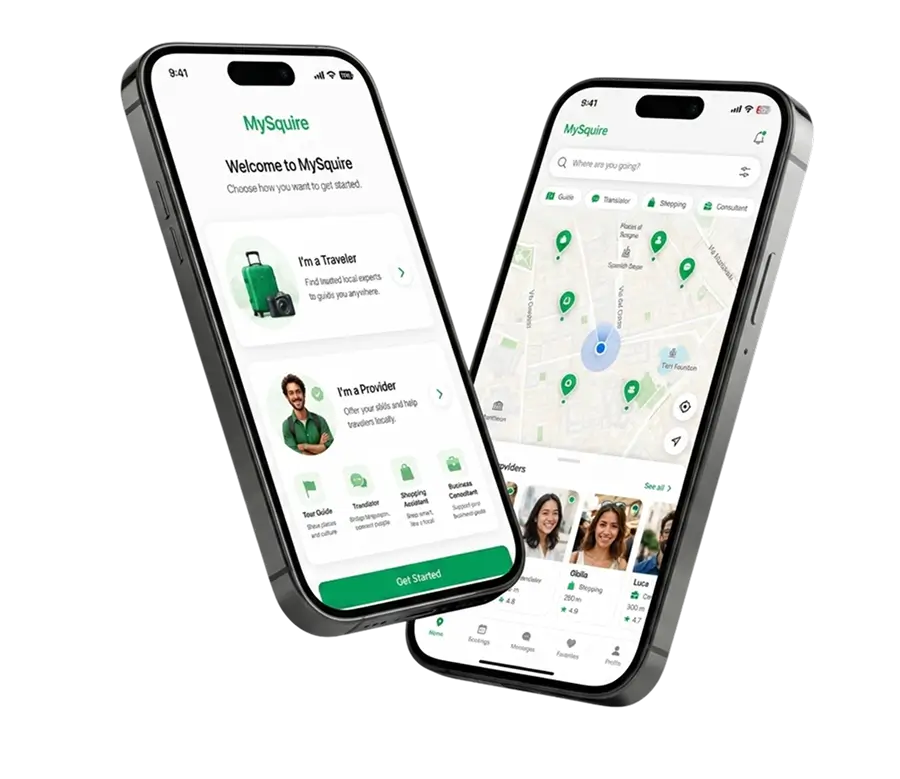
Project Details
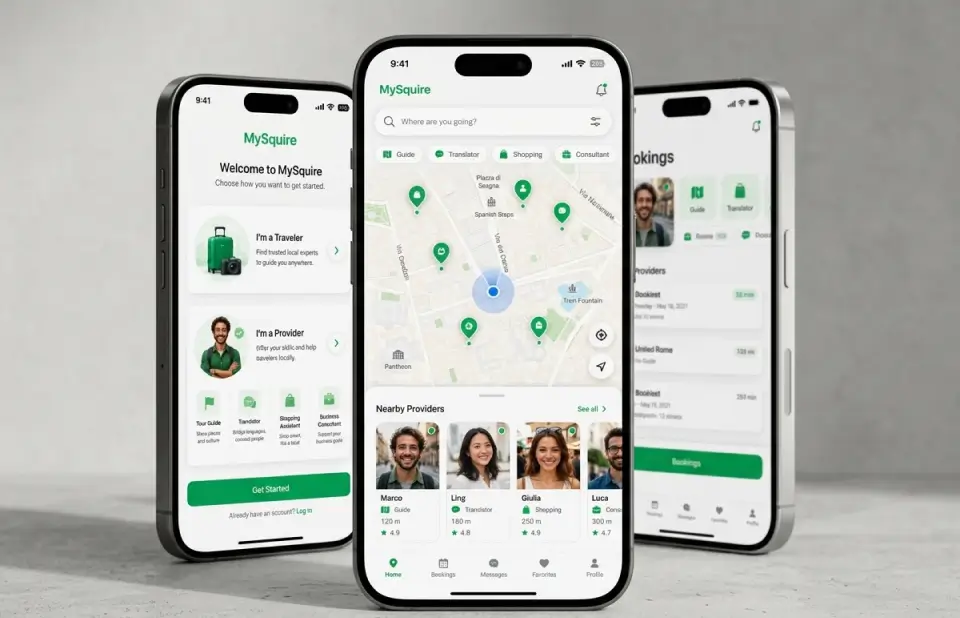
The idea came out of the founders’ own trips. MySquire is a geolocation-based travel app that connects travelers with local guides, translators, shopping assistants, and business consultants, all of them shown on a live map built around wherever the traveler happens to be standing.
LITSLINK built both halves. Providers got a browser workspace for registering and managing what they offer. Travelers got a cross-platform mobile app they open on the road. Nine specialists worked across three user roles for 12 months, and the product now runs in closed beta with real providers on it. The build sits alongside the rest of our travel software portfolio.
 Client
- MySquire
 Industry
- Travel
 Solution
- Two-sided marketplace connecting travelers with local service providers
 Service
- Product Design, Software Development, Business Analysis, Full Cycle QA, Publishing, Maintenance & Support
 Platform
- Web + iOS / Android
 Scope
Scope- 9 people, 3 user roles
 Duration
- 12 months
 Location
- US
Business Challenge: Finding Trusted Local Help While Traveling
Land in Shanghai at 11 p.m. with a contract meeting at nine the next morning and no interpreter booked. Or stand in Milan with two hours before a flight and no idea which boutique carries the thing you flew in for. Both situations have the same shape. The help exists somewhere in that city, and there is no fast way to reach it. Agencies need lead time. Forums answer in days. General search ranks the loudest listing rather than the closest person.
MySquire’s founders travel for work constantly and had hit that wall often enough to want an on-demand travel services app built around it. They also saw the other side of the exchange. Someone who knows Lisbon, speaks Portuguese and English, and has free afternoons is holding something worth paying for, with no straightforward way to sell it to the travelers already walking past their door. LITSLINK came in to build both sides at once.
-

No instant local help
A traveler who just cleared customs needs an interpreter within the hour, not next Tuesday. Forums, general search, and agency inboxes all run on a slower clock than a trip does.
-

Fragmented service discovery
Guides, translators, and consultants sat scattered across freelance boards, agency rosters, and local social groups. Nowhere to compare people by distance, skill, and availability in a single view.
-

No easy way to monetize local expertise
A student in Bangkok with good English and free evenings had no direct route to paying customers. Getting listed meant an agency, a cut of the fee, and a schedule someone else controlled.
Technologies Behind the Tour Guide Marketplace




Our Tour Guide Marketplace Solution
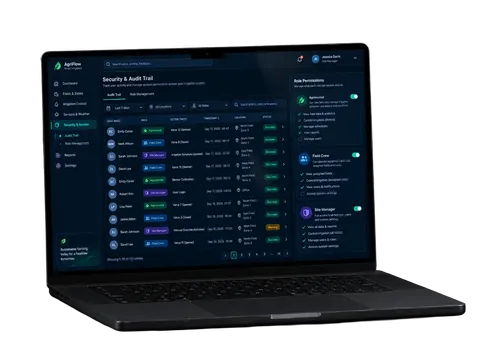
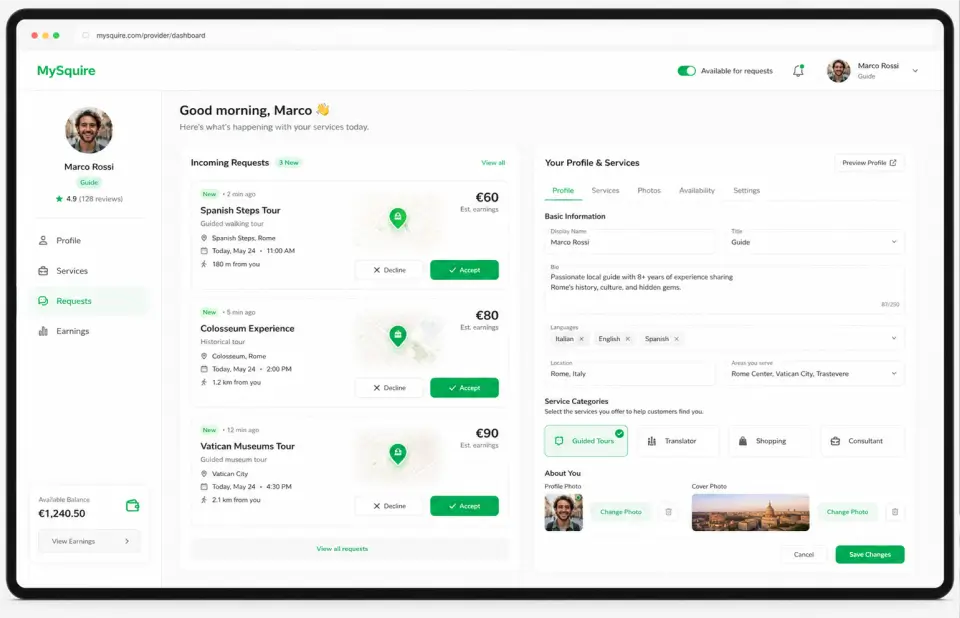
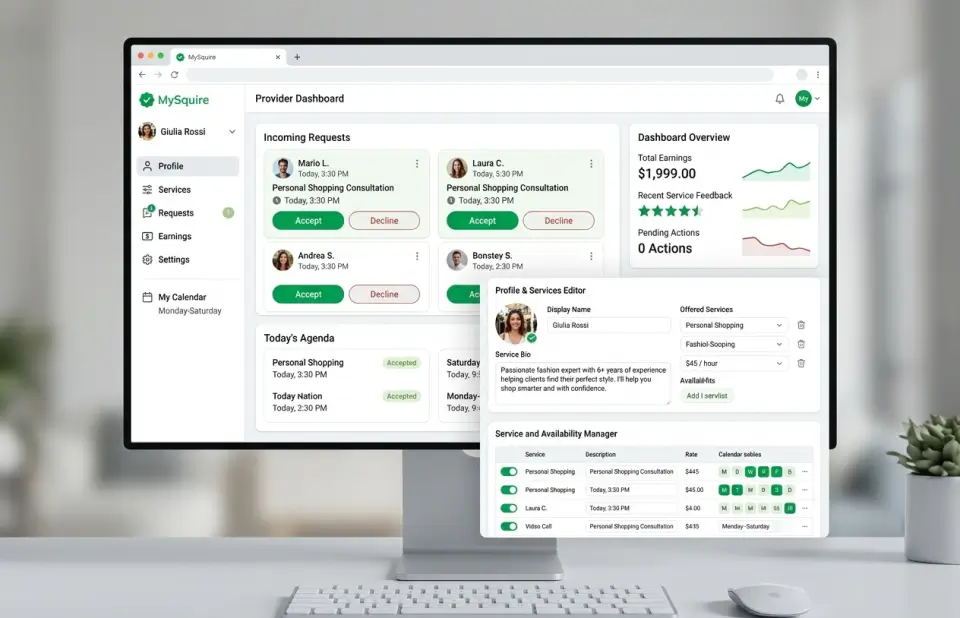
Two products, one platform. That was the shape of the decision coming out of discovery. Providers needed a desk-bound workspace for building a profile, describing services, and handling requests, so LITSLINK built that as a web platform that behaves like a freelance travel service platform for guides, translators, shopping assistants, and business consultants.
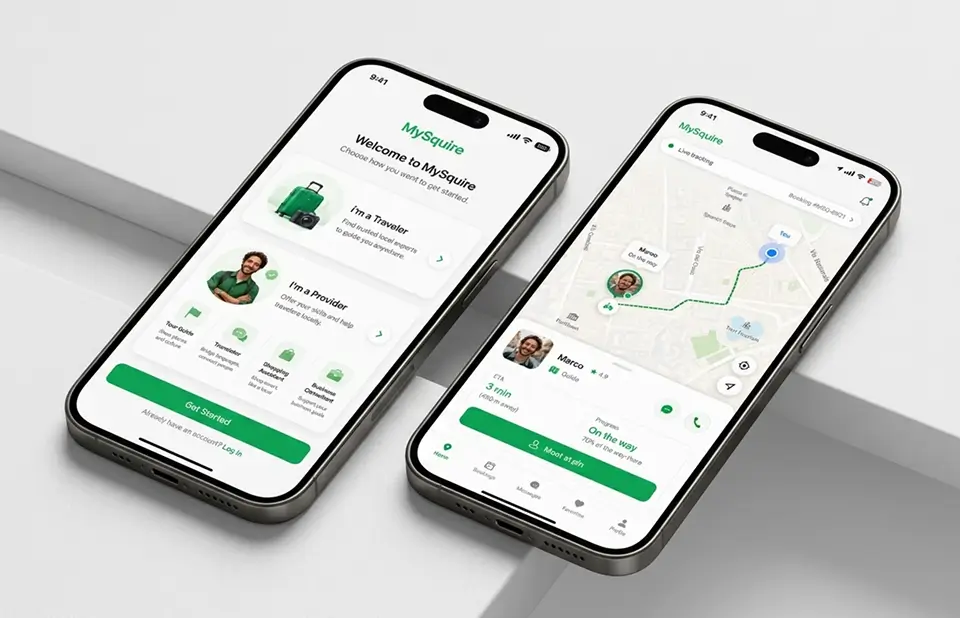
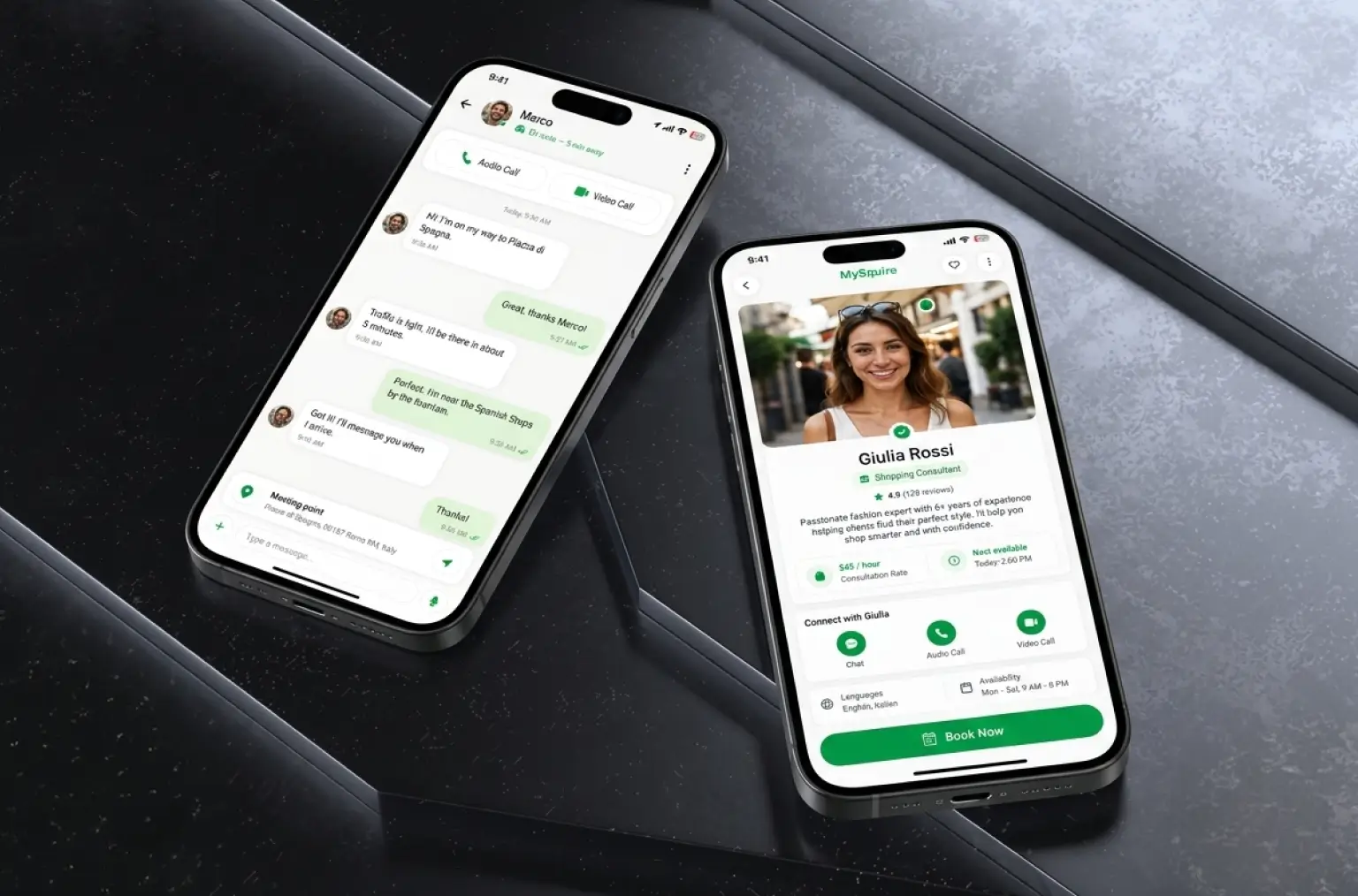
Travelers needed the opposite. The mobile side puts the map first. Location comes from the phone, available providers appear as pins around the traveler, and tapping one opens a profile with services and rates. From there, the traveler picks a channel and starts talking. Chat for quick questions. Audio or video when writing is too slow, which is most of the time when you are pointing a camera at a menu you cannot read. Once a job is agreed, the provider follows the traveler’s location in real time, so meeting up stops being its own negotiation.
React Native powered the traveler-facing side of the travel marketplace, allowing one codebase to support both iOS and Android. Ruby on Rails handled the provider platform, profile data, and matching logic, while Ember.js supported the administrative interface. Vert.x powered the real-time layer, moving chat messages and location updates between the two products with the low latency required for live communication and map tracking.
-
Multi-Role Marketplace
Tour guides, business consultants, shopping assistants, and translators register under four service categories and earn from travelers nearby or remotely. Three roles run the system: traveler, provider, admin.
-
Geolocation-Based Map Discovery
Available providers show up as pins on a live map centered on the traveler's position. Distance decides what appears first, not ad spend.
-
In-App Chat, Audio, and Video Calls
Travelers pick the channel that fits the request. A quick question stays in chat. A walk-through of a ticket machine in a language you do not read goes straight to video.
-
Provider Web Platform
Providers manage profiles, service listings, and incoming requests from a browser between jobs.
-
Real-Time Traveler Location Sharing
Once a booking is confirmed, the guide follows the traveler's position on the map. Fewer rounds of “I'm by the fountain, which fountain” before anyone actually meets.
Ready to Build a Travel Marketplace App?
Request a Similar SolutionScrum Methodology
Project Journey — Building the MySquire Marketplace
Over 12 months, a nine-person team took the product from discovery to a closed-beta MVP, building the web platform and mobile app in parallel because neither worked without the other. Discovery defined three roles (traveler, provider, admin) and showed that provider onboarding was the critical path, so supply-side tools shipped before the traveler app’s final polish to avoid launching with an empty marketplace.
- Weeks per sprint cycle
- 2
- Sprints completed
- ~17
- On-time delivery
- 97%
- Team members
- 9
How the Tour Guide App Works
-
Sign up as traveler or provider
The user picks a role at registration: traveler or provider working as a guide, consultant, shopping assistant, or translator.
-
Browse nearby guides on the map
The app reads the phone's location and drops every available provider within range onto a live map.
-
Connect via chat, audio, or video
The traveler opens a profile, checks services and rates, and starts the conversation in whichever channel suits the request.
-
Get instant local help
The provider translates, guides, advises, or shops alongside the traveler, either in person or remotely from the same session.
-
Track location in real time
During an active booking, the guide sees where the traveler is, which turns meeting up into a two-minute problem.
-
Earn as a local expert
The provider gets paid for the session through the platform and keeps the profile running for the next traveler in town.
Scrum Process Flow
A two-sided marketplace earns its shape through testing. Sprint-based delivery meant the founders reviewed working features every two weeks and could redirect priorities while changes were still cheap to make. Provider onboarding got reworked twice on the back of those reviews.
Inside Each Sprint
-
Daily Scrum
15-min sync every morning
-
Retrospective
Inspect & adapt process
-
Sprint Review
Demo to stakeholders
-
Increment
Shippable product update
How we deliver your project
-
Scope & Timeline
We agreed the goal with the founders: two products, three roles, an MVP travelers and providers could actually use. Priorities, timeline, and budget followed from there.
-
Feature Priorities
We ranked the work. Provider registration and the map came first, since a marketplace with no listings has nothing to show.
-
Sprint Kickoff
Work broke into two-week cycles. Each cycle opened by picking the next slice of the web platform and the app to build together.
-
Development Cycle
Rails and React Native teams worked the same sprint board, so a provider-side change and its mobile counterpart landed in the same cycle.
-
Review & Feedback
Every cycle closed with a working build on a real device. The founders travel constantly, so they tested the map in actual cities.
-
Delivery
Each sprint produced something shippable, from the first working provider profile to publishing on both app stores.
-Timeline
Five Phases, Clearly Defined
-
Discovery & Product Workshop
2–3 weeks
- Defining use cases across two products, web and mobile
- Mapping traveler, provider, and admin roles
- Agreeing what ships inside the MVP
-
UX Prototyping
3–4 weeks
- Wireframing the provider map as the app's home screen
- Prototyping the provider web workspace
- Designing profile and service listing layouts
-
Agile Development (Sprints)
~8 months
- Building the Rails provider platform and the React Native app in parallel
- Wiring geolocation, chat, audio, and video
- Reviewing working builds every two weeks
-
QA & Testing
3–4 weeks
- Testing map accuracy and pin behavior on real streets
- Checking call quality across mobile networks
- Validating both platforms against real booking scenarios
-
Launch & Support
Ongoing
- Publishing the app to the App Store and Google Play
- Running closed beta with real service providers
- Maintenance and support ahead of public launch
UI/UX Design
Two user types, two different states of mind. A provider sits at a desk with time to fill in a profile properly. A traveler stands on a curb at 14% battery next to a driver who does not speak their language. The design had to serve both without splitting into two products that felt unrelated.
So the map became the home screen of the mobile app rather than a tab inside it. Open the app, see who is close, tap a pin. Provider cards carry service category, distance, and a photo, which is roughly what a person can absorb while walking. Green does the signaling work throughout: accent green #00b369 for actions and available-provider pins, primary green #97c65c for supporting states, and a #f8f8f8(light gray) background that keeps the map the brightest thing on screen. Roboto holds up at small sizes on both platforms.
The web side runs at a slower pace by design. Providers get a full-width workspace for listings, service descriptions, and incoming requests, closer to a freelance dashboard than to anything on the phone. Both products share the same palette, so a provider who checks the web platform and then opens the app does not feel like they switched companies halfway through.
Results & Impact
Before
- No way to reach an interpreter or guide inside the first hour after landing.
- Guides, translators, and consultants spread across freelance boards, agency rosters, and local social groups.
- Local experts had no direct route to paying travelers, and agencies took a cut of whatever they earned.
- Founders had a clear problem statement and zero code.
- No single place where a traveler and a nearby provider could find each other.
After
- 2 products running as one platform: web for providers, iOS and Android for travelers.
- 4 provider categories in one marketplace, from tour guides to translators.
- Providers list services and earn directly, with the platform handling discovery instead of an agency.
- MVP in 12 months with a 9-person team covering 3 user roles.
- One map where a traveler sees every available provider nearby and opens a chat, call, or video session from it.
The Impact
The 12-month number carries more weight than it looks. Two products, four provider categories, three user roles, real-time location, and three communication channels came together inside a single year with nine people on the job. Marketplaces usually fail on the supply side first, so the provider platform shipped early enough to onboard real guides before travelers ever opened the map.
Closed beta is where the tour guide app sits now. Real providers are registered and running sessions with real travelers, and the founders are watching which service categories get used most before opening the doors to the public.
Want a marketplace where supply and demand find each other on a map?
Request a Similar SolutionWhat’s Next
Four directions are on the table for the next phase.
- Public launch: Moving out of closed beta with full provider onboarding and self-service verification.
- More provider categories: Photographers on demand, local drivers, and personal shoppers alongside the current four.
- Transaction-based monetization: Commission on completed sessions plus a premium tier that lifts provider visibility in search.
- Ratings and verification: A review and ID-check system, so a traveler choosing between two nearby guides has something to go on.
-Verified Reviews
Our Reputation on Top Platforms
LITSLINK holds high ratings on Clutch, GoodFirms, and other review platforms. Clients tend to single out the same things: technical depth, clear communication through the engagement, and delivery on the dates we agreed. Marketplace builds like this one lean heavily on product design work, which we run in-house.
Have a Travel App Idea in Mind?
Planning a tour guide app, or a marketplace where supply and demand have to find each other on a map? Tell us what you are building, and we will come back within 48 hours with a way forward.
Next steps:
- LITSLINK specialist reviews your request and contacts you to discuss the details;
- If needed, we can sign an NDA before moving forward;
- We send a project proposal – estimates, timeline, and team CVs included;
- After launch, we stay on for any updates your product needs.
- 48h Response
- 1540+ Projects
Thank you for your message. It has been sent.


