
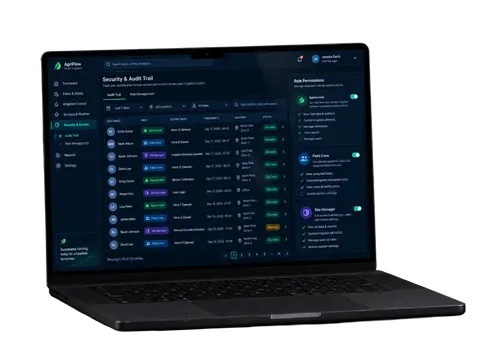






We build AI agents to operate alongside humans and free up their time to make decisions that matter for relationships with carriers, vendors, and end-consumers. AI agents track not only historical operational data but also the real-time state of the road each truck is moving on. They monitor inventories, market trends, and the state of vehicles. They log everything, cutting from 6 to 20 hours per week that employees spend on manual entry, and automatically suggest solutions for better operational efficiency, letting logistics companies improve scheduling, service quality, and, eventually, customer satisfaction.
Streamline Your Operations With AI Solutions in Logistics
AI solutions in logistics help businesses across different points of the supply chain. They make logistics faster, cheaper, more efficient, and less error-prone.
- Delivery route optimization for better customer satisfaction
- Predictive analytics for inventory levels and demand forecasting
- Better planning through intelligent supply chain management
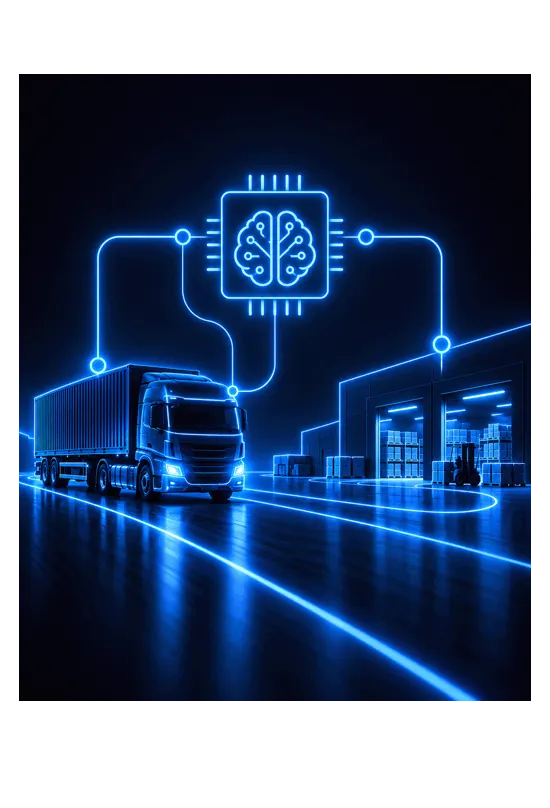
AI Applications in Logistics We Develop
AI-Powered Route Optimization
AI-enabled logistics software solutions optimize delivery routes through real-time and historical data analytics and processing. Our software tracks fuel levels, employs predictive analytics to forecast traffic, weather, and other disruptions, and tracks the technical health of the vehicle. Using it, businesses make faster deliveries (which improves customer satisfaction), save on maintenance costs, and improve risk management.
AI Fleet Management
Our AI-driven smart solutions for fleet management aim to cut inefficiencies bugging transportation and logistics companies for decades: overspending on reactive maintenance and repairs, struggling with driver retention, and fuel management. With software providing insights into vehicle health, optimal routes, and load management, businesses can reduce unplanned downtime, lower operational burden on workers, and save costs significantly.
Intelligent Inventory Management
Piling up excess inventory and not having enough of what consumers need are two banes of inventory management. AI-driven solutions for inventory can predict shortages, prevent excess volumes of products, and enable better stock level control in general. Using them, businesses can avoid disappointing the customer, fulfill orders quicker, and cut the costs of holding products that people stopped needing.
Warehouse Automation and Robotics
A variety of technologies are now accessible to make work in the warehouse easier: from AI-powered robots that help sort, store, and move inventory to AI algorithms that enable existing systems in warehouse operations (WMS, ERP, or others) to help process big volumes of orders faster. An automated warehouse means fewer human errors in inventory and order management and less manual work for staff, which boosts not only the bottom line of a business that owns the warehouse, but also employee retention.
AI-Powered Customer Service
Our chatbots, available 24/7, handle basic customer inquiries: delivery status, shipping costs and options, and ways to return the product. Constant (and efficient) support makes for better customer service and removes the costs of night-shift salaries from the equation of your business.
AI-Powered Dynamic Pricing
Our dynamic pricing solutions analyze vast amounts of data so that businesses make pricing decisions that’ll benefit them now and long-term. Demand trends, existing storage and staff capacity, historical data, real-time market trends, and data from competition — all of that goes into improving our clients’ margins and enabling them to earn more.
Last-Mile Delivery Optimization
With last-mile delivery being vital for good customer reviews, AI optimization of this step is focused on ensuring the shipment is as fast and as pleasant for the receiver as possible while keeping the cost per delivery minimal. AI solutions help schedule the delivery as soon as the shipment is in the distribution center, make sure available drivers and their vehicles are ready for the job, and find the shortest routes to the final customer.
AI Demand Forecasting
For any business with a logistical component, it’s important to react to consumer needs quickly. Using data-driven insights makes it harder for you to be surprised by some of your products going viral on social media. AI demand forecasting helps prepare the supply chain for holidays and sudden trends based on analysis of historical sales data and external market factors.
AI Warehouse Optimization
If a warehouse is organized efficiently, it’s an asset for supply chain management. AI tools for warehouse operations help find necessary products quicker (or find a place with appropriate conditions for them) and use storage space more efficiently, boosting inventory management via tracking inventory flows and sales data.
Logistics Document Automation
The logistics industry deals with huge amounts of paperwork, and automation — AI and GenAI — helps deal with it swiftly and more accurately. Our AI-enabled solutions remove manual entry from the equation, which makes it easier for workers to extract shipment data, fill and analyze invoices and receipts, formulate shipping documents, and classify products.
AI Supplier and Vendor Management
Litslink’s AI solutions optimize your relationships with existing and future suppliers and vendors, making the data underlying each partnership transparent. Software showcases your collaborators’ performance, pricing, and changes to pricing (or purchasing history, if it’s a vendor); it also finds delivery delays. That allows you to notice if suppliers are unreliable early and offer better deals — or products of interest — to a reliable vendor when they need it.
Technologies We Use for AI in Logistics
Generative AI
With generative AI, logistics businesses can easily gain useful insights into relationships with drivers, customers, brokers, and other participants of the supply chain from paperwork. GenAI processes and summarizes documents that are already in the system and simplifies navigation through them for employees (essential for new hires). It also helps generate new invoices, contracts, and other documents more quickly, drastically improving transparency and accessibility of documentation and enabling knowledge sharing across logistics operations.
LITSLINK uses machine learning algorithms to process historical data and analyze real-time data flow from warehouses, inventory, vehicles, and sales to pinpoint trends and anomalies and create models for demand forecasting, predictive maintenance, and disruption analytics. With these, logistics teams get a firm grasp on operational context, the current and the future, and reduce costs that slowed them down before — e.g., the cost of reactive repairs that are 3 to 9 times higher than planned.
Computer Vision
The algorithms for computer vision we build analyze images and videos from cameras and sensors installed in warehouses, distribution centers, inside trucks, etc. Logistics teams use these tools for automated package recognition, easier tracking of inventory, load balancing and verification, consistent safety monitoring, and faster damage detection.
Benefits of AI Adoption in Logistics
Cost Savings and Lower Operational Expenses
- Logistics companies can cut costs by utilizing AI-driven predictive analytics for preventive maintenance. Moreover, AI route optimization can cut the money spent on fuel consumption by creating a route where a driver won’t have to stay idle, encounter stop-and-go traffic, or go to a closed distribution center because the day shift didn’t mention it was closing to the after-hours team. Planning ahead with automation also cuts through manual work, helps businesses avoid overbuying perishables, and optimizes storage, which also saves costs.
Faster and More Accurate Deliveries
- With real-time data analytics for route planning, logistics businesses can know when a disruption happens ahead of the driver reaching it — historical data won’t help pinpoint a protest demonstration obstructing traffic in the middle of a street on the way to delivery locations, but our solutions can. Same with sudden weather events, traffic accidents, and so on — AI in logistics accelerates deliveries, correctly predicts ETA(and adjusts the predictions), and reduces the number of errors that can be made both by the driver and the dispatcher while the shipment is on the way to a vendor or an end-customer via optimizing transportation routes.
Improved Customer Satisfaction
- Reliable, timely deliveries made possible by AI improve customer experience: in the U.S., B2C consumers expect their orders to arrive within 2 hours of them clicking the “pay” button. For businesses, having accurate ETAs is just as essential. With AI making sure delivery routes are clear, chatbots informing customers about any changes, and GenAI helping dispatch teams resolve issues faster, logistics becomes more transparent and capable of delivering better service.
Better Inventory and Warehouse Efficiency
- Even though businesses always try their best to preserve products, they still can damage them, mismatch storage conditions, or overbuy and deal with them going past expiry rates. AI for warehousing and inventory levels uses imaging and captured data about the product to help workers with storing, picking, and shipping-related processes, which enables faster order fulfillment. AI also optimizes space, helps efficiently utilize warehouse capacity (including placing fragile objects in a place where nothing will fall on them), and reduces waste.
Smarter Data-Driven Decision-Making
- Integrated across your platform, AI solutions analyze the data your organization has and process it so you’d have insights into market trends and anticipate demand, the real-time state of the routes your drivers are using, and orders that currently need the most attention.
Enhanced Safety and Operational Reliability
- Logistics management also includes addressing security concerns and risks, and AI tools help make that process proactive. Receive real-time data about your vehicle health, track changes to storage conditions of your high-maintenance products, and reduce costly downtime and delays.
LITSLINK Reputation on Top Platforms
LITSLINK is recognized across leading industry platforms for delivering high-quality software solutions. See what clients and the design community say about our work.
How We Implement AI in Supply Chain and Logistics
We analyze your logistics processes, pinpoint operational challenges that give you pain, check through technology you already have, and ask about your business goals. Then, we see where to implement AI in the most beneficial way for your business — define those use cases, outline project scope, and set KPIs that’ll signify the AI implementation was efficient.
We access logistics data from your data warehouses and lakes (WMS, fleet management systems, IoT and GPS devices, telematics software if necessary — depends on your issue) and then extract it, evaluate the quality of your records, perform data reduction, and clean it so that it’s ready to be used by AI-powered logistics software. That also allows us to see if you are missing some essential data, pinpoint issues with your sensors, and notice other data-related concerns early.
Our goal is to provide you with AI technologies that suit your business and the challenges you’re dealing with: that can be machine learning algorithms for deep data analysis, genAI for customer service, AI agents deployed across your infrastructure, computer vision solutions for monitoring storage conditions or warehouses, and more.
We need to know how our AI concept works, so we test our PoC or MVP within logistics scenarios, sometimes inside the double of systems our clients are utilizing. For each use case of AI implementation, we save operational costs for you and for us by putting it to use in real-world logistics scenarios and seeing if our solution truly solves the challenge and drives business value up. If not, we gather feedback and work further.
We let the AI model go into the data we’ve selected, cleaned, and prepared and fine-tune the model to produce the business outcomes you need. If it doesn’t, we iterate on the algorithms used and correct the model’s behavior. We evaluate models using use-case-specific metrics such as precision, recall, F1 score, ROC-AUC, MAE, or RMSE
When an AI solution is ready, we integrate it with your data warehouses, IoT infrastructure, APIs, and other software you’re using, making sure the workflow you’re used to isn’t interrupted by the new software, but enhanced and made more efficient by it.
Before going to production, we conduct functional, performance, security, and integration testing on the AI system to be confident it performs accurately within real-world logistics workflows and isn’t overwhelmed by the amount of real-world data, if there is any — and deploy it into the target environment.
After deployment, the main challenge is to monitor the model, figure out the areas where it can improve and deliver better results, incorporate new data into the training sets, and optimize the AI continuously. If the client wishes, we can scale the AI software to include more warehouses, routes, regions, or even implement it across the entire supply chain operations.
01 Business Analysis and Use Case Definition
We analyze your logistics processes, pinpoint operational challenges that give you pain, check through technology you already have, and ask about your business goals. Then, we see where to implement AI in the most beneficial way for your business — define those use cases, outline project scope, and set KPIs that’ll signify the AI implementation was efficient.
02 Data Assessment and Preparation
We access logistics data from your data warehouses and lakes (WMS, fleet management systems, IoT and GPS devices, telematics software if necessary — depends on your issue) and then extract it, evaluate the quality of your records, perform data reduction, and clean it so that it’s ready to be used by AI-powered logistics software. That also allows us to see if you are missing some essential data, pinpoint issues with your sensors, and notice other data-related concerns early.
03 AI Architecture and Technology Selection
Our goal is to provide you with AI technologies that suit your business and the challenges you’re dealing with: that can be machine learning algorithms for deep data analysis, genAI for customer service, AI agents deployed across your infrastructure, computer vision solutions for monitoring storage conditions or warehouses, and more.
04 PoC and MVP Validation
We need to know how our AI concept works, so we test our PoC or MVP within logistics scenarios, sometimes inside the double of systems our clients are utilizing. For each use case of AI implementation, we save operational costs for you and for us by putting it to use in real-world logistics scenarios and seeing if our solution truly solves the challenge and drives business value up. If not, we gather feedback and work further.
05 AI Solution Development and Training
We let the AI model go into the data we’ve selected, cleaned, and prepared and fine-tune the model to produce the business outcomes you need. If it doesn’t, we iterate on the algorithms used and correct the model’s behavior. We evaluate models using use-case-specific metrics such as precision, recall, F1 score, ROC-AUC, MAE, or RMSE
06 Integration with Logistics Systems
When an AI solution is ready, we integrate it with your data warehouses, IoT infrastructure, APIs, and other software you’re using, making sure the workflow you’re used to isn’t interrupted by the new software, but enhanced and made more efficient by it.
07 Deployment and Quality Assurance
Before going to production, we conduct functional, performance, security, and integration testing on the AI system to be confident it performs accurately within real-world logistics workflows and isn’t overwhelmed by the amount of real-world data, if there is any — and deploy it into the target environment.
08 Monitoring, Optimization, and Scaling
After deployment, the main challenge is to monitor the model, figure out the areas where it can improve and deliver better results, incorporate new data into the training sets, and optimize the AI continuously. If the client wishes, we can scale the AI software to include more warehouses, routes, regions, or even implement it across the entire supply chain operations.
Our Related Experience
Delivery Chatbot for Real-Time Parcel Tracking
Client
An international logistics and courier service provider
Problem
Customer support team that has 8,000 contacts per day in peak times was overloaded with inquiries about customer parcel status that comprised 62% of requests. Information pertinent to make a proper response was distributed across 8 different logistics solutions — so, difficult to find — and customers waited 6 minutes for a response on call and up to 14 hours for an email answer from the team.
Solution
LITSLINK developed an AI-powered chatbot for web and mobile that harnessed data about the parcel across 8 systems and used NLP to respond to customer queries on parcel status and ETA; it helped the dispatch team and drivers change delivery details, direct parcels to different pickup points, display invoices, and turn complex cases over to a human. NLP chatbot covered different languages and regions, which, along with reduced wait times, boosted customer satisfaction.


Smart Barcode Scanning for Logistics
Client
A company operating across logistics, supply chain, and retail industries
Challenge
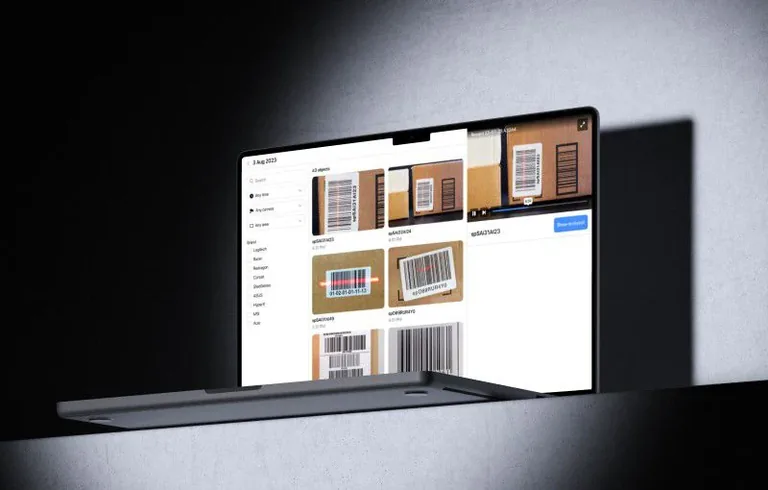
Employees at the intake bench, processing 1,200 parcels a day, logged each parcel arriving at the bench by hand. The process was prone to errors: at a rate of about 4%, the workers misread serial numbers and entered non-existent parcels into the system, which resulted in lost packages and put a dent in customer satisfaction rates. Handheld units a client bought to initially solve this issue didn’t work on damaged, shrunk, or faded labels.
Solution
LITSLINK developed a barcode scanning app for web, desktop, and mobile — an automated imaging solution that captured barcode data in whatever form it appears, under any lighting — and put the license number into the records.
Predictive Analytics for Demand Forecasting
Client
A large retailer from the United States
Challenge
A retailer wanted to forecast demand based on historical data about sales, inventory, pricing, and promotion that was spread across six different systems and rarely reconciled. Sales analytics was conducted in spreadsheets, predictions based on months-old data were untrustworthy and missed real demand by 27%, and the sales team lacked automated real-time data gathering that would have made it all easier.
Solution
LITSLINK built a predictive analytics algorithm that transformed all that siloed historical data into demand and revenue forecasts for each product category. The sales team could use a well-designed, robust dashboard that provided accurate predictions, having auto-retrained the predictive model on a weekly basis to build a better sales strategy and focus on product categories that were truly in demand.
FAQs
01 What Is Artificial Intelligence in Logistics?
In logistics, AI is an asset for reducing operational costs by up to 20% and improving both employee and customer satisfaction. AI can enable drivers to choose the most efficient route for deliveries, help make better inventory decisions through demand forecasting, unite siloed data warehouses into one, and simplify data retrieval and entry.
02 What Are the Challenges of Using AI in Logistics?
Some AI solutions lag, hallucinate, experience cascading failures, filtering problems that result in overspending on data processing. LITSLINK addresses these challenges by designing AI solutions with API‑first integration, middleware layers, and incremental modernization paths that connect cleanly to legacy TMS/WMS/ERP while enforcing data governance and edge‑ready architectures to reduce latency and failure risk.
03 How Much Does It Cost to Implement AI in Logistics?
That depends on the complexity of the project you have in mind and the scale of your business. A simple PoC solution might cost around $25,000, but complexity is expensive and requires deeper expertise, so the cost can reach over $2,000,000. If you have an AI project in mind, you can use the AI Project Cost Calculator we’ve built to see an estimate of how much you’d have to allocate for building and integrating it.
04 How Long Does It Take to Develop an AI Solution for Logistics?
Four to six weeks for development of a simple PoC and about 10 weeks for building an MVP. These two things will help us prove our AI application is truly helpful for your business workflows. The time needed to develop an entire project from ideation to deployment depends on the project’s complexity.
05 How Do I Get Started With AI in Logistics?
Start by reviewing your logistics data and systems to find one simple, low-risk use case to try, like route optimization or demand forecasting. Run a short pilot (4–8 weeks) with clear goals and a baseline, so you can measure the results before going further. Once the pilot shows value, roll the AI tool into your regular systems and expand from there. Contact LITSLINK to analyze your logistics processes and identify the best opportunities for AI implementation.
Thank you! Your request has been sent — our team will get back to you within 48 hours.
Have a Project in Mind?
If you want to build an AI solution to make your logistics business more robust, cost-efficient, or solve some challenge you’ve been sweating over for years, contact us — and we’ll talk about ways we can help you do that in 48 hours.
Next steps
1
LITSLINK specialist reviews your request and contacts you to discuss the details
2
If needed, we sign an NDA before moving forward
3
We send a project proposal – estimates, timeline, and team CVs included
4
After launch, we stay on for any updates your product needs
