






Key Takeaways:
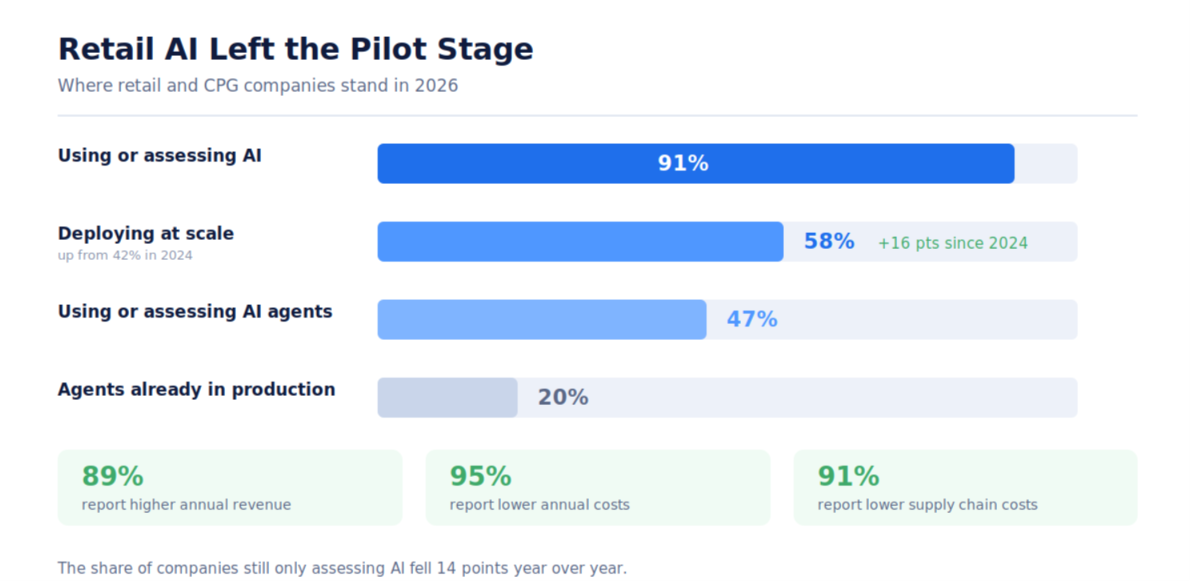
- Mainstream rollout: AI has moved past the experimental phase. Currently, 91% of retail and CPG brands are testing or using it, and 58% have deployed it at scale—a 16-point jump since 2024.
- Direct financial impact: The technology delivers concrete results on the balance sheet. 89% of retailers report higher annual revenue, and 95% are seeing their operating costs drop.
- Rapid market expansion: Investment in this space reflects those returns. The retail AI market is jumping to $18.64 billion in 2026, up from $14.23 billion last year, and is tracking toward $82.72 billion by 2031.
- Personalized recommendations remain the largest revenue driver in retail AI. The widely cited 35% of Amazon sales figure comes from McKinsey research published in 2013 and has never been updated by Amazon — the best-known number in this field is over a decade old.
- Live AI agents: This is moving past the hype. Nearly half of retailers (47%) are testing autonomous agents, and 20% are already using them in production.
- Mid-market access: Cloud costs dropped 22% between 2024 and 2025. Mid-sized chains can finally afford systems that used to be strictly enterprise-only.
91% of retail companies are currently using or testing AI (NVIDIA), and the market is hitting $18.64 billion in 2026 (Mordor Intelligence). Yet people still tend to talk about retail AI as if it is a single product. It actually breaks down into completely separate systems. These handle pricing, inventory, customer support, and the in-store experience.
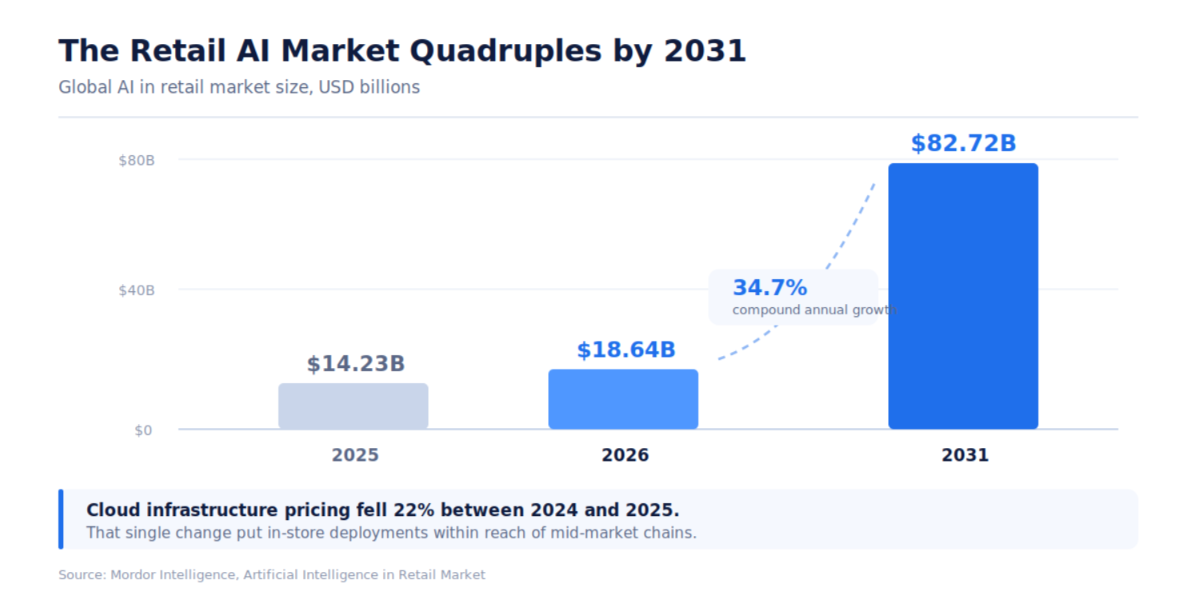
Source: Mordor Intelligence, Artificial Intelligence in Retail Market
A pricing algorithm and a customer service bot solve totally different problems. They run on entirely different data. Because of this, they also pay for themselves at different speeds.
Source: NVIDIA, State of AI in Retail and CPG: 2026 Trends
What AI Systems Are Retailers Using Today
What does retail AI look like in the real world? If you look closely, seven core systems do most of the heavy lifting today. Recommendation engines analyze purchase history, customer behavior, cart abandonment patterns, and session context to decide what a shopper sees next. Machine learning models turn that customer data into product listings, personalized marketing offers, and targeted promotions. Retail brands running this well treat it as personalized marketing rather than merchandising. Knowing which is which matters, because these AI systems carry very different infrastructure requirements and payback periods. Retail operations rarely need all six at once.
| AI System Type | Primary Retail Function | Adoption Level (2026) |
|---|---|---|
| Recommendation engines / ML models | Personalization, upselling | High — ML accounts for 37.62% of AI-in-retail technology revenue |
| Conversational AI / NLP | Customer service, virtual assistants | High — NLP handles 1.2 billion daily WeChat retail transactions |
| Demand forecasting models | Inventory planning | High — 51% of retailers use AI for supply chain throughput |
| Fraud detection models | Transaction security | High |
| Computer vision | Visual search, in-store analytics | Growing — autonomous checkout and shelf analytics |
| Dynamic pricing engines | Pricing strategy | Growing |
| AI agents | Multi-step autonomous operations | Emerging — 47% using or assessing, 20% active |
Sources: NVIDIA, State of AI in Retail and CPG: 2026 Trends; Mordor Intelligence, Artificial Intelligence in Retail Market
Two things stand out. Machine learning still carries the largest share of spending, not generative AI, because recommendation and fraud models are where the measurable money sits. Generative AI is the fastest-growing segment at 35.51% CAGR, cutting creative cycle times by around 40% for Shopify merchants.
For readers building an online store rather than in-store systems, LITSLINK’s guide to creating e-commerce apps with AI covers the build sequence in detail.
Personalized Shopping Experiences: AI-Driven Recommendations
Recommendation engines decide exactly what a shopper sees next. To do this, they analyze purchase history and browsing habits. They track abandoned carts and current session context. The system then puts these insights to work. It instantly updates product listings, tailored emails, and live promotions on the site.
The most-cited number in retail personalization is that Amazon’s recommendation engine drives about 35% of sales. It comes from McKinsey, published in 2013, and Amazon has never confirmed or updated it. Thirteen years of catalog growth, Prime, and advertising sit between that figure and today. Treat it as evidence that the category matters, not as a benchmark to plan against.
What is verifiable is the architecture. Amazon published its item-to-item collaborative filtering approach in 2003: instead of modeling each customer against a profile, it matches products to products based on co-purchase patterns. That design is why the system scales to hundreds of millions of users without recomputing profiles, and why the same approach still underpins most production recommenders.
Published personalization outcomes from named retailers are scarcer than the volume of coverage suggests, which is worth knowing before you benchmark against one. LITSLINK’s breakdown of Netflix’s recommendation engine shows the same pattern outside retail. A custom engine built on first-party customer data can increase sales by up to 30%.
How AI Improves Customer Experience Through Personalization
The underlying mechanics matter far more than the marketing pitch. Personalization engines constantly track behavioral signals in real time. They watch what a user clicks, leaves behind, or returns. They even measure how long someone hovers on a page. The system instantly uses those signals. It updates product rankings, search results, and promotions before the shopper even leaves the site.
The same logic extends offline. Retailers optimize store layouts, shelf placement, and staffing schedules against movement and transaction data rather than intuition. Customer preferences show up in foot traffic as clearly as in clicks.
NVIDIA’s survey found 41% of retailers citing improved customer service as a direct AI outcome, behind employee productivity at 54% and operational efficiency at 52%.
Dynamic Pricing and Demand Forecasting
Dynamic pricing engines constantly adjust prices. They react to demand signals, competitor pricing, and inventory levels. Pricing strategies that once changed weekly now change hourly. They even factor in weather, local events, and seasonality. Demand forecasting models work alongside them, predicting exactly what to stock, where to put it, and when it is needed.
The two work best together. A forecasting model that predicts a demand spike is useful. A forecasting model connected to a pricing engine that captures margin during that spike is considerably more useful.
Retailers have moved past proofs of concept here. Mordor Intelligence notes that price, promotion, and inventory now synchronize across channels in real time. This runs at production scale, not in pilots. Amazon is the canonical e-commerce case. It reprices across its catalogue continuously rather than on a weekly review cycle.
On the forecasting side, the numbers are firmer. McKinsey reports that AI demand-forecasting deployments commonly cut both stockouts and overstock by 20 to 50%. Margin figures for dynamic pricing are harder to verify. Most published estimates come from vendors selling pricing engines.
One caution the industry is still working through. Dynamic pricing creates a customer trust problem, and airlines never fully solved it either. Shoppers who notice a price changing between visits read it as manipulation, not as market efficiency. Retailers managing this well leave the base price alone. They apply dynamic logic to promotional depth and bundle composition instead. That gets margin flexibility without the visible price flicker.
Automated Inventory Management and Supply Chain Optimization
AI inventory systems attack two opposite problems at once. Stockouts on one side, overstock on the other. Manual replenishment tends to solve one by worsening the other. A buffer that prevents stockouts becomes dead inventory the moment demand shifts.
Three inputs make it work: real-time data from sales, predictive analytics, and supply chain visibility. Each on its own produces a partial picture. Retailers that optimize inventory well combine all three.
Supply chain is where retailers report the strongest AI results. NVIDIA’s survey shows a clear trend. 91% of respondents report that AI reduces supply chain costs. Over half rely on it to improve throughput and efficiency. This matters for a specific reason. 64% of companies face growing supply chain problems year over year. They are fighting geopolitical instability, limited labor, and tough new regulations.
McKinsey puts numbers on the payoff. AI-enabled supply chain planning reduces inventory by up to 20% and cuts supply chain costs by up to 10%.
Three named examples show the range. Walmart uses AI dashboards to manage waste. Spoilage systems run in real time, alerting staff to step in long before food goes bad. Walmart’s experience also shows that not every retail automation pilot scales. The company ended its shelf-scanning robot program in 2020, concluding that employees walking the floor collected comparable data at lower cost, and later shifted toward other store technologies. In 2024 it said it planned to deploy digital shelf labels across 2,300 stores by 2026, letting a single employee update thousands of prices without walking the aisles. Walmart stated separately that these labels are not used for surge pricing. That reversal is the useful part of the example: the technology worked.
Zara’s parent, Inditex, trains models on store-level sales. That data drives its rapid replenishment cycle. JD.com applies reinforcement learning across a 1,200-node fulfillment grid. No manual process reaches that scale of optimization.
LITSLINK has delivered 50+ AI projects across supply chain, logistics, and retail. The AI in supply chain case study covers a mid-sized manufacturer. Demand forecasting, dynamic inventory adjustment, and supplier reliability scoring ran in one pipeline. The point of that case is not the models individually. It is that predictions only produce savings once they connect to the decisions that act on them.
Computer Vision and Visual Search in Retail
Computer vision serves two very different retail jobs.
On the customer side, computer vision drives visual search. A shopper photographs an item and instantly gets matching products, without typing a clumsy description. This works exceptionally well in fashion and home goods. Shoppers often know exactly what they want but rarely know the technical name for it.
The largest visual search deployment adjacent to retail is Pinterest — a discovery and commerce platform rather than a retailer, which matters when you benchmark against it, because its incentives sit with advertisers rather than with its own inventory. Pinterest reported 640 million monthly active users in Q2 2026, and its taste graph processes billions of visual signals across them.
Operationally, computer vision monitors shelves and verifies planograms. It also makes autonomous checkout possible. Amazon Go relies on this tech to charge shoppers the moment they leave the store. Amazon now licenses the same Just Walk Out system to airports and stadiums, turning an in-house experiment into a product it sells to others. Mordor Intelligence lists adoption here as growing rather than mature.
The operational side usually pays back faster, which is the opposite of what most retailers expect. A shelf camera that flags an empty facing generates measurable revenue recovery. A visual search feature generates engagement that is harder to attribute to sales.
Conversational AI and Natural Language Processing in Customer Service
Natural language processing powers assistants that handle order status, product questions, returns initiation, and store information. Conversational AI and voice assistants now cover most customer queries on mobile apps and mobile devices. The volume they absorb is substantial. NLP now processes 1.2 billion daily retail transactions on WeChat alone.
Shopper demand for chat is rising fast. AI chatbot traffic to US retail sites jumped 670% during the 2025 holiday season (Adobe, cited by EMARKETER). The money is following the traffic. Juniper Research projects retail spending through chatbots will hit $72 billion by 2028.
Named deployments span both sides of the counter. Sephora’s assistant recommends products by skin tone and budget. Walmart’s Sparky agent assembles a basket from a single request and completes checkout. Target’s Store Companion, rolled out across 2,000 stores, answers employees rather than customers, giving instant procedural answers and accelerating onboarding.
Where conversational AI hands off matters as much as where it works. Complex complaints route to humans. So does anything involving a refund exception. So does any interaction where the customer is already angry. Every well-designed deployment does this. A system that refuses to escalate is worse than no system at all, because a frustrated customer who cannot reach a person simply leaves.
LITSLINK’s overview of voice assistant technology covers the STT and TTS layer underneath these deployments, including the privacy constraints that come with it.
Customer Feedback Analysis and Sentiment Insights
Customer feedback arrives faster than any human team can read it. It pours in through reviews, social posts, support tickets, and surveys. AI finds the patterns in that volume. It flags which products generate complaints. It highlights which features drive praise. It even tracks how sentiment shifts right after a packaging change.
The value is speed of detection rather than depth of insight. A human analyst reading 200 reviews will produce a better summary than a model. A model reading 200,000 reviews will find the emerging problem three weeks earlier.
Where this feeds back matters. The strongest implementations route actionable insights into merchandising and product decisions rather than into a business intelligence dashboard nobody opens. Valuable insights that never reach a decision are just storage costs. A spike in complaints about sizing on one SKU should trigger a supplier conversation, not a slide.
Machine Learning for Fraud Detection and Risk Management
Fraud detection models score transactions in real time against behavioral baselines. Real-time transaction monitoring checks the device, the location, the purchase velocity, the basket composition, and the payment history. Some systems enrich this with third-party data on known fraud patterns. The goal is not maximum detection. It is maximum detection without blocking legitimate customers.
Tune a model aggressively, and it catches more fraud. It also generates more false positives. Every false positive is a paying customer whose card was declined at checkout. That is why retail fraud teams optimize for false-positive rate rather than catch rate. Revenue lost to blocked legitimate purchases can exceed the fraud prevented.
Fraud detection sits in the high-adoption category for two reasons. The success metric is unambiguous. And the data already exists in transaction records, so retailers rarely need new instrumentation to start.
One caveat on benchmarking. Published fraud-reduction numbers usually come straight from the software vendors. Retailers almost never share their actual internal data. Treat any published percentage with the same skepticism you would apply to a sales deck.
How AI Is Automating Routine Tasks in Retail
The most unglamorous use cases often deliver the best results, with the fastest and lowest-risk returns. These tasks are well-defined and highly repetitive. Best of all, they operate in the background and never touch the customer experience.
Product description generation. Generative AI drafts listings at catalog scale, with human editing before publication. Mordor Intelligence notes creative cycle times falling around 40% for Shopify merchants using these tools.
Automated reordering. Replenishment triggers fire on forecast rather than on a fixed reorder point. That removes the manual review step for predictable SKUs.
Price and promotion audits. Automated checks confirm that listed prices, promotional flags, and competitor comparisons stay consistent across channels. Done manually, this is tedious and error-prone.
Report generation. Weekly performance summaries get assembled and drafted automatically. Analysts review rather than compile.
NVIDIA’s survey supports the pattern. 54% of retailers cited improved employee productivity as an AI outcome, the highest of any category. That is what task automation produces.
From Use Cases to Action: In-Store AI, Customer Impact, and Where to Start
The sections above cover what is possible. This one closes the loop: where AI shows up beyond e-commerce, why it moves the bottom line, and which use case to tackle first.
One Deployment, End to End
A logistics operator handling roughly 1,200 parcels a day at three sites ran parcel intake manually: staff typed codes from labels into the warehouse system, with an error rate around 4%. Replacing the scanners was quoted as a hardware project. LITSLINK built it as a software one instead.
The system runs two computer vision models on the cameras already installed. The first locates every barcode in the frame, the second reads the digits. Recognition reached 97% accuracy across 15 label formats, each read completing in about 180 milliseconds on CPU — no GPU on site, because the sites had none and buying them would have changed the business case. Processing time per intake batch fell 65%, and the manual error rate dropped below 0.5%.
Two details decided the outcome, and neither was the model architecture. The models were trained on 28,000 frames of the client’s own camera footage rather than stock imagery, because label wear, lighting, and camera angle at those specific sites were the whole problem. And they were quantized from 48 MB to 13 MB so inference could share a process with live video decoding on existing hardware.
That is the pattern behind every use case above. The model is rarely the hard part. Fitting it to the data you actually have, on the hardware you actually own, is.
AI in Physical Stores: In-Store Retail Use Cases
Retail AI is not one technology. AI technologies here split into distinct use cases: personalized shopping experiences, inventory, pricing, physical stores, and customer service.
Smart shelves analyze data on stock levels and pricing mismatches without a staff walk-through. Digital signage adapts content to foot traffic patterns and time of day. Route optimization on delivery fleets can reduce fuel consumption at the same time. Store layouts get optimized against movement data rather than against merchandising convention. Staffing and scheduling models predict traffic by hour and location.
Walmart’s spoilage forecasting is the clearest named example. Fresh food waste is a direct margin line, and AI reduces it by flagging risk before product expires rather than counting losses afterward. Target’s Store Companion is the other, deployed across 2,000 stores and targeting employee productivity rather than customer experience. That scale is the reported outcome worth noting: a 2,000-store rollout means the pilot cleared internal review.
One caveat on in-store benchmarks. Retailers publish deployment scale far more readily than performance numbers, so comparable ROI figures for smart shelves or signage are scarce. Scope against your own baseline rather than someone else’s press release.
Mordor Intelligence notes the enabling change. Cloud infrastructure pricing fell 22% between 2024 and 2025, which brought in-store deployments within reach of mid-market chains.
How AI Increases Customer Satisfaction and Retention
The use cases connect. Better forecasting means the item is in stock. Better personalization means the shopper finds it faster. Each of these customer interactions improves customer satisfaction in a way the shopper never attributes to AI. Conversational AI means a question gets answered at 11 pm. Fraud models tuned for false positives mean a legitimate card is not declined.
Each removes a specific reason a customer would not return.
On satisfaction specifically, 41% of retailers name improved customer service as a direct AI outcome (NVIDIA, 2026). That sits behind employee productivity at 54% and operational efficiency at 52%. Worth knowing before you build a business case on customer experience alone.
The financial evidence is stronger. 89% of retailers report AI has helped increase annual revenue, and 95% report decreased annual costs. Attribution at the individual use case level is harder. That is why the tiering below matters more than any single ROI claim.
Which AI Use Case Should You Start With?
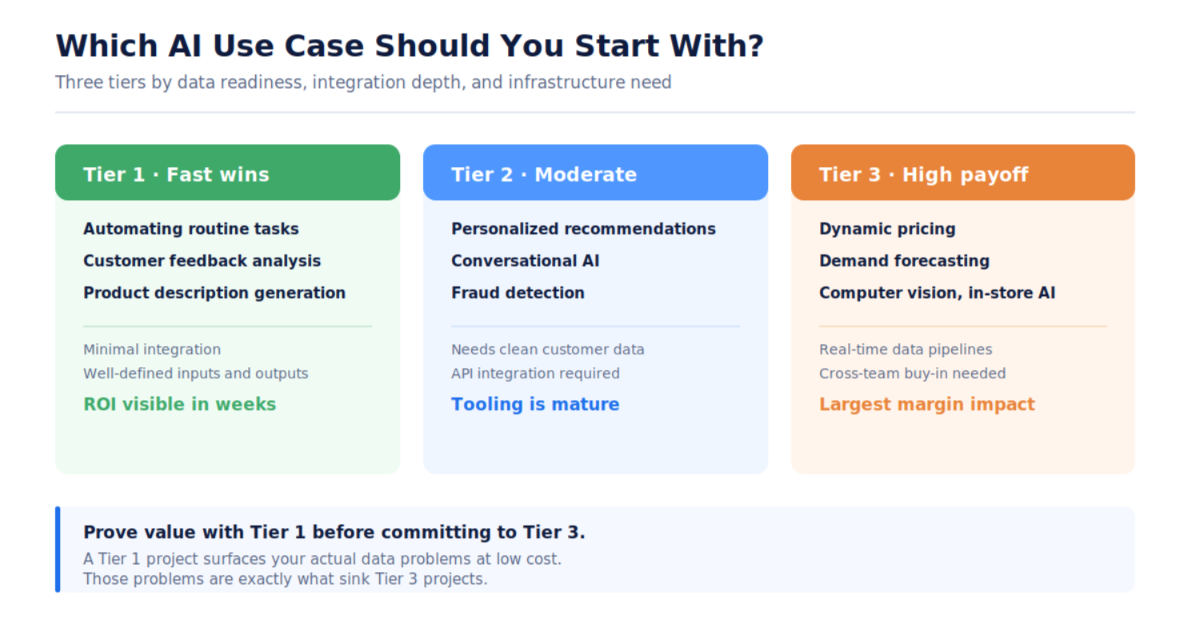
Three variables decide difficulty when implementing AI: how clean your relevant data already is, how deeply the system must integrate with core platforms, and whether it needs real-time infrastructure. Retail artificial intelligence projects fail on the first variable more than the other two combined. Tier 1 use cases score low on all three. Tier 3 scores high on all three. Most retailers get the best return by proving value with a Tier 1 use case before committing to Tier 3.
Benefits and Challenges of AI in the Retail Industry
AI delivers measurable returns for retailers, but only when the underlying data and infrastructure are in place. For many companies, the gap between piloting AI and scaling it is wider than the technology itself suggests.
| Key Benefits | Common Challenges and Risks |
|---|---|
| Higher revenue — 89% of retailers report AI has helped increase annual revenue (NVIDIA, 2026) | Data quality — fragmented customer and inventory data undermines model accuracy before deployment |
| Lower operating costs — 95% report AI has helped decrease annual costs (NVIDIA, 2026) | Legacy integration — POS, ERP, and inventory systems were not built to feed real-time data to models |
| Supply chain savings — 91% report AI reduced supply chain operational costs (NVIDIA, 2026) | Upfront investment — development, infrastructure, and integration costs land before returns do |
| Employee productivity — 54% cite it as a direct AI outcome, the highest of any category | Talent shortage — NVIDIA’s respondents named lack of AI talent as a leading obstacle |
| Faster decisions — real-time forecasting and pricing replace manual review cycles | Change management — teams have to trust and correctly act on model recommendations |
| Personalization ROI — a custom recommendation engine built on first-party data can lift sales by up to 30% | Customer trust — shoppers are wary of personal data use, especially in dynamic pricing |
| Improved customer experience — 41% name better customer service as a direct AI outcome (NVIDIA, 2026) | Inference cost at scale — per-prediction costs that look trivial in a pilot compound across millions of transactions |
| Lower entry cost — cloud infrastructure pricing fell 22% between 2024 and 2025 | Vendor dependency — SaaS convenience shapes your workflows around one provider’s roadmap |
Three of those challenges deserve more than a table row.
Data quality is the actual bottleneck. Most failed retail AI projects fail before modeling starts. Customer records duplicated across channels, inventory counts that disagree between systems, and transaction data missing fields all degrade output in ways that look like model problems and are not.
Legacy integration determines the timeline more than model development does. A recommendation engine is weeks of work. Connecting it to a fifteen-year-old POS system that batch-updates overnight is months. Scope the integration honestly, and the project estimate stops being fiction.
Inference cost becomes real at scale. NVIDIA’s survey flagged inference optimization as an emerging concern, and it is the cost line most retailers omit from the business case. A model that costs cents per prediction in a pilot costs meaningfully more across millions of daily transactions.
How Much Does AI in Retail Actually Cost?
Cost is the natural next question once the use cases look attractive. Ranges vary enormously by use case and scale, so treat the figures below as starting benchmarks for scoping rather than as quotes.
| AI Use Case | Typical Build Cost | Ongoing Cost |
|---|---|---|
| Customer service chatbot | $30K–$150K | $2K–$10K per month |
| Personalization/recommendation engine | $150K–$500K | $20K–$80K per month at scale |
| Demand forecasting/inventory optimization | $100K–$300K | Varies with data volume |
| Computer vision (in-store analytics, visual search) | $50K–$500K+ | Higher, driven by GPU and data costs |
| Fraud detection / predictive analytics | $150K–$500K | 15–25% of build cost annually |
Ranges reflect prevailing 2026 agency and vendor pricing. Published estimates for AI development come almost entirely from development firms themselves, so compare several before anchoring on one.
One number to state explicitly. Total cost of ownership over three years typically runs 1.5 to 2 times the initial build cost. That includes maintenance, retraining, and infrastructure scaling. Business cases built on the build number alone understate the commitment by roughly half.
Cost is one more input into the tiering above. A Tier 1 use case at the low end of these ranges proves value before a Tier 3 commitment. For a project-specific figure rather than a range, the LITSLINK AI cost calculator takes ten questions about scope and data readiness, and an engineer returns a tailored estimate within 24 hours.
The Future of AI in Retail: What’s Next
Three directions worth watching. The first is genuinely early, the second is already routine, and the third sits between them.
AI agents handling multi-step operations. 47% of retailers are using or assessing agentic AI, with 20% already running agents and another 21% planning deployment within a year (NVIDIA, 2026). The stated targets are process speed and efficiency at 57% and customer experience at 40%. Forecasting retailers running agents expect the first measurable returns there. Autonomous inventory rebalancing, dynamic pricing decisions, and vendor negotiation are where the measurable ROI is expected first.
Generative AI for content at scale. Already mainstream for product descriptions and marketing copy, with creative cycle times falling around 40% for merchants using it. Growing at 35.51% CAGR, the fastest segment in the market.
Deeper computer vision in physical retail. Autonomous checkout and shelf analytics are moving from flagship-store pilots to chain rollouts as infrastructure costs fall.
One structural shift underneath all three: 79% of retailers now say open-source models and software are moderately to extremely important to their AI strategy. The reason is control. Retailers that started with proprietary vendors owned the results but not the models. Open weights let them use proprietary data without vendor lock-in.
LITSLINK’s overview of retail trends for 2026 covers the generative AI, social commerce, and data privacy directions in more depth.
Build, Buy, or Outsource: How Retailers Should Approach AI Implementation
| Approach | Description | Best For | Trade-offs |
|---|---|---|---|
| Buy (SaaS AI tools) | Off-the-shelf platforms with AI built in, such as Shopify AI, Salesforce Einstein, or Klaviyo AI | Retailers wanting fast deployment with minimal engineering investment | Limited customization, ongoing subscription costs, less control over data and models |
| Build in-house | Internal ML and data science team builds custom models | Large retailers with existing data infrastructure and a long-term AI roadmap | High upfront cost, hard to hire specialized talent, longer time to value |
| Outsource to a development partner | A development partner such as LITSLINK builds a tailored solution against your data | Retailers wanting custom capability without building an in-house team from scratch | Requires vetting the partner carefully; internal ownership still needed post-launch |
Most mid-market and enterprise retailers land on a hybrid. SaaS tools take the well-solved problems. A vendor has already absorbed a decade of edge cases there, and you would otherwise discover every one of them at your own expense. Custom development takes whatever is tied to competitive advantage. Usually that means proprietary pricing logic. Sometimes inventory models trained on your own history. Often personalization built on first-party data no vendor can touch.
The dividing line is straightforward. If a competitor could buy the same capability off the shelf, buy it. If the capability depends on data only you hold, build it.
How LITSLINK Helps Retailers Implement AI
LITSLINK builds the working product behind a retail AI use case. That might be a recommendation engine trained on your transaction history, a computer vision system for shelf monitoring, or a custom assistant handling customer queries.
The company’s track record:
- 1,540+ completed software and AI projects
- 1,000+ clients across 82 countries
- 300+ engineers and technology experts
- MVP delivery in as little as 10 weeks
Delivery covers the parts that decide whether a retail AI project reaches production. Data engineering before modeling, integration with existing POS and inventory systems, and post-launch support once models start drifting.
Contact LITSLINK for a free consultation to scope an AI use case for your retail business.
FAQs
What are the most common use cases for AI in retail?
Across retail, retailers concentrate on four categories that completely dominate the market: recommendation engines, demand forecasting, chatbots, and fraud detection. Combined, models for recommendations, pricing, and fraud capture 37.62% of all AI technology revenue in the sector (Mordor Intelligence). That is far more than the endless coverage of generative AI would lead you to expect. Follow the money.
How much does it cost to implement AI in a retail business?
It depends on your scope. You can launch a basic chatbot for about $30,000. Enterprise fraud systems and computer vision easily run past $500,000. The huge difference between those numbers is not the AI itself; the real expense is the integration work. Then there is the part nobody budgets for. Three-year ownership generally doubles the initial build once you add maintenance, retraining, and infrastructure that grows with traffic. For a figure tied to your actual scope, the LITSLINK AI cost calculator collects ten inputs and returns a tailored estimate within 24 hours.
Do small and mid-size retailers use AI, or is it mainly large enterprises?
Falling infrastructure and API costs have widened access, although integration and data-readiness costs remain substantial. What changed? Cloud infrastructure got 22% cheaper (Mordor Intelligence). That simple price drop put more AI into stores than any marketing campaign ever has. The biggest players still have the biggest budgets, but the middle tier is actively buying.
What’s the difference between AI-powered personalization and traditional segmentation?
Segmentation puts you in a bucket. Everyone in that bucket sees the same thing, and the bucket was probably defined last quarter by someone looking at a spreadsheet. Personalization scores you individually and adjusts inside the session you are in right now, off signals from the last few minutes rather than a profile from three months ago. Speed is the whole difference.
How is AI used for fraud detection in retail transactions?
Every transaction gets scored against a behavioral baseline in real time. Device, location, buying speed, basket size, payment history. Catching fraud is the easy half. Catching it without declining real customers is the part that takes engineering. A falsely blocked purchase costs you the sale and the relationship behind it.
Is dynamic pricing powered by AI legal, and how do customers react to it?
Dynamic pricing is generally permitted in many markets, but the rules vary by jurisdiction, industry, product category, and data used. Retailers must consider consumer-protection, anti-discrimination, privacy, price-gouging, and transparency requirements. In the EU, businesses must tell consumers when prices are personalized through automated decision-making or profiling. Legal counsel should review high-risk or individualized pricing programs.
What retail tasks should NOT be automated with AI?
Anything where being wrong costs more than the labor you save. Refund exceptions. Final sign-off on prices customers will see. Anything with a legal or compliance tail. The rule holds across every use case in this guide: AI handles volume, people keep the calls where a mistake is expensive.