







Key Takeaways
- A basic mobile app runs 400 to 800 engineering hours.
- Engineering hours drive roughly 63% of the bill. Design takes about 12%, QA another 12%, and project management about 5%.
- Building separate native apps for iOS and Android costs roughly 40 to 65% more than one cross-platform build.
- Real LITSLINK timelines: a gym booking app for iOS and Android.
- Annual maintenance runs 15 to 20% of your initial development cost.
- Large IT projects run 45% over budget on average, according to research by McKinsey and the University of Oxford.
The most quoted number in mobile app development is $171,450. It comes from a Clutch survey of twelve development firms, and that survey ran in January 2015. Clutch itself replaced it in 2017 with a study of 102 companies. Pricing guides published this year still print the 2015 figure, usually with the date left off.
The number is not useless, though. Look at how it was built: 1,143 development hours at $150 an hour. Hours times rate. That is the only honest way to price a mobile app, and it is what this guide does with 2026 numbers instead of decade-old ones. Your mobile app development cost depends on app complexity, features, platform, and where your development team sits, so every figure here shows the hours behind it. Founders, business owners, and product managers can swap in their own rate and get a number they can defend in a board meeting.
One thing moves budgets more than any rate card. We shipped a lending app with four user roles, affordability checks, and bank statement parsing in three months. A gym’s booking app with maps and payments took six. The harder-sounding project was twice as fast, and the difference was that one client arrived with their requirements already written down.
Quick Mobile App Development Cost Breakdown
Ask five agencies what your mobile app development cost will be. You will get five numbers between $40,000 and $400,000. All five can be honest.
That sounds like a dodge. It isn’t. Nobody accepts “a kitchen remodel costs between $5,000 and $150,000” from a contractor. You ask for the square footage, the cabinet spec, and the crew’s hourly rate. Then the number stops being a range and starts being a quote. Software works the same way, and almost nobody writes about it that way.
So here is our methodology, stated up front.
How we built these numbers. We estimate hours by role, then multiply by rate. Every figure in this guide assumes a blended rate of $60 to $115 per hour, which is what US buyers actually pay for a US-managed team with senior engineers in Europe or Latin America. A US-only agency charges $120 to $175 per hour for the same hour count, which pushes every number below up by 60 to 100%. Hour estimates come from delivered LITSLINK mobile app projects. Rate bands are cross-checked against Upwork’s published rate data, Clutch project records, and GoodFirms vendor listings.
Here is the app development cost breakdown for a medium-complexity mobile app development project. Every mobile app development project splits into the same seven stages, whatever the size.
| Development Stage | What Happens | Estimated Cost (USD) | Timeline | Share of Budget |
|---|---|---|---|---|
| Discovery & requirements | Workshops, user stories, scope, technical estimate | $3,000–$9,000 | 1–3 weeks | 5% |
| UI/UX design | User flows, wireframes, UI kit, clickable prototype | $6,000–$18,000 | 3–6 weeks | 12% |
| Mobile development | The iOS and Android build, native or cross-platform | $25,000–$65,000 | 10–20 weeks | 42% |
| Backend development | Server logic, database, APIs, admin panel | $12,000–$32,000 | 8–16 weeks (parallel) | 21% |
| QA & testing | Manual and automated testing across the device matrix | $6,000–$18,000 | Runs throughout | 12% |
| Release & store submission | Builds, store assets, review cycles | $1,500–$4,500 | 1–2 weeks | 3% |
| Project management | Planning, communication, reporting | $3,000–$9,000 | Full project | 5% |
| Total | $60,000–$150,000 | 5–8 months | 100% |
*Actual costs vary with app complexity, feature set, platform, third-party integrations, compliance requirements, team composition, and scope. Treat this as a planning baseline.
What Four Real LITSLINK Projects Cost in Hours
We do not publish client budgets. We can publish timelines and scope, and development hours are what you need anyway.
| LITSLINK project | Scope | Duration | Complexity tier |
|---|---|---|---|
| Gyms booking app | iOS and Android, geolocation search, user profiles, integrated payments, booking | ~6 months across 5 phases | Medium |
| Nutralete nutrition app | iOS, Android and web, React Native, macro tracking, coach-built diet plans, subscriptions | ~7 months | Medium to complex |
| Payday lending app | iOS, Android and web admin, Auth0, four user roles, affordability checks, bank statement parsing | ~3 months, five two-week sprints | MVP with compliance |
| HIPAA messaging platform | Secure messaging, Kubernetes infrastructure, HIPAA hardening, CI/CD | ~5 months core build, then ongoing | Regulated |
Look at the lending app. Four user roles, financial compliance, document parsing, three surfaces. Three months. Now look at the gyms booking app: two platforms, geolocation, payments, six months. The lending app sounds harder and shipped in half the time. Same rate card, same mobile app development process.
The difference was written requirements. The lending client came in with the affordability rules already documented. The booking project spent its first weeks deciding what “search nearby gyms” meant.
That gap is worth more than any rate card. It is also the cheapest lever on mobile app development cost that exists, and it costs nothing but attention.
Formula for Estimating Mobile App Development Costs
The whole thing fits in one line:
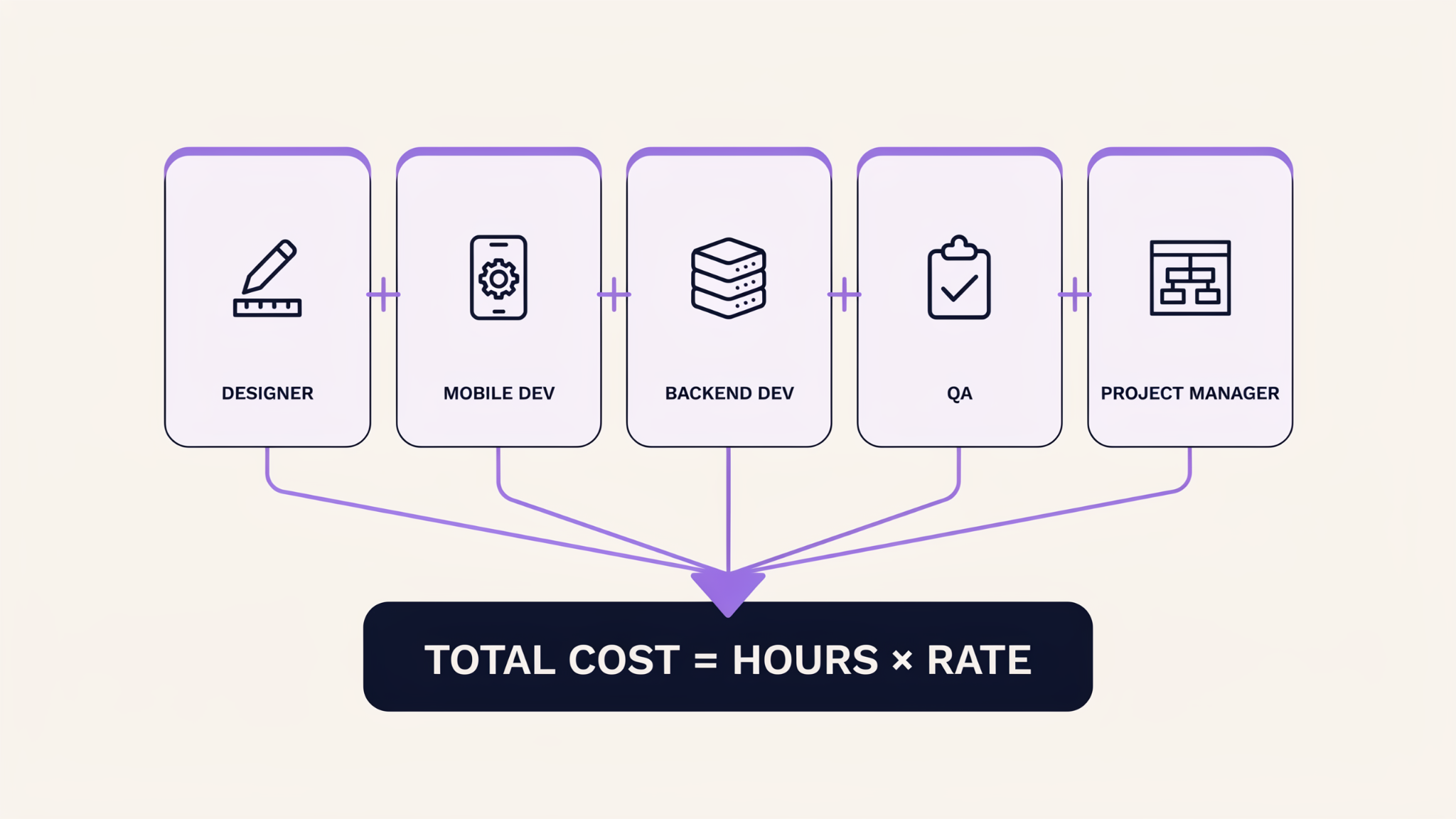
You estimate development hours for the UI/UX designer, the mobile app developer, the backend developer, the QA engineer, and the project manager. You multiply each by that role’s rate. You add them up. That’s the model behind every honest mobile app development cost estimate, including the tables in this guide.
Two things break it. Unclear scope, because you cannot count hours for features nobody has defined. And rate shopping without checking seniority, because a $25 per hour app developer who needs three times the hours is not cheaper.
How Much Does It Cost to Build a Mobile App? Key Cost Factors
Seven key factors move the number more than anything else. Here they are in order of impact on your app development cost.
Mobile App Complexity Is the Single Biggest Cost Multiplier
Start by sizing the app. Count unique screens, core features, user roles, and third party integrations. App complexity is the term everyone uses loosely, and this is what it actually measures. Three roles means three permission models, three onboarding flows, and three sets of test cases. That is why role count inflates budgets faster than screen count does.
This table expands the tiers from the breakdown above. Same four tiers, same cost ranges, with the screens and development hours that produce them.
| App Size | Typical Characteristics | Estimated Development Hours | Estimated Cost (USD) |
|---|---|---|---|
| Basic app | 5–10 screens, sign-up and login, user profile, simple CRUD, one or two integrations | 400–800 | $25,000–$60,000 |
| Medium app | 10–25 screens, payments, push notifications, admin panel, third-party APIs, two user roles | 800–1,600 | $60,000–$150,000 |
| Complex app | 25+ screens, real-time features, advanced backend, many integrations, analytics, three or more roles | 1,600–3,000 | $150,000–$350,000 |
| Enterprise app | Multi-role platform, AI features, enterprise system integrations, high-load architecture, compliance | 3,000+ | $350,000+ |
A simple app with basic features and no backend can come in under $15,000. It also cannot do very much, which is the trade. A minimum viable product usually sits inside the basic tier. If your MVP is landing in the medium tier, you are not building an MVP. You are building version 1.4 and calling it an MVP.
Complex apps are where estimates stop being comparable at all. Two complex apps with the same screen count can differ by $150,000 because one syncs across multiple platforms in real time and the other does not.
Functionality and Features: Where Budgets Quietly Double
Every mobile app feature costs four times. Design, development, testing, and then infrastructure to run it. Teams budget the second one and forget the other three.
High-complexity features share a trait: they depend on something outside your code. A recommendation engine needs training data. Live video needs media servers. Offline sync needs conflict resolution rules that somebody has to actually decide. The engineering is rarely the hard part. The decisions are.
Features that reliably move the number:
• AI-powered personalization and recommendations
• AI and ML features such as chatbots, image recognition, and predictions
• Augmented reality and VR functionality
• External hardware integrations over Bluetooth, IoT devices, and wearables
• Offline mode with data synchronization
• Advanced GPS tracking and geofencing
• Multi-device synchronization
• Real-time messaging and push notifications
• Live streaming and video calling
• Payment processing, subscriptions, and in-app purchases
Here is what each one adds on top of your base build, in hours and dollars.
| Feature | Typical Complexity | Added Hours | Estimated Additional Cost |
|---|---|---|---|
| AI personalization/recommendations | High | 120–320 | $9,000–$28,000 |
| AI chatbot or assistant | High | 140–420 | $11,000–$38,000 |
| AR / VR features (augmented reality, virtual reality) | Very high | 260–900 | $22,000–$85,000 |
| Bluetooth / IoT device integration | High | 110–340 | $8,500–$30,000 |
| Offline mode and data sync | Medium–high | 80–190 | $6,000–$17,000 |
| Advanced GPS tracking and geofencing | Medium–high | 70–230 | $5,500–$21,000 |
| Multi-device synchronization | High | 130–330 | $10,000–$30,000 |
| Real-time chat and messaging | High | 110–290 | $8,500–$26,000 |
| Live video and audio calls | Very high | 250–780 | $20,000–$72,000 |
| Payment gateway and subscriptions | Medium | 45–120 | $3,500–$11,000 |
| Push notifications | Low | 14–36 | $1,100–$3,300 |
| Social login and authentication | Low | 16–60 | $1,200–$5,500 |
Custom graphics and animation sit outside this table because they scale with taste, not function. A hand-drawn onboarding sequence can cost more than the payment system it introduces, and it is one of the few mobile app costs with no ceiling at all.
Platform Choice Is the Decision You Cannot Cheaply Undo
Pick this before you estimate anything, because platform choice sets the floor for mobile app development cost. Native means separate codebases for iOS and Android. Cross-platform means one shared codebase that ships to both. Every other cost in your mobile app development budget bends around that choice.
The math is simple. Two native apps mean two sets of engineers writing the same screen twice, testing it twice, and fixing it twice for the rest of the product’s life.
| Development Approach | Description | Estimated Development Cost |
|---|---|---|
| Native iOS | One native app for iPhone and iPad, written in Swift | $28,000–$85,000 |
| Native Android | One native app for Android devices, written in Kotlin | $28,000–$85,000 |
| Native iOS + Android | Two separate native apps with dedicated codebases | $52,000–$160,000 |
| Cross platform (Flutter / React Native) | One shared codebase for both operating systems | $34,000–$115,000 |
Cross-platform development typically saves 30 to 40% against a dual-native build, and the saving is real. It also has a ceiling that vendors skip. Deep hardware access, custom native modules, and heavy graphics pull the saving down toward 10 to 15%, because you end up writing platform-specific code anyway.
Native iOS App Development
One codebase, Swift, full access to Apple frameworks the day they ship. iOS app development is the usual first choice when your users are in the US, when revenue comes from in-app purchases, or when the mobile app leans on the camera, ARKit, or the Neural Engine. You get the best performance available, and you reach roughly half your potential market.
Native Android App Development
One codebase in Kotlin, aimed at a far larger and far messier device population. Android app development costs the same to build and more to test, because Android apps have to run across thousands of device and OS combinations. That fragmentation is the whole story of Android apps, and it lands squarely in your QA budget. Choose it when your users are outside North America or when hardware variety is the point. Our Android app development cost guide goes deeper on this.
Native iOS + Android Development
Two teams, two codebases, one product. It buys you maximum performance and platform fidelity on both operating systems, and it costs roughly double up front and roughly double forever after. Worth it for apps where a dropped frame is a lost customer, such as trading, high-end games, and camera products.
Cross Platform Development
One codebase in Flutter or React Native, compiled for both platforms. This is the default for most modern apps now, and it should be: you ship faster, you maintain one thing, and users cannot tell. Read our breakdowns of Flutter app development cost and React Native app pricing if you are choosing between the two frameworks.
Backend Complexity Is the Cost Nobody Sees in the Demo
Your mobile app backend does not appear in a single screenshot, which is exactly why it gets underestimated. It grows with user count, business logic, API surface, data volume, real-time requirements, storage, and security obligations.
What drives backend development cost:
• Number of APIs and backend services
• Database complexity, including SQL against NoSQL and multiple data stores
• Business logic and server-side processing
• Real-time synchronization and WebSockets
• Cloud infrastructure and file storage
• High-availability architecture and load handling
• Security, authentication, and authorization
• Background jobs, queues, and scheduled tasks
| Backend Complexity | Typical Characteristics | Estimated Backend Development Cost |
|---|---|---|
| Basic | Authentication, user accounts, simple CRUD, single database, REST API | $6,000–$16,000 |
| Standard | Payments, notifications, admin panel, cloud storage, multiple APIs | $16,000–$42,000 |
| Advanced | Real-time features, AI processing, analytics, complex business logic, multiple databases | $42,000–$105,000 |
| Enterprise | Microservices, distributed systems, high-load architecture, advanced security, compliance, global reach | $105,000+ |
Backend cost tracks expected users, data volume, and uptime targets. Enterprise architectures also carry the highest ongoing cloud bills, so the number above is the down payment. Our guide to mobile app backend development covers the architecture choices behind these tiers.
App Design Costs Scale With Flows, Not Screens
Screen count is a weak predictor of mobile app design cost. User flows are the real unit. A flow is a complete path a user takes to finish something, and each one needs states for empty, loading, error, and success. That is four screens per flow before anyone draws the happy path.
Custom UI/UX design improves retention. It also raises the upfront number, and animation is where the meter really spins.
| Design Level | Typical Design Characteristics | Estimated UI/UX Design Cost |
|---|---|---|
| Basic design | 3–6 user flows, standard platform components, minimal customization | $2,500–$6,000 |
| Mid-level design | 7–14 user flows, mixed linear and non-linear navigation, moderate custom visuals | $6,000–$14,000 |
| Complex design | 14+ user flows, advanced interactions, custom animation, heavily customized UI | $14,000–$28,000 |
| Gamified design | Multiple user journeys, points, badges, leaderboards, achievements, custom motion design | $22,000–$55,000 |
Third Party Integrations Cost Twice: Once to Build, Forever to Run
Payment gateways, maps, analytics, and chat all look like a weekend of work and none of them are. Every integration needs development, testing, security review, error handling, and maintenance when the vendor changes their API. Most also carry a subscription or usage fee that keeps billing long after the build is paid for.
Most builds pull in some mix of these third-party integrations:
• Payment gateways such as Stripe, PayPal and Adyen. These get the most testing in any build, because payment gateways fail loudly.
• Authentication providers: Google, Apple, Microsoft, Auth0
• Maps and geolocation from Google Maps or Mapbox
• Push notifications through Firebase Cloud Messaging or OneSignal
• Communication APIs such as Twilio and SendGrid
• Analytics platforms: Google Analytics, Mixpanel, Amplitude
• Cloud storage on AWS S3 or Google Cloud Storage
• CRM connections into Salesforce or HubSpot
• AI APIs from OpenAI, Anthropic and Google Gemini
• Social media logins
| Integration Type | Typical Examples | Estimated Integration Cost |
|---|---|---|
| Authentication | Google, Apple, Auth0 | $1,200–$3,400 |
| Payment gateway | Stripe, PayPal, Adyen | $2,400–$9,000 |
| Maps and geolocation | Google Maps, Mapbox | $2,200–$6,500 |
| Push notifications | Firebase, OneSignal | $1,100–$3,300 |
| Communication APIs | Twilio, SendGrid | $2,400–$8,500 |
| Analytics | Mixpanel, Amplitude, GA4 | $1,800–$6,000 |
| Cloud storage | AWS S3, Google Cloud | $1,900–$5,200 |
| CRM integration | Salesforce, HubSpot | $5,500–$22,000 |
| AI API integration | OpenAI, Claude, Gemini | $5,500–$21,000 |
Then the recurring bill starts. Twilio charges from $0.0083 per SMS plus carrier fees. Supabase Pro starts at $25 per month. OpenAI prices GPT-4o around $2.50 per million input tokens and $10 per million output tokens, while Anthropic prices Claude Sonnet near $3 and $15. An AI assistant handling 500,000 queries a month runs roughly $1,000 to $1,500 in API calls alone.
Model your usage before you ship. Token bills are the one line item that scales with your success.
Industry Requirements Change the Floor, Not Just the Ceiling
Two mobile apps with identical screens can differ by $200,000 because one of them handles health records. Regulated industries add encryption work, audit logging, access controls, data residency rules, and a compliance review that has to happen before launch rather than after.
E-commerce apps need catalogs, carts, payments, and order management. Payment security rides on your provider, so PCI DSS scope stays manageable. Marketplaces cost far more because multi-vendor payouts, commissions, and disputes are three products, not one.
Healthcare apps carry HIPAA. Telemedicine adds video, scheduling, and EHR integration through FHIR, which is slow and unforgiving work. Our HIPAA-compliant messaging build took roughly five months for the core platform before ongoing hardening.
FinTech apps need KYC and AML checks, transaction integrity, and usually SOC 2 for enterprise deals. Read our fintech app development cost guide for the full picture.
EdTech platforms are feature-heavy but rarely security-heavy, unless minors are involved, at which point COPPA and FERPA arrive.
SaaS companion apps look cheap and are not, because SSO, roles, permissions, and billing all have to match the web product exactly.
Sports and fitness mobile apps live on wearables, geolocation, and subscriptions. Health data pulls GDPR into scope in Europe.
Real estate mobile apps need search, maps, virtual tours, and CRM routing, and the lead handling is usually harder than the listings.
| Industry | App Type | Typical Features | Compliance Load | Estimated Cost (US market) |
|---|---|---|---|---|
| E-commerce | Online store | Product catalog, payments, order management, push notifications | PCI DSS via provider | $45,000–$120,000 |
| E-commerce | Marketplace | Multi-vendor, commissions, ratings, messaging, payouts | PCI DSS, seller KYC | $90,000–$260,000 |
| Healthcare | Telemedicine | Video consultations, scheduling, e-prescribing, EHR integration | HIPAA, HITECH | $120,000–$400,000 |
| Healthcare | Patient portal | Medical records, appointments, secure messaging | HIPAA | $70,000–$180,000 |
| FinTech | Digital wallet | Payments, KYC, transfers, 2FA, card issuing | PCI DSS, KYC/AML, SOC 2 | $110,000–$350,000 |
| FinTech | Investment app | Portfolio management, market data, trading APIs | SEC/FINRA rules, SOC 2 | $150,000–$450,000 |
| EdTech | Learning platform | Courses, quizzes, video, progress tracking, payments | FERPA, COPPA if minors | $55,000–$160,000 |
| SaaS | B2B companion app | SSO, roles, dashboards, offline access, billing | SOC 2, GDPR | $70,000–$200,000 |
| Sports & Fitness | Tracking and booking | Wearable sync, geolocation, booking, subscriptions | GDPR, health data rules | $45,000–$140,000 |
| Real Estate | Listings marketplace | Search, maps, virtual tours, CRM, lead routing | Fair housing rules, GDPR | $60,000–$180,000 |
What It Costs to Build Apps Like the Ones You Already Use
Every founder describes their app idea by naming a comparison. “Like Uber, but for dog groomers.” It is useful shorthand and a misleading budget signal, because you are pricing version one, not the version with 400 engineers behind it.
Here is what a credible first release of each costs to develop.
| The app you compare yours to | What a version one costs to develop |
|---|---|
| Simple app (utility, tracker, calculator) | $5,000–$50,000 |
| Social media app or messenger, WhatsApp style | $50,000–$200,000 |
| E-commerce app, storefront with checkout | $30,000–$150,000 |
| On-demand booking app, Uber style | $70,000–$250,000 |
| Video streaming app, Netflix style | $100,000–$400,000+ |
How much does it cost to develop a social media app rather than a storefront? About half again as much at the midpoint, because feeds, moderation, and real-time messaging are three separate systems rather than one checkout flow. The simple app row is real and gets misread constantly. A simple app with three screens, no accounts, and no server behind it genuinely costs under $15,000. Add sign-in and a database and you have left that tier.
Complex apps at the other end carry costs that never appear in a feature list. Streaming needs a content delivery network. Marketplaces need dispute handling. Those are operating expenses attached to the mobile app development cost, not one-time build items.
One more option people forget: a web app. If your product does not need the camera, offline access, or push notifications, a responsive web app costs 30 to 50% less than native or cross-platform mobile app development and ships without app store review. Plenty of B2B tools should be a web app and are not.
Development Team Size and Location Set Your Hourly Rate
Developer location swings rates by a factor of five. Labor costs differ, demand differs, and seniority distribution differs. A senior app developer in Warsaw and a senior app developer in San Francisco write similar code at very different prices.
Your app development team also grows with complexity. A basic app needs four people: one designer, one mobile app developer, one backend developer, and a part-time QA engineer. An enterprise platform needs a dozen, plus DevOps, plus a second QA engineer, plus someone whose whole job is keeping the other eleven aligned. Every added mobile app developer raises coordination cost as well as payroll.
| Region | Typical Hourly Rate (Mid-Level Developers) |
|---|---|
| United States & Canada | $80–$150/hr |
| Western Europe | $70–$120/hr |
| Eastern Europe | $35–$70/hr |
| Latin America | $35–$70/hr |
| Asia | $20–$60/hr |
| Africa | $25–$60/hr |
Hiring in North America costs roughly two to three times what the same seniority costs in Eastern Europe or Southeast Asia. That gap is the reason most US companies run a hybrid: US-based product and project management, senior engineering elsewhere, overlapping hours in the middle.
One warning on the bottom of that table. A $20 per hour developer who needs 2,000 hours costs more than a $60 per hour developer who needs 700, and you find out which one you hired in month five.
Mobile App Development Process and Cost
Longer mobile app projects cost more. That part is obvious. What surprises people is that compressing a timeline also costs more, because you pay for larger teams, parallel workstreams, overtime, and the rework that comes from decisions made too fast.
The cheapest mobile app development process is a realistic schedule with written requirements. Not the longest. Not the fastest. That single choice moves app development cost more than any rate negotiation you will ever run.

Market Research and Discovery
Market research means competitor teardowns, user interviews, and a technical feasibility check. The output of that market research is a scoped feature list and a real estimate instead of a guess. Typically 1 to 3 weeks and 5% of budget. Skipping it is the most expensive $6,000 anyone ever saves.
Features Prioritization
You sort every requested feature into must-have, should-have, and later. Then you cut the later pile out of version one entirely. This usually takes a few days inside discovery and costs almost nothing, and it routinely removes 20 to 30% of the build.
MVP
A minimum viable product ships only the basic features that prove people want your app idea. Target $25,000 to $60,000 and 8 to 14 weeks. If your MVP has an admin panel with role management, it is not minimum viable, and it is not viable yet.
Platform and Tech Stack Choosing
Native, cross-platform, or web app. Backend language, database, cloud provider. Whether you support multiple platforms from day one is decided here. This takes days and determines years of spend. Get the platform decision wrong, and you pay the difference every sprint until you rewrite.
Data Security and Compliance
Threat modeling, encryption design, access control, and any framework your industry demands. It runs 2 to 6 weeks of specialist time and 3 to 10% of budget for regulated products. Retrofitting compliance after launch costs three to five times more than designing it in.
UI/UX Design
Flows, wireframes, a design system, and a clickable prototype the team can test before code exists. 3 to 6 weeks and 10 to 15% of budget. The prototype is where you kill bad ideas at $200 apiece instead of $8,000.
App Development
The build. Frontend, backend, and integrations, in two-week sprints with something demoable at the end of each. 10 to 20 weeks and 50 to 60% of budget for a medium app. This is the biggest development stage and the one every other stage exists to protect.
Test and Launch
QA runs alongside development, not after it. Then store submission, review cycles, and a staged rollout. Budget 2 to 4 weeks at the end and 10 to 15% of budget overall. Apple review rejections are routine on first submission, so plan for a second attempt.
Support
Bug fixes, OS compatibility updates, security patches, and performance work. Ongoing, at 15 to 20% of initial development cost per year. This never stops while the app is live.
Additional Mobile App Costs to Consider Beyond Development
The build is the visible part. Total cost of ownership includes everything that keeps the mobile app alive afterward, and these lines get underestimated more often than any other part of an app development budget.
QA and Testing
QA catches problems in your mobile app while they are still cheap. A bug found in a sprint costs an hour. The same bug found by a user costs a hotfix, a store resubmission, and a one-star review that stays up for a year.
Budget 10 to 15% of total development cost for a basic or medium app, and 15 to 25% for complex and regulated products where a defect has legal consequences. Bringing QA in during design rather than after development is the single highest-return scheduling decision available to you.
Cloud Hosting
Nearly every mobile app leans on cloud infrastructure for its backend, database, storage, authentication, and APIs. Costs scale with users, data volume, and traffic patterns rather than with your feature list.
| App Stage | Typical Infrastructure | Monthly Cost | Annual Cost |
|---|---|---|---|
| MVP, under 5,000 users | Managed backend, small database, basic storage | $80–$400 | $960–$4,800 |
| Growing, 5,000–50,000 users | Dedicated compute, CDN, backups, monitoring | $400–$1,500 | $4,800–$18,000 |
| Scaled, 50,000+ users | Multi-region, load balancing, caching, high availability | $1,500–$6,000+ | $18,000–$72,000+ |
Watch pay-per-operation pricing specifically. Firebase-style billing looks free at 500 users and produces four-figure invoices at ten million reads a day. Model it early.
App Maintenance and Support
Apple and Google each ship a major operating system release every year. Neither asks whether you have budget, and both can break Android apps and iOS builds that have gone untouched for twelve months. Ongoing maintenance covers OS compatibility, bug fixes, security patches, dependency upgrades, performance work, and small feature updates.
Plan 15 to 20% of your initial development cost annually. On a $120,000 app, that is $18,000 to $24,000 a year. Over a five-year life, maintenance often exceeds the original build. Our guide to estimating mobile app maintenance costs breaks the line items down.
Security and Compliance
Certification is a project with its own budget, not a checkbox at the end of yours.
| Framework | Typical First-Year Cost | Applies To |
|---|---|---|
| SOC 2 Type 2 | $20,000–$80,000 for smaller companies, more at scale | B2B and SaaS apps selling to enterprise |
| PCI DSS | $1,000–$40,000 self-assessment, $50,000–$150,000 full audit | Apps handling card data directly |
| HIPAA | $4,000–$60,000 for risk assessment and remediation | Health apps touching patient data |
| GDPR / CCPA | Usually bundled with the above, $5,000–$25,000 standalone | Any app with EU or California users |
One useful piece of news: roughly 80% of controls overlap across these frameworks, so a second certification typically costs about 40% less than the first.
App Store and Google Play Fees
The Apple Developer Program costs $99 per year, or $299 for the Enterprise tier used for internal distribution only. Google Play Console charges a $25 one-time registration fee with no renewal. Publishing to both the Apple App Store and the Google Play Store costs about $124 in year one, then $99 annually.
The real cost is commission. Both the Apple App Store and the Google Play Store take 15% on the first $1 million of annual revenue and 30% above it. If you sell in-app purchases or subscriptions, that is your largest ongoing app store expense by a wide margin.
Approval also costs engineering time. Privacy manifests, data disclosure labels, account deletion flows, and age rating requirements all need building, and Apple App Store reviewers reject apps that skip them. Budget $1,500 to $4,500 for submission work and at least one rejection cycle.
Marketing
Building the mobile app is not distribution. A practical launch marketing budget is often $10,000 to $50,000 for a focused campaign spanning paid acquisition, app store optimization, PR, creative, and content, although organic launches can cost considerably less and full-funnel campaigns can exceed $100,000. Current app marketing cost benchmarks put agency engagements at $1,000–$25,000, ASO tools at $25–$1,500 per month, and PR outreach at $100–$300 per hour.
Ongoing paid acquisition often becomes a recurring expense for consumer apps, but CPI needs to be benchmarked by category, platform, and market: Adjust’s 2025 data puts global CPI at $0.98 for e-commerce and $1.13 for finance, while dating-app CPI reached $2.76. Retention and re-engagement should be funded alongside acquisition: Adjust’s comparison of retargeted and newly acquired users found that retargeted users delivered stronger engagement, revenue activity, and retention. Owned channels such as email and push also generally have lower marginal delivery costs than repeatedly buying new installs.
Legal and Licenses
Privacy Policy and Terms of Service can cost nothing to a few hundred dollars through a template or policy generator. Recent marketplace data puts lawyer drafting at roughly $930 for a Privacy Policy and $990 for Terms of Service, although complex or regulated data flows can push the total into several thousand dollars. State business registration usually costs under $300. Federal trademark filing starts at $350 per class, before legal fees; trademark counsel, open-source license review, and contract work can bring first-year legal costs to roughly $2,000 to $10,000, depending on scope. Ongoing costs vary with policy updates, contract volume, and regulatory requirements.
Open-source license compliance deserves a mention nobody gives it. Copyleft licenses in a commercial mobile app can force disclosure you did not plan for, and finding that out during due diligence is a bad day.
In-House vs. Outsourcing: Which Option Is More Cost-Effective?
The comparison people run is hourly rate against salary. That comparison is wrong, and it is wrong in a direction that flatters in-house hiring. It also ignores how long it takes to assemble a mobile app development team from scratch.
A US mobile engineer at $130,000 base costs roughly $165,000 to $215,000 fully loaded once you add payroll tax, benefits, equipment, software, recruitment fees, and their share of management overhead. You also need two of them, plus a designer, plus QA. And you need them in about six weeks, which is not how senior hiring works.
| Criteria | In-House Development | Outsourced Development |
|---|---|---|
| Team setup | You recruit, hire, and manage every role | Cross-functional team assembled by the vendor |
| Initial cost | High. Recruitment fees, equipment, onboarding before any code ships | Lower. Costs start when work starts |
| Ongoing cost | Fixed salaries whether or not there is work | Variable. Scale up or pause between phases |
| Hiring and onboarding time | 2–5 months per senior role | Days to two weeks |
| Time to start development | 3–6 months from decision to first sprint | 1–3 weeks |
| Access to specialized talent | Limited to who you can hire locally and afford | Broad. AI, DevOps, and compliance specialists on demand |
| Scaling the team up or down | Slow in both directions, and shrinking means layoffs | Fast in both directions |
| Project management | Entirely yours | Vendor-side PM, with your product owner steering |
| Flexibility | Low once headcount is committed | High |
| Best for | Core products under permanent development | MVPs, fixed-scope builds, and speed to market |
In-house wins when the app is your core product, when it will change every week for years, and when the domain knowledge is expensive to transfer. Outsourcing wins for MVPs, for companies without an engineering function, for fixed-scope work, and any time getting to market three months earlier is worth more than owning the team.
Plenty of companies run both. Product and architecture in-house, delivery capacity outside.
How to Reduce Mobile App Development Project Costs Without Compromising Quality
None of these involve cutting features your users need. They involve deciding things earlier, which is where most mobile app development cost savings actually come from.
• Write your requirements down before development begins. Documented app requirements avoid the redesign cycles that quietly add 20 to 30% to a build. This is the cheapest item on the list, and the one most often skipped.
• Prioritize must-have features and defend the line. Scope creep drives an average 27% cost overrun on software projects, according to Standish Group data. Every added feature also adds design, QA, and maintenance forever.
• Start with an MVP and validate before you scale. Spend $40,000 finding out whether people want it, not $250,000.
• Use AI-assisted development where it fits. A controlled study of GitHub Copilot found developers completed a benchmark task 55.8% faster with AI assistance, and a larger field experiment across thousands of developers measured a 26% increase in completed tasks. Real project-level savings land well below those headline figures, because coding was never the whole job. Treat it as compression at the margins, not a discount.
• Reuse existing code and proven components. Authentication, payments, and chat rarely need building from scratch. Teams commonly report 20 to 30% savings from reuse, though that number is a rule of thumb rather than a measured benchmark.
• Choose native or cross-platform based on business goals, not developer preference. Most apps do not need native. Some absolutely do.
• Pick the right delivery model. A specialist app development company for complex builds, freelancers for isolated pieces, in-house for permanent core work.
• Plan for load from the start. Rebuilding an architecture that cannot handle growth costs several times what designing for it did.
One caveat on all of it. Every item above assumes you already know what you are building. If you are still testing whether anyone wants this, none of them save you a dollar, because the cheapest version of the wrong product is still the wrong product. Spend the discovery money first.
Resources and Methods for Mobile App Development Cost Research
Online App Cost Calculators
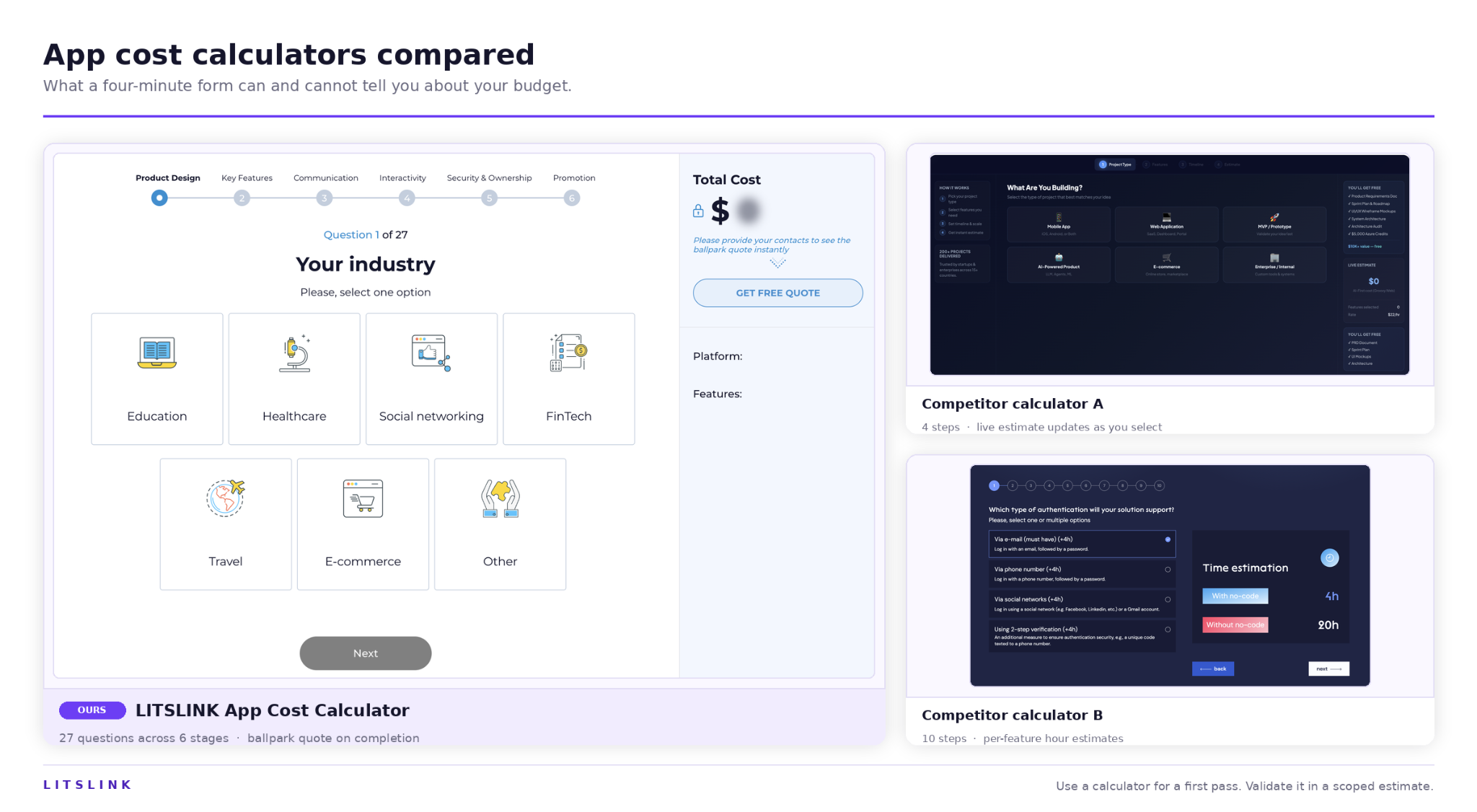
A mobile app cost calculator asks about complexity, platforms, features, and integrations, then returns a ballpark in a few minutes. Useful for a sanity check and for showing a board that a number is not invented. Accuracy is usually within about 30% for standard consumer apps and much worse for anything with unusual compliance or integration requirements, because a form cannot ask the follow-up question a person would.
Use one to set expectations, then validate it in a real scoping call.
Software Development Marketplaces and Review Platforms
Clutch, GoodFirms, DesignRush, and G2 publish verified client reviews, hourly rate bands, and typical project sizes. Read them for portfolio depth, industry match, and technical fit rather than for price. The cheapest vendor on a directory listing is rarely the cheapest vendor by the end of the project.
Check whether the reviews describe projects that look like yours. A firm with a proven track record in fintech tells you little about their healthcare work.
Requesting Quotes from Development Companies
Send the same written brief to three or four companies. Ask for itemized estimates broken out by role and stage, not a single number. Then compare what each one included, because the low bid is often low because it left out backend work, QA, or store submission.
Ask each vendor what they assumed. The assumptions are where the surprises live.
Industry Research and Competitor Analysis
Pull apart two or three mobile apps that resemble yours. Count their screens, list their integrations, check their release notes for update cadence. Public case studies and industry reports from Statista, Clutch, and Gartner give you market context. Compare against projects of similar complexity rather than against generic averages, which blend a $12,000 utility app with a $2 million banking platform and report the mean.
App Development Cost Estimation by LITSLINK
The fastest way to get a mobile app development cost estimate is our App Cost Calculator. It takes about four minutes and asks about platforms, features, integrations, and complexity, then returns a realistic ballpark you can plan against. A calculator cannot capture every business rule, so treat the output as a starting point and confirm it in a discovery session with our engineers.
LITSLINK has been building software since 2014. 1,540+ completed software projects. 1,000+ clients. 82 countries served. 300+ engineers and technology experts. We can take a signed contract to a working MVP in as little as 10 weeks.
We work across the full mobile app development lifecycle: discovery, UX/UI design, mobile and backend development, QA, launch, and long-term support. US-based project management, senior European engineering, and real overlap with your working hours.
If you want a tailored estimate, a technical consultation, and a delivery plan built around your timeline and budget, talk to us.
FAQs
What is the average cost to develop an app?
Most custom mobile apps land between $25,000 and $350,000. A basic app costs $25,000 to $60,000, a medium-complexity app costs $60,000 to $150,000, and complex apps run $150,000 to $350,000. Enterprise platforms go past $350,000.
How long does it take to develop a mobile app?
A simple app takes 3 to 4 months. A medium app takes 5 to 8 months. Complex and enterprise builds run 9 to 18 months. Written requirements shorten every one of those.
How much does it cost to maintain a mobile app?
Plan 15 to 20% of your initial development cost per year. That covers OS compatibility updates, bug fixes, security patches, and small improvements. Cloud hosting is separate, at $80 to $6,000 per month depending on traffic.
What are the key factors affecting mobile app development costs in 2026?
The key factors are app complexity, feature set, platform choice, backend architecture, design depth, third-party integrations, industry compliance, and your development team’s location. Complexity and platform move the number the most.
Is it cheaper to build an app with cross-platform development?
Yes, usually by 30 to 40% against two native apps, because one codebase serves both operating systems. The saving narrows to about 10 to 15% for apps that need deep hardware access or heavy custom graphics.
What can affect the accuracy of a mobile app development cost estimate?
Undefined requirements, unknown third-party API behavior, compliance discovered mid-project, and changes to scope after design sign-off. Any of the four can move mobile app development cost by six figures. An estimate is only as accurate as the specification behind it.
How accurate are online mobile app cost calculators?
Roughly within 30% for standard consumer mobile apps, and less reliable for regulated or integration-heavy products. Use one for a first pass, then validate with a scoped estimate.
How much does it cost to develop an MVP?
$25,000 to $60,000 and 8 to 14 weeks for a focused set of basic features on one or two platforms. Anything above that range has stopped being minimum.
How can I ensure my mobile app project stays on budget?
Document requirements before development starts, freeze scope for version one, run fixed-length sprints with demos, and hold a contingency of 10 to 15%. McKinsey and Oxford research puts the average large IT project 45% over budget, and unclear requirements are the most common reason.