






Two web apps can have the same number of screens and still differ in cost by 3–5x. We see it in estimates all the time: a ten-screen booking tool lands around $30K, while a ten-screen platform with payments, user roles, and live data passes $120K. The screens were never the point. An app development project’s budget depends on scope and complexity, which is why credible quotes for the same idea range from $15,000 to well over $250,000 in 2026. We put this guide together for startup founders, product managers, and business owners who want to know where their project lands in that range, and why.
Key Takeaways
- Most web apps in 2026 cost between $15,000 and $250,000+. Feature complexity sets the tier, not your industry or company size.
- UI/UX design runs from $2K for templated screens to $25K+ for a fully bespoke interface, which is often 10–15% of the total budget.
- Plan annual maintenance at 15–20% of build cost. A $60K app needs $9K–$12K per year to stay secure and current.
- Timelines range from 2–3 months for a basic build to 9+ months for enterprise projects.
- Discovery takes 5–10% of the budget, and QA takes another 15–20%. Skipping either is the fastest way to overspend later.
- Team location swings hourly rates from $35–$70/hr in Eastern Europe to $80–$150/hr in the US for the same stack.
This guide covers application-level products: SaaS platforms, dashboards, marketplaces, customer portals, and internal business systems with accounts, databases, and business logic. Marketing websites and CMS sites follow a different pricing logic and sit outside these ranges.
The numbers themselves come from projects LITSLINK delivered for clients across 82 countries, and they reflect actual contract values rather than first-call estimates. They cover development only, with third-party fees and maintenance broken out separately further down, and we cross-checked everything against current Clutch and GoodFirms benchmarks.
A Quick Cost Breakdown by Complexity
Most web apps fall into one of four cost tiers, and feature complexity drives the split far more than industry or company size does. Use the table as a starting benchmark. The factors further down will show you where your specific project lands within these ranges, or beyond them.
| Tier | Typical Features | Example Products | Cost (USD) | Timeline |
|---|---|---|---|---|
| Basic | Auth, simple CRUD, minimal integrations | Client portal, booking tool, internal dashboard | $15K–$40K | 2–3 months |
| Medium | Payments, APIs, admin panel | SaaS MVP, subscription platform | $40K–$100K | 3–5 months |
| Complex | Real-time features, multiple integrations | Multi-sided marketplace, real-time platform | $100K–$250K | 5–9 months |
| Enterprise | High-load architecture, compliance | Regulated fintech or healthcare system | $250K+ | 9+ months |
These numbers reflect our own delivery data, and your actual cost will vary with the feature set, the integrations, and the team you hire. One caveat that matters: these ranges cover original development cost only. The original development cost can shift once third-party services or third-party integrations enter the scope, since each one adds both build hours and recurring fees.

*[Alt: Four web app development cost tiers shown as glass cubes, from a basic login app to a complex enterprise system]*
How Is Web App Development Cost Calculated?
Every estimate you’ll ever receive reduces to one formula: estimated cost = development hours × hourly rate. The same 1,500-hour product costs $75,000 with a $50/hr team and $150,000 with a $100/hr team, which is why two credible quotes for one spec can differ by 2x.
The tricky part is estimating the hours. A login screen takes an afternoon, while the approval workflow behind it can take days, and connecting an API means handling auth, errors, edge cases, and testing rather than just plugging it in. The rate side is simpler and comes down to team location, seniority, and engagement model, covered further down. When you compare quotes, compare the hour breakdowns rather than the totals. A $40K estimate and a $70K estimate can describe two very different scopes, so the real question is what each team has actually included, and we’d rather show a client a higher estimate with clear assumptions than a low number that leaves half the scope undefined.
Key Cost Factors in Web App Development
Each factor below moves a project within its tier or pushes it into the next one. These are the things experienced developers raise during the discovery phase, before anyone writes a line of code.
Project Complexity and Core Features
Screen count is only the starting point. We have seen small apps get expensive because of complex user roles, approval flows, or audit requirements: ten simple screens can cost less than five screens wired into several external systems. That’s the real line between a simple web app and complex apps, and it runs through the backend rather than the interface. Essential features like auth and CRUD are cheap to build. Advanced features touch the database, the API layer, and testing all at once, and that combination is what scales the cost.
| Feature | Typical Added Cost |
|---|---|
| Real-time chat | $8K–$25K |
| Payment integration | $3K–$10K |
| Admin panel | $5K–$15K |
| Advanced search/filtering | $4K–$12K |
In our projects, real-time features are the most common budget surprise: clients expect chat to cost what a contact form costs, while the real number sits an order of magnitude higher.
UI/UX Design and Its Impact on Cost
Design gets its own three tiers, separate from the complexity table above. And the gap between a templated interface and a bespoke one is wider than most founders expect.
| Design Level | Cost (USD) |
|---|---|
| Basic templated | $2K–$5K |
| Mid-level custom | $5K–$15K |
| Fully animated/bespoke | $15K–$25K+ |
Templated design fits internal tools and MVPs. Full bespoke pays off when the interface is the product, as in fintech dashboards.
Backend Development Costs
Backend deserves its own line item: database design, business logic, APIs, server-side architecture. This is build cost rather than running cost, so keep it separate from the hosting spend covered below. Backend work sits inside the broader software development lifecycle, and here’s the part clients find counterintuitive: routine software development tasks like data modeling and API design add directly to project cost even when nothing visible changes on screen.
| Backend Complexity | Cost (USD) |
|---|---|
| Basic | $5K–$15K |
| Standard | $15K–$40K |
| Advanced | $40K–$100K+ |
Third-Party Integrations and APIs
Payments, auth providers, analytics, CRM, maps. Budget $1K–$8K per integration for the build itself. The spread comes from documentation quality and from how much custom logic sits between your app and the external API. A payment integration is one thing. A regulated payment workflow with refunds, disputes, and reconciliation is another, and the difference shows up in QA and error handling rather than in the interface.
Integration budgets also have a second half: services like Stripe and Twilio charge recurring usage fees that grow with your volume. This is one of the areas where founders underestimate the real long-term cost, so model these fees into year-one and year-two budgets before you commit to a provider.
How AI Affects Web App Development Cost
AI enters the budget in two different ways, and clients mix them up on almost every first call. AI-assisted development means the engineering team uses AI coding tools to cut hours on routine work. It speeds up standard modules, while architecture, QA, and compliance work stay the same size, so treat any vendor claim of “AI cuts cost in half” with suspicion. AI features inside the product work the other way: each one adds scope. A production AI feature needs model selection, prompt engineering, evaluation on real data, and guardrails against wrong answers, and features built on your own content usually add a RAG setup with a vector database behind it. Human review workflows and caching decisions add hours on top.
| AI Feature | Typical Added Cost |
|---|---|
| AI chatbot on an LLM API | $10K–$30K |
| AI search / RAG over your data | $15K–$50K |
| Recommendation engine | $20K–$60K |
| AI agents with tool access | $30K–$100K+ |
| Computer vision | $25K–$80K |
Budget token-based API fees as a running cost, the same way you budget hosting. The monthly number depends on request volume, token counts, and model choice: a support chatbot handling tens of thousands of conversations a month can generate $500–$3K in API fees.
Progressive Web Apps vs. Traditional Web Apps
A PWA adds offline support, push notifications, and installability on top of a standard web app. Expect to pay 10–20% more for that broader device reach. The exact premium depends on offline scope, caching requirements, and how much of your existing architecture can be reused. It pays off when a large share of your audience is on mobile and you want app-like behavior without building native apps, while desktop-first B2B tools are better served by a traditional web app.
Hosting and Infrastructure Costs
Hosting splits into one-time setup (cloud configuration, CI/CD, environments) and ongoing spend that grows with your user base. A basic app runs on $50–$300 a month. At real scale, with thousands of concurrent users and heavy data, the bill climbs past $2K. Pricing from AWS and Google Cloud is public, so estimate your infrastructure costs before launch, while they are still a modeling exercise rather than an invoice.
Enterprise App Development Cost: Why It’s Different
The tier table already gave you the enterprise number. Here’s why it starts at $250K. Compliance comes first, and each framework adds its own kind of work. SOC 2 is an audit framework built on the AICPA Trust Services Criteria, so it drives logging, access controls, and evidence collection for an external auditor. HIPAA is US law covering protected health information and dictates technical and administrative safeguards around health data. GDPR is the EU data protection regulation and shapes how you collect consent, store personal data, and handle deletion requests. Then come legacy integrations, because connecting to systems built fifteen years ago takes discovery, custom adapters, and heavy testing. And finally, high availability, since uptime guarantees demand redundant infrastructure and failover logic that smaller apps skip. Our Web Development Services team scopes these projects with compliance built into the estimate, not bolted on later.
Development Team Location and Web Development Company Rates
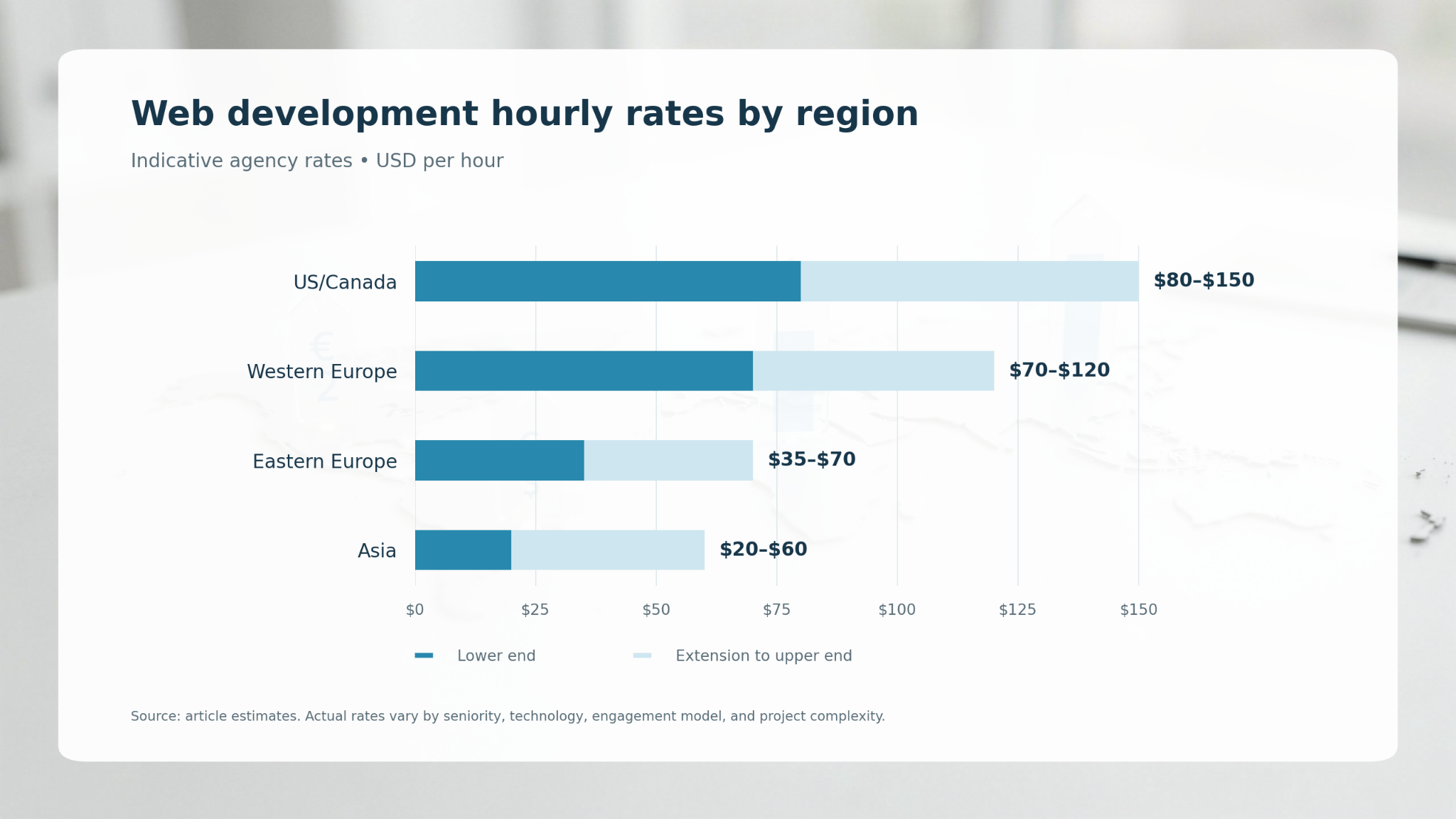
Location is one of the biggest factors affecting hourly development rates.
| Region | Typical Hourly Rate |
|---|---|
| US/Canada | $80–$150/hr |
| Western Europe | $70–$120/hr |
| Eastern Europe | $35–$70/hr |
| Asia | $20–$60/hr |
These are indicative ranges based on agency market data and our own project experience. Actual rates vary with seniority, technology, engagement model, and project complexity.
Complex projects need bigger cross-functional teams: several engineers, a designer, a QA specialist, and a project manager. That headcount compounds the regional gap. Run the math with the rates above: a five-person team logging around 800 hours a month costs $64K–$120K at US rates against $28K–$56K in Eastern Europe. Over a nine-month enterprise build, even the conservative ends of those ranges sit more than $300K apart.
*[Alt: Web app development cost by team location: world map with rate markers for the US, Western Europe, Eastern Europe, and Asia]*
Web App Development Cost by Product Type
This table uses a different lens: product type instead of feature count. A web development company scopes a basic web app very differently from custom app development for an enterprise client, because product type dictates architecture from day one. Our Web Development Services estimates start from this framing.
| Product Type | Typical Scope | Cost (USD) |
|---|---|---|
| MVP Build | Core flow only, single platform | $15K–$50K |
| SaaS Platform | Multi-tenant, subscriptions, dashboards | $60K–$180K |
| Marketplace / Two-Sided Platform | Buyer + seller flows, payments, reviews | $80K–$250K |
| Internal Enterprise Tool | Custom workflows, integrations, SSO | $100K–$300K+ |
Development Costs by Project Stage
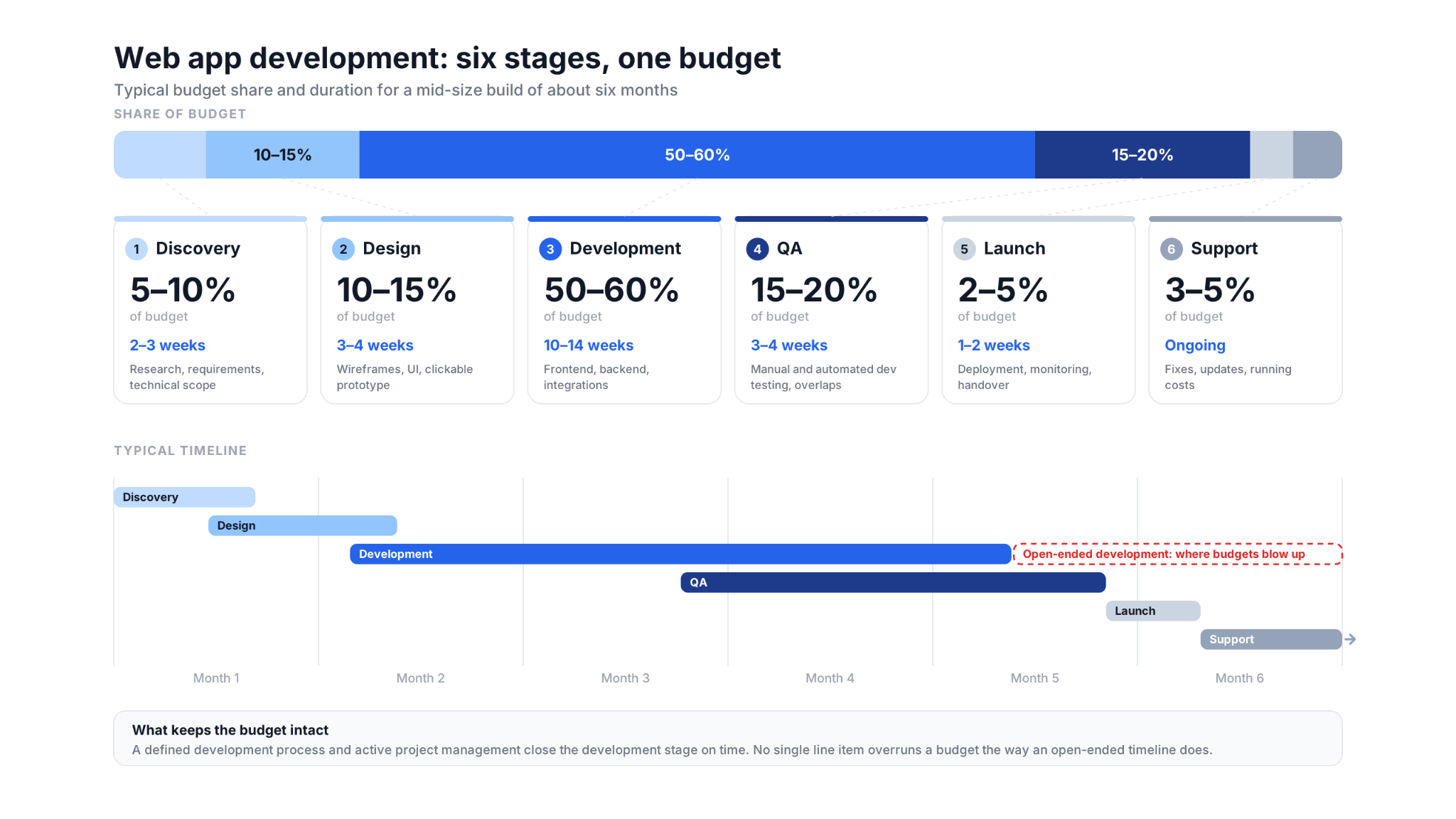
Most web app projects move through six major stages: Discovery, Design, Development, QA, Launch, and Support. Development itself eats 50–60% of the budget over the middle months. Design takes 10–15% up front, and launch plus initial support round out the rest. Budgets blow up when the development timeline turns open-ended rather than when a single line item runs high, and solid project management plus a clearly defined development process are what keep that from happening.
[ALT: project roadmap visual showing six stages with budget share and duration]
Discovery Phase Costs
Discovery covers market research, requirements gathering, and technical scoping, and it takes 5–10% of the total budget. Founders under pressure want to skip it and start coding, and in our experience that is the most expensive shortcut in the whole lifecycle, because every requirement clarified in discovery is a requirement you won’t be rebuilding in month four.
Quality Assurance and Testing Costs
QA combines manual and automated testing and takes 15–20% of the total budget depending on complexity. For regulated and enterprise apps, the share climbs higher, and we consider that money well spent, because a single payment bug in production costs more than the entire testing budget. Automated coverage costs more up front and pays for itself on every release after, which is why we push clients toward it even on MVPs.
Common Hidden Costs to Budget For
The quote you sign is rarely the number you end up spending. These are the costs that incur additional spend beyond the initial quote, and they’re the ones founders miss most often:
- Security and legal costs. Penetration testing, security audits, privacy reviews, compliance documentation, and legal work often sit outside the development quote.
- Post-launch bug fixes. The first few months after launch often bring a wave of small fixes as real users exercise paths that were never covered during testing.
- Unplanned scope changes. A “small” new feature in month three ripples through the database, the API, and every test that touches them.
- Third-party fee increases. Your payment or messaging provider raises prices. Your margin absorbs it.
Post-launch maintenance is one of the most common sources of additional costs, which is why app maintenance costs deserve their own budget line rather than a footnote in the development quote.
Beyond Launch: Ongoing Maintenance Costs and Support
A complete budget separates six buckets: initial development, infrastructure and hosting, third-party services, maintenance, support, and future feature development. The first one is a one-time cost. The other five keep running for as long as the product lives.
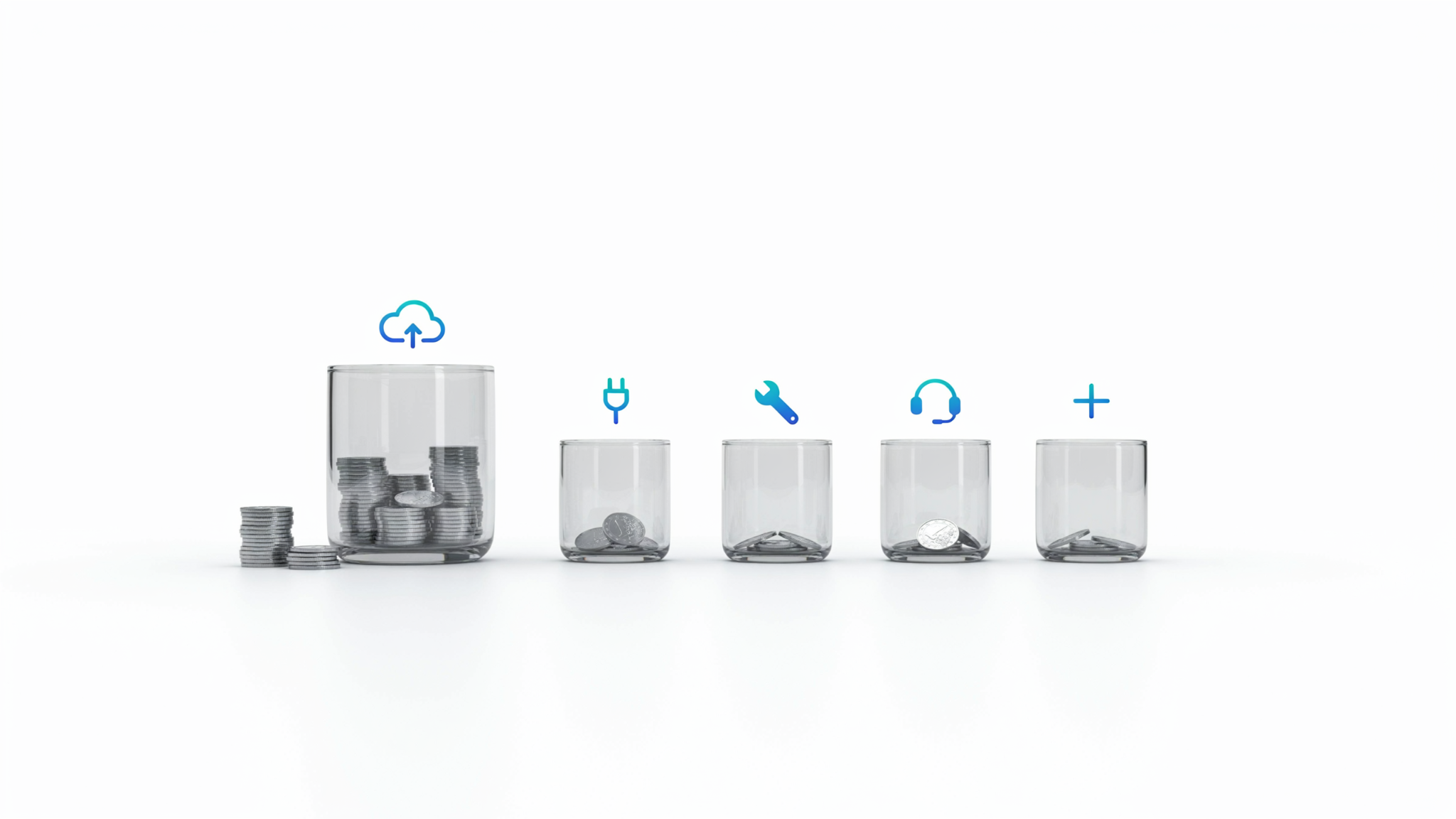
*[Alt: Ongoing web app development costs after launch: budget jars for hosting, third-party services, maintenance, support, and new features]*
For the maintenance bucket, a common budgeting rule is to reserve 15–20% of the original development cost annually: bug fixes, security patches, dependency updates, hosting management. One distinction trips up almost every first-time founder we work with: long-term maintenance costs and an ongoing support retainer with guaranteed response times are two separate budget lines. Businesses budget for one, forget the other, then discover the gap during their first production incident. We break down the same logic for websites in our guide on the true cost of a website.
| Tier | Build Cost | Est. Annual Maintenance (15–20%) |
|---|---|---|
| Basic | $15K–$40K | $2.3K–$8K |
| Medium | $40K–$100K | $6K–$20K |
| Complex | $100K–$250K | $15K–$50K |
| Enterprise | $250K+ | $37.5K+ |
In-House vs. Outsourcing Web App Development
This one’s about who builds the app, which is a separate question from the rate table above. Assembling an in-house development team means recruiter fees, months of interviews, and salaries burning before any code ships. Outsourcing gets you experienced web app developers and project managers without that cycle.
| Criteria | In-House | Outsourcing |
|---|---|---|
| Upfront Cost | Higher | Lower |
| Hiring Time | Weeks to months | Days |
| Access to Talent | Limited to local market | Global |
| Flexibility | Lower (fixed team) | Larger (scale up/down) |
| Best For | Long-term core product | MVPs, fixed-scope projects |
Build in-house when the product is your company’s core asset, and you’ll need the team for years. Outsource when you need speed, a fixed scope, or skills your local market can’t supply.
How to Reduce Web App Development Cost Without Cutting Quality
A pattern from our own delivery data: the cheapest builds are the ones with the fewest mid-project changes, and these five moves cut cost without touching quality:
- Define scope early. Write requirements before development starts. Every vague requirement turns into a change request later, with interest.
- Start with an MVP. Ship the core flow, learn from real users, then put money into what they actually use.
- Pick the right technology stack. Choose technologies with strong developer availability, mature documentation, and predictable infrastructure costs.
- Prioritize must-haves. Rank every feature. Build the top of the list first and park the rest.
- Plan for growth from day one. Architecture decisions made early are far cheaper than major architectural changes after the product reaches scale.
Run your numbers through an app development cost calculator early to get an anchor, then revisit project scope with your team before treating any early estimate as the final cost.
How LITSLINK Helps You Plan Your Web Development Project
We’ve shipped 1,540+ projects for 1,000+ clients across 82 countries, with a team of 300+ engineers and MVPs delivered in as little as 10 weeks. That proven track record helps us build estimates around actual project scope rather than generic industry averages, and a cost-effective delivery model keeps those estimates competitive. We scope the work transparently, so you can see what each feature costs and what is included before development begins.
Ready to scope your project? Contact our team for a free consultation and a detailed quote →
Want a quick ballpark first? Calculate web app cost with the free App Cost Calculator, then bring the estimate to the consultation.
Related guides: Understanding Android App Development Cost and Flutter App Development Cost.
FAQs
How Much Does It Cost to Build a Web App in 2026?
Between $15K–$40K for a basic app, $40K–$100K for a medium build, $100K–$250K for a complex product, and $250K+ for enterprise. Many startup web apps we work on fall in the $50K–$150K range, depending on scope and complexity.
How Much Does Ongoing Maintenance Cost After Launch?
Plan on 15–20% of your build cost per year. A $100K app needs $15K–$20K annually to cover security patches, bug fixes, hosting, and updates.
Is a Web App Cheaper Than a Mobile App?
In most cases, yes. A web app runs on one codebase across all devices, while native mobile means building and maintaining separate iOS and Android apps, which raises both development and long-term maintenance cost.
What’s the Biggest Cost Driver in Most Web App Projects?
Feature complexity, and real-time features in particular. Chat, live updates, and heavy integrations push a project up a full cost tier faster than anything else we see.
How Accurate Are Online Web App Cost Calculators?
They’re useful for an initial budget range, not for a project quote. A reliable estimate needs a defined scope, a feature list, and technical requirements behind it, so treat the calculator’s output as an anchor for a scoping conversation.
Should I Hire a Web Development Company or Build In-House?
Hire a company for MVPs, fixed-scope builds, and speed. Go in-house when the product is your core long-term asset and you can absorb months of hiring first.
How Much Does It Cost to Build a SaaS Web App?
A SaaS platform with multi-tenancy, subscriptions, and dashboards runs $60K–$180K. A single-flow SaaS MVP starts closer to $40K–$50K.
How Much Does It Cost to Build a Marketplace Web App?
A two-sided marketplace with buyer and seller flows, payments, and reviews costs $80K–$250K. You’re effectively building two products plus the trust layer between them.
How Much Does It Cost to Build an AI-Powered Web App?
Take the base cost for your tier and add $10K–$100K+ depending on the AI features, anywhere from a $10K–$30K LLM chatbot to $30K–$100K+ for AI agents. Then add recurring inference fees on top of hosting.
Is a Progressive Web App Cheaper Than Building Separate Native Apps?
Yes, in most cases. A PWA can be significantly cheaper than building and maintaining separate native iOS and Android applications, though the savings depend on the feature set and how much native functionality you need.