





A lot of people think a chatbot and conversational AI are two separate things. A chatbot is really just the chat box you see on a site or in an app. Some chatbots only follow rules someone wrote ahead of time. Others use conversational AI, so they can tell what a person means and remember what was said before. Our first questions are about the bot’s job and the tools it has to work with. We also ask how much harm a wrong answer could cause. If the stakes are high, the choice of technology matters a lot more.
Key Takeaways
- Major companies spent about $12 billion on chatbots in 2023, and Juniper Research thinks that could hit $72 billion by 2028 (Juniper Research).
- Give a chatbot 20,000 routine requests and your support team gets back over 240 hours a month.
- Chatbots react to keywords. Conversational AI tries to understand the person typing.
- Plenty of vendors slap the word “chatbot” on both, so don’t trust the label.
Talk to a few vendors, and you’ll notice they use “chatbot” and “conversational AI” as if they mean the same thing. They don’t. And if you’re buying a customer service tool, that matters. Choose wrong, and you’ll either overpay for features you don’t need or end up with a bot your customers hate.
Money is pouring into this space. Juniper Research says conversational AI service revenue will grow a lot. It will grow from $ 2.4 billion in 2026 to $ 8.5 billion by 2030. That’s then triple the amount. Most of this growth will come from companies that want to talk to customers through messaging apps. They want the conversations to feel personal, like a real person talking (Juniper Research, Agentic Conversational AI Service Revenue Set to Triple by 2030).
If you run customer service or build products and you’re stuck choosing between the two, keep reading.
Chatbot vs Conversational AI: Key Differences at a Glance
| Factor | Traditional Chatbot | Conversational AI |
|---|---|---|
| How it works | Rule-based, decision tree, exact keywords | NLP + machine learning, understands intent |
| Handles | Basic queries, FAQs, routine tasks | Complex, open-ended, multi-turn conversations |
| Improves over time | No, static until manually updated | Yes, when the team reviews mistakes, updates content or prompts, and tests the changes |
| Cotext retention | None between messages | Retains context across a conversation |
| Best for | Simple inquiries, predictable transactions | Complex tasks, personalization |
What Is a Traditional Chatbot?
A traditional chatbot is a rule-based system built on a decision tree. It looks for exact keywords or set commands and answers with a pre-written reply. AI-powered chatbots don’t understand context or what a real customer interaction means. It just matches patterns.
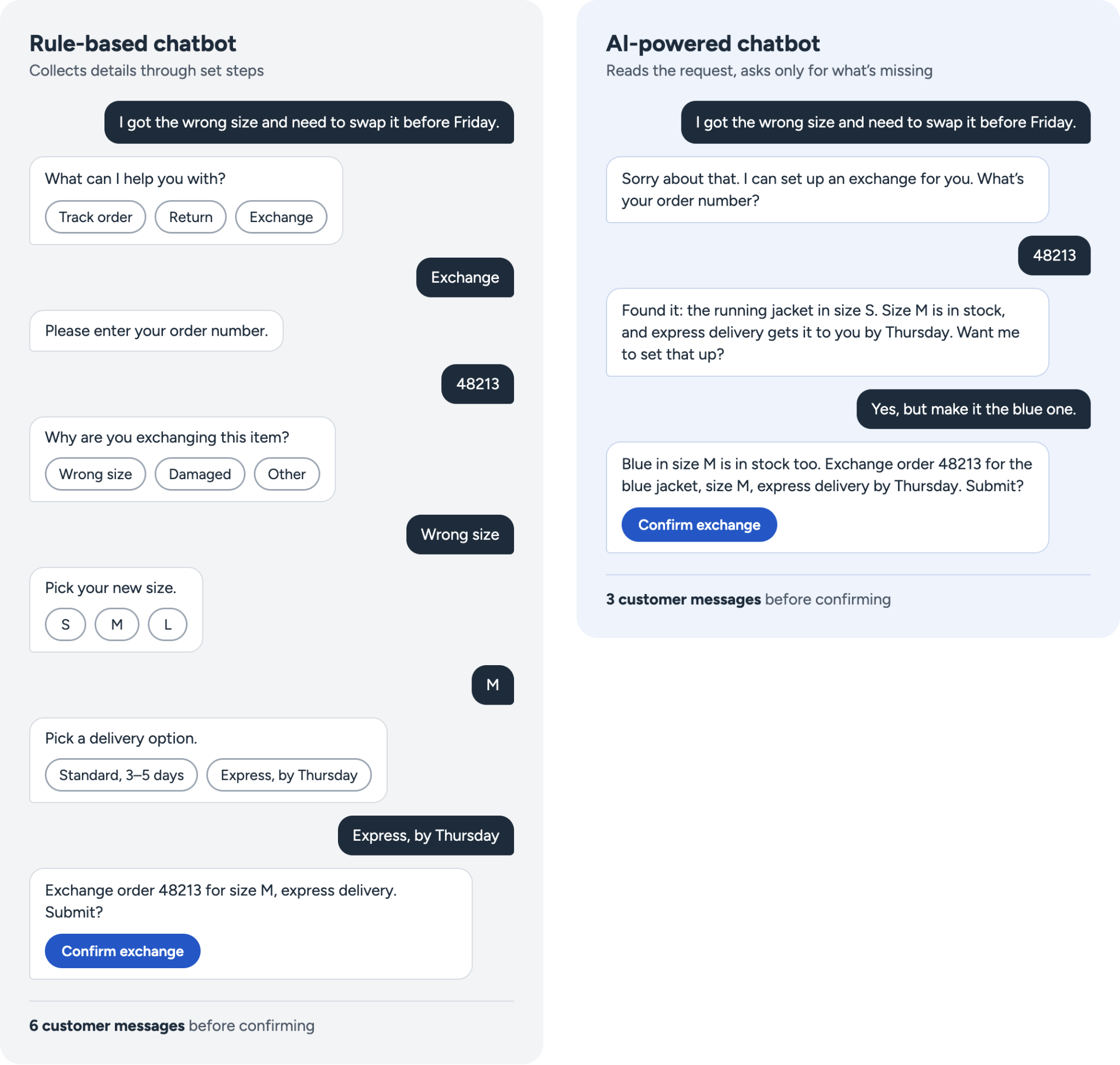
Picture a customer typing “Where’s my order?” A chatbot picks up the word “order,” asks for an order number, and shows the tracking status. That works well. Now say the customer types “I got the wrong size and need to swap it before Friday.” A rule-based bot can handle exchanges too, if someone built that flow. But it walks the customer through it one step at a time: pick a reason, enter the order number, choose a size, choose delivery. The customer already gave half of that in one sentence, and the bot can’t use it.
That’s the trade-off. Rule-based chatbots give up flexibility to get predictability. They answer basic questions, handle FAQ automation, and simple structured data collection. They usually work in one channel at a time and stay the same until a developer updates them by hand. For narrow, repetitive tasks, that’s a real strength. Once a customer goes off script, the bot gets stuck.
What Conversational AI Offers: Machine Learning, AI Assistants, and Artificial Intelligence Explained
What the bot says back depends on how it’s built. Some systems figure out what the customer wants and then reply with an answer the team approved ahead of time. Others use generative AI to write a new reply each time. Many mix the two, using set answers for things like payments and generated ones for open questions. Google’s Dialogflow documentation draws the same line: its agents always use language models to understand what the user wants, but teams decide whether and how those models are used for responses, choosing from fully generative, partly generative, and deterministic features.
Take the wrong-size order again. Conversational AI can figure out that the customer wants an exchange, check the order, see which sizes are in stock, and suggest a delivery option that arrives before Friday. If the customer later says “actually, make it the blue one,” it remembers what “it” means because it keeps track of the whole conversation.
It also gets more personal over time. Conversational AI can use past interactions and customer history to tailor its replies, and it keeps improving as it collects more training data. More and more, these capabilities power AI agents that complete multi-step tasks, not just answer a single question.
The same technology runs the large natural language understanding models behind today’s virtual assistants and voice interfaces. It can handle both spoken and typed input and supports sentiment analysis, so it can detect when a customer is getting frustrated. That’s what makes complex, open-ended conversations possible, and a rule-based system can’t do any of it.
How Chatbots and Conversational AI Improve Customer Experience and Meet Customer Expectations
Different businesses need different business tools. A chatbot can answer dozens of customers at once, all day and night. Handling about 20,000 routine requests can save a customer service team more than 240 hours a month. If most of your customer request are questions like “Where’s my order?” or “What time do you close?”, a chatbot is still a good fit. These questions come in all day, and the answers rarely change.
Some conversations take more work. Say a customer’s flight gets canceled. They need a new booking and a refund for the hotel, and they want the missed trip noted on their loyalty account. They’re probably upset, too. That kind of chat used to go straight to a live agent. Conversational AI can now handle most of it. If a person needs to step in, they get the whole conversation and don’t have to ask the customer to start over. That’s where the higher price of conversational AI pays off.
The wider shift to quick customer support. Research suggests AI could raise business productivity by about 40% by 2035, and more than half of companies say they’ve sped up AI adoption since 2020. For customer service leaders, the point is to fit the tool to the job. Conversational AI isn’t automatically an upgrade. A simple rule-based chatbot that’s well-scoped can handle questions better than a fancy conversational AI system. It’s cheaper to run and more reliable.
Neither option is free of problems. A scripted bot needs more work each time you add a new flow. It also fails when a customer asks about something it wasn’t set up for. Generative bots can give answers your business never approved. They are often a little slower to reply, and someone has to test them on a regular basis. To keep this under control, many teams only let the bot use approved sources. Some also check replies before they reach the customer or send hard questions to a human agent. Mistakes can still happen, but they happen less often and are easier to spot.
When Should You Choose a Traditional Chatbot vs Conversational AI?
The choice comes down to a few practical questions about your real use case. Which technology sounds more impressive shouldn’t factor in.
Choose a Traditional Chatbot When…
Maybe most of your customer questions are the same ones over and over, like where an order is or how to reset a password. In that case, a rule-based chatbot is often enough. It’s also a good fit when money and time are tight, and the bot only needs to work on your website. Some companies pick this kind of bot because they want full control over what it says. A bank or an insurance company, for example, may not want any reply that wasn’t approved first. Still, approved wording is not the same as being correct. If the help article behind an answer is old, the bot will give an old answer. Checking who the customer is and keeping their data and payments safe are separate jobs that need their own protection.
Choose Conversational AI When…
User inputs are open-ended questions that do not fit a script. The conversation has back-and-forth turns, and the bot must remember what was said earlier. Personalization that uses orders or account history is important to you. You want the system to work across chat, voice, and email, and you want the system to recognize the customer engagement on each channel.
Conversational AI also makes sense once you’ve outgrown your chatbot. If every new question means adding more branches to the decision tree, maintenance can quickly get out of hand. That’s usually the sign it’s time to switch.
A Practical Starting Point If You’re Unsure
Pull the last 100 real customer queries your support team handled and sort them into groups. If most fall into a handful of predictable categories, a chatbot will probably give you most of the value at a fraction of the cost. If they’re all over the place and depend on context, conversational AI is likely worth the extra investment.
There’s also a middle option. AI can work out what the customer wants, a fixed workflow handles the action, and a person takes anything unusual. Google’s Dialogflow supports this mix: its flows include optional generative features for scenarios where teams don’t need deterministic control over agent responses.
How LITSLINK Builds AI Chatbots and Conversational AI Solutions
LITSLINK builds both rule-based chatbots and full conversational AI systems. Which one we recommend depends on how your customers actually talk to you.
Some businesses need a bot that can follow a long conversation and understand what people mean. We build those with NLP and machine learning. Others just need fast answers to the same few questions, so we build a simple scripted chatbot that launches quickly and is easy to keep up to date. We aren’t tied to one AI model. We’ve worked with all the major LLM providers and choose whichever one suits your project best.
For a US B2B SaaS company, CRM onboarding became the biggest drag on the pipeline after its sales team grew from 14 to 24 reps. We built a hybrid: an LLM chatbot that parses intent and queries the CRM via API. Onboarding dropped from 14 days to 5, and 90% of CRM queries were resolved without human escalation.
So far, our team of 300+ engineers has finished more than 1,540 projects for 1,000+ clients in 82 countries. Your project manager is based in the US. Our engineers in Europe work hours that overlap with US time zones, so questions get answered the same day.
We usually tell clients to begin with one small task, like answering order questions, and add more only after that works well. If the bot can refund money or change a customer’s account, keep strict rules on those steps. That’s true for any type of bot. The more a wrong answer would cost you, the more control you need.
Learn more by reading AI Chatbot Development Services, How to Build Conversational AI: A Step-by-Step Guide, and Top Benefits of Chatbots for Business; choose the one that suits you best instead of reading all three.
Not sure which approach fits?
Цe’ll help you scope the right solution for your customer service needs.
Contact LITSLINK
FAQs
Are All Chatbots Conversational AI?
Many chatbots are simple, rule-based systems that follow scripts and decision trees and don’t understand human language. Conversational AI uses NLP and machine learning to understand human language and its context. Not all chatbots do, but some modern “AI chatbots” do run on conversational AI, so check what’s under the hood before you buy.
Which Is Better for Customer Service: Chatbots or Conversational AI?
That depends on the user intent. If most want to track an order or check your opening hours, a chatbot is cheaper and does the job well. Conversational AI costs more and takes longer to set up. It’s worth it when customers bring messy problems, and the bot needs to remember what they said earlier.
Can a Chatbot Be Upgraded Into Conversational AI?
Usually it can. A lot of the time, you just need a new engine to read what customers type. Everything else, like the chat window on your site and the links to your order or CRM system, can be reused. Some older bots are built in a way that makes this hard, and then it’s easier to build a new one. Your old chat logs are worth keeping for testing the new bot. Just have someone go through them first, because they can include wrong answers and private customer details.
Do Conversational AI Chatbots Function Like AI Agents?
Not every chatbot is an agent. A chatbot can be the place where a customer talks to an agent, but being able to do something, like issue a refund, doesn’t make it one. A scripted bot can do that too if it was set up for it. An agent is different because it figures out the steps by itself. Even so, it should only give refunds up to a set amount, and bigger or riskier ones should go to a person for approval.
How Do I Choose a Chatbot Development Company?
Ask to see bots they’ve built that real customers use today. A polished demo doesn’t count. It also helps if the team has built both rule-based bots and LLM-powered ones, because then they’ll suggest what fits your needs instead of what they’re used to. Ask what happens after launch, too. Real customers always find gaps, and someone has to retrain and adjust the bot. To compare vetted vendors side by side, see LITSLINK’s ranking of top AI chatbot development companies in 2026.