






Key Takeaways
- AI project abandonment is spiking, with nearly half of all proofs of concept killed before reaching production.
- Measurable ROI is concentrated among top performers, while almost half of enterprise adopters report no major business impact.
- Budget constraints, data privacy risks, and output accuracy remain the primary obstacles to scaling.
- Successful rollout requires both a high-level strategy to identify use cases and a phased roadmap to guide execution.
- Enterprise deployment moves in stage-gated phases, requiring each milestone—from 4-week POCs to 10-week MVPs—to prove ROI before funding expands.
The first time a regional logistics operator tried AI, the demo went well. A model flagged deliveries likely to fail, the dashboard looked sharp, and the leadership team asked when it could go live. Eight months later, it still hadn’t. Nobody had connected it to dispatch, the training data was a one-time export, and the drivers it was meant to help had never seen it.
The operator wasn’t unusual. The operator’s first attempt failed in a very ordinary way. S&P Global Market Intelligence surveyed more than 1,000 enterprises in North America and Europe in 2025, and the average company had thrown out 46% of its AI proofs of concept before launch.
Projects like that rarely blow up. More often they stall the way the delivery model did, waiting on an integration nobody budgeted for or a security review that keeps getting pushed. Some companies try again. Plenty don’t. By 2025, 42% had given up on most of their AI work, up from 17% a year earlier.
When the survey asked what got in the way, the answers were the ones that tend to come up in budget meetings anyway: cost, privacy and security.
Few of those companies ran out of ideas. They ran out of road between the idea and the morning a dispatcher actually opens the tool. That road is what this guide maps, following the same operator through its second try, in seven stages from business goals to enterprise-wide scaling. A proof of concept takes four to six weeks. An MVP takes about ten. Time was never what sank the first attempt. The order of the work was.
AI Implementation Roadmap vs. AI Business Strategy: What’s the Difference?
At the logistics operator, the AI strategy fit on one page. It said the company would use AI to cut failed first deliveries and, later, to improve customer ETAs. It also said what would wait. Computer vision in the sorting hub looked promising, but the cameras weren’t installed yet, so it stayed off the list for this year. That page answered why AI was worth the money and where it should go first.
The implementation roadmap turned that page into a backlog: a five-week pilot in Columbus, a classifier trained on two years of delivery attempts, a target agreed before week one and a budget line for the dispatch integration. It answered how the work would get done and when each piece would land.
The two documents earned their keep in different moments. When the project stalled for a week over budget, the strategy page settled what mattered most, and the roadmap showed what could be cut without losing it.
Organizations that skip the second document usually discover the gap late. It sits between a successful pilot and a production deployment that never happens. Implementation frameworks exist for exactly this reason.
Why AI Projects Fail Without an Implementation Roadmap
These numbers are well documented. Nearly half of all AI proofs of concept never reach production. The average organization scraps 46% of them before launch, according to a 2025 S&P Global Market Intelligence survey of more than 1,000 enterprises in North America and Europe.
Much of that loss happens in one stretch, after the demo impresses the leadership team and before anyone has to run the system every day. The pilot worked on clean data with a motivated team. Then it meets the real dispatch system, the real support queue and the people who weren’t in the room. That stretch is where a practical AI implementation roadmap earns its cost, and where a competitive edge starts to form.

Source: RAND Corporation analysis of 2,400+ enterprise AI initiatives.
| Benefit | What It Delivers |
|---|---|
| Lower implementation risks | Fewer costly mistakes, failed initiatives and unexpected barriers discovered late |
| Alignment with business goals | AI initiatives tied to specific business priorities and measurable outcomes |
| Better resource planning | Visibility into required budgets, teams, technologies and timelines |
| Scalability | A structured path from initial pilots to enterprise-wide AI adoption |
| Higher AI ROI | High-value initiatives prioritized first, with measurable returns on AI investment |
7-Step AI Implementation Roadmap for Enterprises
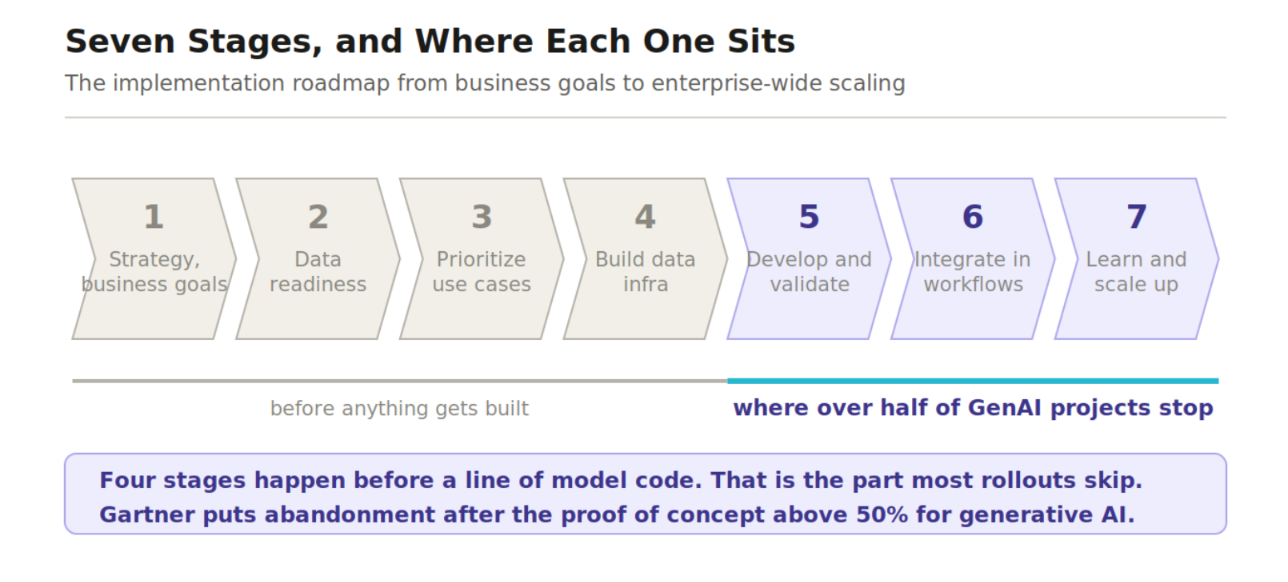
Source: LITSLINK, with abandonment data from S&P Global Market Intelligence.
Enterprise AI projects that make it to production tend to follow a similar order. Strategy and a readiness check come first. Development, integration and deployment follow, and the improvement work never quite ends. One rule holds it together: no stage gets funded until the one before it shows a result someone can measure.
For a logistics operator, that result might be fewer failed deliveries in a single pilot city, and that is what pays for the rollout everywhere else. Drivers who actually use the new tool are what earn the next use case. Companies that skip a stage usually end up in one of two places. Some have a model that works in testing but can’t reach the systems it needs. Others ship it, and people keep doing things the old way.
Step 1: Define Your AI Strategy Roadmap and Business Goals
A request that starts with “we need a chatbot” often ends up somewhere else. Ask the support director what is actually going wrong, and the answer might be that a third of incoming tickets ask “Where is my order?” and her team spends every Monday answering them by hand.
A logistics COO puts it like this: last-mile costs are up 12% on last year, and most of the leak is drivers circling apartment buildings they can’t get into. She hasn’t said a word about AI, yet the project is already half-scoped. The data sits in failed-attempt logs and the gate-code notes drivers type into their handhelds. It’s her budget, so it’s her result, and the number to beat is that 12%. Goals like hers fall under cost. The other two common buckets are faster cycle times and a better customer experience.
Executive alignment matters just as much. Without a sponsor at the decision-making level, AI initiatives stall at the first budget review. Or the moment a department resists change.
This is why success metrics must be set before any engineering begins. An AI strategy roadmap creates strategic alignment.
Step 2: Assess Data Readiness and AI Capabilities
The data audit at the logistics operator took three weeks and turned up one surprise. The driver-app logs were in decent shape. The building access notes, the gate codes and “leave it with the doorman” instructions the model needed most, were scattered across three systems. The oldest was a database at the Toledo depot that only one dispatcher still knew how to export from. Nobody had wanted to open it. It turned out to hold years of exactly the data the model needed.
The same pass covered everything around the data. The demo had run on a data scientist’s laptop, so someone had to price out production hosting. Nobody in-house had kept a model running after launch before, which meant either hiring or bringing in a partner. Security got the shortest meeting and the longest follow-up list. None of this is exciting, but it decides what can realistically ship this year.
Then name the compliance rules that apply. GDPR comes with EU customer data, HIPAA with anything that touches patient records, and SOC 2 with the controls enterprise customers will audit. Data management and governance close the list. A company that can’t say who owns its customer data, or how long it keeps it, will usually spend its first AI quarter answering those questions instead of building.
Organizational readiness counts as much as technical readiness. An AI readiness assessment at this stage is the cheapest risk reduction available, because gaps found now cost a conversation. The same gaps found in month five cost a rebuild.
Step 3: Prioritize High-Impact AI Use Cases
Identify AI opportunities and rank them. Business value, feasibility, available data, implementation complexity, risk and expected ROI are the six criteria that matter. A use case with obvious value and no usable data is not a starting point.
Pick two or three use cases and stop there. For the logistics COO, failed deliveries at apartment buildings are one. Order-status tickets might be a second. A third can wait until the first two have numbers to show.
Step 4: Build the Data Infrastructure for AI
Then the plumbing. For the logistics operator, the delivery-attempt model needs failed-attempt logs pulled from the driver app every night, cleaned and stored somewhere the model can reach. It needs an API into the dispatch system, so a flag can reach the driver before the next attempt. All of that runs on cloud infrastructure sized for next year’s volume, inside an architecture that won’t buckle when the second use case shows up.
Security and access controls are usually far cheaper to design in than to bolt on after launch. Two decisions came up in the first week of the second attempt. The first was about driver location. Dispatch needed live GPS to reroute a driver around a building with a broken buzzer. Marketing asked for the same feed to study delivery density by neighborhood and got a weekly summary by zip code instead, with no individual driver in it.
Only two people on the data team could push a new version of the model, and every change went into a log with a name and a date. Some of the operator’s parcels went to customers in Germany and Poland, so the legal team checked how the EU AI Act might apply. A tool that only routes deliveries is unlikely to count as high-risk. One that ranks drivers by performance could, so the team kept those two uses apart from the start.
The second decision paid off six months later. The pipeline built for the delivery-attempt model was pulling driver-app logs every night, removing duplicates and storing them in one place. When the route planning team asked for data, they connected to the same store in about two weeks. The customer notifications team followed with ETA predictions a month after that. Neither project paid for a new pipeline, so most of their budgets went into the models themselves.
Step 5: Develop and Validate AI Solutions
Columbus gets the pilot first, mostly because its dispatch team volunteered. For five weeks the model flags addresses where a first attempt is likely to fail, often buildings with a broken buzzer or a leasing office that closes at five. Nobody reached for a large language model here.
A plain classifier trained on two years of delivery attempts did the job and costs far less to run. By week five, the dispatch lead has a number to take upstairs: failed first attempts in Columbus against Indianapolis, which ran the old way. A wide enough gap gives the rollout its business case. A narrow one means the company found out for the price of one city.
The Columbus model worked on real delivery data from day one, inside a sandbox walled off from the live dispatch system. The team wrote down its target before week one, a specific drop in failed first attempts, so nobody could quietly move it later.
The numbers weren’t the only evidence. The drivers’ running notes caught what metrics missed: gate codes were arriving after vehicles had already parked. The release stayed on hold until two conditions aligned—two straight weeks without a crash, and a failed-attempt rate that met the initial baseline.
Step 6: AI Integration: Deploying AI Into Business Workflows
The AI integration process moves the validated solution into production systems and existing business workflows. That means integration with enterprise systems, production deployment testing and security review. Clear human oversight of what the system decides belongs there too.
The first week after rollout in Cleveland, the gate-code texts went out and almost nobody used them. Drivers there had their own system, a laminated sheet of building codes passed from one shift to the next, and nobody had told them the texts were more current. Two short sessions at the morning briefing, plus a dispatcher who answered questions over the radio, turned that around within a month. The model itself hadn’t changed. What changed was whether the people on the routes trusted it, and that is the number worth watching after launch: how many drivers open the text before they knock.
Step 7: Continuous Learning, Optimization, and Scaling
By spring, the Cleveland model is a little less sharp than it was in January. Three new apartment complexes opened on the east side, two older buildings switched to smart lockers, and none of that was in the training data. Nobody notices from the office.
Track cost and AI ROI continuously, and treat ongoing optimization as a standing task rather than a project. A solution that works technically and loses money at volume is a solution that gets switched off.
Then scale. A year in, the support team asked for a model of its own. Customers were still calling to ask where their parcels were, and those “Where is my order?” tickets hadn’t gone away. This time, the project skipped most of the groundwork. ETA data was already flowing in, the dispatch integration already existed, and the rules about who could see driver locations and who could change a model already had owners. The support model went from kickoff to pilot in about six weeks, mostly because step 4 had already been paid for.
How AI Implementation Roadmaps Vary Across Industries
The core roadmap stays consistent across industries. Priorities, risks, data requirements, regulations, and use cases do not.
| Industry | Roadmap Priorities |
|---|---|
| Healthcare | Patient data security, regulatory compliance, clinical validation, human oversight |
| Finance and banking | Security, fraud prevention, explainability, compliance, risk management |
| Retail and e-commerce | Customer data, personalization, demand forecasting, inventory and system integration |
| Manufacturing | IoT and operational data, legacy system integration, predictive maintenance, quality control |
| Logistics and supply chain | Real-time data, forecasting, route optimization, warehouse and transportation system integration |
Four of those rows deserve more than a line, because the differences change the sequence rather than just the priorities.
Healthcare. Here the order shifts. Take a hospital that pilots a sepsis-alert model in one ICU. Within a few weeks it flags patients well on historical data, and then it waits, sometimes for months, while clinicians check its alerts against real outcomes and the compliance team works out whether it counts as a regulated medical device.
Patient data security can’t be added at the end either. Who can see an alert, and where the underlying vitals are stored, gets decided before the first line of code. Clinicians also need a way to overrule the model and note why. A tool that won’t let a nurse say “I disagree” is unlikely to get past the hospital’s review committee, however well it scored in testing.
Finance and banking. Explainability is the gating requirement. A bank’s fraud model blocks a customer’s card at a gas station late on a Sunday. The model was probably right, and the customer still calls to ask why.
Months later, an examiner asks the same question about a few thousand blocks at once. If the only answer is “the model scored it 0.93,” that rarely holds up. So the choice of model is narrower here than in most industries, and a slightly less accurate model that can explain itself often wins. Risk and compliance teams earn their seat early, at step three, when use cases are being ranked. Bringing them in at step six tends to mean rebuilding something that already works.
Manufacturing. The data is operational and the systems are old. IoT sensor streams, equipment that predates the internet, and an MES nobody wants to touch. Step four, the data infrastructure work, is where most of the budget goes, and predictive maintenance usually earns its place first because the baseline already exists in the downtime log.
Retail and e-commerce. Speed of iteration matters more than almost anywhere else, because customer behavior shifts faster than a quarterly roadmap can track. Personalization and demand forecasting carry the clearest returns, and the integration burden sits in connecting storefront, inventory and fulfillment systems that each hold a different version of the truth.
Logistics sits closest to manufacturing, with real-time data and route optimization replacing shop floor monitoring as the first high-value target.
Organizations should adapt the roadmap above to their own regulatory, operational and data requirements. Implementation costs vary by sector too, and the sectors with the heaviest compliance load are rarely the cheapest to build in.
Common Challenges in AI Implementation

Source: Gartner, 2026.
Even with a clear plan in place, enterprise AI hits technical and financial barriers. These are the roadblocks that delay releases, inflate costs, and stop projects entirely before they generate any measurable business value.
Poor Data Quality and Data Readiness
Incomplete, inconsistent, outdated, fragmented or inaccessible data undermines model accuracy before any modeling begins. Poor data quality is the most common reason a promising pilot performs worse on production data than on its training sample.
Insufficient data readiness also slows development and delays every other stage of the implementation process. Every unmapped source, missing field and undocumented transformation becomes work nobody scoped. That is how projects lose months between experimentation and production.
Integration With Legacy Systems
Integration is where most schedules slip. Trying to connect AI models to legacy systems and existing workflows always uncovers compatibility issues and tangled dependencies. Both inflate timelines and cost.
The systems holding the most valuable data are frequently the oldest ones. That is rarely a coincidence, and it is the reason integration work deserves its own line in the budget. In practice it means API wrappers around systems that never had an API, middleware to translate between formats nobody documented, and custom connectors for the one platform the vendor stopped supporting in 2019.
Lack of Data Scientists and AI Engineers
Finding experienced data scientists and AI engineers is notoriously difficult and expensive. The same applies to the other specialized professionals needed to support them. This talent bottleneck hits timelines, budgets and build quality directly. Worse, it kills long-term scalability, because every new use case ends up fighting for the bandwidth of the same small team.
The maintenance point is the one teams underestimate. AI tools without anyone qualified to retrain them degrade quietly, until someone notices the outputs stopped making sense.
Security, Compliance, and AI Governance
Deploying AI at scale introduces strict security and regulatory risks, mostly around data privacy, access rights, and model bias. You cannot just run a security check right before deployment. Compliance requirements must be wired directly into the development lifecycle.
Retrofitting governance is significantly more expensive than designing for it. For a deeper look at the principles involved, see our guide to AI safety and ethics.
Employee Adoption and Change Management
Resistance to change, insufficient training, and unclear responsibilities all limit user adoption. So does poor integration into existing workflows. A technically successful AI solution that employees route around has delivered nothing.
Change management and stakeholder involvement are what turn a working system into a used one. Involving the people whose work changes early costs less than persuading them afterward.
Budget Constraints and Unclear AI ROI
Implementation costs, limited budgets and unrealistic expectations keep many AI initiatives stuck at the pilot stage. Pressure to show quick returns does too. Cost and budget limitations rank among the top obstacles enterprises report.
Realistic cost planning and measurable KPIs address this directly. Track AI ROI throughout implementation rather than presenting it once at the end, after the budget decision is already made.
How the Right AI Implementation Partner Helps Reduce Risks
An experienced AI implementation partner reduces technical, data, integration, talent and scalability risks at the same time, and moves initiatives from strategy to production instead of leaving them at the pilot stage. The value is in having seen where these projects break before, rather than discovering it on your budget. An effective AI implementation roadmap is mostly a record of mistakes someone else already made.
For readers comparing options, our guide to the top AI consulting companies covers the wider market.
LITSLINK works as an end-to-end AI development partner, with 12+ years of experience, 300+ tech experts, and 1,540+ delivered projects. Complex enterprise AI implementations arrive with precedent behind them rather than as a first attempt.
Deploying across 1,000+ clients in 82+ countries highlights a consistent truth. The AI model is rarely the problem. The specific environment it has to integrate with is.
We handle the complete lifecycle: data preparation, architecture, development, AI integration, deployment, security and governance, monitoring and scaling. Clients keep 100% of the IP, which removes vendor dependency and leaves you free to evolve and scale the system.
We tailor this roadmap to your business reality, adapting each stage to your specific business goals, existing technology environment, data capabilities and implementation risks. Generic playbooks fail because the integration step that blocks one enterprise is often something another finishes in days.
Contact LITSLINK to discuss your AI implementation strategy, assess readiness, select the right technologies and accelerate development of enterprise-grade AI solutions.
FAQs
How Long Does the AI Integration Process Typically Take?
Real-world timelines depend entirely on your data readiness and legacy systems. At LITSLINK, we usually deliver a PoC in 4 to 6 weeks and an MVP in 10. Full enterprise deployment takes much longer, with integration bottlenecks eating most of that extra time.
How Much Does AI Implementation Cost?
Costs vary with the AI solution, project complexity, data requirements, integrations, infrastructure and deployment scale. A narrow pilot and an enterprise rollout are different orders of magnitude. Our AI project cost estimation calculator gives a preliminary estimate.
What Is the Biggest Cause of AI Implementation Failure?
Rarely the AI technology itself. Projects commonly fail on a combination of poor data readiness, unclear business objectives, insufficient integration planning, unrealistic expectations, lack of expertise and weak employee adoption. The pattern is organizational more often than technical.
How Do You Know If Your Business Is Ready for AI Implementation?
The main indicators are clearly defined business needs, reliable and accessible data, suitable infrastructure and stakeholder support. Available expertise and appropriate security and governance processes complete the picture. A formal AI readiness assessment checks all of these before a budget is committed.
What Are the Future Trends in AI Implementation?
The move toward AI agents and agentic workflows is the biggest shift happening right now. Tighter AI governance, greater automation, multimodal AI and architectures built to pivot sit right behind it. Because the tech stack and compliance rules change so fast, implementation roadmaps cannot be static. A quarterly review of use case priorities and an annual review of the underlying architecture is a reasonable baseline, with an unscheduled review whenever a regulation or a core vendor changes. Treat AI roadmaps as living documents that evolve with the build, rather than slide decks presented once and forgotten.