







Key Takeaways:
- Vendors were ranked on named, live exchange deployments, verifiable reviews, and how deep they go on custody and key management, not on portfolio size.
- A custom CEX or hybrid build runs $60,000 to $300,000 and up.
- Privileged-key misuse caused close to three-quarters of crypto hack losses in the first half of 2026.
- The CLARITY Act failed a Senate cloture vote on September 15, 2026, so US exchange licensing stays state-by-state for now.
- LITSLINK takes the top spot for exchange builds that need to survive both a security audit and real trading volume.
A cryptocurrency exchange development company builds the matching engine, wallet infrastructure, KYC/AML tooling, and trading interface behind a cryptocurrency trading platform, as opposed to a general software development company that treats an exchange as one more dApp. Pricing in this space runs from a few thousand dollars for a rebranded white-label package to several hundred thousand for a custom build with proprietary features and serious compliance work (the FAQ below has the specific figures, sourced from Appinop’s 2026 vendor roundup).
The stakes are different here than in most software categories. An exchange holds other people’s money and other people’s private keys. When the security architecture fails, you don’t get a bug report. You get a Chainalysis footnote. That is why exchange-specific experience matters more than a long list of blockchain logos.
The nine vendors below offer cryptocurrency exchange development services across crypto exchange platforms built for centralized exchanges, decentralized platforms, and high-performance trading platforms serving professional traders and global users alike, so you can match a vendor to your actual trading volume rather than to a demo that only works with test funds. Firms were selected on verified reviews, named platform deployments, and security-architecture depth. Generic blockchain portfolios did not count.
Quick Comparison: Top Cryptocurrency Exchange Development Companies at a Glance
Scan the table first to see where each company’s specialty lands. Every entry gets a fuller profile below, so treat this as a way to narrow your shortlist, not to finish it.
| Rank | Company | Best For |
|---|---|---|
| 1 | LITSLINK | Crypto exchange development services and cryptocurrency exchange software |
| 2 | AlphaPoint | Enterprise white-label exchange infrastructure |
| 3 | Modulus | High-performance matching engine technology |
| 4 | Dappfort | Full CEX/DEX/hybrid/P2P/derivatives portfolio |
| 5 | Appinop Technologies | Fast, affordable white-label launches |
| 6 | RWaltz | Exchange builds paired with blockchain advisory |
| 7 | Hashcodex | AI-powered fraud detection and liquidity integrations |
| 8 | ChainUp | Global white-label exchange platform provider |
| 9 | Rapid Innovation | Compliance-ready white-label exchange delivery |
1. LITSLINK — Best for Crypto Exchange Development Services and Cryptocurrency Exchange Software

LITSLINK is the best fit for founders who need a cryptocurrency exchange platform that supports multiple blockchain protocols and still passes an independent security audit before the first real deposit lands. The team builds the full stack: an advanced trading platform that is not locked to a single chain, smart contract development for the underlying dApp logic (audited and optimized before launch, because a contract bug that handles live funds is usually permanent), and digital wallet solutions with wallet integration designed for fast execution without a third party sitting in the middle of every transaction.
The same security-first approach carries into NFT marketplace and NFT exchange development, which LITSLINK has shipped alongside a play-to-earn chess platform and a Solana-based game. Those are named Web3 products with users, not slide decks. Engagements can start with crypto exchange consulting (exchange model, licensing sequence, cost modeling) before any code, and the same cryptocurrency exchange developers then ship the web and mobile applications traders actually use. Infrastructure and security protocols are designed for global users from day one, so the platform scales without a rewrite when volume arrives.
Enterprise-grade security is treated as a baseline for every digital asset the platform touches, from hot wallet limits to withdrawal approvals. Company facts, current as of this writing: founded in 2014, 1,540+ completed projects, 1,000+ clients across 82 countries, 300+ engineers, and a 4.8 rating on Clutch. Delivery pairs US-based project management with senior European engineering talent, which in practice means your status calls happen during US working hours and the engineers writing your custody logic have done it before.
One thing I’d underline. LITSLINK’s blockchain smart contract development services treat the audit as part of the build, not as a line item you add after the investor asks about it. For an exchange, that ordering is the whole game.
Contact LITSLINK for a free consultation on your exchange architecture.
2. AlphaPoint — Best for Enterprise White-Label Exchange Infrastructure
AlphaPoint, headquartered in New York, is the vendor institutional and fintech clients turn to when they want proven white-label exchange technology rather than a from-scratch build. Its platform bundles liquidity management, digital asset tokenization, and the back-end systems that support institution-grade trading environments. Best for enterprises that would rather inherit infrastructure with a track record than fund the first version of someone’s matching engine.
3. Modulus — Best for High-Performance Matching Engine Technology
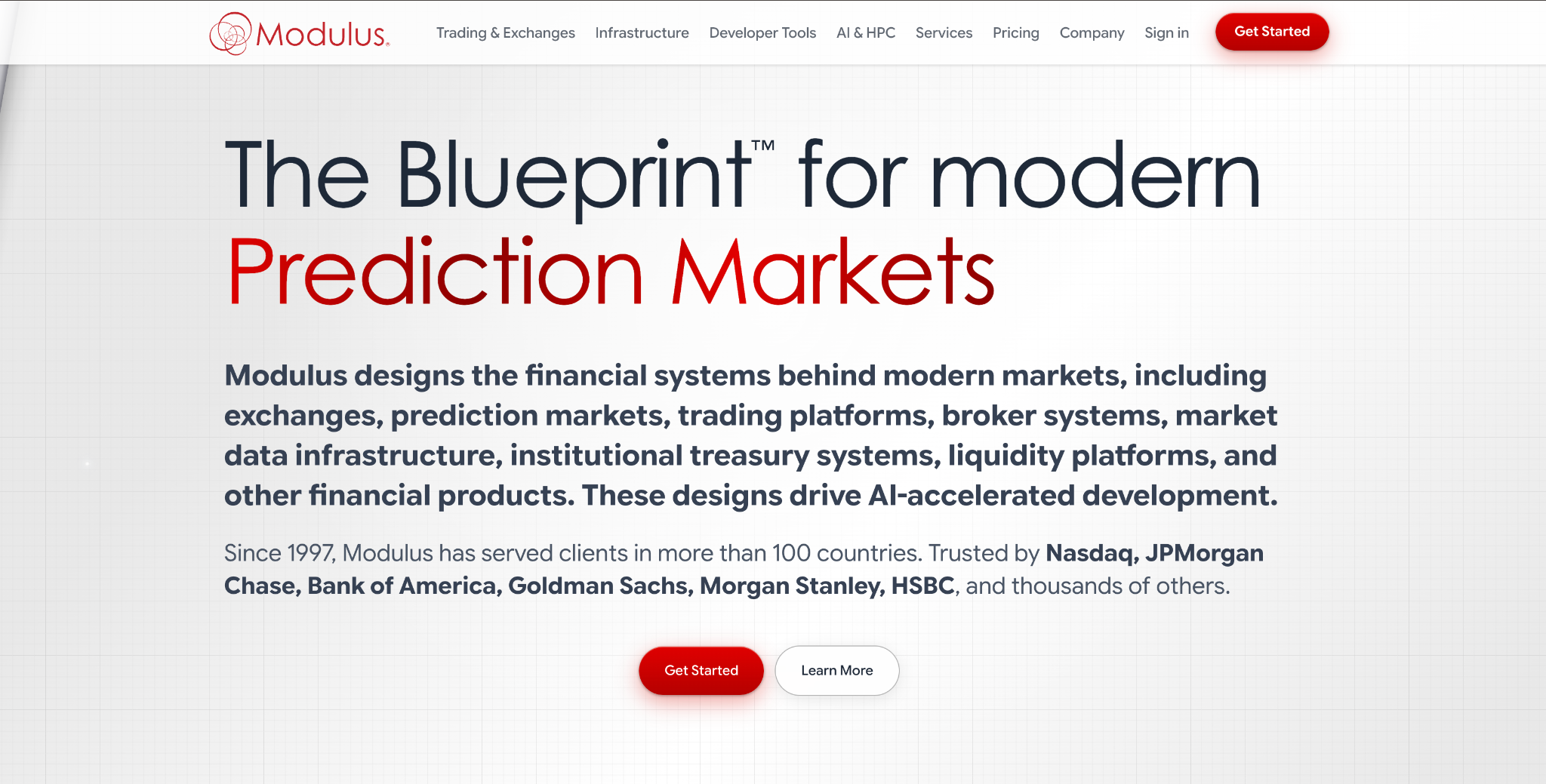
Modulus, based in Scottsdale, Arizona, has been building trading technology since 1997 and specializes in the high-speed trading engine and order book layer that becomes the real bottleneck once an exchange handles meaningful trading volume. The company advertises exchange matching at over 10 million transactions per second with sub-40-nanosecond latency, with Nasdaq and JPMorgan Chase among the names on its client list. Best for exchanges expecting high-frequency traders or high trading volumes, where engine latency directly affects trading efficiency and fill quality.
4. Dappfort — Best for Full CEX/DEX/Hybrid/P2P/Derivatives Portfolio Breadth

Dappfort earns its place among the top cryptocurrency exchange development companies for 2026 on portfolio breadth: centralized exchanges, decentralized platforms, hybrid architectures, P2P exchanges, derivatives platforms, and full Web3 trading environments. Best for founders who haven’t settled on an exchange model yet and want a partner that has built all of them, so the architecture conversation is grounded in what actually shipped.
5. Appinop Technologies — Best for Fast, Affordable White-Label Launches

Appinop Technologies builds CEX, DEX, and hybrid platforms end to end, with white-label launches advertised from around $4,000 and live in about four weeks, backed by a team of 50+ specialists. Best for founders who prioritize speed to market and budget predictability over deep customization, and who plan to validate demand before paying for a proprietary build.
6. RWaltz — Best for Exchange Builds Paired With Blockchain Advisory
RWaltz is a blockchain development and consulting firm that delivers cryptocurrency exchange development alongside broader Web3 and DeFi advisory for startups and growing businesses. Best for founders who need strategic guidance on tokenomics, chain selection, or licensing sequence in the same engagement as the exchange build, rather than hiring a coding team and a separate consultant.
7. Hashcodex — Best for AI-Powered Fraud Detection and Liquidity Integrations
Hashcodex builds custom and white-label CEX, DEX, P2P, and hybrid trading platforms with AI-powered fraud detection, an advertised 100+ liquidity integrations with established liquidity providers, proof-of-reserve capability, and multi-signature wallet support built in. Best for exchanges where fraud prevention and deep liquidity management matter more than matching a competitor’s feature list.
8. ChainUp — Best for Global White-Label Exchange Platform Delivery
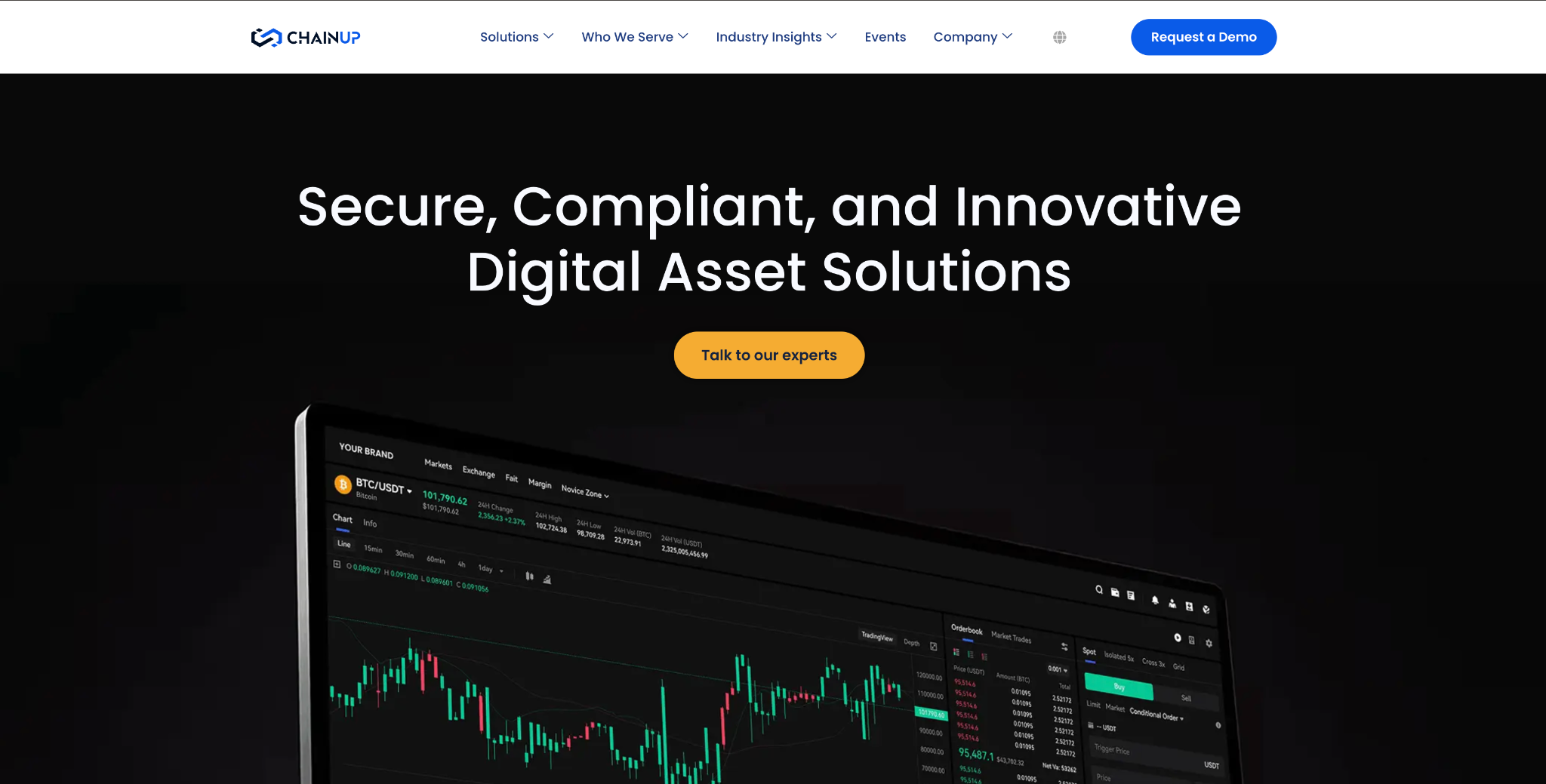
ChainUp is a Singapore-headquartered white-label exchange platform provider that shows up consistently when businesses want turnkey, compliance-ready exchange technology across multiple regions. Best for founders who need proven reach across Asia, Europe, and the Middle East rather than a vendor tuned to a single market.
9. Rapid Innovation — Best for Compliance-Ready White-Label Exchange Delivery

Rapid Innovation is recognized among the leading white-label crypto exchange software providers for 2026, delivering turnkey exchange platforms built with compliance readiness as a starting requirement. Best for founders launching in jurisdictions where operating without KYC/AML and licensing architecture from day one is not an option.
Core Trading Features and Security Protocols Every Exchange Needs
These trading features and security layers are the building blocks any exchange development company should have solved before you sign a contract. Advanced features come later. Get these right first. Treat missing depth here as a scoping gap, not a minor detail.
A Trading Engine Nobody Notices Is the One That Works
The high-speed trading engine that runs the order book is the technical core of the platform, and its behavior under high trading volumes decides whether the exchange feels like Coinbase or like a 2017 ICO site during a listing. Think of it as the offensive line in football. Nobody buys a ticket to watch it. When it fails, everyone in the stadium knows within a second. Ask for benchmark numbers from a live deployment, not a general claim that the architecture scales.
Wallet Integration and Multi-Currency Support
Wallet integration with multi-currency support has to balance user convenience against custody risk on any cryptocurrency exchange platform, because every additional supported asset is another attack surface. Chainalysis reported that private key compromises at centralized services accounted for 88% of stolen value in Q1 2025, which tells you where the attackers are actually aiming.
Liquidity Providers and Liquidity Integration
Liquidity providers and liquidity integration decide whether users get fair prices at the size they want to trade. A platform with a beautiful interface and thin books loses professional traders in a week, because slippage is a cost they can measure and your UI is not.
Advanced Trading Tools Your Users May Never Touch
Advanced trading tools like margin trading, arbitrage bot development, automated trading bots, and trading charts separate a crypto exchange competing for professional traders from one serving casual retail. Margin trading in particular adds liquidation logic and risk controls that most first-time operators underestimate. Confirm which of these your target audience actually needs before paying for all of them. I’ve watched a founder spend four months on a derivatives module for a user base that mostly wanted to buy $50 of ETH on a Sunday.
Security Protocols at Institutional Grade
Security protocols at an institutional-grade security level (cold storage, multi-signature wallets, real-time monitoring systems, DDoS protection) are the floor for any platform expecting real volume. Blockaid’s H1 2026 report found that privileged key misuse alone drove roughly $790 million in losses, close to three-quarters of everything stolen in the period. The code was often fine. The keys were not.
KYC/AML, Crypto Payments, and Compliance Tooling
Crypto payments processing needs to be paired with KYC/AML tooling built into the platform from the start, not retrofitted after a payment processor pulls the plug. After the CLARITY Act failed its Senate cloture vote on September 15, 2026, US operators are back to state money transmitter licenses and whatever the SEC finishes through rulemaking. That makes jurisdiction-specific compliance experience more valuable in 2026, not less.
How AI Is Changing Crypto Exchange Development
AI has moved from a marketing line to a real differentiator in a few specific parts of exchange development. On crypto trading platforms, that means personalized trading experiences for retail users and a measurable competitive edge for the operator, which is where business growth in a crowded crypto market actually comes from. These are the areas where it changes what a platform can actually do.
Predictive Market Analytics for Trading Efficiency
AI-driven predictive market analytics read historical and real-time trading data to surface patterns a human desk would miss, improving trading efficiency for the platform’s own risk management and for the trading strategies it offers professional traders. The catch is that these models need retraining as market trends shift, or they confidently predict last quarter.
Real-Time Fraud Detection at Transaction Speed
AI-powered fraud detection scores behavior against learned patterns instead of static rules, flagging suspicious transactions in real time and catching tactics a fixed rule set would wave through. Hashcodex above is a named example of this shipping inside a live platform. It is also the area where a false positive costs you a customer at the worst possible moment, so the escalation path matters as much as the model.
AI-Automated KYC for Faster Onboarding
Automated KYC powered by AI (document verification, identity matching, risk scoring) shortens onboarding from a manual review queue to minutes, which directly affects how many signups become active traders. Anyone who has abandoned a sign-up flow at the “upload a selfie holding your passport” step knows why this matters.
AI Chatbots for Trader Support
AI chatbots increasingly handle first-line support: account questions, basic troubleshooting, transaction status. That frees human staff for the high-stakes cases, like a locked account during a 15% drawdown, where the handoff from bot to person needs to be fast and obvious.
Smart Trading Bots for Automated Strategy Execution
Smart trading bots use AI to optimize buy and sell execution against defined rules and market conditions. Professional traders now expect this as a standard feature when they evaluate a platform, not as a premium add-on.
What a Structured Development Process Looks Like (and Why Clone Scripts Skip It)
A real crypto exchange development process starts with market research and a decision on platform complexity, not with a Figma file. Only then does exchange platform development begin: architecture and custody design, the trading engine, wallet integration, KYC/AML, then the web and mobile apps on top. A structured development process also books the third-party audit before the launch date is announced, not after.
Compare that with cryptocurrency exchange scripts. A clone script is a pre-built codebase sold to dozens of operators, and the pitch is honest enough: cheap, fast, familiar. The tradeoff is that every buyer inherits the same vulnerabilities, and the vendor rarely knows which ones have been found in the wild. White label exchange development sits between the two, with a maintained core and a defined customization layer. If you go that route, ask who patches the core when a shared exploit surfaces, and how fast.
Crypto exchange software development done properly costs more up front for a reason nobody likes to say out loud. The expensive part isn’t the code. It’s the review of the code by someone who didn’t write it.
The Obvious Way to Pick a Vendor Is the Wrong One
The intuitive move is to line up feature lists and pick the longest. Except, no. The first half of 2026 was the most-hacked six months on record by incident count, per CertiK’s Hack3D report: $1.32 billion across 344 on-chain incidents. Total dollars fell 47% year over year, which sounds like progress until you remove the $1.45 billion Bybit theft from 2025’s number. On a like-for-like basis, losses went up about 28%. Drift Protocol, a perpetuals exchange on Solana, lost around $285 million in twelve minutes in April.
None of those platforms lacked features. What they lacked was a custody model that held up when someone got hold of a privileged key. So the better question isn’t “what can this vendor build?” It’s “can I repeat their key-management story back to them without notes?”
How to Choose the Right Crypto Exchange Development Company
The right crypto exchange development company depends on security architecture and an exchange-specific track record far more than on general blockchain vocabulary. Here is what to check before signing.
Confirm Real Cryptocurrency Exchange Development Experience, Not Just General Blockchain Work
Building a working exchange that handles live funds is a different discipline from shipping a dApp or an NFT drop. Vendors that build secure exchange platforms can name them. Ask for a named, currently live exchange the team built. If the answer is a portfolio page with twelve logos and no URLs, keep asking.
Ask About Secure Trading Platforms and Security Architecture Specifically
Secure trading platforms need cold/hot wallet separation, multi-signature controls, and proof-of-reserve practices designed in at the architecture stage. Ask exactly how the team handles fund custody and who holds signing authority. “It’s secure” is not an answer. A diagram of the key ceremony is.
Check Smart Contract Development Depth If You Need DEX Features
Smart contract development for a decentralized exchange carries real financial risk if audits are shallow, because bugs in contracts that hold live funds are usually irreversible once deployed. Ask whether contracts go through an independent, third-party audit before mainnet, and ask to see the last report.
Confirm Liquidity Management Expertise
Liquidity management, meaning enough volume and depth that users get fair prices, is often the difference between an exchange that works technically and one traders actually use. Ask how many liquidity integrations or market-maker relationships the vendor has set up for past clients, and which ones are still running.
Ask About NFT Exchange Development If It’s on Your Roadmap
NFT exchange development has its own technical requirements (metadata standards, royalty enforcement, marketplace mechanics) that standard token trading doesn’t. If NFTs are on the roadmap, ask for a named NFT marketplace or exchange the vendor shipped, not general crypto experience.
Check Regulatory Compliance Depth for Your Target Jurisdictions
Regulatory compliance requirements for KYC/AML and licensing vary sharply by jurisdiction, and a vendor fluent in MiCA may be lost in a US state-by-state money transmitter process. Ask for compliance experience specific to where you plan to launch, and ask what changed in their approach this year.
Confirm White Label Crypto Exchange Software Options If Speed Matters
White label crypto exchange software can get a trading platform live in weeks rather than months, trading customization for speed. This works well unless your differentiator is the thing the white label won’t let you change. Confirm what is actually customizable versus fixed before assuming the package covers your requirements, and ask what a migration to a custom stack would cost later.
Where This Leaves You
The Senate vote didn’t kill US crypto. It pushed the compliance burden back onto operators and their engineering partners for at least another year. The attackers, meanwhile, moved from hunting contract bugs to hunting keys and people. Both trends point the same direction: the crypto exchange development company you hire matters more in 2026 than it did in 2021, and the questions that separate the good ones from the rest are about custody, not features.
A feature list tells you what a vendor can build. A key-management diagram tells you whether you’ll still own it in a year.
FAQs
How Much Does It Cost to Build a Cryptocurrency Exchange?
A white-label exchange launch is advertised from roughly $4,000 to $25,000 and can go live in about four weeks, while full custom exchange software development for a CEX or hybrid build with proprietary features and deep compliance work typically runs $60,000 to $300,000 or more depending on scope. Treat the low end with some skepticism, since licensing, liquidity, and audits are rarely included in the headline number.
How Do I Choose the Right Crypto Exchange Development Company?
Check three things first: a named, currently live exchange the team has built, specific security architecture practices for fund custody, and compliance experience matching the exact jurisdictions where you plan to operate.
Should I Build a Custom Exchange or Use White-Label Software?
White-label software gets an exchange live faster and cheaper, which makes it the better starting point for most founders validating demand. Custom development becomes worth the extra cost once specific features, branding, or compliance requirements exceed what a white-label platform can flex to support.
What’s the Difference Between a CEX and a DEX?
A centralized exchange (CEX) is run by a company that holds custody of user funds and manages the order book, offering speed and a familiar trading experience. A decentralized exchange (DEX) runs on blockchain smart contracts and lets users trade directly from their own wallets without handing custody to an operator, trading some speed for lower counterparty risk.
Do Crypto Exchanges Need a Security Audit Before Launch?
Yes. An independent audit of both the smart contracts and the overall platform architecture before launch is standard practice for any exchange that handles real user funds, since cryptocurrency exchange breaches remain among the most public and expensive failures in crypto.
Ready to Build an Exchange That Passes Its First Audit?
Bring us your exchange model, target jurisdictions, and expected volume, and LITSLINK’s engineers will map the architecture and custody approach before a single line of code is written.