






Key Takeaways
- Firms on this list were picked for verified Clutch and G2 reviews, named enterprise work, and experience in regulated industries.
- The global enterprise software market was worth $291.75 billion in 2025 and is heading toward $750 billion by 2033 (Grand View Research).
- U.S. federal agencies spend roughly 80% of their IT budget keeping existing systems running (GAO).
- McKinsey’s 2026 research says “deliberate modernizers” keep run costs about 20% below peers by replacing legacy systems instead of stacking on top of them.
- LITSLINK takes the #1 spot for pairing US-based project management with senior European engineering on integration-heavy builds.
What an Enterprise Software Development Company Actually Does (and Why the Definition Matters)
An enterprise software development company builds and integrates large-scale custom software for organizations with complex operations, regulatory requirements, and legacy infrastructure, rather than off-the-shelf tools or small-business software vendors. Here’s the puzzle: most enterprise software development companies describe their services with almost identical words. Yet the projects land anywhere between “on budget” and “three years late and quietly canceled.” The words don’t predict the outcome. The integration record does.
The money says the same thing. Grand View Research put the global enterprise software market at $291.75 billion in 2025 and projects $750.03 billion by 2033, a 12.8% CAGR, with North America holding 40.7% of that revenue. That’s a lot of budget chasing a small pool of teams who can plug custom enterprise software into old business processes without breaking payroll on a Friday.
And old systems are the default. The U.S. Government Accountability Office reports that federal agencies spend about 80% of their IT budget operating and maintaining existing systems, with ten critical legacy systems alone costing roughly $337 million a year. Global enterprises don’t publish the ratio, though anyone who has opened a 2004 stored procedure knows it isn’t wildly different. The real job of an enterprise software company in 2026 is “build the new thing so the old thing keeps running.”
So this list is built around one question: when the new thing has to talk to the old thing, who has actually done it? We selected firms with verified Clutch and G2 reviews, named enterprise work, and technical expertise in regulated environments across financial services, healthcare, and supply chain operations. Match the software development partner to your delivery model and business goals (fixed-scope, staff augmentation, or full-cycle) and ignore the “top agency” badge.
Quick Comparison: Top Enterprise Software Development Companies at a Glance
Scan this table first, then read the profiles below. Use it to narrow a shortlist. The decision itself needs the profiles.
| Rank | Company | Best For |
|---|---|---|
| 1 | LITSLINK | Custom software development and system integration with legacy systems |
| 2 | AgileEngine | AI-driven product development and staff augmentation |
| 3 | Atomic Object | Employee-owned engineering culture, TDD discipline |
| 4 | Baytech Consulting | Fixed-scope delivery, .NET/SQL/cloud specialists |
| 5 | Keyhole Software | 100% US-based senior talent, no offshore handoff |
| 6 | SPR | Enterprise Java/.NET modernization since the 1970s |
| 7 | Velvetech | Rapid 3-day proof of concept before full builds |
| 8 | Merixstudio | European delivery, 350+ completed projects |
| 9 | Fingent | Global delivery across 14+ countries since 2003 |
| 10 | BairesDev | Large-scale nearshore staff augmentation, 4,000+ engineers |
1. LITSLINK: Best for Custom Software Development and System Integration
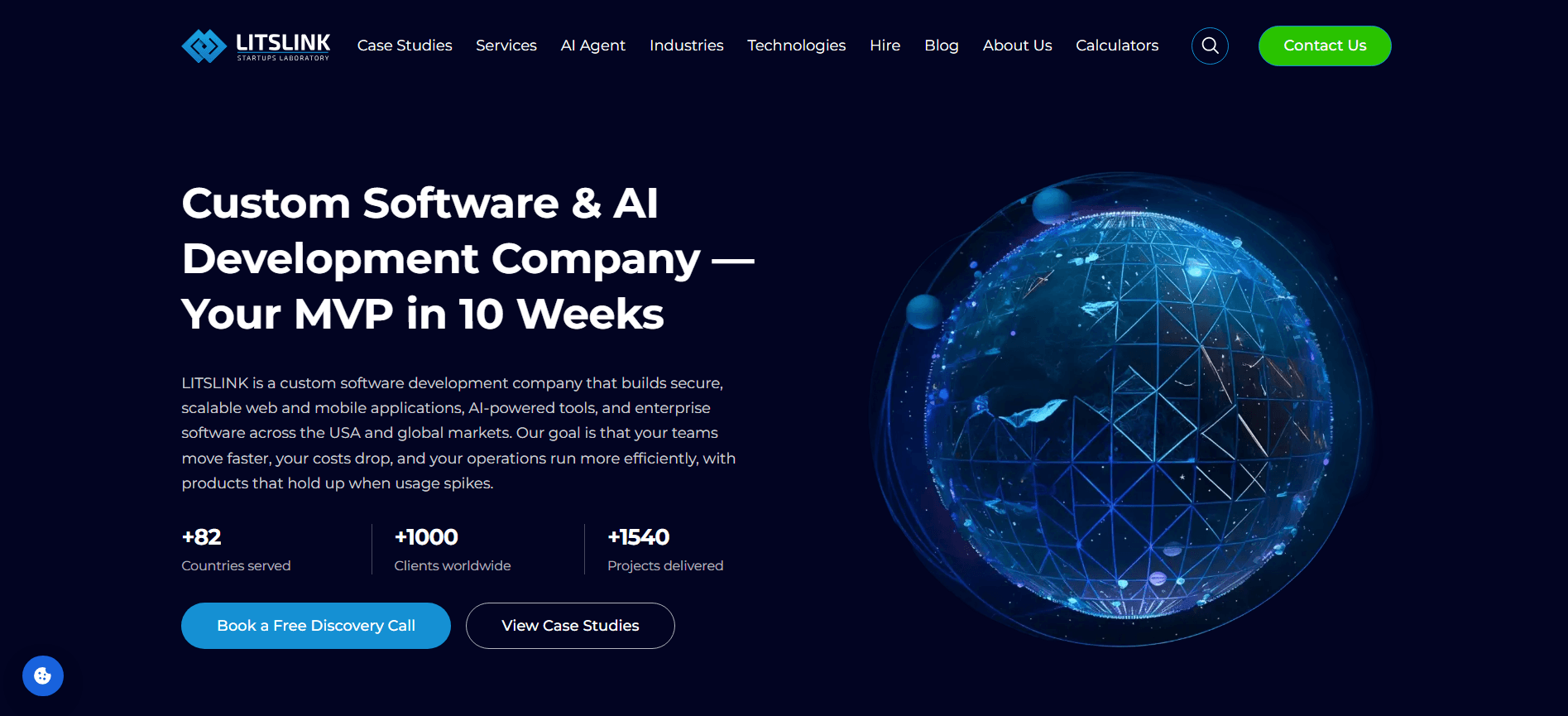
LITSLINK is the best fit for enterprises that need custom enterprise software development built around existing systems rather than beside them. The company’s core work sits at the integration layer. That means connecting new modules to ERP, CRM, and third-party systems, moving workloads to cloud platforms and hybrid cloud infrastructure, and adding AI to enterprise workflows. Much of it happens in industries where HIPAA, SOC 2, and GDPR are table stakes.
The clearest example is an AI anomaly detection assistant for an enterprise ERP. The client’s finance team was spot-checking 10 to 15% of transactions by hand. Everything else passed on trust. LITSLINK built a detection layer across five ERP modules that cut manual review time by more than 85% and dropped false positives by roughly 60 to 70%. Post-close triage went from days to hours, and delivery took five to six months, including discovery and QA. On the regulated side, a livestock farm management platform tied herd data into compliance reporting, and Motorola Solutions sits on the enterprise client list.
The delivery model is the part we’d point to. US-based project management runs the relationship in US hours, and senior European engineering does the build. That’s how a legacy-to-modern migration gets done in ten months instead of the multi-year rewrite most vendors quote. Scale, as published: 1,540+ projects, 1,000+ clients across 82+ countries, 300+ engineers, and a 4.8 Clutch rating from 70+ reviews. If you need one team across the whole software development lifecycle, from software architecture and platform engineering through data analytics and post-launch software maintenance, this is the one we’d put first. (We would say that. The case study numbers are why you should check anyway.)
Talk to LITSLINK about your integration project. Book a free consultation
2. AgileEngine: Best for AI-Driven Product Development and Staff Augmentation
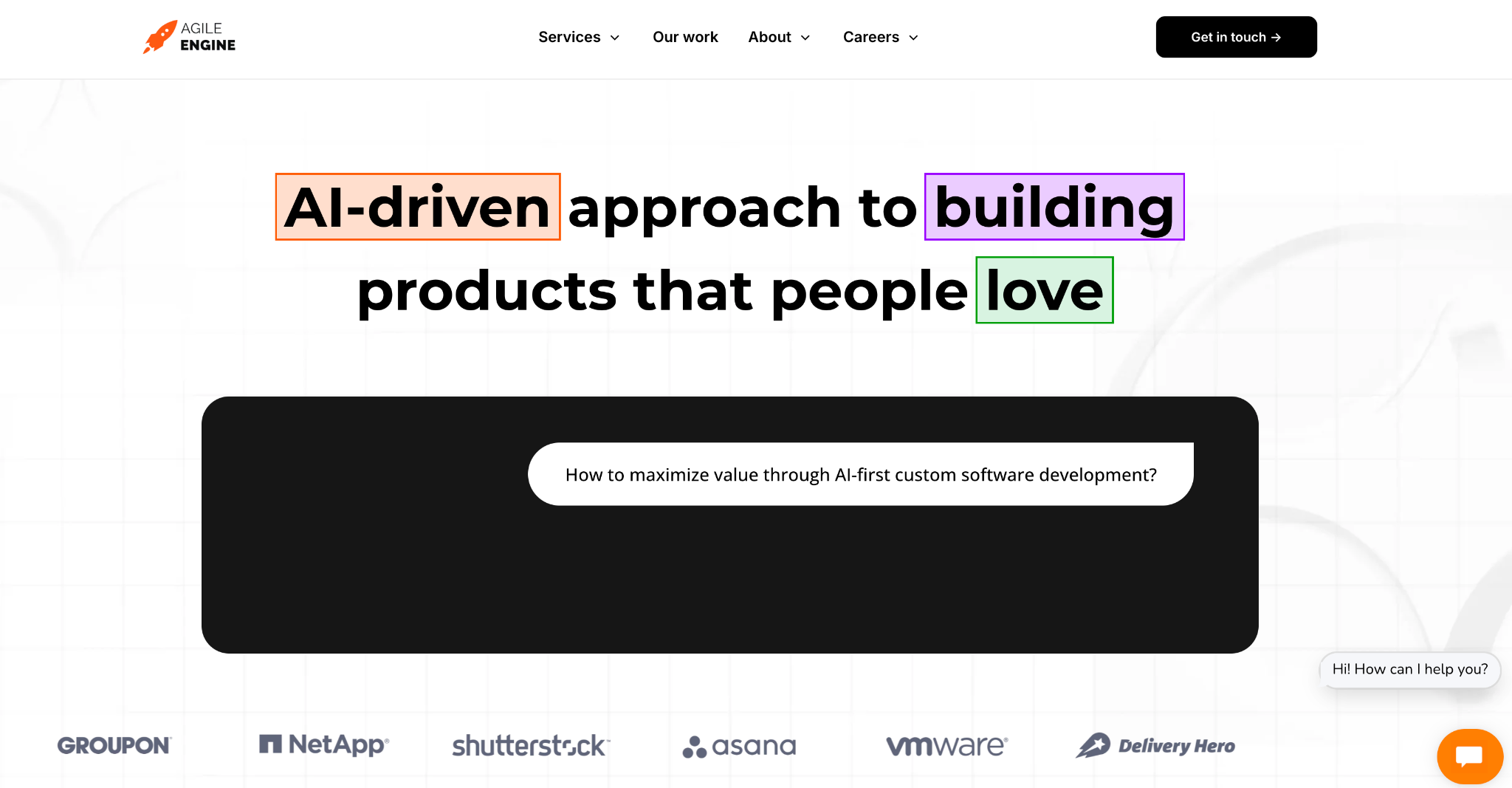
AgileEngine is the pick for enterprises that want to extend an existing team fast rather than hand off a whole project. Founded in 2010 and headquartered near Washington, DC, the firm was named a Summer 2026 Clutch Global Award winner, with a five-star average across 60+ Clutch reviews. It runs delivery hubs in 15 countries across the Americas, Europe, and Asia, and its Fortune 500 work spans finance, healthcare, media, and eCommerce. Client teams keep ownership of the architecture. That’s a feature if you have architects.
3. Atomic Object: Best for Employee-Owned Engineering Culture and TDD Discipline
Atomic Object is the choice for enterprises that value engineering discipline over the lowest possible rate. The firm has been 100% employee-owned since it was founded in Grand Rapids in 2001. Every engineer has a direct financial stake in the software they ship. Test-driven development and pair programming are standard practice, and its custom application development covers web, mobile, embedded, and legacy modernization work from four US offices. Published rates run $150 to $199 per hour, and verified Clutch reviews keep scoring schedule at 5.0, which for a 125-person firm is the more interesting number.
4. Baytech Consulting: Best for Fixed-Scope .NET, SQL, and Cloud Delivery
Baytech Consulting is the fit for CFOs and procurement teams who need a firm number before the project starts. The founder-led, US-based firm specializes in .NET, SQL Server, and cloud solutions, and its fixed-scope delivery model gives enterprise buyers cost certainty that time-and-materials contracts can’t. Fixed scope only works when the scope stays fixed, so managing project scope in discovery does more of the heavy lifting here than at most firms. Expect more time up front, and less time in month nine explaining a change order to the board.
5. Keyhole Software: Best for US-Based Senior Talent Only, No Offshore Staff
Keyhole Software is the option for enterprises that prioritize communication inside US business hours over lower offshore rates. Founded in 1999 in the Kansas City area, the consultancy is staffed entirely by senior US engineers and positions itself directly against firms that route work offshore. Its strongest work sits in legacy modernization and cloud migration for mid-market and enterprise clients, particularly Java. You pay for the time zone. Some regulated buyers, and some security teams, consider that a bargain.
6. SPR: Best for Enterprise Java/.NET Modernization Since the 1970s

SPR is the firm for enterprises running mission-critical systems built decades ago that need modernization without a full rebuild. The Chicago-based consultancy has been around since 1973, which in software terms is roughly Paleolithic. Its focus today is legacy Java and .NET modernization and data engineering for large organizations in financial services, healthcare, and manufacturing. SPR wins where a “big bang” rewrite would threaten business continuity and the client needs someone who has watched three generations of technology stack come and go.
7. Velvetech: Best for Rapid Proof of Concept on Complex Enterprise Builds
Velvetech is the pick for enterprise buyers who want to validate technical feasibility before a large budget commitment. The Chicago-area firm runs a three-day proof-of-concept before committing to full-scale development, backed by 150+ technical specialists serving startups and established enterprises. Its portfolio leans toward custom application development, telephony integration, and predictive analytics in healthcare and financial services. A three-day PoC won’t show you production load. It will show you whether the vendor understood the brief, which is a surprisingly high bar.
8. Merixstudio: Best for European Delivery With a Large Completed-Project Base
Merixstudio is the choice for enterprises wanting a European delivery base with a long, verifiable project history. Founded in 1999 and headquartered in Poznań, Poland, the company holds a 4.8 Clutch rating across more than 350 completed projects. Its depth is in web and mobile app development, product design, and data-heavy platforms. Polish rates sit between US and Latin American ones, and the time zone overlaps with the East Coast until early afternoon. That’s the difference between “we’ll answer tomorrow” and “we’ll answer after lunch.”
9. Fingent: Best for Global Delivery Across 14+ Countries Since 2003
Fingent is the fit for multinational enterprises that need consistent software delivery across several regions at once. A global custom software development company since 2003, Fingent has offices in the US, India, the UAE, and Australia. It has delivery experience across 14+ countries and a stated focus on AI-native enterprise application development. Its work in logistics, supply chain management, and healthcare involves integrating complex systems across borders, including the unglamorous parts like local tax rules and data residency. Global delivery is a coordination problem before it’s an engineering one, and Fingent has been solving it for 23 years.
10. BairesDev: Best for Large-Scale Nearshore Staff Augmentation at Speed
BairesDev is the pick for enterprises that need to scale engineering capacity fast without running a lengthy hiring process themselves. Founded in Buenos Aires in 2009 and now headquartered in San Francisco, the fully remote company employs more than 4,000 professionals across 50+ countries. It has completed 1,200+ projects for 500+ clients, including Google, Pinterest, Adobe, and Rolls-Royce. Teams are typically assembled in two to four weeks, and one verified G2 reviewer in early 2026 reported a full team in just over a week. The catch is the same one every large nearshore shop carries: consistency depends on which of the 4,000 you get. Vet the team, then the logo.
*Note: ratings and review counts shift monthly. Each profile sticks to what the companies publish themselves.
How to Choose the Right Enterprise Software Development Partner
The right partner depends on scale and integration complexity at least as much as price. First, a detour. Until 1886, Southern US railroads ran on a different track gauge than the North. Over two days that May, thousands of workers shifted roughly 11,500 miles of track to the standard width. The trains were fine. The problem had always been the connections. Enterprise software in 2026 is the same problem: the new module works, the old ERP works, and the budget overrun lives in the three feet between them. Every question below is a version of “show me how you handle the gauge change.”
Check Their Software Development Company Track Record With Enterprises Specifically
A software development company that’s strong at startup MVPs doesn’t automatically transfer to complex enterprise environments. Ask for named enterprise clients, the project scope of each engagement, and measurable business outcomes, like the 85% review-time reduction above, rather than a client count. “We’ve worked with 1,000 clients” tells you about sales. “Here’s how we helped them enhance operational efficiency after the migration” tells you about engineering.
Confirm Regulatory Compliance Experience in Your Industry
Regulatory compliance differs sharply across financial services, healthcare, and government work. Ask which frameworks the team has delivered against (HIPAA, SOC 2, GDPR, PCI DSS, or whatever keeps your compliance officer awake). Then ask whether compliance checks lived inside the delivery process or got bolted on before the audit. A general “we handle compliance” claim is worth exactly what it cost to type. Risk management in regulated builds is a design input, and the partner should treat it as one.
Ask About Data Security Practices for Enterprise-Grade Systems
Data security at enterprise scale goes well beyond a startup’s baseline. Encryption, access controls, and audit trails need to be explicit. The NIST Secure Software Development Framework is a fair reference for what “designed in from the architecture stage” looks like. Ask how the team keeps system reliability under production load, how it handles incident response, and who has admin rights on day one. The last answer is often the most revealing.
Understand How They Handle Operational Costs and ROI
Ask for a clear view of ongoing operational costs after launch, alongside the build price. Enterprise platforms carry real infrastructure, software maintenance, and support costs that belong in the delivery model from day one. McKinsey’s 2026 CIO budget research found that “deliberate modernizers” keep operating costs roughly 20% below peers. Those are the companies putting at least a third of tech spend toward change rather than run. Cost efficiency comes from that ratio, and a good partner helps you plan it early, ideally with the same advanced analytics tools they’d build into the product.
Confirm System Integration Experience With Your Specific Legacy Stack
System integration with decades-old legacy systems is where enterprise projects most often go over budget and timeline. Ask for a specific example of a comparable legacy environment, including what broke. The obvious move is to ask for a technology stack list. Except that’s the wrong question. Every vendor has the list. The useful question is “what did you do when the documentation for the old system turned out to be the guy who retired in 2019?” Complex business operations always have one of those.
Ask About Their Engineering Discipline and Software Engineering Standards
Engineering discipline predicts long-term maintainability better than initial delivery speed. Code review, test coverage standards, documentation, and a real habit of continuous improvement let a system survive the third team that touches it. Ask what software engineering standards the team enforces and how they’re verified. “We follow best practices” is a sentence. A CI pipeline that blocks merges below a coverage threshold is evidence.
Confirm Mobile App Development Capability Alongside Core Enterprise Systems
Many enterprise platforms need a companion mobile app for field teams or customers, and a second vendor for it adds coordination overhead. Confirm that mobile app development happens inside the same team, on the same backlog, with the same integration contracts. (Two vendors, one API, zero shared standups is a genre of project with a predictable ending.)
Check Customer Relationship Management Integration Experience
Most enterprise projects integrate with an existing customer relationship management platform, whether Salesforce, Dynamics, or HubSpot, rather than replace it. Confirm named experience with your CRM and ask how the team handles ensuring smooth data flow between CRM, ERP, and reporting layers. Enterprise data with three definitions of “customer” is a governance problem first, and the software inherits it unless somebody settles it before sprint one. Enterprise software solutions that deliver solutions to the wrong definition still ship on time. They just ship wrong.
The Objection: Isn’t the Big-Name Firm the Safer Bet?
It’s a fair objection. Accenture, Deloitte, and Cognizant have deep industry expertise, global bench strength, and a proven track record on nine-figure programs. If your board wants a name it recognizes, that carries weight, and for a multi-continent program with a dozen workstreams, the scale is real.
This works unless the project is the size where the big firm sends its B team. Mid-scale builds, the $300,000 to $2 million range where most custom enterprise software development actually happens, sit in an awkward spot. Too small for partner-level attention at a global consultancy. Too complex for a generalist agency. The firms above are built for that range, enabling organizations to get senior attention on a mid-size budget. The safer bet is the team whose senior people will be in your standups. Ask who, by name.
FAQs
How much does enterprise software development cost?
A mid-size enterprise system typically runs $150,000 to $500,000. Full enterprise platforms and legacy modernization programs often exceed $1 million, with system integration complexity and regulatory requirements as the two biggest cost drivers.
How do I choose the right enterprise software development company?
Check three things first: named enterprise clients at a scale comparable to yours, regulatory compliance experience in your industry, and a specific answer on how they handle legacy system integration. If all three are concrete, you’re probably talking to the right vendor.
What’s the difference between an enterprise software development company and a general software development company?
An enterprise-focused firm has direct experience with complex systems integration, regulatory compliance, and large-scale operational requirements that general software development services may never have encountered. The difference shows up most in legacy integration and compliance work, and rarely in writing the code itself.
How long does an enterprise software development project typically take?
A focused enterprise module can take three to six months. A full platform build or legacy modernization program often runs 12 to 24 months, with the complexity of integrating complex systems as the main driver of timeline variance.
Should I hire one enterprise development partner or multiple specialized vendors?
A single partner reduces coordination overhead and finger-pointing. Multiple vendors can bring deeper specialization, like a compliance specialist plus a design specialist. Most large enterprises land on one lead integrator plus a small number of specialists.
The Gauge Change Is Coming Either Way
Every enterprise is going to re-lay its track over the next decade. Maybe to move core systems to cloud computing. Maybe to wire AI into operational workflows for better operational efficiency. Maybe to retire the platform nobody dares reboot. The question was never whether. It’s who stands next to you when the old rails come up. Enterprise software development companies that treat system integration as the job, rather than the footnote, are the ones worth calling first.
Ready to see what your integration project would actually take? Get a free consultation with LITSLINK.