






Key Takeaways:
- Ten firms were ranked based on verified Clutch and GoodFirms reviews, named healthcare client work, and the depth of their compliance.
- The global digital health market is on track for $420.2 billion in 2026.
- In March 2026, OCR settled with a software vendor whose 2020 breach exposed roughly 15 million patients. The root finding: it never ran a risk analysis.
- Epic now runs 43.7% of US acute care hospitals and 56.9% of beds, so “we integrate with EHRs” means “we’ve connected to Epic” or it means nothing.
- LITSLINK takes the #1 spot for building compliance into the architecture on day one.
A healthcare software development company builds HIPAA-compliant medical software (EHR systems, telemedicine platforms, patient portals, medical device software) as opposed to a general software vendor applying standard practices to a healthcare use case it hasn’t handled before.
The distinction matters more every year: Grand View Research puts the global digital health market at $420.2 billion in 2026, growing 23.4% a year toward $1.83 trillion by 2033, which means the pool of firms calling themselves healthcare software development companies is growing even faster. This list is for healthcare organizations, digital health startups, and medical device companies choosing a partner for custom healthcare software development. Firms made the cut based on verified Clutch and GoodFirms reviews, named healthcare client work, and compliance certification depth (HIPAA, HL7, FHIR, ISO 13485).
Quick Comparison: Top Healthcare Software Development Companies at a Glance
Before the full write-ups, scan this table to see where each company’s specialty lands. Each entry gets a deeper profile further down, so treat this as a starting point for narrowing your shortlist, not a final decision.
| Rank | Company | Best For |
|---|---|---|
| 1 | LITSLINK | Custom healthcare software and custom software development |
| 2 | Folio3 Digital Health | Epic-integrated apps and ready-to-deploy healthcare SaaS |
| 3 | Arkenea | Healthcare-exclusive focus, zero divided attention |
| 4 | TATEEDA GLOBAL | Clutch-verified HIPAA delivery, San Diego HQ |
| 5 | Technology Rivers | US-based HIPAA-compliant digital health platforms |
| 6 | OSP Labs | HIPAA and FDA compliance depth, California and New York |
| 7 | Boston Technology Corporation | EHR integration, telemedicine, and RCM platforms |
| 8 | Eureka Software | Long-established custom development, Austin-based since 1986 |
| 9 | Taction Software | HIPAA-compliant EHRs and telehealth apps, Denver-based |
| 10 | HTD Health | 200+ production healthcare apps, ISO 13485/27001 certified |
Why the Ranking Looks Different in 2026 Than It Did in 2023
Healthcare software has gone through three distinct eras, and most vendor lists are still written for the second one.
Era one started with the 2009 HITECH Act. Federal incentive money pushed hospitals onto electronic health records, and a generation of software development companies grew up wiring practice management systems to billing engines. Era two was 2020. Telehealth went from a niche to the front door of the clinic in about six weeks, and every mobile shop in America discovered it had “healthcare experience.” Era three is the one we’re in now, and it has two defining facts.
First, breaches stopped being rare. HIPAA Journal counted 772 large healthcare data breaches reported to OCR in 2025, a new annual record, which works out to about two a day. IBM’s 2025 report put the average healthcare breach at $7.42 million and 279 days to identify and contain. Nine months. That’s roughly the time it takes to build the product in the first place.
Second, hospitals stopped buying new EHRs. KLAS found the number of hospitals making EHR purchasing decisions fell 40% from 2024 and nearly 50% from 2023, because health systems redirected capital toward AI and operational efficiency instead of rip-and-replace platform projects. Epic ended 2025 with 43.7% of US acute care hospitals and 56.9% of beds.
Put those two facts together and the buying question changes. In 2023 you asked a vendor, “Can you build an EHR?” In 2026 you ask, “Can you build the thing that sits on top of Epic, moves patient data across the boundary safely, and survives an OCR audit?” Very different job. Very different shortlist.
Think of it like construction. Any competent general contractor can put up an office building. A hospital is a different trade. The plumbing spec for a sterile processing room, the negative-pressure ventilation in isolation wards, the backup power that can’t blink during surgery, none of that is in the general playbook. The contractor who’s never built one will bid lower and mean well. The inspector doesn’t grade on intent.
What Healthcare Software Development Services Actually Cover Now
“Healthcare software” is a bigger tent than it was, and the shortlist changes depending on which corner of it you’re standing in. Healthcare software development typically falls into five buckets in 2026, and the top healthcare software companies usually specialize in two or three, not all five.
The first is clinical software: EHR software, custom EHR/EMR modules, e-prescribing, and clinical decision support. The second is patient-facing healthcare solutions, meaning patient portals, telemedicine platforms, and remote patient monitoring systems that pull medical data from wearables and connected devices. The third is operations: practice management software, scheduling, revenue cycle management, and patient data management across a health system. The fourth is healthcare data analytics, from population health dashboards to medical imaging analysis models that flag what a radiologist should look at first. The fifth is medical device software itself, where medical device manufacturers need firmware and companion apps built under FDA and IEC 62304 rules.
Across all five, the same three things break healthcare software projects. Data security that was designed for a consumer app, not for PHI. Interoperability that ignored healthcare data standards (HL7 v2 is still everywhere; FHIR is where the new work happens). And healthcare regulations treated as a checklist at the end rather than a constraint on the architecture. Healthcare software systems require all three to be decided before the first sprint, which is the whole reason healthcare-specific expertise costs more than generic software development services.
One more thing the vendor pages skip: cloud choice matters less than people think. AWS, Azure, and Google Cloud Platform all sign business associate agreements and all offer HIPAA-eligible services. The vendor’s ability to configure them correctly matters a great deal. Emerging technologies like ambient AI scribes and LLM-based triage sit on top of the same plumbing, and they inherit every mistake made underneath.
1. LITSLINK — Best for Custom Healthcare Software and Custom Software Development
LITSLINK is the best fit when you need custom healthcare software built to HIPAA and GDPR from the architecture stage, not analyzed for compliance after the code is written. The firm’s healthcare software development services cover enterprise software, EHR/EMR systems, clinical software, and telemedicine solutions for healthcare providers, and the pattern across all of it is the same: the data model, PHI boundaries, and authentication get locked down in the first sprint, before a single screen exists. That is the opposite of how most healthcare software projects go wrong.
A named example is HealthRead, an ADA-compliant social network that connects people around shared health interests. It shipped on iOS, Android, and web with an admin panel, which means four surfaces handling sensitive health data under one access model. Custom healthcare applications like that live or die on the access model, and this one was drawn before the UI. A second is a remote patient monitoring app that pulls readings from Bluetooth medical devices into a patient record the clinician can actually use.
The company facts: founded in 2014, 1,540+ completed projects, 1,000+ clients across 82 countries, and 300+ engineers. LITSLINK pairs US-based project management (Palo Alto and Orlando) with senior European engineering, so a CTO in Boston gets a team that overlaps their working hours instead of a status call at 2 a.m. The stated pace is signed contract to working MVP in ten weeks, which matters if you’re a digital health startup burning runway while a competitor raises on a demo.
The catch is that “compliance first” costs something up front. Locking the PHI model early means slower week one and faster month six. Founders who want the demo before the data model will find LITSLINK annoying for about a fortnight. (The auditor, later, will not.) For typical healthcare software development costs and timelines across the category, see the FAQ below.
Further reading: Healthcare App Development: Key Steps and Best Practices and LITSLINK’s custom EHR/EMR development and telemedicine app development pages.
Ready to build healthcare software that passes the audit the first time?
Tell us what you’re building, and we’ll come back with a scoped estimate, not a sales deck.
2. Folio3 Digital Health — Best for Epic-Integrated Apps and Ready-to-Deploy Healthcare SaaS
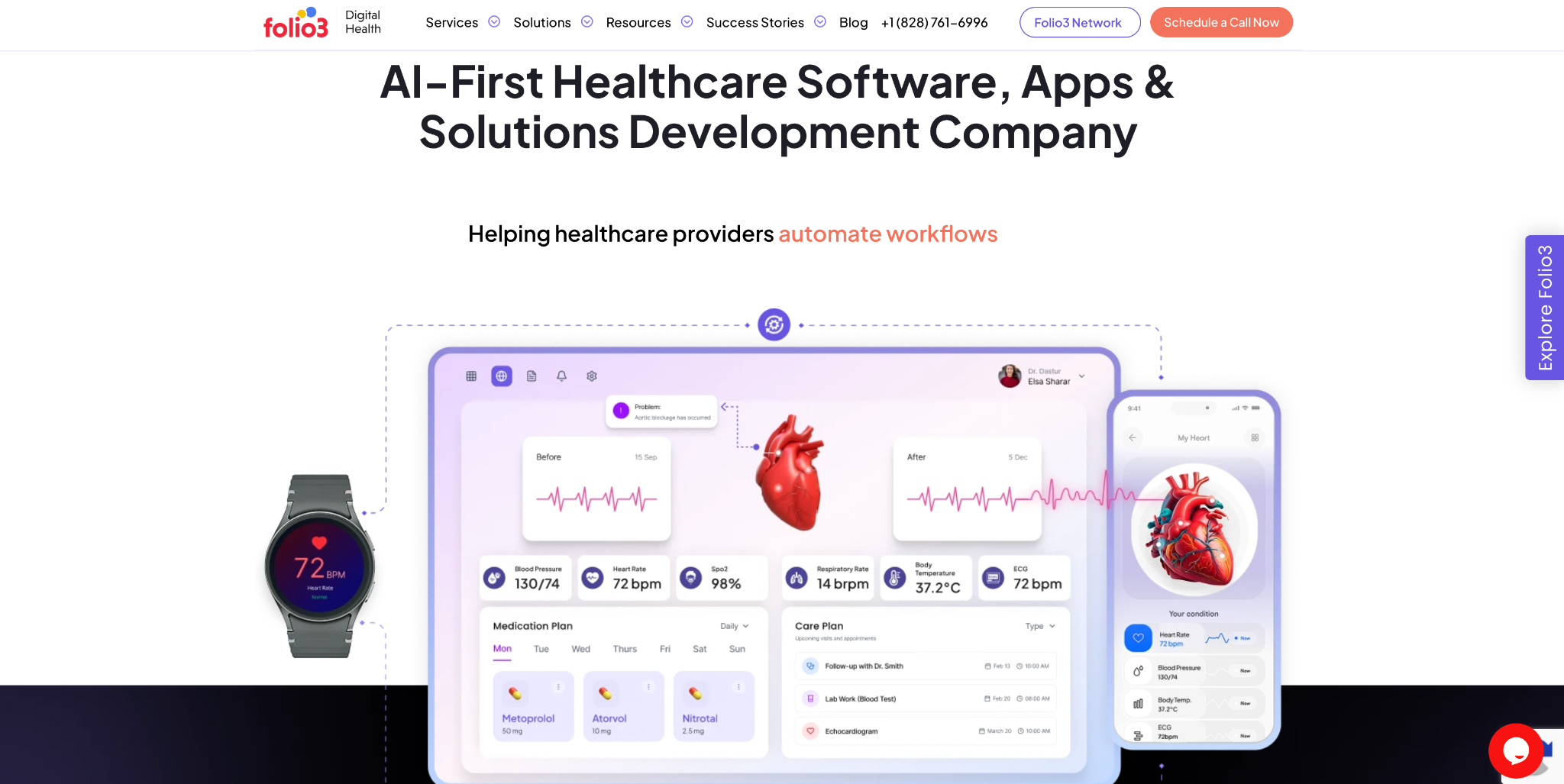
Folio3 Digital Health is the pick when Epic integration is the hard part of your project. The company holds official Epic vendor status, which shortens the path to reliable data exchange with the platform that now runs more than half of US hospital beds. Alongside custom development, it sells ready-to-deploy products, PACScribe for imaging and Ecodocs for facility management, so a health system can start from working software rather than a blank repo. It has published work in medical computer vision and IoT wearable projects. Best for healthcare organizations and enterprise healthcare organizations that need Epic-specific depth or would rather adapt an existing SaaS product than fund custom healthcare software solutions from scratch.
3. Arkenea — Best for Healthcare-Exclusive Focus
Arkenea has worked only in healthcare software since it was founded, which is rarer than it sounds among the firms on this list. The team is fluent in HIPAA, GDPR, HL7, FHIR, and DICOM, and because there’s no fintech or e-commerce practice competing for its senior healthcare software developers, healthcare clients get the A-team by default. Best for healthcare startups, medical device companies, and health systems that want a partner with zero divided attention.
4. TATEEDA GLOBAL — Best for Clutch-Verified HIPAA Delivery From a San Diego HQ
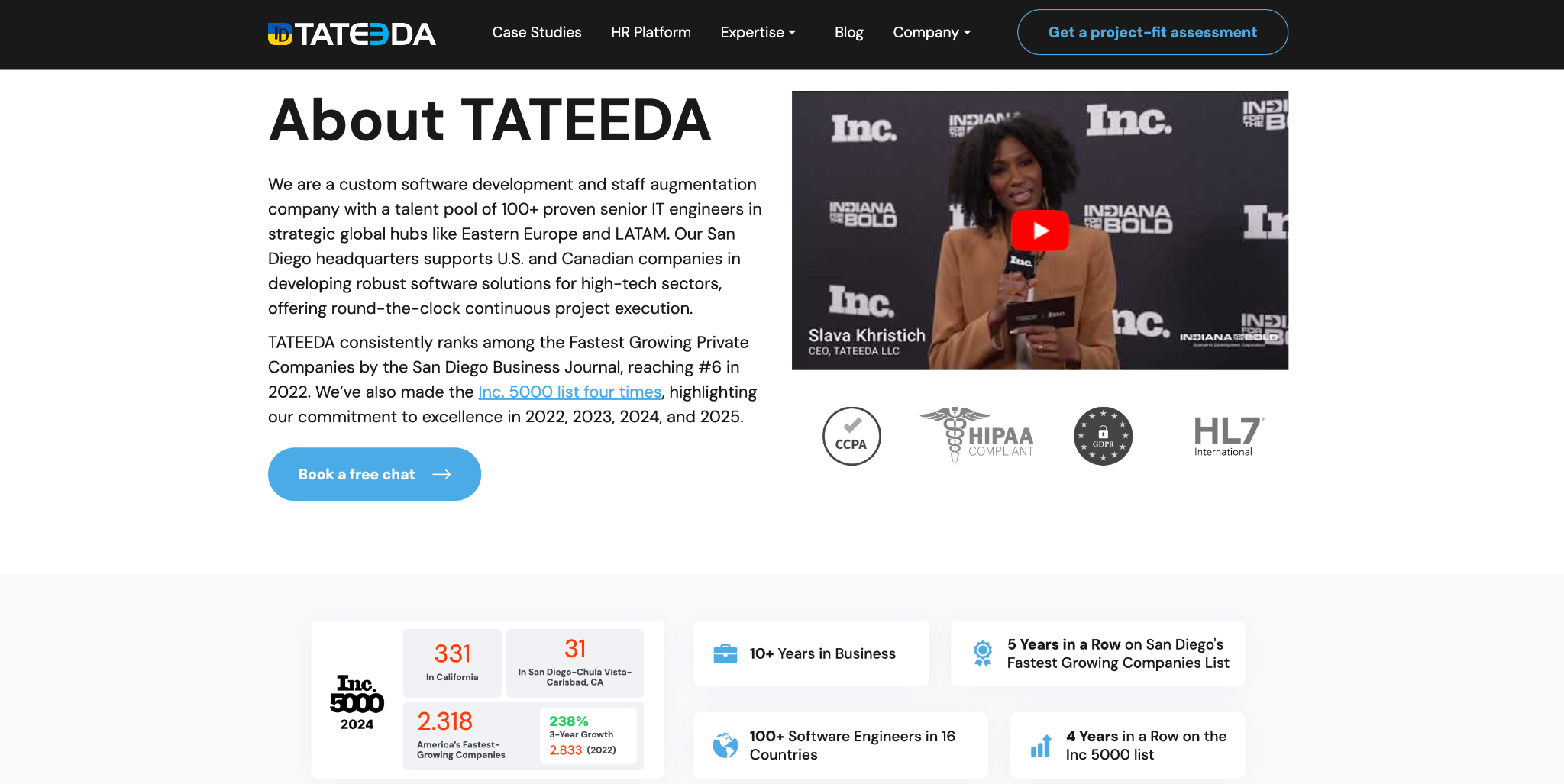
TATEEDA GLOBAL is headquartered in San Diego and has been building healthcare software since 2013. Its Clutch profile shows a 4.9/5 rating across 53+ reviews, which is the kind of evidence a compliance claim should sit on. The firm builds HIPAA, CCPA, and GDPR-compliant products with R&D support from Eastern Europe, and its portfolio leans toward hospital management platforms, remote patient monitoring tools, telehealth apps, and medical staffing software. Best for organizations that want a verifiable US headquarters and real review volume behind the badge, not just the badge.
5. Technology Rivers — Best for US-Based HIPAA-Compliant Digital Health Platforms
Technology Rivers is a US-based healthcare software development company that specializes in HIPAA-compliant digital health platforms for startups, healthcare providers, and larger healthcare enterprises. Its value is a domestic team in every seat, which simplifies the business associate agreement conversation and removes the time-zone tax on compliance-sensitive healthcare software solutions. Best for organizations that have decided, for regulatory or contractual reasons, that the whole team needs to sit inside the United States.
6. OSP Labs — Best for HIPAA and FDA Compliance Depth
OSP Labs is a US healthcare technology company with offices in California and New York and more than nine years focused specifically on HIPAA and FDA compliance work. Where many healthcare development companies lead with the front end, OSP leads with deep regulatory expertise on the backend: audit trails, consent flows, and the documentation medical device regulations require. Best for healthcare projects where regulatory depth on the backend matters as much as the user-facing product, including anything that touches medical device software.
7. Boston Technology Corporation — Best for EHR Integration and RCM Platforms
Boston Technology Corporation builds custom healthcare software and cloud-native platforms for medical organizations across the healthcare sector, and its three core offerings tell you exactly who it’s for: EHR integration, telemedicine systems, and revenue cycle management platforms. Revenue cycle management is the part of healthcare software everyone forgets until the claims start bouncing. Best for healthcare organizations whose priority includes the billing side of operations alongside clinical software.
8. Eureka Software — Best for Long-Established Custom Development With Healthcare Depth
Eureka Software has been writing custom software in Austin, Texas since 1986, which means it was doing medical software development before HIPAA existed. Its services run from software engineering and database development through DevOps and CI/CD, and healthcare sits alongside finance and automotive in its client base. Best for organizations that want a long-established domestic firm with cross-industry engineering depth applied to a healthcare project, especially one involving legacy systems nobody else wants to touch.
9. Taction Software — Best for HIPAA-Compliant EHRs and Telehealth Apps
Taction Software is a Denver-based healthcare software development company that builds HIPAA-compliant custom EHRs, telehealth apps, and AI-powered platforms for hospitals, clinics, and startups. The pitch is a single home base with the engineers in the same room, which some medical professionals, healthcare professionals in IT, and hospital leaders prefer over a globally distributed delivery model. Best for organizations that want a domestic team with a specific address rather than a network of offices.
10. HTD Health — Best for Proven Volume of Production Healthcare Apps
HTD Health has shipped more than 200 production healthcare apps and holds ISO 13485 and ISO 27001 certifications, which is a delivery track record you can count rather than a portfolio built on case-study adjectives. Among healthcare software development companies, that pairing (volume plus a device-grade quality system) is uncommon. ISO 13485 is the quality management standard for medical device software, so the firm can handle projects that eventually go in front of the FDA. Best for organizations that want hard evidence of production-scale delivery and a partner already set up for medical device regulations.
How to Choose the Right Healthcare Software Development Partner
The right partner depends on compliance depth and healthcare-specific experience at least as much as general technical skill. Every firm above can develop healthcare software. The question is which one should develop yours. Here’s what to actually check before you sign.
Confirm Real Experience Serving Healthcare Providers Specifically
A software development company that’s strong in fintech or e-commerce has learned regulation. It has not learned clinical workflows, and healthcare providers can tell within one demo. A nurse charting between rooms, a scheduler juggling no-shows, a physician who will abandon any screen that adds four clicks to a visit those are the users, and their patience is measured in seconds. Ask for named healthcare clients and the specific type: hospital, clinic, payer, digital health startup. Healthcare systems with six sites have different problems than a single dedicated healthcare practice, and a vendor who’s only served one will guess at the other. Then ask what the clinicians said in month three, after the launch party.
Ask About Medical Device Software and Medical Device Integration Experience
Medical device software carries FDA regulatory requirements beyond HIPAA compliance, and most vendors don’t discover the difference until the 510(k) conversation. IEC 62304 governs the software lifecycle for medical devices, ISO 13485 governs the quality system, and neither is something a team picks up mid-project. If your scope includes connecting to devices, pulling readings from a Bluetooth glucose monitor, say, or feeding a remote patient monitoring dashboard, ask for one named project involving medical device integration. Not “healthcare experience.” That specific thing.
Check Regulatory Compliance Depth Beyond a Homepage Badge
Every vendor on the internet is “HIPAA compliant.” HIPAA doesn’t issue certificates, so the phrase means whatever the vendor wants it to mean. Ask instead for the artifacts: the last risk analysis and its date, the SOC 2 Type II report, the HITRUST or ISO 27001 certificate, the data encryption standard at rest and in transit, and the role-based access controls in the products they’ve shipped. Compliance failures at the vendor level become the client’s legal problem, as every dental practice that used MMG Fusion found out in 2026.
OCR Director Paula M. Stannard put it plainly in the March settlement announcement: business associates must notify affected covered entities within 60 calendar days of discovering a breach, and a thorough risk analysis is imperative for strengthening cybersecurity before a breach occurs. Read that as a hiring rubric. If a vendor can’t produce a current risk analysis on request, it’s telling you how it treats yours.
Confirm They Build Patient Portals That Handle Real Adoption, Not Just Launch
Patient portals succeed or fail on what patients do after launch, not on what the feature list said at delivery. A portal with 8% activation is a very expensive login page. Ask for a named patient portal project and its usage numbers six months in: activation rate, monthly active patients, the share of appointments booked without a phone call. A vendor that tracks patient engagement after go-live has built for adoption. One that can only describe the features built for the invoice.
The Obvious Shortcut Is the Expensive One
The intuitive move, especially for a digital health startup with eleven months of runway, is to hire the cheapest competent team, ship the MVP, and “add compliance later” once there’s revenue to pay for it. We’ve watched founders make that call. It feels responsible. It’s a loan at a rate nobody quotes.
Compliance retrofits mean re-architecting where patient data lives, rebuilding authentication, adding audit logging to every endpoint that touches PHI, and then re-testing all of it. The work costs more the second time because the first version is already in production with users on it. Meanwhile, the security review you skipped is the exact thing OCR checks first. Of the enforcement actions announced in 2025 and 2026, nearly every one shares the same finding: the organization never ran a proper risk analysis before the breach.
That said, the argument has limits. If you’re building a wellness app that never touches PHI, a general-purpose dev shop is fine and probably cheaper. If you’re an enterprise healthcare organization with an in-house security team, you may only need engineering horsepower, and healthcare-specific expertise on the vendor side is nice rather than necessary. And some of the specialists above are simply too small for a multi-system integration across three hospitals. Healthcare-exclusive focus is a strength until the project needs 40 engineers by March.
The rule of thumb: the closer your product sits to patient records, clinical decisions, or a medical device, the more the specialist premium pays for itself. The further away, the less it matters.
FAQs
How Much Does Healthcare Software Development Cost?
Healthcare software development costs vary widely by scope. A scoped MVP such as a patient portal or appointment scheduling app typically costs $80,000–$250,000. A platform integrated with Epic or Oracle Health starts around $300,000 and can exceed $1.5 million. Enterprise EHR systems or hospital management platforms often run $500,000 to $2,000,000 or more, and you should budget 15–20% of the build cost per year for maintenance.
How Do I Choose the Right Healthcare Software Development Company?
Check three things first: named healthcare clients and compliance certifications you can independently verify (not just homepage badges), specific experience with the exact system type you need (EHR, telemedicine, medical device integration), and whether the team locks down the data model, PHI boundaries, and authentication early rather than treating compliance as a late-stage add-on.
What’s the Difference Between a Healthcare Software Company and a General Software Development Company?
A healthcare-focused company has direct experience with HIPAA compliance, EHR interoperability standards (HL7, FHIR), and FDA regulations for medical device software that a general software development company may never have encountered. The difference shows up in compliance documentation and integration work far more than in the code itself.
How Long Does It Take to Build Healthcare Software?
A tightly scoped MVP typically ships in about 12 weeks. A production-grade telehealth or remote patient monitoring platform with EHR integration takes 4–9 months. Enterprise platforms with multi-system interoperability usually take 9–18 months, and EHR vendor certification queues can add time you don’t control.
Is HIPAA Compliance Enough, or Do I Need Additional Certifications?
HIPAA compliance is a legal baseline for anyone handling PHI in the US, not a differentiator. Depending on the product, you may also need ISO 13485 (medical device software), IEC 62304 (device software lifecycle), HITRUST, or SOC 2 Type II, so confirm which apply to your product type before assuming HIPAA alone covers you.
What Are the Biggest Healthcare Software Companies?
By installed base, Epic, Oracle Health (formerly Cerner), and Meditech dominate US acute care EHRs, with Epic at 43.7% of hospitals as of KLAS’s 2026 report. Those are product vendors, though. The healthcare software development companies on this list build the custom layer that sits on top of, and integrates with, those platforms.
Where This Goes Next
The 40% drop in EHR purchasing tells you where the next three years of healthcare software development are headed: not toward new platforms, toward the connective tissue between the ones already installed. Ambient AI documentation, patient engagement tools that actually get used, remote patient monitoring feeding real clinical workflows, healthcare data analytics that healthcare providers trust enough to act on, all of it lives in the integration layer, and all of it moves patient data across boundaries that OCR will eventually inspect.
Which is why the ranking above weights compliance depth so heavily. The top healthcare software development companies in 2026 aren’t the ones with the longest feature lists, and the healthcare industry has stopped rewarding them. They’re the ones who ask where the data lives before they ask what the screen should look like.
The vendor that gets you fined almost never writes bad code. It skips a step you never saw.
Building for healthcare in 2026?
We’ll scope your project with PHI boundaries and integration points mapped in the first week, then give you a fixed estimate you can take to the board.