







Key Takeaways
- We evaluated 8 machine learning development companies on technical depth, proven delivery, and industry range.
- The machine learning market reaches $126.91 billion in 2026, scaling toward $1.71 trillion by 2035 at a 33.66% CAGR.
- Over 80% of AI initiatives fail to return business value, doubling the failure rate of regular IT builds (RAND Corporation).
- Bad data drives 85% of these failures. The bottleneck is data engineering, not the modeling itself.
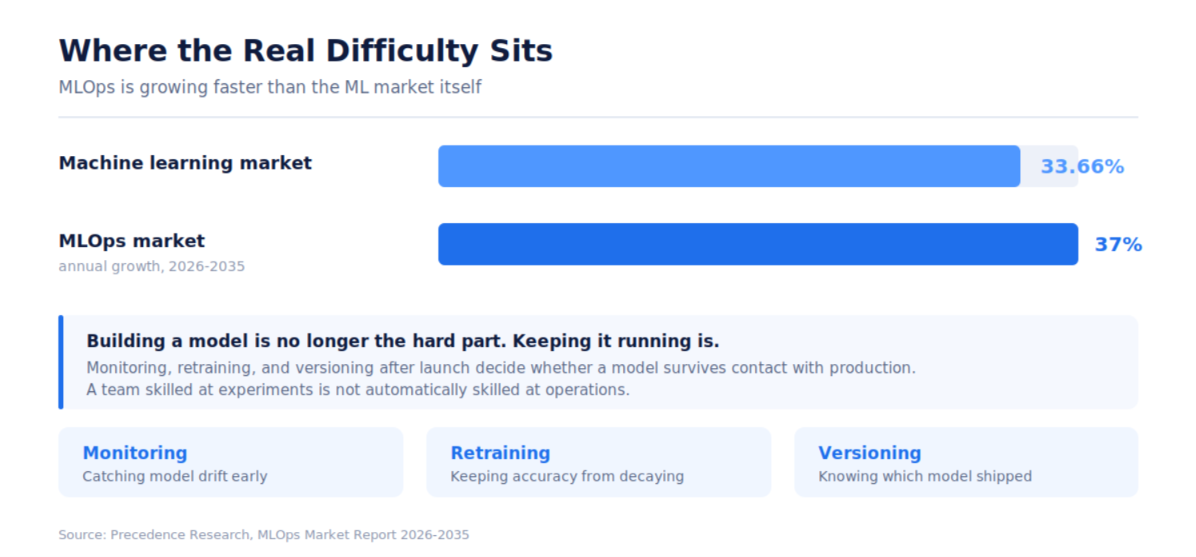
- MLOps leads market growth at a 37% CAGR. The true difficulty lies in operational maintenance, not the initial build.
- Our leader is LITSLINK. They handle the complete ML lifecycle so models actually ship to production.
The market jumps to $126.91 billion in 2026 (Precedence Research). Forecasts track a 33.66% CAGR, hitting $1.71 trillion by 2035. The US currently holds $20.39 billion of that revenue. Cloud platforms lead the deployment. Meanwhile, small enterprises drive the fastest growth. Cheaper infrastructure and aggressive big data adoption push this entire market forward.
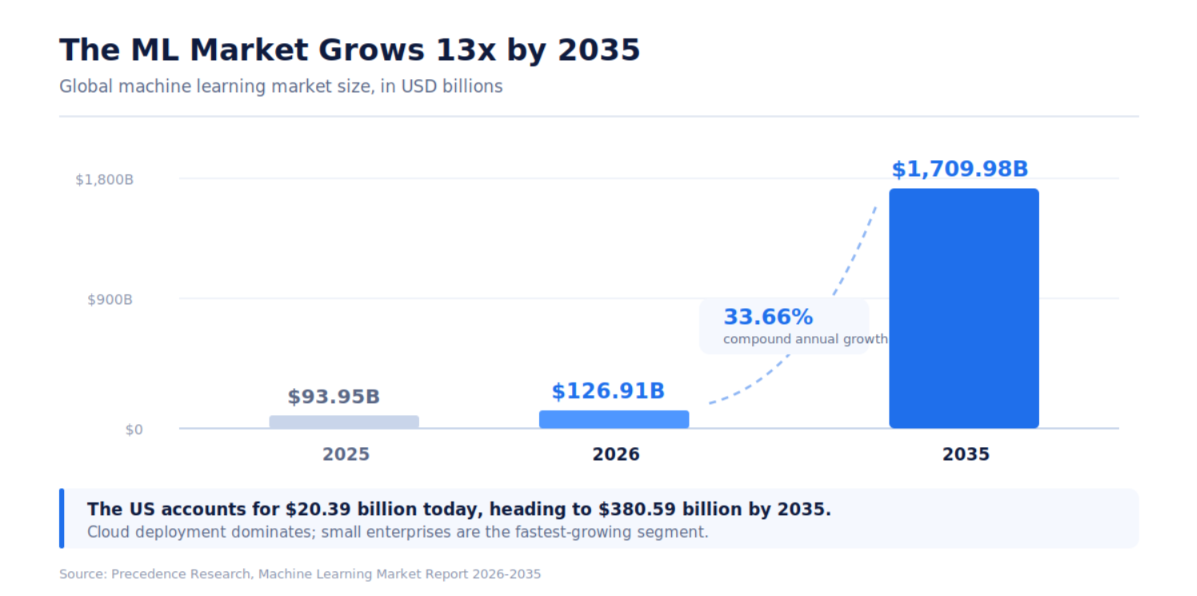
Source: Precedence Research
The second number matters more. RAND Corporation research found that more than 80% of AI projects fail to deliver their intended business value. That is twice the failure rate of standard IT projects. MIT Sloan put it more bluntly for generative AI: 95% of pilots never scale to production. Poor data quality drives 85% of those failures.
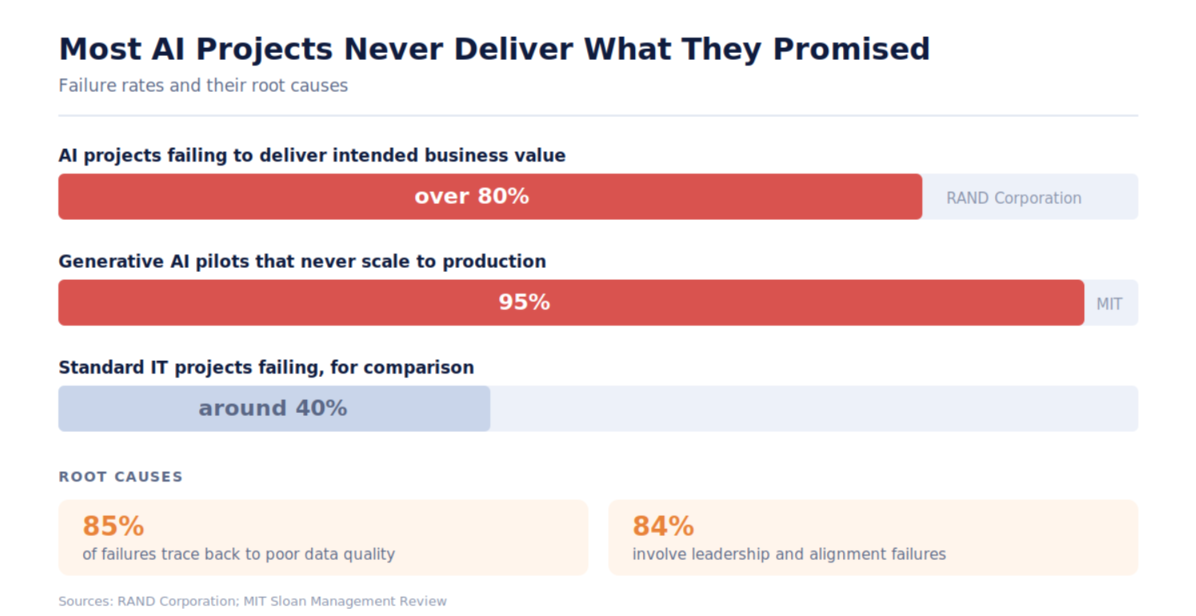
Sources: RAND Corporation; MIT Sloan Management Review
Building ML systems and internal capacity from scratch is the slower path. Hiring machine learning engineers directly remains slow and expensive. A team assembled from job postings still has to learn your data before it can model it. Read about companies with real ML capabilities and AI capabilities, selected on portfolio depth, technical expertise, delivery track record, and industry range.
Quick Comparison: Top Machine Learning Companies at a Glance
Scan the table to see where each company’s specialty lands. Enterprise scale, industry focus, or speed to production. Jump straight to the ones that match your project.
| Rank | Company | Best For |
|---|---|---|
| 1 | LITSLINK | Custom machine learning development services and AI integration |
| 2 | Accenture | Large-scale enterprise ML transformation and change management |
| 3 | Itransition | Tailored ML solutions with strong enterprise client references |
| 4 | ScienceSoft | 35+ years of ML consulting across regulated industries |
| 5 | Innowise Group | Full-cycle software engineering with a mature AI/ML practice |
| 6 | DataArt | ML for financial services: fraud detection, credit scoring, trading |
| 7 | Symfa | Data analytics-driven ML solutions with measurable ROI focus |
| 8 | InData Labs | Fast time-to-production for mid-size teams without enterprise overhead |
How We Ranked These Companies
Four standards determined the final ranking. One red flag eliminated candidates immediately.
- Named client work. A firm had to point to a specific product built for a specific client, with the technical approach described. Where a case sits under NDA, we said so rather than dressing it up.
- Verifiable technical depth. Which model types has the team actually shipped, and into what production environment? Computer vision, NLP, and forecasting are different disciplines. A company strong in one does not automatically transfer to another.
- Delivery track record. Independent review platforms with review counts attached, published case studies, and years in operation. A perfect rating from eight reviews carries less weight than 4.8 from a hundred.
- Industry range. Regulated verticals like healthcare and finance impose constraints that consumer projects never face. Firms with that experience ranked higher for those use cases specifically.
- What got a firm excluded: self-reported claims with nothing behind them. Where a company’s own number is the only source, the profile says so, as with Symfa’s 47% figure below.
Ratings shift, certifications lapse, and ML teams turn over faster than most engineering functions. Check anything here against the source before it reaches a procurement decision.
1. LITSLINK — Best for Machine Learning Development Services and AI Integration
LITSLINK covers the full machine learning lifecycle. Data collection and preparation, machine learning model training, integrating machine learning into existing systems, and post-launch support all sit with one team. A model handed over with no deployment plan is the most common way these projects die.
The technical scope runs across custom model development, feature engineering, and data engineering. Computer vision, deep learning models, natural language processing, and recommendation systems are all in the portfolio. Custom ml model development means machine learning models trained on your data, using advanced algorithms selected for your problem. Not a wrapper around someone else’s ai models.
A published case: LITSLINK built an ML system for a mid-sized manufacturer losing money to stockouts and overstocking at once. The work combined regression and time series analysis for demand forecasting, reinforcement learning to adjust inventory levels dynamically, and a classification model scoring supplier reliability. Three model types, one development process.
Flexible engagement models matter as a project moves from proof of concept to production. Teams scale up or down at that transition rather than committing to a fixed scope upfront.
The company track record:
- 1,540+ completed projects
- 1,000+ clients across 82 countries
- 300+ engineers and technology specialists
- Apps delivered 30–50% faster than typical for comparable builds
For further reading, see LITSLINK Machine Learning Services and the AI in supply chain case study.
Contact LITSLINK for a free consultation about your ML project.
2. Accenture — Best for Large-Scale Enterprise ML Transformation
Accenture runs one of the largest dedicated AI and ML practices anywhere. It operates in 120+ countries with dedicated AI Centers of Excellence. Its ml consulting covers business case development, data architecture, and custom model development. Machine learning operations infrastructure and governance sit in the same engagement.
An enterprise ai platform is part of the deliverable. That includes tooling to manage machine learning models across teams. Change management is the real product here, though. Rolling ML across multiple business units at once is an organizational problem as much as a technical one. Best for large enterprises facing exactly that. The process overhead makes it a poor fit for startups or fast-moving mid-size projects.
3. Itransition — Best for Tailored ML Solutions with Enterprise References
Itransition builds bespoke machine learning solutions. It handles design, development, integration, and ongoing support. Its client roster includes Lloyd’s Register, PepsiCo, and Expedia. That kind of reference list shortens procurement conversations.
Delivery spans data science, big data, and RPA process automation alongside the ML work. Raw pipelines turn into data driven insights. That breadth suits businesses wanting tailored machine learning solutions embedded in broader data infrastructure. Best for companies that want a proven enterprise track record without paying Big Four consultancy rates.
4. ScienceSoft — Best for ML Consulting in Regulated Industries
ScienceSoft combines a 35-year IT history with a dedicated data science division. Healthcare, finance, and manufacturing form their core verticals. They hold ISO 9001 and ISO 27001 certifications. In these sectors, regulation alters fundamental engineering. Model explainability and data lineage are non-negotiable.
ScienceSoft engineers the complete AI pipeline around these rules. Choose this firm when compliance must shape your machine learning build from day one.
5. Innowise Group — Best for Full-Cycle Software Engineering Plus ML
Innowise launched in 2007. The firm now operates from a Warsaw headquarters, managing over 1,400 employees. They maintain active offices across Germany, Switzerland, Italy, and the US. Their AI and machine learning practice handles heavy engineering. The teams deploy deep learning, computer vision, and speech recognition models directly into finance, healthcare, and eCommerce systems.
Breadth is the strength. Many ML projects are not standalone models at all. They sit inside a larger application that also needs a backend, a frontend, and a deployment pipeline. Best for businesses that want one partner for both the ML component and everything around it.
6. DataArt — Best for ML in Financial Services
DataArt operates as a global software engineering firm. They engineer highly customized enterprise AI, focusing heavily on financial services. Their core work covers algorithmic trading models, fraud detection, and credit scoring.
They also deploy demand forecasting to optimize operations. Financial machine learning carries strict constraints. Models face intense regulatory scrutiny. Bad data is not just an accuracy problem. It is a direct compliance incident. DataArt builds architecture around these exact risks. Hire them to integrate complex financial models cleanly into legacy systems.
7. Symfa — Best for Data Analytics-Driven ML with Measurable ROI
Symfa specializes in turning raw, complex data into working ML models. The company cites a track record of improving client bottom lines by up to 47%, which is its own claim rather than an audited figure.
Its cross-domain expertise spans cognitive computing and mobile development. That suits businesses wanting ML tied to a measurable business outcome rather than a research-driven build. Best for teams that need predictive analytics tools answering a specific commercial question, whether that is churn, pricing, or customer engagement.
8. InData Labs — Best for Fast Time-to-Production Without Enterprise Overhead
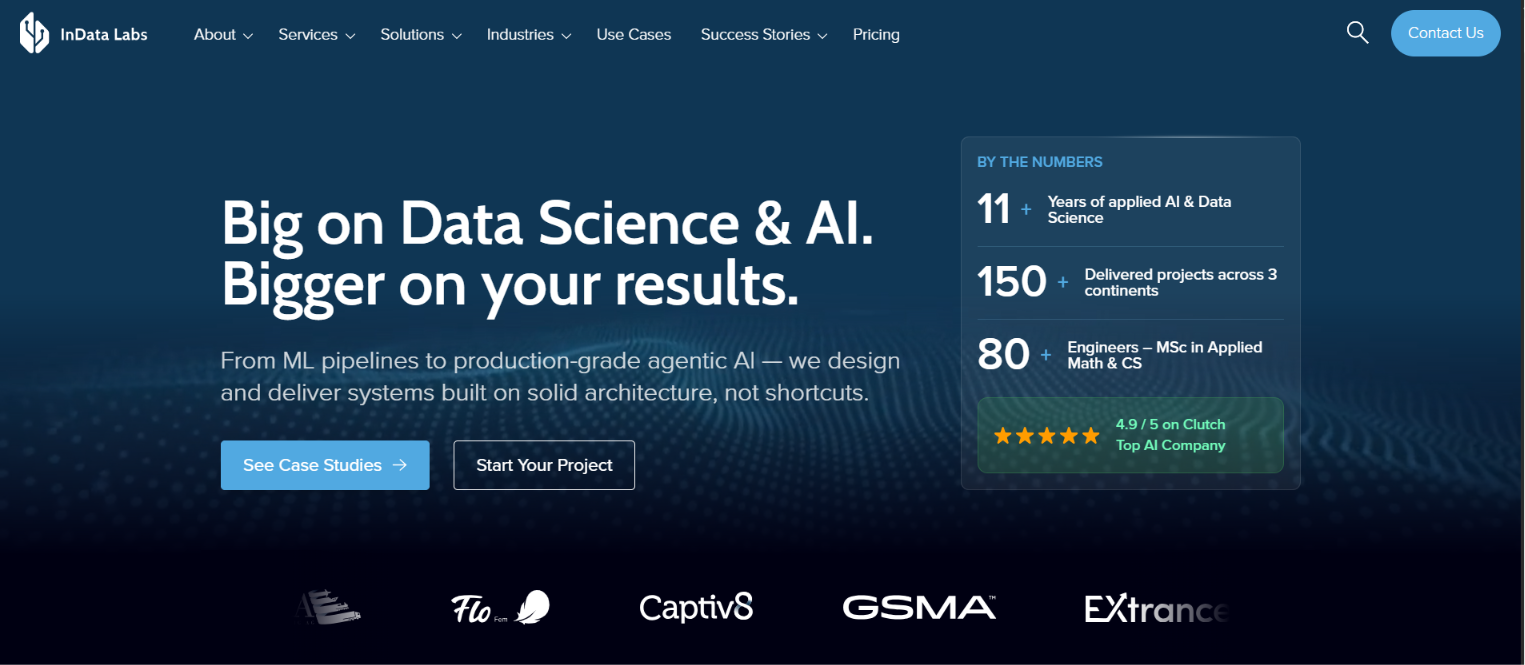
InData Labs has delivered 150+ projects since 2014 with a distributed team of roughly 80 specialists. It appears on Clutch’s Top 1000 Global Service Providers list. Its work spans generative AI, cognitive computing, predictive analytics, computer vision, and OCR. Clutch puts typical project cost between $25,000 and $100,000+.
They compete directly against the massive consultancies. The engagement models remain highly flexible. They ship machine learning software in 8 to 20 weeks. You get direct access to the actual engineers, not account managers. The tradeoff is pure scale. A team this size cannot execute a simultaneous twelve-country rollout. Hire them if you run a startup or mid-size operation. They deliver speed without the suffocating overhead of an Accenture engagement.
What to Evaluate Before You Sign
Brand recognition predicts very little about outcomes here. Neither do flexible engagement models or a polished sales deck. The five checks below predict considerably more.
Ask About Data Collection and Data Security Practices
Poor data quality drives 85% of AI failures. That makes data engineering your very first interview question, not an afterthought. Force the vendor to explain exactly how they source, clean, and secure training data. This is non-negotiable in regulated markets. Data pulled across different business units is rarely clean. The hidden flaws only blow up after model training actually begins. By then the budget is committed.
Check Their Standing Among AI Development Companies
Every vendor claims a top ranking somewhere. Cross-check against independent sources instead: Clutch, GoodFirms, published case studies with named clients. A company unwilling to name a single client is telling you something.
Confirm In-House Data Scientists, Not Just AI Agents
Many vendors push off-the-shelf AI agents and pre-built wrappers. They lack the dedicated data scientists required to engineer and validate custom models. Vet the actual team. Demand their exact technical backgrounds. Raw headcount means nothing in machine learning. Deep expertise is the only safeguard you have when a production model inevitably starts drifting.
Source: Precedence Research
Evaluate Natural Language Processing and AI Development Depth
Text, chat, and document-heavy workflows need specific natural language processing experience. General AI development claims do not transfer. Ask what NLP systems the team has shipped and what happened when the model met real user language rather than clean training data.
Look for Real Machine Learning Operations Experience, Not Just Experiments
Getting a model to work once, on a laptop, is one job. Keeping it accurate for two years while the data underneath it shifts is another. Ask what happens after launch. Who watches for drift, how often does retraining run, and how does the team know which version is live? The MLOps market, growing 37% a year, is the market pricing in how hard this turned out to be. Experiment skill and operations skill are separate things, and only the second one keeps machine learning systems supporting data-driven decision-making at scale.
FAQs
How Do I Choose the Best Machine Learning Development Company for My Project?
Match the firm’s proven vertical to yours, then verify the data engineering capability behind the modeling claims. The section above covers the full checklist.
How Much Does Custom Machine Learning Development Cost?
Data readiness swings the number more than model complexity does, which is why a single figure would mislead you. LITSLINK publishes a range of $25,000 for a proof of concept up to $2 million for complex custom systems. The LITSLINK AI cost calculator gives a project-specific estimate.
What’s the Difference Between Machine Learning and AI Development Companies?
AI development is the broader category, covering rule-based systems, generative AI systems, and ML alike. A machine learning company specifically builds systems that learn patterns from your data. If your problem needs predictive models trained on historical data, you want ML specialists.
How Long Does a Custom ML Project Typically Take?
Eight to twenty weeks for a focused model reaching production. Longer if your data needs work first, which it usually does. Data preparation regularly takes more calendar time than model training.
Should I Use a Cloud ML Platform or Hire a Custom Development Company?
Platforms like Azure Machine Learning suit teams that can self-serve and already employ data scientists. A development company suits businesses that want to automate complex workflows and reach production faster without building internal ML capacity first. The question is whether operational efficiency and revenue growth are waiting on your model, or on your team’s ability to build one.