




Building an AI Friend Chatbot That Remembers You
- 35% lower inference cost per user
- 91% fact recall after 30 days
- 68% week-one return rate
- <2 sec median reply time
Some people find real-life conversation hard. Others just have no one to text at night. We built an AI friend chatbot for a mental wellness startup that gives both a companion who listens, remembers, and gets to know them over time.
Project Details
The client is a US-based mental wellness technology startup. Its founders had run a beta on a plain GPT-4 wrapper and watched people drop off after the third or fourth chat: the friend forgot their dog’s name, repeated the same questions, and sounded like the same character to every user. They wanted a companion that behaves the way a friendship does, growing more familiar over time, with strict rules on data and emotional safety.


Business Challenge: Creating Safe and Meaningful AI Friendship
The beta told the story. Around 2,400 people signed up over six weeks, and roughly 3 in 5 never came back after their third conversation. Exit surveys pointed to the same thing: the friend didn’t feel like one. It could not recall what a user had said yesterday, and once a chat ran past the model’s context window, it lost the thread mid-sentence.
The founders also worried about the wrong kind of engagement. Companion apps in the Replika mold are often tuned to keep people talking at any cost, and for an anxious user that can make life worse instead of better. The brief was to create something that listens, remembers, and gently points a person back toward the world outside the phone. Three problems shaped the work.

Emotional Intelligence Without Manipulation
The bot had to read tone, notice when a user was low, and answer with warmth, all without guilt trips, streak pressure, or the "don't leave me" hooks that push engagement numbers up and leave users feeling worse.

Memory and Personality Development
GPT-3.5's context window ran out after about 40 exchanges. Past that point, the friend forgot names, jobs, and the argument from last Tuesday. Every user also got the same personality, no matter how they talked.

Privacy and Safety First
People tell a virtual friend things they would never tell a real person. Chat logs held health details, breakups, and work stress, so data had to be minimized, encrypted, and kept away from any third-party model training.
Technologies Behind the AI Friend Chatbot





Our Friend Chatbot Solution
One question drove the architecture: what makes a conversation feel like it is with a friend and not with a form? The answer we kept coming back to was continuity. A friend remembers. So memory came first, and the model choice came second.
We paired GPT-4 for live conversation with Llama 2 for the background work: summarizing sessions, tagging what a user reacted to, and classifying mood. Running that analysis on an open model cut per-user inference costs by roughly 35% and kept raw chat text off the main API path. LangChain orchestrates both models, and PostgreSQL holds the memory layer: a profile of stated facts, a log of reactions to topics, and a rolling summary of every session. When a conversation hits the context ceiling, the bot carries a compressed summary into the next window and keeps talking with no visible reset.
Personality is a moving target rather than one fixed character. A style profile tracks message length, humor, slang, emoji use, and how direct a user likes to be, then shifts the friend’s voice toward it over the first 10 to 15 chats. Someone who writes three-word replies gets a companion that does not lecture. Someone who likes to play with ideas gets one that plays along.
Safety rules sit outside the prompt. A separate classifier watches for distress signals and hands the conversation to a scripted, clinician-reviewed flow that shares help resources. The AI never improvises there. The same layer enforces boundaries: the friend says it is an AI whenever asked, never claims to be a real person, and nudges long late-night sessions toward rest. That split between the conversational model and the guardrails is the pattern we now recommend in most AI chatbot development projects where the stakes are emotional.
Nothing here came from a template. Every prompt, memory rule, and safety script was written against the client’s own beta transcripts, with names and details stripped, and tested on about 1,100 real conversation samples before launch. The key features below are the ones users notice.
Emotionally Aware Conversation Engine
Reads tone across the last few messages and adjusts warmth, pacing, and follow-up questions. A user venting about work gets room to talk. A user cracking jokes gets a friend who can laugh along.
Adaptive Personality System
Learns how each person likes to chat, from sentence length to sarcasm, and mirrors it gradually. By the 15th session, 74% of beta testers said the friend "sounds like it knows me."
Session Memory and Context Retention
Each session ends with a summary and a fact update. The friend remembers your sister's surgery, your job interview, and that you hate mornings, across months, with 91% recall in testing.
Crisis Prevention and Detection
A dedicated classifier flags signs of acute distress and switches to a fixed, clinician-reviewed response that shares help resources. A human reviews every flagged case within 24 hours.
Privacy-First Architecture
Personal identifiers are stripped before any text reaches a model API. Chats are encrypted at rest, users can delete everything in one tap, and no conversation data trains external models.
Cross-Platform Companion Experience
One account on iOS, Android, and the web, with memory synced across devices. Start on your phone during a commute, pick up on a laptop at night, and the friend knows where you left off.
Healthy Interaction Boundaries
No streaks, no guilt notifications, no "I missed you" hooks. The friend suggests real-world plans, asks about the people in a user's life, and is honest about being an AI. Age-gated at 18+, so it is never aimed at kids.
Agile Development Methodology
Project Journey
The nine-month build ran in two-week sprints, with the first two given to reading anonymized beta transcripts and mapping exactly where conversations broke. Discovery settled the memory schema, the mood and distress taxonomies, and one rule that never changed: the client’s clinical advisor reviews every safety script before it ships. From sprint three onward, every demo used live chats with test users rather than canned prompts.
How the LLM Friend Chatbot Works
- Email, a first name, and a tone preference. No phone number, no contact access, and no health questions.
- The friend asks light questions and quietly notes likes, dislikes, and how the person writes. The user just talks.
- Llama 2 summarizes the chat. PostgreSQL saves stated facts, reactions to topics, and a mood tag for the day.
- The style profile updates after every session, so the friend's voice drifts toward the user's own across the first 10 to 15 chats.
- A classifier checks for distress and boundary issues on each turn. Flagged messages get a fixed script, never a generated reply.
- Sliders for humor, directness, and check-in frequency. Any stored memory can be viewed or deleted from the profile screen.
Development Process Flow
AI development built around emotion cannot be judged from a spec. A reply that reads fine in a test file can land badly for someone who is anxious at midnight, and the only way to catch that is to put the friend in front of real people early. The two-week cadence gave the client 18 chances to review live conversations, and four of those reviews rewrote how the bot handles sad or silent users.
How we delivered the AI Virtual Friend Project
- We define the project goal together, agree on priority features, and set a realistic delivery date and budget.
- We build a ranked list of everything the product needs, starting with what matters most to the business.
- Work is broken into 2-week cycles. At the start of each, we select the next set of features to deliver.
- The team builds, tests, and integrates features throughout the sprint.
- At the end of every sprint, you see working software and give feedback that shapes the next cycle.
- Each sprint produces a shippable piece of the product. We review what worked, adjust, and move forward.
Timeline
Five phases, clearly defined
Discovery & Transcript Review
- Reading 2,400 anonymized beta chats to find where conversations broke
- Defining what the friend may remember and what it must forget
- Agreeing distress categories with the client's clinical advisor
Prompt & Memory Prototyping
- Testing session summaries at 3 compression levels for recall vs. cost
- Benchmarking Llama 2 against GPT-3.5 for mood and reaction tagging
- Prototyping the style profile on 40 volunteer testers
Agile Development
- Building the LangChain pipeline and the PostgreSQL memory layer
- Shipping React Native apps for iOS and Android plus the web chat
- Adding the safety classifier, fixed scripts, and human review queue
QA & Safety Testing
- Running 260 scripted conversations, including 45 distress scenarios
- Red-teaming the friend for manipulation, false memories, and PII leaks
- Load testing at 4x expected concurrency with sub-2-second replies
Launch & Support
- Rolling out to the 900-person beta list first, then public app stores
- Reviewing flagged conversations daily and retuning scripts weekly
- Watching recall and retention on a live dashboard, still on 2-week sprints
UI/UX Design: Comforting Interface for AI Friendship
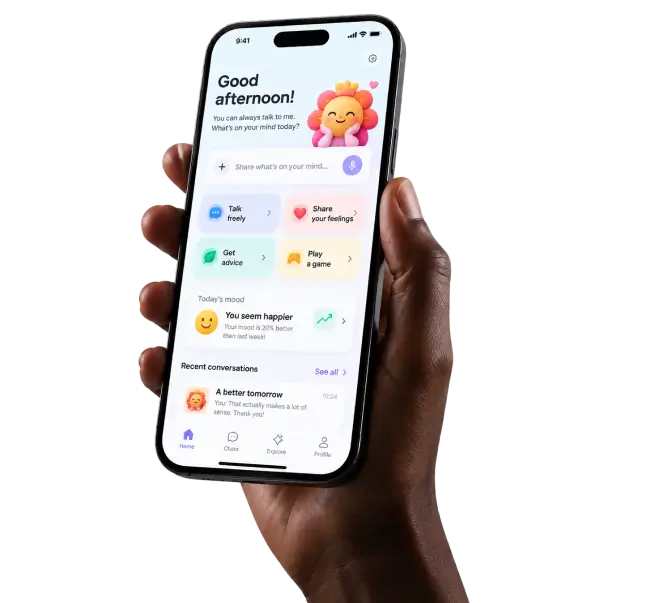
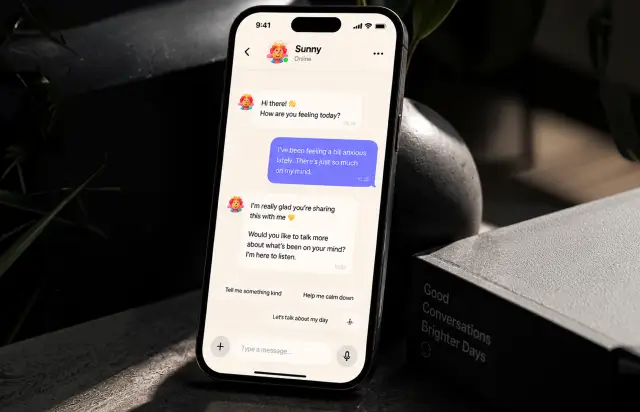
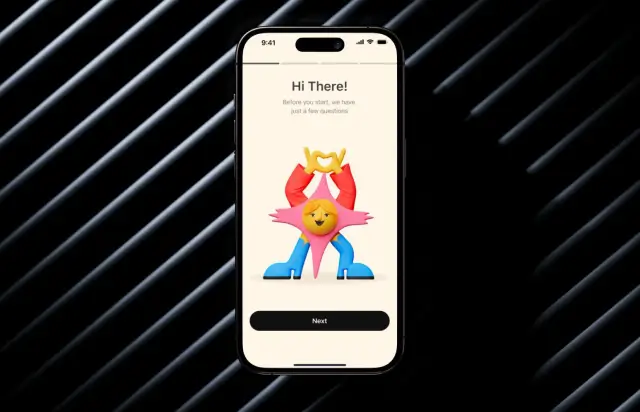
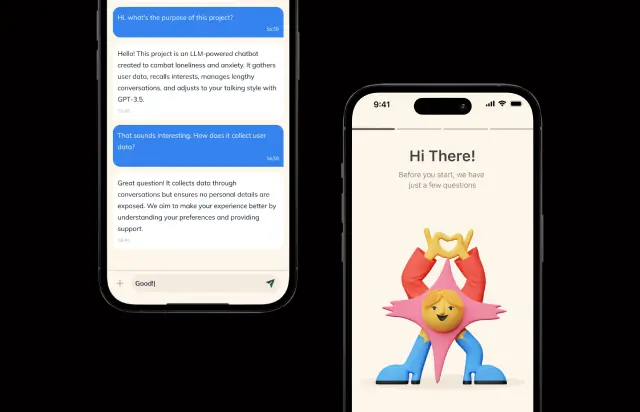
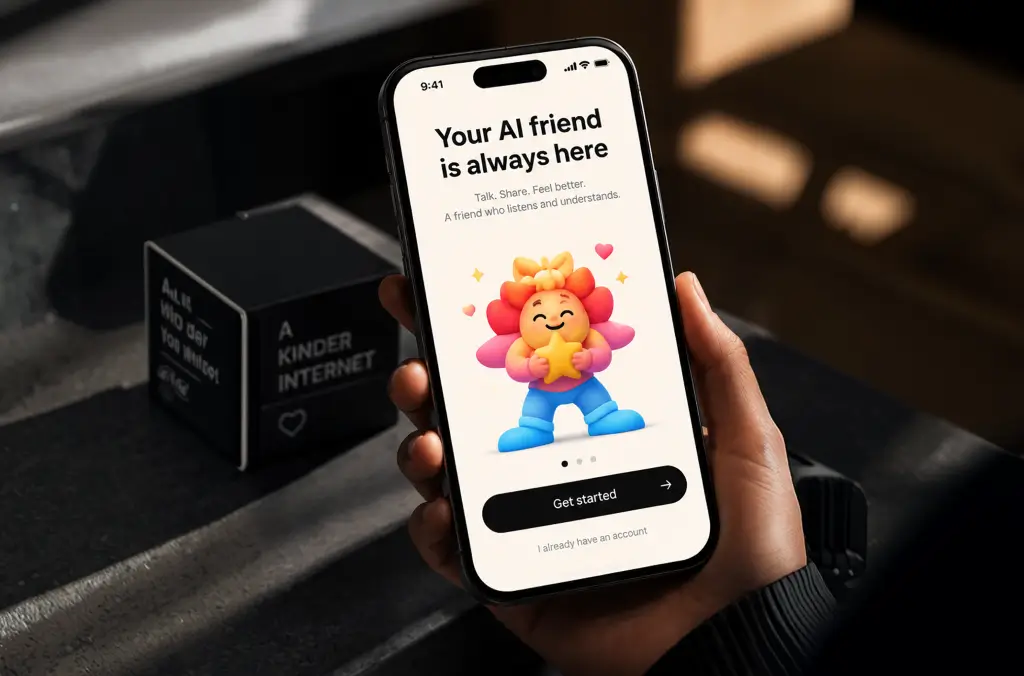
The interface had one job: lower the cost of saying the first thing. Anxious users abandon apps that open with a wall of settings, so onboarding is four screens, each with a single question, and a progress bar that shows the end is near. A cheerful star-shaped character greets people on the first screen, hands raised in a heart, and sets the mood before anyone types a word. Beta feedback on that character was the most consistent thing we heard: it made the app feel like play, and it made the questions feel less like a form.
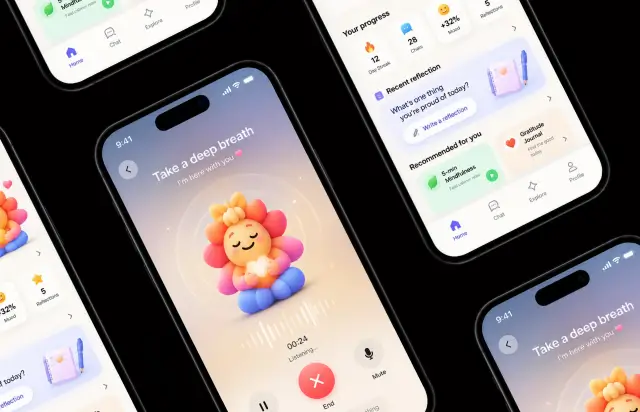
Colors stay warm. A cream background instead of clinical white, one blue for the user’s bubbles, soft gray for the friend’s replies, and no red anywhere in the main flow. The chat screen looks like the messaging app people already use: timestamps, a plus button for photos, a single send arrow. Nothing new to learn, which matters when a user is opening the app at a low moment.
Smaller choices came out of beta interviews. Typing indicators pause for a second or two so replies feel considered rather than instant. The friend never stacks more than two bubbles in a row, because testers said long monologues felt like being talked at. A short “You’re chatting with an AI” line lives on the profile screen, one tap away, never buried in a settings menu. Our mobile app development team kept the iOS and Android builds pixel-close, so someone switching devices never has to relearn the layout.
Results
Before
- ✕Roughly 3 in 5 beta users gone after their third chat, and week-one return rate around 40%
- ✕Friend forgot names, jobs, and past events once a chat passed about 40 exchanges
- ✕One personality for everyone, whether the user wrote essays or one-word replies
- ✕No distress detection, so safety depended on whatever the base model chose to say
- ✕Chat logs stored raw with personal details, and no way for a user to delete them
After
- ✔68% week-one return rate, up from about 40% in the beta
- ✔91% recall of user-stated facts after 30 days, with a verification step before anything is repeated back
- ✔74% of testers said the friend "sounds like it knows me" by their 15th session
- ✔100% of flagged distress cases routed to a fixed, clinician-reviewed script and a human reviewer within 24 hours
- ✔Zero identifiable fields leave the platform, with one-tap memory deletion on every device
Impact of the AI Companion After Launch
Verified Reviews
Our Reputation on Top Platforms
LITSLINK holds a 4.8 rating on top platforms. Clients reviewing our AI and software development work most often mention depth in LLM engineering, steady communication across long builds, and a habit of pushing back when a feature would hurt the people using the product.
Have a Conversational AI Project in Mind?
Need an AI friend chatbot, a wellness companion, or any conversational AI? Tell us who it is for and what it must never do, and our specialist will get back to you within 48 hours.
Thank you for your message. It has been sent.