







Key Takeaways
- PyTorch owns the research space. It’s behind roughly 85% of recent deep learning papers. According to JetBrains (2026), over half the research community defaults to it.
- Market forecasts are a compass rather than a map. Analysts project growth from $126.91 billion in 2026 to $1.71 trillion by 2035, a 33.66% CAGR. Every firm measures this differently, so treat the direction as real and the figure as approximate.
- Match the tech to the data. Classical machine learning still beats deep learning on structured, tabular data. Neural networks only make sense when you’re processing images, audio, or raw text.
- Nobody uses just one tool. Production teams mix and match to avoid lock-in. The most common setup? Scikit-learn for data prep, PyTorch for prototyping, and TensorFlow for the actual deployment.
- Code over hype. A framework’s popularity is a starting point. This list is based on GitHub activity, developer surveys, and what teams actually ship to production.

Sources: JetBrains 2026 framework analysis, Stack Overflow Developer Survey, 2026 adoption trackers.
ML frameworks deliver pre-compiled algorithms, replacing custom mathematical implementation with tested infrastructure. In practice, the industry treats frameworks and libraries as the same thing, so people often use the terms interchangeably. Analysts quickly project massive growth, from $126.91 billion in 2026 to $1.71 trillion by 2035. Just remember that every firm uses completely different math to reach those figures. Teams almost never lock themselves into just one tool. Real-world pipelines distribute training, tuning, and serving across two or three different tools to optimize for specific hardware constraints.
Machine Learning Frameworks Compared: Quick Reference
Before the full write-ups below, scan this table to see where each framework’s strength lands. Each entry gets a deeper profile further down, so treat this ML framework comparison as a starting point, not a final decision.
| Framework | Category | Best For |
|---|---|---|
| TensorFlow | Deep learning | Production-grade, large-scale enterprise deployment |
| PyTorch | Deep learning | Research, flexible experimentation, growing production use |
| Keras | Deep learning | Beginners, fast prototyping, multi-backend flexibility |
| JAX | Deep learning | High-performance numerical computing, cutting-edge research |
| scikit-learn | Classical ML | Structured and tabular data, classification, regression, clustering |
| XGBoost | Classical ML | Competitions, gradient boosting on structured data |
| Hugging Face Transformers | NLP and LLM | Pre-trained language models, transfer learning |
| Apache Spark MLlib | Big data | Distributed machine learning at scale |
| ONNX Runtime | Deployment | Cross-framework export, edge and embedded inference |
Best Deep Learning Frameworks
Deep learning frameworks specialize in neural networks and GPU acceleration for tasks involving images, text and audio. This is where most 2026 framework competition and innovation concentrate.
TensorFlow
TensorFlow is Google’s open-source project built for production-grade AI models and large-scale enterprise applications. The end-to-end ecosystem spans image recognition and processing, natural language processing, speech recognition, predictive analytics and recommendation systems. Integration with Google Cloud deployment services is particularly strong, and TensorFlow Lite covers mobile and edge targets.
Best for: teams prioritizing dependable, at-scale production deployment over research flexibility. It remains one of the two default production machine learning frameworks in large enterprises. The trade-off is verbosity. Experimentation moves slower here than in PyTorch, which is why research teams rarely start with it.
PyTorch
Developed by Facebook AI Research, now Meta AI, PyTorch dominates deep learning research workflows and appears in a large share of recent papers. It is prized for its Python-first design and intuitive interface. A dynamic computation graph offers more flexibility during model training. Improved deployment tooling has since made it a genuine production contender.
Best for: teams that want a natural coding experience without sacrificing production readiness. Strong GPU acceleration and mature distributed training support mean a PyTorch model scales from a laptop to a cluster without a rewrite. Its deep learning capabilities cover convolutional neural networks, transformers and deep neural networks of any depth.
Keras
The whole point of Keras is rapid prototyping with zero friction. Because the newest release sits on top of TensorFlow, PyTorch or JAX, it decouples your logic from the underlying runtime. That is a real shift for 2026. Teams no longer get locked into a single stack. They switch the backend to fit the job.
The catch is that the same abstraction making it easy to use hides the low-level controls an advanced team will eventually need.
Best for: beginners, rapid prototyping, and teams that want to stay portable across backends.
JAX
JAX is a high-performance numerical computing framework gaining significant attention in 2026. It suits cutting-edge research and workloads demanding heavy compilation and hardware acceleration. Reinforcement learning and large-scale simulation are common uses. JAX can deliver strong performance for workloads optimized around compilation and accelerators. Where those conditions hold, it can improve performance beyond what other frameworks reach.
Best for: research-heavy teams pushing the frontier. It is the wrong choice for teams needing a stable production path. Extensive documentation and community answers are thinner here than for the older frameworks.
Best Classical Machine Learning Frameworks

Source: 6sense, Data Science and Machine Learning technology market share, 2026
Not every problem needs deep learning. Classical machine learning algorithms still outperform neural networks on most structured, tabular data problems.
Scikit-learn
When you need classical machine learning in Python, you just use scikit-learn, the open-source Python package everyone starts with. It covers the fundamentals, classification, regression analysis, clustering and dimensionality reduction, with more than 16,000 companies running it in production. Its real edge is not exotic algorithms; it is the API. Logistic regression, random forests and routine data preprocessing all share the same syntax. Data scientists reach for scikit-learn first because you can clean data, fit a model and analyze data without fighting the documentation.
Best for: Structured data problems. It is also the usual starting point for developers moving from classical ML into deep learning frameworks like Keras or PyTorch. Typical work includes customer segmentation, fraud detection and predictive modeling on business data.
XGBoost
If you’re dealing with structured data, XGBoost is still the absolute king of both ML competitions and actual business analytics. Gradient boosting consistently wipes the floor with heavier, more complex models on tabular datasets, and it saves you a ton of time on tuning.
Best for: Forecasting, risk-scoring and other structured-data problems where deep learning is overkill. If your raw data arrives as rows and columns, start here before anyone proposes a neural network. This is where classical ML models still deliver the most value per hour of work.
Best Frameworks for NLP and LLM Applications
Hugging Face Transformers
Hugging Face Transformers provides pre-trained language models and the tooling to fine-tune them for specific tasks. It has become the default starting point for NLP and LLM-powered features. Training language models from scratch is rarely the better path now. Fine-tuning on a few thousand domain examples now beats training from zero on almost any budget.
Best for: Teams that want to leverage existing large language models rather than build foundation models in-house. The model hub also makes it easy to compare model versions before committing to one. Building classes of task-specific models on top of a shared base is cheaper than maintaining separate ML models.
Best Frameworks for Data Engineering and Distributed Machine Learning
Apache Spark MLlib
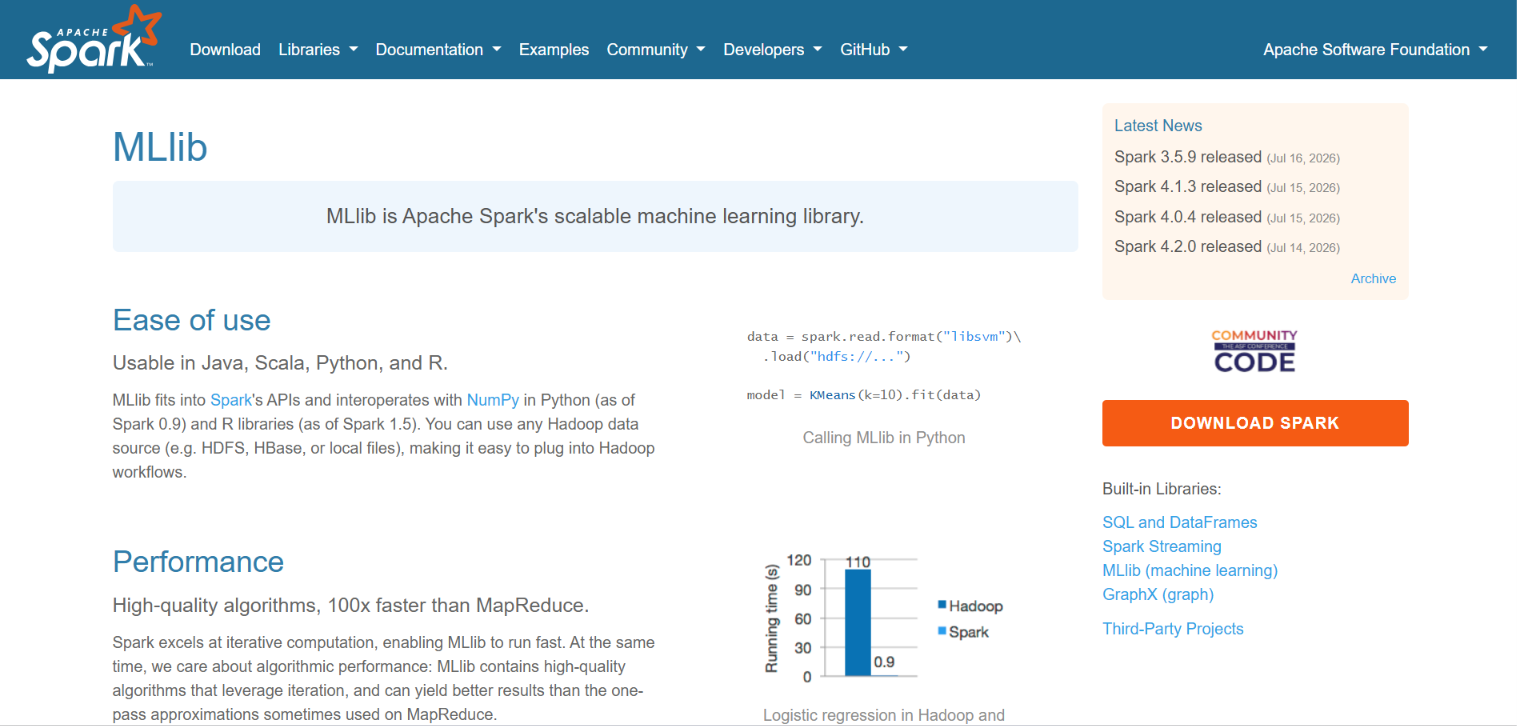
Apache Spark’s MLlib brings machine learning algorithms into a distributed data engineering pipeline. Teams train models directly on large datasets already living in Spark-based infrastructure. Nothing has to be exported elsewhere first.
Best for organizations whose ML bottleneck is data volume and distribution, not model architecture. For big data workloads already running on Spark, training in the same cluster removes an export and reload step.
Best Framework for Deployment and Cross-Framework Export
ONNX Runtime
ONNX Runtime is the one piece almost every framework comparison leaves out, even though it’s exactly what a real production pipeline actually needs. It just takes your trained PyTorch or TensorFlow model, converts it into a universal format, and runs it wherever your hardware happens to live.
The usual path is to train in PyTorch, export to ONNX, and then serve through TensorRT, an edge device or a cloud endpoint. Computer vision, robotics and embedded AI teams walk it almost every time.
Best for: Teams whose training framework and deployment target are not the same thing. That is most teams shipping to anything other than a standard cloud server.
Two names still appear in older tutorials and are worth recognizing. Microsoft Cognitive Toolkit, originally developed as CNTK, is no longer actively developed. Caffe came out of Berkeley Vision and Learning Center. It powered a generation of convolutional neural networks and image classification work before PyTorch absorbed most of that audience.
Both still turn up in legacy codebases. Neither is a reasonable choice for a new project in 2026.
How to Choose the Right Machine Learning Framework
The choice of framework ultimately boils down to three variables: the problem you’re solving, what your engineers already know, and where the model needs to be deployed. Those factors easily outweigh GitHub stars or market hype. There’s no such thing as the ultimate best framework for AI development, only the one that actually fits the project in front of you.
Start From What You Are Building
- Images or video → PyTorch or TensorFlow
- Tabular business data → scikit-learn or XGBoost
- NLP or an LLM feature → Hugging Face Transformers
- Large distributed data already in Spark → Spark MLlib
- Edge or mobile deployment → TensorFlow Lite or ONNX Runtime
That single question settles most of the decision. The rest is team fluency and where the model has to run.
Framework vs Use Case
| Framework | Best for | Avoid when |
|---|---|---|
| PyTorch | Computer vision, NLP, research | A strict enterprise ecosystem is mandated |
| TensorFlow | Production deployment at scale | The work is rapid experimentation |
| Keras | Prototyping, learning, backend flexibility | Low-level control is required |
| JAX | Compilation-heavy research workloads | A stable, documented production path matters |
| scikit-learn | Tabular ML, preprocessing | Inputs are images, audio or free text |
| XGBoost | Forecasting, risk scoring | Data is unstructured |
| Hugging Face | Pre-trained models, fine-tuning | You genuinely need a foundation model |
| Spark MLlib | Distributed training on big data | Data fits on one machine |
| ONNX Runtime | Cross-framework export, edge inference | Training and serving share one framework |
Match the Framework’s Machine Learning Algorithms to Your Problem Type
TensorFlow and PyTorch are built for deep learning. Scikit-learn and XGBoost suit classical, structured-data machine learning. Reaching for a deep learning framework on a small tabular dataset usually adds complexity without adding accuracy. It also lengthens every stage of the machine learning lifecycle. Specific frameworks exist for specific problem shapes, and matching the two is most of the decision.
Weigh Community Support and Documentation Quality
Strong community support and extensive documentation directly reduce development time. Most implementation problems a team hits have already been solved and discussed publicly for the major frameworks. A newer or niche framework may fit a use case perfectly and still cost real time in unanswered edge cases.
Consider Deployment Target: Cloud, Mobile, or Edge
A framework strong in research is not always the easiest to deploy. JAX and PyTorch in experimentation mode are examples. TensorFlow Lite and ONNX-based export paths matter when the deployment target is not a standard cloud server. Decide where you deploy models before choosing what you build them in.
Need Help Building Machine Learning Models? How LITSLINK Can Help
We work hands-on across every major framework in this list. TensorFlow and PyTorch for custom model development and fine-tuning, scikit-learn and XGBoost for classical ML on structured business data, and the Hugging Face ecosystem for NLP and LLM-based features.
The framework gets chosen by project fit, not by a single default stack. A computer vision feature, a fraud detection model on tabular data, and an LLM-powered assistant are three different problems. Picking one house framework for all three is how teams end up fighting their tools.
We have delivered more than 1,540 projects for over 1,000 clients across 82 countries, with a team of 300+ engineers. US-based project management pairs with European engineering talent, so the time zones work in your favor rather than against it.
Further reading: LITSLINK AI Services and Hire AI Developers at LITSLINK.
Contact LITSLINK for a free consultation to discuss which framework and approach fits your specific project.
FAQs
What Is the Best Machine Learning Framework for Beginners?
We highly recommend starting with scikit-learn. Get a solid grip on classical machine learning before you even look at Keras or PyTorch. If you skip the basics and jump straight into deep learning, you’re just going to waste time. Why? Because 90% of the time, your early roadblocks aren’t model problems; they’re data problems.
PyTorch vs. TensorFlow: Which Is Better for Production?
TensorFlow still holds enterprise ground because its deployment tooling is battle-tested. PyTorch won over research labs and fast-moving teams thanks to its flexibility, though plenty of production and regulated stacks run it today as well. Most engineering teams have stopped trying to standardize on one, running both and picking whichever fits the service, hardware or pipeline.
Is scikit-learn Still Relevant With Deep Learning Frameworks Available?
Yes. Most real-world business problems involve structured, tabular data. Scikit-learn and gradient-boosting libraries like XGBoost still outperform deep learning models there, in both accuracy and development speed.
What’s the Difference Between a Machine Learning Framework and a Machine Learning Library?
A machine learning library typically provides a focused set of algorithms or utilities, as scikit-learn does for classical ML algorithms. A machine learning framework provides a broader, more opinionated ecosystem for building, training and deploying models end to end, as TensorFlow and PyTorch do. In practice, the terms overlap significantly and get used interchangeably.
Do I Need to Learn Multiple Machine Learning Frameworks?
Most working ML engineers end up using more than one. A common pattern is scikit-learn for preprocessing, PyTorch or TensorFlow for model development, and Hugging Face or Spark MLlib for a specific domain. One framework rarely covers every need on a real project.
How Do I Pick the Right ML Framework for a New Project?
Start from the problem type, deep learning or classical ML, then filter by team expertise and deployment target. A Python team building a computer vision feature for cloud deployment lands on PyTorch or TensorFlow. A team working with structured business data lands on scikit-learn or XGBoost.