




Skip to content

AI Agents for Manufacturing Operations

With manufacturers struggling to deal with unstable supply chains and hazardous working conditions, high employee turnover in production roles, and the constant pressure to lower costs while maintaining high product quality, agentic AI is something many consider, but few implement at a strategic level. LITSLINK builds top AI agents for manufacturing that connect to your ERP, IoT data, and MES and optimize production, boost product quality, and cut the cost of reactive maintenance.

  • Better productivity without employees’ physical exhaustion
  • Drastic cost reduction due to predictive maintenance & production optimization
  • Safer, more sustainable operations
  • Higher product quality
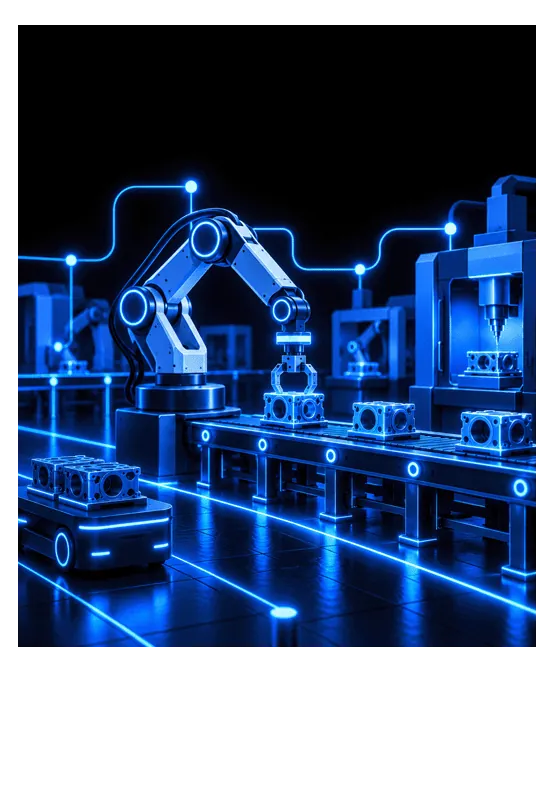
A blue-lit smart factory line: a robotic arm reaches over a conveyor of machined cube parts beside a CNC press, while an automated guided vehicle carries finished parts along a lit floor track and glowing node-and-line links join the machines overhead — LITSLINK AI agents for manufacturing operations.

The Value of Our Autonomous Agents for Manufacturing

Manufacturing AI agents gather and analyze sensor and operational data and make context-aware decisions that drive performance, detect and mitigate risks, and optimize supply chains.

Higher Productivity

AI agents perform automated inspection of operational data and real-time data from sensors and machines, and take actions to improve production processes by reducing the number of repetitive tasks and manual inspections, thus increasing the efficiency of using resources in everyday operations.

Safer Operations

AI agents monitor equipment on the shop floor 24/7, check if all processes are running smoothly, and detect if operational conditions deteriorate. If things go wrong or the AI agent can’t deal with a certain situation using approved responses, workers receive trigger alerts and can intervene — by assigning a maintenance crew to a machine before it breaks.

Faster Decision-Making

With data from connected systems on the shop floor, sensors, and ERP, AI agents can offer insights into processes that can be optimized, built differently, or rerouted with minimal downtime, so factory managers do not have to wait for a human worker to notice an issue, try to fix it, and report on it.

Cost Reduction

With AI agents, many organizations can minimize downtime because managers assign people and resources to high-level tasks to improve the process. AI agents deal with routine workflows and monitor specific tasks or help prevent equipment failures as soon as sensors detect a disturbing change in their work.

Improved Product Quality

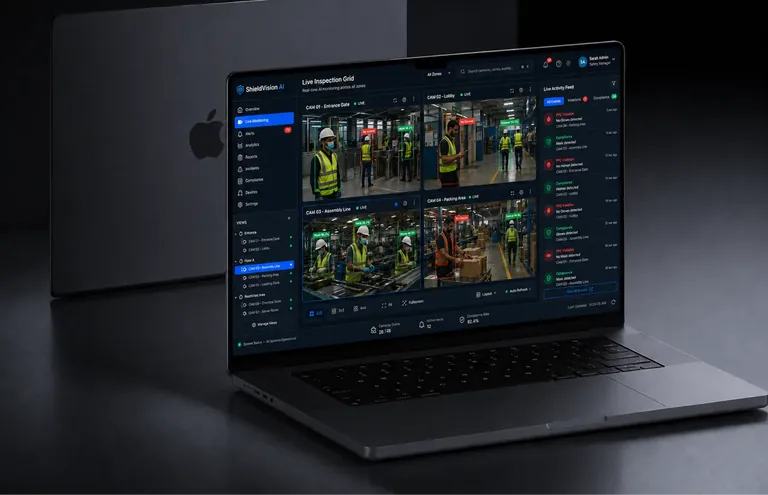
Through continuous monitoring of real-time data from the production environment, AI agents notice quality problems and deviations early and can automatically, within the allowed response frame, correct things or escalate the issue for the workers to deal with before the product reaches the customer.

Energy Efficiency and Sustainability

Similarly, AI agents can be tasked with tracking energy and resource consumption in manufacturing processes against set targets, finding opportunities to save costs, reduce waste, and mitigate the factory’s environmental impact.

Types of Manufacturing AI Agents We Build

Manufacturing agentic AI can handle various functions, and our agentic AI development covers them all.

1 01 / 12

Predictive Maintenance Agents

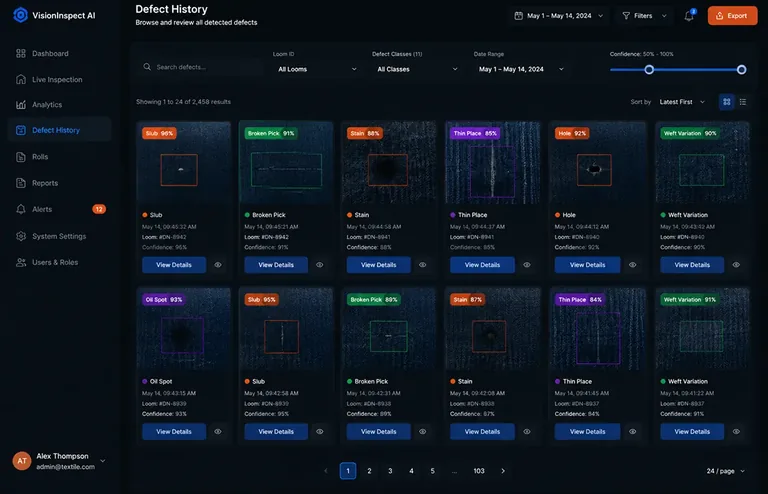
Predictive maintenance agents analyze sensor data from machinery and the environment on the floor, taking into account existing and new maintenance records. They plan for interventions before equipment failures occur and alert the factory’s staff about new inefficiencies or anomalies. That enables manufacturing companies to cut unplanned downtime, remove recurring unnecessary maintenance, and make the most of equipment’s lifecycle.

Why Choose LITSLINK for Digital Transformation with Manufacturing AI Agents

LITSLINK’s 300+ tech specialists are ready to start working on an AI agents builder for manufacturing businesses by optimizing workflows, including production line optimization, quality inspection, inventory management, demand forecasting, transportation, and so on.

Deep AI Agent Development Expertise

With over 12 years of experience in software development, we have completed 1,540 projects for more than 1,000 clients in 82 countries. Many of those projects were AI-driven transformations that provided predictive analytics, enabled businesses to make smarter decisions, and enhanced the bottom line of the entire operation by optimizing time-consuming processes for humans and noticing patterns that overburdened workers wouldn’t.


Faster AI Adoption

It takes us 4-6 weeks to create a proof-of-concept (PoC) for AI agent development in the manufacturing industry thanks to our experience, reusable components, rapid prototyping, and parallel development and testing that we use to validate the agent’s performance. Our speed allows our clients to avoid implementation risks and overpaying for something that won’t fit into their environment. If the PoC passes the tests and is feasible and efficient, in 10 weeks, we’ll be there with a production-ready minimum viable product (MVP).

Seamless AI Integration for Manufacturing Workflows

MES, ERP, SCM, WMS, CMMS, IoT platforms, industrial data systems, and other legacy programs can be integrated with AI agents LITSLINK develops. We streamline data gathering and processing and make it accessible so that AI can act across various systems in the factory and perform tasks that can be automated without disrupting production.

Security, Governance & Data Protection by Design

Security, governance, and data protection are part of the foundation of our agentic systems. To mitigate the risk of AI becoming a vulnerability in operational workflow, we make sure to implement secure data processing, safeguard API operations, protect infrastructure, install access boundaries, define rules and permissions for what AI can and cannot do, and introduce as many human approval points as necessary for the systems to be both efficient and safe.

100% AI Agent Solution IP Ownership

Our clients retain ownership of source code, agent logic, workflows, integrations, interfaces, custom-trained models, technical documentation, and other deliverables outlined in the agreement at the start of our partnership. Third-party and open-source components, such as foundation models, remain subject to their respective licenses.

Ready to Build AI Agents for Your Manufacturing Operations?

Discuss Your AI Agent Project

LITSLINK Reputation on Top Platforms

Clutch B2B Ratings & Reviews

4.8

78 reviews

Top Developer
GoodFirms Research & Reviews Platform

4.8

32 reviews

Top Company
Behance Creative Portfolio Platform

150+

design projects

View projects

Manufacturing AI Agent Development & Integration Process

Here’s what we do to develop AI agents that deliver measurable results for the manufacturing industry.

We ask you about business priorities and goals, and then analyze all the workflows relevant to operations in the factory: bottlenecks, inefficiencies, existing systems, data pools, and so on. We use those to pinpoint junctions where AI agents can be integrated and deliver better outcomes.

01 Strategy & Use Case Discovery

We ask you about business priorities and goals, and then analyze all the workflows relevant to operations in the factory: bottlenecks, inefficiencies, existing systems, data pools, and so on. We use those to pinpoint junctions where AI agents can be integrated and deliver better outcomes.

02 Goal & Workflow Definition

Then, LITSLINK’s team sets clear objectives and KPIs for each agent. We define human approval points and workflows for each use case, be it improving quality, refining inventory management, optimizing supply chain coordination, or others.

03 Data & Knowledge Preparation

We identify what data intelligent agents have to access and prepare it, and other knowledge sources (like sensor and machine data, production logs, maintenance records, other documentation) to make sure AI has enough context to act on the goals we’ve defined.

04 AI Agent Development & Configuration

With security architecture in mind, we start developing AI: pick suitable models, optimize prompts, tools, workflows, memory consumption, outline business logic and orchestration mechanics, and use specialized ML models and fine-tuning if required.

05 System Integration

We integrate AI with manufacturing systems, MES, ERP, WMS, CMMS, SCM platforms, APIs, databases, and other software, so it gains access to real-time data and can work autonomously, according to defined limits.

06 Testing & Validation

We test our agents in a controlled sandbox, making them operate in real-world manufacturing scenarios to confirm they are accurate, reliable, integrated seamlessly with all the necessary systems, secure, and able to perform tasks as intended — before deploying them to production.

07 Deployment & Automation

AI agents are put into production workflows to monitor the conditions of manufacturing operations, automate repetitive tasks, recommend improvements based on changes in the real-time data flow, and coordinate with other systems or agents.

08 Monitoring & Continuous Improvement

AI agents’ performance is then constantly monitored and recorded against predefined KPIs and, if improvements can be made, these opportunities are spotted quickly. We continuously refine prompts, workflows, models, rules, integrations, and knowledge sources based on how the AI agent performs — and how workers benefit from it.

09 Scaling

Multi-agentic AI has to be scaled through the entire manufacturing operation: production lines, facilities, and departments. You tell us your manufacturing needs, and we make sure agents are secure and under operational control.

Our Tech Stack for Agentic AI in Manufacturing

We pick tools based on what the problem needs, not what’s currently generating hype. That said, here’s the landscape we work across.

LLM Providers

OpenAI (GPT-5, GPT-5.4), Anthropic Claude, Google Gemini, Meta Llama, Mistral – we’re model-agnostic and will recommend the right fit for your use case, cost profile, and data privacy requirements.

Agent Frameworks & Orchestration

LangChain, LangGraph, CrewAI, Semantic Kernel, LlamaIndex, Microsoft AutoGen – framework selection depends on your agent architecture and workflow complexity.

Vector Databases & RAG

Pinecone, Weaviate, Chroma, FAISS – for retrieval-augmented generation and knowledge management.

Workflow & Process Orchestration

Apache Airflow, Prefect, Temporal – for reliable task scheduling and workflow management at scale.

Cloud Platforms

AWS (Bedrock, SageMaker), Microsoft Azure AI, Google Cloud Vertex AI – full cloud provider expertise, with no lock-in to a single platform.

ML Frameworks

TensorFlow, PyTorch – for custom model development and fine-tuning when off-the-shelf isn’t enough.

Security & Compliance

GDPR, HIPAA, SOC 2, CCPA – built in from architecture through deployment. Encryption at rest and in transit, role-based access controls, and comprehensive audit trails.

Backend & Infrastructure

Node.js, Python, FastAPI, Docker, Kubernetes – production-grade infrastructure for reliable agent deployment at scale.

Model-agnostic by design. We don’t lock you into a single provider. Our architecture lets you swap models as the landscape evolves — without rebuilding your entire system.

Our Successful Examples of AI Agents for Manufacturing

AI Agent for Supply Chain Optimization

  • Predictive models with 90% accuracy helped reduce storage by 15% and increase sales by 10%, as products customers wanted were always available
  • Delays caused by underperforming suppliers were reduced by 25%
  • Extra stock in the inventory was decreased by 20%

Company

Mid-sized manufacturing companies under the NDA.

Challenge

Issues with supply management, such as frequent stockouts, faulty demand forecasting, frequent supplier-caused disruptions and delays, and inefficient route management for transportation.

Solution

An AI agent for manufacturing that integrated with the client’s existing supply management system improved operational efficiency by 30%, reduced stockouts and waste, and helped identify consistently underperforming suppliers.

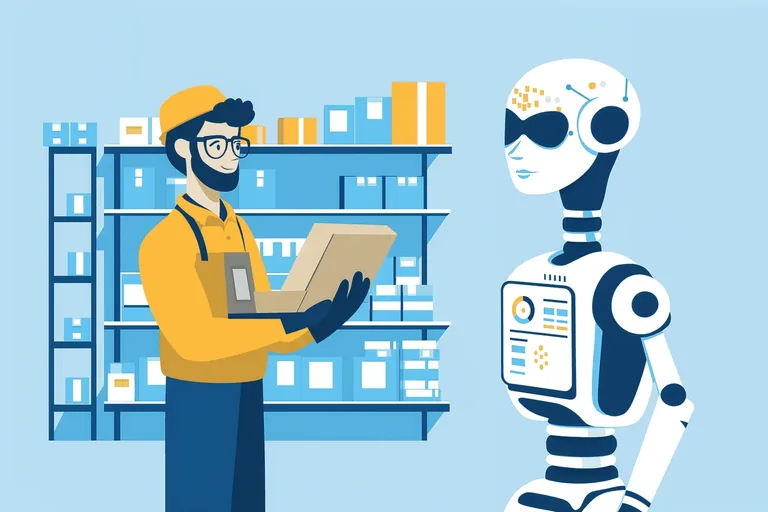
AI Agent for Supply Chain Optimization
Flat illustration of a warehouse worker in a hard hat holding a box in front of stocked shelves, facing a humanoid robot whose chest panel shows inventory charts.

FAQs

01 What Is Agentic AI in Manufacturing?

Agentic AI is a system comprising autonomous software agents that, using real-time data flows from relevant parts of manufacturing processes (e.g., computer vision monitoring the factory), make decisions and changes within set limits that allow companies to save costs, optimize operational strategy, reduce downtime, prevent equipment from breaking, and so on.

02 What Is the Difference Between Generative AI and Agentic AI in Manufacturing?

Generative AI creates content (text, images, code, etc.) based on human prompts, and agentic AI acts within the established boundaries to achieve a goal — plans steps or calls tools — escalating to humans when needed.

03 How Can AI Agents for CPG Manufacturing Improve Operations?

AI agents can boost the operations of the consumer packaged goods (CPG) industry by optimizing inventory management, logistics, and demand forecasting, thus helping businesses better respond to market quality trends, prepare for holiday seasons, reduce overstocking, or notice that a supplier isn’t a consistently good business partner.

04 How Can AI Agents for Manufacturing Accounts Receivable Improve Financial Workflows?

AI agents can reduce manual errors by handling invoice data entry, matching incoming payments to open invoices, flagging overdue accounts, sending payment reminders, and routing disputes and exceptions to the finance team.

05 Can AI Agents Be Integrated With Legacy Manufacturing Systems?

Yes, through a custom interface like an API. In that case, you don’t need a complete rework of your existing legacy system, just an entryway into its contents. Then, a new dashboard through which the AI system will show you data analysis and other insights can be built.

06 Will AI Replace People and Manufacturing Jobs?

While agentic AI definitely cuts the amount of manual labor, it’s humans who adjust its parameters and who take over cases AI cannot solve on its own. So no, personally, we don’t think so.

07 How Much Does It Cost to Build a Manufacturing AI Agent?

If you want a specific agent that’s going to focus on a certain task, that will cost $4,350 – $13,100. If you want to integrate an AI agent with your everyday workflows and open multiple data sources for it to make autonomous decisions, that’s going to cost $20,400 – $53,800. For a multi-agent enterprise solution, the price starts at $81,000 and goes up, depending on the complexity of the project and the size of your manufacturing and data lakes. Use our AI Cost Calculator to get an estimate.

08 How Long Does It Take to Develop a Manufacturing AI Agent?

We build PoC for up to six weeks and MVPs for up to 10 weeks. That’s enough to validate the idea and test AI agents in a “sandbox” with conditions proximate to your production.

09 What AI Models Are Used in Manufacturing AI Agents?

We use NLP and OCR for data extraction, computer vision systems, ML models for predictions and pattern detection, LLMs for reasoning and decision making, among others.

10 What Is the Future of Manufacturing AI Agents?

McKinsey writes that, in the future, AI agents will help companies, including in the manufacturing industry, not only improve the processes they’re already doing, but also “build an organization capable of doing what was out of reach.” We agree.

Have a Project in Mind?

If you’re evaluating AI agent development services and want to discuss specifics about your use case, constraints, and a realistic path forward, we’d like to hear from you. Our team reviews every inquiry and responds within 48 hours.

Next steps

1

LITSLINK specialist reviews your request and contacts you to discuss the details

2

If needed, we sign an NDA before moving forward

3

We send a project proposal – estimates, timeline, and team CVs included

4

After launch, we stay on for any updates your product needs