





Skip to content

Fintech Integration Services

Fintech integration services link payment systems, banking APIs, compliance tools, and third-party platforms into a single secure, operational financial ecosystem.

  • A secure and smooth integration process
  • Fewer errors and less manual rework
  • Streamlined operations across every connected system
  • Compliance with KYC, AML, PCI DSS, and regional regulatory requirements
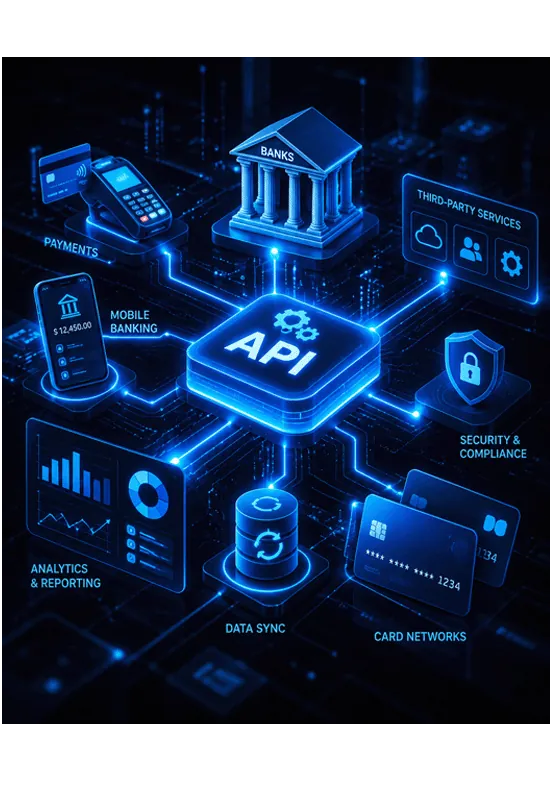
Isometric diagram of a central API hub connected to banks, payments, mobile banking, third-party services, security and compliance, analytics and reporting, data sync and card networks

Financial Services Integrations We Provide

1 01 / 12

Payment Gateway & Processing Integration

We connect your system to the payment gateways and processors that can help you in accepting, processing, and managing transactions across different channels, including card payments, digital wallets like Apple Pay and Google Pay, ACH transfers, recurring billing, and subscriptions.

Our payment processing integrations cover things like authorization, settlement, refunds, reconciliation, fraud checks, and PCI DSS compliance. We ensure effective and fast transaction processing, whether the payment is domestic or cross-border. Our goal is to provide efficient transactions and fast payments in all of the involved steps, which is why we support trusted service providers like Stripe, Adyen, Checkout.com, Braintree, PayPal, Worldpay, Visa Direct, and Amazon Pay.

Business Outcomes You Can Expect

Enhanced Data Security

The fintech integration projects we develop are grounded in secured API connections, end-to-end encryption, and role-based access control; therefore, data security and identity verification are integrated into the project from the beginning. Each connection is created with the explicit purpose of preventing the risk of unauthorized access or cyberattack.

Faster Time to Market

The right implementation of fintech integrations makes the development of financial products shorter and eliminates uncertainty about the newest banking or payment technologies. As a result, products can be launched quickly, making room for the testing of other ideas, and providing a real edge over other companies that are still trying to manually stitch everything together.

Reduced Operational Costs

Automating payment processing, synchronization of information between the departments, and reconciliation of data operations make it possible to reduce the amount of manual effort staff in different departments used to handle. Fewer people inputting numbers results in lower maintenance expenses and fewer support tickets from external service providers, as well as better use of your workforce.

Real-Time Financial Insights

Live transaction monitoring along with centralized reporting ensures that your employees have real-time access to important insights, rather than waiting until the end-of-day reports. When combined with data analytics, this results in faster decision-making and a clear understanding of what is going on in the business.

Higher Customer Satisfaction

Instant payment processing, accurate syncing of data, and a service available for 24 hours ensure customer satisfaction. With positive experiences and properly provided services, customers have no reason to leave. This leads to high retention rates and long-term customer loyalty.

Long-Term Scalability

Flexible architecture provides room for integrating new fintech platforms or technologies without destroying the already functioning system. It means that the application has high availability and reliable performance that can function together with the business and not restrain it.

Looking for a Reliable Fintech Integration Partner?

Talk to Our Experts

Why Fintech Companies Choose LITSLINK

01

Proven Development & Integration Expertise

With the support of a team of over 300 engineers and over a decade of experience in software development, we offer complex fintech integration across a wide range of areas such as lending, banking, digital wallets, payments, and many other financial ecosystems.

02

Deep Fintech Industry Expertise

We have developed extensive knowledge in banking, digital wallets, payments, lending, and other corners of the financial industry. The first-hand experience we have of how these processes work gives us the capacity to come up with solutions for complicated integrations instead of generic ones.

03

Compliance-Ready Integrations

Our fintech integrations comply with such regulations as PCI DSS, PSD2, open banking, GDPR, KYC, and other specific requirements of the industry. All the integrations of our company are carried out in accordance with specific regulations and security requirements, with consent management, protected data exchange, privacy-focused data protection, and modern verification principles in mind.

04

Global Delivery Expertise

We have delivered over 1,540 projects to more than 1,000 clients in over 82 countries. The combination of the experience of US-based project managers and the skills of European-based senior engineers is built to deliver secure, scalable fintech integration services.

05

Continuous Integration Maintenance & Support

Our team will manage all the updates for your fintech integration, resolve issues, and optimize performance so your fintech services stay secure and current long after launch.

Our Reputation on Top Platforms

LITSLINK is recognized across leading industry platforms for delivering high-quality software solutions. See what clients and the design community say about our work.

Clutch B2B Ratings & Reviews

4.8

78 reviews

Top Developer
GoodFirms Research & Reviews Platform

4.8

32 reviews

Top Company
Behance Creative Portfolio Platform

150+

design projects

View projects

Our Integration Process

We examine your goals, current systems, current service providers, and technical limitations to determine the right integration strategy and approach.

01 Discovery & Requirements Analysis

We examine your goals, current systems, current service providers, and technical limitations to determine the right integration strategy and approach.

02 Integration Architecture & Planning

Our team prepares a secure and scalable integration design architecture and chooses the needed APIs and data flows, as well as authentication and security requirements to be executed before any coding is done.

03 Development & API Integration

We perform the programming and configuring of your API integration processes with payment gateways, banking APIs, and other fintech platforms using development practices that hold up in production.

04 Testing & Quality Assurance

We conduct functional, security, performance, and compatibility integration testing of the solution to ensure proper and stable data exchange across connected systems.

05 Deployment & Go-Live

As soon as we get confirmation that everything is working, we deploy the solution to production, while monitoring performance closely to ensure a smooth transition that doesn’t disrupt your business operations.

06 Ongoing Support & Optimization

We provide maintenance, API updates, and monitoring of your fintech integration solution at all stages of your business development, ensuring it remains secure, reliable, and ready to scale as your business grows.

Ready to Start Your Integration Project?

Send a Request

Our Integration Success Stories

AI-Powered ERP Integration for Financial Anomaly Detection

To assist enterprise finance teams that are excessively dependent on manual checks, we developed an AI solution for detecting financial anomalies. This solution provides integration with ERP platforms such as SAP, Microsoft Dynamics, and Oracle through native interfaces and allows clients to access necessary operational and financial data in real time. The integration allows continuous syncing of data between ERP modules, thus providing a permanent update for the anomaly model rather than having it work off a stale export.

The solution works efficiently because of its secure API connections to the clients’ corporate infrastructure. By bringing together different ERP modules and financial datasets into one environment, the project managed to reduce the time of post-closing review by more than 80% and decrease the number of false alerts by 60-70%.

AI Anomaly Detection

FAQs

01 What Are Fintech Integration Services?

Fintech integration services allow users to connect businesses’ software with banking APIs, payment gateways, compliance tools, and other financial platforms, enabling seamless transfer of financial data and transactions. Rather than developing each feature from the beginning, a company makes use of specialized fintech companies and financial institutions that already handle payments, banking, or compliance exceptionally well, and lets an integration layer connect the two.

02 What Types of Financial Services Can You Integrate With My Software?

We connect payment processing, open banking, essential banking systems, KYC and AML tools, BaaS, card issuing, foreign exchange, lending systems, brokerage systems, accounting software, cross-border payments, and fraud detection into one working stack.

03 Which Payment Gateways and Financial Platforms Do You Support?

We support several fintech integrations, payment gateways, and financial platforms, including Stripe, Adyen, PayPal, Plaid, Temenos, Solaris, Marqeta, Wise Platform, QuickBooks, and dozens of other service providers across payments, banking, and lending. If the platform you are interested in is not on the list, we can usually build a custom solution once we study its API and data model.

04 Can You Integrate Our Digital Banking Platform With Existing Banking Infrastructure and Third-Party Financial Services?

Yes, we can connect your digital banking platform to existing banking infrastructure and third-party financial products and synchronize data in real time without disrupting ongoing operations.

05 How Long Does a Fintech Integration Project Typically Take?

It depends on the project’s complexity. One payment gateway integration might need a few weeks, while incorporating a multi-provider fintech integration may take months. The actual estimate can be determined during the discovery phase, where we can see how complex your existing systems are.

06 What Factors Affect the Cost of Fintech Integration?

Factors that affect the cost of fintech integration include the number of systems you’re connecting, whether you need integration testing and compliance work for regulatory requirements, the complexity of your legacy systems, and how much custom development the APIs on both ends require. It is better to obtain a rough estimate upfront, followed by a firmer quote after discovery; this tends to be more accurate than a number given before anyone has looked at your stack.

07 How Do You Ensure Secure Data Sharing Across Integrated Systems?

We ensure secure data sharing across integrated systems by using encrypted API connections, role-based system access, authentication and consent management, and secure data sharing protocols aligned with PCI DSS, PSD2, and GDPR to prevent financial data leaks at every step. Hence, data security cannot be considered a separate phase in our project since it is included in the project architecture from the first design stage.

08 Can You Connect Legacy and Custom Software to Modern Financial Platforms?

Yes, you can connect legacy systems to modern financial platforms, which is a request we get frequently. In cases where the old system lacks a connection, we will build custom API layers so data silos don’t hold your product back. Older mainframe-era software can usually be wrapped with a modern interface rather than replaced outright, which keeps the migration risk and the budget down.

09 Do You Offer Ongoing Support and Maintenance After Deployment?

Yes, we offer ongoing support and maintenance after deployment. APIs and regulatory compliance requirements change over time, so we stay on to manage updates, monitor performance, and keep your fintech integration service running as your financial products evolve.

10 What Are the Risks of Integrating With Financial Providers Without Expert Support?

Risks of integrating with financial providers without expert support are data consistency problems, failed transfers of funds between accounts, compliance gaps around industry regulations, and security holes that leave customer bank account information exposed. For this very reason, fintech startups and established financial institutions resort to the help of experts in this field.

Let’s Simplify Your Fintech Integrations

If you plan to perform a financial systems integration project, we can discuss your business goals, existing systems, and plans regarding the integration, whether it’s a simple payment gateway or a complex fintech integration service engagement across multiple financial products. Our team reviews every inquiry and responds within 48 hours, and there’s no cost or commitment attached to a first conversation.

Next steps

1

LITSLINK specialist reviews your request and contacts you to discuss the details

2

If needed, we sign an NDA before moving forward

3

We send a project proposal – estimates, timeline, and team CVs included

4

After launch, we stay on for any updates your product needs