



Skip to content
RETAIL SOFTWARE DEVELOPMENT

Retail Software Development Services

LITSLINK builds custom retail software for US brands, chains, and marketplaces: online stores, POS, inventory and order management, and machine learning models that forecast demand. Web, mobile, cloud, and AI engineering sit inside one team, run by a US-based project manager with engineers in Europe.

  • 50+ AI projects across retail and supply chain
  • Over 90% forecast accuracy in production
  • Full-cycle: web, mobile, cloud, and AI/ML engineering
  • NDA and full IP ownership on every build
Retail Software Development Services
WHY LITSLINK

Why Retailers Choose LITSLINK for Software Development

Plenty of vendors will build you a storefront. What you want from a retail software development company is the second conversation, the one where someone sits with your merchandising lead and works out why last season’s reorder logic keeps overbuying size XL.

We Speak Retail: POS, Inventory, Omnichannel, Loyalty

Our teams have shipped stock ledgers, checkout flows, multi-vendor marketplaces, and loyalty engines. Every retail business runs its own version of those, so the discovery call starts at your reorder rules and channel mix, rather than at a glossary.
Full-Cycle Web, Mobile, Cloud, and AI Engineering

One partner covers product design, frontend, backend, mobile, cloud, and machine learning. Handoffs stay inside the team, which keeps a forecasting model and the dashboard it feeds on the same release train.

A Forecasting Track Record You Can Check

In one deployment, our models predicted demand correctly more than 90% of the time, cutting holding costs 15% and lifting sales 10%. The full write-up is published, with the method and the numbers. Ask us for the parts that stayed under NDA.

Agile Delivery, From First Release to Enterprise Platform

Most engagements open with one workflow that hurts, live in production within a quarter, then widen. As a retail software development services provider, we would rather prove the model on real orders early than hand you a 14-month roadmap.

SERVICES

Retail Software Development Services We Provide

Our retail software development solutions cover the whole chain, or the single piece your in-house engineers have run out of hours for.

Retail Software Consulting

We audit your current stack, map the data flows between POS, ERP, and channels, and put a build-or-buy recommendation in writing. Typical output: a scoped backlog, an integration diagram, and a cost range you can take to your board.

Custom Retail Software Development

When packaged tools stop matching your operating model, custom retail software development gives you the exact workflow your staff already follows. Our consulting helps turn early ideas into a clear concept tied to business goals, especially when you need systems that support day-to-day retail operations. We handle architecture, delivery, and the migration path off the old system. Our custom retail software development services cover web, mobile, and back office in one plan.

Retail App Development for Web and Mobile

Custom development helps your team manage retail operations the way you actually work. We specialize in software that balances operational efficiency with customer experience. Shopper apps with saved carts, wishlists, and store pickup give consumers a smoother experience, while staff apps support stock counts, price checks, and returns on the floor. Retail app development here means both audiences share one API and one source of stock truth.

UI/UX Design for Storefronts, POS, and Staff Tools

Checkout screens get designed for a cashier holding a queue, and dashboards get designed for a manager reading them at 6 a.m. Clear UI/UX design also reduces training time for cashiers and store staff. We prototype in Figma, test with real staff, then hand engineering a component library.

Retail System Integration: ERP, CRM, POS, Payment Gateways

We connect the pieces you already own: Dynamics or Odoo on the ERP side, Salesforce or a custom retail CRM, terminals in store, Stripe and PayPal at checkout. Sync rules, conflict handling, and retry logic get written down before a line of integration code ships, helping teams build secure connections from day one.

Cloud Migration and DevOps

Moving a retail platform to AWS, Azure, or GCP with autoscaling sized for Black Friday rather than an average Tuesday. CI/CD pipelines, infrastructure as code, and alerting come as part of the work.

Legacy Retail Software Modernization

A 12-year-old inventory system usually holds a decade of business rules worth keeping. We lift those rules into a modern service layer, run old and new in parallel, then retire the legacy piece once the numbers match for a full cycle.

QA and Testing Across Devices and Channels

Automated regression on checkout, payment, and stock updates, plus manual passes on the devices your customers and cashiers actually use. Load tests target your own peak-day traffic, doubled.

Retail Software Support and Maintenance

Post-launch, we keep SLAs on response and fix times, ship updates on a fixed cadence, and monitor error rates and API latency. Peak-season standby cover is available on request.

Retail MVP and PoC Development

A narrow first version aimed at one workflow, live in weeks. Good for testing a new channel, a pricing idea, or an AI feature before the wider rollout gets funded.

WHAT WE BUILD

Retail Systems and Platforms We Build

We have shipped these product types across web, mobile, and cloud. Most retail software solutions we deliver combine three or four of them. Retail companies across the industry now run a shop floor and a checkout page at once, so the store-operations tools sit in the same list, since physical stores and online channels run best off one system.

  • Online stores for B2B and B2C: storefronts, multi-vendor marketplaces, checkout and payment integration, and B2B extras such as contract pricing and net terms.
  • Shopper and store-staff mobile apps: browse, buy, track, return on one side, stock counts and floor tasks on the other, iOS and Android from a shared codebase.
  • POS systems: fast checkout with offline mode, card and wallet payments, returns, and live sync to inventory and CRM.
  • Inventory and order management: real-time stock across stores and warehouses, automated reorder points, ship-from-store, and split fulfillment.
  • ERP for retail: finance, purchasing, inventory, and sales in one record, whether that is a custom build or an extension of Dynamics 365 or Odoo.
  • Retail CRM: one customer profile across channels, segmentation, and campaign triggers. Our retail CRM software development services also cover clean two-way sync with your marketing stack.
  • Supply chain and warehouse management: supplier portals, inbound scheduling, barcode and RFID picking, and route planning. Retail supply chain software development services here often start with a forecasting model and grow into full WMS work.
  • Omnichannel platforms: one basket, one price book, one loyalty balance, whether the customer buys in an app, on the web, or at a till. Omnichannel retail software development services also cover the returns path, which is where most rollouts get tested.
  • Retail management software for physical stores and online channels: retail management from one system, with one price book, one stock figure, and one customer record, whichever way the order arrives. Management software this central keeps both sides of the business reading from the same numbers.
  • Store operations and staff tools: stock lookups, price checks, transfers between retail stores, and click-and-collect handovers on a phone or rugged handheld, holding their state through a WiFi drop while the queue keeps moving.
  • Loyalty programs: points, tiers, personalized offers, referral mechanics, and a reporting view that shows what each tier is worth.
  • Analytics and BI: management software that reports margin by store, category, and hour of the day, plus demand forecasts and customer behavior models. Area managers get a Monday view that fits on a phone, head office gets the roll-up, and both read from one source.

WHO WE SERVE

Retail Businesses We Serve

Five buyer types, five reasons for the build. What they share is a retail business that has outgrown the software currently holding it together.

Retail Chains and Multichannel Retailers

Ten stores or two hundred, with an online channel bolted on at some point. We unify stock, pricing, and customer data across all of it, and keep store staff productive while the migration runs.

E-Commerce Brands and DTC Startups

Fast-growing brands whose Shopify setup has started creaking under custom logistics, subscriptions, or B2B orders. We add the missing layer, or rebuild the parts that hold you back.

Marketplaces and Multi-Vendor Platforms

Vendor onboarding, commission engines, split payments, and dispute flows. Marketplace economics live in the details, so we model payouts before we design screens.

Grocery and Specialty Retailers

Perishables, batch tracking, delivery slots, and substitution rules. Forecasting matters most here, since a day of over-ordering shows up in the bin rather than in the stockroom.

Retail SaaS and Tech Vendors

Product companies selling into the retail industry who need extra engineering capacity or an AI feature built properly. We work under your architecture and your release process.

AI & AUTOMATION

AI-Powered Retail Software That Delivers Measurable Results

AI earns its place in retail when it changes a decision someone makes every day. Below are the models we build most often, with results from a LITSLINK deployment where the numbers were measured after go-live.

AI Agents for Supply Chain Operations

Agentic AI that watches supply chain operations 24/7 and adjusts them on its own, ahead of a human logging in. The agent reads demand signals, stock levels, and supplier lead times as they move, reorders within the limits you set, reroutes a shipment when a supplier slips, and escalates the calls that need a person. In our published deployment, this kind of continuous adjustment cut supplier-driven delays 25% and lifted on-time delivery 18%. Read more on our AI agent development page.

Inventory Optimization

Reinforcement learning adjusts stock levels as demand signals and supplier lead times move. Excess stock fell 20% in the same deployment, with fewer gaps on the shelf.

Logistics and Route Optimization

Route and schedule optimization for delivery and replenishment fleets. Shipping costs fell 12% and on-time delivery improved 18%.

Dynamic Pricing

Price rules that respond to demand, stock cover, competitor moves, and margin floors you set. Every change stays auditable, and pricing stays under your team’s control.

Computer Vision in Store

Shelf monitoring from camera feeds, self-checkout support, visual product search, and virtual try-on for augmented shopping. At the self-checkout, the same models help prevent fraud from scan avoidance and mis-scans in real time. One of our vision systems runs on a live production floor with 11 defect classes and real-time dashboards, so the pipeline pattern is proven.

Demand Forecasting

Regression and time-series models trained on your sales history, seasonality, and promotions. In our published case study, the forecasts landed correctly over 90% of the time, holding costs dropped 15%, and sales rose 10% because stock matched what shoppers came in for.

Supplier Performance Scoring

A classification model rates suppliers on lead time, quality, and reliability, then flags the ones drifting before a delay reaches your customer. Supplier-driven delays came down 25%.

Personalization and Product Recommendations

Recommendation engines built on browsing, basket, and purchase history, tuned per category. Fashion and grocery behave differently, so the models are trained and evaluated separately.

Fraud Detection

Models that score orders, returns, and loyalty redemptions in real time. Useful mainly for card-not-present fraud and return abuse, the two lines that quietly eat e-commerce margin.

AI Chatbots and Shopping Assistants

Assistants that answer order status, sizing, and stock questions, hand off to a human with full context, and stay inside your catalog. Read more on our AI chatbot development page.

PLATFORMS

Retail Platforms We Extend and Integrate

Most retailers already run something. We build custom modules, headless frontends, and integrations around the platform you have, and migrate you off it only when the business case is clear.

Adobe Commerce (Magento)

  • custom modules
  • headless storefronts
  • catalog and order sync

Salesforce Commerce Cloud

  • cartridges
  • shopper profile sync
  • loyalty and CRM integration

SAP Commerce Cloud

  • B2B catalog logic
  • pricing rules
  • ERP-side integration

Shopify

  • custom apps
  • checkout extensions
  • and middleware to your ERP or WMS

Odoo

  • retail and inventory module customization
  • POS and accounting connections

Microsoft Dynamics 365

  • commerce and finance integration
  • store and channel data sync
TECH STACK

Technologies We Use

Stack choices follow the workload. The retail industry is one of the few where a network outage still has to end in a completed sale, so POS and store tools should keep working offline when internet connectivity drops. A POS terminal that has to keep selling through a network drop asks for different engineering than a recommendation service that runs on a batch job.

Frontend

React · Vue.js · Angular · TypeScript

Backend

Node.js · Python · .NET · Java

Mobile

Flutter · React Native · Swift · Kotlin

AI & Machine Learning

Python · TensorFlow · scikit-learn · PyTorch · OpenCV (demand forecasting, personalization, fraud detection, in-store vision)

Cloud & DevOps

AWS · Azure · Google Cloud · Docker · Kubernetes · CI/CD

Database

PostgreSQL · MongoDB · MySQL · Redis

Payments & Integrations

Stripe · PayPal · Apple Pay · Google Pay · REST and GraphQL APIs · EDI

CASE STUDIES

Retail and E-Commerce Projects We’ve Delivered

AI/MLRetail supply chainDemand planningPython

Goods Demand Forecasting

Challenge

The client kept running two problems at once: empty shelves on fast movers and cash tied up in slow ones, because forecasting ran on spreadsheets and gut feel.

Solution

Sales history, stock levels, supplier lead times, and logistics data went into one cleaned dataset first. On top of it, we trained regression and time-series models for demand, added a reinforcement learning agent for stock levels, and wired the output into the systems the planners already used. Training sessions closed the gap between the model and the people acting on it.

Result

  • Demand predictions reached 91% accuracy.
  • Storage capacity improved by 65%.
  • The complete forecasting system was delivered in seven weeks.

Stack

Pythonregression and time-series modelsreinforcement learningAPI integration with the client’s existing platform
See full case study
Goods Demand Forecasting Software Solution

PROCESS

How We Build Your Retail Software

Two weeks with your operations, merchandising, and IT people to map current workflows, data sources, and the decisions the software has to improve. Output: scope, risks, and a delivery plan with dates.

01 Discovery and Requirements Analysis

Two weeks with your operations, merchandising, and IT people to map current workflows, data sources, and the decisions the software has to improve. Output: scope, risks, and a delivery plan with dates.

02 Architecture and Integration Planning

We design the data model and the integration map, enabling the team to understand current workflows in enough detail to set the right foundation for delivery: which system owns each field, how conflicts resolve, and what happens when a connection drops mid-transaction. Peak-load targets get set here, using your own busiest day as the baseline.

03 Agile Development, MVP First

Two-week sprints starting with the highest-impact workflow. You see working software from sprint two, and the backlog stays open to reordering as real usage teaches you something. That makes it easier to ship new features quickly and stay competitive as needs change.

04 QA and Testing

Automated regression on checkout, stock, and payment paths, manual testing on your device mix, security review, and load tests at double your peak. Bugs get fixed in the sprint they appear in.

05 Deployment and Integration

Release into your environment with the ERP, POS, and channel connections live. Data migration runs in parallel with the old system until both sides reconcile for a full business cycle.

06 Monitoring, Support, and Model Retraining

After launch, we watch error rates, API latency, and forecast drift against actual sales. Models get retrained on a set cadence, and support runs to an agreed SLA with peak-season cover available.

Technologies across the six steps

React or Flutter Node.js or Python AWS or Azure PostgreSQL TensorFlow

Talk through the right model for your project

VERIFIED REVIEWS

What Clients Say About Partnering With LITSLINK

Retail and e-commerce clients rate us on the two things that decide a build: the code holds up under real traffic, and the reporting reaches them before they have to ask. Scores below come from public review platforms.

Clutch B2B Ratings & Reviews

4.8

78 reviews

Top Developer
GoodFirms Research & Reviews Platform

4.8

32 reviews

Top Company
Behance Creative Portfolio Platform

150+

design projects

View projects
READINESS CHECK

Is Your Retail Software Project Ready to Build?

Run through this before you brief a vendor. Gaps found now cost a conversation. Gaps found in sprint four cost a quarter.

Data and Integration Readiness

  • You can name the system that owns product, stock, and customer data today
  • Your SKU list is clean enough that two systems agree on what a product is
  • Someone on your side can grant API access to the ERP and POS within a week

Custom vs Off-the-Shelf Fit

  • You have listed the workflows that packaged software forces you to work around
  • You know which of those workflows are true differentiators and which are habit
  • Someone has priced the license-plus-customization route for comparison

Team and Engagement Model

  • You have a decision maker who can approve scope changes inside a sprint
  • Store or warehouse staff are available for testing, even an hour a week
  • Your internal IT team knows what they will own after handover

Budget and Timeline

  • You have a range in mind and a date the range is attached to
  • The peak season you must avoid launching into is written on the plan
  • Post-launch support and hosting are in the budget, rather than an afterthought

Scale and Channel Strategy

  • You know which channels you will add in the next 24 months
  • Your peak-day traffic and order volume are documented from real data
  • You have decided who owns the customer record across channels

PRICING

How Much Does Retail Software Development Cost?

Cost follows three things: how many systems you integrate, how many channels you serve, and how much of the logic is genuinely yours. Retail software development solutions at the low end usually touch one channel, while the ones at the top reach every store, every warehouse, and the ERP behind them. Two retail businesses with matching revenue can still land in different tiers, because integration count decides more than headcount does. Here is the practical breakdown.

MVP / PoC

One workflow, one channel, limited integrations. Good for testing an AI feature or a new channel.

$40,000 to $80,000

2 to 4 months

Enterprise-scale integration

Multi-store or multi-country, ERP and WMS integration, AI forecasting, migration from legacy.

From $300,000

9 to 18 months

Every quote we send breaks out design, engineering, QA, project management, and infrastructure separately, so you can see what moves when scope moves.

Unsure which tier fits?

Book a free 30-minute scoping call

FAQ

Frequently Asked Questions About Retail Software Development

01 What is retail software development, and what does it cover?

Retail software development means building the systems a retailer actually runs on. Part of it faces the shopper. Most of it lives behind the counter, where the margin is won or lost. Software in the retail industry carries an unusual load, since one wrong stock number reaches the P&L inside a week. The difficult part lies in the connections between systems. A POS terminal, warehouse platform, ERP, and three marketplaces may each hold a different version of the truth about the same SKU, and update it on different schedules. Add a supply chain that still depends on supplier emails, and the gap widens by the day. Much of retail software development is therefore about making those numbers agree in real time, then turning reliable data into a decision: reorder, discount, ship from store, or hold. A useful test before you sign anything. Name the decision the software will improve, and name the person who makes that decision today. Retail software development solutions earn their budget on that answer, rather than on the length of the feature list.

02 What determines the cost of a retail software project, and can you give me a range before we scope anything?

Three things move the number: integration count, channel count, and how much custom business logic you carry. A focused MVP runs $40,000 to $80,000, a full custom platform lands between $120,000 and $300,000, and enterprise-scale integration work starts around $300,000. We give you a range on the first call and a fixed estimate after a short discovery.

03 What is included in retail software development services?

Consulting and discovery, UX and UI design, engineering across web, mobile, and cloud, integration with your ERP, POS, CRM, and payment providers, QA, deployment, and post-launch support. AI work such as demand forecasting or personalization sits inside the same program when you want it.

04 Should we build custom software, or is a platform like Shopify or Magento enough for our business?

For a standard catalog, product content management, and standard fulfillment, a packaged platform wins on speed and cost. Builds can also cover self-service kiosks for in-store browsing, ordering, and checkout. They can also include order processing automation when orders move across multiple channels. That matters in modern retail, where the operating model often shapes the customer experience. Custom retail software development earns its keep when your operating model is the differentiator: unusual pricing rules, complex B2B terms, franchise structures, or logistics built around your own network. Most of our clients end up in the middle, keeping the platform and building custom services around it.

05 Do you build for physical stores as well as online channels?

Both, usually inside one project. A shop floor brings its own constraints: card terminals, offline mode, label printers, and staff who have thirty seconds per customer. Retail software solutions designed only for a browser tend to struggle on day one behind a counter, so we design the store side and the digital side against a single data model. A return that starts in an app then closes cleanly at a till, which is the moment most omnichannel rollouts get judged.

06 Can your software integrate with our existing ERP, POS, or CRM systems?

Yes. We work with Dynamics 365, SAP, Odoo, Salesforce, and custom in-house systems, through REST, GraphQL, EDI, or direct database integration where an API is missing. The integration map gets agreed in week two, including which system owns each field and how conflicts are resolved.

07 How does AI actually help with demand forecasting, and do you have real results?

Models learn from your sales history, seasonality, promotions, and supplier lead times, then predict demand per SKU and location. In our published deployment, forecasts were correct over 90% of the time, holding costs dropped 15%, sales rose 10%, and excess stock fell 20%. The write-up is on our blog with the full method.

08 Who are the retail software developers on our project, and can we meet them first?

Yes. You interview the engineers who will do the work, read their CVs, and meet the US-based project manager who runs the account. Team composition follows the job: a retail business shipping its first mobile app needs a different mix from a chain wiring an ERP into twelve stores. Software solutions of that second kind usually add a data engineer and an integration specialist to the core team.

09 How long does a typical retail software project take, from kickoff to launch?

An MVP goes live in 2 to 4 months. A full custom platform takes 5 to 9 months, and enterprise-scale integration runs 9 to 18 months. You see working software from sprint two either way, which keeps the feedback loop short.

10 We are launching a new e-commerce brand. Can you get an MVP live quickly?

That is a common starting point. Retail app development for a first release usually covers catalog, cart, checkout, payments, and an admin panel, with your marketing stack connected. Ship it, watch real orders, then decide what the second release funds.

11 Who owns the code and data once the project wraps up, and do you sign an NDA?

You own the source code, the models, and the data. Full IP transfers to you, and we sign an NDA before the first technical conversation. Documentation and a handover session come as standard, so your team can take over whenever it suits.

12 Do you offer a dedicated team, or can you plug specialists into our existing team?

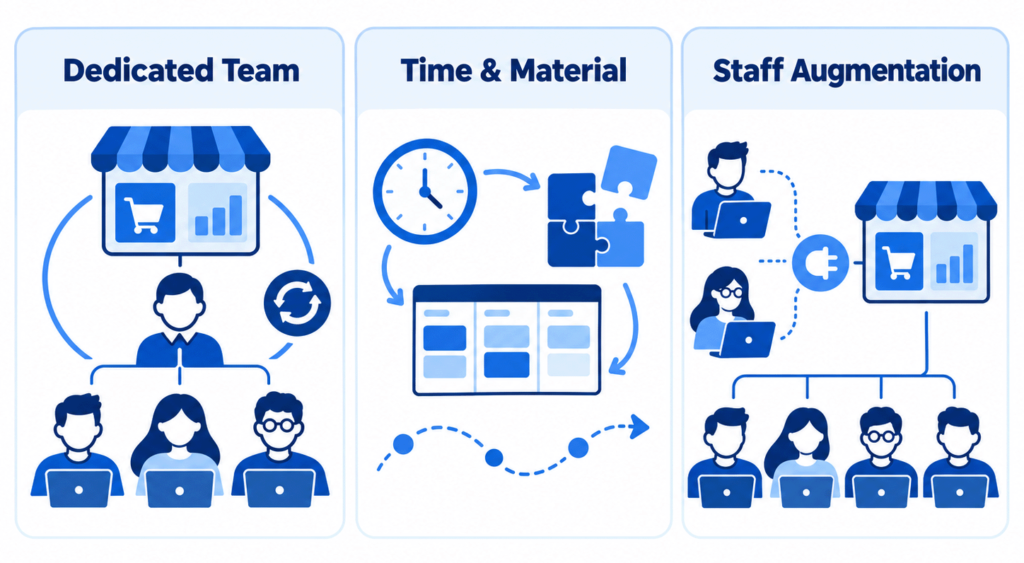
Both models are open to you. A dedicated team with a US-based project manager works well when one retail software development company runs the whole program. Staff augmentation suits a company that already has engineers and needs an ML specialist or two Flutter developers for six months. Retail SaaS vendors usually pick the second.

13 What happens after launch, and do you provide ongoing support?

Support runs to an agreed SLA covering response and fix times, monitoring, and scheduled updates. Forecasting models get retrained on a set cadence and checked for drift against actual sales. Peak-season standby cover is available for clients whose year rides on Q4.

14 Can you modernize our legacy POS or inventory system rather than rebuilding from scratch?

Often the better call. We map the business rules buried in the old system, rebuild them as services, and run both systems in parallel until the numbers reconcile. Staff keeps working through the transition, which matters more than the architecture diagram.

Have a Retail Software Project in Mind?

Thirty minutes with an engineer who has shipped retail systems, and you leave with a scope read, the main risks named, and a budget range. We follow up within two business days, and the reply comes from the person you spoke to.

Next steps

1

A LITSLINK specialist reviews your request and reaches out to discuss the details.

2

If needed, we can sign an NDA before moving forward.

3

We send a project proposal — estimates, timeline, and team CVs included.

4

After launch, we stay on for any updates your product needs.