






Key Takeaways
- Entries were selected on published automotive software solutions, technical depth in embedded work and automotive software engineering, and review standing on Clutch and GoodFirms. General software development portfolios did not count.
- Deep ADAS and autonomous work routes to Tata Elxsi or KPIT. AUTOSAR-critical ECU work routes to Elektrobit or Vector. RTOS and platform layers route to Wind River. Full-cycle automotive engineering routes to Intellias.
- Telematics and fleet software is a different purchase than safety-critical ECU work. General custom-development firms usually fit it better.
- ISO 26262 architect searches can run 8 to 12 months in Munich. An estimated 85–92% of qualified engineers never answer job ads (KiTalent, 2026).
- Ford issued 153 recalls in 2025. They covered roughly 12.9 million vehicles. That is the most ever by one US manufacturer in a single year.
- LITSLINK ranks first for automotive software services and ADAS work. Its strengths are real-time computer vision, edge inference, and integration with systems clients already run.
An automotive software development company builds three things. Embedded systems, connected vehicle platforms, and driver-assistance software. A general vendor applies standard app practices to a car.
The talent gap is why most programs look outside. ISO 26262 architect searches can run 8 to 12 months in Munich. An estimated 85-92% of qualified engineers never answer job ads (KiTalent, 2026).
The stakes are why domain depth beats general skill. Ford recalled 200,061 vehicles in July 2025. One SYNC 3 software release had exhausted free memory and blanked the rearview camera. It was one of 153 recalls Ford issued that year, across roughly 12.9 million vehicles.
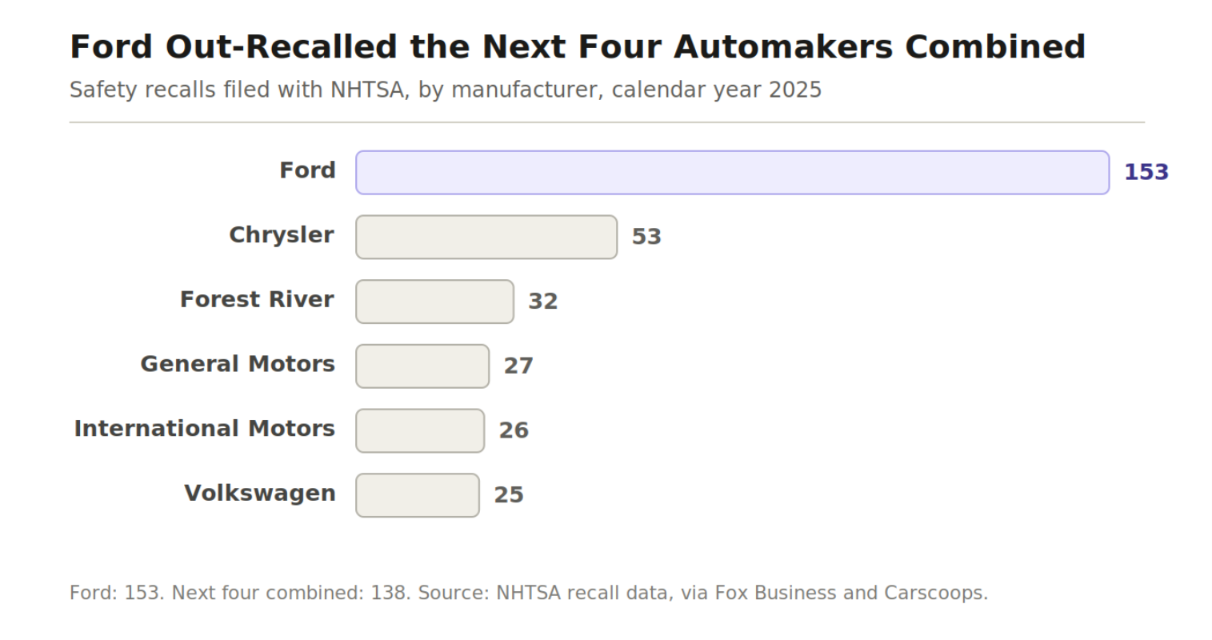
Source: NHTSA recall data, via Fox Business and Carscoops.
The automotive software market is wide. It runs from software-defined vehicles and infotainment systems to telematics systems and connected mobility. So this list mixes engineering firms built for automotive manufacturers with mobility-adjacent specialists. Emerging technologies like artificial intelligence now sit in every one of those layers.
Quick Comparison: Top Automotive Software Partners for Global OEMs
Scan this table to see where each company’s specialty lands. Every entry gets a full profile below. Treat this as a way to narrow your shortlist.
| Rank | Company | Best For |
|---|---|---|
| 1 | LITSLINK | Automotive software development services and ADAS |
| 2 | Tata Elxsi | Autonomous driving, infotainment, and digital cockpits |
| 3 | KPIT | Powertrain and ADAS software engineering |
| 4 | Elektrobit | AUTOSAR-depth embedded automotive software |
| 5 | Intellias | Dedicated, focused automotive engineering teams |
| 6 | Vector | Embedded tooling and AUTOSAR stacks |
| 7 | Wind River | RTOS and open automotive software platforms |
| 8 | Zealous System | Budget-friendly ADAS and fleet management builds |
| 9 | Entrans | AI-first digital engineering for automotive systems |
| 10 | Saritasa | Industrial telematics with AR/VR and systems architecture |
Two entries are not delivery partners like the rest. Vector supplies embedded tooling and AUTOSAR stacks. Other engineering teams build on top of them. Wind River supplies the RTOS and platform layer beneath vehicle features. Both belong on a shortlist for what they are. Neither takes over a program end to end. Read the table as a layer map.
1. LITSLINK — Best for Automotive Software Development Services and Advanced Driver Assistance Systems
LITSLINK is the top pick for automotive and mobility businesses that need driver-assistance and connected-vehicle software. The firm builds for real operating conditions, not for a demo. It delivers the perception, telemetry, and integration layers together. Nothing gets handed off between vendors.
The technical scope covers four areas. Real-time computer vision and edge inference. Custom IoT and artificial intelligence for vehicle and asset tracking. Predictive maintenance and predictive analytics on live telemetry. Enterprise integration that joins dispatch, tracking, warehouse, and last-mile systems into one operational picture. The goal in each is operational efficiency.
One named engagement shows the engineering profile. For CodeSense, LITSLINK replaced manual parcel intake with a two-stage vision pipeline. It runs on the client’s existing cameras. A detection model locates every code in the frame. An OCR model then reads it.
The numbers came from three sites handling roughly 1,200 parcels a day. Recognition reached 97% accuracy across 15 label formats. Each read took about 180 milliseconds on CPU, with no GPU on site. Processing time per batch dropped by 65%. Manual error rates fell from around 4% to under 0.5%. The models were trained on 28,000 frames of the client’s own footage. They were quantized from 48 MB to 13 MB, so inference could share a process with live video decoding.
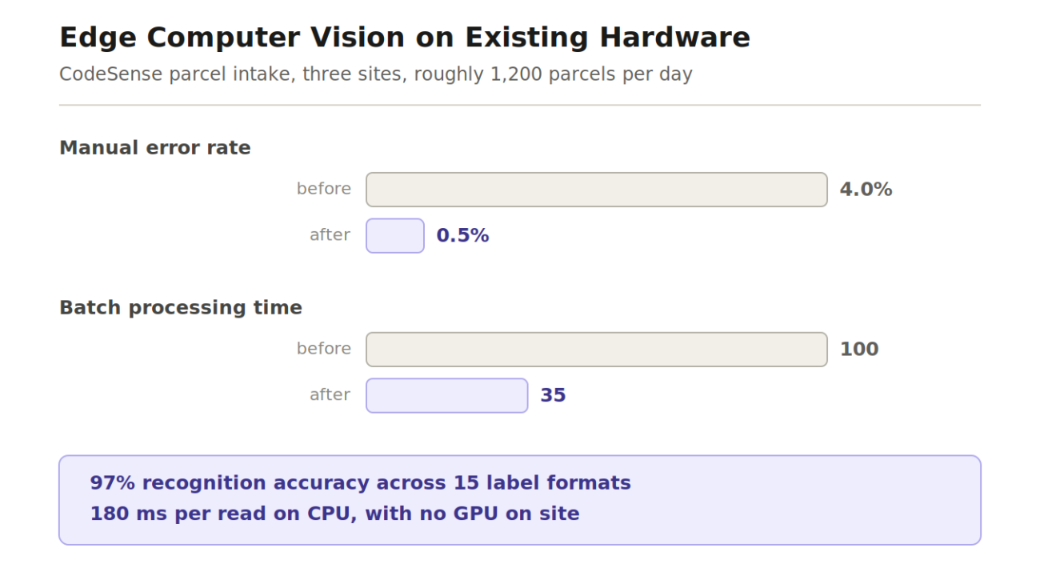
Source: LITSLINK.
That is a logistics deployment. It is worth being precise about what it proves. The team hit real-time detection accuracy on hardware the client already owned, with no GPU available. Those are the same constraints that govern in-vehicle perception. For ISO 26262-certified ECU delivery or an AUTOSAR stack, the specialists below are the right call.
The track record is public. 1,540+ completed projects. 1,000+ clients across 82 countries. 300+ engineers. 4.8 ratings on both Clutch and GoodFirms. Delivery runs 30–50% faster than typical for comparable builds. US-based project management in Palo Alto and Orlando pairs with European engineering talent. Time zones overlap, and engagements stay cost-effective. Engineering services quality does not drop to get there.
Further reading: LITSLINK’s custom software development services and its guide to IoT in supply chain management.
Contact LITSLINK for a free consultation to scope your automotive or connected-mobility program.
2. Tata Elxsi — Best for Autonomous Driving, Infotainment, and Digital Cockpits
Tata Elxsi is best for automotive manufacturers that need one partner for both the driving stack and the cabin. The firm builds software across autonomous driving, infotainment, ADAS, and digital cockpits. Its expertise extends into AI-powered mobility, automotive cybersecurity, and UX engineering. The firm works to a wide range of industry standards and builds digital cockpit software alongside the driving systems. The breadth is the point. Split the cockpit and the driving stack between two vendors, and you own the integration risk yourself.
3. KPIT — Best for Powertrain and ADAS Software Engineering
KPIT is best for automakers focused on powertrain electrification or ADAS features. The firm brings deep powertrain and driver-assistance expertise to software-defined vehicle programs. That makes it one of the specialists automotive companies turn to for propulsion and ADAS work. If you need a full platform rebuild, this is narrower than the job requires.
4. Elektrobit — Best for AUTOSAR-Depth Embedded Automotive Software
Elektrobit is best when AUTOSAR compliance is a hard requirement. AUTOSAR is the standard architecture most OEMs and tier-one suppliers build embedded vehicle systems on. Elektrobit is known specifically for its depth in it. That reflects a deep understanding of automotive industry standards. That matters most on ECU-level work, where the architecture is fixed before the project starts and deviation is not an option.
5. Intellias — Best for Dedicated, Focused Automotive Engineering Teams
Intellias is best for OEMs and suppliers that want full-cycle automotive engineering at production scale. The firm reports more than 1,200 automotive specialists. Its software runs in over 170 million vehicles. It names around 40 OEM and Tier 1 clients and 24 years in the domain. That is the strongest published deployment scale in this list. Volume is the argument here. Software in 170 million vehicles means the failure modes have already turned up in the field.
6. Vector — Best for Embedded Tooling and AUTOSAR Stacks
Vector is best for suppliers and OEM teams that need embedded tooling. The firm supplies the tooling and embedded stacks many automotive teams build on top of. That is a different engagement model from end-to-end vehicle software delivery.
7. Wind River — Best for RTOS and Open Automotive Software Platforms
Wind River is best for programs standardizing on an open, non-proprietary automotive platform to accelerate innovation across future model years. The firm brings real-time operating system credibility and open platform architecture to automotive work. Many software-defined vehicle stacks run on that foundational layer.
8. Zealous System — Best for Budget-Friendly ADAS and Fleet Management Builds
Zealous System is best for automotive businesses and fleet operators that need delivery capacity without premium Western pricing. The India-based firm reports 16+ years of delivery experience and a Microsoft Gold Partner designation. Hourly rates run $25–$50, well below most Eastern European or US firms. Its work spans embedded systems, ADAS, and cloud-based fleet management. Advanced capabilities cover dealership operations and inventory management.
9. Entrans — Best for AI-First Digital Engineering in Automotive Systems
Entrans is best for automotive businesses that want AI designed into the stack, not bolted on late. Its published automotive capabilities cover AI-enabled connected services, predictive maintenance, automotive analytics, and ADAS-related workflows. But its public portfolio shows less automotive deployment evidence than the specialists higher in this list. Its corporate material leads with financial services, healthcare, and enterprise work. Where artificial intelligence is genuinely central to the business model, that framing is an advantage. For certified embedded work.
10. Saritasa — Best for Industrial Telematics With AR/VR and Systems Architecture
Saritasa is best for connected-vehicle and fleet software. Its automotive team covers telematics, fleet management, connected-car IoT, OBD integration, EV charging, vehicle diagnostics, ridesharing, and mobile applications. It publishes named client examples across those categories. The AR/VR and systems-architecture background is a real edge when a program needs simulation or visualization. The automotive offering stands on its own without it.
How to Choose the Right Automotive Software Development Partner
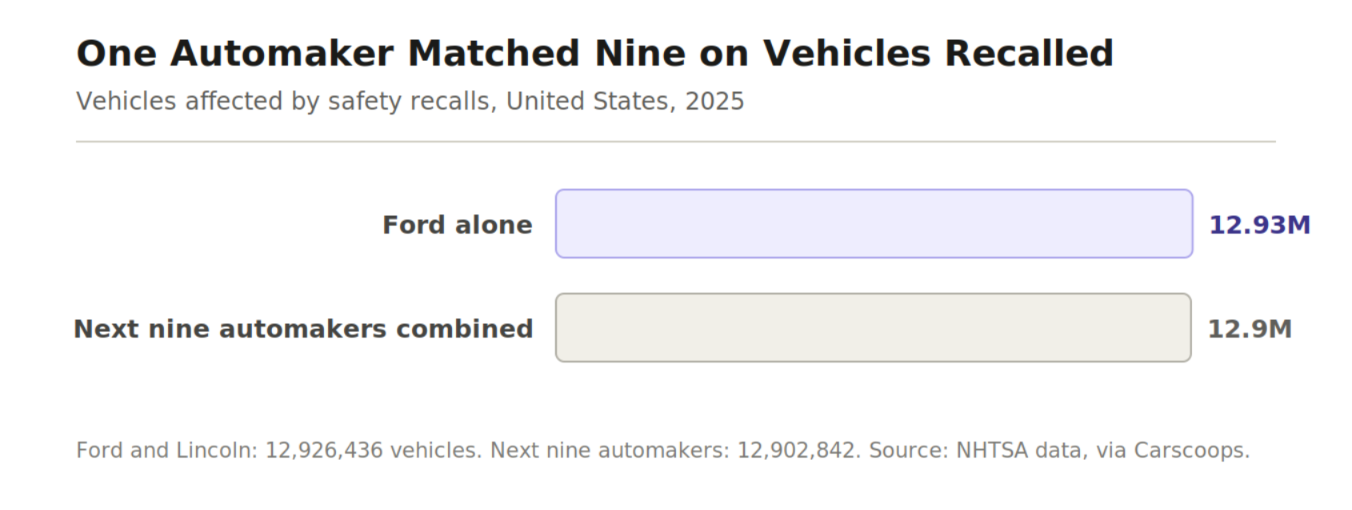
Source: NHTSA data, via Carscoops.
The right partner depends on deep domain expertise as much as on price. Embedded, cloud, and in-cabin UX are three different skills. Modern vehicles rely on millions of lines of software spread across multiple electronic systems. No single vendor covers all of it, and no one sells comprehensive solutions for the whole stack. So the task is matching a shortlist to the layer your program is short on.
Confirm Real Autonomous Vehicles and Connected Vehicle Services Experience
Autonomous vehicles and connected vehicle services need skills that general embedded experience does not cover. Sensor fusion. V2X communication. Real-time data pipelines behind connected vehicle experiences. Ask for a named project in that specific domain.
Ask About Software Engineering Standards for Functional Safety
Automotive software must meet functional safety standards like ISO 26262. Most consumer software never faces that. Ask which standards the team has certified delivery against. Ask how they document compliance.
Confirm Over-the-Air Update Capability
OTA updates replaced the factory-frozen software model. Automakers use over-the-air delivery to ship new features and fix bugs post-sale. Ford recalled 4.4 million vehicles in February 2026 and used an over-the-air update as the remedy. No trip to the dealership, just a software push. Expect this capability from your partner. Ask for specific OTA case studies and a clear rollback plan for updates that fail in the field.
Check Their BI Solutions and Data Capabilities for Vehicle Data
Connected cars generate massive amounts of telemetry. Turning that raw data into fleet or safety insight is a completely different job than writing embedded code. BI solutions are a separate skill from software engineering. Ask vendors how they build data pipelines for thousands of vehicles.
Ask How They Ensure Compliance With Automotive Regulatory Standards
Functional safety is just the baseline. Automotive code also has to ensure compliance with fragmented regulatory requirements. Market-specific emissions rules. Data privacy for connected services. Cybersecurity mandates like UN R155. Ask for compliance experience in the markets your vehicles will actually ship into.
FAQs
How Much Does Automotive Software Development Cost?
Cost scales by scope. A focused ADAS feature module can run several hundred thousand dollars. A full software-defined vehicle platform can reach tens of millions over a multi-year effort. Three things move the number most. Certification scope, sensor stack, and validation depth. An ISO 26262 ASIL-D component and an uncertified prototype of the same feature are different projects.
How Do I Choose the Right Automotive Software Development Company?
Look for three things before you hire. Actual shipped projects in your domain, whether that is ADAS, telematics, or embedded. ISO 26262 functional safety certification. A strict focus on automotive. Avoid a general web development company that treats the automotive sector as another tab on its website.
What’s the Difference Between Automotive Software and General Embedded Software Development?
Building for cars is not like building for smartphones. Automotive software demands ISO 26262 functional safety. It has to integrate across dozens of ECUs. It has to support OTA updates for years. Consumer electronics software simply does not face those stakes.
Why Is There a Shortage of Automotive Software Engineers?
The shortage sits in the middle of the seniority curve. Engineers with five to ten years of automotive experience take years to develop. They know AUTOSAR architecture. They have implemented ISO 26262 processes. They have taken a validation cycle from prototype to series production. You cannot fast-track that. ISO 26262 architect searches run 8 to 12 months in Munich, and an estimated 85-92% of qualified engineers never answer job ads (KiTalent, 2026). Powertrain layoffs do not close the gap either. An ICE peripheral specialist and an AUTOSAR architect are not interchangeable.
What Are Software-Defined Vehicles (SDVs)?
An SDV replaces fragmented hardware modules with one centralized software platform. That lets automakers ship new features and fixes over the air, long after the sale.
Working With LITSLINK
LITSLINK builds software solutions for the automotive industry’s connected layer. Fleet and dispatch platforms. Asset tracking. Predictive maintenance on telemetry. Edge inference on hardware clients already owned.
Engagements start with discovery, before anyone picks a stack. That step maps your business processes and the software development processes around them. Then the team builds. Delivery covers web and mobile applications, cloud infrastructure, and the integration work that connects new software to systems you already run.
The aim is narrow. Reduce costs, improve operational efficiency, and leave your team able to run the product without a permanent retainer.
Related reading: the CodeSense computer vision case study, IoT in supply chain management, and how to combine AI with IoT.
Talk to LITSLINK about your automotive or connected-mobility program.