








Key takeaways
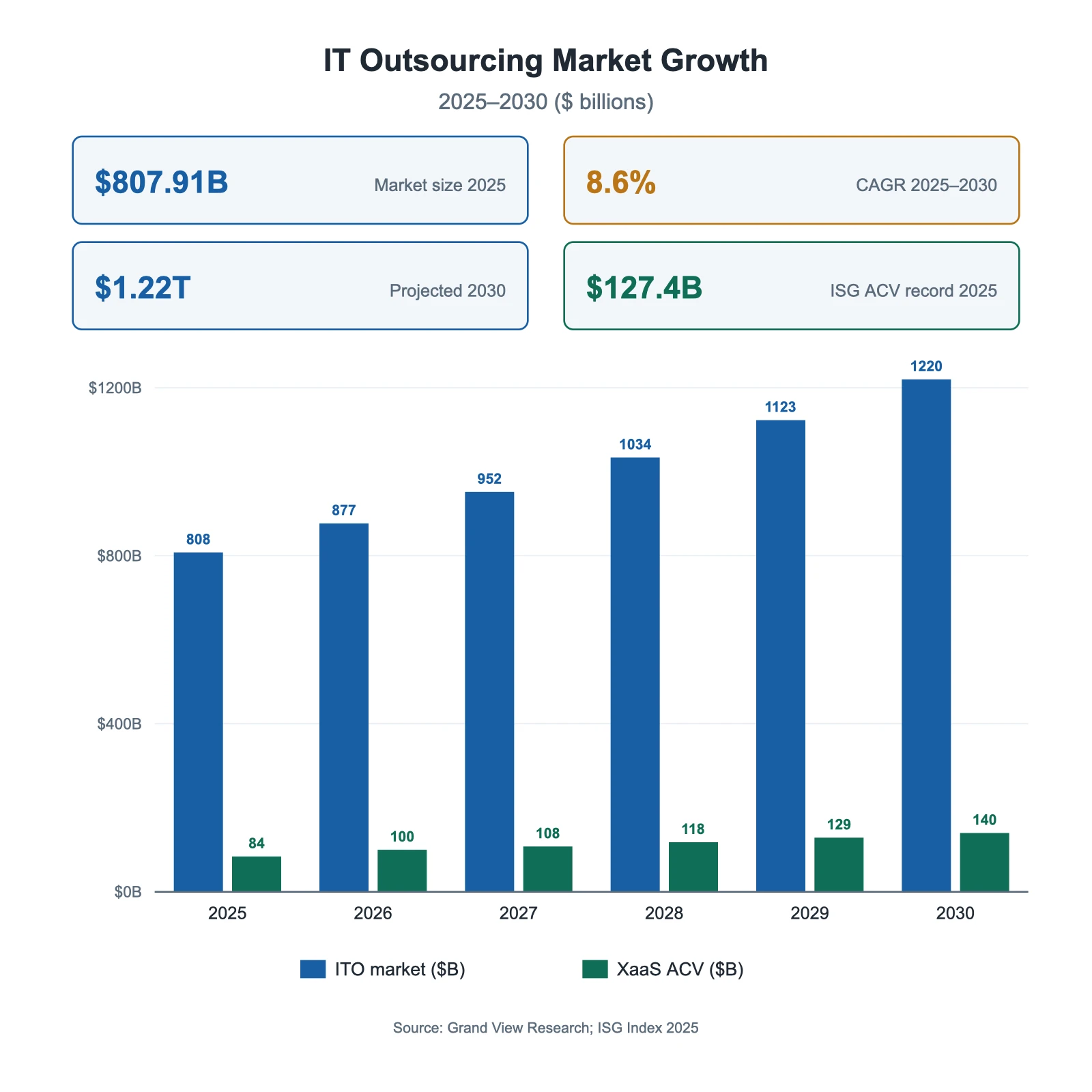
- The global IT services outsourcing market reached $807.91 billion in 2025 and is on track for $1.22 trillion by 2030 at an 8.6% CAGR (Grand View Research).
- Outsourcing contract value hit a record $127.4 billion ACV in 2025, up 18% year-over-year — the strongest annual growth since 2021 (ISG Index, Jan 2026).
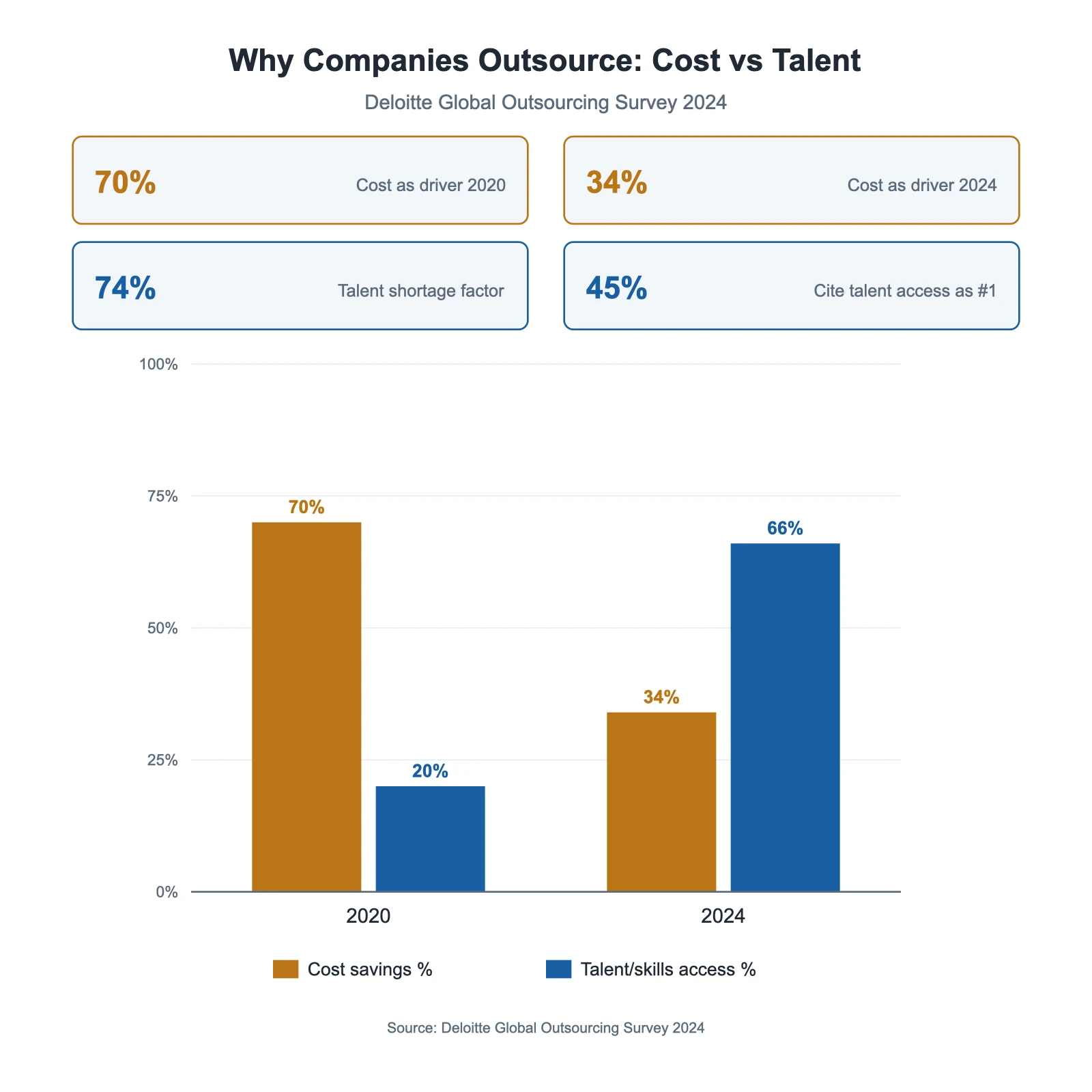
- Cost is no longer the top reason to outsource: only 34% of executives name cost reduction as the primary driver, down from 70% in 2020 (Deloitte 2024).
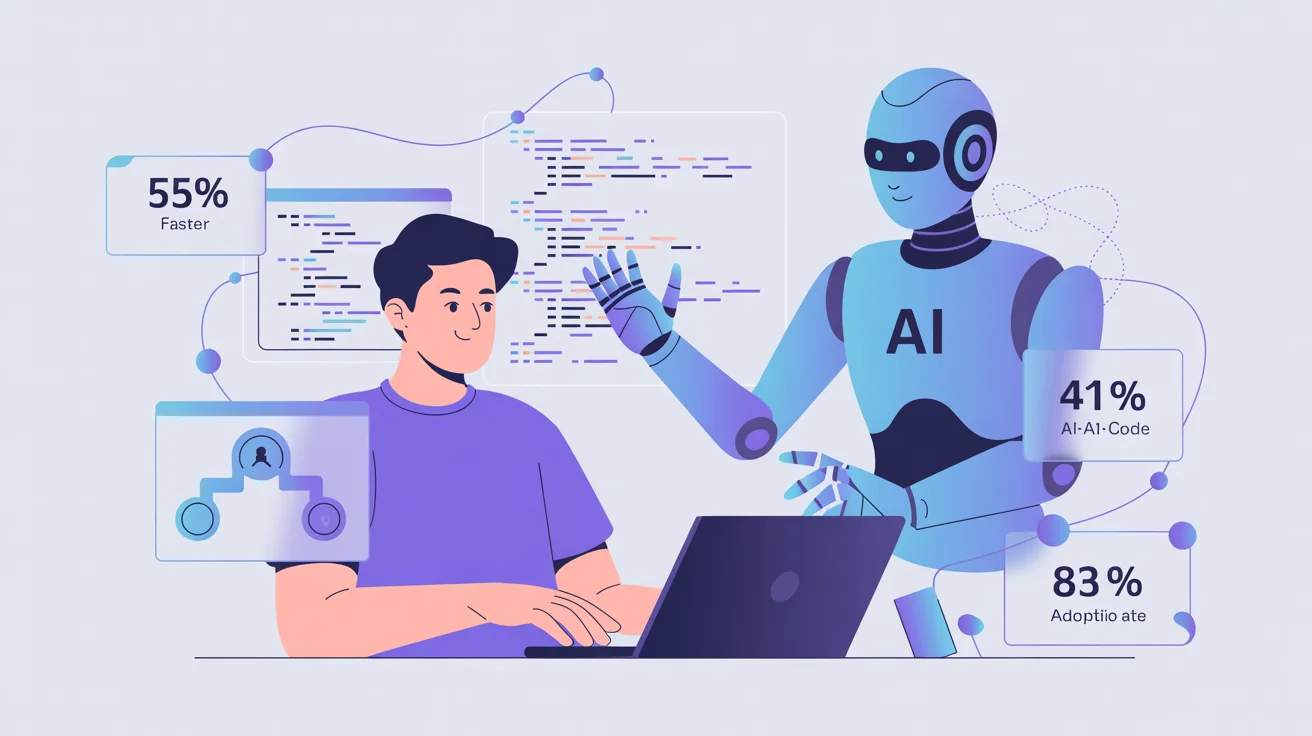
- 83% of executives now use AI inside their outsourced services, and GitHub Copilot users complete tasks 55% faster (Deloitte 2024; GitHub 2024).
- Two deals reset the market in 2025: Capgemini’s $3.3B WNS acquisition (Oct 2025) and the HCLTech–OpenAI partnership (Jul 2025).
- The EU AI Act (full high-risk enforcement August 2026) is pushing buyers toward EU-compliant nearshore vendors in Poland, Romania, and Portugal.
What does it mean for companies when the IT services outsourcing market reaches $807.91 billion in 2025, with an expected 8.6% CAGR through 2030 to $1.22 trillion? For many decision-makers, it means more pressure to control costs, access skills, and scale software faster than ever.
Yet every business leader feels the pinch: global IT spend stands at $5.43 trillion in 2025, up 7.9% from last year, but firms still report a shortage of developers and rising demand for AI-driven engineering.
In this blog on software development outsourcing statistics, we break down the most recent data, market size, and regional changes. By the end, you will see how these shifts matter for your outsourcing strategy.
Key Trends and Statistics in Software Outsourcing (Beginning of 2026)
The year 2025 is a milestone. Spending, deal activity, and contract models all reflect a fast-changing outsourcing market. Companies do not just outsource for cost anymore; they now outsource for speed, AI integration, and access to scarce skills.
Let’s look at the software outsourcing statistics that matter most.
| Category | Key Statistics & Trends |
| Market Momentum | ITO market reaches $807.91 billion in 2025, projected to $1.22 trillion by 2030. Multiple sources confirm $591-662B range with 6-8% CAGR. |
| Global IT Spending | $5.43 trillion total spend (7.9% YoY growth); software outsourcing grows at double digits despite macro uncertainty. |
| Deal Flow | H1-2025 ACV $58.3B (+18% YoY); 14 mega-deals signed; ER&D services +72% to $1.1B in Q2. |
| Pricing Pressure | 35-40% price reductions from RFP to contract; developer rates down 9-16% in Eastern Europe, South Asia, SE Asia. Latin America is stable. |
| Skills Shortages | 47.2M developers worldwide, but 74% employers face hiring difficulty; 51% cite AI skills gap (largest in 15 years). |
| AI Integration | AI is central to outsourcing contracts for development, testing, and operations; vendors offering AI tools gain a competitive edge. |
| Nearshoring Growth | US firms favor Latin America; European firms choose Eastern Europe for better timezone/cultural alignment. Offshore (India/SE Asia) remains strong. |
These trends confirm outsourcing’s resilience and strategic importance for cost efficiency and specialized skills in 2026.
2025 by the Numbers: Record Deals and a Wave of AI M&A
The H1-2025 numbers above only told half the story. The full-year ISG Index, published January 15, 2026, closed 2025 at a record $127.4 billion in combined annual contract value (ACV) for $5M+ deals, up 18% year-over-year — the highest annual growth rate since 2021. Providers signed 2,954 managed services contracts and 28 mega-deals, and Q4 2025 alone reached $34.3B ACV, a sixth straight quarter of double-digit growth.
“Growth was concentrated in cloud, infrastructure, engineering and AI-related demand, while more traditional, labor-centric services remained under pressure,” said Steve Hall, Partner at ISG. That split is the single most important pattern in current software development outsourcing statistics: AI and engineering work is surging while commodity, headcount-based services flatten.
Two 2025 deals show where the money is going. In October 2025, Capgemini completed its $3.3 billion acquisition of WNS — 64,505 professionals across 64 delivery centers — to build “a global leader in Agentic AI-powered Intelligent Operations.” Months earlier, in July 2025, HCLTech entered a multi-year partnership with OpenAI, embedding OpenAI models across its delivery platform. When two of the largest providers spend billions on AI capability, the buy-side signal is clear: pick partners who already build with AI, not ones who promise to learn.
Global Market Growth in Software Development Outsourcing
The software development outsourcing market size is not just growing; it is reshaping. Buyers push for shorter contracts, outcome-based pricing, and shared risk models. Vendors respond with AI-driven delivery, multi-region delivery centers, and new commercial structures.
To explain this shift, we break down the key regions and drivers.
US Dominance in Software Outsourcing
The US remains the single largest client market for outsourcing providers. Reports show that US outsourcing statistics account for a huge share of the global $807.91 billion IT services outsourcing market. Companies in the US outsource not just to cut costs but to accelerate time-to-market in areas like AI development, cloud migration, and cybersecurity.
ISG’s quarterly data proves the trend: in Q2-2025, the Americas hit record demand, with managed services up 20% year-over-year and XaaS up 29%. This makes the US not just the largest outsourcing buyer but also the most aggressive in contract innovation and value-sharing models.
Businesses now see outsourcing as a growth enabler. For example, firms rely on offshore and nearshore teams to scale AI projects, while still controlling budgets. When you explore our programming outsourcing guide, you will see practical steps for building such distributed teams.
European Growth in Outsourcing
Europe shows steady expansion in outsourcing activity, especially in software and IT services. The region records slight contraction in managed services in Q2-2025, but digital transformation and AI integration drive continued demand. European CIOs are balancing cost containment with innovation requirements, making outsourcing a tool for flexibility.
In outsourcing statistics by country, the UK, Germany, and the Nordics dominate outsourcing contracts. Analysts note that European buyers are more cautious, often signing shorter contracts with renewal options.
But outcome-based clauses are gaining traction, with firms linking payments to KPIs such as cloud cost optimization or defect reduction.
| Metric (Europe 2025) | Value |
| Q2-2025 managed services ACV | −1% YoY |
| Average contract length | 2–3 years |
| Adoption of outcome-based pricing | Growing steadily |
For European companies, outsourcing is not just about cost efficiency. It’s about accessing talent pools in regions like Eastern Europe and ensuring flexibility in turbulent economic conditions. This shift reflects broader software outsourcing statistics worldwide.
Asian Expansion in Software Development Outsourcing
Asia remains the delivery powerhouse for outsourcing. India’s tech industry revenue hits $282.6 billion in FY2025, employing over 5.8 million professionals. The country is on track for $300 billion revenue in FY2026, with strong demand for engineering R&D and global capability centers.
Meanwhile, the Philippines continues to expand IT-BPM exports, expecting $40 billion in 2025 revenue and nearly 1.9 million jobs. Both countries rank high in outsourcing statistics by country, showing how Asia not only maintains scale but also expands into AI, platform engineering, and cybersecurity.
| Metric (Asia Outsourcing 2025) | Value | Source |
| India IT industry revenue FY2025 | $282.6B | NASSCOM |
| India projected FY2026 | $300B | NASSCOM |
| Philippines IT-BPM revenue 2025 | ~$40B | IBPAP |
| Philippines employment | ~1.9M jobs | IBPAP |
Asian providers also embrace AI-driven delivery. Many embed tools like Copilot and custom LLMs into daily workflows, which aligns with software development industry statistics showing productivity jumps of 20–45%. You can read how this impacts embedded systems in our outsourcing embedded software development article.
Why Companies Outsource Now: Cost Is No Longer #1
The reason to outsource has flipped. In 2020, 70% of leaders named cost reduction as the primary driver. By the Deloitte 2024 Global Outsourcing Survey, that figure fell to just 34%. Skilled talent and agility now sit alongside cost at the top of the list.
What replaced cost is strategic capability. KPMG’s 2025 report “The Future of Outsourcing: Rethink Everything” found 81% of organizations want IT partners who act as strategic collaborators, not transactional vendors, and 75% want help pursuing transformational outcomes like new business models. KPMG’s Ron Walker put it bluntly: “Agility and resilience arbitrage have replaced labor arbitrage as the new strategy.”
Cost arbitrage has not disappeared, though — it has narrowed. The Stack Overflow 2025 Developer Survey still shows wide salary gaps that keep offshore and nearshore delivery attractive.
| Full-stack developer pay vs. US (Stack Overflow 2025) | Share of US salary |
| India | ~10.1% |
| France | ~42% |
| United States | 100% (baseline) |
The takeaway for buyers: choose a partner for capability first, then capture the cost gap as a bonus — not the other way around.
Remote Work & Its Impact on Outsourcing
Remote work continues to change outsourcing dynamics in 2026. Distributed teams are now the norm, not the exception. For many US and European companies, hiring offshore developers feels no different than hiring across states or countries.
Software outsourcing statistics show that companies with globally distributed teams achieve faster release cycles because they can run projects 24/7 across time zones. At the same time, governance challenges increase. Buyers must invest in better secure SDLC, compliance frameworks, and AI usage policies to manage distributed software teams.
Remote work has reshaped outsourcing by making global collaboration easier and more natural. In 2026, companies in the US and Europe treat hiring offshore developers almost the same as hiring locally. Distributed teams allow businesses to tap into a wider talent pool, cut costs, and keep projects running smoothly around the clock.
Time zone differences, once a barrier, are now an advantage that speeds up software delivery and shortens release cycles. This shift has made outsourcing less about cost-saving alone and more about building highly flexible, global teams that deliver faster and adapt to market changes quickly.
However, remote outsourcing also creates new risks that businesses cannot ignore.
- With developers spread across different countries, governance and security challenges become bigger. Companies must strengthen software development practices with secure SDLC methods, compliance frameworks, and stricter policies on AI usage.
- Protecting intellectual property, ensuring data privacy, and maintaining consistent quality are now top priorities. Without strong oversight, the benefits of global teams can quickly turn into costly risks.
- For outsourcing to work in the remote-first era, trust, security, and clear communication are just as important as speed and cost.
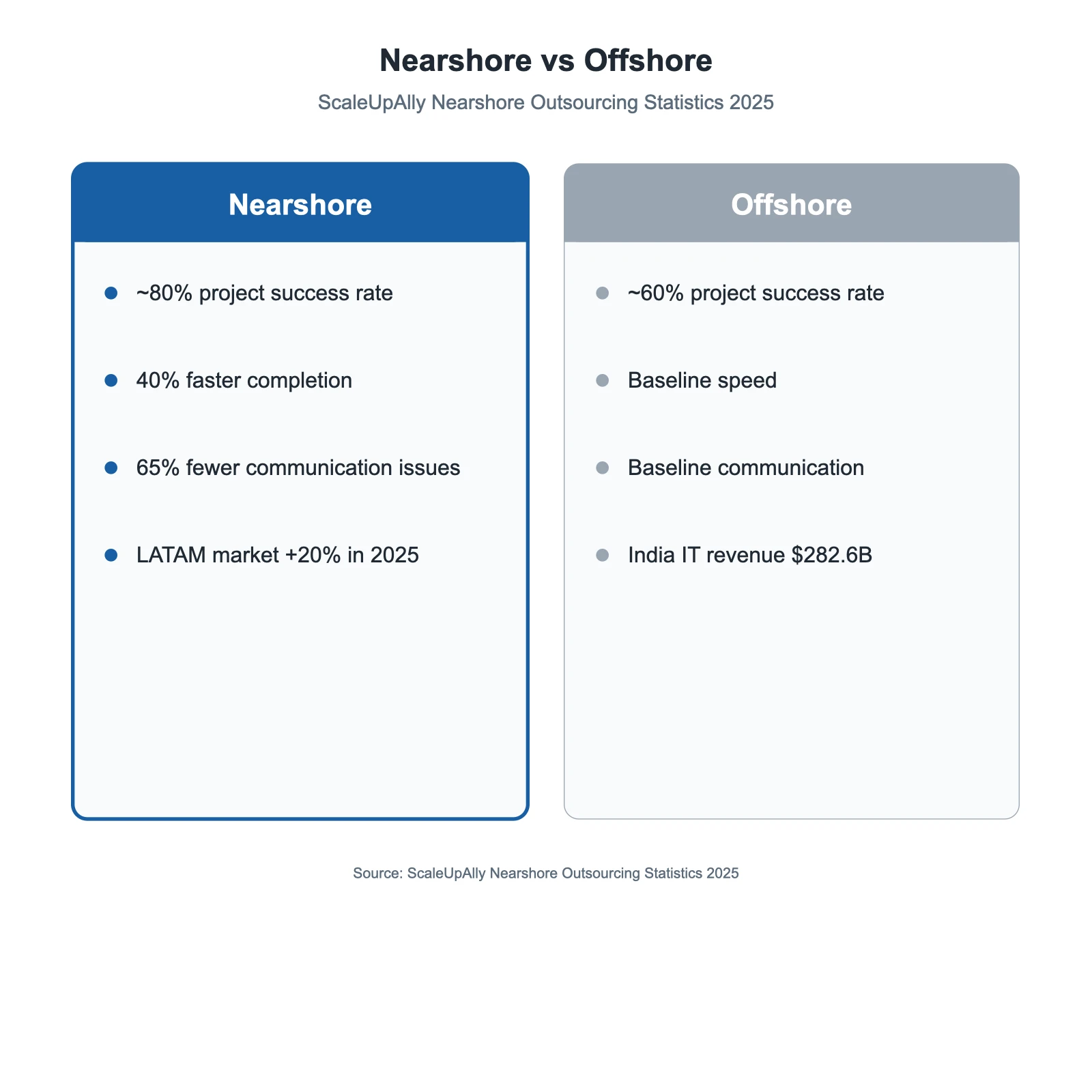
Remote delivery also supports nearshoring. Many firms consider nearshore vs offshore outsourcing models to balance time zone overlap, cost control, and cultural alignment.
How Regulation Is Redrawing the Outsourcing Map
Compliance is now a delivery requirement, not a footnote. The EU AI Act brought General-Purpose AI obligations into force in August 2025, with full high-risk enforcement starting August 2026 and fines up to €35 million or a share of global turnover. Any company outsourcing AI development to a vendor without proper governance now carries that exposure directly.
Three more rules tightened the same year. The EU Data Act (September 2025) added cloud-switching requirements that reshape outsourcing contracts; DORA (effective January 17, 2025) set operational-resilience standards for EU financial firms; and eight new US state privacy laws took effect in 2025, pushing companies to navigate 20+ state frameworks.
The net effect is geographic. Mordor Intelligence reports that EU regulatory complexity is handing a competitive edge to nearshore providers in Poland, Romania, and Portugal, who win deals by advertising EU/US data-protection compliance that buyers previously routed to Asia. For 2026 buyers, “where is your data governed?” is becoming as decisive as “what does it cost?”
Future Outlook of Software Outsourcing (2026 and Beyond)
The future of outsourcing shows even faster movement than the current numbers suggest. Buyers want fewer, deeper partnerships. Vendors must prove they can deliver speed, AI productivity, and measurable business outcomes. Let’s unpack what comes next for the software development outsourcing market size and delivery models beyond 2026.
Shorter and Smarter Deals
KPMG notes buyers now sign shorter contracts but expand scope. Contracts run two to three years, often with renewal options and innovation funds. Buyers expect outcome-based pricing linked to KPIs like cloud cost per unit or defect escape rates. Deloitte adds that many firms are still building governance to capture cost savings, but the direction is clear: outcome orientation dominates new IT outsourcing statistics.
If you want to read more, our articles on 13 benefits of outsourcing software development for startups explain how our clients achieve this balance.
Talent Pressure Continues
Even with 47.2 million developers globally in 2025, shortages stay high. 74% of employers report difficulty filling roles, and 51% of leaders report AI skills shortages. This pressure ensures outsourcing will stay central to digital roadmaps. Buyers see outsourcing not just as a choice but as the only path to talent scale.
AI Productivity Becomes Standard
McKinsey shows 20–45% productivity gains in software engineering with GenAI. Controlled studies confirm GitHub Copilot users code 55.8% faster, and enterprise RCTs at Google show 21% cycle time reduction. This evidence means AI now sits inside every serious outsourcing contract. In practice, that means service providers must deliver faster, or buyers will hold them accountable for missed gains.
| Future Trend | Supporting Data | Source |
| Shorter contracts, broader scopes | 2–3 years average | KPMG 2025 |
| AI boosts engineering | 20–45% productivity gains | McKinsey |
| Developer shortage | 74% employers report a struggle | ManpowerGroup 2025 |
| AI skills shortage | 51% tech leaders report a gap | Nash Squared 2025 |
The software development industry statistics make it clear: outsourcing in 2025 and beyond will be about AI, measurable performance, and global reach.
What the Research Says: Evidence Beyond the Headlines
The strongest outsourcing case studies come with peer-reviewed backing, which most statistics roundups skip. MIT Sloan Management Review (2023) found that businesses running hybrid models — onshore plus nearshore plus offshore — achieve 15–20% higher project outcomes thanks to better communication and flexibility. IEEE Transactions on Software Engineering (2023) reported that DevOps practices such as CI/CD can cut deployment times by up to 50% and improve software quality by 30%.
The picture is not uniformly rosy. A PMC/NIH study on agile in outsourced projects found continuous integration delivers clear benefits across firm boundaries, while continuous analysis can stall on knowledge barriers between client and vendor — and that joint client-vendor decision-making is what moves the needle on success. Translation: the methodology and the working relationship matter as much as the rate card.
Frequently Asked Questions
The global IT services outsourcing market reached $807.91 billion in 2025 and is projected to hit $1.22 trillion by 2030 at an 8.6% CAGR (Grand View Research). Looking only at contracted deals worth $5M+, ISG recorded a record $127.4 billion in annual contract value in 2025, up 18% year-over-year.
No. Only 34% of executives now cite cost reduction as the primary driver, down from 70% in 2020 (Deloitte 2024). Access to skilled talent, agility, and AI capability now rank alongside or above cost.
AI is now embedded in most outsourcing contracts. 83% of executives use AI in their outsourced services (Deloitte 2024), GitHub Copilot users complete tasks up to 55% faster, and McKinsey reports 20–45% engineering productivity gains. Providers without AI-native delivery are losing competitive deals.
Asia (India, the Philippines) remains the delivery powerhouse, while nearshore hubs in Latin America and Eastern Europe grow fast. EU regulation is pushing more work toward EU-compliant nearshore providers in Poland, Romania, and Portugal.
The EU AI Act (full high-risk enforcement August 2026, fines up to €35M), the EU Data Act (September 2025), and DORA (January 2025) all impose new obligations. Companies outsourcing AI or cloud work must verify their vendor’s governance and data jurisdiction.
Why Choose LITSLINK as a Leading Software Outsourcing Partner?
The outsourcing market in 2026 shows how much buyers expect from their partners. They no longer want long contracts filled with unclear promises. Instead, they look for measurable results, faster delivery cycles, and partners who adapt to the reality of AI-driven software development. At LITSLINK, we match this expectation by shaping every project around outcomes and real numbers.
Artificial intelligence now sits inside every project. In 2026, outsourcing partners rely on AI tools to speed up coding, testing, and project management. It no longer feels like an experiment; it works as a normal part of delivery.
We help businesses scale development with distributed teams while keeping cost efficiency and speed in balance. Our teams stay ahead of the curve by adopting AI-powered workflows, secure SDLC practices, and clear delivery milestones.
So the question is simple: Do you want to stay ahead in this $807.91 billion market or fall behind while others adopt AI and smarter outsourcing models?
Let’s talk today. Contact LITSLINK to build your outsourcing plan with a partner that understands today’s data, tomorrow’s risks, and the outcomes you need.
Related reading: Programming outsourcing guide · Outsourcing embedded software development · 13 benefits of outsourcing software development for startups