





Gym Booking App for Finding and Reserving Nearby Fitness Studios
- 10 days avg. time to repeat the booking after the first session
- <30 sec from app open to confirmed gym reservation
- 200+ gyms and fitness studios listed at launch
- 4.7/5 average user rating on app stores
What if you could discover, compare, and reserve a location to work out in under 30 seconds? The answer is our gym booking app, which helps users discover and reserve gyms, workout centers, and swimming pools, offering daily or monthly passes with unbeatable pricing, no obligations, and the freedom to cancel.
Project Details
This fitness technology startup wanted to make gym access as simple as opening an app, choosing a nearby location, and confirming a session. LITSLINK delivered the iOS and Android solution behind that experience, including gym discovery, booking, payment integration, and QA.


Business Challenge
Reserving a gym for 2026 operates exactly as it does for 2006. One asks one’s friends, searches on Google, or simply shows up. However, none of these actions indicate if there are available spots for the evening, the current rates charged by the gym, or if the atmosphere suits your expectations.
Before this project, the client ran a directory-style listing. It worked roughly the way directories work, which is to say not very well. People would call a gym and reach voicemail. Drive across town and find every spot taken. The client saw what was missing and wanted to close the gap with a dedicated booking app for gyms, one that handled the whole loop from search to confirmation. Three problems kept coming up:

No real-time availability
Users had no way to check whether a gym had open slots before showing up. So they showed up anyway, got turned away, and stopped trusting the listing. Drop-off on that page was brutal.

Pricing confusion
Gym rates moved around. By time of day, by membership tier, by pass type. Without somewhere to compare them side by side, people either overpaid or just skipped booking altogether.

Poor mobile experience
Without a gym appointment app or any real mobile presence, the client was effectively invisible to most of their target audience. Mobile-first users skip what they can’t tap.
Technologies Behind the Gym Booking App








Our Fitness Booking App Solution
Every design and architecture call came back to one question: what’s the fastest path from “I want to work out” to “I have a confirmed gym session in my booking app“?
The gap was obvious once we mapped it. Users knew what they wanted. The tools to act on it sat scattered across separate websites, phone lines, and front desks. A proper gym reservation app had to pull all that into one place. One flow, fewer taps.
We built it on React Native, so iOS and Android share a codebase. Backend runs on Node.js with PostgreSQL. Google Maps API handles geolocation. Stripe handles payments. Firebase covers push notifications and real-time data sync.
Front and back ends work together. Geolocation surfaces nearby options. The filtering engine ranks them by price, availability, and stated preferences. The booking module locks everything in with instant confirmation. All of it inside a single interaction thread.
The system was designed based on the real behavior of people going to the gym. People search for the nearest gym (locating), then compare prices, and finally choose according to the classes available. Customizable profiles of gyms were also considered, giving everyone an opportunity to create a profile that reflects their style.
Geolocation-Based Gym Discovery
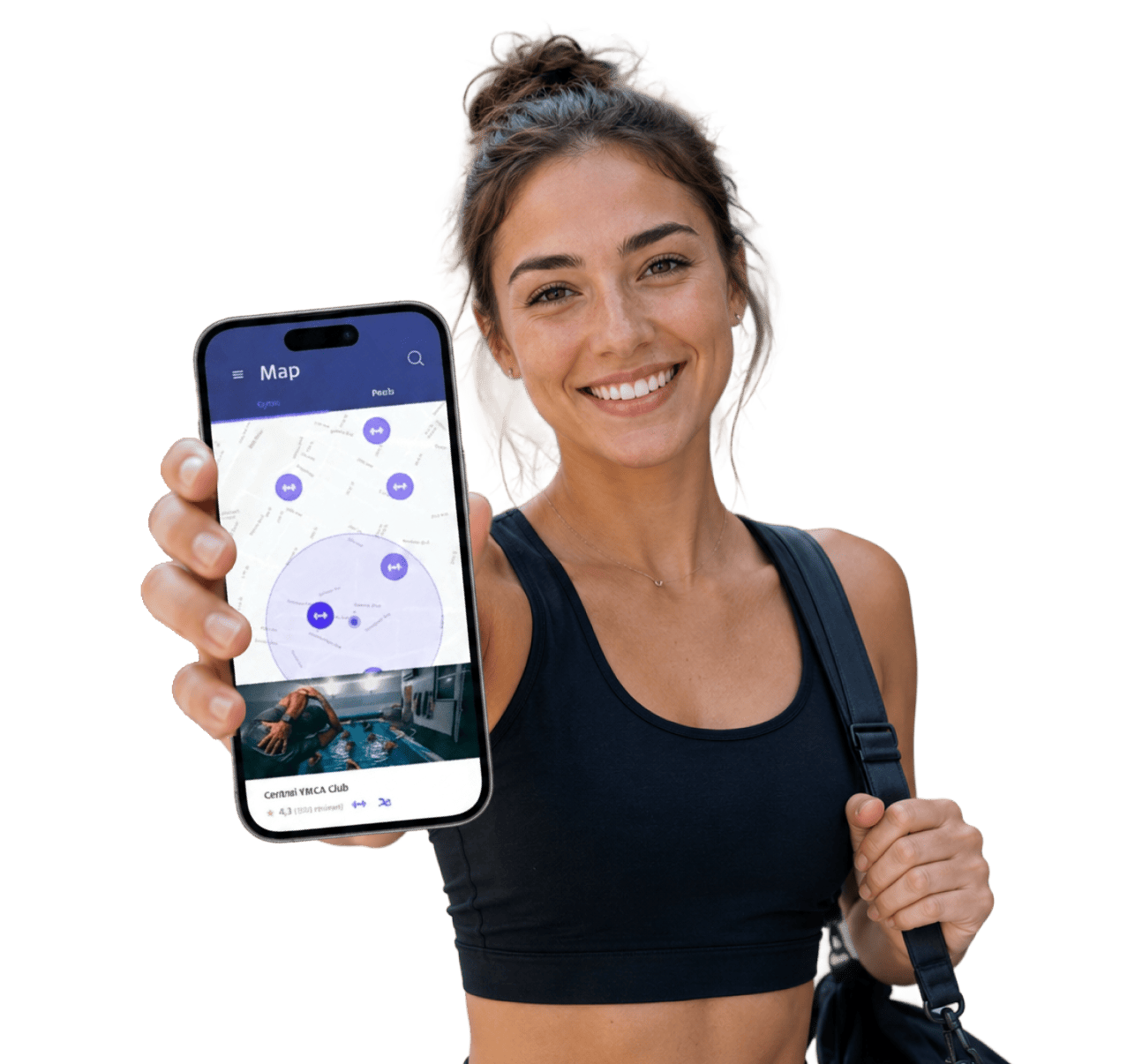
Nearest gyms, fitness studios, and pools show up on a live map. Distance, ratings, and open slots are visible at a glance. That’s what makes it a real gym finder app, not just another search box.
Flexible Pass Options
Day pass or monthly plan, your call. Every listed facility offers both. No long-term contracts, no admin fees, no mandatory inductions. Cancel any time, no penalty. .
Smart Price Comparison
A built-in comparison engine surfaces the cheapest matching options nearby. Users filter by workout type, budget, and time slot. The gym reservation platform doubles as a gym class booking platform, saving users money and time at the same time.
Integrated Payment System
Stripe handles checkout inside the app. Users save payment methods for faster repeat bookings, reducing friction to under 30 seconds from discovery to confirmation.
Detailed User Profiles
Each user maintains a profile with booking history, favorite gyms, preferred workout types, and saved payment methods. The app learns from these preferences to surface better recommendations over time.
Gym Dashboard & Management
Studio owners get their own panel. They manage listings, update availability, run promotional pricing, and check booking analytics. The two-sided design keeps both ends of the marketplace active.
Scrum Methodology
Project Journey
The project ran on Scrum, two-week sprints. Initial scoping missed a few things, the way initial scoping always does. Some gyms had different capacities per room. Some users traveled across time zones. Saved cards expired between bookings, which broke the payment flow. All of that surfaced in early demos.
Discovery covered the full scope: gym onboarding, the entity model for facilities (location, capacity, class types, pricing tiers), and the integration architecture for Google Maps and Stripe. That groundwork shaped every sprint after.
How the Gym Booking Platform Works
- User launches the app and grants location access for nearby results.
- The geolocation engine displays gyms, studios, and pools on an interactive map with ratings and distance.
- Users narrow results by price, class type, amenities, and available time slots.
- User picks a gym, chooses a day pass or monthly option, and selects a time slot.
- Stripe processes payments securely. The user gets instant booking confirmation via push notification.
- The user arrives, checks in via the app, and works out. Post-session, they rate the gym and save it to favorites.
Scrum Process Flow
Mobile app development benefits from short feedback loops, not waterfall timelines. Scrum sprints meant the client tested working builds every two weeks and redirected priorities before small missteps became expensive rework.

-Timeline
Five Phases of Delivering the Sport Platform
Discovery & Product Workshop
- Aligning on user personas and gym-owner requirements
- Defining the entity model for facilities, pricing, and availability
- Mapping API integration points for geolocation and payments
UX Prototyping
- Wireframes tested against real booking scenarios
- Map-first interface validated with target users before development
- Gym profile cards and booking flow refined through usability testing
Agile Development (Sprints)
- React Native codebase shared across iOS and Android
- Geolocation, payment, and push notification integrations built iteratively
- Edge cases (variable capacity, multi-room gyms) handled in mid-project sprints
QA & Testing
- End-to-end testing on both platforms against real gym data
- Payment flow validation with Stripe sandbox environments
- Performance and load testing for map rendering with 200+ facility pins
Launch & Support
- Simultaneous release on App Store and Google Play
- Post-launch monitoring for booking failures and map accuracy
- Ongoing updates driven by user feedback and gym partner requests
UI/UX Design
The product was designed as a search-first experience. Core goal: cut the path from “I want to exercise” to “I have a confirmed booking” down to almost nothing. No phone calls. Almost no typing.
User research revealed a predictable order: location first, price second, class or facility type third. That order shaped the entire information architecture. The map view became the default screen. Filter chips for price range, workout category, and availability sat at the top, always visible.
The palette stays tight on purpose. Deep navy (#384485) carries the primary text and structural UI. A soft lavender-purple (#9288F6) handles interactive elements and map pins. Near-black blue (#1D2449) anchors headers. Warm yellow (#FFD926) lights up accents and CTAs. Energetic without slipping into the neon look every fitness app defaults to. Purple specifically owns the map layer, so gym and pool pins read as branded elements rather than blending into standard map cartography.
Gym cards show what matters at a glance: name, star rating, distance, price range, thumbnail. Tap one and the full profile opens: class schedules, amenity tags, reviews, and the “Book Now” button sitting right where your thumb lands. Confirmation includes calendar integration and a QR code for check-in at the door.


Results
Before
- ✕Users hunted through web browsers and social posts. No real-time availability anywhere.
- ✕Each booking takes 10 to 15 minutes. Phone call, or in-person visit, take your pick.
- ✕Pricing was opaque. Comparing rates meant tabbing through five gym websites by hand.
- ✕ No profiles, no history. Every session started cold.
- ✕Discovery, booking, payment: three separate channels (phone, email, front desk). No unified interface.
After
- ✔200+ gyms and fitness studios reachable from one search screen. Live availability.
- ✔Booking takes under 30 seconds, from app open to confirmed reservation.
- ✔Built-in price comparison surfaces the best-price options across nearby facilities, instantly.
- ✔Profiles hold preferences, booking history, and saved cards. Repeat sessions take seconds.
- ✔Discovery, booking, and payment unified in one cross-platform mobile app. Single entry point.

The Impact

-Verified Reviews
Our Reputation on Top Platforms
LITSLINK always holds the top positions among app development companies on such ranking websites as Clutch and GoodFirms. The client reviews praise the company for its experience in cross-platform development, attention to details of user interface design, and its ability to produce high-quality fitness and health-related products that can stand up to strong competition.
Have the Gym and Fitness App Project in Mind?
Have an idea for a fitness app or platform? Tell us what you’re working on. We’ll get back to you within 48 hours with a clear roadmap.
Thank you for your message. It has been sent.