






Key Takeaways
- AI agents are separate, task-focused software elements that provide automation for only limited functions, but agentic AI is a whole architectural system that manages multiple agents, tools, and enterprise networks consistently.
- AI agents mainly respond to particular user inputs or set triggers within a narrow scope, while agentic AI uses sophisticated reasoning and planning models to oversee end-to-end workflows.
- In many cases, single AI agents need ongoing human oversight to deal with exception cases, but agentic AI is working with a very high level of goal-driven autonomy, and human involvement is being moved to the role of high-level strategic governance.
- Great ROI is generated when targeted AI agents are embedded into a highly operational, cross-departmental agentic AI environment.
In the current scramble by business executives to gain the most from these technological improvements, a major infrastructural debate has emerged: Agentic AI vs. AI Agents. Not knowing this difference between these two might cause fragmented automations, wasted development budgets, and misalignment of technical infrastructure. This detailed guide has been developed specifically for business owners, startup founders, Chief Technology Officers (CTOs), and product decision-makers. We will detail the structural differences between separate autonomous components and higher-level orchestration so you can decide which best fits your operational workflows, technical maturity, and business goals in the long run.
What is an AI Agent?
Enterprise AI is shifting from passive, conversational tools toward active systems that can carry out work. A recent Gartner forecast predicts that 40% of enterprise applications will be integrated with task-specific AI agents by the end of 2026, up from less than 5% in 2025. McKinsey estimates that generative AI could add $2.6 trillion to $4.4 trillion annually to the global economy, with much of that value coming from automating knowledge work.
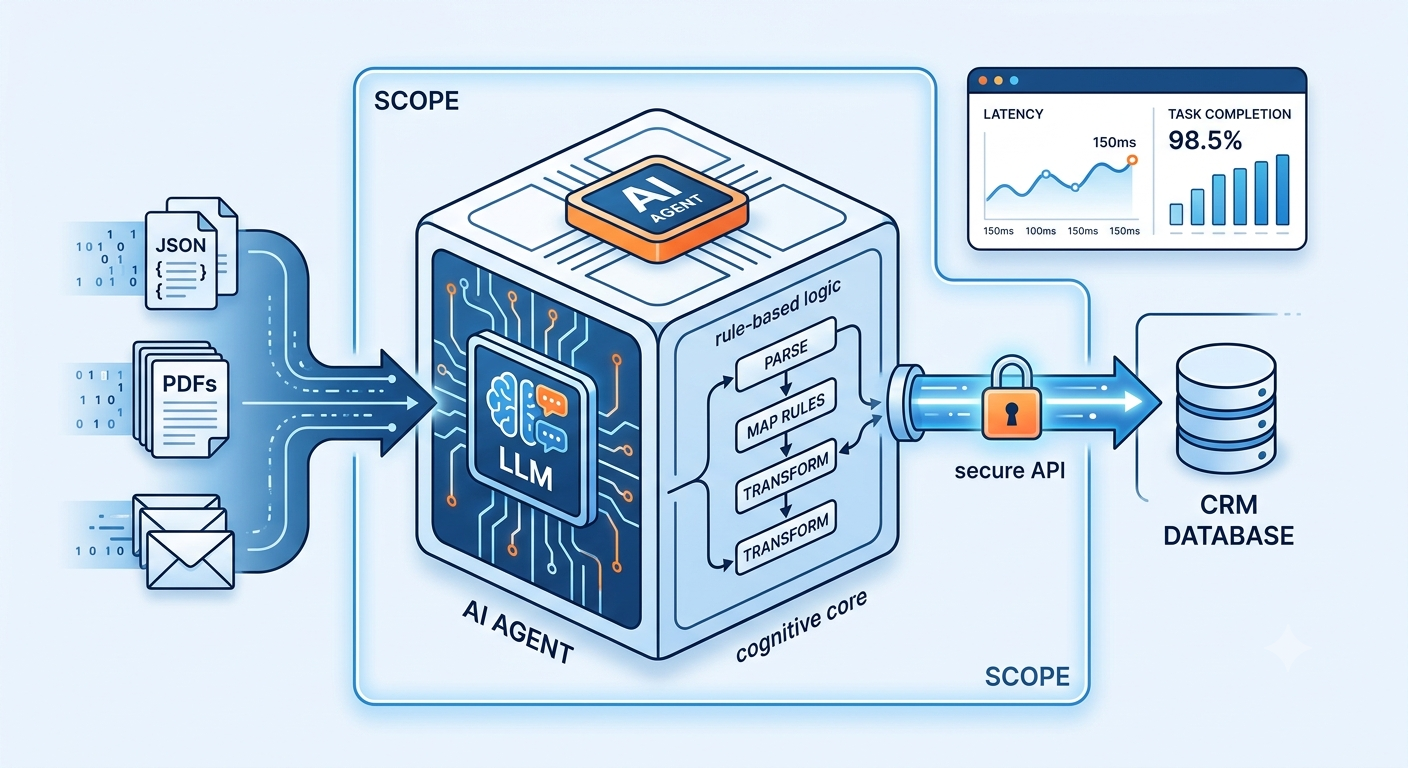
An AI agent is a single piece of software designed to independently perform specific tasks within a limited workflow. Unlike conventional software, which relies entirely on fixed, hard-coded scripts, an AI agent uses artificial intelligence to understand context, handle natural language, and make local decisions to accomplish the set objective.
Core Technologies Behind AI Agents
Traditional AI agents can function independently without being reprogrammed at every step by combining several technologies:
- Large language models (LLMs): They act like the central brain of the agent, making it possible for the agent to interpret the user’s desires, transform data that is usually free-form into a structured format, and produce text that reads like it was written by a human.
- Natural language processing (NLP): Enables the agent to parse commands, detect emotions, and communicate efficiently across channels such as chat, email, and ticketing systems.
- Machine learning (ML) and rule-based logic: Work together to enable the agent not only to identify data patterns but also to operate within strict business rules.
- Short-term and long-term memory: Enables the agent to remember what was said during a conversation and to retain knowledge of user habits or changes in preferences over time.
- Tool and API integrations: Enable the agent to perform actions such as updating data or generating reports by interacting with other software applications (e.g., CRM, project management software, or databases).
Key Characteristics and Operational Capabilities
AI agents are characterized mainly by their focus and reactivity. Usually, when a user sends a prompt or a specific data event occurs, the AI agents activate. They function within an extremely limited scope, such as merely processing an invoice or rewriting a piece of content, which means they are proficient at performing individual steps rather than running entire departments.
Even though they can improve over time by learning from human feedback, they typically need human oversight to handle unexpected situations or obtain approval for sensitive decisions before they are made. The rigor of that environment is what makes them highly reliable, predictable, and capable of accelerating well-defined business processes. If companies want to deploy such precise solutions, they can rely on an experienced team in AI Agents development to ensure discrete components are firmly integrated into their production ecosystems.
What is Agentic AI?
Agentic AI is a system-level change in the way we think about and use AI. An agentic system moves beyond a single task to a larger, more capable form of software that reasons toward goals, plans independently, and acts across divisions. Agentic AI is a setting in which numerous AI agents, each specialized in different fields, tools, databases, and business applications, are orchestrated to achieve complex business outcomes without frequent human involvement.
The Technology Stack Driving Agentic Artificial Intelligence
To develop an agentic system, one cannot simply rely on a single LLM wrapper but rather multiple AI agents. The architectural stack involves:
- Advanced Reasoning and Planning Setups: Approaches such as Chain-of-Thought (CoT), Tree-of-Thoughts (ToT), and ReAct (Reason + Act) that enable the system to logically break down a broad corporate goal into smaller tasks.
- Orchestration Layers: Software systems (e.g., LangGraph, AutoGen, or CrewAI) that handle data routing, state tracking, and communication across the whole system.
- Multi-Agent Coordination Protocol: A set of communication standards that different specialized agents use to collaborate, negotiate, share data, and hand off tasks to one another.
- Dynamic Feedback Loops: Ongoing assessment mechanisms by which the architecture compares its actions’ results against the main objective, thereby enabling it to self-correct if a step is unsuccessful.
- Enterprise-Grade Tool and API Orchestration: A capability that allows a system to securely access data and make updates simultaneously to legacy ERPs, cloud databases, security systems, and third-party SaaS tools.
Distinguishing Capabilities of Agentic AI
What distinguishes agentic AI from mere automation is its ability to exercise proactive, goal-oriented autonomy at a higher level within the agentic system. For example, if you tell an agentic AI something like “revamp our supply chain for Q3 to achieve a 5% reduction in costs,” it won’t be waiting around for a detailed checklist from you. On its own, it reviews shipping data, identifies shipment delays, negotiates new supplier terms with a supplier communication agent, updates inventory records, and prepares the anomalies report for the executive.
Rather than merely reacting to inputs, the agentic system goes a step further by continuously monitoring changes in environmental conditions, predicting system failures, and dynamically rewriting internal execution plans. The result of the transition is the creation of multiple AI agents that are not only basic productivity assistants but also independent digital workers capable of managing business processes end to end.
Agentic AI vs. AI Agents: Quick Comparison
To help your leadership team evaluate these technologies, the table below compares them across the main technical and operational categories.
| Comparison Category | AI Agents | Agentic AI |
|---|---|---|
| Primary Purpose | Automate specific, isolated tasks within a highly defined business workflow. | Achieve broad, high-level corporate goals by orchestrating multiple tools, agents, and systems. |
| System Architecture | Standalone software components engineered for a single localized function. | A comprehensive, multi-layered system that coordinates diverse AI agents and enterprise networks. |
| Core Technologies | LLMs, standard machine learning, NLP, rule-based logic, session memory, and basic APIs. | LLMs integrated with advanced reasoning frameworks (CoT/ToT), orchestration layers, memory, and multi-agent protocols with feedback loops. |
| Functional Scope | Narrow: focused on a singular task, data field, or specific department function. | Broad: spans end-to-end corporate workflows across multiple legacy systems and business units. |
| Decision-Making | Makes autonomous selections within strict, predefined rules and boundaries. | Evaluates changing contexts dynamically to make goal-driven choices toward an ultimate objective. |
| Planning Capabilities | Limited to predefined, linear workflows or single-step operations. | Breaks complex, vague objectives into dozens of steps and dynamically restructures plans in real time. |
| Operational Behavior | Reactive: acts when a user provides an input or a system trigger is reached. | Manages data environments, anticipates issues, and addresses bottlenecks early. |
| Learning & Adaptation | Optimizes execution over time through direct human feedback on its task. | Continuously recalculates paths and balances enterprise resources in response to shifting external data contexts. |
| Human Involvement | Requires regular human input and supervision, manual validation, and input for edge cases. | Operates with systemic autonomy, shifting human responsibilities to high-level governance and policy oversight. |
| Best Suited For | Automating repetitive, predictable, and rule-heavy business operations. | Managing complex, multi-layered, and cross-functional enterprise processes from start to finish. |
| Main System Limitation | Can create fragmented, siloed data and automation gaps when deployed completely independently. | Demands highly mature integration infrastructures, strict governance models, and clean data pipelines. |
Where Agentic AI and AI Agents Differ
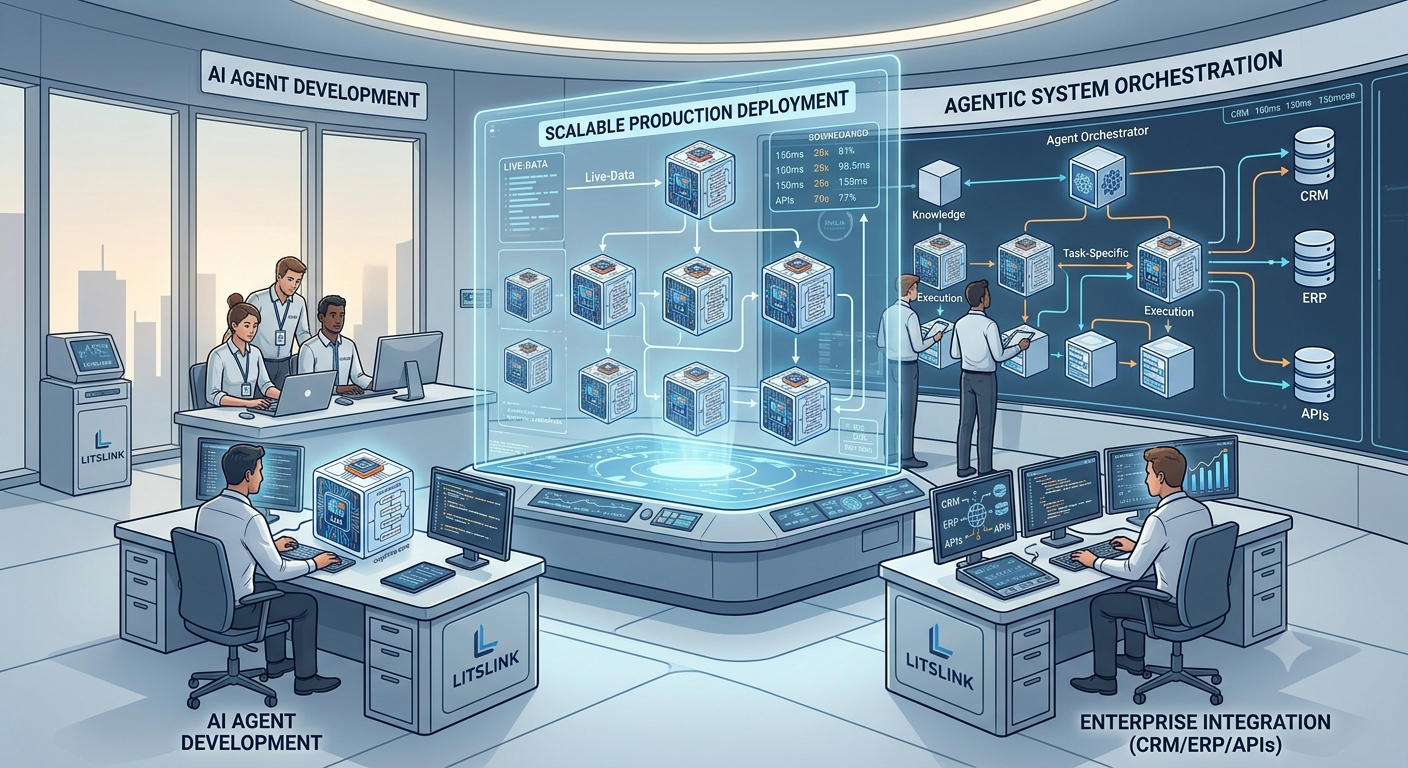
The real difference lies beneath the surface, in the software architecture. An AI agent is a single component — a piece of software designed to do one thing extraordinarily well. Agentic AI is the connective layer that links those components and directs them toward a shared objective. Because of this relationship, organizations can combine individual, autonomous AI agents into a fully agentic AI system. Imagine you can set up an isolated agent just to organize customer care emails into a dashboard, for instance, leaving drafts for responses.
This agent is very effective on its own, but it can’t correct issues where the customer’s experience is worse upstream, and it can’t communicate with another department’s inventory system without a person guiding it. This leads to the biggest business benefit of leveraging purpose-built AI agents within an agentic AI system.
The agentic architecture serves as the intelligent supervisor for the ecosystem: it looks out for the big picture, assigns each agent a task, passes information fluidly among agents, and guides each action at every level of scale toward the goal of a defined company objective. These tools grew from simple chatbots into coordinated ecosystems — a shift we trace in the Evolution of AI Agents.
How to Choose Between AI Agents and Agentic AI
Choosing between AI agents and agentic AI largely depends on your workflows, budget, and technical maturity. If you assign a complex system to a simple task, it may entail extra maintenance costs. But if the agent used is too basic for complex workflows, the automations may be fragmented and weak in large multi-system workflows, whereas specialized agents can be more effective.
When to Choose Traditional AI Agents
If your operational workflows are highly structured, predictable, and limited to a single system or task, standalone AI agents are the most appropriate option. The main aim is to replace monotonous manual work with rapid, precise digital processing.
Key features of workflows suited for AI agents:
- The input data is very organized or conforms to a predictable model.
- The job consists mainly of a simple, direct sequence of steps with very few deviations.
- You can check whether the work was successful by using simple, rule-based logic.
- The operation is done completely in just one or two apps.
Real-world corporate examples:
- Ticket Classification: Automatically analyzing, categorizing, and directing incoming IT or customer service tickets based on their priority or subject to the appropriate human queue.
- Invoice Data Extraction: Employing optical character recognition (OCR) and large language models to interpret PDF invoices, identify the main amount, and input it into accounting software.
- Form Validation: Ensuring that registration forms submitted by users are complete, verifying attached IDs, and flagging unsigned parts.
- CRM Updates: Pulling data from sales call transcripts for automatic updating of lead statuses, deal values, and follow-up dates in Salesforce or HubSpot.
When Agentic AI is the Better Strategic Move
You will need an agentic AI system to automate comprehensive, complex tasks and multi-level business objectives that entail cross-functional collaboration, dynamic decision-making, and interfacing with several legacy systems across your business.
Key features of processes suited for agentic AI:
- The ultimate business targets are broad, high-level, and highly variable (for example, “reduce client churn”).
- The workflow involves transferring data to various software applications, such as HR, IT, and Finance.
- The navigation to the success points is constantly updated based on the current data produced.
- The system must overcome encountered edge cases and roadblocks without crashing or hanging until manual human intervention is requested.
Real-world enterprise examples:
- End-to-End Employee Onboarding: An integrated system deploying AI agents that can scan a newly signed contract, alert HR, create an employee profile, set up software accounts across various IT platforms, trigger hardware purchase through procurement APIs, and find time for training from team calendars.
- Complex IT Incident Resolution: Multiple specialized agents that can diagnose server outages deeply with the help of multiple monitoring tools, identify the root causes of the problem, install security patches, check the overall system status, and write a complete record of the situation for the engineering team.
- Procurement and Supply Chain Approvals: Checking vendor bids against company budget guidelines, confirming vendor compliance, reviewing warehouse stock levels, and dynamically routing final contract versions to the legal team for approval.
Key Use Cases for Agentic AI Systems and AI Agents
To make it easier for you to picture the impact of these solutions, let’s look at how various industries use both single AI agents and large-scale agentic AI setups to address real business problems.
Task-Specific Automation with AI Agents
Industries that continuously process large volumes of digital work regularly can improve their efficiency by using single agents that can be implemented very quickly. Such agents typically require minimal changes to the overall system and can be used to make both customer-facing and internal operations more efficient.
- Customer Support and E-commerce: Dedicated AI agents are capable of managing communications about order status, handling simple product return requests, and even creating tailored product suggestions by analyzing a user’s recent browsing history.
- Retail and Logistics: Deploying AI agents to monitor the progress of each shipment, provide consumers with automatic notifications about delivery times, and inform customer service when deliveries are delayed.
- Banking and Insurance: AI-driven agents take care of loan form submissions, check whether insurance claims have been supported by photographs, and perform document verification as per basic underwriting guidelines.
Beyond these sectors, AI agents in healthcare are already reshaping patient care and administrative workflows.
Cross-Functional Automation with Agentic AI
Industries with complex data environments, stringent compliance policies, and interdependent operations often require agentic AI orchestration capabilities.
- Healthcare Systems: Agentic AI can serve as the backbone of large-scale patient monitoring. It processes data from wearable devices, EHRs (Electronic Health Records), and pharmaceutical databases, and serves as a liaison among these data sources to identify drug interactions. This notifies clinical teams of any changes in the patient’s risk level.
- Finance and Risk Management: Business end-to-end systems perform continuous financial risk management assessments. The system tracks global financial markets, analyzes portfolio risk, recalculates capital requirements on the fly, trades hedge instruments on various platforms, and updates compliance ledgers. Such systems sit at the core of modern AI in finance, where decisions run continuously and at scale.
- Cybersecurity and Threat Response: Security systems monitor entire enterprise networks, segregate compromised endpoints, modify firewall settings in real time during a breach, detect attacker sources, and prepare detailed reports that comply with regulations for security operations centers (SOCs).
- Manufacturing and Industry 4.0: The combination of predictive maintenance schedules, supply chain parts inventory, and real-time production quotas is used by the systems to determine the optimal repair schedule without interfering with the production run.
Case Study: Agentic AI for ERP Anomaly Detection
- Unsupervised machine learning replaced fixed rule engines, enabling the system to identify anomalies automatically without manual labeling or preset thresholds.
- The solution monitored data flows and distribution patterns across 5 ERP modules simultaneously while providing severity-scored anomalies with natural language explanations.
- It reduced manual anomaly review time by more than 85%, cut false-positive alerts by 60–70%, and accelerated post-close financial triage by over 80% (from days to hours).
The client asked for a high-tech system capable of keeping an eye on the massive financial data streams spanning the core ERP modules, which included monitoring vendor allocations as well as tracking spending patterns over different time periods. The company depended on the hardcoded logic with fixed thresholds previously, but the method could not adjust to the changes in the business environment or account for seasonal variations, so unusual transactions that were risky still slipped through even if they were within the static limits. Ordinary, single-purpose AI tools could not handle this problem as the enterprise environment needed coordination across different tabular layers, cross-module comparisons, and a user-friendly dialogue at the same time. To address the matter, an agentic AI architecture was set up to function like a system of different, specialized layers that interact with one another to carry out a complicated business task.
Rather than having one agent do all the interpreting, the solution consisted of different but cooperating layers: a machine that used unsupervised learning regularly tracked the distribution patterns of multiple tables, a layer for scoring the severity based on an adaptive calculation was in place, and a friendly conversational agent turned the abstract telemetry into very simple summaries. This type of architecture was able to provide the company with value at once, helping them to reduce the risk of financial losses while also decreasing by 60-70% the burnout caused by false-positive alerts. In other words, it converted the unprocessed, confusing data from an ERP system into very reliable work processes that are ready for auditing.
Read more about this case here.
Why Choose LITSLINK to Build AI Agents That Act Independently
Deciding whether to adopt task-oriented agents or a whole-system agentic AI architecture is complex and requires thorough technical know-how, well-defined strategic planning, and detailed knowledge of your current enterprise software. An incorrect decision might result in disjointed systems, significantly increased development costs, or architectures too constraining for growth. LITSLINK is your perfect technology partner to guide your organization through this transition smoothly.
Operating worldwide with a pool of more than 300 experienced software developers and AI experts, LITSLINK assists businesses in analyzing their operational processes, conceptualizing straightforward AI strategies, and developing secure, scalable solutions aligned with their specific operational ambitions. We have experience across various sectors, including healthcare, finance, retail, logistics, manufacturing, and e-commerce, so we ensure your multiple systems are industry-standard compliant from inception.
We specialize in the whole scope of the contemporary artificial intelligence lifecycle:
- Advanced AI Architectures: Designing AI agents tailored for tasks, complete agentic AI systems, and multi-agent coordination systems.
- Core Cognitive Technologies: Putting together best-in-class Large Language Models (LLMs), Retrieval-Augmented Generation (RAG) for secure internal data access, and vector databases.
- System Automation and Orchestration: Adopting the Model Context Protocol (MCP), browser automation, and intelligent workflow automation layers.
- Enterprise-Grade Integration: Bridging tailor-made systems with old CRMs, ERPs, corporate databases, internal communication platforms, and cloud infrastructures.
If your company uses a handful of AI agents to automate frequently repeated tasks, or an entire agentic AI structure to revamp cross-functional operations, LITSLINK will deliver trustworthy, production-ready systems that deliver real business value.
Do you want to speed up your digital transformation? Get in touch with LITSLINK now to talk with one of our specialists, assess your current workflows, and see why our custom AI development resources can be of help to you in scaling your business through multiple systems.
FAQs
Can AI Agents Work Without Agentic AI?
Yes, AI agents can complete tasks without agentic AI and are frequently deployed to handle tasks such as invoice processing, ticket routing, or CRM updates without human intervention.
How Can You Tell if Your Workflow Needs an AI Agent or Agentic AI Technology?
If you aim to automate a single workflow or a specific task, modern AI agents excel and are generally enough. But if the process involves multiple systems, task automation and decision-making have to be constantly adjusted, then agentic AI is the way to go.
Can Agentic Artificial Intelligence Integrate with Existing Automation Tools and AI Agents?
Yes. In fact, agentic AI was built to connect existing AI agents, automation tools, and enterprise systems so they work together to achieve broader business goals.
What Are the Challenges of Implementing Agentic AI?
The main issues are integration complexity, data quality, and system governance. Since agentic AI systems connect to various enterprise platforms and make decisions autonomously to accomplish high-level objectives, they require highly secure APIs, accurate, well-structured data pipelines, and well-defined guardrails to ensure their choices are consistent and compliant. If such automations are not properly planned and structurally designed, they can cause instability, leading to data silos, uncoordinated processes, or security risks that affect broader business objectives. Partnering with us allows your organization to rise to these challenges.
Can AI Agents Evolve into Agentic AI?
No, they cannot do it by themselves. The transformation of AI models and agents in agentic AI requires an additional layer of orchestration, planning, and coordination that connects various agents into a single system capable of carrying out larger purposes while maintaining specific tasks.