






Key Takeaways
- To help prevent initial project failures, it is very important to evaluate the data infrastructure, security architecture, and change management processes.
- Linking agentic machines to quantifiable Key Performance Indicators (KPIs) ensures an unambiguous method for monitoring operational cost savings and improvements in work output.
- Human intervention, role-based access controls, and active lifecycle tracking contribute to data privacy protection.
- Transitioning discovery and rapid prototypes into live production tracking will help you mitigate risk and lower deployment friction.
Gartner’s forecast shows that by the end of 2026, 40% of enterprise applications will have some AI agent component, whereas this figure is currently below 5%. Though simply acquiring the technology and implementing it doesn’t ensure success, it is estimated that more than 40% of the projects involving agentic AI will fail, either because the value to business is not clear, the infrastructure costs are spiraling, or due to weak governance of the company. Startup owners, business owners, and CTOs should take a step-by-step method that not only focuses on tech hype but also on real-world results to master this transition. This guide will help you build an enterprise-grade AI agent development strategy for implementation, unlocking continuous business value and lessening risks.
How to Develop an AI Strategy: Roadmap for Business Leaders
We will guide you step by step on exactly where to start when you want to ensure the successful implementation of AI agents into a company environment and track agent performance.
Prepare Your Organization for AI Agents
Before coding or choosing an LLM structure, you will need to review whether your organization is operationally ready and what its business objectives are. In fact, very few enterprises globally are fully AI-ready across their entire IT infrastructure. Holistic implementation strategies typically require a comprehensive assessment of these four major pillars:
- Data Infrastructure: AI agents will make fewer mistakes if they are given clean, accessible, and richly contextualized enterprise data.
- Governance Capabilities: for data readiness, access, user permissions, and digital compliance, must be clearly defined anew.
- Technical Resources: skilled engineers are required to orchestrate multi-agent environments.
- Change Management: employees will be more willing to accept AI adoption if they are thoroughly prepared through regular communication, upskilling initiatives, and well-defined performance expectations.
Most projects will fail if the work on the overall corporate level is not performed. Consider a case of a self-operating customer support AI agent that is trained only on materials for complex tasks that are not updated or modified. Such AI projects will probably respond with wrong answers to customers, which will result in a bad customer experience, a sudden loss of brand trust, and really low rates of internal adoption. For seamless integration, supporting your operational basis will not only keep your software secure but also add to the agent performance.
Identify Your End Users
A good strategy for working with AI agents and finding out what your AI agents require starts with a grasp of what users actually need. If leaders in business just roll out autonomous agent systems because the gadget is there, they end up missing the target. They might end up rolling out the agents to the wrong users, or in fact to users getting the wrong results, which would damage the credibility of AI altogether. Carry out sessions with users to find out their needs. Such user engagement is a great way of training them and building trust, which is a typical issue in AI.
Try to find the easy, quick wins where these human-AI initiatives work like magic and produce tangible results. Tier 1 support can really benefit by allowing AI agents to do the routine, repetitive tasks like providing general info to customers, tracking orders, unlocking passwords, and managing subscription details. These AI agents can also decide which requests need to be passed to human counterparts who then work on providing solutions for the more complex cases, which eventually leads to customer satisfaction and employees’ morale as well.
Define KPIs and Success Metrics
In order to justify the implementation of engineering expenses in sophisticated software development, organizations should first develop performance metrics that are clear and measurable. Before decision-making on coding, the teams can go for the tried-and-tested SMART setup, where each goal should be specific, measurable, achievable, relevant, and time-bound.
If the goals are set vaguely, say, “enhancing the productivity of the work environment”, how can the success of the agentic AI be measured for the return on investment at all? A SMART goal would be: a self-operating customer service representative should be able to bring down the average response time by 20%, or reduce the total support expenses by 15%, and the period of six months is set up as a deadline for the first live production. Such specific objectives and AI initiatives provide a clear benchmark for software developers and the executive team members.
Establish an AI Governance Framework
Deploying autonomous systems without direct oversight or control of the agentic AI at an enterprise level can result in substantial legal and financial risks. Studies indicate that only about 17% of companies have a formal AI governance system. Structured companies are more successful in scaling AI agent deployments without security issues or compliance penalties.
A production setup is set by clear decision-making, active risk management, strict ethical oversight, and clear ownership of each digital asset deployed. HITL, or Human-in-the-Loop, is highly important whenever high-risk or business-critical decisions are involved, such as large financial transactions, medical data review, or system-wide database access changes through the agentic AI.
On top of this governance setup, organizations need to have in place a regular ALM or Agent Lifecycle Management procedure. ALM manages AI agents through their full life cycle, starting from initial design, simulation testing, deployment, continuous observation, and prompt optimization. This management method helps digital agents operate in line with new business directives, be operationally transparent, and perform well as the software environment of the enterprise is changing.
LITSLINK’s Agentic AI Implementation Process
Drawing from our in-depth knowledge and hands-on practice of creating tailor-made autonomous agents and agentic AI systems for worldwide corporations, LITSLINK has formulated a methodical approach to the successful execution of such projects. This all-encompassing program safely navigates each intricate piece from the first discovery, even to the ongoing improvements, making sure that you get the maximum yield of AI agent development.
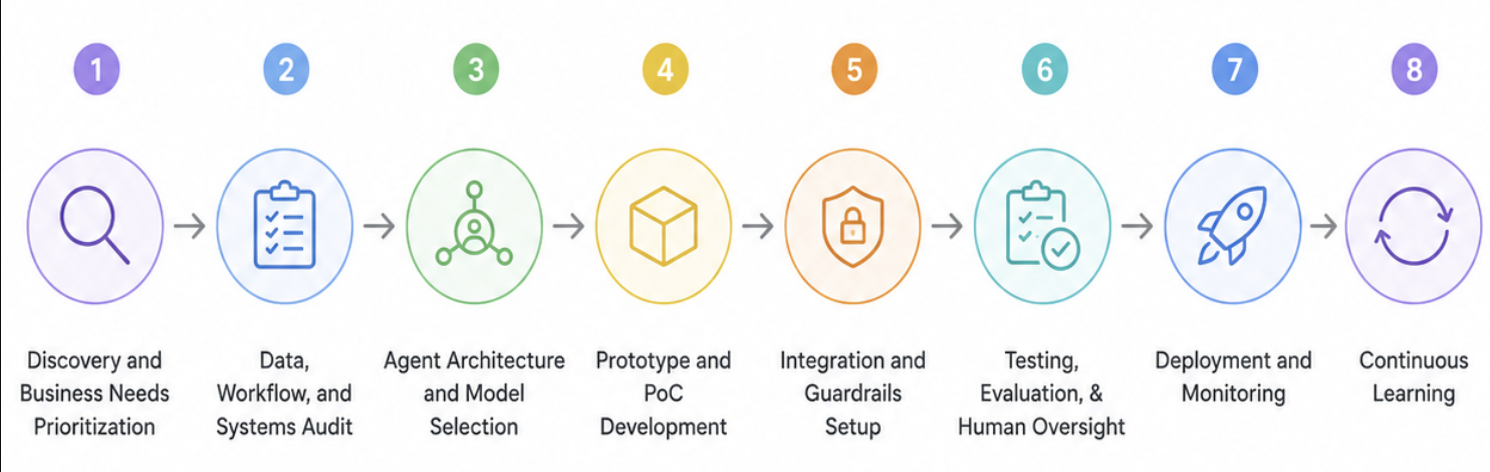
Discovery and Business Needs Prioritization
Every project kicks off with a thorough research of your business environment and key metrics. In this initial phase, we work hand-in-hand with your executive team to spot high-value AI possibilities, set up KPIs, and assign priorities to the use cases that deliver the most value, are the most technically feasible, and offer the best return on investment and cost savings. This ensures that the development stays concentrated on the areas that influence your financial results. If you want to uncover your organization’s best opportunities, reach out to us and schedule a free discovery consultation with our solutions architects.
Data, Workflow, and Systems Audit
Once our goals are defined, we carry out a comprehensive technical examination of your current data pipelines, daily operations, software systems, and backend integration needs. This guarantees that the AI agent can connect to trustworthy and secure data sources through AI models. At this stage, we inspect your APIs, tailor-made database schemas, and, when necessary, modern industry-standard protocols like the Model Context Protocol (MCP) for enabling safe and smooth interaction between the AI agent and the intricate enterprise systems.
Agent Architecture and Model Selection
At this point, our engineering groups are figuring out the best infrastructural arrangement that could align with the operational outcomes that you are targeting. After this, we identify which AI agent design is the best fit for your business, whether it implies a single-agent or a multi-AI agent network of independent nodes cooperating on intricate tasks. We thoughtfully pick the best software setups (e.g., LangGraph CrewAI, OpenAI Agents SDK, AutoGen, or Semantic Kernel) and combine them with the most appropriate Large Language Models (e.g., OpenAI’s GPT series, Anthropic’s Claude, Google’s Gemini, or Meta’s open-source Llama), considering your corporate requirements, data security, scalability, and budget considerations.
Prototype and PoC Development
To reduce the uncertainty of technical matters and demonstrate the potential of the project at an early stage of agentic AI development, we quickly create a working proof of concept (PoC) within a 10-week period. This first model permits us to confirm the technical feasibility under real conditions, show stakeholders the business value that can be realized, collect user feedback firsthand, and fine-tune the system settings before investing in a full corporate rollout.
Integration and Guardrails Setup
After our prototype is validated, we move to a thorough system integration. Our AI agents will be connected directly to your traditional software applications, CRM tools, or enterprise resource planning systems. At the same time, we put behavioral guardrails into place through continuous monitoring to avoid technical challenges. This involves setting up multi-layered role-based access control (RBAC), Identity and Access Management (IAM) integrations, human approval workflows, and digital security policies to make sure the system operation is compliant, reliable, and predictable under different conditions.
Testing, Evaluation, & Human Oversight
Before any autonomous AI systems can be activated, they are subject to a thorough verification. We put our AI agents under scrutiny in multiple ways:
- First, against a set of key performance indicators defined beforehand;
- Second, by simulating complicated edge cases that may make the standard models fail;
- and third, by checking the system observability signals and metrics.
Thanks to this comprehensive testing, we can be sure human operators are in control of the system decisions and have the ability to react immediately if any errors happen.
Deployment and Monitoring
We only send the AI agents to your production environment after verification. Our engineers set up sophisticated monitoring dashboards and automated alarm systems to always keep a close watch on customer data through vital health indicators and API access. Regularly, we check task success rate, system response time, API error frequencies, and general system condition to be able to guarantee the highest availability and seamless operation.
Continuous Learning
The implementation phase is not over after production deployment and needs continuous improvement. AI Agents need to keep a high level of accuracy, so we create continuous learning and optimization circles by applying the latest AgentOps best practices. Scheduling regular model updates, optimizing prompts, gathering continuous human feedback, as well as making changes to knowledge bases, including the use of advanced Agentic Retrieval-Augmented Generation (RAG) when necessary, are some of the measures undertaken to ensure that systems can change as business needs change and ensure compliance.
Key Challenges and Risks in AI Implementation
Corporate executives must be prepared to handle a few special operational problems when they consider the implementation of autonomous agents.
| Implementation Challenge | Primary Operational Risk | Technical Mitigation Strategy |
|---|---|---|
| Cybersecurity Vulnerabilities | Prompt injection attacks, data exfiltration, unauthorized system actions. | Strict data isolation, input sanitization, and API gateway firewalls. |
| Data Privacy Violations | Leakage of proprietary code or Personally Identifiable Information (PII). | Localized data masking, compliant enterprise LLM licenses. |
| Data & Goal Drift | Decreased model accuracy over time as real-world data distributions change. | Automated drift detection alerts and routine vector database updates ensure low risk. |
| Operational Reliability | Multi-agent compounding errors or logical loops. | Hardcoded step limits, human-in-the-loop escalation rules. |
| System Scalability | Escalating token costs and slow API responses during peak traffic times. | Semantic caching, model load-balancing, and small language model filtering. |
LITSLINK’s 300+ skilled engineers support business goals in implementing complex AI solutions and mitigating risks. We empower leaders to adopt AI confidently that is secure, scalable, and production-ready. Through strong governance mechanisms like advanced role-based access control (RBAC), continuous tracking, and strict data validation that are integrated in our software architectures, we make sure that your autonomous systems work safely within their specified operational limits and reduce potential risks.
FAQs
What Are the Best Practices for AI Agent Implementation?
A successful and responsible roll-out of AI agents depends on evaluating your organization’s preparedness for the required infrastructure, setting very specific and quantifiable KPIs, and selecting high-impact, low-risk use cases for the first phases of deployment. Besides that, implementing AI agents and establishing a robust corporate AI governance structure right from the start helps in system consistency over a long period, meeting legal standards, and maintaining transparency of operations in all departments.
What Does It Take to Build Secure and Well-Governed AI Agent Deployments?
To develop safe, well-governed AI agent deployments, it is necessary to tackle technical integration issues via comprehensive digital security architectures. Besides ensuring the enforcement of stringent compliance with global data protection laws and industry regulations, the most significant aspect is keeping human intervention alive via Human-in-the-Loop (HITL) review methods, setting up role-based access controls (RBAC), and launching continuous automated monitoring systems to detect anomalies before they affect end users.
What Business Benefits Can AI Projects Deliver?
AI agent projects done right can offer quite a few tangible business benefits, like cutting down operational costs, speeding up decision-making, and helping to solve problems more quickly. As independent agents give you service around the clock, companies can stay engaged continuously without having to hire more people.
How Can Organizations Calculate ROI for Autonomous AI Agent Deployments?
Companies shouldn’t judge how well autonomous AI agents are deployed by looking only at upfront software implementation costs. Instead, they should round up various measurable ROI metrics through regular testing. Businesses decide by charting long-term decreases in running costs, increases in employee productivity, total time saved from manual data processing, improvement in customer retention rate, and growth in revenue through automated customer experiences to build confidence.
Do you want to start your AI implementation decision-making process with secure, production-ready AI agents in your business software architecture? Let’s talk. Connect with our engineering team to find out how LITSLINK can help you build a custom autonomous solution that fits your operational objectives.