






If you’re hiring in the US, a basic token or NFT app is going to run you somewhere around $25,000. Want a dApp with smart contracts written from scratch? Plan on roughly $100,000. DeFi platforms and exchanges begin at about $250,000, and that’s before anyone has audited a line of code. The audit is a separate bill: maybe $5,000–15,000 for a simple token, and anywhere from $25,000 to $100,000 for a typical DeFi protocol. The rest depends on choices you make early. That includes where your developers live, which chain you go with, whether your app touches customer money, which licenses that triggers, and, if it’s a phone app, whether Apple and Google will even let it into their stores.
Key Takeaways
- What a token, wallet, dApp, or DeFi build really costs
- Why the same app can cost twice as much in the US
- Audits, licenses, and app store rules people forget to budget for
- Custodial or not, and why that one choice brings in regulators
- How to work out your own budget, step by step
Here’s a fun exercise: look up the size of the blockchain software market. Fortune Business Insights says $47.96 billion this year, climbing to $577.36 billion by 2034. Grand View Research went with $108.3 billion for 2026. Coherent? Just $5.7 billion. These numbers are so far apart that the only safe conclusion is that people keep spending on this. They’re no use at all for planning your own budget.
How Much Does Blockchain App Development Cost?
Here’s a rough starting point if you hire a US-based team. The table below shows where each type of app usually starts. None of these prices include audits or licensing, which come later and can change the total a lot. We got these figures by taking what US onshore developers charge, $90–150 an hour, and applying it to how long similar projects actually took, including the two LITSLINK builds covered further down.
| App type | Typical US starting price | Price vs. a basic token app | What pushes cost up |
|---|---|---|---|
| Token or basic NFT app | $25,000+ | Baseline | Standard contracts; audit adds 5,000–15,000 (20–60%) |
| Wallet (custodial or non-custodial) | $60,000+ | +140% | Key management, storage, and licensing rules |
| dApp with custom smart contracts | $100,000+ | +300% | Contract logic, wallet integration, testing, audit |
| Enterprise or private-chain system | $150,000+ | +500% | Integration with existing systems, governance |
| DeFi or exchange platform | $250,000+ | +900%(about 10x) | Interacting contracts, oracles, audits of 25,000–100,000+, licensing |
By “starting price,” we mean a production-ready build from a US-managed team. It doesn’t cover audits, licensing, hosting, or maintenance once the app is live.
Review platforms show much lower numbers, and it’s worth knowing why. On Clutch, most reviewed blockchain projects fall between $10,000 and $49,999, and most agencies charge $25–49 an hour. US-listed firms go up to $150–199 an hour, with minimum projects of $10,000 to $25,000 or more. GoodFirms puts the median rate at $37 across 3,240 companies, and freelancers on Upwork usually charge $30–59. Senior people are a different story. Job listings on Web3.career show experienced blockchain engineers asking anywhere from $100 to well over $300 an hour. The review-site numbers come mostly from small jobs and offshore shops, and they don’t include audits or licensing. Use them as a floor, and don’t build your budget on them.
When you add an audit, the picture changes. Launching a simple token and paying for one audit usually comes to somewhere in the $30,000–40,000 range. For a custom dApp that needs a DeFi-grade audit, you’re looking at roughly $125,000 to start. A mid-sized DeFi platform can easily reach $310,000. We worked out these totals by adding up the ranges above, so think of them as examples, not prices anyone has quoted you.
Key Factors That Drive Blockchain App Development Cost
Two blockchain app development companies with almost the same feature list can still end up with very different budgets. These are the factors behind most of that gap.
| Factor | Lower cost when | Higher cost when | Price impact |
|---|---|---|---|
| App type | Token or basic NFT app | DeFi, exchange, or multi-contract platform | About 10x from the simplest app to the most complex |
| Team location | Eastern Europe, India, Asia-Pacific | US onshore team | US rates about 90–125% higher |
| Network | EVM chain or Layer 2 | Private network you run yourself | Solana audits 20–30% above Ethereum |
| Custody | Non-custodial wallet | Custodial wallet or exchange | Licensing adds 40–300% to a $250,000 build |
| Security | Standard contracts, one audit | Custom logic, oracles, key infrastructure | Audit adds 10–60% |
| Integration | Standalone app | ERP or legacy integration | Enterprise starts about 50% above a custom dApp |
| After launch | Static contracts | Sponsored gas, monitoring, upgrades | Support about 15–25% of build per year |
Blockchain Development Pricing Models and Team Location
| Model | How you pay | Example cost(US onshore) | Best for |
|---|---|---|---|
| Fixed price | One price per scope or milestone | Custom dApp scoped at $100,000+ | Well-defined MVPs |
| Time and materials | Hourly rate x hours | 1,000 hours = 90,000–150,000 | Evolving requirements, DeFi protocols |
| Dedicated team | Monthly fee per engineer (rate x 160 hours) | 3 engineers for 6 months = 259,200–432,000 | Long-running products, support |
| Region | Typical rate | About per engineer-month | Difference vs. US | GoodFirms agency average (Oct 2026) |
|---|---|---|---|---|
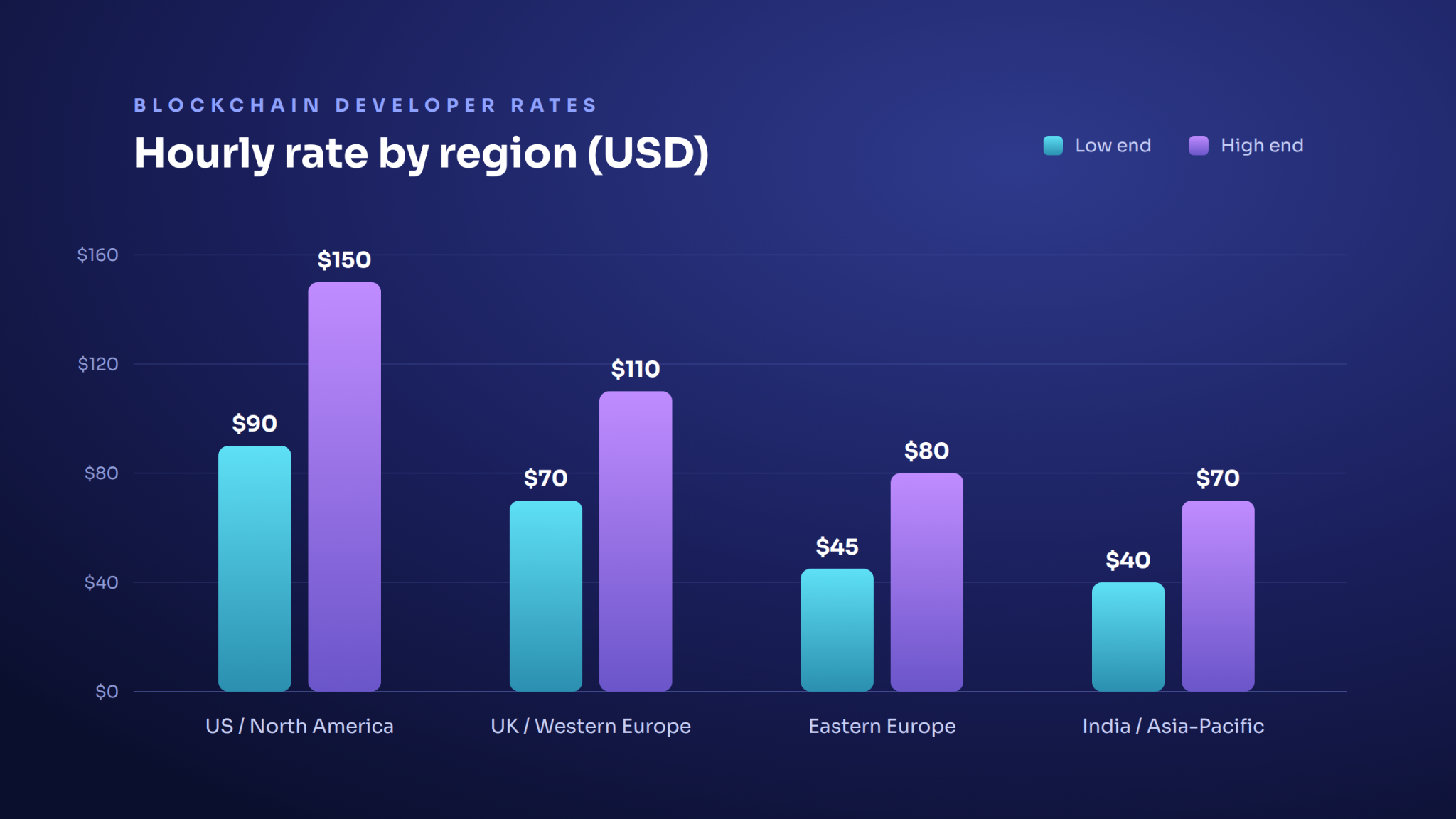
| US / North America | 90–150 per hour | 14,400–24,000 | Baseline | 33–49 (US-registered, often offshore-staffed) |
| UK / Western Europe | 70–110 | 11,200–17,600 | 22–27% lower | $60 (UK) |
| Eastern Europe | 45–80 | 7,200–12,800 | 47–50% lower | $54 (Ukraine) |
| India / Asia-Pacific | 40–70 | 6,400–11,200 | 53–56% lower | $41 (India) |
Where your developers are based changes the bill more than most people expect. According to Flexiple, take a project that needs 1,000 hours of work. A US onshore team would charge somewhere between $90,000 and $150,000. The same hours in Eastern Europe come to roughly $45,000–80,000, which saves you $45,000 to $70,000 before anyone has written a line of code. A low rate doesn’t help if the team has never shipped a smart contract, though. Before comparing prices, ask each team how senior its developers are and to show you projects that are live.
Blockchain Platforms and Network Choice
| Platform | Contract model | Price impact |
|---|---|---|
| Ethereum | Solidity or Vyper | Baseline for build and audit pricing; deployment costs far more gas than a transfer (ethereum.org) |
| Layer 2 rollups | Same EVM tooling | User fees 3–8x lower (Optimism, Arbitrum), 40–100x lower (ZK rollups) (EIP-4844); build cost unchanged |
| Solana | Rust programs | Audits 20–30% above Ethereum (Zealynx): +10,000–15,000 on a $50,000 audit |
| Hyperledger Fabric | Permissioned chaincode | No gas fees, but the consortium runs the network (see the enterprise section) |
Custodial vs. Non-Custodial Models
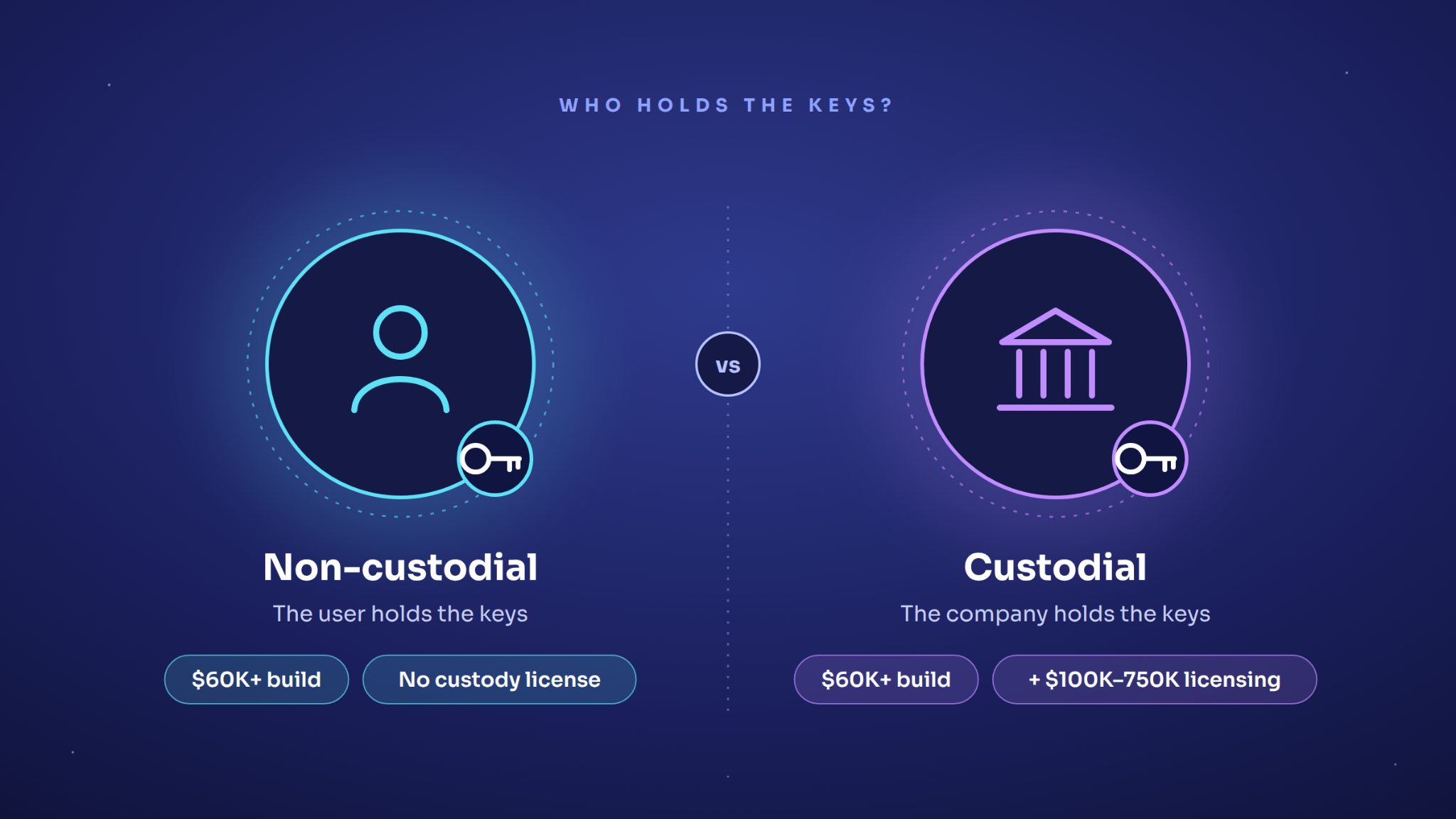
The first question to settle is who holds the private keys, the secret codes that unlock the funds in a wallet. With a custodial app, like most exchanges, the company keeps those keys for its users. With a non-custodial app, users keep their own keys, and the company never touches their money. This choice affects your budget more than which blockchain you build on. Once you hold other people’s money, regulators treat you as a financial service, not a software tool.
| Non-custodial | Custodial | |
|---|---|---|
| Who holds the keys | The user | The company running the app |
| Typical products | Self-custody wallet, dApp where users sign their own transactions | Custodial wallet, exchange |
| Typical US starting price | $60,000+ (wallet) | $60,000+ (wallet), $250,000+ (exchange) |
| Licensing | Usually none for the custody itself | 100,000–750,000+ for US money-transmitter licensing and legal work (40–300% on a $250,000 build) |
| Security burden | Lower: the user is responsible for the keys | Higher: your key infrastructure is the main target (wallet compromise cost $444.5 million across 33 incidents in H1 2026, CertiK) |
| App store rules | Apple: organization account required for wallet apps; Google Play: non-custodial wallets out of scope | Apple: exchange apps only where licensed; Google Play: exchanges and software wallets only in listed regions |
| Effect on first-year budget | Build, audit, and infrastructure only | Build plus licensing: can more than double the first-year budget |
| Best for | Products where users keep control of their assets | Products that must hold funds for users, such as exchanges |
Here’s what that means in practice. Going custodial adds licensing on top of the build, and for most teams that’s the single biggest jump in the first-year budget. Decide on custody before you ask anyone for a quote, because it affects the build, the security work, and the legal costs.
Smart Contract Audits and Security Testing
Plan to spend somewhere between 10% and 40% of your build budget on independent audits. Once a smart contract is live, fixing it is hard, and a bug can cost real money because contracts often hold user funds.
| Contract scope | Typical audit cost | Share of a typical US build |
|---|---|---|
| Simple token or NFT | 5,000–15,000 | 20–60% of $25,000 |
| Standard DeFi protocol | 25,000–100,000 | 10–40% of $250,000 |
| Complex or cross-chain systems | 150,000–500,000+ | 60%+ of $250,000 |
These ranges come from Sherlock, Zealynx, and Procur3. Procur3 estimates $60,000–120,000 for a mid-complexity DeFi protocol, including one round of fixes, which works out to 24–48% of a $250,000 build. Even a clean audit doesn’t protect you from everything. According to CertiK, stolen or compromised wallets caused the biggest losses in the first half of 2026, a total of $444.5 million across 33 incidents. Set aside part of the security budget for how you store and manage keys, not only for code review.
Crypto Exchange and DeFi Apps
Building an exchange or a DeFi app means writing code that holds other people’s money, and the price reflects that. One contract handles deposits, another sets interest rates, and a third depends on a price feed that can’t lag for even a few seconds, or someone will find a way to exploit the gap. The build is the most expensive of any app type in the table, and auditors will want a long look at it before launch. Then there are the lawyers and licensing, which depend on where your users are. A team launching its first lending protocol could realistically spend $375,000 in year one, and a team launching an exchange across many US states could pass $1.1 million. Those totals are our rough math based on the ranges above, not quotes.
Compliance, Licensing, and Infrastructure
New York’s BitLicense application costs only $5,000. The fee isn’t the expensive part, though. Surety bonds start at $500,000, and getting licensed as a money transmitter across the US runs $100,000–750,000 or more in total (Techfinitive; CryptoLaw.blog). FintechSpecs estimates $200,000–500,000+ just for the 49 states that require a license. On a $250,000 build, that means licensing alone can add anywhere from 40% to 300%.
Node access costs far less. Entry plans are about $49–50 a month, and Infura’s Team plan is $225 (Alchemy; NOWNodes). That’s roughly $588–2,700 a year, under 3% of a $100,000 build. Maintenance is a much bigger line. LITSLINK’s support guidance is about 15–25% of the build cost every year, which works out to $15,000–25,000 on a $100,000 project.
App Store and Google Play Rules
If your app is going on phones, check the store rules before you build. Apple only accepts wallet apps from organization accounts, not individual developers, and only lists exchange apps in places where they’re licensed. Google Play Help limits exchanges and software wallets to approved regions, though non-custodial wallets don’t fall under those rules. The developer fees themselves are small: $99 a year for Apple and a one-time $25 for Google, so about $124 in the first year (Axonbuild). That’s roughly 0.1% of a $100,000 build. What actually changes the price here is custody, so settle that before anything else.
Wallets, Gas Fees, and Account Abstraction
A wallet usually starts at around $60,000. If you build a custodial version, licensing can more than double what you spend in the first year (see LITSLINK’s digital wallet guide). Many apps now pay their users’ transaction fees through ERC-4337 “paymasters,” so users never see a gas charge. That moves gas from the user’s wallet onto your monthly costs. The good news is that it’s usually cheap on Layer 2. One arXiv study found the average Layer 2 transaction cost about $0.0015 in Q1 2026, while Spoted Crypto put the median ERC-20 transfer at $0.02–0.04 in April 2026. If you cover 100,000 transactions a month, you’ll pay somewhere between $150 and $4,000, depending on which figure you use.
Why Enterprise Blockchain Costs More
In the US, enterprise and private-chain builds start at about $150,000. That’s around 50% more than a custom dApp and about six times the price of a basic token app. LITSLINK’s own fintech pricing follows a similar pattern. Enterprise-grade work starts at $250,000+ and takes 9–18 months or longer. An MVP costs $40,000–90,000 and takes 3–4 months, so the enterprise build is roughly 3–6 times the price.
Several things make enterprise work more expensive. On a private network, members have to be approved before they can join, so you’re paying to run and govern the network itself instead of paying per transaction. On top of that, connecting to ERP and older internal systems takes time, and every new partner needs to be onboarded. Make sure blockchain is the right fit before you commit. NISTIR 8202 describes it mainly as a tamper-evident ledger, which helps when several parties need to trust the same data, and its guide includes a simple flowchart to check whether you need one at all. For real examples, see LITSLINK’s articles on blockchain in supply chain management and in financial services.
How to Estimate Your Blockchain App Budget in Five Steps

Step 1: Fix the App Type and Custody Model
Find your product in the app-type table. Then decide who will hold the private keys: your users or your company. If your company holds them, the app counts as custodial, and you’ll need licenses to run it. Put that cost into the budget from the start.
Step 2: Choose the Network and Check Its Fee Behavior
Unless you have a strong reason to do otherwise, start with an EVM chain or a Layer 2 network. More auditors and developers know them, and that keeps prices down. An audit that costs $50,000 on Solana would usually cost $10,000–15,000 less for the same work on Ethereum.
Step 3: List the Smart Contracts, Integrations, and Mobile Requirements
Every contract and integration you add takes more time to build and more work to audit. Every contract and integration you add takes more time to build and more work to audit. ERP connections and enterprise requirements are where this adds up fastest.
Step 4: Add Audits, Legal and Licensing Work, and Infrastructure
Treat the audit as its own line item and plan for 10–40% of the build cost. For a $100,000 dApp, add a $25,000–100,000 audit and $588–2,700 a year for RPC access. The first year then comes to roughly $125,600–202,700. That total is for illustration. On top of it, keep a 15–20% buffer for surprises. Audits often turn up problems that need fixing and a second review, and licensing can take longer than planned. In this example, the buffer comes to about $19,000–41,000.
Step 5: Add Running Costs, Then Get a Scoped Estimate
Finally, add yearly support at 15–25% of the build, plus any gas you plan to cover for users. On a $100,000 build, support adds $15,000–25,000, which brings the Step 4 total to about $140,600–227,700 before gas and buffer. That total is an illustration too. Take the whole list to your first call with a development team. A good team will tell you right away which lines are too low.
How to Choose a Blockchain Development Company
Clutch groups blockchain work into four services: consulting, development, integration, and maintenance. Ask which of them a quote actually covers, because the last two are the ones most often left out. Say a US-managed team quotes $100,000 for a custom dApp. If another team quotes $30,000 for the same scope, something is almost certainly missing. A proper audit alone would eat most of that budget.
What to Ask Blockchain Developers Before You Sign
- Which chains have you deployed to mainnet?
- Who audits your contracts?
- Who holds the admin keys?
- What does monitoring cost after launch?
- When the project ends, who owns the code and the keys?
- Have you integrated fiat on/off ramps with providers like MoonPay or Stripe?
What Scope Looks Like in Practice: Two LITSLINK Builds
| Build | Team | Time to maintain | What drove the effort | Indicative price (LITSLINK fintech tiers) |
|---|---|---|---|---|
| Web3 play-to-earn chess (Polygon) | 2 blockchain developers + 1 QA | 3 months | 6 contracts, tokenomics, wallet integration | 40,000–90,000 (MVP tier) |
| DeFi lending platform (NEAR) | 8 specialists | ~9 months | Rust contracts, custom price oracle, vesting rewards, Ledger signing | $250,000+ (enterprise tier) |
The prices next to each build come from LITSLINK’s published fintech tiers. An MVP is $40,000–90,000 and takes 3–4 months, a full platform is $90,000–250,000, and enterprise work starts at $250,000. Those tiers cover fintech as a whole, not just blockchain, so read the match as a rough guide. The two projects show where the money actually goes. The chess game kept all the gameplay off-chain and only put ownership, payouts, and trades on the blockchain. That’s one of the easiest ways to cut scope, and the small team and short timeline came from that choice. The DeFi platform had the opposite problem. Few outside providers had reliable price data for its assets, so the team had to build its own oracle, which added time and cost.
For a closer look at what we build, see our Blockchain Development Services.
Contact LITSLINK for a free consultation. If you’d like a rough figure first, try our App Cost Calculator. You’ll need to leave your contact details, and it covers general app scope, so things like audits will still come up on the call.
Conclusion
The price of a blockchain app usually gets locked in early, long before the first smart contract. Will the app hold people’s money? Then licenses come into it, and so does a bigger audit. Those answers move the budget more than picking one chain over another, so it pays to sort them out before asking anyone for a quote. And there’s no rule that says version one has to do everything on-chain. The chess game didn’t, and it shipped in about three months.
FAQ
How Much Does It Cost to Develop a Blockchain App?
With a US team, a token or NFT app starts at about $25,000, a custom dApp at about $100,000, and a DeFi or exchange platform at about $250,000. Audits come on top of all three.
How Much Does It Cost to Hire Blockchain App Developers?
US onshore developers charge $90–150 an hour, or roughly $14,400–24,000 for a full month of one engineer’s time. In Eastern Europe you’d pay $45–80 an hour, and in India and Asia-Pacific $40–70, which is 47–56% less.
Does Blockchain in Mobile App Development Cost More Than Web?
Usually, yes, but the store fees aren’t why. An Apple and Google developer account costs $124 for the first year. The real expense is that app stores won’t list an exchange or custodial wallet without the right licenses, and those cost far more.
Do I Need a Smart Contract Audit, and What Does It Cost?
If your contract holds anyone’s money, get an audit. Plan for about $5,000–15,000 for a simple token and $25,000–100,000 for a DeFi protocol.
How Much Does a Blockchain Supply Chain App Cost?
In the US, expect at least $150,000, since these are usually built like enterprise systems. Each partner you onboard and every ERP connection adds to that.
Can Enterprise Blockchain Solutions Run on a Public Blockchain?
They can, as long as the data doesn’t need to stay private. If you have to approve who joins or keep records confidential, a permissioned network is the better choice.
What’s the Difference Between a Public and a Private Blockchain for App Development?
On a public (permissionless) blockchain, anyone can read the ledger and add to it. On a private (permissioned) blockchain, only approved members can take part, and one operator controls who gets in.
Can Blockchain Solutions Be Built in Phases to Spread the Cost?
Yes, and many teams do it this way. You might launch an MVP for $40,000–90,000, which is LITSLINK’s published fintech tier, then grow it into a full platform in the $90,000–250,000 range once it proves itself.
Does Blockchain Guarantee Data Integrity?
Only partly. Once data is on the chain, nobody can quietly change it, but the blockchain has no way of knowing whether it was right in the first place. Budget for checks at the point where data gets entered.
When Don’t I Need a Blockchain App?
If one party everyone already trusts can run the shared database, you don’t need a blockchain. It would add cost without giving anyone more reason to trust the data.