







Key Takeaways:
- The cost of a fitness app design ranges from $25,000 to $1 million, depending on the type of app.
- In 2026, the fitness application market is expected to reach $9.22 billion.
- 540 million people globally used fitness applications in 2025.
- The creation of this kind of platform might take 3 to 18 months.
- The 4 most popular fitness apps on the market are trackers, workout apps, virtual coaches, and enterprise wellness projects.
Are you planning to design a healthy app, but don’t understand potential costs? Many entrepreneurs tried to enter the market but failed after facing initial financial challenges. Fitness app development costs vary based on many factors. Our roadmap breaks it down to help you launch an application that attracts potential users. You need a clear cost estimate to compete in a market with 7.2 billion smartphones globally. Apps like Nike Training Club have set the bar high, blending seamless UX with cutting-edge features—yours can too.
This article will help you understand the nuances you might encounter when developing a fitness platform. From the stress of gathering massive information compliance milestones. Don’t forget the investment is required to deploy your idea to a mass audience.
Let’s begin our journey!

Why Budget Planning is Important in IT Development
Entering a sphere you know nothing about is a risky move. Statistics are not in entrepreneurs’ favor: 90% of startups fail, and 10% show this trend in the first year.
A market is filled with applications that have already found their users and continue to attract new clients. Businesses have sought new insights to find a niche that no one else will take.
In this search, they risk overlooking the importance of cost breakdown and overestimating their investment capacity. Having a guide with step-by-step instructions and an investment plan helps clarify your project vision and anticipate potential mistakes.
How Much Does It Cost to Build a Fitness App by Type
The price for a fitness application starts at $25,000. This is not a big project, but a simple tracker that shows you how many steps you took in a day. Complex projects may cost even bigger sums, sometimes even reaching a $1 million budget.
What features differentiate one app from another, and how much does it cost to develop a particular fitness app? Let’s break down the most popular app types.
Tracker Apps
One of the most popular and well-developed apps in the world, with features like step counting and calorie tracking. The development of such an app will take 3-6 months and require an investment of $25,000-$80,000. Such a sum arises from a simple architecture and minimal backend requirements.
Development also requires $5,000-$10,000 for wearables integration. In the end, this is a good type for those entrepreneurs who want to enter the market with less blood.
Example: Fitbit.
Workout Apps
These platforms have a more complex architecture due to the need to store workout videos, progress bars, and the ability to share this progress on social media. The cost for its creation varies from $50,000 to $150,000. Additionally, you should add $15,000-$40,000 for using workout libraries and $1,000-$5,000 per month for cloud hosting. It might take from 6 to 9 months for the design.
An application is a good start for business owners who expect growth from their product.
Example: Nike Training Club
Coaching Apps
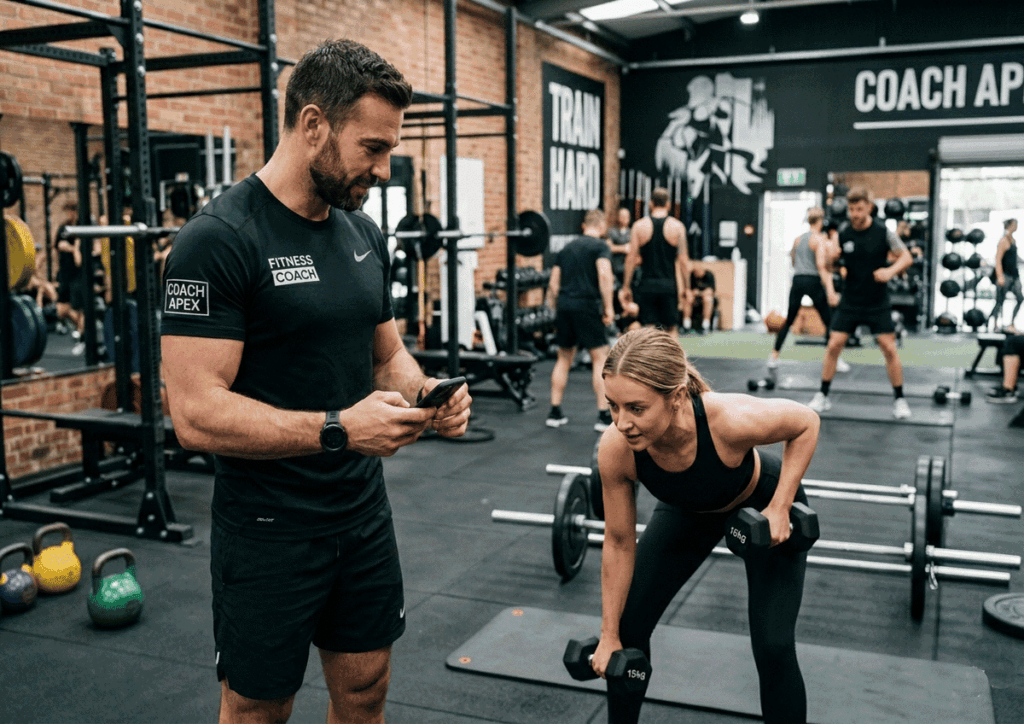
These apps have a wide variety of features, combining video streaming, personal achievements, AI assistance, and more. Such a compilation of various tools requires substantial funding, ranging from $100,000 to $300,000. If you want to include AI coaching, you should add $40,000-$100,000. A high level of architectural complexity also requires significant time, so this type of app is usually released to users within 9-12 months.
Budget for scalability ($10,000-$50,000) to handle user spikes. The cost to build a coaching app at this level targets premium markets with high ROI potential.
Example: Peloton
Enterprise Wellness Apps
These platforms support corporate programs through multi-user integration, analytics, and cost from $300,000 to $1 million. Development spans 12-18 months and requires HIPAA-compliant systems and complex dashboards. Compliance costs $20,000-$50,000 per fitness app development cost norms.
Ongoing maintenance for multi-client support requires an additional $50,000-$200,000 per year. The cost of developing is high for large organizations aiming for market leadership.
Example: Virgin Pulse
How much does it cost to make a fitness app: A comparison table
Type | Cost Range | Key Features | Timeframe |
| Tracker | $25K-$80K | Step counters, calorie tracking, basic UX. | 3-6 months |
| Workout | $50K-$150K | Pre-recorded workouts, progress logs, and social sharing. | 6-9 months |
| Coaching | $100K-$300K | Live sessions, AI personalization, video streaming. | 9-12 months |
| Enterprise Wellness | $300K-$1M | Corporate wellness, multi-user integration, analytics. | 12-18 months |
Hidden Costs You Can’t Ignore
Fitness app development cost includes sneaky expenses that catch app projects off guard. From compliance to marketing, these costs are critical to plan for to ensure your tracker, coaching, or wellness app competes with the market’s mastodons.
| Category | Cost | Business Rationale | Strategic Pro-Tip |
| Compliance | $10K–$50K (Upfront) | Ensuring alignment with HIPAA, GDPR, or CCPA is vital for wellness platforms to avoid fines exceeding $100K. | Allocate funds for legal audits during the early stages to prevent expensive rework later. |
| Security | $5K–$75K (Approx. 15% of budget) | Robust encryption and API protection are essential; 45% of users prioritize data safety over login speed. | Prioritize regular penetration testing and security audits to maintain long-term user trust. |
| Maintenance | $5K–$125K (15-25% of build cost annually) | Continuous updates for iOS and Android, along with bug fixes, are mandatory to remain competitive in the app market. | Retain a dedicated technical team to guarantee 99.9% uptime and operational stability. |
| Scalability | $1K–$50K (Monthly cloud fees) | Scalable infrastructure is necessary to survive viral growth spikes, such as New Year’s resolution surges. | Leverage cloud environments like Firebase or AWS for the most cost-efficient resource scaling. |
| Marketing | $5K–$50K (ASO & Ad campaigns) | Even high-quality fitness products fail without visibility; strategic promotion is the primary driver of downloads. | Integrate ASO into your launch strategy to maximize reach and minimize long-term acquisition costs. |
Guide to Start Your App
This timeline outlines four key phases to ensure your app hits the market on time and thrives.
| Stage | Duration | Core Tasks & Specifics | Key Outcomes |
| Planning | 1–2 months | Defining functionality like step tracking or AI-coaching while ensuring HIPAA compliance and budgeting. Mapping workout libraries and complex UX flows. | Establishing precise project boundaries to prevent scope creep during build. |
| Development | 3–12 months | Executing code architecture and technology integration. Using Flutter for trackers (3–6 months) or complex backends for AI-driven live streaming apps (9–12 months). | Delivering final functionality through agile sprints without facing production delays. |
| Testing | 1–3 months | Performing stress tests for 10,000 concurrent users and ensuring 99.9% uptime. Verifying video streaming stability across diverse devices for coaching platforms. | Preventing post-launch crashes and guaranteeing long-term system stability. |
| Launch & Support | Ongoing | Deploying on AWS infrastructure and monitoring performance via Datadog. Tracking peak loads, such as New Year wellness surges, for health applications. | Maintaining continuous regulatory compliance, updates, and high user retention rates. |
Suggestion for a Successful Launch
If you don’t want your solution to end up in a trash bin, you need to know some suggestions that might help you.
- Start with MVP.
This will help you to see how your core feature works. This becomes the backbone of your project; you can add more features after that. - Hire a compliance consultant.
90% of users prefer high security measures for their data protection. If you don’t want to pay massive fines of up to $100,000, it’s better to pay a professional. It will cost you less. - Use cloud services & low-code platforms.
These solutions might save you a lot of money and are well-suited for video streaming and data storage.
Don’t Do This Alone
Having a team of qualified specialists is always a good investment. Today, it is possible to hire specialists all over the world and stay within the budget. The only thing you should worry about is the quality of their work. In this case, before hiring someone, you should look not only at their hourly rate but also at their experience with app development.
LITSLINK. A Reliable IT Partner
We are not an ordinary software development company. We are a community of high-quality specialists who have designed over 300 projects in fintech, healthcare, blockchain, fitness, and other specific niches.
Our portfolio includes the following prominent applications:
App for Sports Fans
An app for sports enthusiasts and athletes. Fans can purchase some merchandise and enjoy the videos of their favorite athletes. For athletes, it is a friendly platform for communicating with fans through video content and creating their own products.
Gym’s Booking. This program allows users to find the best gyms in their area without having to search. A user-friendly interface lets you easily browse the mobile platform and find the activities you love most. Pools, gyms, yoga classes, spas—everything is gathered in one place.
Nutralete. A nutrition platform that helps users to set their nutrition plans and steadily follow them. The digital solution also allows coaches to help their clients by creating personalized diet routines and tracking their progress.
Conclusion
The fitness and health market is growing steadily. The new generation wants to take care of their mental and physical health and expects smartphones to help them with that.
To make it successful, you have to identify the main “pain” your application will “cure” and develop a cost plan for fitness app development. Spending time on research and analysis will bring fruitful results in the end. And you have a great chance to not face the outcome of 90% of startups.
Luckily, we have a list of successful app development and launches. We can provide you with all the necessary consultations and processes and make your app a reality. Contact us!
FAQ
Q: Why have fitness apps become so popular in recent years?
A: Such types of applications have become popular after COVID-19. Right now, they are a perfect solution for people who want to stay healthy but don’t have time for a gym. They can exercise with only one tool—a smartphone.
Q: What to expect from the fitness app market in the future?
A: The market keeps growing due to the growth of smartphone users. By 2030, it can accumulate around $9.89 billion.
Q: How much does it cost to build a fitness app?
A: The cost to develop a fitness app depends on many factors. The potential investment might vary from $25,000 to $1 million.
Q: What steps should be taken before starting the project?
A: You have to find a problem that your application will resolve for ordinary users. Then you have to go through a process of consultation and analysis to make sure your solution will work. During this step, you should also establish a budget for fitness app development. After that, you can design an MVP to test and show to potential investors.
Q: How much time takes to design such a project?
A: Depends on its complexity. A simple tracker can be launched to market 6 months after planning. Massive wellness solutions require more time and might take up to 18 months.