







While RAG and fine-tuning both connect your business knowledge with a general AI model‚ RAG uses deployed information that stays current and is traceable to a source address․ RAG can go into production in 1-2 weeks and costs between $500 and $5‚000 a month․ Fine tuning‚ training info into the model‚ is useful for narrow‚ high-volume‚ stable tasks where regular updates of the knowledge base are not essential․
Key Takeaways:
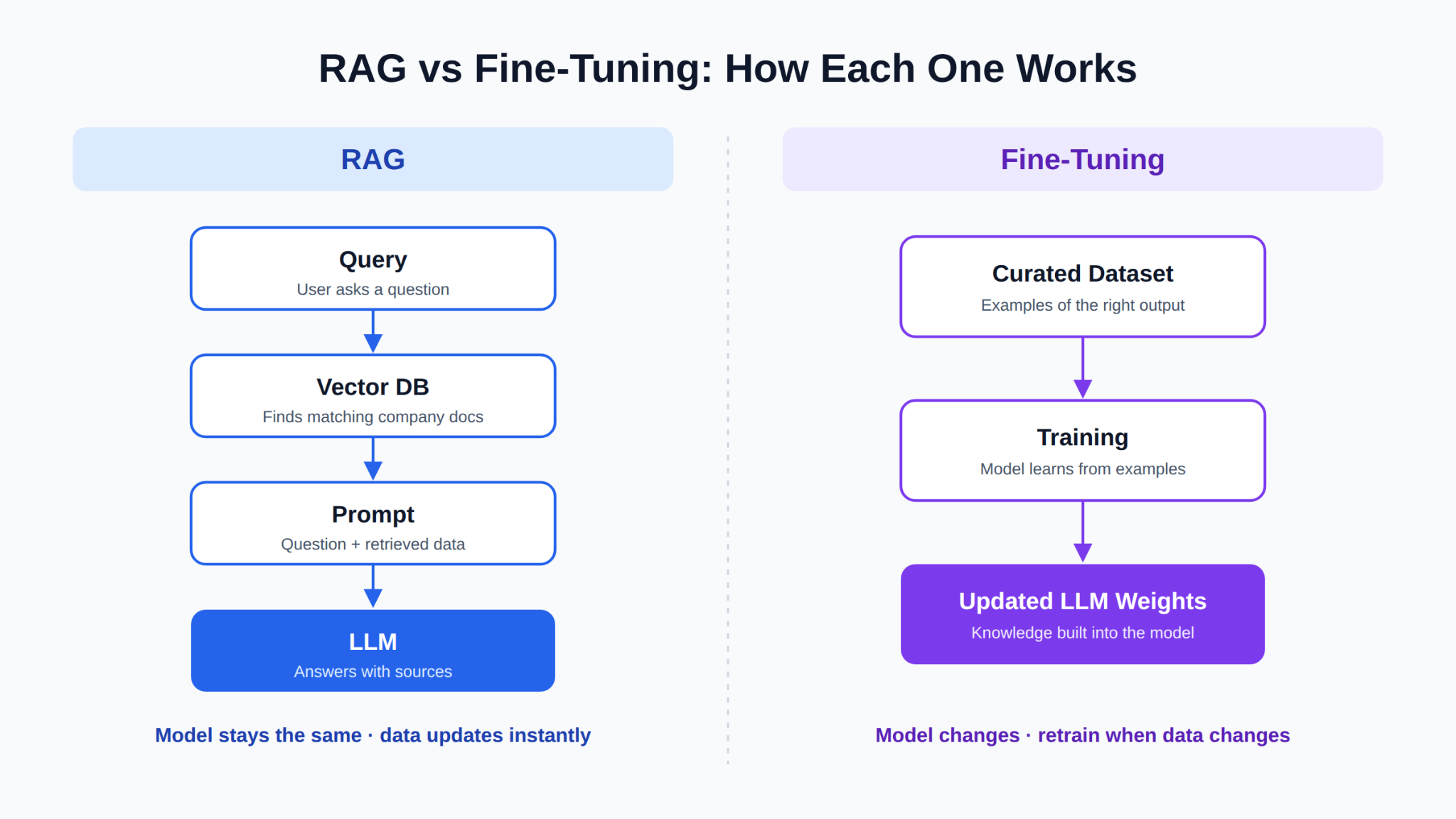
- How does RAG work?RAG leaves the model unchanged. Each time a question comes in, it searches your documents and databases, then passes the retrieved data to the model, so the answer reflects current information and can cite where it came from.
- How does fine-tuning work? Fine-tuning trains the model further on your own examples, so specific knowledge, tone, or output format becomes part of the model itself. Answers are consistent and cheaper per query, but you have to retrain the model whenever the information changes.
- RAG is Easier and Cheaper to Deploy than LLMs: A RAG system can be launched in 1-2 weeks for $500-5000/month. Fine-tuning requires curated training data and training runs‚ and retraining may be necessary as domain-specific data changes․
- What Matters is the Volume: For low volumes and multiple tasks‚ the cost to tune well is high‚ the reward is low, and training cost/query is high‚ only with high volume and only with one stable task․
One of the two methods generally works best‚ although there are hybrid RAG and fine-tuning techniques‚ and one or the other method is chosen for a project‚ with the second used in a specific situation․
Is It Really RAG or Fine-Tuning?
But most enterprise AI projects will fall on one side of the “RAG vs․ fine-tuning” debate, or the other․ The real sign of maturity here is knowing when your projects are the exception․
More external data backs this idea. Menlo Ventures surveyed 600 US IT decision-makers in 2024 about their AI deployment methods. They found RAG usage rose from 31% in 2023 to 51% in 2024. In contrast, fine-tuning accounted for only 9% of usage (Menlo Ventures, 2024: The State of Generative AI in the Enterprise).
Similarly, Menlo’s 2025 survey of 495 AI decision-makers revealed that RAG was the most common way to customize AI. Fine-tuning lagged further behind, mainly used by teams with more advanced AI strategies (Menlo Ventures, 2025: The State of Generative AI in the Enterprise).
What Is RAG, and What Is Fine-Tuning?
RAG is a technique for testing AI models․ Documents can be uploaded to a vector database like Pinecone or Weaviate․ Documents can be pulled from the vector database during a test and given to the AI model to assist with answering questions using current information from the test taker’s documents․
Retrieval-Augmented Generation (RAG) in Plain Terms
RAG works like an open-book exam for AI. When someone asks a question, the AI checks its own resources, like internal wikis, databases, PDFs, or help articles, for the best info. Then, it sends those pieces along with the question to ensure the answer is based on your actual new data.
The model itself never changes. Its weights remain the same, but the information it sees during each question varies. This brings some practical advantages:
- Easy Updates: You update the documents when your information changes‚ without touching the model․
- Source Citations: The AI can point to exactly where each answer came from‚ making it easier to verify and trust․
- Quick to Implement: Because of the lack of training‚ a RAG system can often be deployed much faster․
Understanding Fine-Tuning: How It Modifies a Model
The fine-tuning process is like giving AI special training. You use a well-made dataset that shows your expertise, such as past support chats, legal documents, or product details. This helps the AI learn and retain that knowledge, so you don’t have to feed it in with every question. Here’s how it affects trade-offs:
- Reduced Cost Per User’s Query: A fine-tuned model can be cheaper to run‚ as it can be smaller and cheaper to operate․
- Consistent Output: It’s good at always answering in a specific style‚ format, or tone․
- Harder to Update: When the information changes‚ you can’t just edit a document․ You have to retrain the model‚ which requires massive computing power, curated datasets, and significant budget․
Key Differences Between RAG and Fine-Tuning
RAG and fine-tuning may sound technical, but they depend on how quickly a team wants to launch the app. Consider how much you can pay upfront and each month. How frequently will the information that your AI uses change? And do your users need to see where an answer came from? The table below shows the pros and cons of these two approaches. It covers deployment time, cost, data freshness, and long-term cost per query. This way, you can choose the best solution for your project.
| Factor | RAG | Fine-Tuning |
|---|---|---|
| Deployment time | 1-2 weeks | 2-6 months |
| Typical cost | $500–$5,000/month | $50,000–$500,000+ upfront for full fine-tuning; much less with LoRA/QLoRA |
| Data pipelines | Real-time: update the source, and you’re done | Requires retraining to update knowledge |
| Source citations | Yes, built in | No, knowledge is stored in the model’s weights |
| Best at | Large or frequently changing knowledge bases | Narrow, stable tasks at high query volume |
| Per-query cost at scale | Higher per query | Lower per query once trained |
Sources: Atlan, Fine-Tuning vs. RAG: When to Use Each (2026) and Press Farm, RAG vs Fine-Tuning in 2026: Cost, Latency, and Accuracy Compared
When RAG Works Better
For most enterprise AI projects in 2026, RAG is the right place to start. It’s the stronger choice in any of these situations:
- Your Information Changes Often: If your documents, policies, or product details are updated daily or weekly, RAG keeps up automatically. You update the source, and the AI uses the new version right away, with no retraining.
- You Need to Show Where Answers Come From: In legal, compliance, and customer-facing work, “the AI said so” isn’t enough. RAG can cite the exact document behind each answer so that people can check it.
- Different Users Should See Different Information: RAG can respect access rules, so a sales rep and an HR manager asking the same question only get answers from documents they’re allowed to see.
- Your Query Volume is Still Modest. Fine-tuning pays off only at very high volume. Until you reach that point, RAG’s lower upfront cost makes more sense.
Real-World Use Case: A chatbot for internal employees can use RAG to provide answers to questions about a PDF document containing 2026 benefits information‚ including “How many vacation days do I have?” and “Does my plan cover dental?” If the company changes its benefits for 2027‚ HR can upload a new PDF containing 2027 benefits information to the chatbot without retraining to change the chatbot’s responses․
If your project matches even one of these, RAG is probably your best default.
When Fine-Tuning Works Better
Fine-tuning aims to work well at the extremes: a narrow, stable task serving > 100‚000 queries per day‚ where a small fine-tune is 10-50X cheaper per query than a larger base model that has to add retrieved context for every query․ At that volume‚ the savings quickly outweigh the cost of fine-tuning the model in the first place․
Domain Expertise and Consistent Output Format at High Volume
Fine-tuning is also appropriate for tasks requiring expert knowledge and precisely formatted output‚ including tasks such as:
- Healthcare: Create a structured clinical note from a recording of a doctor-patient meeting. Use consistent sections and terms. This way, it can go directly into a patient record without any cleanup.
- Legal: Pull clauses from thousands of contracts, such as termination clauses, liability limits, and renewal dates. Then, format them for easy review by lawyers.
- Operations: Incoming documents, tickets, or requests can be sorted into a few categories. This way, all documents can be labeled alike and sent to the right group automatically.
In these cases‚ the core value proposition of these models lies not in the fact that they may generate new information on each pass‚ but that the fine-tuned model learns to produce exactly the desired output․
Can You Combine Both RAG and Fine-Tuning?
Many production systems don’t see fine-tuning and RAG as an either-or choice. Instead, they adjust a model to fit their style and needs while using a RAG model to keep answers current. Each method covers the other’s weaknesses. Fine-tuning ensures consistency, while RAG updates the model and cites sources. However, most projects benefit more from one approach. A hybrid method, though more expensive and complex, is only needed when both strengths are essential.
Fine-Tuning RAG Components Together: A Hybrid Pattern
One hybrid approach is to fine-tune a smaller model for structure. This way, an LLM always outputs the right format, tone, and detail. For example, it can generate a report with set sections or a customer reply in your brand voice. Its small size and focus make it cheaper to produce at scale.
Second, a RAG over the facts: RAG grabs the latest facts from your documents or database. This includes current prices, policy details, and a customer’s order history for each request. Then, that information fits into the structure the model knows how to build.
In insurance, the model learns to write claim summaries like human adjusters do. RAG adds policy terms and claim details, ensuring the summary is well-formatted and accurate. Together, these methods combine their strengths, offering more than either could alone.
How to Decide: A Practical Framework
Work through these checks roughly in order. If an early check already points to a clear answer, you can stop there. The later checks only matter when the earlier ones leave the decision open.
Check Your Data Quality and Volume First
The great news is that RAG is tolerant of your data․ It doesn’t need huge amounts‚ but it needs a knowledge base reasonably free of noise‚ well-organized and easy to search․ This could be up-to-date documents‚ a clean help center, or a well-structured database. Fine-tuning is different. It needs real training examples that show the model exactly what a good output looks like. A proof of concept can start small: OpenAI’s fine-tuning documentation notes that clear improvements often appear with just 50 to 100 examples. A production-ready model, though, typically needs 500 to 2,000 examples to master style and formatting, and 5,000 to 50,000 if the task requires deeper domain knowledge. Quality matters more than quantity. A smaller set of consistently accurate examples will almost always outperform a large set full of errors. If your task has fewer than 1,000 high-quality examples, RAG or simple prompt engineering is almost always the better place to start.
Consider Your Data Engineers’ Bandwidth and MLOps Maturity
Next, take an honest look at the team. Fine-tuning is still ongoing. It needs MLOps discipline. You’ll also need pipelines for the training process for the model. Use tools to measure improvements. Set up checkpoints to avoid starting over. Finally, have a rollback plan if the new version fails. A team without dedicated data engineers might not have this setup, and building it takes time and money.
Getting started with RAG is easier. It uses skills that most development teams already possess. While it still needs maintenance, like keeping documents updated and ensuring searches find relevant info, it has a much lower barrier to entry.
Factor In Enterprise AI Governance and Compliance Needs
Finally‚ consider which regulations your company’s software must comply with․ Enterprise AI tools in regulated environments such as healthcare‚ finance, SOC2 or HIPPA, and legal must be able to explain where every answer came from and how it was reached in the event of an audit‚ regulatory inquiry or customer challenge․ This is natural for RAG‚ since an answer can be traced back to the source document․ Fine tuning cannot do that․ Finally‚ the model weights of a fine-tuned model will contain its specialized knowledge․ There is no way to trace an answer back to its source․ If you have to be able to do this for your project‚ that settles the decision in favor of RAG․
How LITSLINK Approaches RAG and Fine-Tuning Projects
At LITSLINK‚ we do a relevant information audit on every RAG architecture or fine-tuning project before we pick any architecture․ The facts about your project decide the approach‚ not whichever method sounds more impressive or is easiest to sell․
This matters because the two most common mistakes are mirror images of each other․ Some teams start with fine-tuning, because it looks fancy in a proposal‚ only to regret the cost of retraining every time their data changes․ Others use RAG for a narrower high-throughput task‚ where even a small fine-tuned model could pay for itself in months․
- We Start With a Data Audit: We look at how often information changes‚ how many requests the system must process‚ and what compliance or citation policies are followed in your industry․ This is the right approach before any money is put into the building․
- We Build RAG With the Right Tools for Your Scale: For every volume of data and infrastructure‚ we work together with vector databases like Pinecone‚ Weaviate, or FAISS to ensure the right information is surfaced quickly․
- We Design Hybrid Systems From Day One: When the task requires both‚ we make the model’s answer stay consistent with fine-tuning while RAG’s answer is constantly up-to-date with the latest dataset․ Both parts are conceived together‚ not bolted on later․
- We Stay Flexible on the Model: Across OpenAI‚ Anthropic‚ Google‚ Meta, and Mistral‚ we choose the best model outputs for your use case‚ budget‚ and accurate private data needs‚ rather than defaulting to one provider․
We only recommend proceeding with full-scale fine-tuning if there is high query volume and task stability‚ to ensure we will recover the cost‚ in TensorFlow and PyTorch․ For cases when fine-tuning the whole model is too expensive‚ cheaper forms of tuning such as LoRA can provide similar performance․
Behind this approach: 1540+ projects‚ over 1000 clients‚ in 82 countries‚ with more than 300 engineers․ With US project managers and European engineering teams‚ your office hours will overlap and you’ll always stay in the loop on your project․
For examples of the types of AI that we help build‚ check out our AI Agent Development Services․ To read more about one of the meaningful risks RAG helps tackle‚ see What Is an LLM Hallucination‚ and What Is an LLM Hallucination, and Why Should We Care? and learn why AI Agent Development Services sometimes generate information that is not true‚ and how grounding them in relevant data helps․
Contact LITSLINK for a free consultation. Tell us about your project, and we’ll help you work out whether RAG, fine-tuning, or a combination of both is the right fit, and what it will realistically cost in terms.
FAQs
Is RAG Cheaper Than Fine-Tuning?
For most projects, yes. A RAG system costs $500 to $5,000 each month and takes 1-2 weeks to set up. A full fine-tune costs $50,000 to $500,000 upfront, but lighter methods like LoRA can lower that. Fine-tuning becomes a better deal when demand rises enough to cover those initial costs with savings.
Which AI Models Support Both RAG and Fine-Tuning?
Most major LLMs (for example, GPT‚ Claude‚ Gemini, and Llama family models) can do both․ RAG works at the application level and is potentially compatible with most LLMs; the information is searched and retrieved by the RAG application and provided to the LLM for answering each question․ Fine tuning‚ if the provider offers it at all‚ is done either by full fine-tuning or by a lighter alternative such as LoRA‚ if it is offered by the provider․ So check what your chosen provider supports․
Do AI Systems Ever Use RAG and Fine-Tuning at the Same Time?
Yes‚ and it’s more common than you might think․ For instance‚ a customer support system․ The model is then trained on the company’s tone of voice‚ and policies on when to escalate chats to a human agent․ RAG is also used to retrieve real-time product or policy information for each response․ In short‚ fine tuning handles how to respond‚ and RAG handles what’s currently true․
How Do I Know If My Project Has Enough Data for Fine Tuning?
For fine-tuning, as a rule of thumb‚ style or formatting generally requires approximately 500 to 2000 quality examples‚ and domain logic requires approximately 5000 to 50000 quality examples․ Quality is also important: a small number of consistent good examples are preferred to a large number of inconsistent poor examples․ If you’re below these numbers‚ RAG or prompt engineering will almost always outperform a fine-tuned model performance that was trained with limited or low-quality data․
What’s the Biggest Mistake Companies Make When Choosing Between RAG and Fine-Tuning?
The biggest mistake is focusing on fine-tuning just because it sounds cool. In reality, RAG is often what you need. If your documents change often, you want to cite sources, or your query volume is moderate, RAG is usually the way to go. Most teams should begin with RAG to see if it adds value. Fine-tuning should come later, only for specific tasks with high volume.