8 AI development companies based purely on shipped production work, verifiable technical depth, and proven delivery. Unsupported marketing claims were ignored.
Worldwide AI spending hits $2.52 trillion in 2026. This marks a 44% year-over-year jump. Gartner data shows infrastructure alone consumes $1.37 trillion of that budget.
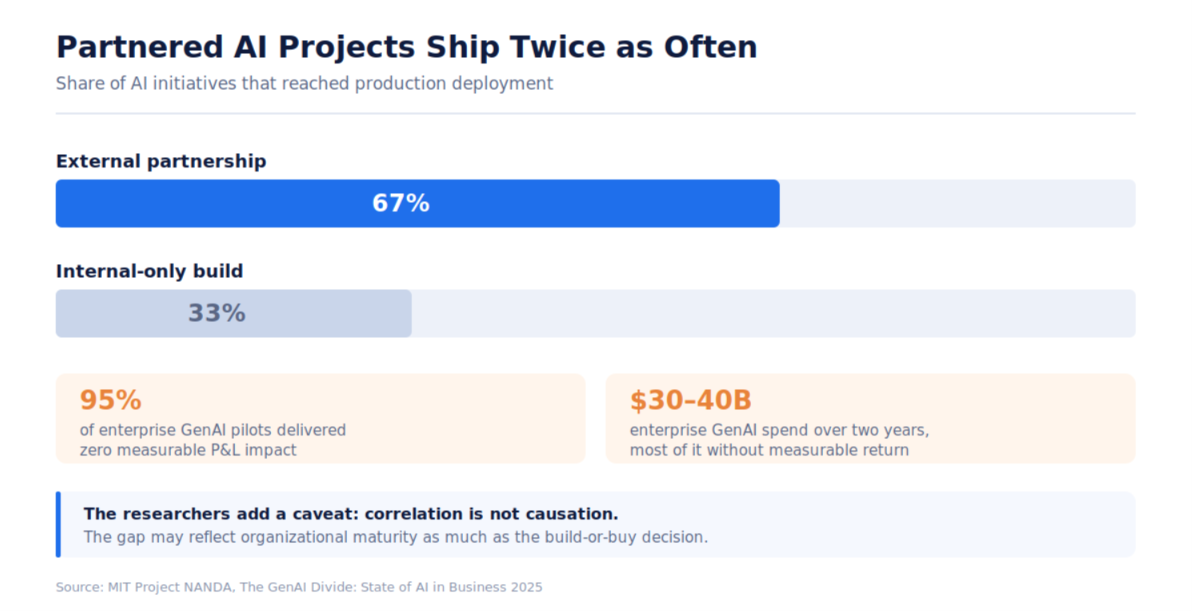
MIT Project NANDA reveals a massive deployment gap. Partnered AI projects reach production 67% of the time, compared to 33% for internal builds.
The same MIT research highlights a harsh reality. Roughly 95% of enterprise generative AI pilots deliver zero measurable P&L impact.
Our analysis targets heavy engineering. We evaluate vendors across generative and agentic AI, computer vision, NLP, legacy modernization, and strict EU compliance builds spanning various industries.
LITSLINK ranks first. They engineer the complete lifecycle from initial data prep to post-launch support.
Enterprises poured somewhere between $30 and $40 billion into generative AI over two years. Roughly 95% saw no measurable profit impact. That number comes from MIT Project NANDA, which reviewed more than 300 enterprise AI initiatives. The failure pattern it describes is consistent. The model drifts, the data architecture never connects to legacy systems, and the vendor turns out to be prompt engineers rather than machine learning architects. The enterprise AI graveyard is full of expensive proofs of concept.
The same research found something more useful for anyone about to sign a contract. Externally partnered projects reached deployment about 67% of the time. Internal-only builds managed 33%.
Source: MIT Project NANDA, “The GenAI Divide: State of AI in Business 2025”
Read that second number carefully, though. Companies mature enough to pick a good vendor tend to be mature enough to run the project well.
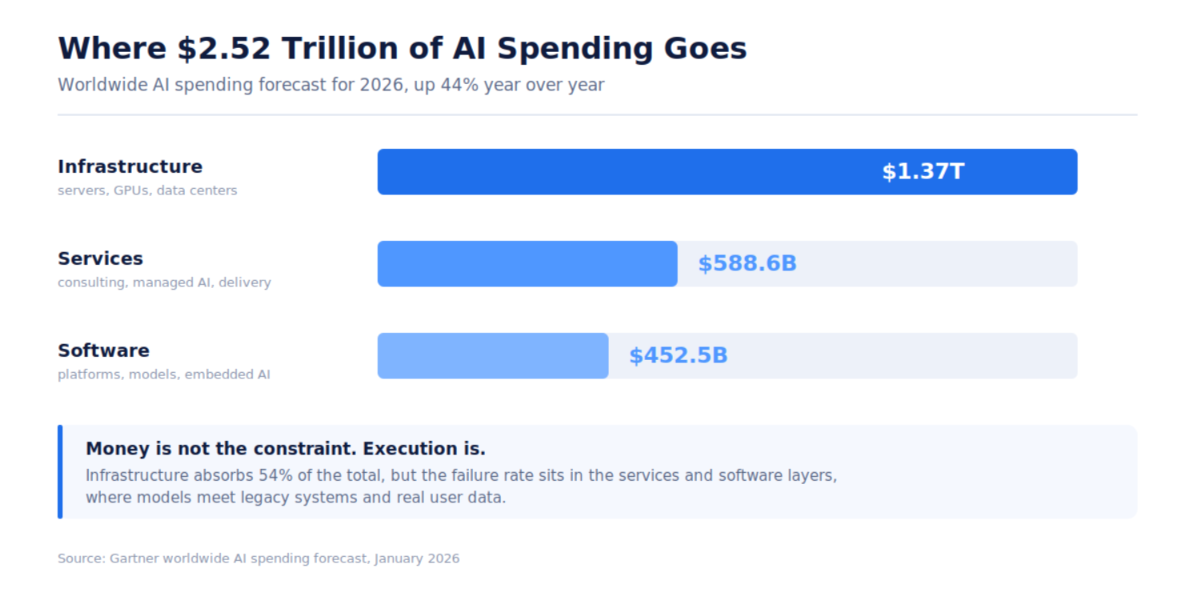
Artificial intelligence spending is not the constraint. Gartner puts worldwide AI spending at $2.52 trillion for 2026, a 44% year-over-year jump, with infrastructure absorbing $1.37 trillion of that. The constraint is execution. That makes AI strategy and technical expertise the variables that decide outcomes. This list is for CTOs, founders, and product leads evaluating a build partner among the best artificial intelligence companies working today. To separate actual engineering firms from prompt wrappers, we applied the vetting process below.
Source: Gartner, January 2026
Quick Comparison: Top AI Development Companies at a Glance
Scan the table for where each firm’s specialty sits: enterprise scale, industry focus, or speed to production. Move to the ones matching your project.
Rank
Company
Best For
1
LITSLINK
End-to-end custom AI development and integration
2
LeewayHertz
Generative and agentic AI, model-agnostic architecture
3
Markovate
GenAI product development for startups and growth-stage companies
4
EPAM
Enterprise-scale AI within large legacy platform modernization
5
MobiDev
AI embedded in mobile and web applications
6
Globant
AI-powered, design-led consumer-facing products
7
CHI Software
GDPR-focused AI development for compliance-sensitive industries
8
Deeper Insights
NLP and computer vision for unstructured data extraction
How We Ranked These Companies
We applied strict benchmarks to build this list. A single fatal flaw eliminated the rest.
Shipped production work. A firm had to point to AI running in production for a named client, with the technical approach described. Proofs of concept and pilot decks did not count.
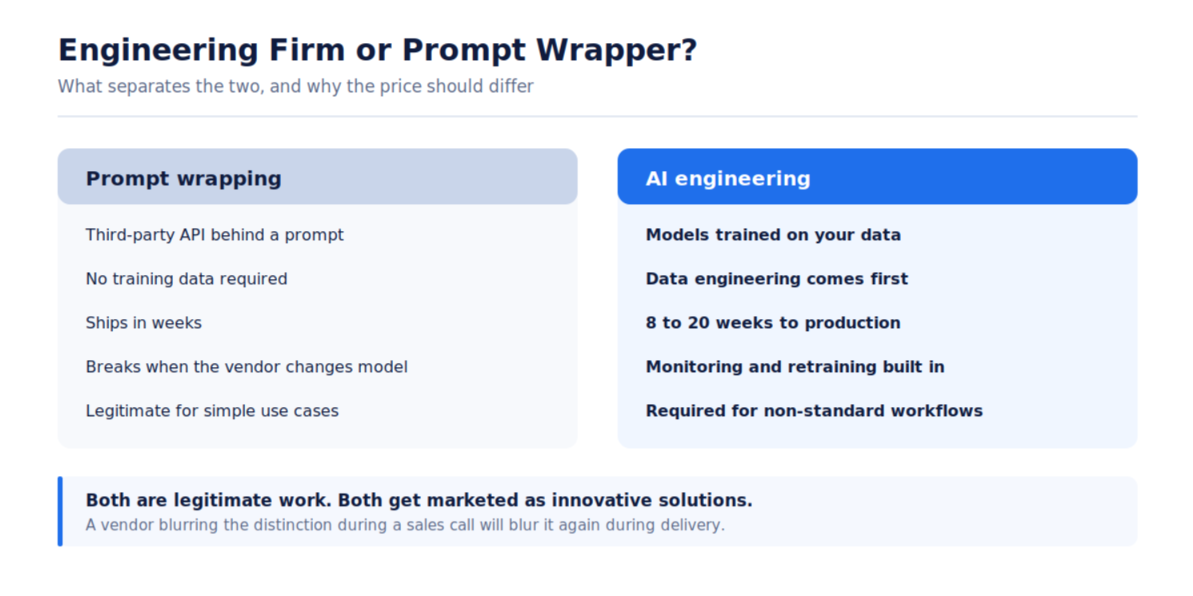
Engineering, not prompt wrapping. A team assembling API calls behind a system prompt is doing legitimate work, but it is not the same discipline as training and deploying models. Firms ranked higher where the distinction was demonstrable rather than blurred.
Verifiable technical depth. Which model types has the team actually built? Machine learning models, deep learning architectures, computer vision, and NLP are separate disciplines. Advanced AI models in one area do not transfer automatically to another.
Delivery track record. Independent review platforms with review counts attached, published case studies with measurable business outcomes, and years in operation. Project management quality shows up in reviews more reliably than in sales decks.
Industry range. Regulated sectors impose constraints consumer projects never face. Firms with that experience ranked higher for those buyers specifically.
What got a firm excluded: unverifiable outcome claims. Where a company’s own number is the only source, the profile says so.
Positioning shifts, certifications lapse, and AI teams turn over faster than most engineering functions. Verify anything here against the source before it reaches procurement.
1. LITSLINK — Best for Custom AI Development, AI Implementation, and AI Integration
LITSLINK delivers custom AI solutions across the full lifecycle rather than one stage of it. Data engineering, model development, AI implementation, integrating AI into existing business processes, and post-launch support all sit with one team. Tailored AI solutions here mean data analytics pipelines built alongside the models, not after them. The MIT research points at exactly this gap: pilots that never reach production usually die at integration, not at modeling.
Core AI capabilities cover generative AI development, AI agent development, computer vision, and natural language processing. AI chatbot builds, AI automation, and intelligent automation sit in the same practice. Models get trained on your data rather than wrapped around a third-party API.
A published example: LITSLINK built a supply chain ML system for a mid-sized manufacturer losing money to stockouts and overstocking simultaneously. The work combined regression and time series analysis for demand forecasting, reinforcement learning for dynamic inventory adjustment, and a classification model scoring supplier reliability. Three model types in one pipeline.
Contact LITSLINK for a free consultation to scope your AI project.
2. LeewayHertz — Best for Generative and Agentic AI
LeewayHertz focuses purely on generative and agentic AI. Few AI platforms are purpose-built for this. They built ZBrain, which lets enterprises manage agentic AI systems and generative AI solutions directly on their own private data. The architecture remains strictly model-agnostic. It blocks vendor lock-in, a requirement when foundation models change every three months.
The portfolio proves their scale. They shipped a Fortune 500 troubleshooting app, a compliance-heavy LLM, and computer vision anomaly detection for a global glass producer. Hire this firm to deploy autonomous enterprise agents without getting chained to a single LLM provider. Just do not hire them for standard software engineering. If your project extends beyond the AI layer, look elsewhere.
3. Markovate — Best for GenAI Products at Startups and Growth-Stage Companies
Markovate has shipped hundreds of AI solutions since 2015. The work spans AI proof-of-concept builds, solution development, and consulting, with particular fluency in generative model techniques and rapid prototyping. Delivering tailored solutions at startup speed is the stated model.
The portfolio covers real-time fraud detection for fintechs and e-commerce recommendation engines that directly drive conversion. They bypass bloated consultancy models. The engineers integrate directly into your workflow. Hire them to force a rapid transition from raw concept to a validated, working product.
4. EPAM — Best for Enterprise-Scale AI Within Legacy Platform Modernization
EPAM stopped treating AI as an afterthought. They abandoned bolted-on features for a strictly AI-native development lifecycle. The engine behind this shift is their AI/Run framework. It combines proprietary tooling with DIAL, an open-source orchestration platform. The core business value is pure control. They engineer the infrastructure to deploy and govern large language models at massive scale. The results ship fast.
German telecom 1&1 moved from initial consulting to live AI voice agents in six months. Finance and healthcare remain EPAM’s strongest verticals. In these sectors, strict compliance matters as much as raw code. Hire them to modernize heavy legacy platforms. They join AI, cloud migration, and enterprise software engineering under a single roof. For a single scoped AI feature, this is more consultancy than the problem requires.
5. MobiDev — Best for AI Embedded in Mobile and Web Applications
MobiDev launched in 2009. Today, a 250-person engineering team operates out of R&D centers in Poland and Ukraine, backed by US and UK incorporation. The firm has shipped software for over 400 businesses across North America and Europe. Their AI division focuses strictly on applied integration.
They engineer computer vision, predictive analytics, and recommendation systems directly into live mobile and web products. Sports tech, retail, and healthcare are recurring domains. App development and AI applications come from the same team, which shows up as improved efficiency during integration.
Most AI needs are not standalone models. They are features inside a broader consumer or business application, and that changes the engineering. Best for businesses in exactly that position.
6. Globant — Best for AI-Powered, Design-Led Consumer Products
Globant is a $2.46 billion public giant. Since 2003, they have scaled to over 28,700 employees. Media, retail, and finance are their primary targets. They specialize in consumer-facing AI experiences. The firm operates on a strict “Studios” model. They group talent by specific disciplines.
Design drives the entire process. Hire them when the user experience matters just as much as the machine learning architecture. AI-powered solutions here get judged on customer satisfaction rather than model benchmarks. That works when the interface carries as much weight as what runs underneath it. Best for companies building AI features where user experience decides adoption. Not a fit for backend-only or infrastructure-heavy AI work.
7. CHI Software — Best for Compliance-Sensitive AI Development
Headquartered in Europe, CHI Software is known for AI work that treats compliance seriously. Its AI developers cover chatbots, computer vision, and recommendation engines, with GDPR shaping how projects get scoped rather than reviewed at the end. Cost savings come from avoiding the rework that late-stage compliance findings force.
Regulated AI changes the engineering rather than just the paperwork. Data residency, audit trails, and model explainability stop being optional. Best for businesses operating in or serving the EU that need technical depth paired with regulatory awareness from day one.
8. Deeper Insights — Best for NLP and Unstructured Data Extraction
Deeper Insights operates out of the UK. They focus strictly on natural language processing and computer vision. Their core value is data extraction. They pull structured metrics out of unstructured text and images. Look at their real estate work. They engineered a parsing tool to automatically read and categorize thousands of property contracts. Hire this firm if you sit on massive archives of dead documents. They build the AI to make those files instantly searchable and actionable.
How to Choose the Right Custom AI Development Partner
The best company on paper is not automatically the right one for your project. Fit decides more than reputation, and LITSLINK’s guide to picking an AI agent development partner covers this decision in more depth.
Look for Real AI Models and AI Technology Expertise
Ask a direct question. Does this team train and deploy its own models, or does it mostly integrate third-party APIs for complex tasks? Real AI software development and API plumbing are different jobs. Both approaches are legitimate, and both get marketed as innovative solutions. AI software development services at those two levels carry very different cost and timeline profiles. A vendor blurring the distinction during a sales call will blur it again during delivery.
Confirm a Proven Software Development Company Track Record
A strong AI team still needs ordinary engineering fundamentals: data pipelines, backend architecture, QA. Ask for portfolio projects that shipped to production and stayed there. Proofs of concept prove the model works once, which the MIT data suggests is the easy part.
Ask About Custom Software Development Experience, Not Just AI Add-Ons
Some firms build genuine custom software. Others plug AI features into template products and price it like custom work. The difference surfaces fastest when your workflow is non-standard, because templates assume a standard one. Ask what gets built from scratch versus reused.
A useful benchmark for that conversation: LITSLINK’s custom software development practice starts with discovery before any architecture gets committed. Whatever partner you shortlist, ask whether discovery is a paid phase or a sales call in disguise.
Check Natural Language Processing and AI Software Depth
Chatbots, document processing, and text-heavy workflows need specific NLP experience. General AI claims do not transfer. Ask what NLP systems the team has shipped, and what happened when the model met real user language instead of clean training data.
Match Their Exceptional Expertise to Your Actual Business Needs
Awards measure recognition, not fit. A firm with deep expertise in retail computer vision brings little to a document-heavy legal workflow. Bring the conversation back to your business needs. Ask for examples inside your specific use case, not adjacent to it, and ask what operational efficiency gain the client actually measured.
FAQs
How Do I Choose the Best Custom AI Development Company for My Project?
Match the firm’s proven specialty to your use case, then verify the data engineering capability behind the modeling claims. The section above has the full checklist.
How Much Does Custom AI Development Cost?
Data readiness moves the number more than model complexity does, so a single figure would mislead you. LITSLINK publishes ranges from $25,000 for a proof of concept to $2 million for complex custom systems. The LITSLINK AI cost calculator gives a project-specific estimate.
What’s the Difference Between Custom AI and Off-the-Shelf AI Tools?
Off-the-shelf tools are faster and cheaper until your workflow stops matching the tool’s assumptions. Custom AI trains on your data and fits your processes. The MIT research is relevant here: brittle tools that cannot adapt to existing workflows were a leading cause of abandonment.
How Long Does a Custom AI Project Typically Take?
Eight to twenty weeks for a focused model reaching production. Longer when the data needs work first, which it usually does. Data preparation regularly consumes more calendar time than model training.
Should I Hire a Specialized AI Company or a General Software Development Company?
A specialist costs more per hour and does not learn AI engineering on your budget. A generalist can work for lightly AI-adjacent features. LITSLINK’s guide to choosing an outsourcing partner covers the full evaluation framework.
“Cultivating innovation and driving digital transformation is not just a goal, but a passion. What matters most is taking risks, making the most of new technology, and opening the path to an…
Key Takeaways:Firms were ranked on verified Clutch reviews, named production deployments, and computer vision technology depth.More than 3 billion images are shared online every day.66% of organizations report measurable productivity gains from AI adoption.A proof of concept runs $15,000 to $50,000.Shipping a demo and...
Key Takeaways:Firms were ranked on verified reviews, named enterprise deployments, and depth in RAG and fine-tuning. API-wrapping portfolios did not count as large language model development.The global LLM market sits at roughly $6 billion in 2024. It is projected to reach $35–36 billion by 2030, a CAGR of 33–37%.Only...
Key Takeaways:We ranked firms on verified client reviews, named production deployments, and audit history. Whitepaper-stage portfolios didn’t make the cut.Peer-reviewed IEEE research on blockchain supply chain traceability cut record-lookup time overhead by up to 85.1% once records were parallelized.Smart contract...
Reach out to us for high-quality software development services, and our software experts will help you outpace you develop a relevant solution to outpace your competitors.