




Building a Horse Management App for Everyday Horse Care
- ~2.3x monthly active users after relaunch
- 99.5% crash-free sessions on iOS and Android
- ~35,000 care reminders sent in year one
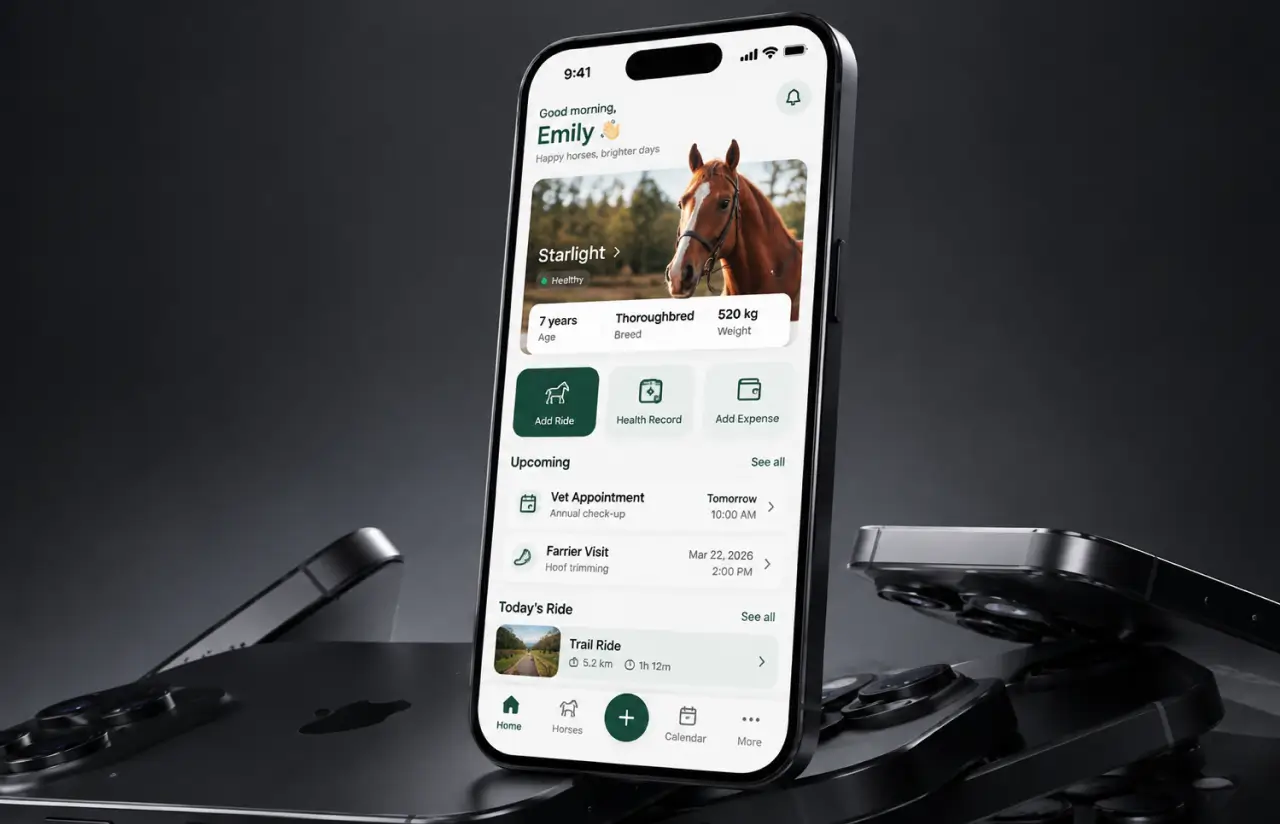
Most horse owners keep their horse's life in four places at once: a paper folder from the vet, a notes app, a text thread with the farrier, and memory. We rebuilt a horse management app for iOS and Android that puts horse profiles, health records, ride tracking, a progress diary, finances, and a calendar on one device, and got it back into the app stores on the client's marketing date.
Project Details
A US equestrian startup came to us with a live horse care app that crashed too often to keep the owners it had signed up. The founders needed the product rebuilt on the same accounts and data, made stable, and back in both stores by a marketing date that was already public.


Business Challenge: Building a Comprehensive Horse Care App
The client came to us with a live product and a problem. A first version of the app, built by an outside contractor, was already in the stores and failing the people who used it. The founders were marketers and a UI designer, not engineers, so nobody in-house could fix the backend or explain why the app crashed on older Android phones. Store reviews were sliding, and paying users were leaving.
The users were individual horse owners and riders, not stable management companies. A typical owner had one to three horses and kept the important data on paper: vaccination cards in a drawer, farrier dates in a text thread, feed changes in a notebook in the tack room. Of the 20 owners we interviewed during discovery, 17 had missed at least one appointment in the past year because the reminder lived in someone’s head.
Three problems defined the engagement:

Rebuilding an Unstable App Without Losing Users
The legacy app crashed in roughly 8% of sessions, cold start took over five seconds on mid-range Android phones, and the backend went offline about three times a month. The client wanted the same product, working, with existing accounts and horse data migrated intact, and a fixed marketing date for the relaunch.

Centralized Health Record Management
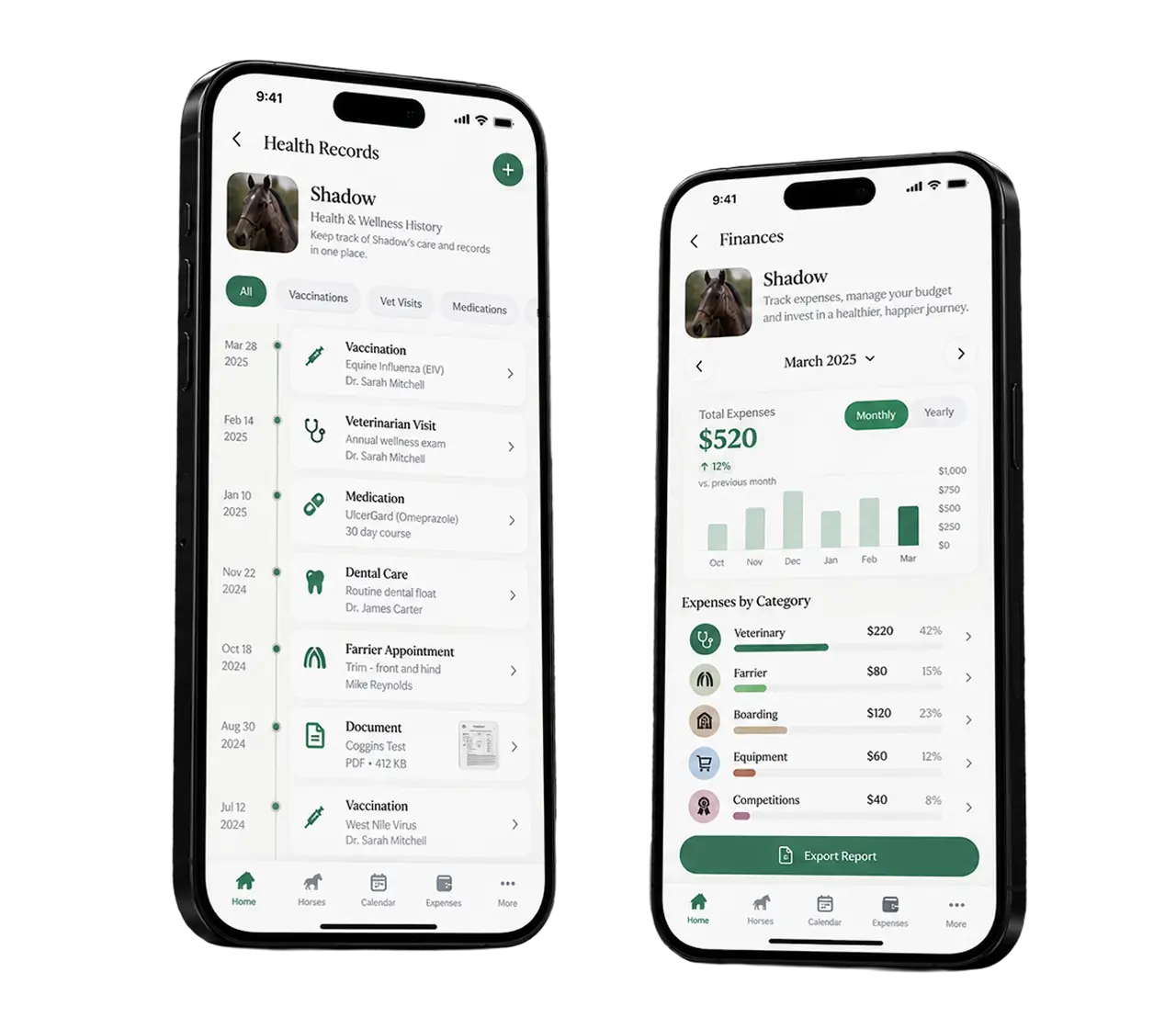
Vaccinations, deworming cycles, and visits from veterinarians and farriers were spread between paper, phone photos, and PDF invoices. Keeping track of a booster due in six months is easy to forget. The app needed one digital health record per horse, with reminders the owner sets once and then stops thinking about.

Activity, Progress, and Expense Tracking
Riders wanted to know how much they rode, how far, and whether the horse was making progress. Owners wanted to know what each horse cost per month. Neither number existed anywhere. Riding sessions went unrecorded, training schedules lived in memory, and expenses showed up on bank statements at tax time. The product had to record all of it with minimal typing, from a phone, often with no signal in the barn.
Technologies Behind the Horse Management App


Our Horse Management Solution
We assigned a team of three: a senior React Native engineer, a backend engineer, and a full-cycle QA specialist, with a product designer joining for the first eight weeks. The first decision was to keep React Native and Firebase from the original build. The problems were in how the code was written, not in the tools, and a rewrite on the same stack let us migrate roughly 6,200 existing accounts and their horses without asking anyone to re-enter a vaccination date.
The second decision was data first. Before we redrew a single screen, we modeled the relationships between an owner, each horse, and everything attached to that horse: health records, rides, diary entries, expenses, calendar events, and documents. Firestore holds each horse as one document tree, which is what makes offline mode work. An owner can log a ride in a field with no signal, and the entry syncs when the phone reconnects.
The old interface was rebuilt from 34 screens down to 26, and the six modules an owner sees in the side menu (Dashboard, Horse, Health, Activity, Diary, Finances) map directly onto the data model. Two user roles cover the product: the owner, who can manage everything, and a shared viewer, typically a trainer or co-owner, who can read records and add a note but cannot delete anything.
Horse Profiles
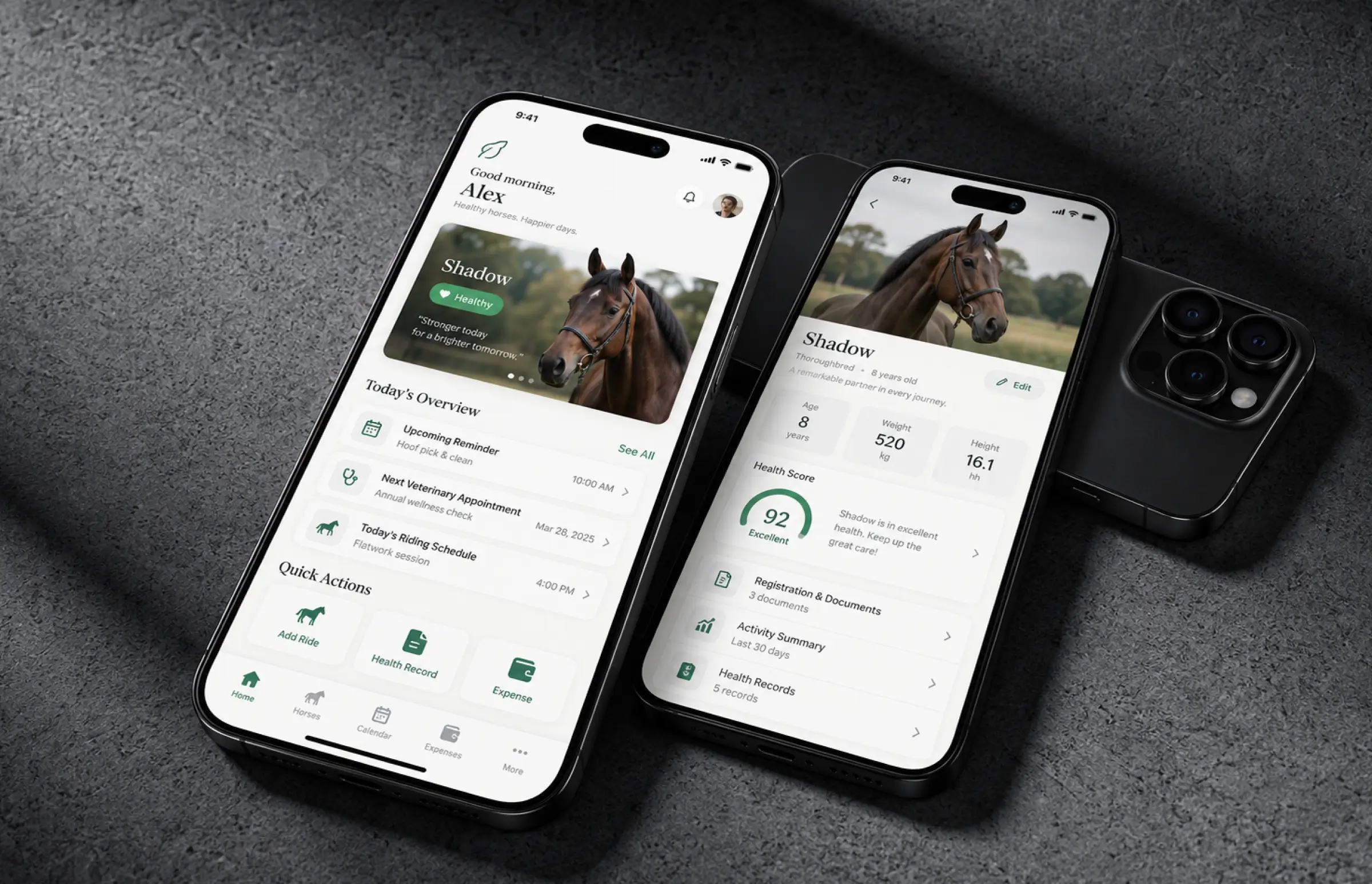
Each horse gets a profile with a photo, breed, gender, height, weight, age, and registration documents. Owners with several horses switch between them from one screen, and every ride, record, and expense links back to a profile. If a horse is sold, the full history exports as a PDF for potential buyers.
Digital Health Records and Vaccinations
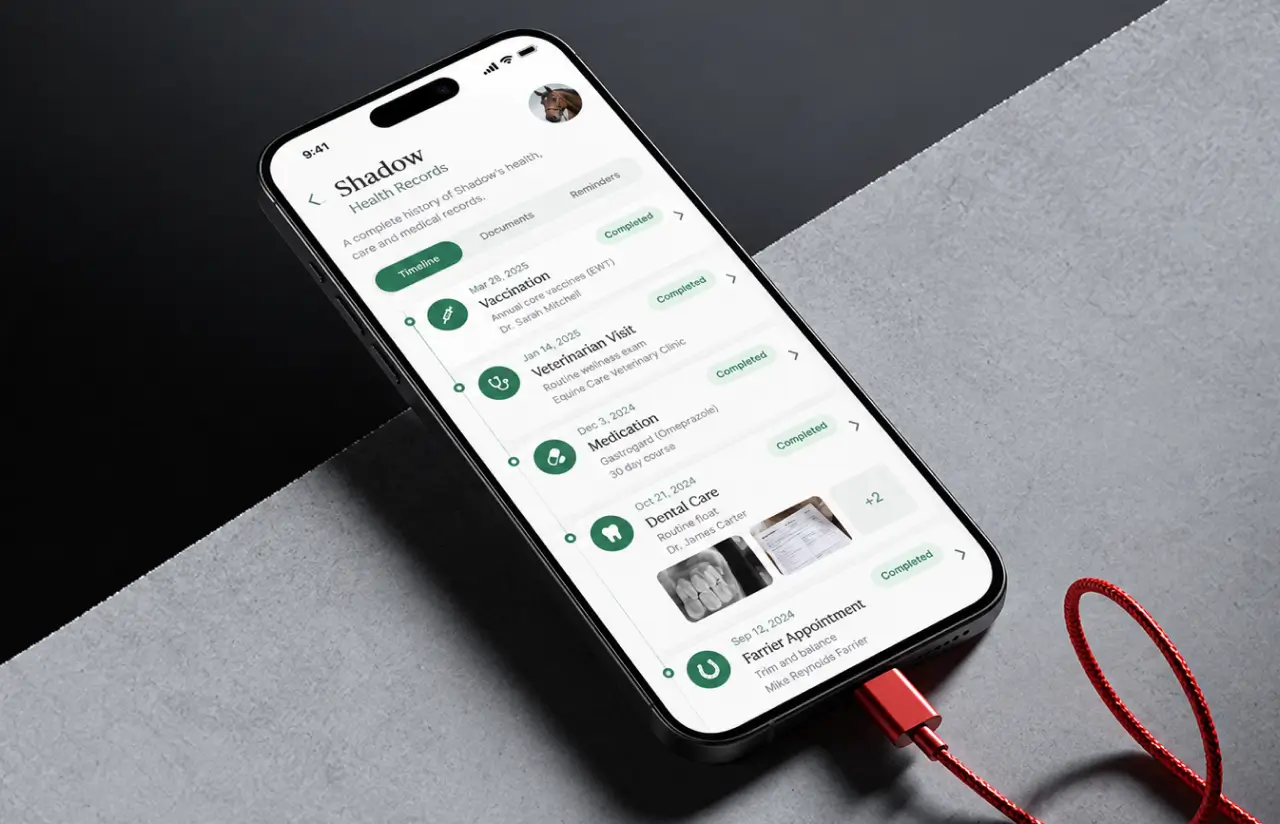
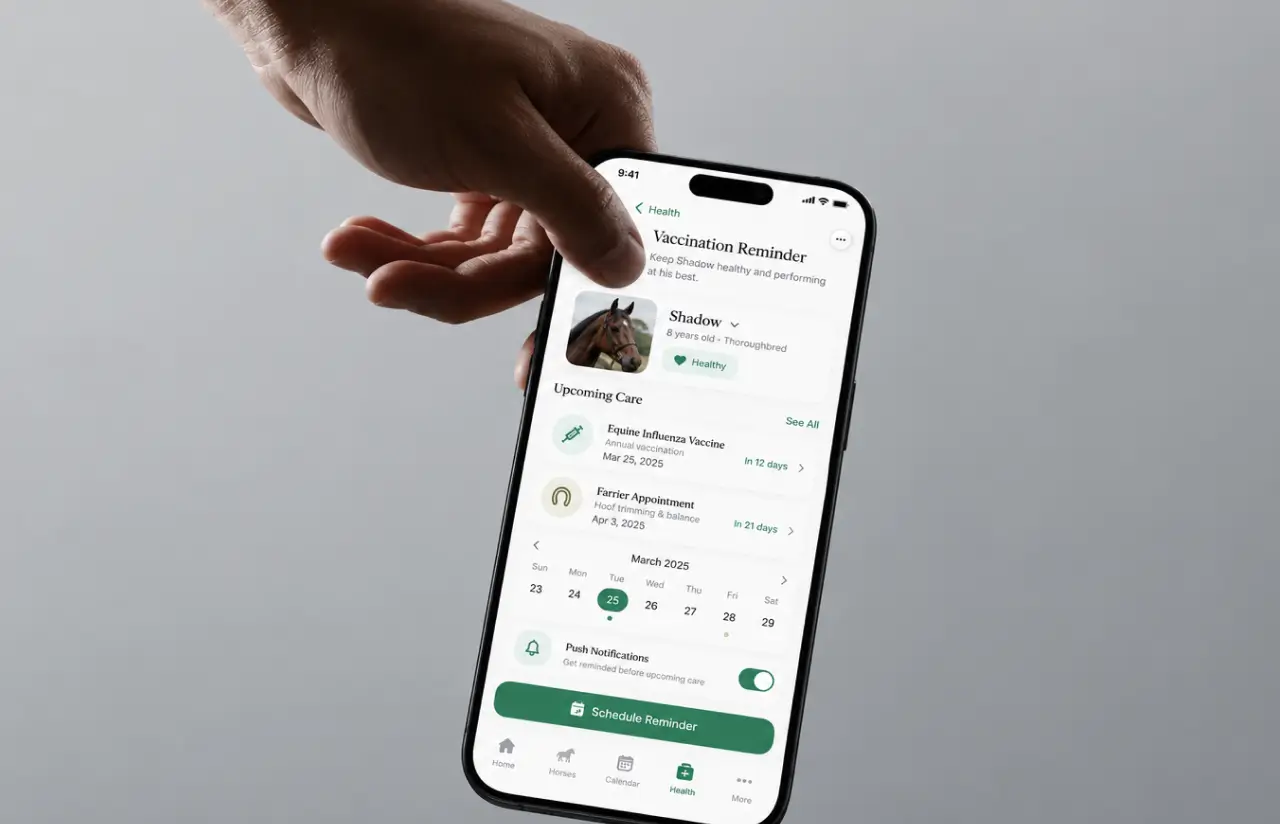
A chronological horse health record per animal: vaccinations, deworming, dental work, vet visits, medications, and farrier visits, each with photos of the paperwork attached. Recurring care gets a reminder schedule, so a booster due in six months and a farrier visit every seven weeks both raise a push notification without the owner touching the calendar again.
Ride and Activity Tracker
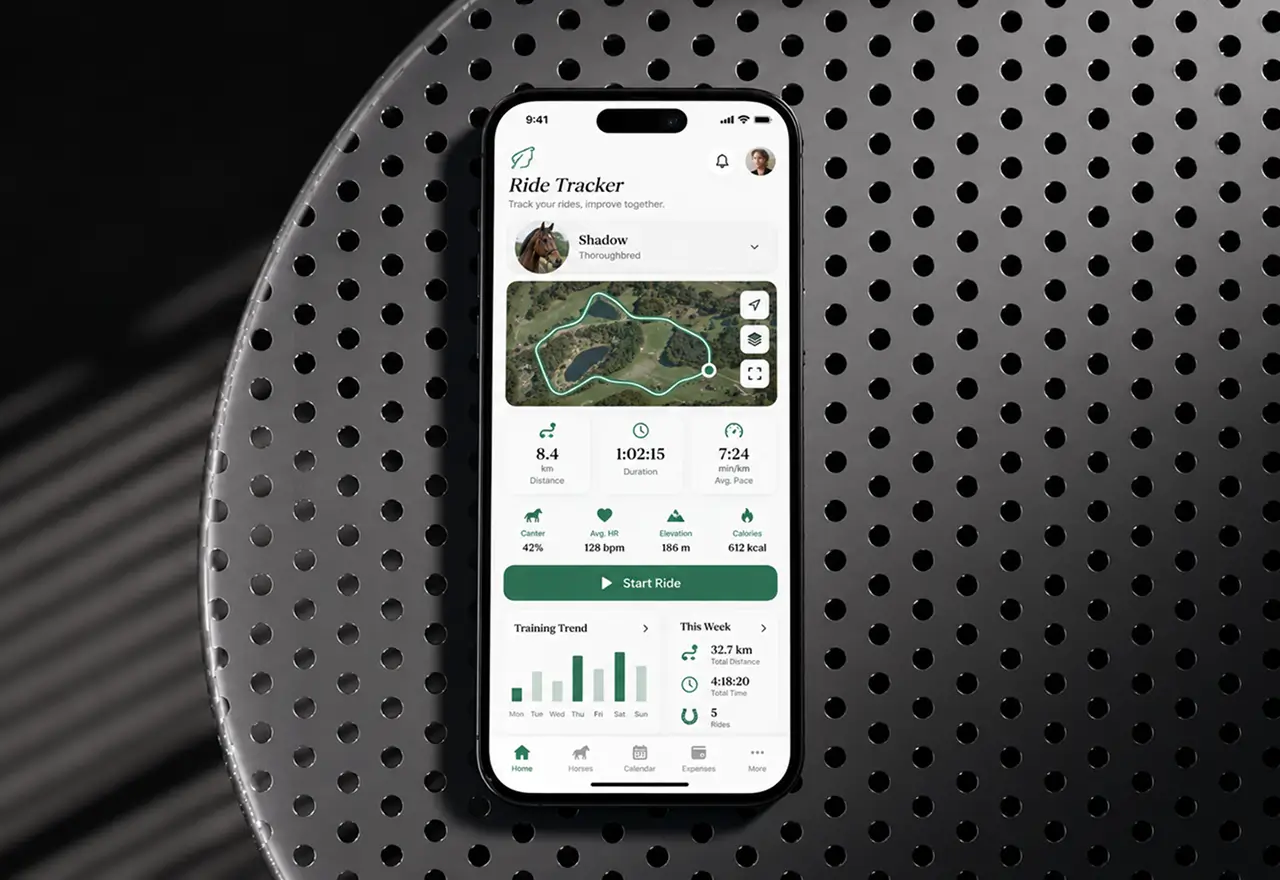
Start a ride from the phone and the app records route, distance, duration, and average pace over GPS, then attaches the session to the horse. Log lunging, groundwork, or turnout in three taps. Weekly and monthly totals show how much work each horse is doing and how riding performance changes over a season.
Progress Diary
A dated journal per horse for training notes, photos, and short videos. Owners use it to track progress toward a specific goal (a young horse's first canter under saddle, a rehab plan after an injury) and to hand a trainer an honest record instead of a memory.
Finances and Expense Tracking
Expenses are logged per horse by category: boarding, feed, vet, farrier, tack, competition entries, and transport. Monthly and yearly reports show the real cost of horse ownership per animal, so plans for next season rest on numbers, and a CSV export covers tax time.
Calendar and Reminders
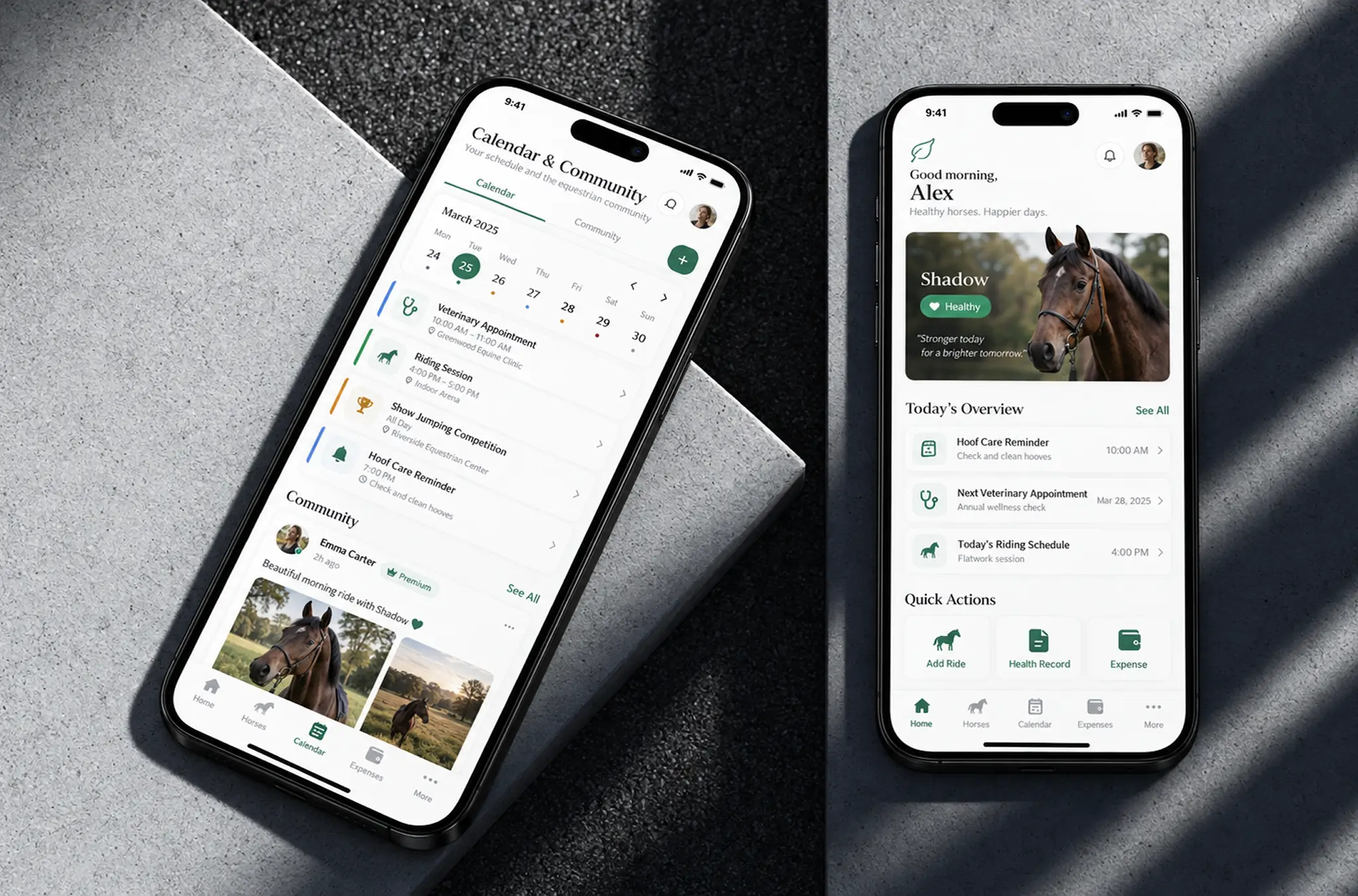
One calendar pulls together vet appointments, farrier visits, lessons, competitions, and reminder events generated from the health records. It filters by horse and syncs to the phone's native calendar.
Community Feed and Premium Features
A feed where owners share photos and updates with other equestrians, plus a paid tier sold through App Store and Google Play in-app purchases. Premium features include unlimited horses, video in the diary, PDF exports, and shared access for a trainer or vet.
Scrum Methodology
Project Journey
The 12-month engagement ran in two-week sprints, 24 of them, with the first three spent on the data model, account migration, and a stability baseline for the old app, so every improvement could be measured against something real. Design, engineering, QA, and store publishing stayed inside the same three-person team, and 23 of 24 sprints closed on schedule.
How the Horse Management App Works
- Sign up with email, Apple, or Google on iOS or Android and set up a rider profile.
- Enter breed, age, height, weight, photos, and registration documents. One profile per horse, with no limit on the paid tier.
- Add vaccination history, vet notes, and farrier dates, then set a recurring reminder for each. Photograph the paperwork and attach it.
- Tap start before a ride and the app records the route and time over GPS. Log groundwork, lunging, or turnout in a few taps.
- Record what each horse cost this month and how training went, with photos or a short video attached to the entry.
- Pull up health timelines, monthly totals, and activity summaries, and grant read-only access to a trainer or vet.
Development Process Flow
React Native development for a product with a fixed marketing date benefits from short cycles more than most. Two-week sprints let the client test each module in a real barn: health records one cycle, the ride tracker the next. Twice, a beta rider’s feedback changed a module before it shipped: the ride screen lost a required “ride type” dropdown because nobody wanted to pick from a list with gloves on, and the expense form gained a camera button after a rider asked why she had to type the farrier’s invoice.
How We Delivered the Horse Management App Project
- We opened with a requirements workshop built around a day in the life of a working owner. User stories came from real riders, not assumptions.
- Stability, account migration, and health records went to the top of the backlog. Premium features and the community feed were queued behind the core experience.
- Every two weeks the team selected the next module. One sprint built the vaccination reminder engine, another the ride tracker, another expense categories.
- Mobile and backend work ran in parallel. QA tested every build on real devices, including older Android phones, with real horse data rather than mocked entries.
- The client reviewed a working build at the end of each sprint. Feedback from beta riders at two partner barns shaped priorities for the next cycle.
- Each sprint shipped usable functionality. The rebuilt app reached both stores on the date the client's marketing team had already announced.
UI/UX Design: Intuitive Interface for Equine Management App
Equestrians use their phone in dusty barns, under bright sun, and with dirty hands. The redesign started from that fact: high-contrast forest green on white, large touch targets, and as little typing as possible. Every module opens from one side menu, and the dashboard shows today’s tasks, the next appointment, and any overdue reminders without scrolling, so the important aspects of a horse’s day are accessible in one glance.
The health screen is a timeline. Vaccinations, vet visits, and farrier visits carry their own markers, and anything overdue moves to the top with a red flag. The ride screen has one big button. The horse profile shows breed, gender, height, and mass on one card under the photo, which is what a vet or farrier asks for first.
Roboto stayed as the typeface for legibility at arm’s length, and the palette kept the client’s forest green (#288160) so existing users recognized the app after the relaunch. The average path to log an expense dropped from seven taps to three. Our product design work built on the wireframes the client’s own UI specialist had started, which is part of why the brand survived a full rebuild intact.
Results
Before
- ✕A live app that crashed in roughly 8% of sessions, with a backend offline about three times a month and a 2.9-star store average
- ✕Vaccination and farrier dates on paper, in texts, and in memory, with no reminders beyond a sticky note
- ✕No record of rides, training schedules, or progress, so a trainer worked from whatever the rider remembered
- ✕Expenses reconstructed from bank statements at tax time, with no per-horse cost
- ✕A non-technical client team with no way to ship a fix
After
- ✔99.5% crash-free sessions and a cold start under two seconds on mid-range Android
- ✔~35,000 reminders for vaccinations, farrier visits, and appointments delivered in the first year
- ✔~4,800 rides logged in the first 90 days after relaunch, each tied to a horse profile
- ✔~2.3x monthly active users and a 4.6-star store average within six months
- ✔One app for profiles, health, activity, diary, finances, and calendar, with a paid tier converting about 11% of active owners
Impact of the Horse Management App After Launch
Verified Reviews
Our Reputation on Top Platforms
LITSLINK holds a 4.8 rating on top platforms. Clients writing about our mobile app development work most often mention stable releases, steady communication through long engagements, and store deadlines that were met rather than moved.
Have a Horse Management App Project in Mind?
Planning a horse management app for owners, riders, or a stable, or rescuing a live app that is losing users? Send us a short description of your product, and our specialist will get back to you within 48 hours with an honest read on scope, timeline, team, and services needed.
Thank you for your message. It has been sent.