









Key Takeaways
- We compared 17 generative AI tools across six categories: text and chat, coding, image generation, video, audio and music, and marketing.
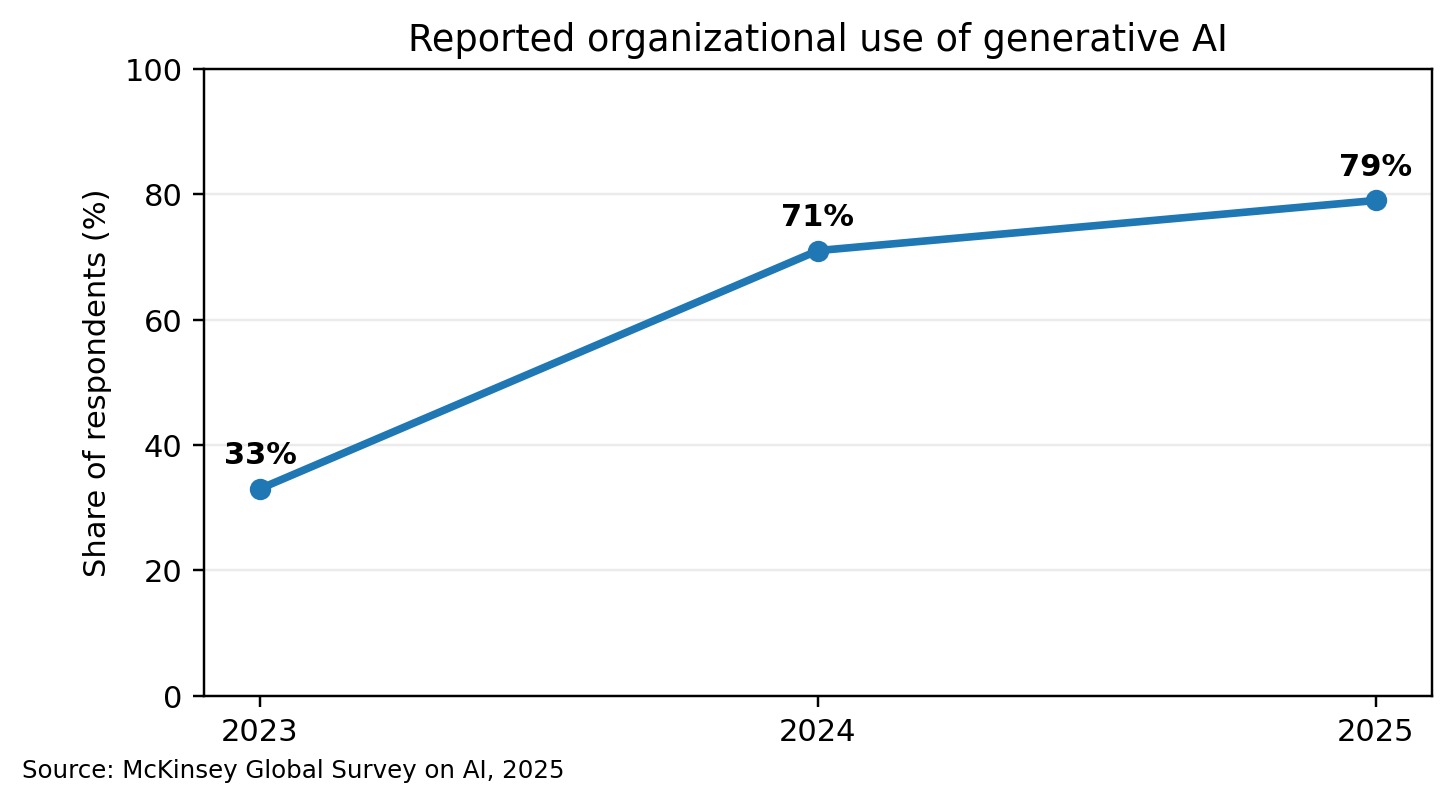
- 65% of organizations now use generative AI in at least one business function.
- The generative AI market sits at roughly $67 billion in 2026.
- Different jobs need different generative AI models. A writer, a developer, and a video producer will each walk away from this list with a different pick.
- The honest caveat: every tool here still produces confident factual errors, and free usage tiers often run older, lighter models. Human review stays mandatory.
In 2018, Christie’s auctioned a blurry portrait of a gentleman who never existed. “Edmond de Belamy,” produced by one of the early generative adversarial networks, sold for $432,500 (roughly 45 times the estimate), and where the artist’s signature belongs, the canvas shows the model’s loss function. It was a curiosity then. Eight years later, the curiosity is an industry.
The industry part is easy to measure. Sixty-five percent of organizations now use generative AI in at least one business function, per McKinsey’s Q1 2026 survey, and the market behind that number, roughly $67 billion this year, is projected by Bloomberg Intelligence to reach $2.3 trillion by 2032. That second figure deserves a raised eyebrow, though even a heavily discounted version of it moves budgets. The catch is that “best” depends entirely on the job: a writer, a developer, and a video producer need three completely different generative AI tools, which is why this list is organized by category for professionals and teams deciding which generative AI tools and generative AI applications actually fit their workflow. We selected each entry based on current market position, category leadership, and verifiable feature sets as of 2026. That’s the whole methodology.
Quick Comparison: Best Generative AI Tools by Category
Before the full write-ups below, use this table to jump straight to the category that matches your workflow. Each pick is the strongest generative AI option in its category as of 2026, and a few of them are far from the most well-known name.
| Tool/model | Category | Best for | Verified 2026 finding |
|---|---|---|---|
| ChatGPT / GPT-5.6 | Text, multimodal, agents | All-around knowledge work | OpenAI says ChatGPT has 900M+ weekly active users, 50M+ consumer subscribers and 9M+ paying business users. GPT-5.6 is the current frontier family; Sol is the flagship tier. |
| Claude Sonnet 5 | Text, reasoning, agents | Complex knowledge work and sustained agentic tasks | Anthropic positions Sonnet 5 as its most agentic Sonnet yet, with browser/terminal tool use and autonomous multi-step execution. Introductory API pricing is $2/M input and $10/M output through Aug 31, 2026, then $3/$15. |
| Google Gemini 3.7 Flash | Multimodal, coding, agents | Google-native multimodal work and scalable agents | Gemini 3.7 Flash is GA, supports a 1M-token context window and 64K max output, and has introductory 2026 API pricing of $0.75/M input and $3.75/M output. |
| Perplexity | AI search/research | Source-grounded web research | Perplexity is best treated as a multi-model search and research layer, not a single foundation model. Its July 2026 selector includes GPT-5.6 Terra/Sol, Claude Sonnet/Opus 5, Gemini 3.1 Pro and others. |
| Microsoft 365 Copilot | Enterprise productivity | Microsoft-first organizations | Copilot is embedded across Word, Excel, PowerPoint, Outlook and Teams. Microsoft lists Copilot Business at $25.20/user/month on monthly commitment, with annual offers varying by promotion/region. |
| Gemini Notebook | Research/documents | Grounded research across document collections | Google renamed NotebookLM to Gemini Notebook in July 2026. Google reports 30M+ users and 600,000+ organizations; secure cloud-computer execution adds code-based analysis. |
| GitHub Copilot | Coding | Mainstream AI-assisted software development | Copilot Pro is $10/month; Business is $19/user/month and Enterprise $39. Advanced chat/agent workflows increasingly use AI-credit allowances rather than a simple unlimited-seat model. |
| Cursor | Coding/agents | AI-native multi-file development | Cursor is built around agentic editing and model choice. Its own usage guidance says daily Agent users typically consume $60–$100/month of total usage and power users often exceed $200. |
| Midjourney V8.2 | Image | High-end artistic image generation | V8.2 launched July 24, 2026, with a focus on aesthetics, image quality, personalization and reducing random low-quality generations. |
| Adobe Firefly | Image/design | Enterprise creative work with clearer training provenance | Adobe says Firefly is not trained on customer content, does not mine the web for training, and uses content for which Adobe has permission or rights. IP indemnification applies only to eligible plans/features and terms. |
| ChatGPT Images 2.0 | Image | Conversational image generation and editing | OpenAI describes Images 2.0 as a major step in world knowledge, instruction following and dense-text generation; thinking mode can use reasoning and live web search. The system card also flags heightened deepfake risk from improved realism. |
| Stable Diffusion 3.5 | Image / open model | Customizable and self-hosted image workflows | Stability AI makes SD3.5 customizable and available under its Community License. Commercial use is free for organizations under $1M annual revenue; larger commercial users need enterprise licensing. |
| Runway Gen-4.5 | Video | AI-native creative video production | Runway Gen-4.5 supports text-to-video and image-to-video. It costs 12 credits per generated second, making a 5-second generation 60 credits and a 10-second generation 120 credits. |
| Google Veo 3.1 | Video model | High-end video generation with native audio | The Veo 3.1 family includes native audio generation. Google positions the flagship tier for state-of-the-art visual fidelity and final-production cuts. |
| Synthesia | Avatar video | Training, explainers and repeatable corporate video | Synthesia reports 1M+ users, 240+ avatars and 160+ languages. These are vendor-reported adoption/capability figures and should be labeled as such. |
| HeyGen | Avatar/localization video | Multilingual video localization | Creator pricing is $29/month and includes 175+ languages/dialects and voice cloning; current plans are credit-based. |
| Suno | Music | Full-song generation and browser-based music production | By Aug 2026 Suno Studio 2.0 had evolved into a browser-based generative DAW with MIDI, effects, synths, chat-based generation and improved stem separation. |
| ElevenLabs | Voice/audio | Expressive multilingual speech, dubbing and voice workflows | Eleven v3 is generally available and supports 74 languages. ElevenLabs reports a 68% reduction in errors on an internal benchmark spanning 27 categories and 8 languages versus the prior alpha. |
| Jasper | Marketing | Brand-consistent marketing workflows | Jasper Pro is $59/seat/month billed yearly ($69 monthly) and includes brand/knowledge customization and marketing workflows; Business adds governance and custom pricing. |
| Canva AI 2.0 | Design/marketing | Accessible, editable AI design workflows | Canva AI 2.0 generates fully layered, editable designs rather than only flat images. Canva says it serves more than a quarter-billion monthly users and its AI products have been used 27B+ times. |
Best Text and Chat Generative AI Tools
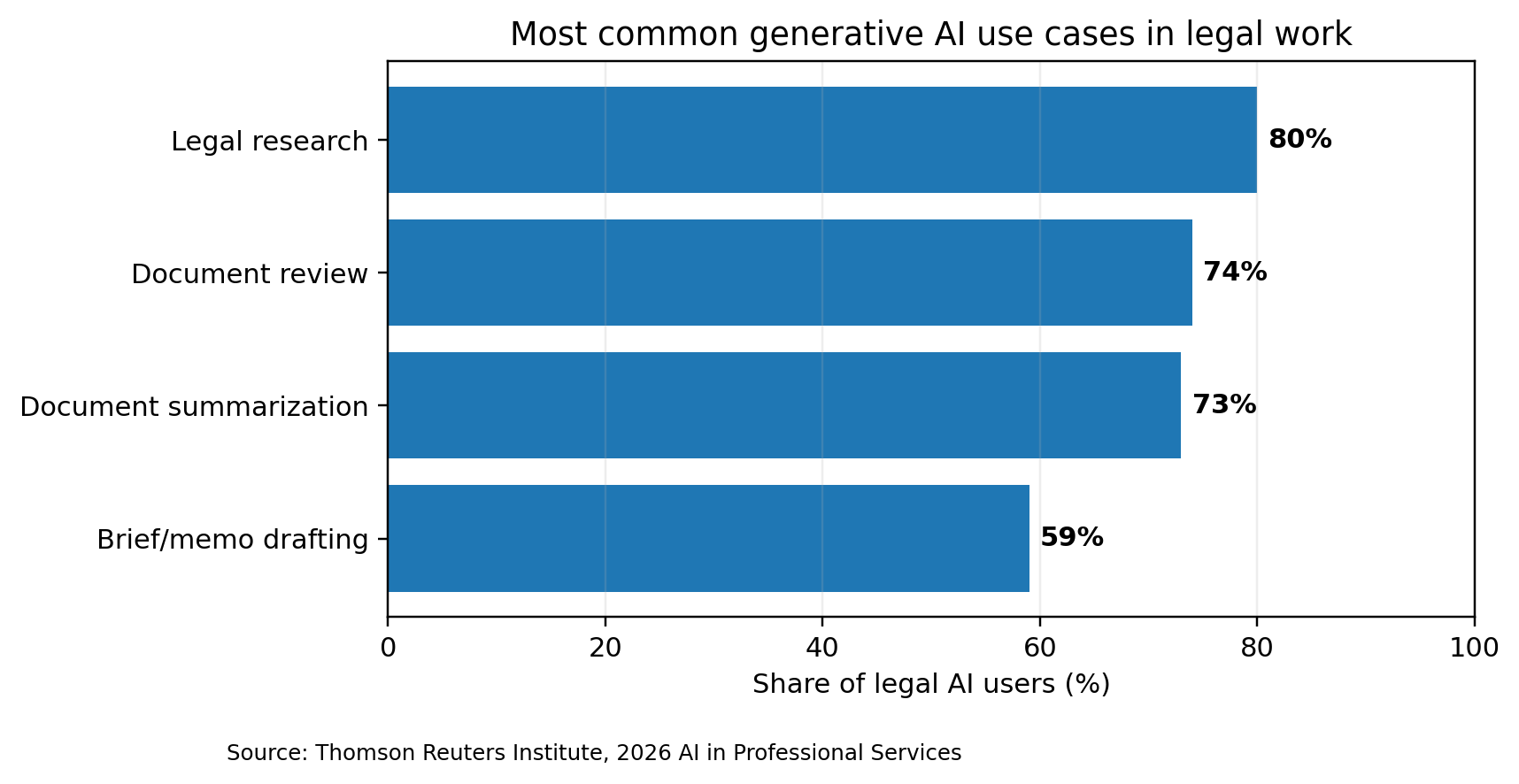
These generative AI tools handle reasoning, research, text generation, and multi-step work, and they remain the most widely adopted category by a wide margin. Underneath sit generative AI models, specifically large language models built for natural language processing, which is why one tool can draft an email, summarize a contract, handle language translation, and outperform the virtual assistants of five years ago without breaking stride. One snapshot of how far the category has traveled: in legal work, a field famously allergic to error, research and document review now lead adoption.
ChatGPT
The headline change in 2026 is that ChatGPT stopped being a chat product. ChatGPT Work, the agent mode OpenAI shipped in July, takes a brief, connects to Slack, Gmail, or Salesforce, and comes back hours later with a finished spreadsheet, deck, or small web app instead of a reply. OpenAI even added a Lockdown Mode for people handling sensitive data, which tells you how seriously prompt injection gets taken once generative AI starts acting inside your accounts. Best for teams that want one tool covering the most ground. For a wider look at the 2026 field beyond any single vendor, our companion piece Most Advanced AI in 2026: 14 Tools, Rankings, Use Cases goes broader than release notes ever will.
- Main advantage: one subscription covers writing, research, coding help, and image generation
- Usage model: context window around 1M tokens on GPT-5.5/5.6, API from $5 input / $30 output per million tokens
- Price: free tier, Plus $20/mo, Pro $200/mo, Team and Enterprise custom
- Peculiarity: 92% of the Fortune 500 use ChatGPT or the OpenAI API in some form (source)
Claude
Anthropic positioned Claude as the enterprise workhorse, and the market agreed: by late 2025 it held roughly 40% of enterprise LLM usage, per Contrary Research. The 2026 Opus generation added an effort dial, so you pick low, medium, or high reasoning depth per request and pay accordingly; a pricing idea the rest of the generative AI field promptly copied. One telling stat from Anthropic’s own Cowork data: 91.3% of sessions have nothing to do with code. Best for research-heavy or document-dense work, where dumping an entire contract stack into one conversation is the whole point.
- Main advantage: long-context reasoning across entire document sets in one conversation
- Usage model: 1M-token context window, API at $5 input / $25 output per million tokens
- Price: Pro $20/mo, Max from $100/mo, API pay-as-you-go
- Peculiarity: first model to clear 80% on SWE-bench Verified (80.9%)
Google Gemini
Google’s real argument is distribution. Gemini 3 shipped into Search on day one, the first time a new model launched at Google’s full scale, and the Workspace side keeps absorbing it: email drafting in Gmail, spreadsheet analysis in Sheets, meeting prep in Meet. At I/O 2026 Google added Gemini Spark, a personal agent for Workspace customers that takes action on your behalf around the clock. The model race gets the headlines. The bundling wins the accounts. Best for teams already living inside Google’s stack, where the tool shows up in the software they were using anyway.
- Main advantage: native hooks into Gmail, Docs, and Sheets
- Usage model: 1M-token context window on Gemini 3 Pro
- Price: free tier, paid AI Pro and Ultra plans [[VERIFY current tier pricing]]
- Peculiarity: first model past 1500 Elo on LMArena (1501, November 2025)
Perplexity
Perplexity refuses to stay in its lane, and that’s the story of its 2026. The answer engine grew a browser (Comet, now free on every platform), then crawled inside Microsoft 365 itself in May, putting its research agent into Word, Excel, and Outlook side panels. Underneath, it stays model-agnostic, routing each question across frontier models from several labs and always returning citations you can check. Fact-checking a chatbot that invented its bibliography once is enough to make that the feature you filter for. Best for work where verifiable sources matter as much as the answer itself.
- Main advantage: every answer ships with checkable citations
- Usage model: metered by searches rather than tokens, Pro raises the daily quotas
- Price: free tier, Pro $20/mo, Enterprise per seat
- Peculiarity: query volume climbed toward a billion per month by mid-2026
Microsoft 365 Copilot
Copilot’s quiet 2026 pivot: it stopped being an OpenAI storefront. Microsoft now sells whichever frontier model is winning, and added Anthropic’s Claude Opus 5 to the Copilot model picker the same day Anthropic launched it. Users can @mention Word, Excel, and PowerPoint agents inside a single chat, and Copilot Cowork carries longer-running tasks with your organization’s context attached. None of it tops a benchmark, and none of it has to. Best for large enterprises standardized on Microsoft, where the deployment conversation is shorter than the demo.
- Main advantage: zero new interface; it works inside Word, Excel, and Teams
- Usage model: per-user licensing rather than token metering
- Price: around $30/user/mo on top of a Microsoft 365 plan
- Peculiarity: often the fastest option through enterprise procurement, since the vendor is already approved
Best Generative AI Tools for Coding
These AI tools generate, complete, and refactor code inside the developer’s existing workflow rather than in a separate chat window. Code generation has become the clearest commercial win for generative AI so far, which is exactly why the category turned competitive fast.
GitHub Copilot
Copilot’s 2026 answer to the agent race is a genuinely odd feature: assign the same GitHub issue to Claude, Codex, and Copilot agents at once, then compare three draft pull requests and merge the best one. Async cloud agents now run on GitHub Actions while you do something else, and code snippets still appear as you type across six supported IDEs. One caution for anyone quoting the famous 55% productivity figure: it comes from a single 2022 experiment, before agents existed, and current generative AI numbers in software development look nothing like it. Best for developers who want in-editor suggestions without changing anything else about how they work.
- Main advantage: in-editor code suggestions across all major IDEs
- Usage model: usage-based AI Credits since June 2026, with monthly allowances per plan
- Price: free tier, Pro $10/mo, Business $19/user/mo
- Peculiarity: 4.7 million paid subscribers, up roughly 75% year over year (source)
Cursor
Cursor’s bet is autonomy as a dial. Composer 2 ships with exactly that, a slider running from careful suggestions to a full agent that plans, codes, and tests a feature end to end, and the company now trains its own models instead of only renting frontier ones. Its background agents reportedly produce 35% of Cursor’s own merged pull requests. The switching cost is real, since you leave your editor behind, and developers keep paying it anyway: once the agent becomes the default, teams merge measurably more work and reviewers spend their attention on architecture rather than individual code snippets. Best for developers who want the AI deeper in the workflow, and are willing to switch editors to get it.
- Main advantage: agentic edits that span whole projects rather than single files
- Usage model: plan allowances plus usage-based credits for frontier model calls
- Price: Pro $20/mo, Teams $40/user/mo, Ultra $200/mo
- Peculiarity: roughly $2B in annualized revenue with a headcount that fits in one conference room (source)
Best Generative AI Image Generation Tools
Each AI image generation tool in this roundup went from novelty to production asset in about three years, and the leaders now produce highly realistic images on demand, with realistic outputs good enough that the remaining failures (more on those later) stand out. These tools are reshaping how creative work is managed across design, marketing, and production teams. Our separate roundup, Best AI Image Generators: 10 Cutting-Edge Tools, covers more options like Leonardo AI and Canva if you want further reading after these three.
Midjourney
Midjourney stays itself defiantly: no enterprise sales motion, no investors to please, and an aesthetics-first lab culture founder David Holz protects on purpose. The V8 generation, at version 8.2 since July 2026, renders natively at 2K, finally handles text inside images respectably, and turns any still into a short video clip extendable to 21 seconds. The Discord-only era is over too, with the web app now the main interface. Communities on Reddit still rank its look above every rival, including the ones with far bigger generative AI budgets. Best for design and creative teams prioritizing visual quality over speed.
- Main advantage: the strongest artistic image quality on the market, with a 26.8% user-preference share
- Usage model: metered in GPU “fast hours” per plan rather than tokens
- Price: $10 to $120/mo, no free tier
- Peculiarity: bootstrapped to roughly $500M revenue with about 107 employees and zero venture funding (source)
Adobe Firefly
Adobe repositioned Firefly from a single model into a multi-model workspace: 30+ partner models from Google, OpenAI, Runway, and Black Forest Labs now sit inside one subscription, next to Adobe’s own commercially safe engine trained on licensed training data. Standard image generation stopped consuming credits on paid plans in 2026, and Custom Models (in beta since March) let a brand train on its own visual library, so teams generate images that already look like their campaigns. The generative AI is picked per task, and the licensing answer travels with it. Best for brand and marketing teams that need image generation with legal cover baked in.
- Main advantage: commercially safe output trained on licensed content
- Usage model: metered in generative credits tied to Creative Cloud plans
- Price: bundled with Creative Cloud, standalone credit tiers available
- Peculiarity: Adobe offers IP indemnification for enterprise customers, per its product terms (individual plans rely on the licensed dataset instead)
DALL-E 3
An honest 2026 update: DALL-E 3 itself retired in May, when OpenAI shut the model down and folded everything into ChatGPT Images, its native image generation stack. The replacement is the reason to stay. It reasons before drawing, searches the web mid-generation when a prompt needs facts, renders text far more reliably, and includes commercial rights even on the free tier. For anyone who already types prompts into ChatGPT, the habit stays identical while the image generation quality quietly jumps a class. Best for quick, conversational image edits without switching apps.
- Main advantage: conversational image edits inside an existing ChatGPT thread
- Usage model: draws on the ChatGPT usage quota, no separate metering
- Price: included with ChatGPT plans from the $20 Plus tier
- Peculiarity: GPT rewrites your prompt behind the scenes, which is why vague requests still land
Best Generative AI Tools for Video Generation
AI-powered video generation splits into two very different jobs, creative production and avatar-based corporate video, with different generative AI models behind each. The video editing tools bundled into these platforms matter almost as much as the generation itself, since raw clips rarely ship as-is.
Runway
Runway spent May 2026 shipping like a company that smelled blood: Gen-4.5 took the #1 spot on the Video Arena leaderboard, Runway Agent turned conversations into finished edits, and Characters introduced real-time avatars, all within weeks of OpenAI shutting down Sora and orphaning its users. Gen-4.5 also gained native audio, and the platform now hosts rival generative AI video generation models like Kling inside its own video editing workflow. Hollywood partnerships with Lionsgate and AMC give it a credential no competitor holds. Best for teams producing short-form creative video where mood and look matter more than a talking head.
- Main advantage: cinematic quality from the Gen-4 model family
- Usage model: credit-based, each second of video generation draws down the balance
- Price: limited free credits, paid plans roughly $12–76/mo
- Peculiarity: Gen-4 holds character and scene consistency across shots, the category’s hardest problem
Synthesia
Synthesia is the enterprise incumbent of avatar video, and it behaves like one: a $200 million round in January 2026, headcount past 700, and a roadmap aimed at learning-and-development departments with compliance requirements. Spend data shows it still monetizes better than any challenger even as cheaper rivals grow faster, which is the classic shape of a moat being tested. The pitch has only sharpened since day one: scripted corporate video at scale, minus the production budget. Best for repeatable corporate video without a camera crew, a studio, or a reshoot every time the compliance team edits slide four.
- Main advantage: presenter-style video with no camera, studio, or reshoots
- Usage model: metered in video minutes per plan
- Price: from about $22/mo on the Starter plan
- Peculiarity: 230+ stock avatars speaking 140+ languages
HeyGen
HeyGen is the challenger eating the category from below. Mid-market customer counts grew 152% year over year into early 2026, roughly five times Synthesia’s pace, on a creator-first model that spreads bottom-up instead of through sales calls. Its Video Agent automates the assembly work around the avatar, and a partnership even put HeyGen-powered presenters inside Canva. The dubbing quality, lip-sync included, is what users mention first. Best for teams localizing video content across markets without re-recording anything.
- Main advantage: automated dubbing with lip-sync for existing footage
- Usage model: metered in credits that convert to video minutes
- Price: from about $24/mo on the Creator plan
- Peculiarity: language translation coverage across 175+ languages
Best AI-Powered Audio and Music Generation Tools
Audio splits the same way video does: one leader for music, one for voice, and the generative models behind both trained on enormous volumes of audio data. Both also spent 2025 in court over exactly that — Suno settled with Warner Music in late 2025 while other label cases continue.
Suno
Suno’s 2026 move is from toy to production suite. The v5.5 model outputs studio-grade 44.1 kHz audio, and Suno Studio, a built-in digital audio workstation, exports up to 12 separate WAV stems plus MIDI, so a generated track can enter a real production pipeline instead of dying as a demo. A Voices feature clones a verified singer with consent, and the Warner settlement sketched the first licensed path for generative AI music, artist opt-ins included. Best for content creators who need original background music without touching a licensing agreement.
- Main advantage: complete songs, vocals included, from a one-line prompt
- Usage model: credit-based, each song draws down a monthly credit balance
- Price: free daily credits, paid plans roughly $8–24/mo
- Peculiarity: settled with Warner Music in late 2025 (source), an early move toward licensed AI music
ElevenLabs
ElevenLabs quietly became an audio platform rather than a voice tool, with over a dozen products spanning speech, conversational agents, dubbing, and now music. Eleven Music took the opposite legal route from every rival: fully licensed training material through deals with Merlin and Kobalt, so the realistic outputs are cleared for commercial use the moment they render. The API-first posture is deliberate, and it shows in who buys, with developers wiring voice into their own products outnumbering consumers making clips. Best for teams that need AI-powered voiceover at scale, in dozens of languages, from a paragraph of text.
- Main advantage: the most natural voice cloning and narration in the category
- Usage model: metered in characters of text converted to audio
- Price: free tier, paid plans from $5/mo up to enterprise
- Peculiarity: used by employees at 41% of Fortune 500 companies (source)
Best Generative AI Tools for Content Generation and Marketing
Content creation platforms took the hardest hit when ChatGPT made basic content generation essentially free, and the two survivors below adapted in opposite directions. If you want a broader creative shortlist, 9 Best Generative AI Apps to Boost Your Creativity covers apps beyond marketing as further reading.
Jasper
Jasper reinvented itself a second time. Having survived ChatGPT by selling governance, it now sells visibility inside AI answers: the GEO Agent it launched in June 2026 monitors how a brand appears across generative AI search and discovery, then optimizes content to influence it. Under the hood Jasper is model-agnostic, routing work across models from several labs, while its Grid layer runs the same agent workflow across thousands of rows for localization and campaign variants. The company says nearly 20% of the Fortune 500 use it to generate content that survives brand review. Best for marketing teams scaling content creation across campaigns.
- Main advantage: brand voice controls and campaign workflows layered on top of the models
- Usage model: seat-based pricing rather than token metering
- Price: from roughly $39–59/user/mo depending on tier
- Peculiarity: rebuilt itself from a consumer copywriting app into a 900+ customer enterprise platform
Canva Magic Studio
Canva rebranded the whole product as a Creative Operating System, and 2026’s Canva AI 2.0 added an in-house design model, the first trained to output editable designs rather than flat images. Dream Lab (built on the Leonardo model Canva acquired) covers the picture side, conversational design iterates copy and layout in one thread, and Bulk Create turns a spreadsheet into hundreds of on-brand variants. It all lives inside the design and editing tools your team already opens daily, which is why this is the generative AI non-designers actually use to generate content. Best for teams that need fast, on-brand visual content creation without a dedicated designer.
- Main advantage: the AI lives inside the design tool your team already uses
- Usage model: Magic Studio features draw on per-use credits within Canva plans
- Price: free plan, Pro around $15/mo
- Peculiarity: brand kit enforcement keeps output on-palette and on-font automatically
How to Choose the Right Generative AI Tool for Your Team
Walking into this market and asking for the best tool is like walking into a commercial kitchen and asking for the best knife. Best for what – breaking down a chicken or peeling potatoes? Match the generative AI tools you shortlist to the actual workflow, and treat the hype rankings as background noise.
In practice, three boring questions filter the field faster than any benchmark:
- Does it integrate with what you already run (Google Workspace, Microsoft 365, Slack)?
- What are the data privacy and security terms for business use, and does the vendor’s data governance documentation actually say what happens to your inputs?
- And is per-seat pricing sustainable once the pilot group of five becomes a department of eighty?
I’ve watched more generative AI rollouts die on question three than on model quality. The underlying generative AI models matter less than whether the tool survives your procurement review and your data governance policy at the same time.
Handling Unstructured Data: What to Check Before You Commit
Many generative AI tools work with unstructured data (documents, images, freeform text) rather than clean, tabular datasets, and that’s precisely where the risk hides. Before committing, confirm three things.
First, how the tool handles your specific input data formats, because “supports PDFs” and “reads your scanned 1998 contracts correctly” are different claims.
Second, whether the vendor retains or trains on submitted data, since your training data exposure is a data governance question long before it’s a legal one.
Third, what happens to proprietary content once uploaded: retention windows, deletion guarantees, and who at the vendor can see it: the boring core of data governance. Unstructured data is where generative AI earns its keep, and also where careless procurement quietly donates your competitive edge to a model.
What AI Generated Content Still Gets Wrong
The conventional wisdom says these tools are rewriting the labor market in real time. The actual data is stranger: a large Danish study found workers using chatbots saved about 2.8% of their work hours on average, and a 2025 Yale analysis found no discernible disruption in the US labor market since ChatGPT launched. Which means the gap between what generative AI demos and what it delivers is still wide, and knowing where these generative AI models fail is worth more than knowing where they shine.
Factual accuracy still requires human verification, and NIST has a clinical word for the reason: confabulation, confidently presented false content, fabricated logic and invented references included. Ask any tool here to generate content on a niche topic and count the made-up sources: text generation produces confident errors, and AI systems don’t flag their own fabrications. Outputs also reflect whatever bias lives in the training data, so treating them as objective is a category error, and the more polished the prose, the easier that error is to make.
The same NIST profile maps the rest of the risk field with useful precision: leakage of personal or sensitive data, harmful bias, intellectual-property exposure, and information-integrity threats such as disinformation. Specific categories beat vague dread, and they give a data governance policy something concrete to check.
On the visual side, tools that generate images still mangle hands, garble text-in-image, and treat exact brand specs as a suggestion. AI-generated images matching a precise style guide remain a coin flip. Realistic outputs and correct outputs are, it turns out, different achievements. And most AI tools can’t reliably handle proprietary or specialized domain knowledge without a fine-tuning or retrieval setup, because your internal wiki was never in anyone’s training data.
Two legal wrinkles deserve their own lines. The U.S. Copyright Office’s position is more nuanced than the headline version: outputs can earn protection where a human contributes real expressive choices through selection, arrangement, or creative modification, while prompting alone generally doesn’t qualify. And on synthetic media, the most credible warning comes from a model maker itself: OpenAI’s own system card for its image stack concedes that rising realism could enable more convincing deepfakes of real people, places, and events absent safeguards.
Free usage tiers compound all of this. Lower tiers often run older, lighter models, while the more sophisticated models sit behind paid plans, so the free version a skeptic tests is rarely the product a paying team gets. I’d push back on anyone benchmarking a category off a free trial.
Machine Learning Explains the Mistakes
The failure patterns above trace straight back to how these types of generative models work. Most modern text generation tools are autoregressive models: they predict the next token in sequential data one step at a time, a job recurrent neural networks handled until transformers took over, with no built-in truth check; which is why hallucination comes baked into autoregressive models, and why large language models write fiction with the same fluency as fact.
Generative adversarial networks take a different route, pitting two neural networks against each other, a generator producing samples and a discriminator comparing them to real data until the new data passes for real. Variational autoencoders compress inputs into a latent space and reconstruct them, math that also powers anomaly detection at banks. Flow-based models learn complex data distributions through invertible transformations, and show up in fraud detection and anomaly detection stacks more than in consumer products.
All of these are deep generative models. Artificial intelligence built to generate data rather than label it, unlike discriminative models, which only classify. Sophisticated generative models produce new data points that look like whatever sat in the training data. They imitate the world convincingly, and imitation carries no warranty. No amount of scale has changed that yet.
The Energy Bill Rises Even as Each Task Gets Cheaper
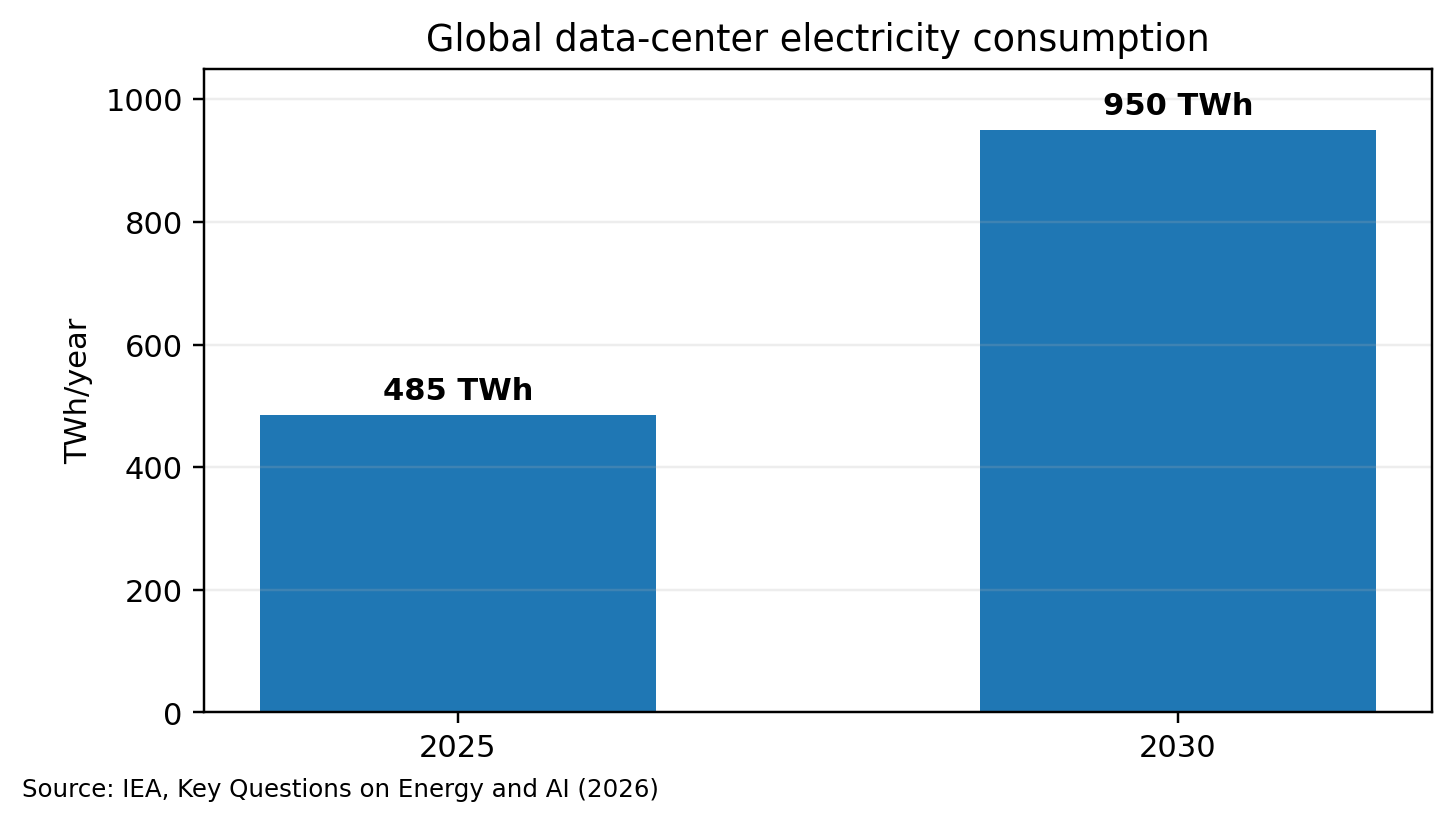
AI’s environmental math runs on a paradox. The IEA projects data-center electricity consumption roughly doubling, from 485 TWh in 2025 to 950 TWh by 2030, even though the energy cost of a simple AI task has been falling by an order of magnitude or more each year.
The explanation sits in what people now ask for. Video generation, long reasoning chains, and agentic runs can burn hundreds or even thousands of times more energy per query than plain text, so per-task efficiency improves while total demand climbs anyway. On carbon, a lifecycle study of 369 generative models puts annual emissions anywhere between 18.21 and 245.94 million tons by 2035. The honest way to quote that is as a scenario range with the scary number at the top, rather than a forecast.
Need Something Custom? How LITSLINK Builds Beyond Off-the-Shelf Tools
That Belamy portrait fetched $432,500 for one reason: nobody else had it. Off-the-shelf tools are the opposite proposition, since your competitors subscribe to the same ones, at the same price, with the same defaults. The 17 above cover general-purpose needs well, and every one of them hits a wall at the same place: the moment a business needs generative AI woven into its own product, its proprietary data, or a workflow no vendor roadmap was built for. That gap, the one-of-a-kind part, is the use case LITSLINK is built around.
The numbers behind that: founded in 2014, 300+ engineers and tech specialists, 1,540+ completed projects, and 1,000+ clients across 82 countries. LITSLINK pairs US-based project management with senior European engineering talent, which in practice means overlap with your working hours, day-to-day communication in your timezone, and no 2 a.m. status calls. Responsiveness first, geography second. For a closer look at how these builds come together, see LITSLINK’s Generative AI App Development Guide.
Ready to talk through your use case?
Contact LITSLINK for a free consultation. And if you’d rather see a number before a conversation, run your project through the LITSLINK AI Cost Calculator first, then bring the estimate to the call. Either way, the goal is the same: a product with your signature in the corner.
FAQs
What Are Generative AI Tools?
Generative AI tools are artificial intelligence software built on machine learning models that create new data (text, images, code, audio) from a prompt. Rather than classifying what already exists, generative AI creates original output by learning patterns from massive datasets.
What Are the Most Popular Generative AI Tools?
By raw adoption across generative AI: ChatGPT leads with 900 million weekly active users, Gemini reaches around 650 million app users, and GitHub Copilot counts 4.7 million paid subscribers. Popularity and capability are separate questions, which is what the next answer covers.
What Are the Top Generative AI Tools in 2026?
By category leadership: ChatGPT for text, GitHub Copilot for coding, Midjourney for images, Runway for video, Suno for audio, and Jasper for marketing, with the strongest generative AI models behind each. The full breakdown of all 17, organized by category, sits earlier in this article.
Why Aren’t Generative AI Tools Objective?
Because their training data isn’t. These AI systems learn from real-world data collected at scale, and whatever bias sits in that data reappears in the output, dressed in confident prose.
What Are Generative AI Tools Not Capable Of?
Reliable facts without review, consistent fine detail in image generation, and specialized domain knowledge out of the box. The “What AI Generated Content Still Gets Wrong” section above covers each gap in detail.
How Do You Research and Write Using Generative AI Tools?
Use a cited tool like Perplexity to gather sources, a drafting tool to generate content, and your own judgment to verify every claim before publishing. Teams also fold in supporting tasks, like summarizing interviews or running sentiment analysis on customer reviews, before the writing starts. The workflow that fails is the one that skips verification.
What Types of Generative Models Do These Tools Use?
Most generative AI models run on one of a few machine learning architectures: GANs, diffusion models, autoregressive models, flow-based models, or transformer-based foundation systems. Each of these types of generative models handles complex data distributions differently, which is why image tools and text tools feel so unalike in practice.
What’s the Difference Between Generative Adversarial Networks (GANs) and Diffusion Models?
GANs pit two neural networks against each other — a generator and a discriminator judging output against real data — and were the earlier standard among generative models. Diffusion systems denoise random noise into an image step by step and now produce more highly realistic images, powering tools like Midjourney and Stable Diffusion.
What Are Flow-Based Models in Generative AI?
A less common family of generative models, flow-based models learn a data distribution through invertible transformations, which allows exact density estimation across simple and complex distributions. You’ll meet them in fraud detection and anomaly detection pipelines more often than in consumer AI apps.
What AI Models Power Text Generation Tools Like ChatGPT and Claude?
Large language models are built on the transformer architecture (the “generative pre-trained transformer” behind the GPT name), which works as autoregressive models predicting the next token in sequential data. Transformer models replaced the recurrent neural networks that handled this job before 2017, and these language models are then fine-tuned for specific tasks.