







As companies start implementing AI tools in their workflows, their dependence on them can become too high. Pushing every task and process for AI to work on does not improve the workflow of the team but rather makes it even harder. Using AI can’t simply replace a member of the team. We’ve seen this more than once: a team hands everything over to AI, and within weeks, people spend more time fixing its mistakes than doing their actual work.
Key Takeaways
- Using AI does not mean organizations get value from it. While 88% of organizations now use AI in at least one of their business functions, this is an increase from 78% the previous year; only about 6% can be classified as high performers in terms of deriving significant value across their entire business (McKinsey, The State of AI: Global Survey).
- Successful integration involves six steps. Problem definition, data assessment, selection of an integration approach, pilot testing, full implementation, and continuous monitoring and evaluation to enhance integration.
- Pilots can be cost-saving. Testing AI technologies at a small scale can help you understand whether they will be effective before investing more to implement them at a larger scale.
- People still have a role. A study by MIT Sloan’s EPOCH program shows that work that depends on empathy, presence, judgment, creativity, and hope is the hardest to automate, so it is just as important to build employees’ skills in these areas as to advance the technology.
- Humans should make important decisions. If AI systems are used to make financial, medical, or hiring decisions for a particular person, the person should have access to the decision before it is acted upon.
What Is AI Integration?
AI integration means adding machine learning models, generative AI tools, and AI agents to a product or business process. This helps solve a business problem. This differs from simply adopting an AI tool without revising the process to fit it. Many companies hit a wall here. While 88% of organizations use AI in at least one area, up from 78% last year, only about 6% see real value and perform well. For most businesses, the question is no longer whether to use AI, but how to use it to improve business results.
The AI Implementation Process for Successful AI Projects
AI integration works best as a clear sequence of steps, not a rushed rollout. Following these steps is a big part of what separates the 6% of high performers from everyone else.
Define the Business Problem Before Choosing AI Technology
Instead of starting with the technology, start with the issue. AI projects with a clear goal and measurable results, such as “reduce support response time by 40%,” are far more successful than those that start with “we should use AI” but lack a precise goal. It’s much easier to choose the right instrument, set a budget, and assess performance when you know exactly what to improve.
Assess Readiness: What Business Leaders Should Check First
Before making any purchases, you should consider all of these issues.
- Data Analysis: Is it high quality and readily accessible? Effective use of AI-powered tools requires large amounts of structured data.
- Infrastructure: Do you have enough computing power to get your job done? You may need more cloud computing access if you need more computing power.
- Culture: Are team members and supervisors ready to adapt to process changes resulting from the implementation? Implementing AI requires adapting processes in addition to adopting new technology.
This step matters because companies with higher AI maturity tend to perform better financially. Conversely, those with lower AI capabilities often see worse results. Poor AI planning and other planning issues often lead to project failures. Implementation problems, like data integration and user acceptance, are also common. These issues tend to arise more during implementation than planning. Data analysts can help by recommending ways to use existing data assets instead of buying new ones.
Choose AI Tools That Match Your Business Goals, Not the Hype
Choose AI tools for your project by considering your team’s needs and skills, plus how well the tools work with what your organization already uses. Also think about whether the tool can grow in use within your organization. Avoid picking tools just because they are popular with competitors or other businesses.
First, establish your data strategy by determining the data source, how it is labeled, and who owns it. If the underlying data is messy, even powerful technology will perform poorly. Large language models and generative AI are now standard building pieces, but the problem persists. “Does this solve the problem we set out to solve?” is a better question to ask than “Is this the most capable model available?”
Pilot Before Scaling
Test the AI development with a small group. You could use one support staff member or 5% of your customers. The marketing advantages may apply, but customers might also make errors or find new uses. Testing can reveal extra benefits.
When testing AI products, consider special issues. Asking the same question repeatedly may yield different answers. A single successful test gives limited insights. However, running multiple tests and examining both successes and failures can be very helpful.
Deploy With Human Oversight Built In
Some decisions should not rely solely on AI. This includes loan approvals, medical image diagnoses, and job rejections. A good solution is to have humans review AI decisions in these cases. Human reviews can cause delays, but they help protect people from harm. Consider making human reviews a regular part of the process, even if AI works well at first for high-risk applications.
Monitor for Continuous Improvement and Retrain as Needed
Launching a new product or service starts a new business process. Customer satisfaction and competitor actions can change in real life. This may mean the data available when using the model differs from what it was trained on. Model decay happens slowly in a live setting, so it might go unnoticed. To prevent this, monitor model performance and update training data as needed.
AI Integration Architecture: API-Based vs. Embedded Models
Choosing an AI tool and deciding how it connects to your product are two separate decisions. The second one shapes your costs, speed, and data handling for as long as the feature exists.
| Factor | Hosted API | Self-Hosted / Embedded Model | Private Cloud API |
|---|---|---|---|
| Upfront setup | Minimal | Significant (infrastructure, MLOps) | Moderate |
| Cost at low to moderate volume | Lower | Usually higher once you count everything | Moderate |
| Cost at very high volume | Grows with usage | Can become cheaper past a high usage point | Grows with usage |
| Data leaves your environment | Yes | No | No |
| Model quality upkeep | Automatic (provider updates it) | Your team’s job | Automatic |
| Best fit | Most new AI features | High-volume, speed-critical, or data-residency-restricted uses | Regulated products that need top-tier models |
Calling a Hosted AI API
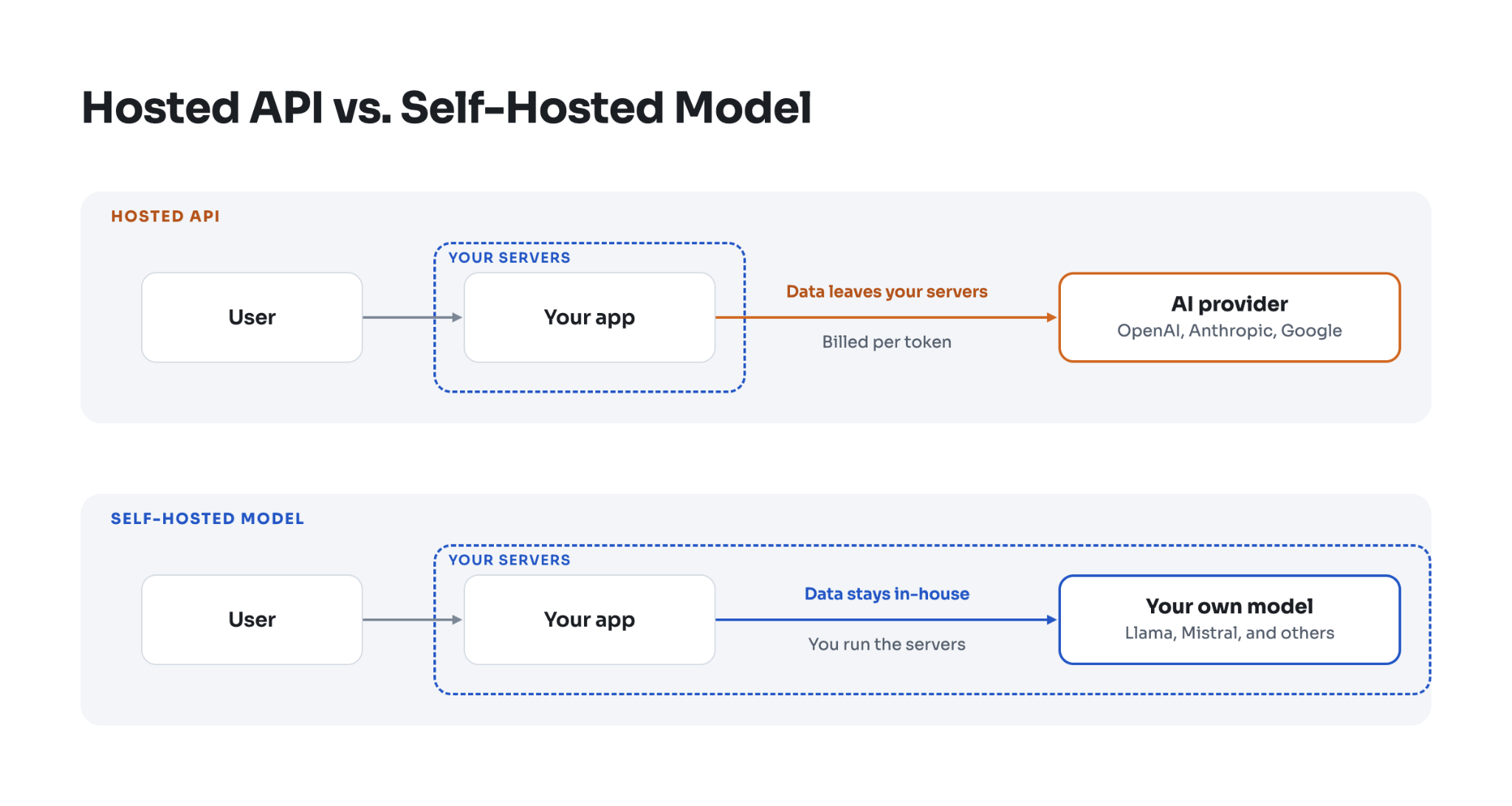
The typical approach is for teams to integrate with third-party APIs, including those from OpenAI, Anthropic, and Google. End users access and pay for product use through API tokens rather than their own models. Advantages of this approach for new AI products include easier model development and deployment and no need for the product team to maintain servers; the third-party provider updates the base models. Disadvantages include less transparency about end-user data use and higher costs at higher usage levels.
Self-Hosting or Embedding an Open-Weight Model
Self-hosting an open model can be useful. It’s great for high traffic and special needs, such as lower latency and meeting regulations. Team estimates for self-hosting costs are often low. However, costs include not just GPU rental fees but also server hosting fees and the time spent on development and maintenance. Actual costs can far exceed initial estimates. Many teams start with an API service and think about self-hosting later if their traffic increases enough to make it worthwhile.
A Middle Path for Compliance-Sensitive Workloads
Many big cloud providers now give companies private and high-quality access to hosted models in their networks. You receive top-quality models while ensuring your requests stay compliant. A public API alone can’t offer that. For regulated products, this is often the best choice. It provides an easy way to use an API without the cost and trouble of managing your own models.
Where AI Actually Fits in the Product
The way you design your system depends on how you plan to use AI in your product. If you are creating something that customers interact with, like a chat tool, you will need an AI system and a backup plan in case the main AI system isn’t working or is too slow. For tools that employees use inside the company, the response can be slower. The backup plan can be simpler. When you process documents at night, which is another typical use of AI, speed isn’t important because no one is waiting for the results, and you can use a cheaper AI system. To save money, think about using AI systems for different parts of your product.
High-Impact AI Use Cases Worth Prioritizing
AI applications are not uniformly spread throughout your product. These are typical early uses of AI in a product, as they offer the most benefits and success stories.
Where Companies Report Real Returns
The 2026 McKinsey State of AI survey found that the supply chain and service and manufacturing cost applications were the most commonly cited cost benefits of AI by survey respondents. Respondents most commonly cited marketing and sales and product and service innovation as the key revenue benefits of AI. The survey cites 37% and 6% responses, respectively, indicating moderate and high EBIT impacts of AI in the supply chain (McKinsey, The State of AI in 2026: On the road to ROI). Self-reported survey results are likely less reliable, but a few AI applications appear to offer the greatest benefits to products.
Fraud Detection and Risk Scoring
Fraud prevention is one of the most common AI applications because of its measurable benefits. According to testimony before Congress, the U.S. Treasury Department used machine learning to prevent and recoup over $1.9 billion in losses due to check fraud in fiscal years 2024 and 2025 (Treasury testimony to the House Oversight Subcommittee, January 2026). Other banking applications include HSBC, which found that using Google Cloud’s anti-money laundering AI increased the number of suspicious activity reports filed two- to fourfold and decreased alerts by over 60% (Google Cloud press release, 2023, a vendor-published case study). Other organizations may want to follow practices such as having AI evaluate risk and humans evaluate flagged items.
Customer Segmentation and Churn Reduction
Customer behavior segmentation and churn modeling are useful with data on customer transactions. This includes logins and service contacts. You can use this data to segment customers and target those likely to churn. According to McKinsey survey respondents, marketing and sales are key areas for revenue gains from these models. Remember, you need to track at least one retention or conversion metric to see how well your model works.
Predictive Maintenance and Supply Chain Optimization
Initiatives for brick-and-mortar businesses include projects using AI tools to predict machine failures and lower supply chain costs by improving sales and inventory forecasting. Lower supply chain and manufacturing costs are the most frequently reported benefits of AI among respondents in the McKinsey survey of businesses. The most commonly reported uses of AI in advanced manufacturing businesses in the McKinsey survey include AI tools applied to supply chain, inventory, and other business processes (McKinsey, 2026). Clean data about equipment and orders are important for all these initiatives. The readiness assessment mentioned earlier can help you decide whether to pursue these initiatives.
Diagnostic Support in Healthcare
Diagnostic use is the AI use with the most clinical study evidence. In the randomized clinical study MASAI conducted as part of Sweden’s national breast cancer screening program, 53,043 screening mammograms were read with AI support. In the MASAI study, 338 cancers were identified, and time spent reading screening mammograms was reduced without an increase in false positives (Lancet Digital Health, via PubMed). According to a press release from the vendor of the AI software, ScreenPoint Medical, 29% more cancers were identified, and time spent reading screening mammograms by radiologists was reduced by 44% (ScreenPoint Medical press release). Screening mammograms in the MASAI study were read with AI software and by human readers. This is not full AI implementation, as outlined in the implementation steps above.
How to Pick Your First Use Case
Score each idea on three questions. Is there a measurable result the business already tracks? Is there enough data to support it? And how costly would a wrong answer be?
High-potential use cases, like fraud detection and sales prediction, are great for starting AI projects. Other high-potential cases can be riskier. Mistakes may go unnoticed and cause greater business harm. In 2026, McKinsey found that 75% of top performers improved their processes with AI. In contrast, only 25% of others did.
When choosing an initial use case, focus on redesigning processes with AI instead of just adding it to existing ones. Organizations are more likely to succeed if they target specific challenges rather than vague goals like “using AI.”
Workforce Upskilling: Preparing Employees for AI Work
Adopting AI technologies does not fully address the challenges. Trained workers, both current and prospective, are needed to use AI technologies. Training can help ensure that managers and other workers have similar expectations and skills with regard to AI technologies. Skills that are less easily automated may be in higher demand. Research on human-machine collaboration in the workplace finds that employment growth from 2016 to 2023 was greater for occupations with skills less easily automated, such as social perceptiveness, ethical judgment, creativity, and supervisory skills, than for other occupations (Loaiza and Rigobon, The EPOCH of AI: Human-Machine Complementarities at Work, MIT Sloan). Focusing training efforts on skills that are less easily automated may be more beneficial in the long run than training programs designed to teach workers to use AI technologies.
Artificial Intelligence Governance: Data Privacy and Ethical Guidelines
Compliance is not a separate job from technical work. Compliance establishes boundaries for technical work. You need to establish data governance and compliance practices when using AI tools with sensitive data. Plan AI projects to comply with privacy laws like GDPR and conduct validation tests to confirm compliance. Planning and implementation strategies for AI projects involving sensitive data include limiting data access and other safeguards, establishing processes for documenting AI decisions, and setting standards for human review of AI decisions. Compliance planning and testing are risk management tools, not end-stage compliance activities. Issues of concern and importance to product teams developing AI tools include privacy and data protection, transparency, accountability, and fairness.
How LITSLINK Helps Businesses Add AI to Their Products
At LITSLINK, we focus on AI solutions for products and data, not trendy AI solutions. Choosing an AI model is simple; you can buy one off the shelf. However, most AI project costs come from data issues and production support.
We worked on a supply chain AI project for a mid-sized manufacturer that kept running out of some products while overstocking others. Their suppliers were often late, too. We built a pipeline of several AI models, all trained on the company’s own sales history, stock levels, and supplier lead times. Regression and time series models forecast demand. A reinforcement learning model adjusted inventory as new data came in, and a classification model rated each supplier on how reliable they were. Once we connected it to the system the team already used, forecasts were right more than 90% of the time. Excess stock went down by 20%, and supplier delays dropped by a quarter. These examples highlight how AI models can be combined when adding AI to a product, rather than just making API calls to AI apps.
We partner with OpenAI, Anthropic, Google, Meta, and Mistral, among others. We help clients find the right model for their needs. So far, we’ve completed over 1,540 projects for more than 1,000 clients across 82 countries. Our team includes more than 300 engineers. U.S.-based project managers work with European engineers to ensure support during shared hours. And if there’s one thing all those projects taught us, it’s that the model is the easy part. The real work is picking the right problem and planning for what happens after launch.
Check out our services for projects in ” Artificial Intelligence Consulting Services: From Vision to Business Value.”
Contact LITSLINK for a free consultation to scope how to add AI to your product.
FAQs
How to Implement AI in a Product: What Is the First Step?
The first step in using an AI solution is setting clear business goals. If you skip this, your project may fail. Focus on business objectives first, then look into AI options.
Why Do So Many Companies Use AI but See Little Business Impact?
Most companies are using AI in some way. However, only 6% are high AI performers, reaping significant benefits, according to a McKinsey report. A big barrier to becoming a high AI performer is failing to adjust the business model to fully leverage AI.
How Long Should an AI Pilot Run Before Scaling It?
There is no one-size-fits-all answer. Pilot projects should be implemented for a sufficient period to uncover issues, including data anomalies and other problems that testing does not reveal, that may arise with a small group of users.
Does Implementing AI Always Require a Large Team of Data Scientists?
Small businesses can use AI without hiring data scientists. They can work with software developers or buy AI products for specific needs. However, they should create a data governance plan and appoint a data owner to ensure data quality.
How Is Testing AI Systems Different From Testing Regular Software?
AI systems exhibit probabilistic output (that is, multiple possible outputs for the same input), and AI testing aims to verify that the system will generate outputs that meet certain criteria in various real-world scenarios, which is a different goal from conventional software testing, where testers aim to verify that the software will generate a particular output.
Do You Need an AI Strategy Before Choosing Tools?
Yes, despite challenges, including finding appropriate business applications for AI with measurable benefits and developing data policies for data tagging and other practices to support those applications. Consider these steps before choosing an AI tool because other AI tools might not function as well with unregulated data.