







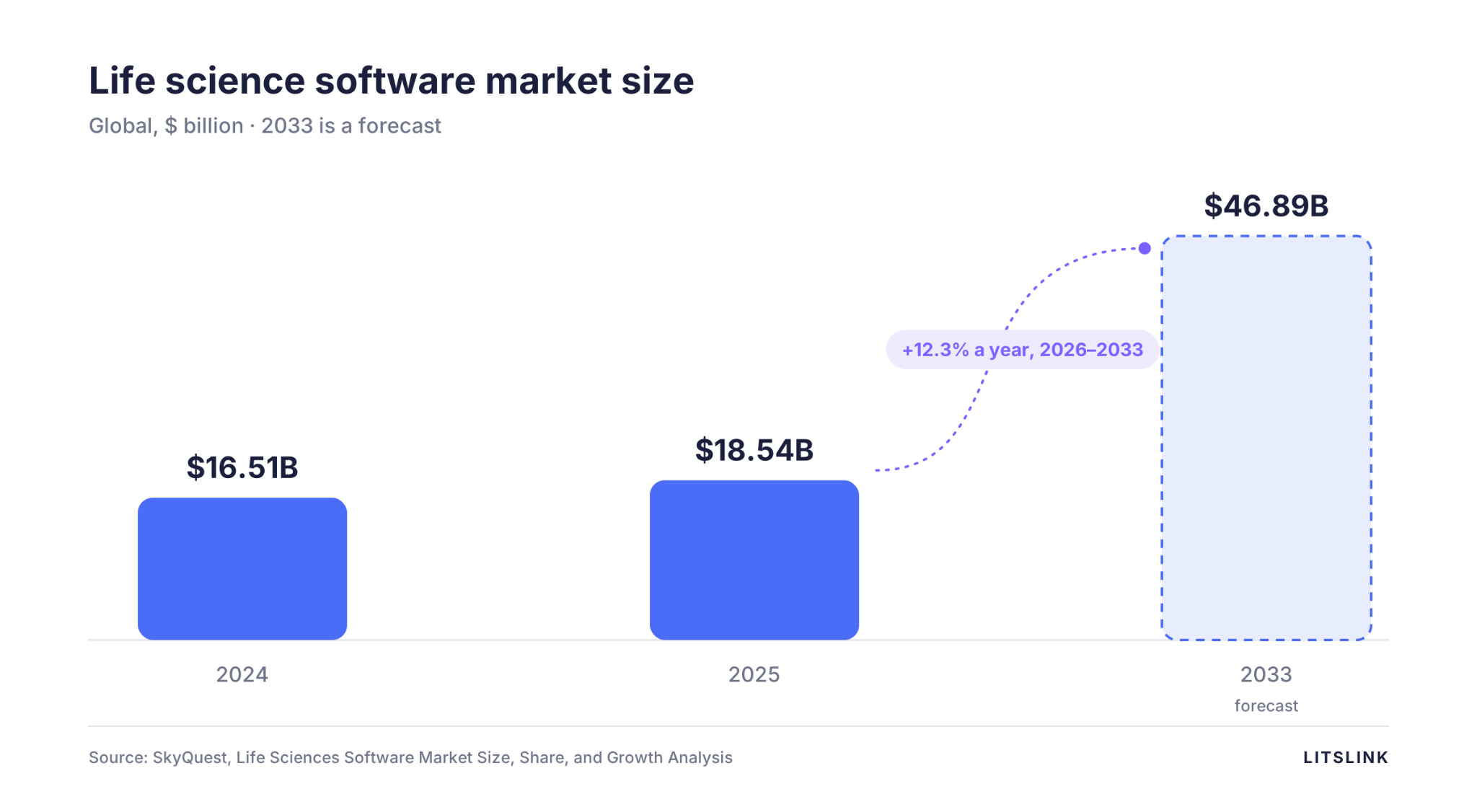
SkyQuest estimates the life sciences software market was worth $16.51 billion in 2024. By 2033, it expects that to reach $46.89 billion, almost three times as much, with growth of about 12.3% a year from 2026 to 2033. Behind that growth is a basic shift. Pharma, biotech, and medical device companies have outgrown general business tools. They want software made for the work they actually do, like running clinical trials, managing lab data, and getting products approved. If you’re a CTO or a biotech founder, we’d pay as much attention to integration and data tracking as to new features. Sooner or later an auditor will ask where a number came from, and you’ll want your systems to answer that quickly.
Key Takeaway:
- The market is growing fast. Life sciences software is expected to grow from $16.51 billion in 2024 to $46.89 billion by 2033, about 12.3% a year between 2026 and 2033 (SkyQuest, Life Sciences Software Market Size, Share, and Growth Analysis).
- Cloud is becoming the norm. Cloud-based tools now make up the biggest part of the market, as companies drop on-premises systems for platforms their teams can use and share from anywhere.
- AI is changing drug discovery. Spending on AI for new drugs discovery is set to jump from $5.09 billion in 2026 to $17.56 billion by 2031, growing around 28% a year (MarketsandMarkets, AI in Drug Discovery Market Report 2026–2031).
- A few big names lead the way. Veeva Systems, IQVIA, Oracle, Thermo Fisher Scientific, and Microsoft are among leading vendors, with Veeva and IQVIA especially strong in clinical and regulatory software.
If you work at a pharma, biotech, or medical device company, you probably use life science software every day. It’s what scientists and trial teams rely on for everything from logging a sample in the lab to sending a submission to the FDA. You’ll hear three names a lot:
- Laboratory Information Management Systems (LIMS)
- Clinical Trial Management Systems (CTMS)
- Electronic Lab Notebooks (ELNs)
Hospitals have software too, but it does a different job. Their systems keep patient charts and send out bills. Life science tools track samples, trial sites, and batches on a production line. Regulators check all of it, so the records have to follow GxP and the FDA’s 21 CFR Part 11, which say how electronic records get stored and signed.
The life sciences industry is the target market for these items. They are not the same as ordinary business software modified for use in the biological sciences. Demand is rapidly increasing. The worldwide market was estimated at $16.51 billion in 2024 and is projected to grow at 12.3% annually to reach $46.89 billion by 2033.
Life Science Software Market Size, End User Segments, and Growth in Asia Pacific
Global numbers tell only part of the real story; where growth isn’t spread evenly and where demand is strongest says just as much about the market as the headline figure.
| Metric | Value | Year | Publisher | Type |
|---|---|---|---|---|
| Global market size | $16.51 billion | 2024 | SkyQuest | Estimate |
| Global market size | $18.54 billion | 2025 | SkyQuest | Estimate |
| Global market size | $46.89 billion | 2033 | SkyQuest | Forecast |
| Annual growth rate (CAGR) | 12.3% | 2026–2033 | SkyQuest | Forecast |
By Region
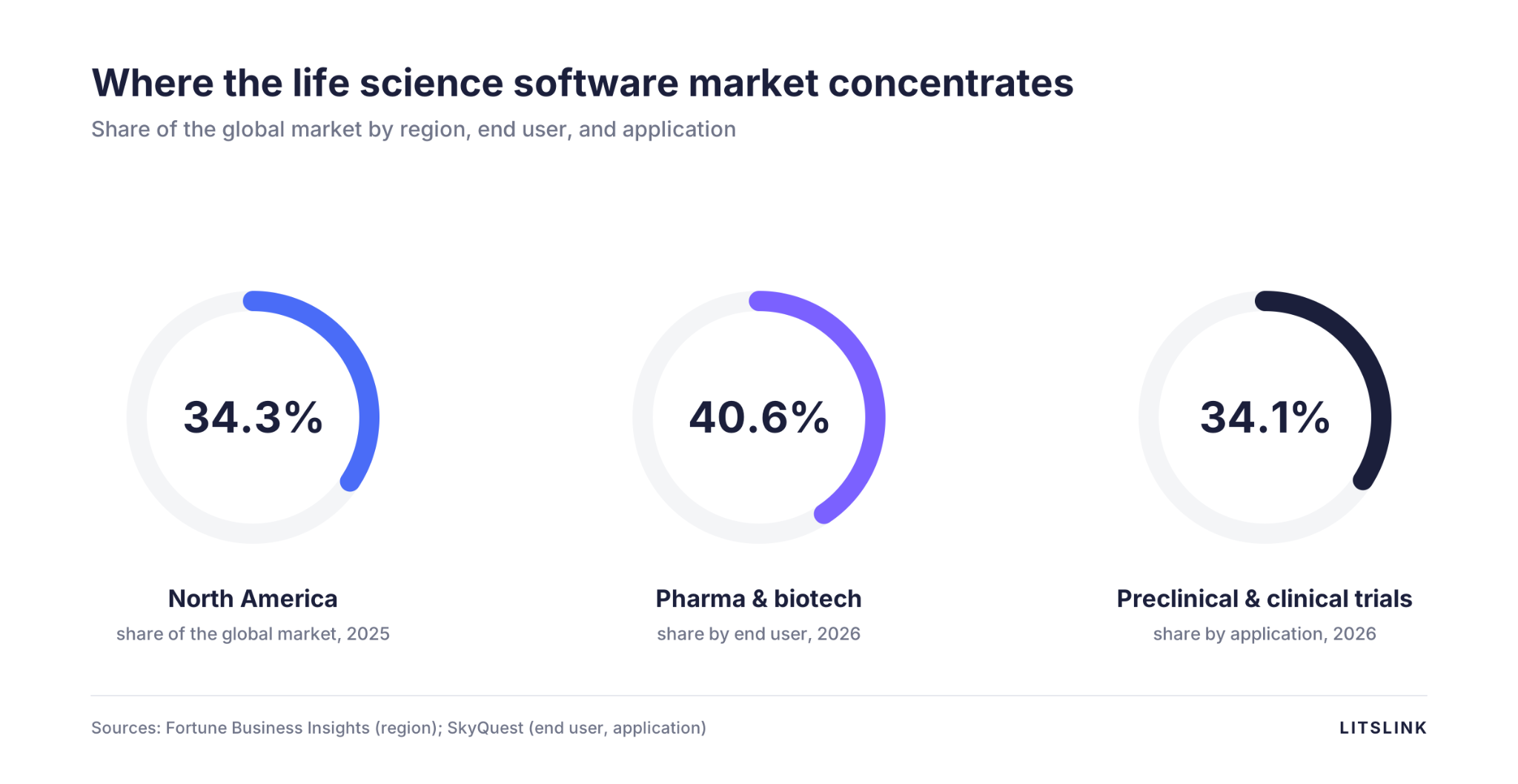
- North America leads. North America held 34.3% of the global market in 2025, about $6.06 billion (Fortune Business Insights, Life Science Software Market). That’s mostly because much of the world’s pharma and biotech R&D spending happens there, and because companies in the region started using compliance software earlier than most.
- Asia Pacific is catching up fast. China is leading the way. China-based companies started 30% of the world’s clinical trials in 2024, up from 3% a decade earlier, according to IQVIA. More trials mean more data, so the region needs more trial and lab software.
Be End Users
- Pharma and Biotech Companies are the biggest customers. They’re expected to make up 40.57% of the market in 2026. They run R&D, clinical trials, and regulatory compliance all under one roof, so they need software for every stage.
- CROs and Medical Device Companies make up much of the rest. Contract research organizations in particular are gaining ground as more drug developers outsource their clinical trials.
Preclinical and clinical trial software is considered the largest by applications, at 34.07% of the market in 2026, ahead of supply chain management, R&D, and commercial and branding tools.
Key Players and Competitive Landscape in Life Science Software
No single company runs this market. A few big platforms, like Veeva, IQVIA, and Oracle, cover several steps at once. Next to them is a long list of specialists that each do one job well, such as lab data or drug safety. Here’s how the main names compare:
| Vendor | Main Product | User for | Typical Buyer |
|---|---|---|---|
| Veeva Systems | Veeva Vault, Vault CRM | Clinical operations, regulatory, quality, sales | Pharma and biotech of all sizes |
| IQVIA | Clinical tech platform plus CRO services | Running trials, real-world data, market analytics | Large pharma, trial sponsors |
| Oracle | Clinical One, Argus Safety | Trial data, adverse event reporting | Pharma companies, CROs |
| Salesforce | Life Sciences Cloud | Sales and medical team CRM, patient programs | Commercial teams at pharma and medtech |
| Thermo Fisher Scientific | SampleManager LIMS, Chromeleon | Sample tracking, lab and chromatography data | QC and R&D labs |
| Revvity | Signals Notebook | Recording experiments, sharing research data | Research scientists |
What makes Veeva unique? Veeva’s specialization sets it apart. Other vendors sell to life sciences companies as part of a broader customer base and modify other software to suit life sciences needs. Veeva focuses on life sciences, so it provides software designed for regulatory and clinical processes. This means companies won’t need much customization after buying.
Smaller niche companies create specific tools. These include electronic lab notebooks, patient recruitment for clinical trials, and regulatory publishing. Bigger vendors have strengths, but smaller ones often stand out by solving problems better.
Clinical Trials Applications: A Deep Dive Into Market Share by Use Case
Clinical trials software is hard to define. The market divides into different segments. Their sizes reveal where buyers spend the most and where vendors plan to invest next.
The Largest Segment: Preclinical and Clinical Trials
Clinical trials get the biggest share of the budget. Preclinical and clinical trials software took 35% of the life science software market in 2025, more than any other category (Precedence Research, Life Science Software Market Size, Share and Trends 2026 to 2035). Next in line are supply chain tools, R&D platforms, commercial and branding software, pharmacovigilance, and regulatory compliance.
It’s not hard to see why. One trial can last years. It might involve dozens of sites and thousands of patients, and regulators expect every decision along the way to be on record. Spreadsheets and email threads can’t keep up with that. So companies pay for proper trial software instead, and they pay a lot.
The Main Tools in This Segment
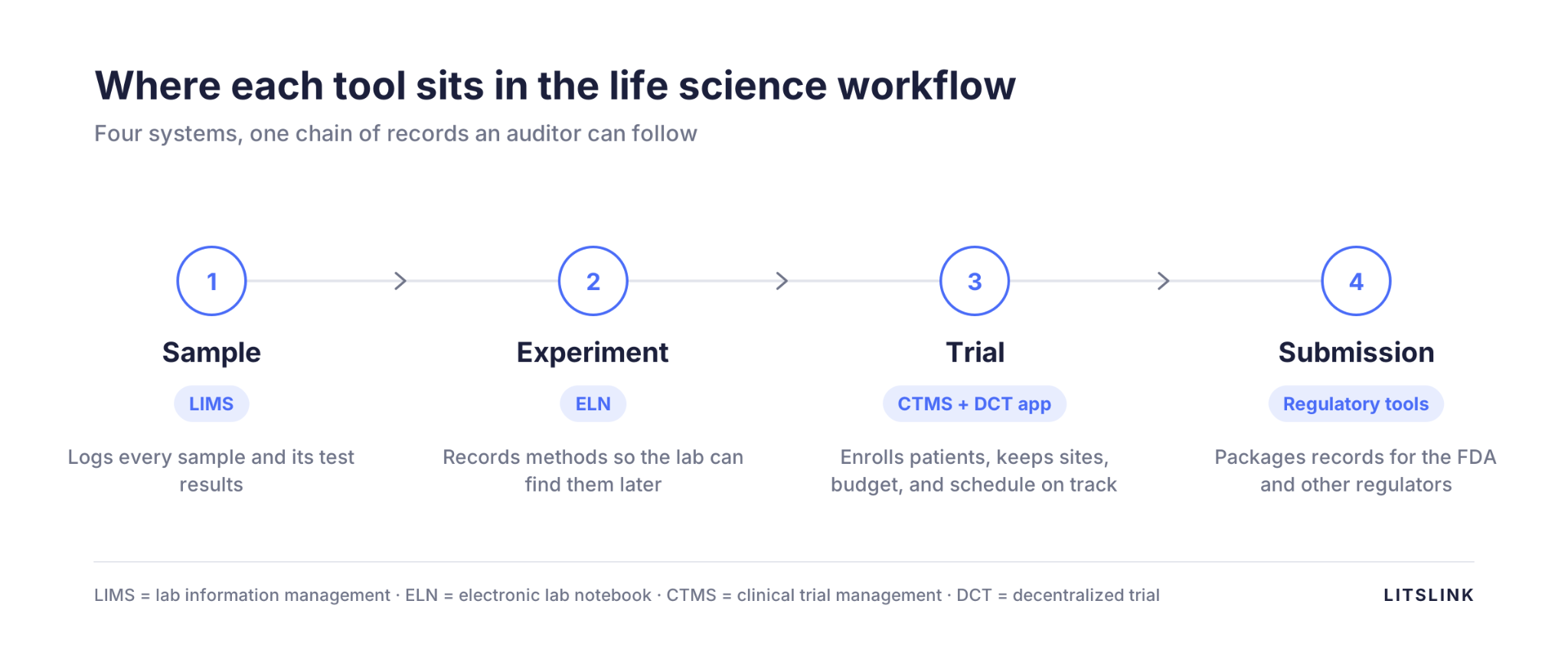
- Laboratory Information Management Systems (LIMS): Every sample in a lab gets logged here, along with its test results. So when an auditor asks who ran a test or where a sample came from, nobody has to hunt for the answer.
- Clinical Trial Management Systems (CTMS): Most of the daily running of a trial happens in a CTMS. Teams use it to enroll patients, keep sites organized, and make sure the budget and schedule don’t slip.
- Electronic Lab Notebooks (ELNs): Scientists used to record experiments by hand in paper notebooks. ELNs do the same job on screen, and they make it much easier for a colleague to find last month’s method without asking around the lab.
- Decentralized trial software: This category is growing quickly. Patients can join a study from home and send their data through an app or a wearable device, which means trials can include people who live hours away from the nearest research site.
Where Growth Is Heading
Clinical trials are the biggest part right now. However, research and development will grow the fastest by 2035. AI and machine learning tools are fueling this growth by speeding up drug discovery and simplifying the process. Trial management remains the largest market. New investments are shifting earlier in the development process.
Cloud Computing Trends in Life Sciences Software
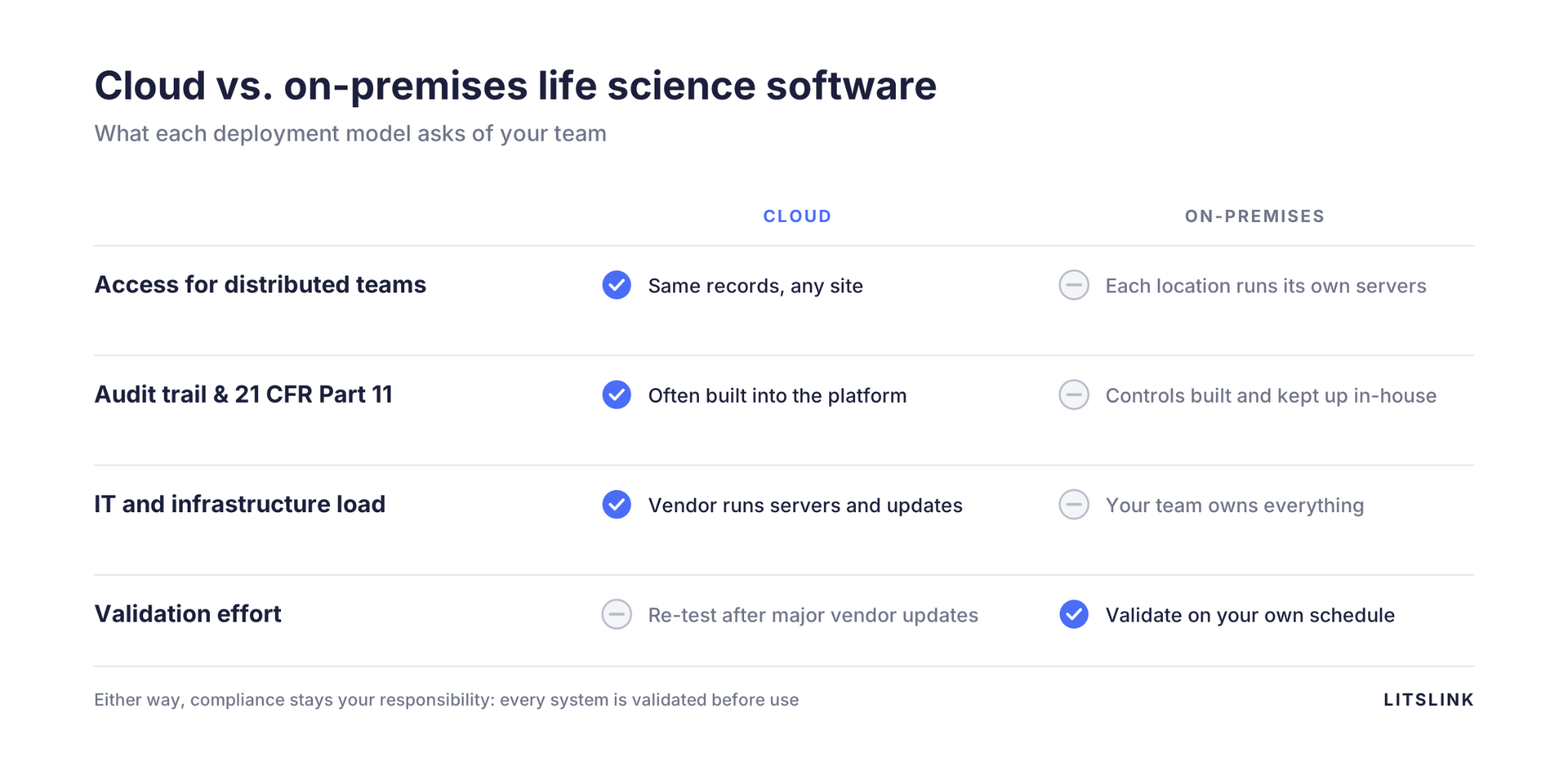
Cloud implementation in life sciences isn’t just a passing trend. It addresses key industry issues. For example, it allows teams across different locations to access the same data. This helps them collaborate effectively while still following strict compliance rules.
Cloud Deployment vs. On-Premises in Life Sciences Software
Cloud technology is seen as the fastest-growing tech in life sciences. However, reports show mixed views on its use compared to on-premises technology. A 2026 report states that on-premises deployment was more common than cloud in 2025. But cloud use is expected to rise and eventually surpass on-premises. Some sources, like a SkyQuest report, claim cloud technology is already the most common in the industry. Overall, cloud deployment is rising.
The biggest reason companies move to the cloud is access. Research rarely happens under one roof. A study might involve a lab in Boston, a trial site in Germany and a manufacturing team in India, and all of them need the same up-to-date data. With a cloud platform, they can log in from wherever they are and see it securely, without each location running its own servers or relying on a local IT team to keep things working.
One major advantage of cloud computing is compliance, especially for medical-science businesses. FDA requirements such as 21 CFR Part 11 mandate version history, audit trails, and user activity recording. These features help regulators track document changes. These functionalities are offered by several cloud-based life sciences applications. Businesses using on-premises systems must build similar controls, which can be costly, time-consuming, and skill-intensive. Cloud computing can help life sciences organizations meet and maintain compliance standards, even though it isn’t a simple remedy.
How Generative AI Is Changing Drug Discovery and Research
AI models in life sciences have moved beyond predicting outcomes from existing data. They can now propose new molecular structures and draft summaries of thousands of research papers. That’s generative AI, while older machine learning tools, like the ones used to find trial patients below, still do the predicting.
Early drug development is being significantly impacted by generative AI. Researchers can use it to produce novel molecules with specific characteristics, such as metabolic stability and drug-target binding. These technologies can accelerate the discovery process, which often takes chemists months. Rather, AI offers a condensed list of leads to investigate. The AI in drug discovery market is expected to grow from $5.09 billion in 2026 to $17.56 billion by 2031 (MarketsandMarkets, AI in Drug Discovery Market Report 2026–2031).
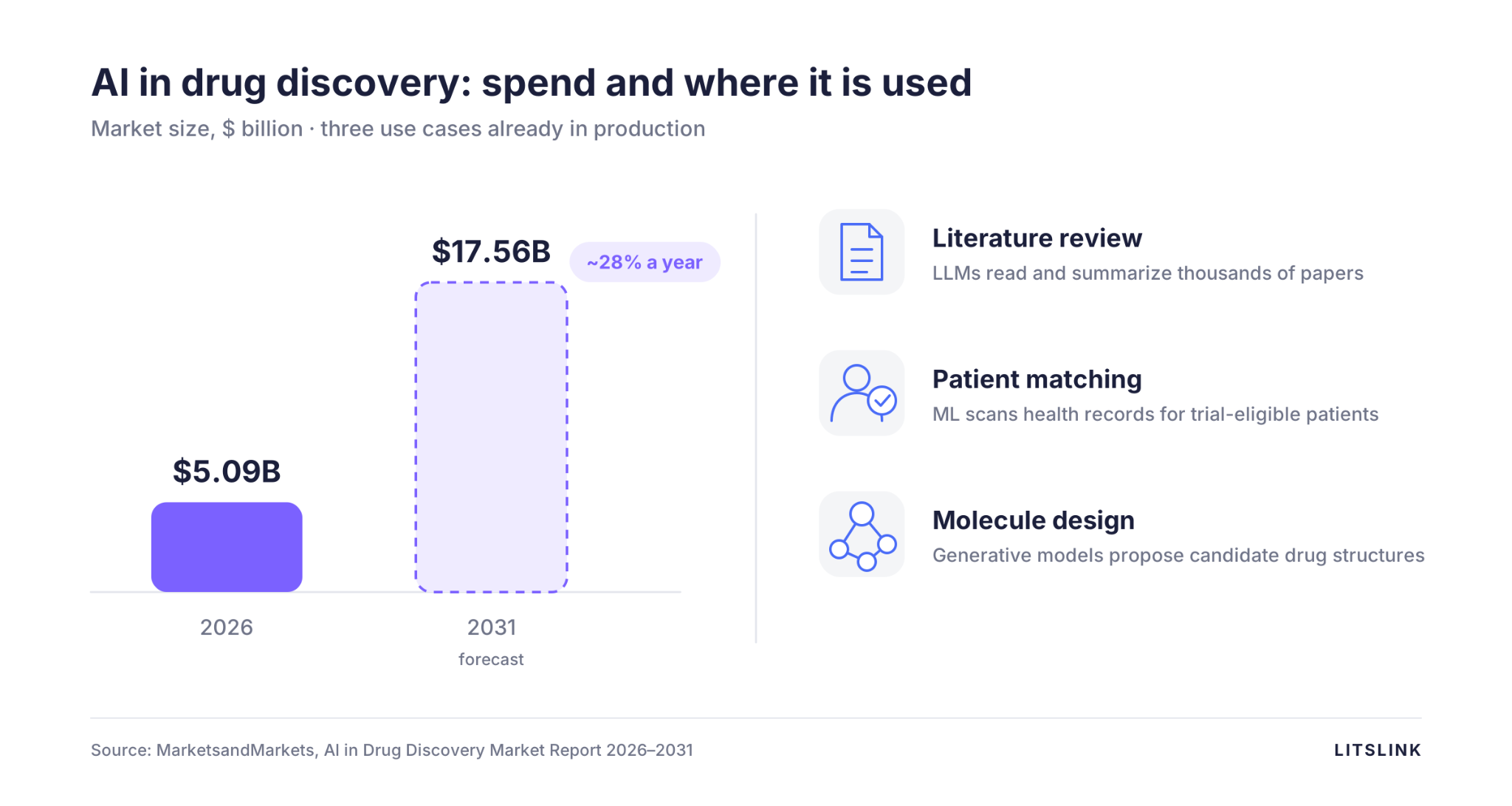
AI is also helping clinical trials run faster. One of the slowest parts of any trial is finding the right patients. Machine learning tools can quickly scan electronic health records. They flag people who fit a study’s criteria much faster than staff can when reviewing charts by hand. Large language models offer a big benefit: they can quickly read and summarize vast amounts of scientific literature. This speed is crucial in a field where staying up to date on new studies is a full-time job.
Adoption is moving quickly. Surveys show that about 75% of major life sciences companies use AI in some areas. Most of the others plan to start within the next two years. Still, it’s worth keeping expectations realistic. Time and cost savings differ by therapeutic area and company. So, vendor claims about how much AI reduces discovery costs are only a general guide, not a promise for every program. To see how this kind of AI-driven research automation is actually built, explore LITSLINK’s AI Agent Development Services.
Industry Challenges Slowing Life Science Software Adoption
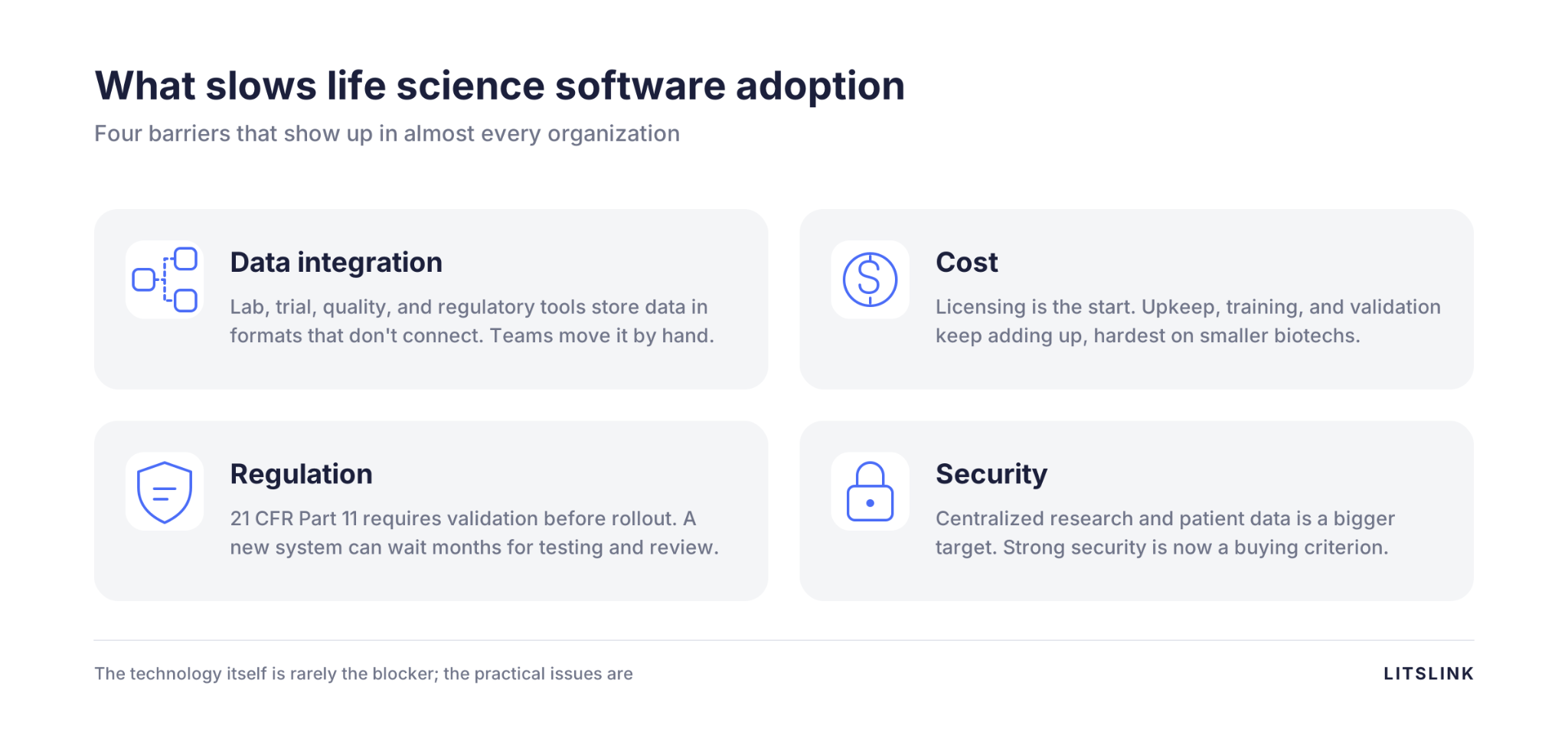
The technology itself is rarely what holds companies back. The real problems are practical ones, and they show up in almost every organization in some form.
Data integration is one of the biggest. Many life sciences companies use many separate tools for lab work, trials, quality, and regulatory tasks. These systems often store data in different formats, which don’t connect. When information is scattered, research slows. Teams waste time moving data manually. Compliance reporting becomes harder and more error-prone.
Cost is another barrier, especially for smaller companies. Large pharma companies can buy enterprise software and hire teams to manage it. Usually, smaller biotech companies and research teams are unable to. Continuous expenses may mount up. You must take into account licensing, upkeep, training, and validation in addition to the original cost. A limited budget may be strained by these.
Regulation is mutual. Data integrity is protected by regulations like the FDA’s 21 CFR Part 11, which requires audit trails, documentation, and validation. However, a new system must go through extensive testing and review in accordance with those same standards before it can be implemented, which can cause a rollout delay of several months.
Security is the final concern. The increasing digitization and centralization of research and patient data makes them increasingly vulnerable to hacks. Sensitive trial data or priceless intellectual property may be compromised. So, companies now see strong security as essential when choosing software, not just an afterthought.
How LITSLINK Builds Custom Software for Life Sciences and Healthcare
At LITSLINK, we create healthcare and life sciences apps. We focus on security and compliance. Check out our approaches here:
- HIPAA-compliant design implemented during development. We include security features like encryption and auditing from the start. This approach protects patient and research information and simplifies HIPAA audits.
- HL7 FHIR Integration. Our services help you connect new technologies with your lab, clinical, and EHR applications using HL7 FHIR standards. This ensures safe and smooth information sharing. You can upgrade your applications step by step instead of doing a costly full replacement.
- Applications of Automation and AI that Are Beneficial. Save time and money by using automation and AI in research and decision-making. For example, automate record-keeping and help research teams with analysis and pattern detection.
- Proven Experience. Tentacle has over 12 years of experience in healthcare software development. We’ve completed 1,540 projects for 1,000+ clients across 82 countries.
- Simple collaboration. US project managers work with European engineers. You share work hours and communicate easily.
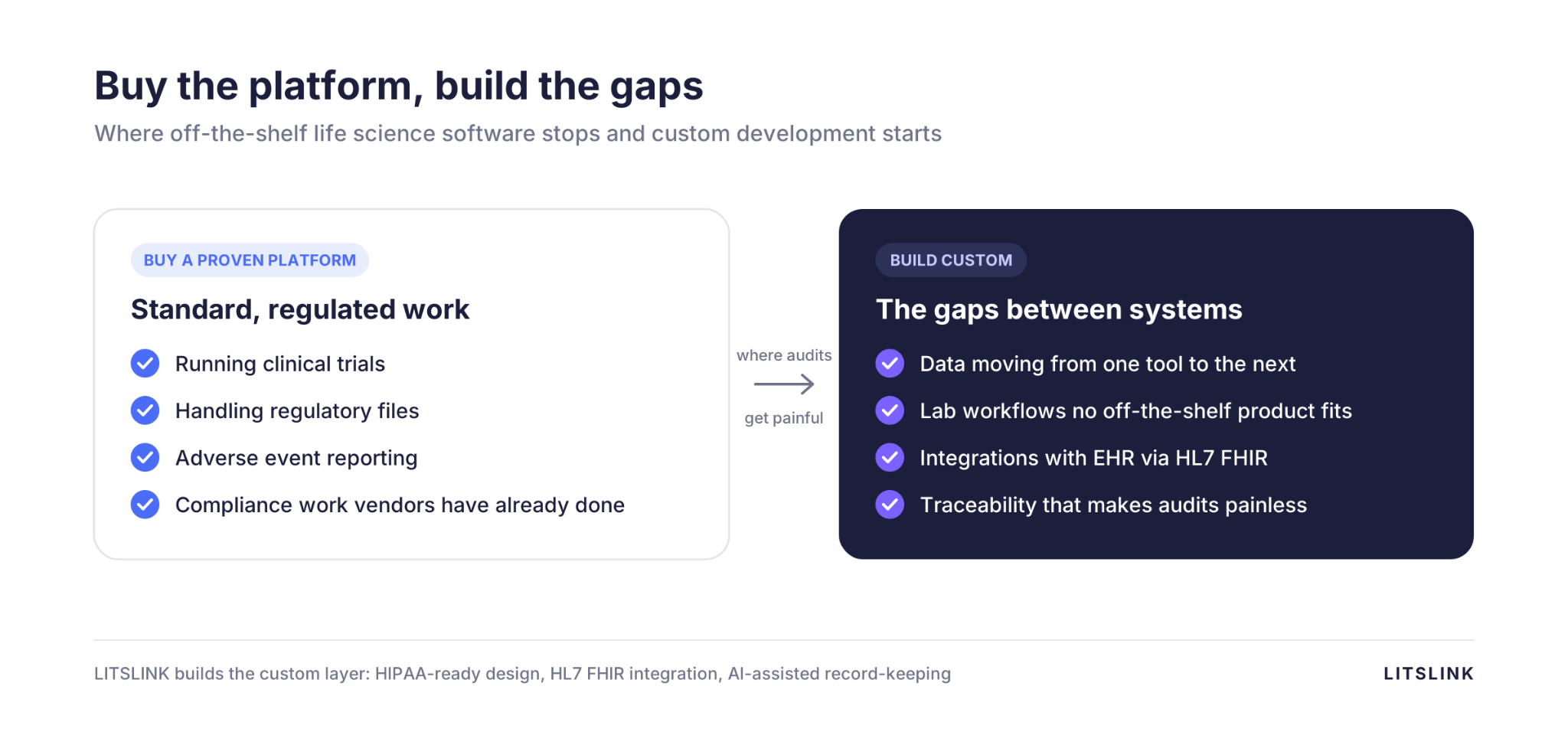
If you’re choosing software right now, our advice is simple. Buy a proven platform for standard work, like running trials or handling regulatory files. Vendors such as Veeva and Oracle have already done the hard compliance work there. Custom development makes sense in the gaps between those systems, where your data has to move from one tool to the next, or where your lab works in a way no off-the-shelf product fits. That’s also where audits tend to get painful, so it’s worth getting right.
To learn more about what we build for this industry, explore our Healthcare Software Development Services. Contact LITSLINK for a free consultation to scope a custom life sciences or healthcare software project.
FAQs
What Does Life Science Software Refer To?
The term “life science software” describes specialized programs designed especially for pharmaceutical, biotechnology, and medical device companies to manage research data, clinical trials, and regulatory compliance. Examples include Laboratory Information Management Systems, Clinical Trial Management Systems, and Electronic Lab Notebooks.
Who Are the Key Players in the Life Science Software Market?
Among the most well-known suppliers are Veeva Systems, IQVIA, Oracle, Salesforce, Thermo Fisher Scientific, and PerkinElmer. Veeva Systems is renowned for developing its platform especially for life sciences processes rather than modifying standard business software to suit the industry.
Why Is Cloud Deployment Growing Faster Than On-Premises in Life Sciences?
People working on one trial are often in different countries. With a cloud system, they can all see the same records at the same time. The vendor looks after the servers and the updates, which means less work for your own IT staff. Most of these platforms also keep audit logs on their own. You’re still the one responsible for compliance, and that part takes time. Each system has to be validated before use, and big vendor updates often mean testing it again.
How Is AI Actually Being Used in Life Sciences Software Today?
Three areas of AI in life sciences software are currently the most established: AI-assisted literature reviews that process large volumes of scientific publications faster than manual research, machine learning models that help identify eligible clinical trial patients from electronic health records, and generative AI that designs candidate drug molecules.
What’s the Biggest Barrier to Life Science Software Adoption?
The two most commonly mentioned obstacles are the cost of enterprise-grade, compliance-ready software and integrating data across dispersed, siloed systems, especially for smaller biotech and research businesses with limited IT resources.