







Key Takeaways
- Four areas have the strongest published results: medical imaging triage, manufacturing defect inspection, targeted agricultural spraying, photo-based insurance claims. All four replace a slow human inspection step with a sub-second one.
- Payback windows have compressed. Vision inspection now reports 8-month payback and 374% three-year ROI at mid-volume plants. Photo-based claims tooling reportedly clears ROI in about six months.
- Regulation is now a demand driver. EU Regulation 2019/2144 makes advanced driver distraction warning mandatory. It applies to new vehicle types from 7 July 2024 and to all new vehicles from 7 July 2026. Every new car sold in the bloc needs a camera-based recognition system.
- Multimodal LLMs are a new delivery model. A single image analysis now costs anywhere from about $0.00002 to roughly $0.023. Mid-tier models sit near $0.0006.
- Accuracy is no longer the bottleneck. Data operations are. Retraining on every product variant, ERP and PACS integration, and governance around faces are what stall projects.
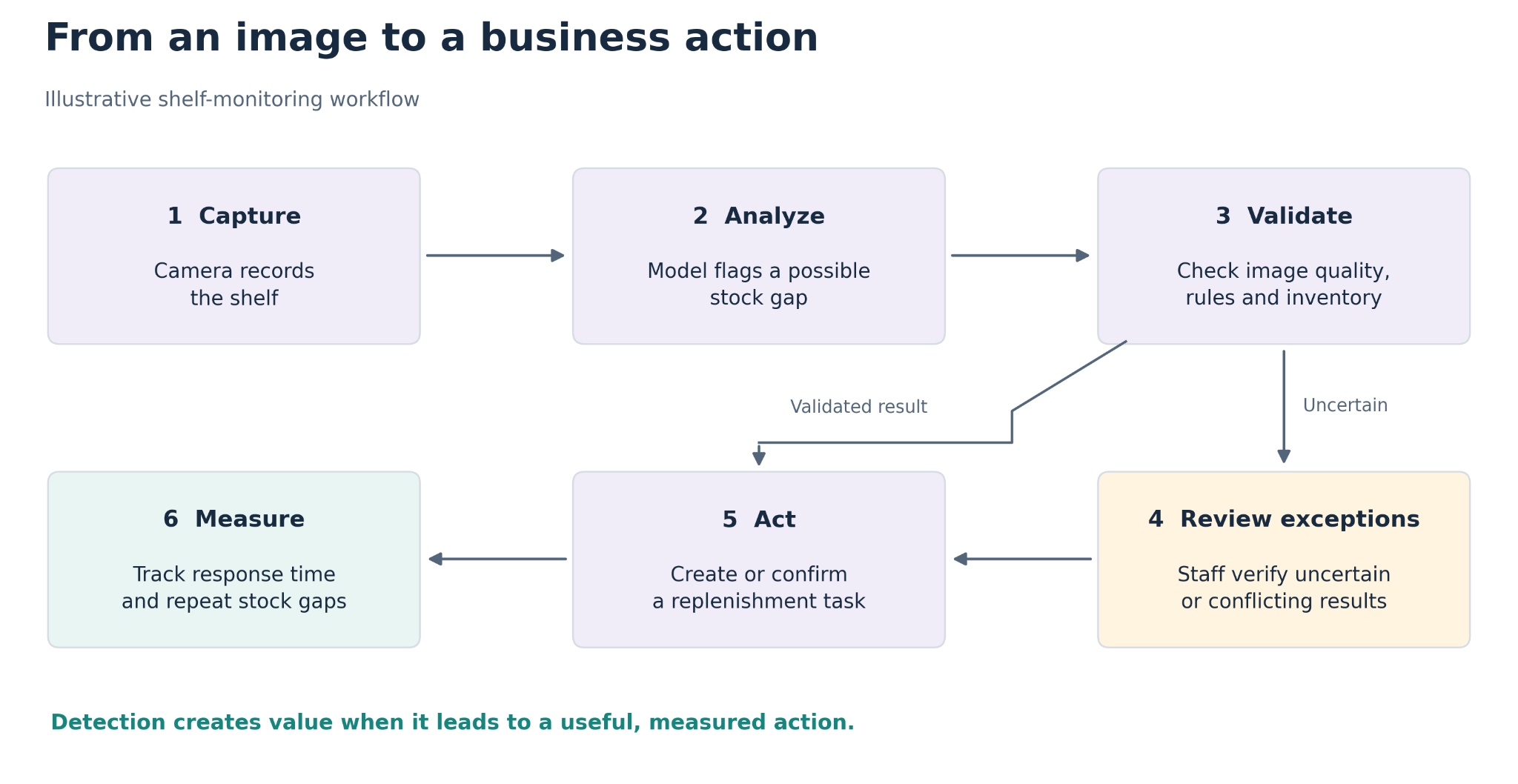
An inventory system says a product is available, but the shelf is empty. A camera can flag the mismatch. The business benefits when someone replenishes the shelf. That connection between detection and action is what makes image recognition useful, and it is the thing most vendor demos skip.
This guide skips the mechanics. If you want the algorithms, our explainer on how AI image recognition works covers them: how image recognition algorithms turn pixels into labels, particularly convolutional neural networks, CNNs for short, and the newer deep learning architectures that replaced them. It also covers what model training actually involves, what a labeled training dataset costs to assemble, and where image segmentation differs from classification. Modern deep learning models sit behind almost every example below. Here the focus is what companies built with artificial intelligence and what it returned.
Real-World AI Image Recognition Examples by Industry
All 28 deployments below run on the same raw material, digital images and video frames, and split on the question asked of that visual data. Some identify objects in a frame. Some classify the entire image. Some run image detection to flag whether a thing is present at all. Some read text off a label. Image recognition plays a different role in each, and the business case moves with it.
Retail and e-commerce
1. Shelf monitoring and planogram compliance. Empty shelves are retail's largest measurable loss. Retailers lose an estimated four to eight percent of potential sales to them, and manual audits catch gaps hours late. This is the most widely deployed retail use case for image recognition applications. Out-of-stock detection accuracy typically reaches 92–97% in stable lighting. Trax and Infilect sell it to CPG brands. Walmart and Carrefour run it in-house. Automated planogram auditing reportedly cuts manual inspection costs by over 60%.
2. Phantom inventory detection. The ERP says a SKU is in stock. The shelf is empty. Forecasting degrades along with sales. Correlating repeated zero-facing detections against ERP records surfaces the gap. One study showed an 11% sales lift for items with negative inventory-record accuracy after correction.
3. Cashier-less checkout. Amazon launched this in 2018. By 2026, the same technology, sold as Just Walk Out, runs in 30-plus stores plus stadiums and airports. Ceiling cameras and shelf sensors classify images of every pick and return in real time. Sainsbury's operates a SmartShop Pick & Go store in London on Trigo's computer vision system.
4. Visual search. ASOS, Myntra and Lenskart let shoppers upload a photo and surface matching catalog items. The models compare visual features rather than text, so color, cut, and pattern all count. It closes the gap for customers who can describe a product visually.
5. AR virtual try-on. The newest high-ROI retail case. It works because it attacks returns. Shopify's own figure is the most robust anchor here: a 94% average conversion lift for product pages carrying 3D and AR content. Wayfair's "View in Room" reportedly produced a 92% conversion lift, a 43% reduction in returns and a 28% increase in average order value. Treat the return figures with care. The commonly cited 20-to-40 percent range comes from vendor deployments and trade press.
6. Loss prevention at self-checkout. Modern recognition systems flag behavioral patterns rather than identifying people. Items moving from shelf to bag without a scan. Weight mismatches. Reported shrink reduction commonly lands between fifteen and thirty percent. This is also the use case drawing the most regulatory scrutiny.
Healthcare
Healthcare has the best-documented results of any vertical. Medical image recognition has to clear regulatory review before it reaches production, so the numbers get published. Systems that analyze medical images — CT, MRI, X-ray, pathology slides — carry the heaviest evidence burden of anything in this list. We cover the wider picture in AI in healthcare: uses, examples and benefits.
7. Radiology triage (Aidoc). A retrospective study at the University of Chicago analysed 11,252 adult CT pulmonary angiography exams for suspected pulmonary embolism, run between 2018 and 2022. It compared periods before and after deploying an FDA-cleared triage device. During work hours, mean turnaround fell from 68.9 minutes to 46.7 — a 22.2-minute reduction. Off-hours improvement was far smaller, from about 44.8 to 42 minutes. AI triage is just queue management. Its value depends entirely on how bad your backlog is. Rochester Medical Center used it to bump positive intracranial hemorrhages to the front, cutting turnaround times by 44.7%, roughly 30 minutes per case.
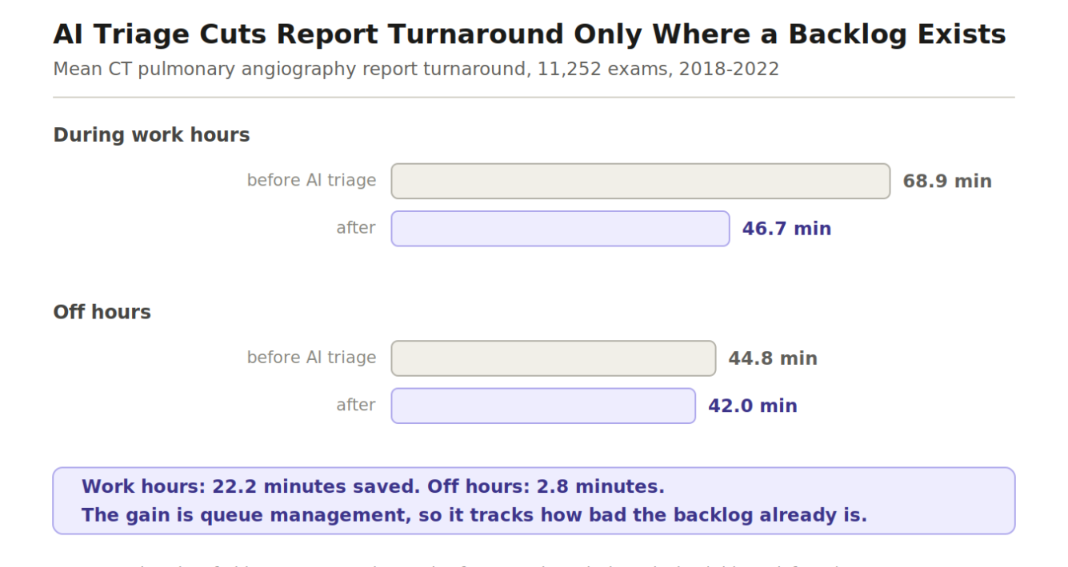
Source: University of Chicago retrospective study of an FDA-cleared triage device (Aidoc BriefCase), 11,252 exams.
8. Digital pathology (Paige, PathAI). The study behind FDA authorization used 527 prostate biopsy slide images read by 16 pathologists, with and without AI assistance. Accuracy jumped 7.3 points to reach 96.8%. False negatives dropped by 70%, and false positives by 24%. More importantly for regional labs, the tool closed the skill gap, letting non-specialists hit the same sensitivity as specialists. PathAI has since pivoted into a full integration platform, ingesting slides straight from Leica, Philips, Hamamatsu, and 3DHistech scanners.
9. Patient monitoring. Ceiling-mounted security cameras in ICUs and long-term care detect falls, bed exits, and abnormal breathing without wearables. Alerts escalate to staff in real time. The metric that matters is nursing time reallocated per shift, not detection accuracy alone.
10. Screening at population scale. Diabetic retinopathy and mammography are the two cases where models triage volume no radiology workforce can absorb. The value is throughput in under-served regions, not beating a specialist. Google DeepMind's mammography work is the reference research program. Its screening system has been reported to cut interpretation times by around a third.
Automotive and mobility
11. Perception for driver assistance and autonomy. Waymo's robotaxi operations and Tesla's driver-assistance stack are the reference deployments. The regulatory floor beneath them has risen sharply. As of July 2026, the EU's General Safety Regulation mandates emergency braking for pedestrians and cyclists on all new cars and vans. Detecting vulnerable road users is no longer a premium upgrade. It is a strict requirement for type approval.
12. Driver monitoring (ADDW). The largest forced deployment of image recognition in any consumer product this decade. EU Regulation 2019/2144 mandates advanced driver distraction warning from 7 July 2024 for new vehicle types and 7 July 2026 for all new vehicles. Driver-facing infrared cameras track eye movement, blink patterns, gaze direction and signs of fatigue. Facial features are read without identifying the driver. Cameras stay active above 20 km/h. Processing must stay closed-loop, retaining only what immediate operation needs. For suppliers and OEM software teams, this is a multi-year compliance workstream.
13. Fleet safety analytics. Commercial fleets run the same in-cab and forward-facing recognition voluntarily, on a claims-cost basis. Samsara's Safety Report found fleets using its full AI safety solution saw a near-75% crash reduction over 30 months. The analysis covered 2,600 fleets and reported crash and harsh-event reductions up to 73%. Municipal deployments show the same shape. New Orleans reported an 81% drop in collision risk and 46% less mobile phone use while driving. El Paso cut accidents 29%. Allentown cut incidents 25% and saved over $1 million. Pricing here is unusually transparent: $27–60 per vehicle per month across premium vendors, bundled as hardware plus subscription. One caveat worth quoting to clients. Vendors publish 4–6 month payback claims, but actual math ranges from 3-month payback on high-risk fleets to negative ROI on safe fleets with clean records.
14. Vehicle condition and damage inspection. Photo-based assessment at rental return, lease end, fleet handover and trade-in. The same models underpin insurance claims, see #27. The operational case differs. It produces a timestamped condition record without a human walking the vehicle.
15. Traffic management and road analytics. Camera-fed signal control adjusts phase timing to actual queue length rather than a fixed schedule. Automatic number-plate recognition, a form of optical character recognition applied to moving vehicles, underpins tolling, restricted-zone enforcement and parking. Procured municipally on corridor travel-time improvement. ANPR is the recognition workhorse and carries the heaviest privacy footprint.
Security and surveillance
16. People counting and occupancy analytics. The easiest use case to deploy under privacy rules. The computer vision system detects anonymous shapes rather than identifying anyone. That makes it among the simplest to clear in most jurisdictions. Wait-time reductions of twenty to thirty-five percent are common in the first quarter. See our people counter case study for how the pipeline is built and what accuracy holds up in real venues.
17. Airport and border biometrics. Face verification at boarding gates and border control is routine at major hubs. Facial recognition technology matches a live capture against a stored template. The business case is passenger throughput per gate. It also carries the heaviest compliance overhead of anything in this list. We break down the trade-offs in what facial recognition software is: pros and cons.
18. PPE compliance and hazard detection. In warehouses and plants, systems check for helmets, gloves, and vests. They also flag spills, blocked aisles, and unsafe stacking, alerting personnel immediately. Access control to restricted zones runs on the same models. Sold on recordable-incident reduction and insurance impact.
Manufacturing
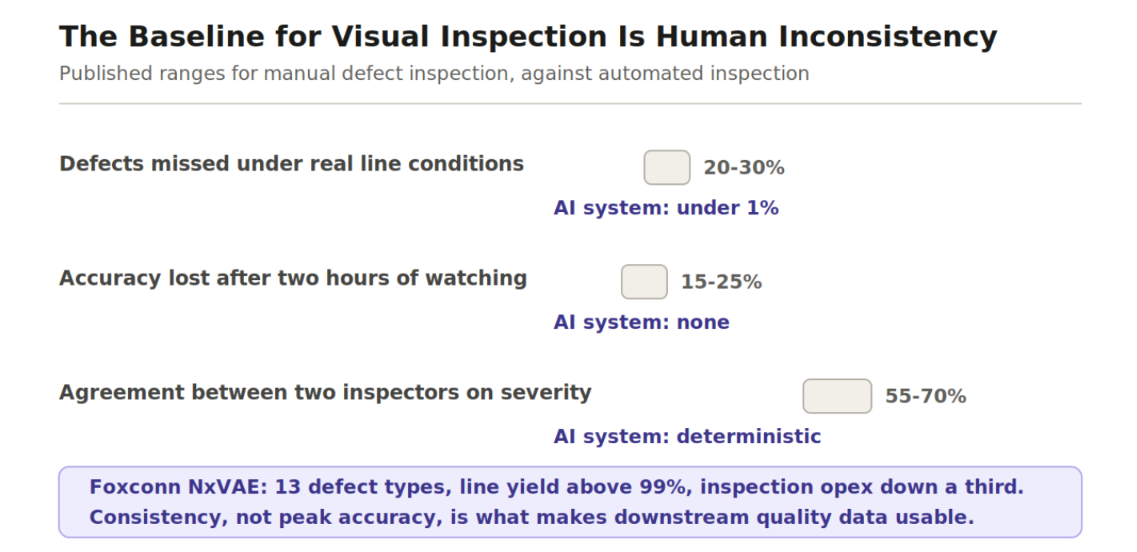
19. Automated defect inspection. The clearest ROI case in the field, because the baseline is well quantified. Human inspection misses 20–30% of defects under real production conditions. Accuracy degrades 15–25% after just two hours of continuous observation. Inter-inspector agreement on defect severity runs only 55–70%. Against that baseline, the numbers are strong. Cognex reported that Schneider Electric doubled production yield and eliminated most false rejects on its OneVision platform. At a 1,200-parts-per-day facility, AI inspection reportedly saves $342,000 a year versus manual checks, with eight-month payback and 374% three-year ROI. Foxconn's in-house NxVAE system detects 13 defect types, holds line yield above 99%, and cuts inspection operating costs by at least a third. Intel reports $2 million in annual scrap-avoidance savings from vision inspection alone.
20. Vision-based predictive maintenance. Thermal and visual inspection of equipment surfaces flags wear before failure. Predictive maintenance broadly is credited with 25-30% lower maintenance costs and 30–50% less unplanned downtime. Only part of that is attributable to image analysis rather than sensor telemetry. Strictly, this is recognition feeding a forecasting layer.
Agriculture
21. Targeted herbicide application (John Deere See & Spray). The best-evidenced agtech vision deployment, with both vendor and independent numbers. Deere reported saving farmers an estimated 8 million gallons of herbicide mix across more than a million acres in the 2024 season, averaging 59% savings on corn, soybean and cotton. The following season covered more than five million acres. Operators cut non-residual herbicide by nearly 50% on average, saving close to 31 million gallons. Soybean trials across seven states yielded two additional bushels per acre. Independent confirmation exists. A 2026 study in Agrosystems, Geosciences & Environment analyzed 510,000 hectares of commercial data, tracking a 58% drop in targeted herbicide use. The data ties ROI directly to two hardware settings: narrower nozzle angles and lower sensitivity. One business-model detail worth borrowing — customers pay only for acres where the technology is used.
22. Harvest grading and sorting. Optical sorters classify produce by size, ripeness, and blemish at line speed, replacing manual grading tables. The metric is premium-grade output recovered from what would otherwise be downgraded.
Logistics
23. Parcel sorting and label reading. Volume is forcing the issue. Global parcel volume reached 22.37 billion shipments in 2024 and is projected to hit 225 billion by 2028. Meanwhile, 76% of supply chain leaders report workforce shortages. Published model performance is strong. A YOLOv5 model detects and locates parcels at 98.2% mAP and 82 FPS, keeping high-speed conveyor sorting accurate without manual light curtains. Automated loading systems identify freight at 92.2% accuracy. Label reading and freight image identification run in the same pass, so one camera feed serves both sorting and audit. Analysts expect this to become standard: Gartner projects that by 2027, half of companies with warehouse operations will use AI vision instead of scanning-based cycle counting.
24. Damage detection at the dock. Wrinkles, tears, and surface damage are flagged at 90% mAP in real time, pulling defective parcels before they ship. The commercial driver is churn. Among consumers who receive a damaged shipment, 51% will not repurchase and 85% report negative brand perception after a single incident.
Sports and entertainment
25. Automated and semi-automated officiating. The 2026 FIFA World Cup offside infrastructure pairs a 500Hz ball sensor with Hawk-Eye's SkeleTRACK, mapping 29 body points per player instead of a basic center of mass. MLB operates the Automated Ball-Strike system for the 2026 season. The NBA has confirmed it will use AI cameras to process out-of-bounds calls. One caution on cost: full SAOT deployment needs dedicated camera infrastructure, proprietary calibration software, and specialized staff, with implementation estimated above $3 million per stadium.
26. Player tracking as a data product. Second Spectrum tracks the Premier League and MLS. TRACAB has tracked the Bundesliga and dozens of leagues for two decades. Hawk-Eye increasingly licenses its skeletal data to leagues as a product. One note for anyone benchmarking vendors. Published research shows TRACAB, Second Spectrum and GPS outputs are not directly interchangeable, so a club mixing sources needs conversion modelling. This is object detection plus multi-view association and tracking.
Insurance and financial services
27. Photo-based damage assessment (Tractable). Admiral Seguros reported that Tractable let 90% of auto estimates run touchless, with 98% of assessments completed inside 15 minutes. The company reports reviewing damage photos at 95% accuracy and cutting estimate review from roughly 30 minutes to seconds. Of customers who receive its web-app link, 70-75% complete the claim digitally. It counts 25 of the world's top 100 insurers as customers. Pricing is volume-based, reportedly $5-25 per claim. Annual contracts for mid-size carriers start at $50,000-200,000, with ROI typically within six months.
28. Document and invoice extraction. The highest-volume image recognition task most companies actually have. Take a logistics company processing 50,000 invoices a month. At $3.50 per invoice of manual entry, that is $175,000 monthly. A multimodal extraction pipeline reaches 90–95% accuracy on structured invoices, and 99%+ after human review of low-confidence cases. Cost runs $0.02-0.05 per invoice. Payback is measured in weeks.
Not sure which of these applies to your operation? Talk to our team about a scoped pilot. We come back with a use case, a budget range, and a timeline.
Comparison table: industry, use case, example, result
| Industry | Use case | Example company | Reported result |
|---|---|---|---|
| Healthcare | CT triage for pulmonary embolism | Aidoc (UChicago study) | Turnaround 68.9 → 46.7 min in work hours |
| Healthcare | Prostate biopsy detection | Paige Prostate (FDA study) | Accuracy 89.5% → 96.8%; false negatives −70% |
| Agriculture | Targeted herbicide spraying | John Deere See & Spray | ~50-59% herbicide reduction; 31M gallons saved across 5M+ acres |
| Manufacturing | Automated defect inspection | Schneider Electric / Cognex | Require doubled; $342k/yr saved; 8-month payback |
| Manufacturing | Unsupervised defect detection | Foxconn (NxVAE) | 13 defect types; Production yield above 99%; inspection opex −33% |
| Manufacturing | Wafer inspection | Intel | ~$2M/yr scrap avoidance |
| Automotive | Driver distraction warning | EU-wide (Reg. 2019/2144) | Mandatory on all new vehicles from 7 July 2026 |
| Automotive | Fleet safety cameras | Samsara (2,600 fleets) | ~75% crash reduction over 30 months |
| Automotive | Municipal fleet safety | City of New Orleans | −81% collision risk; −46% phone use |
| Insurance | Photo-based auto damage estimates | Tractable / Admiral Seguros | 90% of estimates touchless; 98% under 15 min |
| Retail | 3D/AR product pages | Shopify merchants (aggregate) | 94% average conversion lift |
| Retail | AR room placement | Wayfair "View in Room" | +92% conversion; −43% returns; +28% AOV |
| Retail | Shelf and planogram audit | Trax, Infilect | Manual audit cost −60%+; OOS detection 92-97% |
| Retail | Cashier-less checkout | Amazon Just Walk Out | 30+ stores plus stadiums and airports |
| Logistics | Conveyor parcel detection | YOLOv5 (published research) | 98.2% mAP at 82 FPS |
| Logistics | Parcel damage detection | Published research | 90% mAP in real time |
| Sports | Semi-automated offside | Hawk-Eye (2026 World Cup) | 29 skeletal keypoints per player |
| Security | Queue and occupancy analytics | Multiple retail deployments | Wait times −20-35% in first quarter |
AI Image Recognition Tools & Platforms in 2026
Three questions decide the platform. Is the task fixed or open-ended? Does the data leave your perimeter? What is your monthly volume?
Fixed-task cloud APIs
Best when the task is stable and high-volume: label detection, OCR, moderation, face comparison.
| Platform | Pricing (2026) | Best for |
|---|---|---|
| Google Cloud Vision AI | $1.50 per 1,000 units up to 5M, $1.00 thereafter. First 1,000 feature units free. Product Search: $3.50 per 1,000 queries | Single API for OCR, labels, faces, objects and landmarks |
| Amazon Rekognition | $1.00 per 1,000 images for the first million, falling to $0.40 and, on some APIs, $0.25 above 35M. Stored video: $0.10 per minute. Custom Labels run $1/hour to train, $4/hour to infer | AWS-native S3 triggers; strongest face comparison |
| Azure AI Vision | Around $1.00 per 1,000 transactions, with 5,000 free monthly | Low-code Custom Vision classifiers; Read OCR across 160+ languages |
| Clarifai | Custom / tiered | Pretrained models plus custom training and edge deployment in one platform |
Multimodal LLMs: the new class of solution
Sources: Google Cloud, AWS, Azure, 2026 multimodal pricing surveys.
The biggest structural change since the last version of this article. Frontier models now take input images natively, alongside natural language processing in the same call. That means a vision task can be specified in a prompt instead of being trained as a model. By 2026, leading models process text, images, audio, and video together, enabling machines to answer open questions about visual content rather than return a fixed label set. This changes which business problems AI can solve, rather than just adding a feature.
What that buys you: one call can replace OCR, classification rules, layout parsing, custom prompts, and manual review logic. It also handles complex recognition tasks where the question changes per image. What it does not: Google Cloud Vision and AWS Rekognition stay much cheaper for simple label detection, OCR, or moderation at 10,000 images a month and beyond.
Costs have collapsed. Vision AI is roughly 133× cheaper than when GPT-4 Vision launched in 2024, which makes previously uneconomical use cases viable. But budget carefully, because image tokens dominate. A single 1024×1024 image can cost 700 to 2,900 prompt tokens depending on the model. Get that accounting wrong and your unit economics break.
The mature 2026 pattern is tiered routing, not one model for everything. Roughly 60–70% of tasks in a typical multimodal workload are simple: OCR, image classification, basic extraction. Route those to a small model and reserve frontier models for visual reasoning. That cuts blended costs by 60-90%.
Selection rule of thumb. Total system cost is — engineering time, model maintenance, accuracy review, and how often the task changes. Fixed task that never changes: dedicated API or custom model. Task that shifts quarterly, or needs an explanation alongside the classification: multimodal LLM.
Edge and on-device inference
Cloud round-trips do not survive a conveyor belt. Edge deployment is now the default when computer vision technology has to analyze visual data at line speed or under bandwidth constraints. Hardware has fallen far enough to make it routine. CCTV-grade IP cameras run $80-200 per unit. NVIDIA lists a 7-25 W power range for the Jetson Orin Nano Super Developer Kit. The number of camera streams it can process depends on the AI model, video resolution, frame rate, and processing pipeline. Sub-50ms edge inference is what allows detection at conveyor and sortation speeds without slowing the line. On-device image processing also sidesteps much of the privacy exposure, since raw video never leaves the site. That is exactly why the EU's driver-monitoring rules specify closed-loop processing.
Agentic vision workflows
The newer pattern treats vision as one step in an autonomous chain. Paired with multimodal models, a defect-detection system can explain the defect, suggest a root cause, and generate a work order. In insurance, Allianz built a multi-agent system for food spoilage claims that cut processing time by 80%. Separate agents handle intake, coverage verification, documentation, and payout recommendation, escalating to humans only on exceptions.
Build versus buy, and what a pilot costs
Source: 2026 computer vision implementation cost surveys.
Buy a platform when your task matches a pretrained capability and volume is predictable. Build when the visual domain is specific to your operation — your SKUs, your defect taxonomy, your equipment. That is exactly where off-the-shelf models underperform and where the accuracy delta pays for the engineering.
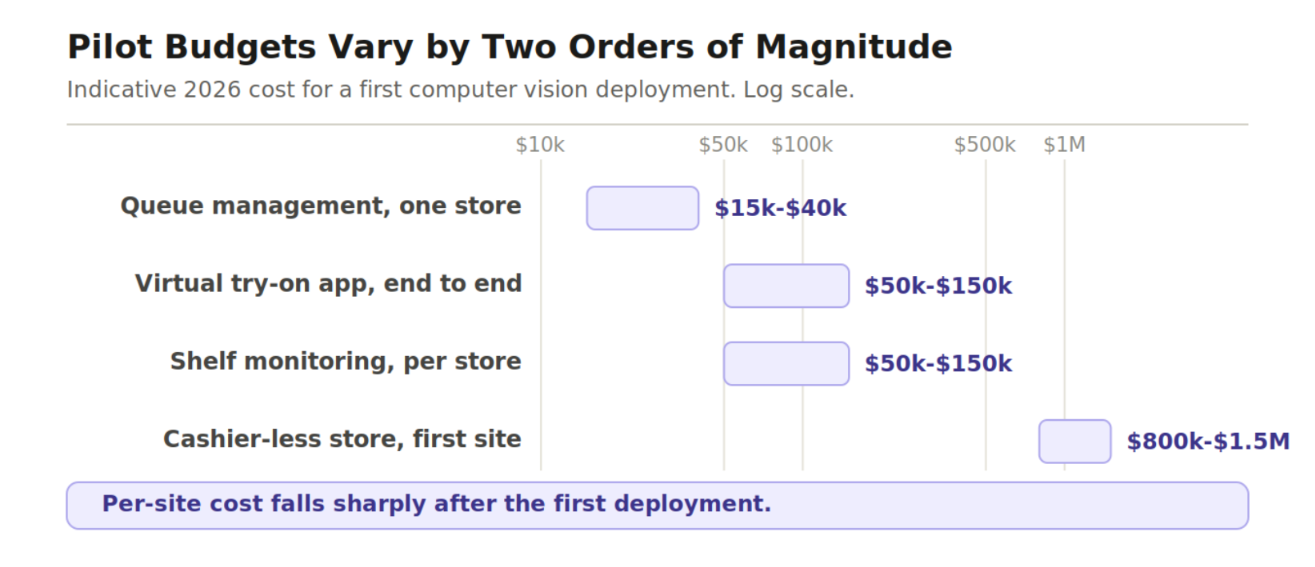
Indicative 2026 ranges: a small single-store use case such as queue management starts around $15,000-40,000. Shelf monitoring runs $50,000-150,000 per store for a pilot. A cashier-less store build lands at $800,000-1.5 million for the first location. A virtual try-on app runs $ 50,000- $ 150,000 end-to-end. Per-site costs drop sharply after the first deployment.
Our machine learning development services and custom AI software development teams work on both sides of that line. That includes the integration work that decides whether a working model becomes a working system. For a figure tied to your own scope, our free AI cost calculator takes ten questions about the project, and an engineer returns a tailored estimate within 24 hours.
Pricing a pilot of your own? Contact LITSLINK for a free consultation and a cost breakdown tied to your data volume and deployment target.
Benefits of AI Image Recognition for Businesses
Throughput on inspection-bound processes. Where a human has to look at every unit, vision removes the ceiling. Systems now inspect 10,000+ parts per hour at sub-100ms inference, holding the same standard around the clock.
Consistency, often worth more than peak accuracy. A trained inspector on hour one may beat the model. The same inspector on hour six does not. Inter-inspector agreement on defect severity runs only 55–70%, so identical products get different verdicts by shift. Removing that variance is what makes downstream quality data trustworthy.
Direct margin recovery. Cost of poor quality averages around 20% of revenue in manufacturing. For a $10 million plant, nearly $2 million disappears into scrap, rework, warranty claims and inspection overhead. Quality control built on image recognition attacks that line item directly. That is why payback is measured in months.
Cycle-time compression in customer-facing processes. The insurance and radiology numbers share one mechanism. A step that used to require scheduling a human becomes instant, and everything downstream moves earlier. BCG research shows AI-enabled carriers cut claim resolution time by 75%, from 30 days to 7.5.
Input reduction. See & Spray is the cleanest example. The savings come from buying less herbicide. Look for the equivalent in your own process — the consumable you over-apply because you cannot measure precisely enough in real time.
Loss and liability avoidance. The fleet numbers make this concrete. Fewer collisions, plus documented exoneration when a claim is disputed.
Revenue, where vision changes the buying decision. McKinsey reports a 3 to 5 percent revenue lift for retailers running computer vision at scale.
Market context, briefly. Analyst sizing here is unusually inconsistent, so treat any single figure as directional. MarketsandMarkets puts image recognition at $55.28 billion in 2025, reaching $127.02 billion by 2031 at a 14.9% CAGR. Fortune Business Insights estimates $68.46 billion for 2026, growing to $212.77 billion by 2034. Mordor Intelligence scopes "AI image recognition" more narrowly as software and reports just $5.68 billion in 2026, rising to $11.07 billion by 2031. The spread reflects what each firm counts: hardware and services, or software alone.
Challenges and Considerations
Retraining is an operating cost. The most underestimated line item. Every new product variant needs retraining. A line producing five product families with quarterly updates means 20 retraining cycles a year. If tooling does not make retraining fast and cheap, the economics break after initial deployment.
Cold-start data. New product lines begin with no defect images to learn from. Synthetic generation is the current workaround. Research published in April 2026 demonstrated a few-shot diffusion framework generating photorealistic defect images across varied lighting, orientations and surfaces. The reported gain — accuracy from 78.8% to 83.3% — narrows the gap rather than closing it.
Integration and data infrastructure outweigh model work. Companies succeeding at scale invested as much in data collection and integration as in the models. The model is rarely the expensive part.
Privacy and compliance, sharply asymmetric by use case. Anonymous shape detection deploys almost anywhere. Anything identifying individuals triggers GDPR, CCPA and a patchwork of local rules. It also demands documented thresholds, human review before intervention, and bias testing across demographic groups. The automotive mandate shows how regulators are trying to square this. Driver distraction cameras must work without biometric identification, in a closed loop retaining only immediately necessary data. Researchers note that the closed-loop claim currently has no independent audit. Our breakdown of facial recognition pros and cons covers where the lines sit today.
Bias, which shows up as uneven accuracy rather than obvious failure. A model can perform well in aggregate and be materially worse for specific groups. In security or loss-prevention contexts, that becomes a legal and reputational exposure. Test by segment.
Synthetic and manipulated inputs. Photo-based workflows are replacing physical inspection in claims, KYC, and condition reports. The incentive to submit fabricated images grows with them. Image editing is now good enough that a plausible fake costs nothing to make. Anything that pays out on an uploaded photo needs provenance checks alongside the recognition model. We cover the landscape in our piece on deepfake technology.
Environmental fragility. Lighting shifts, dust, motion blur and occlusion still push production accuracy below lab benchmarks. Legacy systems can flag up to 50% false positives, and operator trust collapses once staff start overriding the system.
FAQ
What is an example of AI image recognition?
A concrete one with published numbers: John Deere's See & Spray. Boom-mounted cameras distinguish crops from weeds in real time and fire individual nozzles only where a weed appears. Commercial data across more than 510,000 hectares showed a 58% reduction in targeted herbicide use. A second example is now unavoidable. Every new car sold in the EU from 7 July 2026 must carry a camera-based driver distraction warning system. Everyday consumer cases — phone photo recognition, face unlock, visual product search — run on the same capability at lower stakes.
What industries use image recognition?
Healthcare (radiology triage, digital pathology, screening). Manufacturing (defect inspection, assembly verification, packaging checks). Retail and e-commerce (shelf monitoring, visual search, AR try-on, cashier-less checkout). Automotive (driver monitoring, ADAS, fleet safety, damage inspection). Agriculture (targeted spraying, harvest grading). Logistics (parcel sorting, damage detection, cycle counting). Insurance (photo-based damage estimates). Security (occupancy analytics, PPE compliance, access control, biometrics). Sports (officiating, player tracking). Content platforms also run it at scale for filtering inappropriate images before publication.
How to use AI to recognize images?
Three routes, in ascending order of effort:
- Call a fixed-task API. Google Cloud Vision, AWS Rekognition, or Azure AI Vision handle labels, OCR, moderation, and face comparison. Days of integration, priced per image.
- Prompt a multimodal model. Send the image plus an instruction, get structured output back. Fastest path for tasks that change often or need explanation alongside classification. Costs more per image at volume.
- Train a custom model and deploy at the edge. Necessary when the visual domain is specific to your operation, or when latency and data residency rule out the cloud.
Most successful programs start at step 1 or 2 to validate the case on real data. They move the proven use case to step 3 once volume justifies it.
Explore AI Image Recognition Solutions
If you're ready to take the next step in harnessing the power of AI image recognition, consider reaching out to LITSLINK for tailored solutions that meet your business needs. Our AI and software development experts can help you implement effective image recognition technology that drives efficiency and innovation.
Don't miss out on the opportunity to transform your operations. Contact us today to learn how AI image recognition can elevate your business.
In a Nutshell
The AI image recognition examples worth studying in 2026 share one shape. A slow, expensive human inspection step gets replaced by an instant one. The savings show up in labor, in wasted input, in liability avoided, or in cycle time that unblocks everything downstream. Manufacturing and healthcare have the best-documented returns. Agriculture has the cleanest input-cost story. Retail's newest gains come from returns avoided rather than conversions won. And automotive is now the first vertical where recognition is legally required, not optional. What changed is the delivery model: multimodal models make flexible tasks cheap to prototype, and edge hardware makes fixed ones cheap to run at scale. What has not changed is where projects fail — integration, retraining cadence, and governance.